Leakage and Efficient Updates on Commodity Hardware
Attila A. Yavuz1and Jorge Guajardo2
1 The School of Electrical Engineering and Computer Science, Oregon State University, Corvallis, OR 97331
2 Robert Bosch Research and Technology Center, Pittsburgh PA, 15203 [email protected]
Abstract. Dynamic Searchable Symmetric Encryption (DSSE) enables a client to perform keyword queries and update operations on the encrypted file collections. DSSE has several important applications such as privacy-preserving data outsourcing for computing clouds. In this paper, we developed a new DSSE scheme that achieves the highest privacy among all compared alternatives with low information leakage, non-interactive and efficient updates, compact client storage, low server storage for large file-keyword pairs with an easy design and implementation. Our scheme achieves these desirable properties with a very simple data structure (i.e., a bit matrix supported with two static hash tables) that enables efficient yet secure search/update operations on it. We prove that our scheme is secure (in random oracle model) and demonstrated that it is practical with large number of file-keyword pairs even with an implementation on simple hardware configurations.
1 Introduction
Searchable Symmetric Encryption (SSE) [9] enables a client to encrypt data in such a way that she can later perform keyword searches on it via “search tokens” [27]. A promi-nent application of SSE is to enable privacy-preserving keyword searches on cloud-based systems (e.g., Amazon S3). A client can store a collection of encrypted files re-motely at the cloud and yet perform keyword searches without revealing the file or query contents [19]. Desirable properties of a practical SSE scheme are as follows:
•Dynamism: It should permit adding new files or deleting existing files from the encrypted file collection securely after the system set-up.
•Computational Efficiency and Parallelization: It should offer fast search/updates Moreover, which are parallelizable across multiple processors.
• Storage Efficiency: The SEE storage overhead of the server depends on the en-crypted data structure (i.e., enen-crypted index) that enables keyword searches. The num-ber of bits required to represent a file-keyword pair in the encrypted index should be small. The size of encrypted index should not grow with the number of update oper-ations (eventually results in re-encrypting the entire index). The persistent storage at the client should be minimum.
•Communication Efficiency: Non-interactive update/search operations should be possible to avoid the delays, with a minimum amount of data transmission.
•Security: The information leakage due to search/update operations must be pre-cisely quantified based on formal SSE security notions (e.g., dynamic CKA2 [18]).
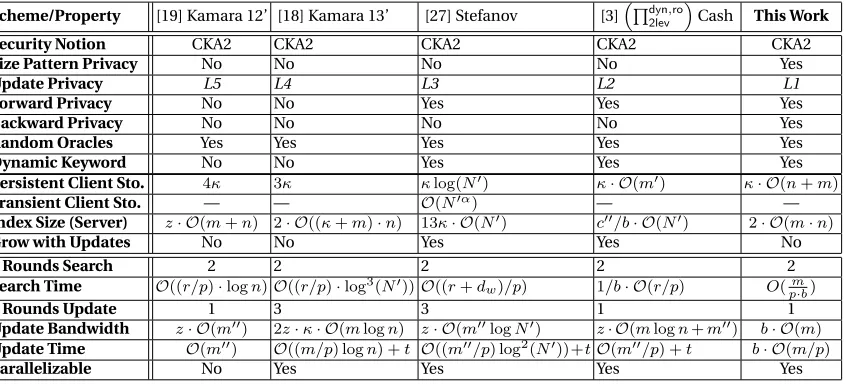
static data, which strictly limits their applicability. Later, Dynamic Searchable Sym-metric Encryption (DSSE) schemes (e.g., [3,19]), which can handle dynamic file collec-tions, have been proposed (we discuss further related work in Section 2). To date, there is no single DSSE scheme that outperforms all other alternatives for allmetrics: pri-vacy (e.g., information leak), performance (e.g., search, update execution and commu-nication, storage) and functionality. Having this in mind, we develop a DSSE scheme that achieves the highest privacy among all compared alternatives with low informa-tion leakage, non-interactive and efficient updates (compared to [18]), compact client storage (compared to [27]), low server storage for large file-keyword pairs (compared to [3,18,27]) and conceptually simple and easy to implement (compared to [18,19,27]). Table 1 compares our scheme with existing DSSE schemes for various metrics.
The intuition behind our scheme is to rely on a very simple data structure that en-ables efficient yet secure search and update operations on it. Our data structure is a bit matrixI that is augmented by two static hash tablesTw andTf. IfI[i, j] = 1 then it means keywordwi is present in filefj, elsewi is not infj. The data structure con-tains both the traditional index and the inverted index representations. We use static hash tablesTw and Tf to uniquely associate a keywordwand a file f to a row index iand a column indexj, respectively. Both matrix and hash tables also maintain cer-tain status bits and counters to ensure secure and correct encryption/decryption of the data structure, which guarantees a high level of privacy (i.e.,L1as in Section B) with dynamic CKA2-security [18]. Search and update operations are encryption/decryption operations on rows and columns ofI, respectively. They are simple, easy to implement, non-interactive (for the main scheme) and practical with large number of file-keyword pairs even with an implementation on simple hardware configurations (as opposed to high-end servers). The advantages of our scheme are summarized below:
•High Security: Our scheme achieves a high-level of update security (i.e.,Level-1), forward-privacy, backward-privacy and size pattern privacy simultaneously (see Sec-tion 3 for the details). We quantify the informaSec-tion leakage via leakage funcSec-tions and formally prove that our scheme is CKA2-secure in random oracle model [1].
•Compact Client Storage: Compared to some alternatives with secure updates (e.g., [27]), our scheme achieves smaller client storage (e.g., 10-15 times with similar parameters). This is an important advantage for lightweight clients such as mobile devices. The schemes in [4,27] also require keeping state information at the client side or interaction with re-encryption (as in our variant scheme). The schemes presented in [18, 19, 27] do not keep state at the client but leak more information than ours.
•Compact Server Storage with Secure Updates: Our encrypted index size is smaller than some alternatives with secure updates (i.e., [18, 27]). For instance, our scheme achieves 4·κsmaller storage overhead than that of the scheme in [18], which intro-duces a significant difference in practice. Asymptotically, the scheme in [27] is more server storage efficient for small/moderate number of file-keyword pairs. However, our scheme requires onlytwo bitsper file-keyword pair with the maximum number of files and keywords. Hence, it is more storage efficient for large number of file-keyword pairs than [27] (e.g., requiring 1600 bits for per file-keyword pair).
Table 1: Performance Comparison of DSSE schemes. The analysis is given for the worst-case (asymptotic) complexity. All schemes leak search and access pattern.
Scheme/Property [19] Kamara 12’ [18] Kamara 13’ [27] Stefanov [3]Qdyn,ro 2lev
Cash This Work
Security Notion CKA2 CKA2 CKA2 CKA2 CKA2
Size Pattern Privacy No No No No Yes
Update Privacy L5 L4 L3 L2 L1
Forward Privacy No No Yes Yes Yes
Backward Privacy No No No No Yes
Random Oracles Yes Yes Yes Yes Yes
Dynamic Keyword No No Yes Yes Yes
Persistent Client Sto. 4κ 3κ κlog(N0) κ· O(m0) κ· O(n+m)
Transient Client Sto. — — O(N0α) — —
Index Size (Server) z· O(m+n) 2· O((κ+m)·n) 13κ· O(N0) c00/b· O(N0) 2· O(m·n)
Grow with Updates No No Yes Yes No
# Rounds Search 2 2 2 2 2
Search Time O((r/p)·logn)O((r/p)·log3(N0))O((r+d
w)/p) 1/b· O(r/p) O(pm·b)
# Rounds Update 1 3 3 1 1
Update Bandwidth z· O(m00) 2z·κ· O(mlogn) z· O(m00logN0) z· O(mlogn+m00) b· O(m) Update Time O(m00) O((m/p) logn) +t O((m00/p) log2(N0))+tO(m00/p) +t b· O(m/p)
Parallelizable No Yes Yes Yes Yes
∗Our persistent client storage isκ· O(m+n). This can become4κif we store this data structure on the server side.
This, however, comes at the cost of one additional round of interaction (See Section 6).
•Rounds refer to the number of messages exchanged between two communicating parties. Anon-interactivesearch and aninteractiveupdate operation require two and three messages to be exchange, respectively. Our main scheme, the scheme in [19] and some variants in [3] also achievenon-interactiveupdate with only single message (i.e., an update token and an encrypted file to be added for the file addition) to be send from the client to the server.
•mandnare the maximum # of keywords and files, respectively.m0andn0are the current # of keywords and files, respectively. We denote byN0=m0·n0the total number of keywords and file pairs currently stored in the database.
m00is the # unique keywords included in an updated file (add or delete).ris # of files that contain a specific keyword.
• κis the security parameter.pis the # of parallel processors.bis the block size of symmetric encryption scheme.zis the pointer size in bits.tis the network latency introduced due to the interactions.αis a parameter,0< α <1.
•Update privacy levelsL1,...,L5are described in Section B. In comparison with Cash et al. [3], we took variantQdyn,ro
bas
as basis and estimated the most efficient variantQdyn,ro
2lev , wheredw, aw, andc00denote the total number of deletion
operations, addition operations, the constant bit size required to store a single file-keyword pair, respectively (in the client storage, the worst case ofaw=m). To simplify notation, we assume that both pointers and identifiers are of size c00and that one can fitbsuch identifiers/pointers per block of sizeb(also a simplification). Observe that the hidden constants in the asymptotic complexity of the update operation is significant as the update operation of [3] requires at least six PRF operations per file-keyword pair versus this work, which only requires one.
encrypted index due to frequent updates. This is more efficient than some alternatives (e.g., [27]) whose server storage grows linearly with the number of file deletions.
•Dynamic Keyword Universe: Unlike some alternatives (e.g., [9,18,19]), our scheme does not assume a fixed keyword universe, which permits the addition of new keywords to the system after initialization. Hence, the file content is not restricted to a particular pre-defined keyword but can be any token afterwards (encodings)3.
•Efficient and Non-interactive Updates: Our basic scheme achieves secure updates non-interactively. Even with large file-keyword pairs (e.g.,N = 1012), it incurs low com-munication overhead (e.g., 120 KB form = 106 keywords andn = 106 files) by further avoiding network latencies (e.g., 25-100 ms) that affect other interactive schemes (e.g., as considered in [3,18,22,27]). One of the variants that we explore requires three rounds (as in other DSSE schemes), but it still requires low communication overhead (and less
3
transmission than that of [18] and fewer rounds than [22]). Notice that the scheme in [22] can only add or remove a file but cannot update the keywords of a file with-out removing or adding it, while our scheme can achieve this functionality intrinsically with a (standard) update or delete operation.
•Oblivious Updates: Our update operation takes always the same amount of time, which does not leak timing information depending on the update.
•Parallelization: Our scheme is parallelizable for both update and search opera-tions (unlike schemes that rely on linked-lists such as [19]).
•Forward Privacy: Our scheme can achieve forward privacy by retrieving not the whole data structure (e.g., [27]) but only some part of it that has already been queried.
2 Related Work
SSE was introduced in [25] and it was followed by several SSE schemes (e.g., [5, 6, 9, 14, 21]). The scheme of Curtmola et al. in [9] achieves a sub-linear and optimal search time asO(r), whereris the number of files that contain a particular keyword. It also intro-duced the standard security notion for SSE, which is called asadaptive security against chosen-keyword attacks (CKA2). However, the static nature of those schemes limited their applicability to applications with dynamic file collections. Moreover, some of them (e.g., [9]) were not parallelizable. Kamara et. al. developed a DSSE scheme in [19] that could handle dynamic file collections via encrypted updates. However, it leaked signifi-cant information for updates and was not parallelizable. Kamara et al. in [18] proposed another DSSE scheme, which leaked less information than that of [19] and was paral-lelizable. However, it requires interactive updates and impractical server storage.
Recently, a series of new DSSE schemes (i.e., [3, 22, 23, 27]) have been proposed by achieving better performance and security results. While being asymptotically better, those schemes also have drawbacks. The scheme in [27] requires high storage overhead at the client side (e.g., 210 MB), where the client fetches non-negligible amount of data from the server and performs an oblivious sort on it. It also requires significant amount of data storage (e.g., 1600 bits) for per keyword-file pair at the server side. The scheme in [3] extends the work in [4] that focuses on boolean queries. While showing asymp-totically better performance, it leaks more information compared to [27] also incurring in non-negligible server storage. The data structure in this work grows linearly with the number of deletion operations, which requires re-encrypting the data structure even-tually. The scheme in [22] uses a different approach from all the aforementioned alter-natives, in which the server does not perform any processing, but just acts as a storage and transmission entity. The scheme relies on a primitive called “blind-storage”. While the scheme shows good performance, it requires higher interaction than its counter-parts, which may introduce response delays for distributed client-server systems. The scheme leaks less information than that of [3], but only support single keyword queries. The scheme can add/remove a file but it cannot update the content of a file. Because of all these significant differences, we have not included it in Table 1.
system model compared to traditional SSE schemes: “The SSE setting focuses on data outsourcing rather than data sharing. That is, in SSE the data owner is the client, and so no privacy against the client is required” [23]. Other differences are as follows: The Blind Seer requires three parties (one of them acts as a semi-trusted party) instead of two. The Blind Seer relies on sophisticated cryptographic tools to attain security against semi-honest (or malicious as in [11]) client, while our schemes rely on only ba-sic primitives (e.g., symmetric encryption, PRF) and are very simple, in which clients are data owners (e.g., the client is by default not malicious). Our schemes focus on only basic keyword queries but achieves the highest update privacy in the traditional SSE setting. Note that the update functionality of Blind Seer is not oblivious (this is explic-itly noted in [23] on page 8, footnote 2). The Blind Seer solves the leakage problem due to non-oblivious updates by periodically reencrypting the entire index. Finally, the overall execution times reported in [3, 11, 23] are difficult to compare to ours given that they use high-end server hardware (e.g., 20-TB server with 96 GB RAM and X5650 Intel Xeon processor in [11]) as opposed to our implementation on a commodity platform.
3 Preliminaries and Models
Operators||and|x|denote the concatenation and the bit length of variablex, respec-tively.x← S$ means variablexis randomly and uniformly selected from setS. For any integerl,(x0, . . . , xl) ← S$ means(x0 ← S$ , . . . , xl ← S$ ).|S|denotes the cardinality of setS.{xi}l
i=0 denotes(x0, . . . , xl). We denote by{0,1}∗the set of binary strings of any finite length.bxcdenotes the floor ofxanddxedenotes the ceiling ofx. The set of items qi fori = 1, . . . , nis denoted byhq1, . . . , qni. Integerκdenotes the security parameter.
logxmeanslog2x.I[∗, j]andI[i,∗]mean accessing all elements in thej’th column and thei’th row of a matrixI, respectively.I[i,∗]T is the transpose of thei’th row ofI.
An IND-CPA secure private key encryption scheme is a tripletE = (Gen,Enc,Dec)
of three algorithms as follows:k1 ← E.Gen(1κ)is a Probabilistic Polynomial Time (PPT) algorithm that takes a security parameterκand returns a secret keyk1;c← E.Enck1(M)
takes secret keyk1and a messageM, and returns a ciphertextc;M←E.Deck1(c)is a
de-terministic algorithm that takesk1andc, and returnsM ifk1was the key under which cwas produced. A Pseudo Random Function (PRF) is a polynomial-time computable function, which is indistinguishable from a true random function by any PPT adver-sary. The functionF :{0,1}κ× {0,1}∗→ {0,1}κis a keyed PRF, denoted byτ ←Fk2(x),
which takes as input a secret key k2 $
← {0,1}κ and a stringx, and returns a token τ. G : {0,1}κ× {0,1}∗ → {0,1}κ is a keyed PRF denoted asr ← Gk3(x), which takes as
inputk3 ← {0,1}κand a stringxand returns a keyr. We denote byH:{0,1}|x|→ {0,1} a Random Oracle (RO) [1], which takes an inputxand returns a bit as output.
iden-tifiersid1, . . . , idn) and their corresponding ciphertext computed underk1viaEnc, re-spectively. Data structuresδandγdenote the index and encrypted index, respectively.
Definition 1. A DSSE scheme is a tuple of nine polynomial-time algorithmsDSSE= (Gen,
Enc,Dec,SrchToken,Search,AddToken,Add,DeleteToken,Delete)such that:
1. K←Gen(1κ): It takes as input a security parameterκand outputs a secret keyK. 2. (γ,c)←EncK(δ,f): It takes as input a secret keyK, an indexδand filesf, from which
δconstructed. It outputs encrypted indexγand ciphertextsc.
3. fj ←DecK(cj): It takes as input secret keyKand ciphertextcj and outputs a filefj.
4. τw←SrchToken(K, w): It takes as input a secret keyKand a keywordw. It outputs a
search tokenτw.
5. idw←Search(τw, γ): It takes as input a search tokenτw and an encrypted indexγ. It outputs identifiersidw⊆c.
6. τf ←AddToken(K, fid): It takes as input a secret keyKand a filefidwith identifierid
to be added. It outputs an addition tokenτf.
7. (γ0,c0)←Add(γ,c, τf): It takes as input an encrypted indexγ, ciphertextsc, an addi-tion tokenτf. It outputs a new encrypted indexγ0and ciphertextsc0.
8. τf0←DeleteToken(K, f): It takes as input a secret keyKand a filefidwith identifierid
to be deleted. It outputs a deletion tokenτf0.
9. (γ0,c0)←Delete(γ,c, τf0): It takes as input an encrypted indexγ, ciphertextsc, and a deletion tokenτf0. It outputs a new encrypted indexγ0and new ciphertextsc0.
Definition 2. LetDSSEbe a dynamic SSE scheme consisting of the tuple of nine algo-rithm as given in Definition 1. ADSSEscheme is correct if for allκ, for all keysK gener-ated byGen(1κ), for allf, for all(γ,c)output byEncK(δ,f), and for all sequences of add,
delete or search operations onγ, search always returns the correct set of identifieridw.
Most known efficient SSE schemes (e.g., [3, 4, 14, 18, 19, 22, 27]) reveal theaccess and search patternsthat are defined below.
Definition 3. Search patternP(δ,Query, t)is defined as follows: Given search queryQuery=
wat timet, the search pattern is a binary vector of lengthtwith a 1 at locationiif the search timei≤twas forw, 0 otherwise. The search pattern indicates whether the same keyword has been searched in the past or not.
Definition 4. Access pattern∆(δ,f, wi, t)is defined as follows: GivenQuery=wat time t, the access pattern is identifiersidwof filesf, in whichwappears.
We consider the following leakage functions, in the line of [18] that captures dy-namic file addition and deletion in its security model as we do, but we leak less infor-mation compared to [18] as discussed in Section B.
Definition 5. Leakage functions(L1,L2)are defined as follows:
1. (m, n,idw,h|fid1|, . . . ,|fidn|i) ← L1(δ,f): Given the indexδ and the set of filesf (in-cluding their identifiers),L1outputs the maximum number of keywordsm, the
2. (P(δ,Query, t), ∆(δ,f, wi, t))← L2(δ,f, w, t): Given the indexδ, the set of filesfand a
keywordwfor a search operation at timet, it outputs the search and access patterns.
Definition 6. LetDSSEbe a DSSE scheme consisting of the tuple of nine algorithms as defined in Definition 1. LetA be a stateful adversary andS be a stateful simulator. Con-sider the following probabilistic experiments:
RealA(κ): The challenger executes K ← Gen(1κ). A produces (δ,f) and receives (γ,c) ← EncK(δ,f) from the challenger. A makes a polynomial number of adaptive
queriesQuery∈(w, fid, fid0)to the challenger. IfQuery=wthenA receives a search token
τw ← SrchToken(K, w)from the challenger. IfQuery = fidis a file addition query then
A receives an addition tokenτf ←AddToken(K, fid)from the challenger. IfQuery=fid0 is a file deletion query thenA receives a deletion tokenτf0 ← DeleteToken(K, fid0)from the challenger. Eventually,A returns a bitbthat is output by the experiment.
IdealA,S(κ): A produces (δ,f). GivenL1(δ,f), S generates and sends (γ,c) to A .
A makes a polynomial number of adaptive queriesQuery ∈(w, fid, fid0)toS. For each adaptive query,S is givenL2(δ,f, w, t). IfQuery =wthenS returns a simulated search
tokenτw. IfQuery=fidorQuery=fid0,S returns a simulated addition tokenτf or dele-tion tokenτf0 ,respectively. Eventually,A returns a bitbthat is output by the experiment.
ADSSEis said(L1,L2)-secure against adaptive chosen-keyword attacks (CKA2-security)
if for allPPTadversariesA, there exists aPPTsimulatorS such that
|Pr[RealA(κ) = 1]−Pr[IdealA,S(κ) = 1]| ≤neg(κ)
Remark 1. In Definition 6, we adapt the notion of dynamic CKA2-security from [18], which captures the file addition and deletion operations by simulating corresponding tokensτf andτf0, respectively (see Theorem 1 in Appendix A.2).
4 Our Scheme
We now introduce our main scheme (several variants of it are given in Section 6). As in other index-based schemes, our DSSE scheme has an indexδrepresented by a m×nmatrix, whereδ[i, j]∈ {0,1}fori= 1, . . . , mandj = 1, . . . , n. Initially, all elements ofδ are set to 0.I is am×nmatrix, whereI[i, j] ∈ {0,1}2. I[i, j].vstoresδ[i, j]in en-crypted form depending on state and counter information.I[i, j].ststores a bit indicat-ing the state ofI[i, j].v. Initially, all elements ofIare set to 0.I[i, j].stis set to 1 whenever its correspondingfj is updated, and it is set to 0 whenever its corresponding keyword wi is searched. For the sake of brevity, we will often writeI[i, j]to denoteI[i, j].v. We will always be explicit about the state bitI[i, j].st. The encrypted indexγ corresponds to the encrypted matrixIand a hash table. We also have client state information4in the form of two static hash tables (defined below). We map each filefidand keywordwpair to a unique set of indices(i, j)in matrices(δ, I). We use static hash tables to uniquely
4It is always possible to eliminate client state by encrypting and storing it on the server side. This comes at the cost
associate each file and keyword to its corresponding row and column index, respec-tively. Static hash tables also enable to access the index information in (average)O(1)
time.Tfis a static hash table whose key-value pair is{sfj,hj, stji}, wheresfj ←Fk2(idj)
for file identifieridj corresponding to filefidj, indexj ∈ {1, . . . , n}andstis a counter value. We denote access operations byj ← Tf(sfj) and stj ← Tf[j].st. Tw is a static hash table whose key-value pair is {swi,hi, stii}, where token swi ← Fk2(wi), index
i ∈ {1, . . . , n}andstis a counter value. We denote access operations byi ← Tw(swi) andsti←Tw[i].st. All counter values are initially set to 1.
We now describe our main scheme in detail.
K←Gen(1κ): The client generatesk1←E.Gen(1κ),(k2, k3) $
← {0,1}κandK←(k1, k2, k3).
(γ,c)←EncK(δ,f): The client generates(γ,c)as follows:
1. Extract all unique keywords(w1, . . . , wm0)from filesf = (fid
1, . . . , fidn0), where n0≤nandm0 ≤m. Initially, set all the elements ofδto 0.
2. Constructδforj = 1, . . . , n0andi= 1, . . . , m0:
(a) swi ←Fk2(wi),xi ←Tw(swi),sfj ←Fk2(idj)andyj ←Tf(sfj). (b) Ifwiappears infjsetδ[xi, yj]←1.
3. Encryptδforj= 1, . . . , nandi= 1, . . . , m: (a) Tw[i].st←1andTf[j].st←1.
(b) ri←Gk3(i||sti), wheresti ←Tw[i].st.
(c) I[i, j]←δ[i, j]⊕H(ri||j||stj), wherestj ←Tf[j].st. (d) I[i, j].st←0.
4. cj ← E.Enck1(fidj)forj = 1, . . . , n
0andc← {hc1, y1i, . . . ,hc
n0, yn0i}.
5. Output(γ,c), whereγ ← (I, Tf). The client gives(γ,c)to the server, and keeps
(K, Tw, Tf).
fj←DecK(cj): The client obtains the file asfj ← E.Deck1(cj).
τw←SrchToken(K, w): The client generates a search tokenτwforwas follows:
1. swi ←Fk2(w),i←Tw(swi),sti ←Tw[i].standri ←Gk3(i||sti).
2. Ifsti = 1thenτw ←(i, ri). Else (ifsti>1),ri←Gk3(i||sti−1)andτw ←(i, ri, ri).
3. Tw[i].st←sti+ 1.
4. Outputτw. The client sendsτwto the server.
idw←Search(τw, γ): The server finds indexes of ciphertexts forτwas follows:
1. If((τw = (i, ri)∨I[i, j].st) = 1)hold thenI0[i, j]← I[i, j]⊕H(ri||j||stj), else set I0[i, j]←I[i, j]⊕H(ri||j||stj), wherestj ←Tf[j].stforj= 1, . . . , n.
2. I[i,∗].st←0.
3. Setl0←1and for eachjsatisfiesI0[i, j] = 1, setyl0 ←jandl0 ←l0+ 1.
4. Outputidw ← (y1, . . . ,yl). The server returns(cy1, . . . , cyl)to the client, where l←l0−1.
5. After the search is completed, the server re-encrypts rowI0[i,∗]withriasI[i, j]← I0[i, j]⊕H(ri||j||stj)forj= 1, . . . , n, wherestj ←Tf[j].stand setsγ ←(I, Tw)5.
5This provides privacy if the server is compromised by an outsider after a search operation occurs (the server deletes
rifrom the memory after the step 5 is completed). It also keepsIconsistent for consecutive search operations
τf ←AddToken(K, fidj): The client generatesτf for a filefidjas follows:
1. sfj ←Fk2(idj),j←Tf(sfj),Tf[j].st←Tf[j].st+ 1,stj ←Tf[j].st. 2. ri ←Gk3(i||sti), wheresti ←Tw[i].stfori= 1, . . . , m.
3. Extract(w1, . . . , wt)fromfidj and computeswi ← Fk2(wi)andxi ← Tw(swi)for i= 1, . . . , t.
4. SetI[xi]←1fori= 1, . . . , tand rest of the elements as{I[i]←0}mi=1,i /∈{x1,...,xt}. 5. I0[i]←I[i]⊕H(ri||j||stj)fori= 1, . . . , m.
6. c← E.Enck1(fidj).
7. Outputτf ←(I0, j). The client sends(τf, c)to the server.
(γ0,c0)←Add(γ,c, τf): The server performs file addition as follows:
1. I[∗, j]←(I0)T,I[∗, j].st←1and incrementTf[j].st←Tf[j].st+ 1. 2. Output(γ0,c0), whereγ0 ←(I, Tf),c0is obtained by adding(c, j)toc.
τf0←DeleteToken(K, f): The client generatesτf0 forfas follows:
1. Execute steps (1-2) ofAddTokenalgorithm, which produce(j, ri, stj). 2. I0[i]←H(ri||j|stj)fori= 1, . . . , m6.
3. Outputτf0 ←(I0, j). The client sendsτf0 to the server.
(γ0,c0)←Delete(γ,c,τf0): The server performs file deletion as follows:
1. I[∗, j]←(I0)T,I[∗, j].st←1and incrementT
f[j].st←Tf[j].st+ 1.
2. Output(γ0,c0), whereγ0 ←(I, Tf),c0is obtained by removing(c, j)fromc.
Keyword update for existing files: Some existing alternatives (e.g., Naveed et. al. [22]) only permit adding or deleting a file, but do not permit updating keywords in an exist-ing file. Our scheme enables keyword update in an existexist-ing file. To update an existexist-ing filefby adding new keywords or removing existing keywords, the client prepares a new columnI[i] ← bi, i = 1, . . . , m, wherebi = 1ifwi is added andbi = 0otherwise (as in
AddToken, step 4). The rest of the algorithm is similar toAddTokenalgorithm.
Variants: Several variants of our main schemes are given in Section 6 and Appendix C.
5 Security Analysis
Theorem 1 If Enc is IND-CPA secure,(F, G) are PRFs and H is a RO then our DSSE scheme is(L1,L2)-secure in ROM according to Definition 6.
Proof: We give the proof of correctness of our scheme in Appendix A.1. The security proof and simulators are presented in Appendix A.2.
6
6 Evaluation and Discussion
We have implemented our scheme in a alone environment using C/C++. By stand-alone, we mean we run on a single machine, as we are only interested in the perfor-mance of the operations and not the effects of latency, which will be present (but are largely independent of the implementation7.) For cryptographic primitives, we chose
to use thelibtomcryptcryptographic toolkit version 1.17 [10] and as an API. We modi-fied the low level routines to be able to call and take advantage of AES hardware accel-eration instructions natively present in our hardware platform, using the correspond-ing freely available Intel reference implementations [17]. We performed all our exper-iments on an Intel dual core i5-3320M 64-bit CPU at 2.6 GHz running Ubuntu 3.11.0-14 generic build with 4GB of RAM. We use 128-bit CCM and AES-128 CMAC for file and data structure encryption, respectively. Key generation was implemented using the expand-then-extract key generation paradigm analyzed in [20]. However, instead of us-ing a standard hash function, we used AES-128 CMAC for performance reasons. Notice that this key derivation function has been formally analyzed and is standardized. Our use of CMAC as the PRF for the key derivation function is also standardized [7]. Our random oracles were all implemented via 128-bit AES CMAC. For hash tables, we use Google’s C++ sparse hash map implementation [16] but instead of using the standard hash function implementation, we called our CMAC-based random oracles truncated to 80 bits. Our implementation results are summarized in Table 2.
Performance Comparison.We performed our experiments on the Enron database of
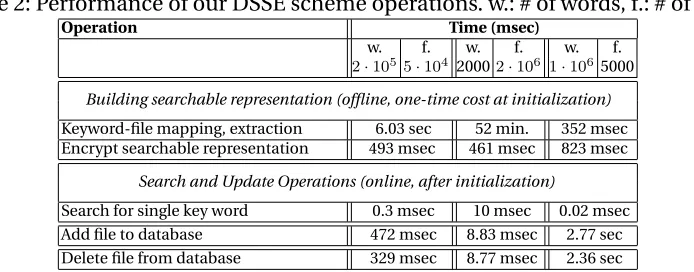
emails as in [19]. Table 2 summarizes results for three types of experiments: (i) Large number of files and large number of keywords, (ii) large number of files but compara-tively small number of keywords and (iii) large number of keywords but small number of files. In all cases, the combined number of keyword/file pairs is between109 and
1010, which surpass the experiments in [19] by about two orders of magnitude and are comparable to the experiments in [27]. One key observation is that in contrast to [27] (and especially to [3] with very high-end servers), we donotuse server-level hardware but a rather standard commodity Intel platform with limited RAM memory. From our results, it is clear that for large databases the process of generating the encrypted rep-resentation is relatively expensive, however, this is a one-time only cost. The cost per keyword search depends linearly asO(n)/128on the number of files in the database and it is not cost-prohibiting (even for the large test case of1010 keyword/file pairs, searching takes only a few msec). We observe that despite this linear cost, our search operation is extremely fast comparable to the work in [19]. The costs for adding and deleting files (updates) is similarly due to the obliviousness of these operations in our case. Except for the cost of creating the index data structure, all performance data ex-trapolates to any other type of data, as our data structure is not data dependant and it is conceptually very simple. We observe that we still have room for improvement since have not taken advantage of parallelization.
7As it can be seen from Table 1, our scheme is optimal in terms of the number of rounds required to performany
Table 2: Performance of our DSSE scheme operations. w.: # of words, f.: # of files
Operation Time (msec)
w. f. w. f. w. f.
2·1055·104 20002·106 1·1065000
Building searchable representation (offline, one-time cost at initialization)
Keyword-file mapping, extraction 6.03 sec 52 min. 352 msec Encrypt searchable representation 493 msec 461 msec 823 msec
Search and Update Operations (online, after initialization)
Search for single key word 0.3 msec 10 msec 0.02 msec Add file to database 472 msec 8.83 msec 2.77 sec Delete file from database 329 msec 8.77 msec 2.36 sec
Functionality, Security, and Data Structure Comparison.Compared to Kamara et al. in [19] scheme, which relies on an inverted index approach with multiple linked lists and achieves optimalO(r) search time, our scheme has linear search time, uses an inverted index approach with a simple matrix-based data structure (augmented with hash tables for fast retrieval) but in contrast we achieve completely oblivious update operations. Moreover, the [19] can not be parallelized, whereas our scheme can. Ka-mara et al. [18] relies on red-black trees as the main data structure, achievesparallel
search and oblivious update operations. However, it requires interactive updates and incurs in significant server storage overhead due to its very large encrypted index size. The scheme of Stefanov et al. [27] requires high storage overhead at the client side (e.g., 210 MB for moderate size file-keyword pairs), where the client fetches non-negligible amount of data from the server and performs an oblivious sort on it. We only require
one hash table and four symmetric secret keys storage. [27] also requires significant amount of data storage (e.g., 1600 bits) for per keyword-file pair at the server side ver-sus 2 bits per file-keyword pair in our scheme (and a hash table8). The scheme in [3] it leaks more information compared to [27] also incurring in non-negligible server stor-age. The data structure in [3] grows linearly with the number of deletion operations, which requires encrypting the data structure eventually. Our scheme does not re-quire re-encryption (but we assume an upper bound on the maximum number of files), and our storage is constant regardless of the number of additions, deletions, or up-dates. The scheme in [22] requires higher interaction than its counterparts, which may introduce response delays for distributed client-server architectures, it leaks less in-formation than that of [3], but only support single keyword queries. The scheme can add/remove a file but it cannot update the content of a file in contrast to our scheme.
We now discuss some variants and trade-offs in our scheme, which can result in significant performance improvements.
Variant-I: Trade-off between computation and interaction overhead.In the main sc-heme,His invoked for each column ofIonce, which requiresO(n)invocations in total. We propose a variant scheme that offers significant computational improvement at the cost of a plausible communication overhead.
8The size of the hash table depends on its occupancy factor, the number of entries and the size of each entry.
Assum-ing80-bits per entry and a 50% occupancy factor, our scheme still requires about2×80 + 2 = 162bits per entry, which is about a factor 10 better than [27]. Observe that for fixedm-words, we need a hash table with approximately
We use counter (CTR) mode with a block sizebforE. We interpret columns ofI as d=nbblocks with size ofbbits each, and encrypt each blockBl,l= 0, . . . , d−1, sepa-rately withEby using a unique block counterstl. Each block counterstlis located at its corresponding indexal(block offset ofBl) inTf, whereal ←(l·b) + 1. The uniqueness of each block counter is achieved with a global countergc, which is initialized to 1 and incremented by 1 for each update operation. A state bitTf[al].bis stored to keep track the update status of its corresponding block. The update status is maintained only for each block but not for each bit of I[i, j]. Hence, I is a just binary matrix (unlike the main scheme, in whichI[i, j] ∈ {0,1}2). AddTokenand Addalgorithms for the afore-mentioned variant are as follows (DeleteTokenandDeletefollow the similar principles):
τf ←AddToken(K, fidj): The client generatesτf for a filefidjas follows:
1. sfj ←Fk2(fidj),j←Tf(sfj),l←
j
j b
k
,al←(l·b) + 1andstl←Tf[al].st.
2. Extract(w1, . . . , wt)fromfidj and computeswi ← Fk2(wi)andxi ← Tw(swi)for i= 1, . . . , t. Fori= 1, . . . , m:
(a) ri←Gk3(i||sti), wheresti ←Tw[i].st
9.
(b) The client requestsl’th block, which contains indexjoffidfrom the server. The server then returns the corresponding block(I[i, al], . . . , I[i, al+1−1]), whereal+1←b(l+ 1) + 1.
(c) (I[i, al], . . . , I[i, al+1−1])← E.Decri(I[i, al], . . . , I[i, al+1−1], stl). 3. SetI[xi, j]←1fori= 1, . . . , tand{I[i, j]←0}m
i=1,i /∈{x1,...,xt}. 4. gc←gc+ 1,Tf[al].st←gc,stl ←Tf[al].standTf[al].b←1.
5. (I0[i, al], . . . , I0[i, al+1−1])← E.Encri(I[i, al], . . . , I[i, al+1−1], stl)fori= 1, . . . , m. 6. c← E.Enck1(fidj).
7. Outputτf ←(I0, j). The client sends(τf, c)to the server.
(γ0,c0)←Add(γ,c, τf): The server performs file addition as follows: 1. Replace(I[∗, al], . . . , I[∗, al+1−1])withI0.
2. gc←gc+ 1,Tf[al].st←gcandTf[al].b←1.
3. Output(γ0,c0), whereγ0 ←(I, Tf),c0is obtained by adding(c, j)toc.
GenandDecalgorithms of the variant scheme are identical to that of main scheme. The modifications ofSrchTokenandSearchalgorithms are straightforward (in the line of
AddTokenandAdd) and therefore will not be repeated. In this variant, the search
opera-tion requires the decrypopera-tion ofb-bit blocks forl= 0, . . . , d−1. Hence,Eis invoked only O(n/b)times during the search operation (in contrast toO(n)invocation ofHas in our main scheme). That is, the search operation becomesbtimes faster compared to our main scheme. The block sizebcan be selected according to the application require-ments (e.g.,b= 64,b= 128orb= 256based on the preferred encryption function). For instance,b= 128yields highly efficient schemes if the underlying cipher is AES by tak-ing advantage of AES specialized instructions in current PC platforms. Moreover, CTR mode can be parallelizable and therefore the search time can be reduced toO(n/(b·p)), wherepis the number of processors in the system. This variant requires transmitting
9
2·b·O(m)bits for each update compared toO(m)non-interactive transmission in our main scheme. However, one may notice that this approach offers a trade-off, which is useful for some practical applications. That is, the search speed is increased by a factor ofb(e.g.,b= 128) with the cost of transmitting just2·b·mbits (e.g., less than 2MB for b= 128, m= 105). However, a network delaytis introduced due to interaction.
Remark 2. Theb-bit block is re-encrypted via an IND-CPA encryption scheme on the
clientside at the cost of one round of interaction. Hence, encrypting multiple columns does not leak additional information during updates over our main scheme.
We discuss three other variants of our main scheme in Appendix C. We prove secu-rity of the main scheme and extend the proof to this variant in Appendix A.2.
References
1. M. Bellare and P. Rogaway, “Random oracles are practical: A paradigm for designing efficient proto-cols,” inProceedings of the 1st ACM conference on Computer and Communications Security (CCS ’93). NY, USA: ACM, 1993, pp. 62–73.
2. D. Boneh, A. Sahai, and B. Waters, “Functional encryption: Definitions and challenges,” inProceedings of the 8th Conference on Theory of Cryptography, ser. TCC’11. Berlin, Heidelberg: Springer-Verlag, 2011, pp. 253–273.
3. D. Cash, J. Jaeger, S. Jarecki, C. Jutla, H. Krawcyk, M.-C. Rosu, and M. Steiner, “Dynamic searchable encryption in very-large databases: Data structures and implementation,” in21th Annual Network and Distributed System Security Symposium — NDSS 2014. The Internet Society, February 23-26, 2014.
4. D. Cash, S. Jarecki, C. Jutla, H. Krawczyk, M.-C. Rosu, and M. Steiner, “Highly-scalable searchable symmetric encryption with support for boolean queries,” inAdvances in Cryptology, CRYPTO 2013, ser. Lecture Notes in Computer Science, vol. 8042. Springer Berlin Heidelberg, 2013, pp. 353–373. 5. Y.-C. Chang and M. Mitzenmacher, “Privacy preserving keyword searches on remote encrypted data,”
inProceedings of the Third International Conference on Applied Cryptography and Network Security (ACNS), ser. Lecture Notes in Computer Science, vol. 3531. Berlin, Heidelberg: Springer-Verlag, 2005, pp. 442–455.
6. M. Chase and S. Kamara, “Structured encryption and controlled disclosure,” inAdvances in Cryptol-ogy - ASIACRYPT 2010, ser. Lecture Notes in Computer Science, vol. 6477, 2010, pp. 577–594.
7. L. Chen, “Nist special publicatin 800-108: Recomendation for key derivation using pseudorandom functions (revised),” National Institute of Standards and Technology. Computer Security Division, Tech. Rep. NIST-SP800-108, October 2009, available at http://csrc.nist.gov/publications/nistpubs/ 800-108/sp800-108.pdf.
8. J.-S. Coron, A. Mandal, D. Naccache, and M. Tibouchi, “Fully homomorphic encryption over the in-tegers with shorter public keys,” inAdvances in Cryptology, CRYPTO 2011, ser. Lecture Notes in Com-puter Science, vol. 6841. Springer Berlin Heidelberg, 2011, pp. 487–504.
9. R. Curtmola, J. Garay, S. Kamara, and R. Ostrovsky, “Searchable symmetric encryption: improved def-initions and efficient constructions,” inProceedings of the 13th ACM conference on Computer and communications security, ser. CCS ’06. New York, NY, USA: ACM, 2006, pp. 79–88.
10. T. S. Denis, “LibTomCrypt library,” Available at http://libtom.org/?page=features&newsitems= 5&whatfile=crypt, Released May 12th, 2007.
11. B. Fisch, B. Vo, F. Krell, A. Kumarasubramanian, V. Kolesnikov, T. Malkin, and S. M. Bellovin, “Malicious-client security in blind seer: A scalable private DBMS,” May 18-20, 2015.
12. S. Garg, C. Gentry, S. Halevi, M. Raykova, A. Sahai, and B. Waters, “Candidate indistinguishability obfuscation and functional encryption for all circuits,” inFoundations of Computer Science (FOCS), 2013 IEEE 54th Annual Symposium on, Oct 2013, pp. 40–49.
15. O. Goldreich and R. Ostrovsky, “Software protection and simulation on oblivious rams,” J. ACM, vol. 43, no. 3, pp. 431–473, 1996.
16. google [email protected], “sparsehash: An extemely memory efficient hash map imple-mentation,” Available at https://code.google.com/p/sparsehash/, February 2012.
17. S. Gueron, “White Paper: Intel Advanced Encryption Standard (AES) New Instructions Set,” Available at https://software.intel.com/sites/default/files/article/165683/aes-wp-2012-09-22-v01. pdf. Software Library available at https://software.intel.com/sites/default/files/article/181731/ intel-aesni-sample-library-v1.2.zip, Document Revision 3.01, September 2012.
18. S. Kamara and C. Papamanthou, “Parallel and dynamic searchable symmetric encryption,” in Finan-cial Cryptography and Data Security (FC), ser. Lecture Notes in Computer Science. Springer Berlin Heidelberg, 2013, vol. 7859, pp. 258–274.
19. S. Kamara, C. Papamanthou, and T. Roeder, “Dynamic searchable symmetric encryption,” in Proceed-ings of the 2012 ACM conference on Computer and communications security, ser. CCS ’12. New York, NY, USA: ACM, 2012, pp. 965–976.
20. H. Krawczyk, “Cryptographic extraction and key derivation: The HKDF scheme,” inAdvances in Cryp-tology - CRYPTO 2010, ser. LNCS, T. Rabin, Ed., vol. 6223. Springer, August 15-19, 2010, pp. 631–648. 21. K. Kurosawa and Y. Ohtaki, “UC-secure searchable symmetric encryption,” inFinancial Cryptography and Data Security (FC), ser. Lecture Notes in Computer Science, vol. 7397. Springer Berlin Heidel-berg, 2012, pp. 285–298.
22. M. Naveed, M. Prabhakaran, and C. A. Gunter, “Dynamic searchable encryption via blind storage,” in
35th IEEE Symposium on Security and Privacy, May 2014, pp. 48–62.
23. V. Pappas, F. Krell, B. Vo, V. Kolesnikov, T. Malkin, S. G. Choi, W. George, A. D. Keromytis, and S. Bellovin, “Blind seer: A scalable private DBMS,” in2014 IEEE Symposium on Security and Privacy, SP 2014. IEEE Computer Society, May 18-21, 2014, pp. 359–374.
24. N. P. Smart and F. Vercauteren, “Fully homomorphic simd operations,” Des. Codes Cryptography, vol. 71, no. 1, pp. 57–81, 2014.
25. D. X. Song, D. Wagner, and A. Perrig, “Practical techniques for searches on encrypted data,” in Pro-ceedings of the 2000 IEEE Symposium on Security and Privacy, ser. SP ’00. Washington, DC, USA: IEEE Computer Society, 2000, pp. 44–55.
26. E. Stefanov and E. Shi, “Oblivistore: High performance oblivious cloud storage,” inSecurity and Pri-vacy (SP), 2013 IEEE Symposium on, May 2013, pp. 253–267.
27. E. Stefanov, C. Papamanthou, and E. Shi, “Practical dynamic searchable encryption with small leak-age,” in21st Annual Network and Distributed System Security Symposium — NDSS 2014. The Internet Society, February 23-26, 2014.
28. M. van Dijk, C. Gentry, S. Halevi, and V. Vaikuntanathan, “Fully homomorphic encryption over the integers,” inProceedings of the 29th Annual International Conference on Theory and Applications of Cryptographic Techniques, ser. EUROCRYPT’10. Berlin, Heidelberg: Springer-Verlag, 2010, pp. 24–43.
A Proofs
We first provide the correctness argument for our main scheme followed by several variants of it. We then provide the formal proof of our main scheme.
A.1 Proof of Correctness of the DSSE Scheme
The correctness argument for our main scheme is as follows:
Lemma 1. (Correctness) The DSSE scheme presented above is correct according to Defi-nition 2.
The algorithmsSrchTokenandAddTokenincrease the countersTw[i].stfor keyword wandTf[j].stfor filefj, after each search and update operations, respectively. These counters allow the derivation of a new bit, which is used to encrypt the corresponding cellI[i, j]. This is done by the invocation of random oracle asH(ri||j||stj)with row key ri, column positionj and the counter of columnj. Note that the row keyri used in H(.)is re-derived based on the value of row counterstiasri ←Gk3(i||sti), which is
in-creased after each search operation. Hence, if a search operation is followed by an up-date operation, algorithmAddTokenderives a fresh keyri ←Gk3(i||sti), which was not
released during the previous search as a token. This ensures thatAddTokenalgorithm securely and correctly encrypts the new column of added/deleted file. AlgorithmAdd
then replaces new columnjwith the old one, increments column counter and sets all state bitsI[∗, j]to 1 (indicating cells are updated) for the consistency.
The rest is to show that algorithmsSrchToken and Search produce correct search results. If keywordwis searched for the first time, the algorithmSrchTokenderives only ri, since there were no past search increasing the counter value. Otherwise, it derivesri with the current counter valuestiandriwith the previous counter valuesti−1, which will be used to decrypt recently updated and non-updated (after the last search) cells of I[i,∗], respectively (i.e., step 3). That is, given search tokenτw, the algorithmSearchstep 1 checks ifτw includes only one key (i.e., the first search) or corresponding cell value I[i, j]was updated (i.e.,I[i, j].st = 1). If one of these conditions holds, the algorithm
SearchdecryptsI[i, j]with bitH(ri||j||stj) that was used for encryption by algorithm
Enc(i.e., the first search) orAddToken(i.e., update). Otherwise, it decryptsI[i, j]with bit H(ri||j||stj). Hence, the algorithmSearchproduces the correct search result by properly decrypting rowi. The algorithmSearchalso ensures the consistency by setting all state bitsI[i,∗].stto zero (i.e., indicating cells are searched) and re-encryptingI[i,∗]by using
the last row keyri(i.e., step 5).
A.2 Proof of Security
We prove that our main scheme achievesadaptive security against chosen-keyword at-tacks (CKA2)(with secure update operations as defined in Definition 6) as below. Re-mark that it is straightforward to extend the proof for our variant schemes. Further note that our scheme is secure in the Random Oracle Model (ROM) [1]. That is,Ais given access to a random oracleRO(.)from which she can request the hash of any message of her choice. In our proof, cryptographic functionH used in our scheme is modeled as a random oracle via functionRO(.).
Theorem 1. If Encis IND-CPA secure, (F, G)are PRFs and H is a RO then our DSSE scheme is(L1,L2)-secure in ROM according to Definition 6 (CKA-2 security with update operations).
Proof. We construct a simulatorS that interacts with an adversaryA in an execution of anIdealA,S(κ)experiment as described in Definition 6.
In this experiment,S maintains listsLR,LKandLHto keep track the query results, states and history information, initially all lists empty.LRis a list of key-value pairs and is used to keep trackRO(.)queries. We denotevalue ← LR(key)and⊥ ← LR(key)if
simulation and it follows the same notation that ofLR.LHis used to keep track search and update queries,S’s replies to those queries and their leakage output from(L1,L2).
Sexecutes the simulation as follows:
I. HandleRO(.)Queries: Functionb←RO(x)takes an inputxand returns a bitbas
output. Given inputx, if⊥=LR(x)then setb← {$ 0,1}, insert(x, b)intoLRand return bas the output. Else, returnb← LR(x)as the output.
II. Simulate(γ,c): Given(m, n,hid1, . . . , idn0i,h|cid
1|, . . . ,|cidn0|i) ← L1(δ,f),S simu-lates(γ,c)as follows:
1. sfj $
← {0,1}κ,yj ←Tf(sfj)and insert(idj, sfj, yj)intoLH, forj= 1, . . . , n
0.
2. cyj ← E.Enck({0}
|cidj|
), wherek← {$ 0,1}κforj= 1, . . . , n0. 3. Forj= 1, . . . , nandi= 1, . . . , m
(a) Tw[i].st←1andTf[j].st←1.
(b) zi,j ← {$ 0,1}2κ,I[i, j]←RO(zi,j)andI[i, j].st←0.
4. Output(γ,c), whereγ ←(I, Tf)andc← {hc1, y1i, . . . ,hcn0, yn0i}.
Correctness and Indistinguishability of the Simulation:chas the correct size and dis-tribution, sinceL1leaksh|cid1|, . . . ,|cidn0|iandEncis a IND-CPA secure scheme, respec-tively.I andTf have the correct size sinceL1 leaks(m, n). EachI[i, j]forj = 1, . . . , n andi= 1, . . . , mhas random uniform distribution as required, sinceRO(.)is invoked with a separate random numberzi,j.Tf has the correct distribution, since eachsfjhas random uniform distribution, forj = 1, . . . , n0. Hence,A does not abort due to A’s simulation of(γ,c). The probability thatA queriesRO(.)on anyzi,jbeforeS provides ItoAis negligible (i.e., 1
22κ). Hence,S also does not abort.
III. Simulateτw: Assume that simulatorS receives a search querywon timet.S is given (P(δ,Query, t), ∆(δ,f, wi, t)) ← L2(δ,f, w, t). S adds these information to LH.
Sthen simulatesτwand updates lists(LR,LK)as follows:
1. Ifwin listLHthen fetch correspondingswi. Else,swi $
← {0,1}κ,i← Tw(swi),sti ← Tw[i].stand insert(w,L1(δ,f), swi)intoLH.
2. If⊥=LK(i, sti)thenri← {0,1}κand insert(ri, i, sti)intoLK. Else,ri← LK(i, sti). 3. Ifsti>1thenri ← LK(i||sti−1)andτw ←(i, ri, ri). Else,τw←(i, ri).
4. Tw[i].st←sti+ 1.
5. Given L2(δ,f, w, t), S knows identifiers idw = (y1, . . . , yl). SetI0[i, yj] ← 1, j = 1, . . . , l, and rest of the elements as{I0[i, j]←0}j=1,j /∈{y1,...,y
l}.
6. If ((τw = (i, ri) ∨ I[i, j].st) = 1) then V[i, j] ← I[i, j]0 ⊕I[i, j] and insert tuple
(ri||j||stj, V[i, j])intoLRforj= 1, . . . , n, wherestj ←Tf[j].st. 7. I[i,∗].st←0.
8. I[i, j]←I0[i, j]⊕RO(ri||j||stj), wherestj ←Tf[j].stforj= 1, . . . , n. 9. Outputτwand insert(w, τw)intoLH.
Correctness and Indistinguishability of the Simulation: Given any∆(δ,f, wi, t),S sim-ulates the output ofRO(.)such thatτw always produces the correct search result for
idw ← Search(τw, γ). S needs to simulate the output ofRO(.)for two conditions (as
the simulation of(γ,c). (ii) If any filefidj containingwihas been updated after the last search onwi(i.e.,I[i, j].st= 1), sinceS does not know the content of update.S sets the output ofRO(.)for those cases by inserting tuple(ri||j||stj, V[i, j])intoLR(as in III-Step 6). In other cases,S just invokesRO(.)with(ri||j||stj), which consistently returns previously inserted bit fromLR(as inIII-Step 8).
During the first search onwi, eachRO(.)outputV[i, j] =RO(ri||j|stj)has the cor-rect distribution, sinceI[i,∗]ofγ has random uniform distribution (seeII-Correctness and Indistinguishability argument). Let J = (j1, . . . , jl) be the indexes of files con-taining wi, which are updated after the last search on wi. Ifwi is searched then each
RO(.)outputV[i, j] = RO(ri||j|stj)has the correct distribution, sinceτf ← (I0, j)for indexesj∈Jhas random uniform distribution (seeIV-Correctness and Indistinguisha-bilityargument). Given thatS’sτwalways produces correctidwfor given∆(δ,f, wi, t), and
relevant values andRO(.)outputs have the correct distribution as shown,A does not abort during the simulation due toS ’s search token. The probability thatA queries
RO(.)on any(ri||j|stj)before him queriesS onτwis negligible (i.e., 21κ), and therefore
S does not abort due toA’s search query.
IV. Simulate (τf,τf0): Assume thatS receives an update requestQuery= (hAdd,|cidj|i,
Delete)at timet.Ssimulates update tokens(τf, τf0)as follows:
1. If idj inLH then fetch its corresponding (sfj, j) from LH, else setsfj $
← {0,1}κ, j←Tf(sfj)and insert(sfj, j, fidj)intoLH.
2. Tf[j].st←Tf[j].st+ 1,stj ←Tf[j].st.
3. If⊥=LK(i, sti)thenri ← {0,1}κand insert(ri, i, sti)intoLK, wheresti ←Tw[i].st fori= 1, . . . , m.
4. I0[i]←RO(zi), wherezi $
← {0,1}2κfori= 1, . . . , m. 5. I[∗, j]←(I0)T andI[∗, j].st←1.
6. IfQuery =hAdd,|cidj|i, simulatecj ← E.Enck({0}
|cid|), addcjintoc, setτ
f ← (I0, j) output(τf, j). Else setτf0 ←(I0, j), removecj fromcand outputτf0.
Correctness and Indistinguishability of the Simulation: Given any access pattern
(τf, τf0) for a file fidj, A checks the correctness of update by searching all keywords W = (wi1, . . . , wil)includedfidj. SinceS is given access pattern∆(δ,f, wi, t)for a search query (which captures the last update before the search), the search operation always produces a correct result after an update (seeIII-Correctness and Indistinguishability
argument). Hence,S’s update tokens are correct and consistent.
V. Final Indistinguishability Argument:(swi, sfj, ri)fori= 1, . . . , mandj= 1, . . . , n are indistinguishable from real tokens and keys, since they are generated by PRFs that are indistinguishable from random functions.Encis a IND-CPA scheme, the answers returned byS toAforRO(.)queries are consistent and appropriately distributed, and all query replies ofS toAduring the simulation are correct and indistinguishable as discussed inI-IV Correctness and Indistinguishabilityarguments. Hence, for all PPT ad-versaries, the outputs ofRealA(κ)and that of anIdealA,S(κ)experiment are negligibly
close:
|Pr[RealA(κ) = 1]−Pr[IdealA,S(κ) = 1]| ≤neg(κ)
Remark 3. Extending the proof to Variant-I presented in Section 6 is straightforward10. In particular, (i) interaction is required because even if we need to update a single entry (column) corresponding to a single file, the client needs to re-encrypt the wholeb-bit block in which the column resides to keep consistency. This, however, is achieved by retrieving the encryptedb-bit block from the server, decrypting on theclientside and re-encrypting using AES-CTR mode. Given that we use ROs and a IND-CPA encryp-tion scheme (AES in CTR mode) the security of the DSSE scheme is not affected in our model, and, in particular, there is no additional leakage. (ii) The price that is paid for this performance improvement is that we need interaction in the new variant. Since the messages (the columns/rows of our matrix) exchanged between client and server are encrypted with an IND-CPA encryption scheme there is no additional leakage either due to this operation.
B Discussion on Privacy Levels
The leakage definition and formal security model described in Section 3 imply various levels of privacy for different DSSE schemes. We summarize some important privacy notions (based on the various leakage characteristics discussed in [3, 18, 22, 27]) with different levels of privacy as follows:
•Size pattern: It refers to the current number of file-keyword pairs stored in the system.
•Forward privacy: It refers that a search on a keywordwdoes not leak the identifiers of files matching this keyword for (pre-defined) future files.
•Backward privacy: It refers that a search on a keywordwdoes not leak the iden-tifiers of files matching this keywords that were previously added but then deleted (leaked though additional information kept for deletion operations).
• Update privacy: Update operation may leak different levels of information de-pending on the construction:
– Level-1 (L1) leaks only the timet of the update operation and an index number.
L1does not leak the type of update due to the type operations performed on en-crypted indexγ. Hence, it is possible to hide the type of update via batch/fake file
10
addition/deletion11. However, if the update is addition and added file is sent to the server along with the update information onγ, then the type of update and the size of added file are leaked.
– Level-2 (L2) leaksL1plus the identifier of the file being updated and the number of keywords in the updated file (e.g., as in [27]).
– Level-3 (L3) leaksL2plus when/if that identifier has had the same keywords added or deleted before, and also when/if the same keyword have been searched before (e.g., as in [3]12).
– Level-4 (L4) leaks L3 plus the information whether the same keyword added or deleted from two files (e.g., as in [18]).
– Level-5 (L5) leaks significant information such as the pattern of all intersections of everything is added or deleted, whether or not the keywords were search-ed for (e.g., as in [19]).
The work of Naveed et al. [22] leaks the number of keywords that are common to all the files in a given subset. The search reveals “removed” versions of the files in the search results. However, it does not reveal actual file identifier during the search. Observe that, in addition to achieving CKA2-security (defined below), our construction achieves the highest level ofL1update privacy, forward-privacy, backward-privacy and size pattern privacy. Hence, it achieves the highest level of privacy among its counterparts.
C Additional Variants of the Main Scheme
We discuss further variants of our main scheme as below.
Variant-II: Trade-off between storage and communication overhead.The storage over-head ofTwandTf are practically small, and therefore in our main scheme, we assume that the client stores them to maximize the update and search efficiency for an ex-change of a small storage overhead. For instance,(N = 1011, m = 105, n = 106), the approximate storage overhead is around 10MB with truncation13.
It is easy to avoid storingTf at the client, which requires three message exchanges, only for update operations, with a very small communication overhead: InAddToken, givensfj, the server returns(j, stj)to the client and the client follows theAddToken al-gorithm as described in the main scheme. This twist requires transmittinglog2(n)+|stj| bits (e.g., approximately 52 bits forn= 106and 32-bit counter) from server to the client, but reduces the client storage up to only1MB(which is the overhead ofTwform= 105). Notice that this storage requirement is plausible even for resource-constrained devices such as mobile phones14. It is also possible to avoid storingTwat the client by accept-ing further communication overhead. That is, the client encryptsTw and stores it at
11In our scheme, the client may delete filef
idj fromγbut still may send a fake filef 0
idj to the server as a fake file
addition operation.
12Remark that despite the scheme in [3] leaks more information than that of ours and [27] as discussed, it does not
leak the (pseudonymous) index of file to be updated.
13The client can truncates
fjandswi(e.g., 40 bits) to further reduce the storage overhead (but with a security
trade-off ).
14The client may synchronize the encrypted version ofT
wwith the server from time to time to ensure that it is backed
the server. Whenever a search or update is required, the client retrieveTw, decrypts it and then follows the main scheme.
Variant-III: Alternative Deletion Algorithm.File deletion can be simplified by adding just another bit to each element ofTf, which is denoted asTf[j].d, j= 1, . . . , n. Assume that filefidwith corresponding indexjis needed to be deleted. The client setsTf[j].d←
0and then sends indexjto the server. The server also setsTf[j].d←0. During a search operation, the server simply omits the column values whose deletion bits are zero. If filefid is added in the future, we followAddand AddTokenalgorithms by also setting Tf[j].d← 1. Notice that in this variant, the update operations directly leak the type of update operation (see Section 3).
Variant-IV: Reducing Row Encryption Cost.In all variants, the last step ofSearch al-gorithm re-encrypts rowi, which was decrypted during the search operation. As dis-cussed, this step protectsIagainst server breaches (e.g., if the server is compromised at timet, the attacker cannot learn past search results conducted beforet)15. It is possible
to reduce the computational overhead of re-encryption: Given rowi, only the matrix cells that were encrypted with row keyriare re-encrypted. Hence, the server can sim-ply keep a copy of rowibefore the decryption operation and re-use matrix cells that are encrypted with row keyri(and delete the copy).
Support for Parallelization: The main scheme and all its variants can be easily paral-lelized, since both search and update operations involve bit operations between inde-pendent vector positions. That is,(F, G, H)and⊕operations can be paralelly executed bypdifferent processors.
Limitations: The search time of our scheme isO(pm·b)and is practical as shown by the estimated execution times even for very largeN(e.g.,N = 1011form = 105,n = 106). However, it is asymptotically less efficient than that of [3, 18, 27] schemes. Observe that we gain the highest level of privacy, low client storage, dynamic keyword universe with secure updates and bandwidth efficiency in exchange. Observe that our scheme pre-serves its practicality in terms of search execution time as discussed (being comparably efficient to [3, 18, 19, 27]), while gaining all these advantages. Another limitation is that our scheme assumes a conservative upper bound on the maximum number of key-words and files to be used in the system (as in [18] but unlike [3, 27]). However, we gain low server storage overhead for large number of file-keyword pairs (i.e., two-bits storage overhead for per file-keyword pair) in exchange. Moreover, our scheme focuses on single keyword search as in [18, 19, 22, 27] (but unlike [3] for boolean queries, with an exchange of more information leak). In practice the requirement of having to spec-ify the upper bound in the number of files can be work around in several ways. The most straightforward way is to define a second index data structure once the upper limit is reached in the first one. This would not be unlike requesting an additionalxGB of storage in quota-based systems. An alternative is to simply retrieve the index data structure stored in the server and re-encrypt it. This would have the added advantage
15
of “erasing” the server history and any leakage associated with it. This approach is used in ORAM [26] to make the system oblivious and it has been proposed in other DSSE schemes as a way to reduce leakage or to re-claim storage space [3].
D Alternative Approaches to DSSE