ANALYSIS OF THE BEHAVIOR OF REACTIVE
POWER COMPENSATION FOR STATCOM
CONTROLLED HYBRID SOLAR/WIND POWER
GENERATING SYSTEMS
Touseef Ahmad Dar
1, Mohd Ilyas
2, J.S. Khan
31
Student, M.Tech,
2Associate Prof.,
3Professor, Department of Electrical & Electronics Engineering,
Alfalah University, (India)
ABSTRACT
Now-a-days the trend goes on hybrid power generation systems but here the controlling and compensation is
necessary. This thesis investigates the use of a Static Synchronous Compensator (STATCOM) along with wind
farms and solar for the purpose of stabilizing the grid voltage after grid-side disturbances such as a temporary
trip of a wind solar generation and sudden load changes. It has capacity to absorb or inject volt-ampere
reactive (VAR) or Reactive power at faster rate. STATCOM has rehabilitation to control or stabilize the voltage
sag after drastic disruption through voltage source converter. It absorbs or injects reactive power at greater
rate. Due to faster dynamic response, it will go from capacitive mode to inductive mode. The strategy focuses on
a fundamental grid operational requirement to maintain proper voltages at the point of common coupling by
regulating voltage and reactive power. The proposed paper is shown that the use of advanced control methods,
such as the standard robust control method, in the control system of FACTS could improve their performance
with the help of Simulink MATLAB.
Keywords: STATCOM, Reactive Power, Wind Turbines, PV Array, MATLAB.
I. INTRODUCTION
Renewable resources are the essential resources in the power generation sector and have played a vital role till
date. These resources viz. wind, solar, tidal, hydroetc. have granted power generation in different ways. Energy
is needful to our society to make certain our quality of life and to predicate all other elements of our economy.
The escalation in cost and environmental matters involving conventional electrical energy. Sources have
increased interest in renewable energy sources. Many societies across the world in which we live have
developed a large appetite for electrical energy. This inclination has been prompted by the relative ease with
which electricity can be generated, distributed, and utilized, and with much diversity of applications. It is
conceivable whether the utilization of electricity should be allowed to grow unbounded, but the fact is that there
is an always increasing insistence for this energy form. Clearly, if this insistence is to be clash, then the
of electricity. There are problem facing the further development of generating methods based on any of these
conventional fuels. Wind-solar power generations are visible options for future power generation. Besides being
free, they are free of recurring costs. They also offer power supply solutions for remote areas, not accessible by
grid power supply today around 30,000 wind turbines and more than 1,00,000 off-grid solar PV systems are
installed all over the world[1-5]. Wind and solar hybrid model with proper storage system have been keen
interest for the last few years. In this paper a hybrid model of solar / wind is developed using STATCOM. In
this paper, it is an effective way to get the electric power by integrating the Hybrid solar/wind generating system
and then regulated and stabilized with the help of static compensator which includes wind power/voltage
stabilization and harmonic filtering. The simulation circuit will include all realistic components of the system.
II. SOLAR PANEL MODELING
When light energy is converted into electrical energy, it is called solar power generation. Many modules and
panels are connected electrically in parallel-series combination to generate the needed power. By using the
effects of photoelectric effects, the light is directly converted into electric current. Depending upon the light
intensity, the Photovoltaic Array produces direct current. With the help of inverter or universal bridge, the dc
power is being converted into ac power having phase and frequency. In my thesis, eight photoelectric modules
are being used which is shown in figure 1. The characteristics and electrical behavior depends on illumination
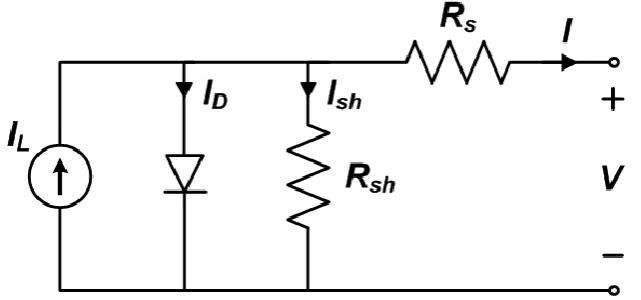
and temperature. The maximum limit of solar irradiance is 1000 W/m2. The circuit diagram is shown in figure 2.
Figure 2: Equivalent Circuit Diagram of PV System with Series and Parallel Resistance
The electrical characteristics of the PV module are generally represented by the current vs. voltage (I-V) and the
current vs. power (P-V) curves. The V-Icharacteristic equation of the PV module is:
I = I
L- I
0(e
q(V +IRs)/nkT
- 1)
Where
IL = photo current,
I0 = diode saturation current,
RS = series resistance,
q = charge of electron,
T = temperature,
N = number of PV module.
Power output from the PV array can be obtained by using the equation:
Ppv (t) = Ins (t) * A*Eff (pv)
Where
Ins (t) = insolation data at time t (kW/ m2),
A = area of single PV panel (m2),
Eff (pv) = overall efficiency of the PV panels and DC/DC converters.
The open circuit voltage of a single Photovoltaic cell is approx. 0.5V. It needs high voltage for practical
applications. Photovoltaic cells are connected in series to enhance the open circuit voltage. [4].
III. WIND TURBINE MODELING
It is one of the less expensive sources of renewable energy and this technology is publicized in many countries.
A wind turbine captures the kinetic energy from rotor having many blades and converting into electrical energy.
If the mechanical energy is used directly by machinery, such as a pump or grinding stones, the machine is called
a windmill. If the mechanical energy is then converted to electricity, the machine is called a wind generator. Its
components are designed in a proper way to get maximum energy. The output power equation of wind turbine is
given by
Cp= Performance coefficient of turbine
ρ= Air density (Kg/m3),
λ= speed ratio
A= swept area of turbine
β= blade pitch angle
Vw= wind speed (m/s)
In this paper, Permanent Magnet Synchronous Generator is being used because of having better performance
due to higher efficiency. It has less maintenance cost due to which it can be used without gearbox as it does not
contain rotor current, thus the reduction of weight of nacelle and reduces cost. The mechanical energy is being
obtained from Wind and converted into electricity. The Simulink model of wind Turbine is shown in figure 3.
Figure 3: Simulink of wind Turbine
IV. STATCOM DESCRIPTION AND MODELLING
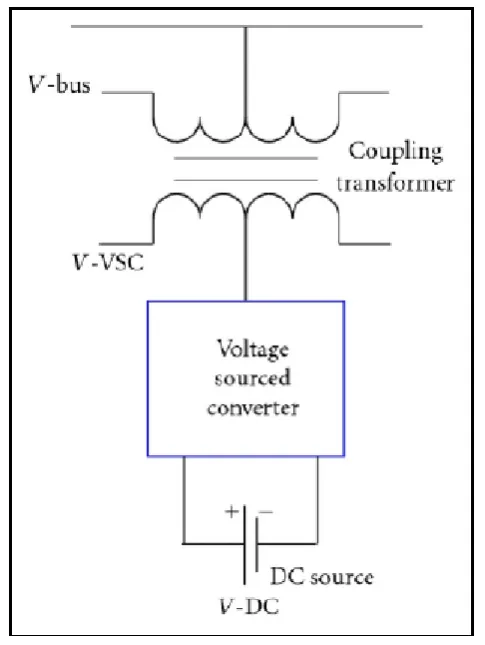
STATCOM is a shunt connected compensation device having the ability of injecting or absorbing the reactive
power. It also improves the steady state and transient stability systems.The main components include Voltage
source Inverter (VSI), DC Capacitor, Signal Generation, Coupling Transformer and Control Circuit. Its output
can be varied to control the various parameters of power system. It is considered as solid state switching
converter because having the capability of injecting or absorbing real and reactive powerat its output terminals
when it is being supplied from solar/wind hybrid input terminal system. The three phase output ac voltage
produced after using STATCOM is in phase with the corresponding ac voltage through leakage reactance.The
DC side of the voltage source converter is connected to a DC capacitor carrying the input current. No power will
be delivered to the system if the AC terminal voltage will become equal to the output voltage of the VSI. The
operation of Statcom will be in capacitive mode if the output voltage will be greater than ac output voltage.
Similarly Statcom will operate in Inductive mode if ac output voltage is greater than output voltage of VSI.The
Figure 4: Circuit Diagram of STATCOM
Figure 5Simulink Model of STATCOM
V. SIMULATION AND RESULTS
With above based models and methods, The PV/Wind hybrid system with power grid connected has been
implemented with STATCOM in the Simulink/MATLAB as shown in figure. The proposed system consists of
PV Panel which is connected to the universal bridge to convert dc into ac supply. The second part consists of
Wind Turbine which is connected to the PMSG to obtain the ac supply. The ac supply from hybrid PV/WIND
and balanced, we use STATCOM 100MVAR to this distribution network and the bus feeder is about 100km.
The output of STATCOM is coupled in parallel with 1.25/25 KVA step up delta-star transformer. A filter bank
is provided at the end of STSTCOM output to absorb the harmonics. The primary side of this transformer is fed
with Voltage source Inverter and 3000 μF Capacitor is used as a dc voltage source for inverter.STATCOM
plays a vital role for regulating the bus voltage by generating or absorbing it. STATCOM will behave as
Inductive mode, if the secondary voltage is lower than the bus voltage and it will behave as capacitive mode if
bus voltage is lower than secondary voltage.
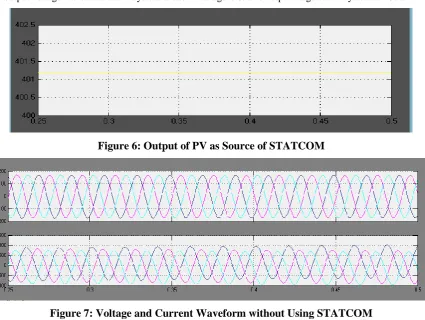
The output voltage waveform of PV system is shown in figure 6. The output range of PV system is 401.2V DC.
Figure 6: Output of PV as Source of STATCOM
Figure 7: Voltage and Current Waveform without Using STATCOM
From above Waveforms, we see the Current is unbalanced and contains harmonics from the hybrid PV/Wind
generating power system.
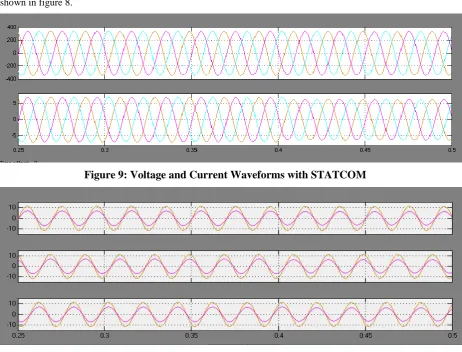
Due to low power factor from the generating side, which results high amount of current is drawn at load side as
shown in figure 8.
Figure 9: Voltage and Current Waveforms with STATCOM
Figure 10: Voltage and Current Waveforms with Improved Phase Difference Due to High
Power Factor Using STATCOM.
VI. CONCLUSIONS
In this paper, the power quality improvement with the help of STATCOM has been analyzed. STATCOM
synchronize the bus voltage and maintain the reactive power. The hybrid PV/Wind generating system with
STATCOM is being analyzed with the help of MATLAB/Simulink. STATCOM improves the performance of
power system and make it balanced as shown in various waveforms. The voltage stability of the STATCOM is
shown by altering the inductive load which regulates the load side voltage and current almost constant.
REFERENCES
[1] Pierre Giroux, Gilbert Sybille, Hoang Le-Huy “[1] pierre Giroux, Gilbert Sybille, Hoang Le-Huy
“modeling and simulation of distribution STATCOM using Simulink power system blockset”IECON’01:
the 27th annual conference of the IEEE industrial electronics society
[2] G.sundar, S.Ramareddy,”digital simulation of DSTATCOM for voltage”IECON’01: the 27th annual
[3] Power Quality Improvement for Hybrid Wind, Solar and Diesel Generator Energy Systems, Using
DStatcom, S.UmaMaheswari, G.Vijaya Gowri, IJAEEE, ISSN: 2319-1112 /V3N1: 36-46
[4] Sandeep kaur, G S kochar, D S mahal, Sunita Goyal “ power quality improvement using distributed static
synchronous compensator” international conference on electrical power and energy system
[5] Power Quality Improvement of Standalone Hybrid Solar-Wind Power Generation System using FACTS
Devices, S.Angalaeswari, M.G.Thejeswar, R.Santhana Poongodi, W.Valeed Basha, .Sasikumar, IJAEEE,
Vol. 3, Issue 3, and March 2014.
[6] A Statcom-Control Scheme for Grid Connected Hybrid Wind-Solar Energy System to Improve Power
Quality Boopathi.R, Vijayakumar.G, INTERNATIONAL JOURNAL OF ENGINEERING SCIENCES &
RESEARCH TECHNOLOGY(IJESRT),Vol. 3(1) 1,January 2014.
[7] Simulating Solar and Wind Based Hybrid Systems Synchronized and Segmented for Grid Connectivity,
Md. Sifat Ferdous Chowdhury and Mohammad Abdul Mannan,IJMSE, Vol.5, No. 8, August 2014.
[8] Simulation and Analysis of Wind Energy and Photo Voltaic Hybrid System, R. Valarmathi, S.
Palaniswami, N. Devarajan, International Journal of Soft Computing and Engineering (IJSCE) ,ISSN:
2231-2307, Volume-2, Issue-2, May 2012.
[9] E.muljadiand C.P .butterfied, “Methodology for optimally sizing the combination of a battery bank and
PV arrayina wind–PV hybrid system”.IEEE Transaction on industry applications, vol.37, Page(s):240–246,
2001.
[10] Meei Songkang, “Generation Cost Assessment of an Isolated Power System With a Fuzzy Wind Power
Generation Model”.IEEE Transaction on energy, IEEE transactions on energy conversion, vol.22, no. 2,
Page(s):397–404, June2007.
[11] Modelling and simulation of hybrid systems (PV/Wind/Battery) connected to the grid, Saib Samia, Gherbi
Ahmed, International Conference on Electrical Engineering and Automatic Control, Setif, 24‐26 November
2013.
[12] Dynamic Modelling and Control of Grid Connected Hybrid Wind/PV Generation System K. Shivarama
Krishna, B. Murali Mohan, and Dr. M. Padma Lalitha,International Journal of Engineering Research and
Development, Volume 10, Issue 5 (May 2014), PP.01-12.
ABOUT AUTHOR
MOHD. ILYAS was born on 2nd April 1976. He is an associate professor in department of electrical &
electronics with Al-Falah University Faridabad, Haryana. He received his B.Tech in electrical engineering &
M.Tech in electrical power system & management from Jamia Millia Islamia, New Delhi. Now he is pursuing
PhD. from MD University, Rohtak. He has more than 14 years experience in teaching. He taught various
subjects such as Power Electronics, Electrical measurement & Measuring Instrument, Electric Power Generation
etc. He has published more than 15 papers in National & International Generals. He attended many national and
international Seminars and conferences. He has guided number of B.Tech and M.Tech projects in his teaching
career.
Touseef Ahmad Dar born 30th March 1990 is pursuing his Master of Technology in Power System from
Al-Falah school of Engineering & Technology, Faridabad, Haryana. He completed his Bachelor Degree in
Dr. Jafar Salamat Khan (born 19th February 1950) obtained his B.Sc. Engg. (Elect.) ,M.Sc. Engg. (Elect.) and
Ph.D from Aligarh Muslim University, Aligarh in 1971, 1974 and 1979 respectively. He worked with M/s.
Engineering Projects (India) Ltd, New Delhi, a Govt. of India Enterprise, from 1977 to 1982. He joined Council
of Scientific & Industrial Research (CSIR) in 1982 as a Scientist and superannuated from CSIR as Advisor in
February 2010. He has rich and wide experience in Project Engineering, Project Marketing, R&D Planning,
Technology Marketing, and Commercialization of indigenous technology developed through R&D. He has
published more than 30 papers in National & International journal. He joined Al-Falah University in March -