IJEDR1604109
International Journal of Engineering Development and Research (www.ijedr.org)708
Iris Recognition Using Dual tree complex transform
1Rehana Parwin, 2Swati Verma M.E. Scholar SSGI, 2Assistant Professor
SSGI Bhilai (C.G.)
________________________________________________________________________________________________________
Abstract - A biometric system provides automatic identification of an individual based on a unique feature or characteristic possessed by the individual. Unlike other biometric such as fingerprints, hand geometry and face recognition, the distinct aspect of iris comes from randomly distributed features. Iris recognition is regarded as the most reliable and accurate biometric identification system available [1]. Due to its reliability and nearly perfect recognition rates, iris recognition is used in high security areas. In this paper dual tree complex wavelet transform is used as the feature extraction technique and hamming distance is used for classification. The obtained result showed that the proposed approach enhances the classification accuracy.
Keywords - Biometric, Iris Recognition, DTCWT, Hamming Distance
________________________________________________________________________________________________________ 1. INTRODUCTION
In today’s world, identity verification is an increasingly important process in all phases of our daily lives. In order to use our own equipment, or to gain access to physical places, we have to prove our identity and satisfy our claim. So, it is important to have a reliable and robust authentication and identification system to identify a user.
Traditional access control methods fall into two categories: (i) knowledge-based authentication (proving that you know something such as password and personal identification number), (ii) token-based authentication (proving that you own something such as passport and driver’s license). But these classical methods are vulnerable because the passwords can be lost, stolen or shared. This motivated researchers to seek for reliable and accurate alternative for identity verification over the traditional password/ ID card based systems. A solution to these problems of identification comes from the performance-based biometric systems where a user is recognized using his own biometrics.
A physiological characteristic is relatively stable physical characteristics, such as fingerprint, iris pattern, facial feature, hand silhouette, etc. This kind of measurement is basically unchanging and unalterable without significant duress. A behavioral characteristic is more a reflection of an individual’s psychological makeup as signature, speech pattern, or how one type sat a keyboard. The degree of intra-personal variation in a physical characteristic is smaller than a behavioral characteristic.
.
Figure1.Iris Image
There is world wide applications area of iris recognition system. National border controls as living passport, computer login: a password, secure access to bank account at ATM machine, ticketless travel, authentication in networking, permission access control to home, office, laboratory etc, driving licenses, and other personal certificates, tracing missing or wanted persons, anti-terrorism, security at airports, using as any type of password.
2. LITERATURE REVIEW
TITLE AUTHOR & YEAR ALGORITHM USED CONCLUSION
1.Efficient Content Based Image Retrieval Using 2D Dual Tree Complex Discrete
Yogita Mistry Dr. D. T. Ingole M. D. Ingole
2D DTCWT Euclideance distance
IJEDR1604109
International Journal of Engineering Development and Research (www.ijedr.org)709
Wavelet Transform2.Enhancement of IRIS Recognition Using Gabor Over FFBPANN
Shirke Swati, SuvarnaPansambal
(shirke)(2015)
log 2D Gabor filter Hamming Distance
Iris recognition using log 2 D Gabor filter approach is define over FFBPANN to identify the authorized person.
Gabor filter has more accuracy than ANN. 3.Iris Recognition System
Using Circular Hough Transform
Mrigana walia Dr. Shaily Jain
Canny Edge Detector Circular Hough
transformation
Tested using UBIRIS database of
greyscale eye images in order to verify the claimed performance of Iris Recognition technology.
4. Iris Recognition System for Biometric Identification
Sowmya.B, Sreedevi.S.L
Hamming Distance In this paper, an efficient method for personal identification and verification with iris patterns are presented. 5. A neural network based iris
recognition system for personal identification
Usham Dias, Vinita Frietas, Sandeep P.S. Amanda Fernandes
circular hough transform, conjugate gradient
algorithms
A biometric system based on Iris using Neural Network was presented.
Canny edge detection gave the best results for threshold 0.2 and sigma between 2 and 4.
6.iris recognition using gabor Shirke Swati D. . Prof.Gupta Deepak
Euclidean distance, 2-D Gabor
Novel iris recognition technique that minimizes false identification rates is discussed.
7. A coherent framework for multiscale signal and image processing
(2005)
Ivan w. selesnick, Richard g.baraniuk,
Nick g. kingsbury
Dual tree complex wavelet transform
The dual-tree cwt is a valuable enhancement of the traditional real wavelet transform that is nearly shift invariant and, in higher dimensions. 8.iris recognition system using
biometric template matching technology (2010)
Sudha gupta, Viral doshi, Abhinav
jain sreeram iyer
Hamming distance The system performed with perfect recognition on a set of 40 eye images.
9. Image features extraction using the dual-tree complex wavelet transform
Stella vetova, Ivan ivanov
Dual tree complex wavelet transform
This paper introduces an algorithm for image feature extraction using dt cwt. It satisfies all modern requirements for optimum feature extraction rate. 10. Efficient biometric iris
recognition using hough transform with secret key
Kriti sharma, Himanshu monga
Hough transform Canny algotithm
In this paper efficient biometric iris recognition using hough transform is presented.
3. PROBLEM IDENTIFICATION
Personal identification based on biometrics technology is a trend in future. Traditional approaches, for example, information keys, ID cards, username and password, are not satisfactory not reliable enough in security fields, biometrics authorizations based on iris, face, fingerprint have become a great research field. The iris recognition is regarded as a high accuracy verification technology, so that many countries have same idea of adopting iris recognition to improve safety of their key departments . Human iris can also be considered a valid biometrics for personal identification. Biometrics recognition based on iris patterns is a hotspot as face recognition and fingerprint recognition recently years. Iris is colored ring on human eye between pupil and the white sclera. And lots of physical biometric can be found in colored ring of tissue that surrounds pupil, such as filaments, corona, crypts, flecks, pits, radial furrows and striations. Iris features can be encoded by mathematical representation.
In real-time iris recognition software system, iris localization is a very important step for iris recognition. Iris regions segmentation accuracy and localization real-time performance will affect whole recognition system’s correct rate and effectiveness for large-scale database.
Because iris region is a small object and has low grey value, this is very difficult to capture high contrast iris image clearly. In order to improve iris image contrast usually some illuminations such as near infrared light source are used to increase intensity; however these illuminations may result in some facular in iris image and affect iris segmentation and iris features.
4. METHODOLOGY
Iris Recognition System works in two phases i.e. training phase and testing phase. Both the phases go through Feature extraction and recognition step. In the training phase, extracted
IJEDR1604109
International Journal of Engineering Development and Research (www.ijedr.org)710
Figure 2: Flowchart for database training
No
Yes
Start
Load iris image
Segmentation
Template
generation
Feature extraction
using DTCWT
Save in the
database
Stop
Start
Image
segmentation
Feature extraction
if
matched
Details display
Feature
Classification
IJEDR1604109
International Journal of Engineering Development and Research (www.ijedr.org)711
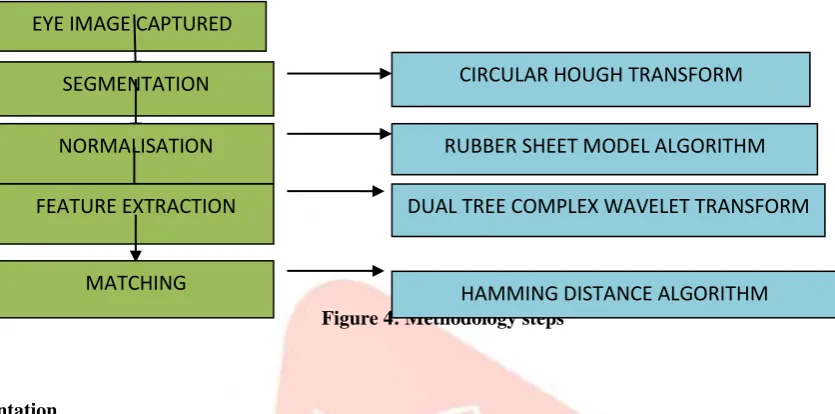
Figure 3: Flowchart for database testingFigure 4: Methodology steps
A.Segmentation
In Segmentation process Circular Hough transform based approach is used for detecting the upper and the lower eyelids ofthe eye, and the iris and pupil boundaries. This procedure involves generation of an edge map, which is done through employing Canny Edge Detection technique. In this, gradients are biased in the vertical direction for the outer iris.
1. Canny Edge Detection
Canny edge detection is one of the basic algorithms used in shape recognition. The algorithm uses a multi-stage process to detect a wide range of edges in images. Steps for Canny Edge Detector algorithm are as follows:
1. Image smoothing: This is done to reduce the noise in the image. 2. Calculating edge strength and edge direction.
3. Directional non-maximum suppression to obtain thin edges across the image. 4. Invoking threshold with hysteretic to obtain only the valid edges in an image. B.Normalization and Enhancement
Daugman’s rubber sheet model technique was employed to demonstrate the normalization of the iris regions. The reference point here refers to the centre of the pupil, and the radial vectors that are considered pass through the iris region.
𝑟′= √𝛼𝛽 ± √𝛼𝛽2 − 𝛼 − 𝑟 12 Where
𝛼 = 𝑜𝑥2+𝑜𝑦2
𝛽 = cos (𝜋 − arctan (𝑜𝑦
𝑜𝑥) − 𝜃)
C.Feature extraction
General complex wavelet transform couldsolve the limitations of traditional discrete wavelet. Howeverit was difficult to find the perfect reconstruction filter corresponding the complex wavelet transform because the import of complex wavelet transform is plural form when it
was resolved more than one layer. To solve this problem, Kingsbury put forward a dual tree complex wavelet transform (DT -CWT), which was designed using double tree filter form according to certain rulesand not only retained the advantages of general complex wavelet, but also tit could be completely reconstructed.
Complex wavelet can be expressed as;
Ψ (t) = ψr (t) + jψi (t)
EYE IMAGE CAPTURED
SEGMENTATION
NORMALISATION
FEATURE EXTRACTION
MATCHING
CIRCULAR HOUGH TRANSFORM
RUBBER SHEET MODEL ALGORITHM
DUAL TREE COMPLEX WAVELET TRANSFORM
IJEDR1604109
International Journal of Engineering Development and Research (www.ijedr.org)712
ψr (t ) , ψi (t ) denotes the real and the imaginary part of complex wavelets respectively and they are real functions, DTCWT canbe expressed as two separate real transforms, comprising two parallel decomposition tree: tree A and tree B. Tree A represents the real part of DTCWT and tree B represents the imaginary part If the low-pass filter and the high pass filter of Tree A are
assumed as h 0(n), h1 (n) respectively, the low and highpass filter of tree B are g0 (n), g1(n). If in the first layer of transform tree A
had one sampling period time delay with respect to tree B, we could ensure that the first layer of the tree B got the sample value of tree A which was given up during the interval point of tree A sampling. Even long filter was used in more than two layers of decomposition with ¼ of the sampling period time-delay and each layer had a 0.5 time-delay of the sampling period inwhich way there did not need linear phase filter. Obviously, the wavelet function oftree A and tree B composed a Hilbert transform pair, so the DTCWT ψ( t)= ψr (t) + jψi (t) has the excellent feature of unilateral spectrum and also has no bias frequency and
approximate shift invariance under two sampling which is he advantages of the Tree Complex Wavelet Transform. D.Matching
For the comparison of the two iris codes, the hamming distance algorithm is employed. Since the iris region contains features with very high degrees of freedom, and each iris produces a unique bit-pattern which is independent to that produced by any another iris, whereas the codes produced by the same iris would be similar. If two bits patterns are completely independent,then the ideal Hamming distance between the two patterns will be equal to 0.5. It happens because independent bit pattern are completely random. Therefore, half of the bits will agree and half will disagree between the two patterns. The Hamming distance is the matching metric system employed by Daugman, and calculation of the Hamming distance is taken only in bits that are generated from the actual iris region.
The distance between the minimum Hamming distance value for inter-class comparisons and maximum Hamming distance value for intra-class comparisons could be used as a metric to measure separation; however, this is not a very accurate measure since outliers will corrupt the value calculated, and the measure is dependent on the number of iris templates compared. A better metric is ‘decidability, which takes into account the mean and standard deviation of the intra-class and inter-class distributions.
𝑑′= µ𝑠−µ𝐷 √(𝜎𝑠2+𝜎2 𝐷2 )
The advantages of dual tree complex wavelet transform
Although the discrete wavelet transform has achieved great success in the field of signal and image processing, its own defects such as having no translation invariance and more direction selectivity which were significantly important for image manipulation treatment limited its delopment. The dual tree complex wavelet transforms not only overcome the above drawbacks of traditional discrete wavelet transform, but also had its own advantages: translation invariance,
More direction selectivity, limited data redundancy, Less amount of calculation. The dual tree complex wavelet transform was widely applied in the image processing fields such as image denoising, image enhancement, edge detection, pattern recognition, data compression, texture analysis and digital watermark and so on because of those above characteristics. [12]
5. RESULTS AND DISCUSSION
All images taken are in colour iris images. Features in the iris region are highly visible and there is good contrast between pupil, iris and sclera region. It was not possible to use all of the eye images from each database, since perfect segmentation success rates were not attained.
Table-5.1 Features for training database
S. No. XCP YCP RP XCL YCL RL
DTCWT feature
Mean
DTCWT feature (SD)
1 87 78 8 92 73 70 99.3333 15.3731
2 106 138 28 108 134 62 101.3333 36.4600
3 75 147 14 73 145 62 93.33333 45.0814
4 170 92 28 175 93 78 115.3333 52.2143
5 108 99 7 110 96 62 89.3333 24.6847
6 82 94 7 78 96 66 80 15.0997
7 220 336 30 224 335 100 219.66667 117.5599
8 185 230 23 187 225 91 167.6667 69.0604
9 83 170 9 88 167 62 150.6667 54.6839
10 82 117 12 77 120 65 87.33333 28.9194
11 87 183 7 86 188 63 112.3333 66.5307
12 103 114 7 107 114 64 95 27.0740
13 84 143 23 85 140 67 97.33333 38.0607
14 67 130 14 68 132 62 87.33333 38.7986
15 80 80 8 79 75 62 72 8.8882
16 82 153 16 77 155 65 99 48.8672
17 110 131 7 112 126 62 110 33.6452
IJEDR1604109
International Journal of Engineering Development and Research (www.ijedr.org)713
19 99 120 7 94 118 62 91.3333 28.0951
20 83 128 21 85 123 62 90 30.8058
Table 5.2 Features for testing of the iris images
S. No. XCP YCP RP XCL YCL RL
DTCWT feature
Mean
DTCWT feature
(SD)
Matching Yes/no
1 81 127 28 76 125 62 87.6667 33.0807 NO
2 80 143 23 85 138 65 96 37.7227 NO
3 83 150 20 87 152 73 104 42.1545 NO
4 107 160 47 109 162 71 114 45.7056 NO
5 126 188 7 130 188 65 78.3333 11.9304 NO
6 82 94 7 78 96 66 80 15.0997 YES
7 80 80 8 79 75 62 72 8.8882 YES
8 179 200 22 181 196 78 151.6667 64.2365 NO
9 83 170 9 88 167 62 150.6667 54.6839 YES
10 82 117 12 77 120 65 87.33333 28.9194 YES
11 73 159 7 75 164 62 100.3333 55.5188 NO
12 103 114 7 107 114 64 95 27.0740 YES
13 77 141 13 80 136 67 94.3333 36.6652 NO
14 67 130 14 68 132 62 87.33333 38.7986 YES
15 220 336 30 224 335 100 219.66667 117.5599 YES
16 79 163 7 84 167 65 105.3333 54.2433 NO
17 110 131 7 112 126 62 110 33.6452 YES
18 81 174 7 78 173 63 104.6667 59.6518 NO
19 88 115 13 88 111 66 86.6667 22.7230 NO
20 83 128 21 85 123 62 90 30.8058 YES
The key objective of an iris recognition system is to be able to achieve a distinct separation of intra-class and inter-class Hamming distance distributions. With clear separation, a separation Hamming distance value can be chosen which allows a decision to be made when comparing two templates. As per our methodology we calculate the feature of iris that is the center coordinate of pupil and limbic and mean of an iris and standard deviation of an iris by using DTCWT.
If the Hamming distance between two templates is less than the separation point, the templates were generated from the same iris and a match is found. Otherwise if the Hamming distance is greater than the separation point the two templates are considered to have been generated from different irises.
The distance between the minimum Hamming distance value for inter-class comparisons and maximum Hamming distance value for intra-class comparisons could be used as a metric to measure separation; however, this is not a very accurate measure since outliers will corrupt the value calculated, and the measure is dependent on the number of iris templates compared. A better metric is ‘decidability, which takes into account the mean and standard deviation of the intra-class and inter-class distributions.
𝑑′= µ𝑠−µ𝐷 √(𝜎𝑠2+𝜎𝐷2 )
2
Decidability d' is a distance measured in standard deviations and is a function of the magnitude of difference between the mean of the intra-class distribution 𝜇𝑠, and the mean of the inter-class distribution µs, and also the standard deviation of the intra-class and inter-class distributions, 𝜎𝑠2 and 𝜎𝐷2 respectively. The higher the decide ability, the greater the separation of intra-class and inter-class distributions, which allows for more accurate recognition. With a pre-determined separation Hamming distance, a decision can be made as to whether two templates were created from the same iris (a match), or whether they were created from different irises. However, the intra-class and inter-class distributions may have some overlap, which would result in a number of incorrect matches or false accepts, and a number of mismatches or false rejects.
Performance Parameters -
False acceptance rate(FAR):-The probability of accepting an outsider as an entrolled images in the data base.
False rejection rate(FRR):-The probability of rejecting an enrolled subjected by considering him/her as an outsider. Accuracy:- The probability of correctly identifying a test user form enrolled users.
IJEDR1604109
International Journal of Engineering Development and Research (www.ijedr.org)714
Table 5.3.1 Testing table recognition and accuracy for 50 imagesTesting for 50 images for 5 times
FAR FRR 1 0.00 0.00 2 0.00 0.02 3 0.00 0.00 4 0.00 0.00 5 0.00 0.00 FAR=0.0 FRR=1/50 =0.02
Average FAR=0+0+0+0+0 5 =0.00
Average FRR=.02+0.0+0.0+0.0+0.0
5 =.004
Accuracy = 1- (𝐹𝐴𝑅+𝐹𝑅𝑅 2 ) = 1- (
0.00+0.004
2 ) = .998 =0.998*100 = 99.8%
Table 5.3.2 Testing table recognition and accuracy for 100 images
Testing for 100 images 5 times FAR FRR
1 0.00 0.00
2 0.01 0.01
3 0.00 0.00
4 0.00 0.01
5 0.00 0.00
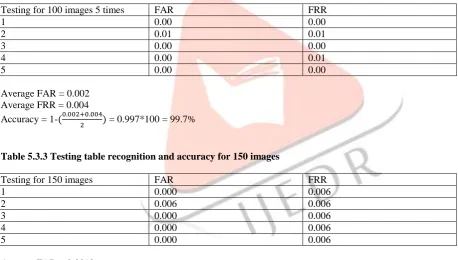
Average FAR = 0.002 Average FRR = 0.004 Accuracy = 1-(0.002+0.004
2 ) = 0.997*100 = 99.7%
Table 5.3.3 Testing table recognition and accuracy for 150 images
Testing for 150 images FAR FRR
1 0.000 0.006
2 0.006 0.006
3 0.000 0.006
4 0.000 0.006
5 0.000 0.006
Average FAR = 0.0012 Average FRR = 0.006 Accuracy = 1-(0.0012+0.006
2 ) = 0.9964*100 = 99.64%
Table 5.3.4 Testing table recognition and accuracy for 200 images
Testing for 200 images FAR FRR
1 0.000 0.005
2 0.005 0.005
3 0.005 0.005
4 0.005 0.005
5 0.005 0.005
Average FAR = 0.004 Average FRR = 0.005 Accuracy = 1-(0.004+0.005
IJEDR1604109
International Journal of Engineering Development and Research (www.ijedr.org)715
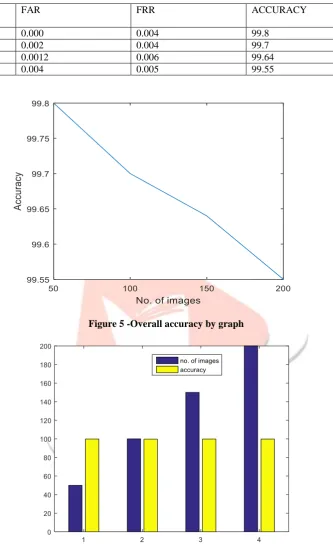
Table 5.3.5 Recognition accuracy with DTCWT feature extraction techniqueNo. Of images in training dataset
FAR FRR ACCURACY
50 0.000 0.004 99.8
100 0.002 0.004 99.7
150 0.0012 0.006 99.64
200 0.004 0.005 99.55
Figure 5 -Overall accuracy by graph
Figure 6 - Overall accuracy by bar graph
The graph shows that the accuracy decreases when no. of images increases. The accuracy (Accuracy = 100 – (FAR+FRR)/2) of the iris verification system is 99.8%, with zero false acceptance rate. It can be eaisly concluded that FRR has reduced though slightly by use of DT-DWT wavelet for feature extraction instead of using HAAR wavelet transform. With the ‘colour database’ data set perfect recognition is possible. With a false accept rate and false reject rate of 0.00 % and 0.004 % respectively is achieved.
CONCLUSION
IJEDR1604109
International Journal of Engineering Development and Research (www.ijedr.org)716
REFERENCES1. Pooja Kawale, Jagruti Ghatole, Shweta Thote, Gauri Pohokar, Pallavi Dupare ,Karuna Gechude “Matlab based iris pattern recognition system ” International Journal of Advanced Research in Computer Engineering & Technology (IJARCET) Volume 4 Issue 1, January 2015.
2. Yogita Mistry ,Dr. D. T. Ingole,M. D. Ingole “Efficient Content Based Image Retrieval Using 2D Dual Tree Complex Discrete Wavelet Transform” 978-1-4673-9542-7/15/$31.00 ©2015 IEEE.
3. Shirke Swati,SuvarnaPansambal (shirke) “Enhancement of IRIS Recognition Using Gabor Over FFBPANN” 978 -9-3805-4416-8/15/$31.00 c 2015 IEEE.
4. Mrigana walia, Dr. Shaily Jain “Iris Recognition System Using Circular Hough Transform” Volume 3, Issue 7, July 2015 International Journal of Advance Research in Computer Science and Management Studies.
5. Sowmya.B#1, Sreedevi.S.L*2 “Iris Recognition System for Biometric Identification ” National Conference on Architecture, Software systems and Green computing-2013(NCASG2013).
6. Usham Dias1, Vinita Frietas2, Sandeep P.S.3 and Amanda Fernandes4 “A neural network based iris recognition system for personal identification ” Department of Electronics and Telecommunication, Padre Conceicao College of
Engineering, Goa, India(2010).
7. S V Sheela ,P A Vijaya “Iris Recognition Methods - Survey” International Journal of Computer Applications (0975 – 8887) Volume 3 – No.5, June 2010.
8. Stella Vetova1, Ivan Ivanov2 “Image Features Extraction Using The Dual-Tree Complex Wavelet Transform” 1Institute of Information and Communication Technologies, 2Telecommunication Technologies 1Bulgarian Academy of
Sciencies.
9. Himanshu Srivastava “Personal Identi Kriti Sharma*1, Himanshu Monga2 fication Using Iris Recognition System, a Review” International Journal of Engineering Research and ApplicationsVol. 3, Issue 3, May-Jun 2013, pp.449-453. 10. Fuqiang,Zhang, Zengli,Liu “Image Denoising Based on the Bivariate Model of Dual Tree Complex Wavelet
Transform” 2015 11th International Conference on Computational Intelligence and Security.
11. Zatin Singhal, Preeti Gupta, Kavita Garg “Biometric Recognition: Personal Identification Technique” IJCEM International Journal of Computational Engineering & Management, Vol. 15 Issue 3, May 2012.
12. Kriti Sharma*1, Himanshu Monga2 “Efficient Biometric Iris Recognition Using Hough Transform With Secret Key Kriti” Volume 4, Issue 7, July 2014 International Journal of Advanced Research in Computer Science and Software Engineering.
13. Li Ma, Tieniu Tan, Yunhong Wan and Dexin Zhang “Efficient Iris Recognition by Characterizing Key Local Variations” IEEE transactions on image processing, vol. 13, no. 6, june 2004.