IJEDR1603138
International Journal of Engineering Development and Research (www.ijedr.org)850
Comparative analysis of 3-dimensonal single pulse
per plane with direct detection (SPPDD) code using
space and polarization
1Manvir Singh, 2Amrit Kaur 1Student, 2Assistant Professor 1Electronics and Communication,
1UCOE, Patiala, India
________________________________________________________________________________________________________
Abstract - In this paper, three dimensional (3D) SPPDD codes for data encoding in OCDMA has been done and
comparative performance of the W/T/S and W/T/P three dimensional codes for different distances is carried out. The data modulation format is considered non return to zero (NRZ) for space channel S=2. The comparison between W/T/S and W/T/P is done by varying the bit error rate (BER) against various parameters like length of fiber, number of users and input power. It is found that OCDMA system with W/T/S data format performs better than W/T/P. In this we take SPPDD codes with fixed space, but varied wavelength and time channels. As the wavelength and time channels are varied, the performance of the system is also varied. It gives better performance for (W>S) and shows large BER for (W≤S).
Index Terms— BER, Q-factor, SPPDD, Distance, NRZ
________________________________________________________________________________________________________
I. INTRODUCTION
Optical Code division multiple access (OCDMA) is one of the upcoming technology for future multiple access networks [1]. We can say that OCDMA is a spreading technique in which assigning a code to each user in fiber optic communication. A ‘1’ is transmitted by the user in the form of an assigned code and 0 by means of no transmission [2]. Optical CDMA can operate asynchronously, without centralized control, and it does not suffer from packet collisions [3]. Two main factors to be consider regarding codes are the nature of codes and type of codes. The nature of codes in OCDMA system means that whether codes used are unipolar and bipolar. In bipolar (-1, +1) codes, both the positive and negative logic are used to encode the data bit‟1‟ and zero logic level is used to encode the data bit ‘0’. In OCDMA system, unipolar codes are used to transmit the information and optical power cannot be negative. The type of codes in OCDMA system can be one dimensional, two dimensional and three dimensional, out of these three types of codes- three dimensional codes are generally preferable due its performance [4]. Generally used 3D code is space/wavelength/time code with single pulse per plane with direct detection (SPDD).
In OCDMA system, the system performance is determined by the bandwidth efficiency of the optical codes which is closely related to the error probability behavior of optical codes in multiple user circumstances as well as code set size dependence on code length and also on the modulation format of the input data. Moreover, there are two possible modulation formats, non return-to-zero (NRZ), in which a constant power is transmitted during the entire bit period, and return-return-to-zero (RZ), in which power is transmitted only for a fraction of the bit period [5], in intensity-modulated direct-detection (IM/DD) optical communication systems. The NRZ pulses have a narrow optical spectrum. The reduced spectrum width improves the dispersion tolerance but it has the effect of inter symbol interference between the pulses. The narrow spectrum of NRZ pulses yields a better realization of dense channel spacing in DWDM systems. The RZ pulse shape enables an increased robustness to fiber non-linear effects and to the effects of polarization mode dispersion (PMD) [6].
Various 3D codes for the OCDMA systems are proposed and one of them performs well is 3D SPPDD [30] code and this code is analyzed for different space channels and find out only those channels are suggested to use which fulfill (W>S) condition and if we use W=4, it provides channel S=2 and S=3 are better the comparison of NRZ and RZ format for both of the channels. W/T/S and W/T/P codes for three dimensional codes are not compared till now. Now, we present this comparison for W/T/S and W/T/P, for 3D single pulse per plane with direct detection (SPPDD).
II. ANALYTICAL MODEL
Three dimensional code words are represented by the 3-D matrices that have binary (1or 0) values for their elements. Single pulse per plane 3D code having a single ‘1’ element per plane with the three dimensions: wavelengths, time and the space channels and hence are the (Wavelength x Time x Space Channels) codes. In case of W/T/P there is third dimension of polarization and wavelengths are similar. Each element represents whether the corresponding point in 3D conceptual space is occupied by optical pulse or not. The ‘1’ chips in the code denote that an optical pulse is to be transmitted over the optical channel in the corresponding time slot over the respective wavelengths and ‘0’ represents transmitting nothing.
IJEDR1603138
International Journal of Engineering Development and Research (www.ijedr.org)851
The code auto-correlation and cross-correlation constraints for a general 3-D SPP code family are defined below [7]:Auto-correlation constraint: For a 3D SPP code Y (W, T, S) Auto-correlation,
Cross-correlation constraint: For any two 3D SPP codes Y&Z (W, T, S) Cross-correlation,
In the above definitions, non-negative integer‟s λa and λc are the peak out-of-phase auto correlation and the peak cross-correlation values; denotes modulo-n addition. The cross correlation constraint guarantees asynchronous operation of the 3D code based system. Hence use of direct detection with 3D optical SPP codes improving the bit error rate performance and provides larger code set.
III. SIMULATION SETUP
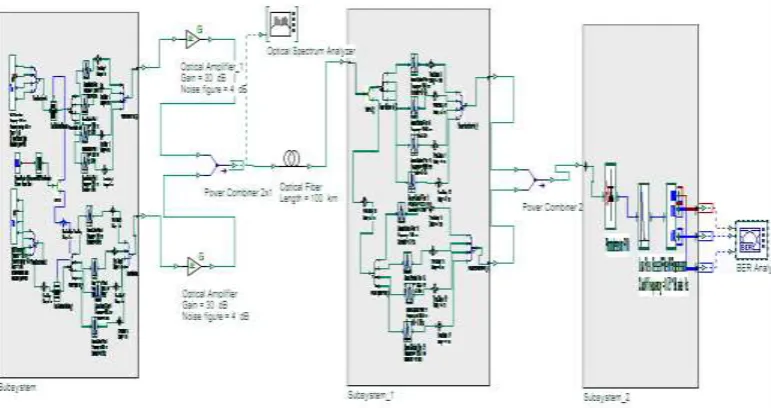
The simulation setup for OCDMA system, implementing 3D SPPDD codes for space channel S=2 and P=2 with constant value of W=T=4 is shown in figure 1.1 and in figure 1.2 respectively. As S=2, there are two space channels and each channel is having four wavelengths, then the number of wavelengths becomes 8. In case of the polarization as third dimension, the wavelengths are four. This is due to the fact that the change in the polarization state of same 4 wavelengths two time such as zero degree for first four and 90 degree again. Total number of wavelengths are determined by (W x S) in case of W/T/S only. For S=2 there are total 8 wavelengths and these wavelengths are ranging from 1549 nm to 1551.4 nm and 1555 to1557.4 nm. For P=2 there are total 4 wavelengths and these wavelengths are ranging from 1549 nm to 1551.4 nm.
Each wavelength differs from another wavelength by .8 nm. These setups having chip spectral width (.01 nm). The random input data bit sequence is generated at the rate of 1 Gbps, after that coded light signal modulates the input data. The modulator is driven by the modulator driver which decides the input data format and the modulator uses in both setups is Machzender. The input data format NRZ. The modulated data is encoded in the encoder, that spreads the data in both wavelength and time domain because encoder consists of filter and time delays. Outputs of all encoders of space channels combine and sent to the single mode optical fiber of different length. All the dispersion 17 ps/nm/km and non linear effects are activated and specified according to the typical industrial values to simulate the real environment as close as possible.
IJEDR1603138
International Journal of Engineering Development and Research (www.ijedr.org)852
Figure 1.1 W/T/S 3-D OCDMA simulation setupFigure 1.2 W/T/P 3-D OCDMA simulation setup RESULTS AND DISCUSSION
IJEDR1603138
International Journal of Engineering Development and Research (www.ijedr.org)853
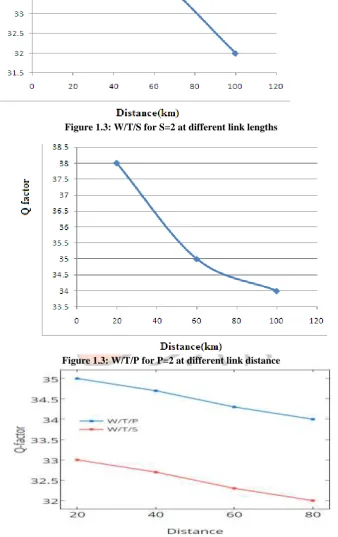
Figure 1.3: W/T/S for S=2 at different link lengths
Figure 1.3: W/T/P for P=2 at different link distance
Figure 1.4: W/T/S and W/T/P for different link
Comparison of the two codlings has been shown in figure 1.4, that represents the superior performance of the polarization coded system as third dimension.
IV. CONCLUSION
IJEDR1603138
International Journal of Engineering Development and Research (www.ijedr.org)854
third dimension is presented. The comparison of data these dimensions for space channel S=2 and polarization channel P=2 is done. It is shown that the W/T/P has lowest BER value and better system performance as compared to W/T/S. Hence, W/T/P data modulation in OCDMA can be recommended for 3D codes and for the larger distance in OCDMA at higher bit rates.V. REFERENCES
[1] E.Inaty, H.M.H Shalaby, P.Fortier and L.A. Rusch, “Multirate Optical fast frequency hopping CDMA system using power control”, “Journal of lightwave technology”, vol 20, no.2, pp-166-177,Feburary 2002.
[2] S.A. Aljunid, M.Ismail, A.R. Raml, B.M. Ali and M.K. Abdullah. “ A new family of optical code sequence for spectral amplitude coding optical CDMA systems”. IEEE photonics technology letters, vol.16, no.10, pp-2383-2385, October 2004. [3] S. Kim, K. Yu, N. Park, A new family of space/wavelength/time spread three dimensional optical code for OCDMA network,
J. Lightwave Technol. 18 pp. 502–511, April 2000.
[4] Bin Ni and James S. Lehnert, “Performance of an incoherent Temporal Spreading OCDMA system with broadband light sources”. Journal of lightwave technology, vol 23,no.7, pp-2206-2214, July2005.
[5] R.S. Kaler, T.S. Kamal, A.K. Sharma, Approximate and exact small signal anal-ysis for single-mode fiber near zero dispersion wavelength with higher order dispersion, Fiber and Integrated Optics 21 (5) pp. 391–415 2002.