Optimizing Resource Consumption in
Computational Cloud Using Enhanced ACO
Algorithm
Preeti Kushwah, Dr. Abhay Kothari
Department of Computer Science & Engineering, Acropolis Institute of Technology and Research
Indore bypass road Mangliya square
Abstract— The need of efficient computing is increasing day by day. In order to satisfy this need, various technologies are invented and implemented in recent years. Cloud and grid computing are few of the most popular effort amongst them. Cloud computing is a hardware and software infrastructure which offers high performance computing, data storage and resource distribution. Additionally, it also provides various hardware and software services. The cloud infrastructure has two critical issues, firstly privacy and security, and secondly the resource planning and management.
In this work resource management is taken as primary issue. That is a software level conflict, which takes place when more than two jobs are looking for the same resources and both are unsatisfied with the existing one. Thus in order to manage such condition, resource scheduling algorithm is utilized. In order to simulate the issue and solution, a simulation using the Cloud Sim is developed. In which first default time shared and memory shared techniques are implemented. Afterward for optimizing more the scheduling is prepared using BPN and traditional ACO algorithm. After implementing them, we observed that resource scheduling is an optimization problem thus ACO algorithm is slightly modified.
Finally, the performances of all implemented algorithms are compared in terms of time and space complexity and their scheduling performance. Among them proposed algorithm found optimum and delivers high performance resource allocation.
Keywords — Cloud Computing, Resource Scheduling, Virtual Machine, Ant Colony Optimization Algorithm and CloudSim Tool.
I. INTRODUCTION
Cloud computing is a new generation computing infrastructure for providing the efficient computational experience in remote manner.The cloud computing enables the data sharing, data transfer, job execution, application hosting and resource sharing techniques for efficient computing. Using the cloud computing environment, a user can get and consumes software and computational resources in plug and play manner. The key advantage of this infrastructure is no need of installation and maintenance of software’s and data. If users have internet connection then they directly gain the advantage of distributed computing. Due to computational resource sharing a significant amount of users are taking advantages of services. These services are delivered according to the user request and their requirements. Due to this a number of
computational resources are organized in efficient manner for work execution.
Fig. 1 Cloud Environments
As shown in Figure 1 it describes a corporation, organization or individual that uses a Web-based application for every task rather than installing software or storing data in a computer.
There are so many scheduling algorithms are available in computational cloud such as FCFS, Round-Robin, Min-Min algorithm, Max-Min algorithm and meta-heuristic algorithms which includes GA, PSO, ACO and many more.
Fig. 2 Resource Scheduling
the proposed study is intended to investigate different cloud computing resource management and resource provisioning techniques and proposes a new technique for improving the cloud scheduling. In this presented work the task and resource scheduling techniques are investigated for finding the optimum technique of resource management and allocation. Here, the main focus on scheduling of virtual machine and Cloudlet with various scheduling policies.
II. PROPOSED WORK
The scheduling and resource conflict issues can be handled using the optimization algorithms and techniques. The main objective of this work is to find optimum technique of the resource scheduling for optimizing the computational resource management and task scheduling. The entire study work is sub-divided in the following modules.
Study of resource scheduling techniques: In this phase different resource scheduling techniques are investigated and most optimum techniques are distinguished for resources and task scheduling.
Implementation and design of new resource scheduling techniques: In this phase using the optimization techniques a new algorithm is designed using the ACO (ant colony optimization algorithm) and implemented using Cloud Sim simulation tool.
Comparative performance study of proposed technique: In this phase the performance of the implemented technique is evaluated for finding the optimum resource scheduling and their computational complexity.
A. Problem Domain :
The cloud computing is adoptable for large scale service distribution, data storage, applications and data owner management for different business and educational domains. Therefore a huge computational infrastructure is required for computational services. These computing servers are built with OS which execute on multiprocessor architecture. The architecture of these multi-processor OS are based on unimulti-processor OS and their organizations. During job submission and execution, resource conflict and efficient resource provisioning problem arises. Therefore resource conflict in cloud systems is a situation that occurs when two concurrent processes, each waiting for the other to complete before proceeding. The result is that processes hang and not respond for a significant amount of time. Most commonly in multitasking and client/server environments these issues are much common. Therefore a new solution is desired for providing efficient scheduling with low resource consumption.
B. Solution Domain :
The scheduling and resource conflict issues can be handled using the optimization algorithms and techniques. Therefore for resolving the resource conflict and efficient job execution we need the modified ACO algorithm, which is desired to optimize using high-low normalization technique. By which the most jobs are satisfied with minimal number of available resources.
C. Simulation Architecture:
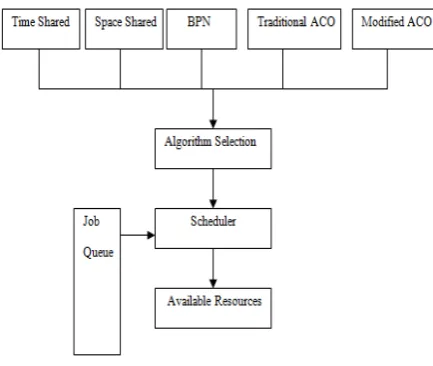
The proposed simulation architecture is given using figure 3. In this given system the different optimization and resource allocation algorithms are implemented namely back propagation neural network, space shared, time shared, ACO and modified ACO algorithm. And for selecting the algorithm an additional provision is made. User can select an appropriate scheduling algorithm which can work as the scheduler. In addition of that the generated work load is named here as job queue where the user submitted jobs take place. Additionally the available lists of resources are available. Scheduler accepts the available resources, jobs submitted and the scheduling algorithm. Scheduler uses the scheduling algorithm and find the optimum set of resources for satisfying the maximum jobs for execution. After evaluation the resources are allocated to the jobs for execution.
Fig. 3 Simulation Architecture
1) Time Shared: Here, the operating system is considered on a time shared basis, in this kind of system the resources are shared on time basis, here the elapse time is increased if numbers of jobs in queue are increased.
2) Space Shared: In this scenario type of operating system is considered as the memory shared system. That is a high efficient system type, that increases the resource consumption, but the time required to execute a job is too small with respect to the time shared system.
3) BPN: In this scheduling technique the back propagation algorithm is selected for simulation. Using this system estimate the pattern of resource allocation and learn using historical pattern. After training the model is able to calculate the upcoming trend of jobs requirement and predict the resources which may best fit for solution.
from their nest to the food sources. Ants communicate using pheromone, which is a chemical substance produced by them and is applied to their trails. The more pheromone on a specific trail shows higher the possibility of that trail to be followed by ants using this scheme, ants indirectly communicate and cooperate to complete their food searching task as efficiently as possible. 5) Proposed Algorithm (Modified ACO):
Ant colony optimization algorithm is a genetically inspired algorithm for finding the optimum solution. In this algorithm a number of solutions exist and among them an optimum solution that are best satisfying the problem is available. This technique minimizes the resource consumption and maximizes the job execution. Therefore the proposed algorithm is described as:
Let there are N number of jobs in the job queue and for executing the jobs the available resources I thus, the following procedure taken place.
1. Find available resources R[i] 2. List total jobs in job queue J[n]
3. Input the no. of iterations K, population size P 4. For p=0 to p<P
5. RR[p] random(R[p]); 6. End for
7. For k=0 to K
8. for each available solution in RR 9. If (RR[k] satisfies (J[n])) 10. Estimate fitness F[k]; 11. End if
12. End for 13. Find Fvalue=
14. Initialize min[] and max[] 15. For i=0 to f.length () 16. If F[i]<Fvalue 17. Min[i] F[k]; 18. Else
19. Max[i]F[k]; 20. End if
21. for each solution do
22. OS[i] = Combine (min[i], max[i]); 23. End for
24. Sort (OS[i]); 25. Return optimum
III.IMPLEMENTATION
Simulation Setup: This section describes the simulation development and their parameters by which the system is simulated.
Cloud Infrastructure Parameters: The simulation of the cloud environment using CloudSim discrete event simulator requires configuring first the cloud infrastructure, then after the simulation scenarios are necessary to be write down using codes.
TABLE I
CLOUD INFRASTRUCTURE PARAMETERS
S. No. Parameters Values
1 Number of Virtual Machine 20 2 Number of Cloudlets 40 3 VM Image Size 10000 MB
4 RAM 513MB
5 Number of Instruction 1000 MIPS
6 Processing Units 1
Network Parameters: After finalizing the cloud infrastructure required to design simulation scenario, for that purpose some network parameters are also required to be utilized, the network setup is given using the below given table.
TABLE III NETWORK PARAMETERS
S. No. Parameters Values
1 Resource length 1000
2 File Size 300MB
3 Host Memory 2048MB
4 Storage 1000000MB
5 Bandwidth 1000
6 Output size 300MB
7 Instructions per second for Host
1000
IV.RESULT ANALYSIS
This section reports the performance analysis of the proposed task scheduling strategy. In addition of that the comparative performance using different performance parameters are reported. The performance evaluations of the different implemented algorithms are given in two different phases: first the algorithm computational complexity and then after their scheduling ability.
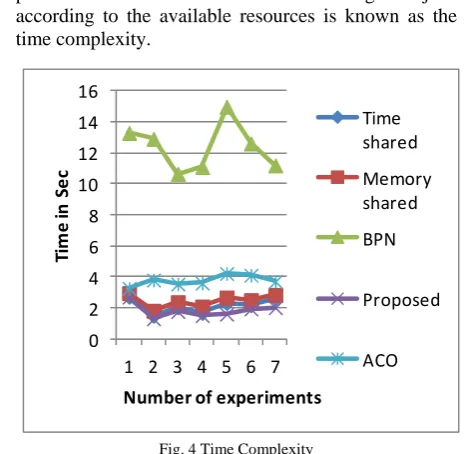
1. Time Complexity: The amount of time required to process the available data for scheduling the jobs according to the available resources is known as the time complexity.
0 2 4 6 8 10 12 14 16
1 2 3 4 5 6 7
Ti
m
e
in
Se
c
Number of experiments
Time shared
Memory shared
BPN
Proposed
ACO
Fig. 4 Time Complexity
experiments and Y axis shows the consumed time in seconds. According to the obtained results the time consumption of the proposed system is very fewer than other algorithms.
2. Space Complexity: Here, the focus is the amount of main memory required for process the algorithm is known as the memory consumption of the system.
0 5000 10000 15000 20000 25000 30000 35000 40000 45000
1 2 3 4 5 6 7
Me
mo
ry
in
KB
Number of experiments
Time shared
Memory shared
BPN
Proposed
ACO
Fig. 5 Space Complexity
Figure 5 shows the memory consumption of the proposed simulation model. In this diagram the all algorithms are compared on the basis of memory consumption. For performance demonstration the X axis contains the different experiments performed and the Y axis contains the memory consumption in terms of kilobytes.
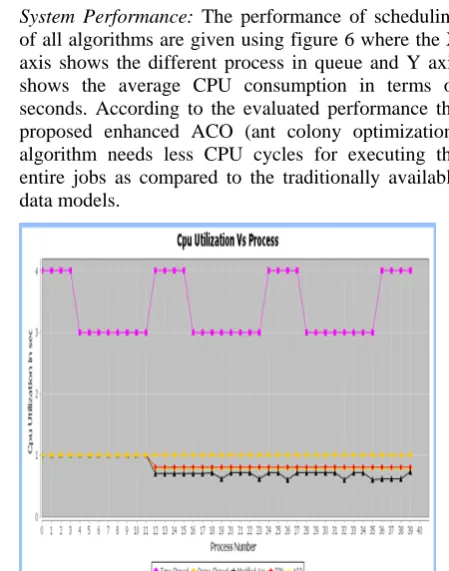
3. System Performance: The performance of scheduling of all algorithms are given using figure 6 where the X axis shows the different process in queue and Y axis shows the average CPU consumption in terms of seconds. According to the evaluated performance the proposed enhanced ACO (ant colony optimization) algorithm needs less CPU cycles for executing the entire jobs as compared to the traditionally available data models.
Fig. 6 Performance Evaluation
V. CONCLUSION
Cloud computing is an efficient computing technique for new generation computing. That promises to provide the data, applications and services in less cost and efficient environment. The cloud computing faces two major challenges, first privacy and security, another resource management and their scheduling. In this presented work the computational cloud is investigated for their resource scheduling strategy and efficient resource allocation.
Thus a number of resource scheduling techniques are evaluated and that is concluded, the optimization techniques are much helpful. Thus ACO (ant colony optimization) algorithm is investigated and explored. Then a modified ACO algorithm is proposed for enhancing the ACO algorithm.
The modified ACO algorithm prepare a Fvalue using the mean fitness value of generated solutions and using this value the entire solutions are recomputed after combining them. We get the efficient outcomes as a result in less number of iterations.Thus the ACO algorithm is used for resource scheduling and allocation of jobs. The implementation and simulation of the proposed ACO based scheduling algorithm is performed in Cloud Sim simulation tool and using JAVA technology.
After implementation of the desired simulation, the proposed algorithm is compared with two inbuilt algorithms, namely time shared and space shared. In addition of that, the proposed technique is also compared with the machine learning based back propagation algorithm and traditional ACO algorithm. After that the performances of all implemented algorithms are compared in terms of time and space complexity and their scheduling performance.
TABLE 3 PERFORMANCE SUMMARY S.
No. Parameters
Time Shared
Space
Shared BPN ACO Proposed
1 Space
Complexity Avg High High Avg Less
2 Time
Complexity Avg High High Avg Less
3 Scheduling
Performance Less Avg Avg Avg High
VI. FUTURE WORK
REFERENCES
[1] Introduction to Cloud Computing, White Paper,Dialogic, 2013. [2] A. Huth and J. Cebula, “The Basics of Cloud Computing”,Carnegie
Mellon University, Produced for US-CERT, 2011.
[3] Er. Shimpy, J. Sidhu, “Different Scheduling Algorithms in Different Cloud Environment”,International Journal of Advanced Research in Computer and Communication Engineering, vol. 3, September 2014.
[4] T. Arun Prakasam, D. Maruthanayagam, “Job Scheduling in Cloud Computing using Ant Colony Optimization”, International Journal of Advanced Research in Computer Engineering & Technology (IJARCET), vol. 3, February 2014.
[5] N. Purohit, R. Sinha and H. Diwan, “Resource Optimality Improvisation in Cloud Environment by Efficiency Enhancement through Two Level Scheduling”, IJCST, vol. 3, April-June 2012. [6] F. Wuhib and R. Stadler, “A Gossip Protocol for Dynamic Resource
Management in Large Cloud Environments”, IEEE Transactions on Network and Service Management, vol. 9, June 2012.
[7] Himani, H. Sidhu, “Comparative Analysis of Scheduling Algorithms of Cloudsim in Cloud Computing”, International Journal of Computer Applications, vol. 97-no.16, July 2014. [8] K. Malathi, “An efficient Job Scheduling in Cloud Computing
Using IBP Algorithm”, Journal of Recent Research in Engineering and Technology, vol. 1, May 2014.
[9] M. Gokilavani, S. Selvi, C. Udhaya kumar, “A Survey on Resource Allocation and Task Scheduling Algorithms in Cloud Environment”, International Journal of Engineering and Innovative Technology (IJEIT),vol. 3, October 2013.
[10] T. Kowsalya, N. R. Gayathri, “Resource Scheduling in Cloud using Hybridization PGA”, International Journal of Advance Research in Computer Science and Management Studies, vol. 2, March 2014. [11] R. Yanggratoke, Fetahi Wuhib and Rolf Stadler, “Gossip-based
resource allocate on for green computing in Large Clouds”, 7th International conference on network and service management, Paris, France, 24-28 October, 2011.
[12] N. Mirzaei, “Cloud Computing”, Community Grids Lab, Indiana University Pervasive Technology Institute, 2008.
[13] S. P. Bates, R. Lander, B. M. Butchko, “Cloud Computing and Software as a Service: An Overview for Security Professionals”, Copyright © 2010 by ASIS International, February 2010.
[14] J. Gray, “Distributed computing economics,” ACM Queue, vol. 6, pp. 63-68, 2008.
[15] M. May, "Forecast calls for clouds over biological computing," Nature Medicine, vol. 16, 2010.
[16] S. Pandey, L. Wu and R. Buyya, “A Particle Swarm Optimization-based Heuristic for Scheduling Workflow Applications in Cloud Computing Environments”, 24th IEEE International Conference on Advanced Information Networking and Applications (AINA), 2010. [17] P. Kumar, A. Verma, “Independent Task Scheduling in Cloud
Computing by Improved Genetic Algorithm”, International Journal of Advanced Research in Computer Science and Software Engineering, vol. 2, May 2012.
[18] R. Mishra and A. Jaiswal, “Ant colony Optimization: A Solution of Load balancing in Cloud”, International Journal of Web & Semantic Technology, vol. 3, pp. 33-50, 2012.
[19] K. Li, G. Xu, G. Zhao, Y. Dong, "Cloud Task Scheduling Based on Load Balancing Ant Colony Optimization", IEEE, 2011.
[20] K C Gouda, "Priority based resource allocation model for cloud computing", International Journal of Science, Engineering and Technology Research (IJSETR), vol. 2, January 2013.
[21] M. Mishra, A. Das, P. Kulkarni, and A. Sahoo, “Dynamic Resource Management Using Virtual Machine Migrations”, IEEE Communications Magazine Cloud Computing: Networking and Communications Challenges, September 2012.
[22] L. Wu, S. Kumar Garg and R. Buyya, “SLA-based Resource Allocation for Software as a Service Provider (SaaS) in Cloud Computing Environments”, 2011 11th IEEE/ACM International Symposium on Cluster, Cloud and Grid Computing.
[23] R. N. Calheiros, R. Ranjan, R. Buyya, “Virtual Machine Provisioning Based on Analytical Performance and QoS in Cloud Computing Environments”, 40th International Conference on Parallel Processing (ICPP)IEEE Computer Society, pp. 295-304, 2011.
[24] A. J. Younge, G. V. Laszewski and W. Carithers, “Efficient Resource Management for Cloud Computing Environments”, IEEE 2010.
[25] N. Asha, Dr. G. Rao , “A Review on Various Resource Allocation Strategies in Cloud Computing”, International Journal of Emerging Technology and Advanced Engineering, vol. 3, July 2013.
[26] L. Zhu, Q. Li and L. He, “Study on Cloud Computing Resource Scheduling Strategy Based on the Ant Colony Optimization Algorithm”, International Journal of Computer Science Issues, vol. 9, no. 2, September 2012.