R E V I E W
Relationship of inhaled long-acting
bronchodilators with cardiovascular outcomes
among patients with stable COPD: a meta-analysis
and systematic review of 43 randomized trials
This article was published in the following Dove Press journal:
International Journal of Chronic Obstructive Pulmonary Disease
Chenxi Li1
Wenke Cheng2
Jin Guo1 Wei Guan1
1Department of Respiratory, Affiliated
Hospital of Qinghai University, Xining, People’s Republic of China;2Department of Cardiology, Affiliated Hospital of Qinghai University, Xining, People’s Republic of China
Background: Long-acting muscarinic antagonists (LAMAs) and long-actingβ2–agonists
(LABAs) are the mainstay of maintenance therapy for chronic obstructive pulmonary disease (COPD). Although previous studies have supported inhaled long-acting bronchodilators (ILABs) for overall cardiovascular safety, the risk of specific cardiovascular outcomes such as arrhythmia, heart failure and stroke is still unknown.
Materials and methods:We systematically searched from PubMed, the Embase database
and the Cochrane Library for published studies on ILABs and COPD, from its inception to November 10, 2018, with no language restrictions. The RRs and corresponding 95% CIs were pooled to evaluate ILAB/placebo.
Results: Finally, 43 randomized controlled trials were included. Compared with placebo,
ILABs do not increase the risk of overall and specific cardiovascular adverse events (AEs); on the contrary, they can reduce the incidence of hypertension (RR 0.73, 95% CI 0.55–0.98; I219.9%;P= 0.221). However, when stratified according to the specific agents of ILABs, olodaterol might reduce the risk of overall cardiovascular adverse events (OCAEs) (RR 0.65, 95% CI 0.49–0.88;I227.5%;P= 0.000), and the protective effect of lowing blood pressure disappeared. Similarly, the use of inhaled LABA might increase the risk of cardiac failure (RR 1.71, 95% CI 1.04–2.84;I20%; P= 0.538), but this risk disappeared when stratified according to the specific agents of LABA. Besides, formoterol might decrease the risk of cardiac ischemia (RR 0.53, 95% CI 0.32–0.91; I20%;P= 0.676).
Conclusions: Overall, the use of ILABs was not associated with overall cardiovascular
AEs in patients with stable COPD. When stratified according to the specific agents of LABA, olodaterol might reduce the risk of OCAE; and formoterol might decrease the risk of cardiac ischemia. LABA might reduce the incidence of hypertension, but might increase the risk of heart failure. Therefore, COPD patients with a history of heart failure should use it with caution.
Keywords: bronchodilators, long-acting muscarinic antagonists, long-acting β2–agonists,
adverse events, meta-analysis
Introduction
Chronic obstructive pulmonary disease (COPD) is a disabling chronic lung disease
characterized by poor reversibility and progressive airflow limitation.1 COPD is
prevalent in both industrialized and developing countries, with a prevalence of 5%
Correspondence: Wei Guan Department of Respiratory, Affiliated Hospital of Qinghai University, No. 29 Tongren Road, Xining 810000, People’s Republic of China
Tel +860 971 623 0883 Email [email protected]
International Journal of Chronic Obstructive Pulmonary Disease
Dove
press
open access to scientific and medical research
Open Access Full Text Article
International Journal of Chronic Obstructive Pulmonary Disease downloaded from https://www.dovepress.com/ by 118.70.13.36 on 22-Aug-2020
in western countries. However, in people >65 years, the
prevalence can be as high as 10%.2 Among COPD
patients, cardiovascular disease is the most common comorbidity, which is one of the main causes of
hospita-lization and death.3COPD will be the third leading cause
of death worldwide by 2020.4
Long-acting muscarinic antagonists (LAMAs) and
long-acting β2–agonists (LABAs) are the mainstay of
maintenance therapy for COPD.1,5Currently, inhaled
long-acting bronchodilators (ILABs), LABA and/or LAMA are recommended by the Global Initiative for Chronic Obstructive Lung Disease (GOLD) guidelines for the
man-agement of moderate-to-severe COPD.4When LABAs and
LAMAs are inhaled, they can be transported systemically through the large surface area of the lung, which is
char-acterized by minimal barriers to blood flow.6Therefore,
this feature may enable LABAs and LAMAs to success-fully reach the heart and induce potential adverse events
(AEs). Although previous studies7–9 have supported
ILABs for overall cardiovascular safety, the risk of
speci-fic cardiovascular outcomes such as arrhythmia, heart
fail-ure and stroke is still unknown. Therefore, the purpose of this meta-analysis was to evaluate the relationship between ILABs and cardiovascular outcomes including overall and
specific cardiovascular AEs in COPD patients.
Methods
Literature retrieval and study selection
This meta-analysis was performed on the basis of Preferred Reporting Items for Systematic Reviews and Meta-Analyses (PRISMA) guideline. Since this meta-analysis only used data from published studies, no ethical approval was provided.
Two researchers systematically searched from
PubMed, the Embase database and the Cochrane Library for published studies on ILABs and COPD, from its incep-tion to November 10, 2018, with no language restricincep-tions. Meanwhile, manual retrieval was also carried out. Generally, literature search was conducted, including
three keywords such as “bronchodilators”, “chronic
obstructive pulmonary disease” and “cardiovascular”.
Besides, the Boolean operator “AND” is used in these
three sets of keywords, and “OR” is used within each
group. The detailed search process is shown in Appendix S1. The inclusion criteria for the study are as follows: 1) patients with stable COPD aged at least 40 years have been in clinical stable phase for nearly 3 months without
cardiac complications; 2) the experimental group was an ILAB and the intervention group was a placebo; 3) the duration of the treatment was >12 weeks and the endpoint was cardiovascular AE; 4) the type of study was limited to a randomized, double-blind trial. In addition, the exclusion criteria are as follows: 1) the patient had a history of asthma, nearly 3 months in acute exacerbation, or had a cardiac complication; 2) the experimental group was a noninhaled long-acting bronchodilator and the interven-tion group was not a placebo control; 3) the durainterven-tion of the
treatment was <12 weeks and the endpoint was
a noncardiovascular AE; 4) the study type was
a nonrandomized, double-blind trial; 5) if duplicate data were used, the study with the longest or most populated follow-up data would be used; 6) Polled studies, confer-ence abstracts, letters and case reports were excluded.
Data extraction and quality assessment
The following data were extracted by using a unified data
list which includesfirst author, year of publication, clinical
trials identifier, treatment duration, number of patients,
predicted FEV1(%), mean age, intervention and outcome.
The primary outcome of the present meta-analysis was
overall cardiovascular AEs and specific cardiovascular
AEs during treatment. Overall cardiovascular adverse
events (OCAEs) were defined as the total of any
cardio-vascular-related side-effect events recorded in one study.
Fatal cardiovascular adverse events (FCAEs) were defined
to include fatal cardiovascular negative events, sudden death and cardiac death, as described in the previous
meta-analysis.10 Meanwhile, if the included studies reported
serious cardiovascular events, we classified serious
cardi-ovascular negative events as FACEs. All cardicardi-ovascular AEs were encoded by the Medical Dictionary for Regulatory Activities (MedDRA). The included study
population should be stable COPD patients with
a duration of continuous treatment of at least 12 weeks, and the total number of people in the experimental and control group was extracted. Since most studies only reported the mean value of predicted FEV1 in COPD patients and the corresponding SD, we could not accu-rately analyze the severity of COPD in all patients. However, the predicted FEV1 of the majority of patients
was in the range of 30–80%, so we considered that the
severity of COPD in patients was moderate to severe. The RRs and corresponding 95% CIs were pooled to evaluate ILABs/placebo. When the required data were not clear or Dovepress
International Journal of Chronic Obstructive Pulmonary Disease downloaded from https://www.dovepress.com/ by 118.70.13.36 on 22-Aug-2020
missing, the original author would be contacted. Any dis-agreement in the research process was resolved through
consensus. The modified JADAD scale was used to
eval-uate the quality of the study, which included 8 items such as randomization, blinding, withdrawals/dropouts, inclu-sion/exclusion criteria, adverse effects and statistical
ana-lysis, with a total score of 8 points. Specifically, studies
with 4–8 points were considered high quality, studies with
0–3 points were considered low quality.11
Statistical analyses
All statistical analyses were performed using Stata 12.0. The
heterogeneity was evaluated using the I2statistic. The 25%,
50% and 75% I2 values represent low, medium and high
heterogeneity, respectively.12To estimate the combined RRs
more conservatively, we used a random-effect model rather
than afixed-effect model because the former was more able to
explain the heterogeneity between the studies. Besides the pooled results were more stable. In addition, subgroup analysis and sensitivity analysis were used to explain the potential sources of heterogeneity. And also, the potential publication bias was assessed using the Begg’s test.13
In addition, we divide the ILABs into LAMA and LABA and divide OCAE into hypertension, arrhythmia,
heart failure, etc. for subgroup analysis. Besides,
a sensitivity analysis was conducted to assess the impact of each study on the results of the pooled study by elim-inating each study one by one. And also, analysis
trim-ming and filling would be carried out if necessary.
Results
From the electronic database (PubMed, Embase database
and Cochrane), a total of 1,545 studies were identified, as
shown in Figure S1. No additional studies that met the inclusion criteria were found by manual search. In the 1,545 studies, 1,225 studies remained after the duplicated studies were excluded. By reading the title or abstract screening, 1,038 unrelated studies were excluded. After reviewing the full text of 187 studies, 144 studies were excluded. The reasons for exclusion are: a) short-acting anticholinergic agents (n=2); b) hormone compound inha-lation agents (n=6); c) the duration of trails was <12 weeks (n=5); d) nonplacebo control (n=18); e) outcomes were not cardiovascular events or not related to treatment (n=16); f)
cohort studies and case–control studies (n=26); g)
confer-ence abstracts (n=29); h) pooled studies (n=5); i) reviews and meta-analysis (n=37). Finally, 43 randomized con-trolled trials were included. The detailed characteristics
of the 43 studies14–55 included are shown in Table S1.
All studies had a JADAD score of 4–8 points, of which
both were high-quality studies.
Meta-analysis
Overall cardiovascular AEs
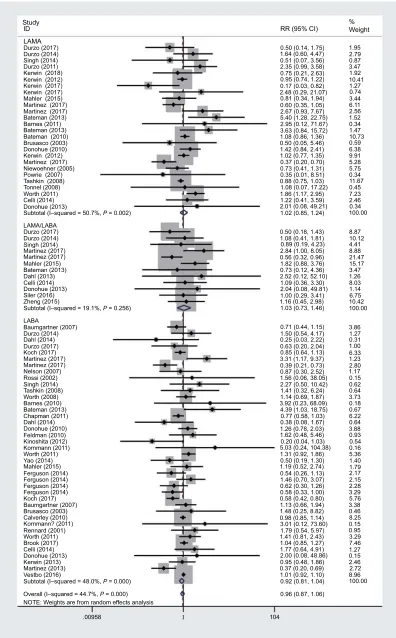
As shown in Figure 1, the use of inhaled LABA/LAMA, LABA or LAMA was not associated with overall
cardio-vascular negative events ([RR 1.03, 95% CI 0.73–1.46; I2
19.1% ;P= 0.256], [RR 0.92, 95% CI 0.81–1.04; I248%;
P= 0.000], [RR 1.02, 95% CI 0.85–1.24; I2 50.7%;
P= 0.002]), respectively. Meanwhile, the use of ILABs
was not associated with overall cardiovascular AEs in the overall population, regardless of the type of inhaled bronch-odilator
(RR 0.96, 95% CI 0.87–1.06; I2 44.7%; P= 0.000).
However, when stratified according to the specific agents
of LABA, it is shown that olodaterol might reduce the risk
of OCAE (RR 0.65, 95% CI 0.49–0.88; I2 27.5%;
P= 0.000), as shown in Table 1. The funnel plot of ILABs
and OCAE is shown in Figure S2. Subjectively, the funnel
plot was not significantly symmetrical. However, the Begg’s
test did not find significant evidence of publication bias
(P=0.534). In the sensitivity analysis, after each individual
study was excluded, the results were only slightly changed. Although 8 additional studies needed to be added by the
trimming and filling analysis, there was no significant
change in the pooled results (HR 0.958, 95% CI 0.912–1.006 ;P= 0.082).
Fatal cardiovascular AEs
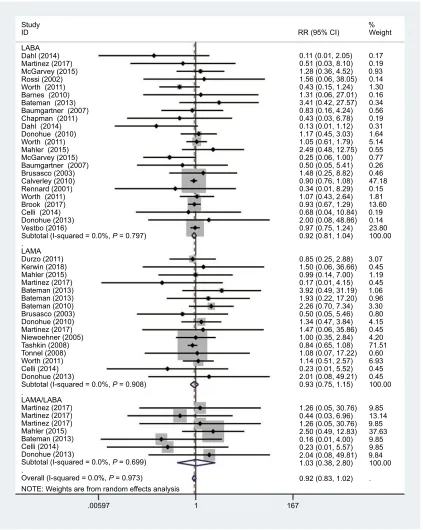
As shown in Figure 2, the use of inhaled LABA/LAMA, LABA or LAMA was not associated with fatal cardiovascular
negative events ([RR 1.03, 95% CI 0.38–2.8; I2 0%;
P= 0.699], [RR 0.93, 95% CI 0.75–1.15 I20%;P= 0.908),
[RR 0.92, 95% CI 0.81–1.04; I20%;P= 0.797]), repsectively.
Meanwhile, the use of ILABs was not associated with fatal cardiovascular AEs in the overall population, regardless of the
type of inhaled bronchodilator (RR 0.92, 95% CI 0.83–1.02; I2
0%;P= 0.973). Not only that, the subgroup analysis showed
that any kind of inhaled agents did not increase the risk of FCAE, as shown in Table 1. The funnel plot of ILABs and FCAE is shown in Figure S3. Subjectively, the funnel plot was
not significantly symmetrical. However, the Begg’s test did
notfind significant evidence of publication bias (P=0.276). In the sensitivity analysis, after each individual study was excluded, the results were only slightly changed. In addition,
International Journal of Chronic Obstructive Pulmonary Disease downloaded from https://www.dovepress.com/ by 118.70.13.36 on 22-Aug-2020
Study ID
LAMA
RR (95% CI)
0.50 (0.14, 1.75)
0.96 (0.87, 1.06) 0.92 (0.81, 1.04) 1.01 (0.92, 1.10)
100.00 8.96 2.72 2.46 0.15 1.27 7.46 3.29 0.95 0.15 8.25 0.46 3.38 5.76 3.29 2.28 2.15 2.17 1.79 1.40 5.36 0.16 0.54 0.93 3.88 0.64 6.22 0.67 0.18 3.73 0.64 0.62 0.15 1.17 2.80 1.23 6.33 1.00 0.31 1.27 3.86 100.00 10.42 6.75 1.14 8.03 1.26 3.47 15.17 21.47 8.88 4.41 10.12 8.87 100.00 0.34 2.46 7.23 0.45 11.67 0.34 5.75 5.28 9.91 6.38 0.59 10.73 1.47 0.34 1.52 2.56 6.11 3.44 0.74 1.27 10.41 1.92 3.47 0.87 2.79 1.95 1.64 (0.60, 4.47)
0.51 (0.07, 3.56) 2.35 (0.99, 3.58) 0.75 (0.21, 2.63) 0.95 (0.74, 1.22)
2.48 (0.29, 21.07) 0.81 (0.34, 1.94) 0.60 (0.35, 1.05) 2.67 (0.93, 7.67) 5.40 (1.28, 22.75) 2.95 (0.12, 71.67) 3.63 (0.84, 15.72) 1.08 (0.86, 1.36) 0.50 (0.05, 5.46) 1.42 (0.84, 2.41) 1.02 (0.77, 1.35) 0.37 (0.20, 0.70) 0.73 (0.41, 1.31) 0.35 (0.01, 8.51) 0.88 (0.75, 1.03) 1.08 (0.07, 17.22) 1.86 (1.17, 2.95) 1.22 (0.41, 3.59)
1.02 (0.85, 1.24)
0.50 (0.18, 1.43) 1.08 (0.41, 1.81) 0.89 (0.19, 4.23) 2.84 (1.00, 8.05) 0.56 (0.32, 0.96) 1.82 (0.88, 3.76) 0.73 (0.12, 4.36) 2.52 (0.12, 52.10) 1.09 (0.36, 3.30) 2.04 (0.08, 49.81) 1.00 (0.29, 3.41) 1.16 (0.45, 2.98) 1.03 (0.73, 1.46)
0.71 (0.44, 1.15) 1.50 (0.54, 4.17) 0.25 (0.03, 2.22) 0.63 (0.20, 2.04) 0.85 (0.64, 1.13) 3.31 (1.17, 9.37) 0.39 (0.21, 0.73) 0.87 (0.30, 2.52) 1.56 (0.06, 38.05) 2.27 (0.50, 10.42) 1.41 (0.32, 6.24) 1.14 (0.69, 1.87) 3.92 (0.23, 68.09) 4.39 (1.03, 18.75) 0.77 (0.58, 1.03) 0.38 (0.08, 1.67) 1.26 (0.78, 2.03) 1.62 (0.48, 5.46) 0.20 (0.04, 1.03) 2.01 (0.08, 49.21) 0.17 (0.03, 0.82)
0.37 (0.20, 0.69) 0.95 (0.48, 1.86) 2.00 (0.08, 48.86) 1.77 (0.64, 4.91) 1.04 (0.85, 1.27) 1.41 (0.81, 2.43) 1.79 (0.54, 5.97) 3.01 (0.12, 73.60) 0.98 (0.85, 1.14) 1.48 (0.25, 8.82) 1.13 (0.66, 1.94) 0.58 (0.42, 0.80) 0.58 (0.33, 1.00) 0.62 (0.30, 1.26) 1.46 (0.70, 3.07) 0.54 (0.26, 1.13) 1.19 (0.52, 2.74) 0.50 (0.19, 1.30) 1.31 (0.92, 1.86) 5.03 (0.24, 104.38)
% Weight Durzo (2017) Durzo (2014) Singh (2014) Durzo (2011) Kerwin (2018) Kerwin (2012) Kerwin (2017) Kerwin (2017) Mahler (2015) Martinez (2017) Martinez (2017) Bateman (2013)
Bateman (2013) Bateman (2010) Barnes (2011)
Brusasco (2003) Donohue (2010) Kerwin (2012) Martinez (2017) Niewoehner (2005) Powrie (2007) Tashkin (2008) Tonnel (2008) Worth (2011) Celli (2014) Donohue (2013)
Subtotal (I–squared = 50.7%, P = 0.002)
Subtotal (I–squared = 19.1%, P = 0.256)
Subtotal (I–squared = 48.0%, P = 0.000) Vestbo (2016) Martinez (2013) Kerwin (2013) Donohue (2013) Celli (2014) Brook (2017) Worth (2011) Rennard (2001) Kornmann? (2011) Calverley (2010) Brusasco (2003) Baumgartner (2007) Koch (2017) Ferguson (2014) Ferguson (2014) Ferguson (2014) Ferguson (2014) Mahler (2015) Yao (2014) Worth (2011) Kornmann (2011) Kinoshita (2012) Feldman (2010) Donohue (2010) Dahl (2014) Chapman (2011) Bateman (2013) Barnes (2010)
Overall (I–squared = 44.7%, P = 0.000) LAMA/LABA Durzo (2017) Durzo (2014) Singh (2014) Martinez (2017) Martinez (2017) Mahler (2015) Bateman (2013) Dahl (2013) Celli (2014) Donohue (2013) Siler (2016) Zheng (2015) LABA Baumgartner (2007) Durzo (2014) Durzo (2017) Dahl (2014) Koch (2017) Martinez (2017) Martinez (2017) Nelson (2007) Rossi (2002) Singh (2014) Tashkin (2008) Worth (2008)
NOTE: Weights are from random effects analysis
.00958 104
Figure 1The RRs of ILABs for the risk of OCAE in stable COPD.
Abbreviations:RR, relative risk; ILAB, inhaled long-acting bronchodilator; OCAE, overall cardiovascular adverse event; COPD, chronic obstructive pulmonary disease.
Dovepress
International Journal of Chronic Obstructive Pulmonary Disease downloaded from https://www.dovepress.com/ by 118.70.13.36 on 22-Aug-2020
T able 1 Subgr oup of speci fi c car diovascular outcome T ype of ILAB OCAE HR (95 % CI), P SCAE HR (95 % CI), P Arrh ythmia HR (95 % CI), P Hypert ension HR (95 % CI), P MI HR (95 % CI), P Card iac Fa ilur e HR (95 % CI), P Str ok e HR (95 % CI), P Car diac ische-mia HR (95 % CI), P Aclidinium 0.89 (0.38 – 2.08), 0.278 -0.87 (0.44 – 1.71), 0.408 -Acldinium/ formoter ol 0.7 8(0.41 – 1.48), 0.000 -0.78 (0.41 – 1.48), 0.566 -F ormoter ol 0.91 (0.67 – 1.25), 0.056 0.62 (0.30 – 1.29), 0.475 0.85 (0.60 – 1.19), 0.319 0.76 (0.50 – 1.14), 0.408 0.67 (0.22 – 1.99), 0.221 1.63 (0.50 – 5.33), 0.103 0.74 (0.12 – 4.72), 0.236 0.53 (0.32 – 0.91), 0.676 Glycop yrr olate 0.98 (0.63 – 1.53), 0.024 0.80 (0.31 – 2.06), 0.775 1.34 (0.46 – 3.98), 0.012. 0.68 (0.43 – 1.07), 0.391 0.49 (0.09 – 2.68), 0.432 0.96 (0.37 – 2.45), 0.555 1.99 (0.50 – 7.92), 0.997 0.56 (0.28 – 1.10), 0.685 Glycop yrr olate/ formoter ol 1.19 (0.23 – 6.06), 0.005 0.82 (0.14 – 4.75), 0.845 -1.37 (0.54 – 3.48), 0.314 --Indacater ol 1.03 (0.72 – 1.47), 0.022 1.07 (0.71 – 1.60), 0.487 0.94 (0.62 – 1.43), 0.331 0.61 (0.29 – 1.28), 0.178 1.02 (0.60 – 1.72), 0.532 2.06 (0.87 – 4.88), 0.828 0.68(0.32 – 1.49), 0.630 -Indacater ol/ glycop yrr olate 1.63 (0.85 – 3.15), 0.626 -Olodater ol 0.65 (0.49 – 0.88), 0.238 -1.22 (0.38 – 3.85), 0.096 0.66 (0.43 – 1.03), 0.309 -Salmeter ol 1.03 (0.89 – 1.18), 0.671 0.91 (0.76 – 1.08), 0.906 1.41 (0.71 – 2.79), 0.551 -1.68 (0.65 – 4.37), 0.576 Tiotr opium 1.01 (0.80 – 1.28), 0.006 0.92 (0.74 – 1.15), 0.825 0.73 (0.44 – 1.22), 0.194 0.83 (0.39 – 1.75), 0.194 0.81 (0.62 – 1.05), 0.378 0.90 (0.60 – 1.35), 0.897 1.04 (0.78 – 1.39), 0.905 1.13 (0.16 – 7.93), 0.011 Umeclidinium 1.28 (0.46 – 3.57), 0.000 0.67 (0.07 – 6.46), 43 -Vilanter ol 0.94 (0.74 – 1.19), 0.047 0.95 (0.78 – 1.16), 0.961 -0.77 (0.06 – 9.88), 0.095 -Umeclidinium/ vilanter ol 1.12 (0.61 – 2.06) 0.68 (0.07 – 6.53) -Abbre viations: ILAB, inhaled long-acting br onchodilator ; OC AE, ov erall car diovascular adv erse e vent; SC AE, se ver e fatal car diovascular adv erse e vent; MI,m yoc ar dial infar ction.
International Journal of Chronic Obstructive Pulmonary Disease downloaded from https://www.dovepress.com/ by 118.70.13.36 on 22-Aug-2020
no additional studies needed to be added by the trimming and
filling analysis.
Arrhythmia
As shown in Figure S4, the use of inhaled LABA/LAMA, LABA or LAMA does not increase the risk of arrhythmia ([RR
0.93, 95% CI 0.34–2.51; I253.5%;P= 0.092], [RR 0.94, 95%
CI 0.79–1.12 I2 14.9%; P= 0.251], [RR 0.84, 95% CI
0.57–1.24; I2 40.6%; P= 0.063]), respectively. Meanwhile,
the use of ILABs was not associated with arrhythmia in the overall population, regardless of the type of inhaled
broncho-dilator (RR 0.89, 95% CI 0.75–1.06; I227.2%;P= 0.056). And
Study
RR (95% CI)
% Weight ID
LABA
0.11 (0.01, 2.05) 0.17 0.19 0.93 0.14 1.30 0.16 0.34 0.56 0.19 0.31 1.64 5.14 0.55 0.77 0.26 0.46 47.18 0.15 1.81 13.60 0.19 0.14 23.80 100.00
3.07 0.45 1.19 0.45 1.06 0.96 3.30 0.80 4.15 0.45 4.20 71.51 0.60 6.93 0.45 0.45 100.00
9.85 13.14 9.85 37.63 9.85 9.85 9.84 100.00
. 0.51 (0.03, 8.10) 1.28 (0.36, 4.52) 1.56 (0.06, 38.05) 0.43 (0.15, 1.24) 1.31 (0.06, 27.01) 3.41 (0.42, 27.57) 0.83 (0.16, 4.24) 0.43 (0.03, 6.78) 0.13 (0.01, 1.12) 1.17 (0.45, 3.03) 1.05 (0.61, 1.79) 2.49 (0.48, 12.75) 0.25 (0.06, 1.00) 0.50 (0.05, 5.41) 1.48 (0.25, 8.82) 0.90 (0.76, 1.08) 0.34 (0.01, 8.29) 1.07 (0.43, 2.64) 0.93 (0.67, 1.29) 0.68 (0.04, 10.84) 2.00 (0.08, 48.86) 0.97 (0.75, 1.24) 0.92 (0.81, 1.04)
0.85 (0.25, 2.88) 1.50 (0.06, 36.66) 0.99 (0.14, 7.00) 0.17 (0.01, 4.15) 3.92 (0.49, 31.19) 1.93 (0.22, 17.20) 2.26 (0.70, 7.34) 0.50 (0.05, 5.46) 1.34 (0.47, 3.84) 1.47 (0.06, 35.86) 1.00 (0.35, 2.84) 0.84 (0.65, 1.08) 1.08 (0.07, 17.22) 1.14 (0.51, 2.57) 0.23 (0.01, 5.52) 2.01 (0.08, 49.21) 0.93 (0.75, 1.15)
1.26 (0.05, 30.76) 0.44 (0.03, 6.96) 1.26 (0.05, 30.76) 2.50 (0.49, 12.83) 0.16 (0.01, 4.00) 0.23 (0.01, 5.57) 2.04 (0.08, 49.81) 1.03 (0.38, 2.80)
0.92 (0.83, 1.02) Dahl (2014)
Martinez (2017) McGarvey (2015)
McGarvey (2015) Rossi (2002) Worth (2011) Barnes (2010) Bateman (2013)
Brusasco (2003) Calverley (2010) Rennard (2001) Baumgartner (2007)
Baumgartner (2007) Chapman (2011) Dahl (2014) Donohue (2010) Worth (2011)
Worth (2011) Brook (2017) Celli (2014) Donohue (2013) Vestbo (2016)
.
.
. LAMA
LAMA/LABA Durzo (2011) Kerwin (2018) Mahler (2015)
Mahler (2015) Martinez (2017) Bateman (2013) Bateman (2013)
Bateman (2013) Bateman (2010) Brusasco (2003) Donohue (2010) Martinez (2017)
Martinez (2017) Martinez (2017) Martinez (2017) Niewoehner (2005) Tashkin (2008) Tonnel (2008) Worth (2011) Celli (2014)
Celli (2014) Donohue (2013)
Donohue (2013)
Subtotal (I-squared = 0.0%, P = 0.797)
Subtotal (I-squared = 0.0%, P = 0.908)
Subtotal (I-squared = 0.0%, P = 0.699)
Overall (I-squared = 0.0%, P = 0.973)
NOTE: Weights are from random effects analysis
.00597 1 167
Mahler (2015)
Figure 2The RRs of ILABs for the risk of FCAE in stable COPD.
Abbreviations:RR, relative risk; ILAB, inhaled long-acting bronchodilator; FCAE, fatal cardiovascular adverse event; COPD, chronic obstructive pulmonary disease.
Dovepress
International Journal of Chronic Obstructive Pulmonary Disease downloaded from https://www.dovepress.com/ by 118.70.13.36 on 22-Aug-2020
also, the subgroup analysis showed that any kind of inhaled agents did not increase the risk of arrhythmia, as shown in Table 1.
Hypertension
As shown in Figure S5, the use of inhaled LABA/LAMA or LAMA does not increase the risk of hypertension [RR
0.66, 95% CI 0.40–1.08; I2 38%; P= 0.127], [RR
0.75,95% CI 0.54–1.04; I2 14.5%; P= 0.299]),
respec-tively. However, the use of inhaled LABA might reduce
the risk of hypertension (RR 0.73, 95% CI 0.55–0.98; I2
19.9%; P= 0.221). Similarly, the use of ILABs presented
a trend of lowering blood pressure in the overall popula-tion, regardless of the type of inhaled bronchodilator (RR
0.72, 95% CI 0.59–0.88; I2 18.7%; P= 0.159).
Nevertheless, the subgroup analysis showed that any kind of inhaled agents would not increase the risk of hyperten-sion, as shown in Table 1.
Myocardial infarction
As shown in Figure S6, the use of inhaled LABA or LAMA does not increase the risk of myocardial infarction
([RR 1.01, 95% CI 0.75–1.35; I20%;P= 0.628], [RR 0.80,
95% CI 0.62–1.04; I20%;P= 0.762]), respectively. Due to
the limited number of studies, no LABA/LAMA-related studies were included. However, the subgroup analysis showed that any kind of inhaled agents did not increase the risk of myocardial infarction, as shown in Table 1.
Cardiac failure
As shown in Figure S7, the use of inhaled LABA/LAMA or LAMA does not increase the risk of cardiac failure
([RR 1.48, 95% CI 0.62–3.55; I2 0% ;P= 0.498], [RR
0.91,95% CI 0.63–1.32; I2 0%; P= 0.967]), respectively.
Besides, the use of ILABs was not associated with cardiac failure in the overall population, regardless of the type of
inhaled bronchodilator (RR 1.17,95% CI 0.88–1.55;
I2 0%; P= 0.767). However, when analyzed according to
stratification of bronchodilator type, the use of inhaled
LABA might increase the risk of cardiac failure (RR
1.71,95% CI 1.04–2.84; I2 0%; P= 0.538). Surprisingly,
this risk disappeared when stratified according to the
spe-cific agents of LABA, as shown in Table 1.
Stroke
As shown in Figure S8, the use of inhaled LABA or LAMA does not increase the risk of stroke ([RR 0.79,
95% CI 0.53–1.18; I20%; P= 0.544], [RR 1.07, 95% CI
0.80–1.42; I20%;P= 0.991]), respectively. Meanwhile, the
subgroup analysis showed that any kind of inhaled agents would not increase the risk of stroke, as shown in Table 1. Due to the limited number of studies, no LABA/LAMA-related studies were included.
Cardiac ischemia
As shown in Figure S9, the use of inhaled LABA or LAMA does not increase the risk of cardiac ischemia ([RR 0.9,
95% CI 0.55–1.46; I265.1%;P= 0.001], [RR 0.73, 95% CI
0.33–1.59; I254.6%; P= 0.040]), respectively. However,
when analyzed according to stratification of bronchodilator
type, the use of inhaled formoterol might decrease the risk
of cardiac ischemia (RR 0.53, 95% CI 0.32–0.91; I20%;
P= 0.676), as shown in Table 1. Due to the limited number
of studies, no LABA/LAMA-related studies were included.
Discussion
The results of this meta-analysis suggested that the use of ILABs would not increase the risk of overall
cardiovascu-lar AEs in the overall population. Moreover, no significant
relationship was found between ILABs and other specific
cardiovascular AEs. However, when considering stratified
analysis based on bronchodilator type, inhaled LABA might reduce the risk of hypertension, but increase the risk of heart failure.
COPD patients are mostly elderly and often have multiple cardiovascular risks. Therefore, a reasonable evaluation of different types of bronchodilators is parti-cularly important for cardiovascular safety. As we all know, LABAs and LAMAs were one of the mainstays of COPD treatment, whether alone or in combination. The use of long-duration bronchodilators improved lung mechanics and cardiovascular function by reducing the required fall in pleural pressure during inspiration and cardiac afterload in COPD patients. However, these drugs not only bound to the lung receptor, but also bound to cardiac receptors. Therefore, these drugs
might bring cardiovascular benefits accompanied by
potential cardiovascular side effects. Studies conducted
by Calzetta et al56 indicated that there was a synergistic
effect between LABA and LAMA in the dual broncho-dilation therapy, which would reduce the dose of each single component, thus reducing the risk of negative events. On the other hand, the use of one type of ILABs alone might be more likely to result in cardio-vascular AEs.
International Journal of Chronic Obstructive Pulmonary Disease downloaded from https://www.dovepress.com/ by 118.70.13.36 on 22-Aug-2020
Studies by Matera et al57 have shown that the use of
LABA might activate stimulatingβ2-adrenoceptor (β2-AR)
in the atria and ventricles, which induces an increase in heart rate, palpitations, and tachyarrhythmias. In addition,
acti-vatedβ2-AR might also induce vasodilation and reflex
tachy-cardia, which might be one of the underlying mechanisms to explain the relationship between inhaled LABA and risk of hypertension and heart failure. Meanwhile, the study of
Andreas et al7study showed that the use of LABA would
reduce blood pressure, which might be related to the diastolic
effect ofβ2-AR on blood vessels. Recently, guidelines for
heart failure58have shown that the safety of long-term use of
cardioactive inhaled pulmonary drugs is uncertain, and patients with heart failure should reconsider the necessity of using these drugs.
Although several previous meta-analyses59–61have
evalu-ated the relationship between bronchodilators and cardiovas-cular AEs, the present meta-analysis still has the following
strengths. First, this is the first meta-analysis based on
a specific cardiovascular outcome classification. Second, all
included studies were high-quality randomized controlled trials, and subgroup analyses were conducted according to the types of long-acting bronchodilators. Third, the results of most studies are highly homogeneous. After sensitivity analy-sis, publication bias analysis and trimming andfilling analysis, only slight changes occurred in the pooled results, which
ensured the stability of the study results. Fourth, ourfindings
enrich and validate previous conclusions.
Meanwhile, this meta-analysis inevitably has the following limitations. First, all included study populations were long-term use of long-acting bronchodilators in patients with stable COPD, so the effects of exacerbation of COPD, short-acting bronchodilators, or short-term treatment on cardiovascular out-comes remain unknown. Second, part of the included studies recorded incomplete cardiovascular negative events, which might result in a degree of subjective bias. Third, only the funnel plots of ILABs and OCAE, FCAE were drawn to assess publication bias. In addition, there was a high heterogeneity between some studies, and subgroup analysis cloud not been
conducted tofind potential sources of heterogeneity due to the
limited number of studies. Fourth, the dropout rates in most studies were inevitable, and from the perspective of medical ethics, although the dropout rates in most studies might be
significant, it was acceptable. Fifth, in 42 of these included
studies, the average age of the study population was over 60 years old,and the severity of COPD was moderate to severe. Generally, cardiovascular disease was the most common com-plication in elderly patients with COPD and the patients in
these 43 included studies did not exclude underlying cardio-vascular disease. Therefore,part of the patients included might have a history of cardiovascular disease.
Overall, the use of ILABs was not associated with overall cardiovascular AEs in patients with stable COPD, regardless
of the type of inhaled bronchodilator, instead, when stratified
according to the specific agents of LABA, olodaterol might
reduce the risk of OCAE. and formoterol might decrease the risk of cardiac ischemia. Although the use of inhaled LABA can reduce the incidence of hypertension, but may increase the risk of heart failure. Therefore, COPD patients with a history of heart failure should use it with caution.
Acknowledgments
This study was supported by Health Commission of Qinghai Province, Medicine Science and Technology Project(No.2017-wjzd-11). Thanks are due to Jianting Li (MD, Department of Burn and Plastic Surgery,
Affiliated Hospital of Qinghai University, Xining,
China) for assistance with constructive comments and suggestions in the process of submitting and modifying manuscripts. Besides, thanks to reviewers and editors for correcting the shortcomings of this article.
Author contributions
Chenxi Li, Wenke Cheng and Wei Guan conceived and designed the experiments. Chenxi Li, Wenke Cheng and Jin Guo were responsible for acquisition of data. Chenxi Li analyzed the data and wrote the paper. All authors contributed to data analysis, drafting or revising the article,
gave final approval of the version to be published and
agree to be accountable for all aspects of the work.
Disclosure
The authors report no conflicts of interest in this work.
References
1. Vogelmeier CF, Criner GJ, Martinez FJ, et al. Global strategy for the diagnosis, management and prevention of chronic obstructive lung disease 2017 report[J]. Am J Respir Crit Care Med. 2017;195 (5):557. doi:10.1111/resp.13012
2. Centers for Disease Control and Prevention (CDC). Chronic obstruc-tive pulmonary disease among adults United States, 2011. MMWR Morb Mortal Wkly Rep. 2012;61:938–43.
3. Divo M, Cote C, de Torres JP, et al. Comorbidities and risk of mortality in patients with chronic obstructive pulmonary disease.Am J Respir Crit Care Med. 2012;186(2):155–161. doi:10.1164/ rccm.201201-0034OC
4. GOLD. 2017. Global strategy for the diagnosis, management and prevention of COPD. [cited February 10, 2018]. Available from: http://goldcopd.org/download/326/
Dovepress
International Journal of Chronic Obstructive Pulmonary Disease downloaded from https://www.dovepress.com/ by 118.70.13.36 on 22-Aug-2020
5. Qaseem A, Wilt TJ, Weinberger SE, et al. Diagnosis and management of stable chronic obstructive pulmonary disease: a clinical practice guideline update from the American College of Physicians, American College of Chest Physicians, American Thoracic Society, and European Respiratory Society. Ann Intern Med. 2011;155 (3):179–191. doi:10.7326/0003-4819-155-3-201108020-00008 6. Rogliani P, Calzetta L, Coppola A, et al. Optimizing drug delivery in
COPD: the role of inhaler devices. Respir Med. 2017;124:6–14. doi:10.1016/j.rmed.2017.01.006
7. Andreas S, Bothner U, Trampisch M, Haensel M, Buhl R, Alter P. Effect of long-actingβ2-agonists olodaterol and formoterol on heart rate and blood pressure in chronic obstructive pulmonary disease patients. Pulm Pharmacol Ther. 2018;52:1–6. doi:10.1016/j. pupt.2018.08.002
8. D’Urzo AD, Kerwin EM, Chapman KR, et al. Safety of inhaled glycopyrronium in patients with COPD: A comprehensive analysis of clinical studies and post-marketing data.Int J COPD. 2015;10 (1):1599–1612. doi:10.2147/COPD.S81266
9. Donohue JF, Singh D, Kornmann O, Lawrence D, Lassen C, Kramer B. Safety of indacaterol in the treatment of patients with COPD. Int J Chron Obstruct Pulmon Dis. 2011;6:477–492. doi:10.2147/COPD.S23816
10. Singh S, Loke YK, Furberg CD. Inhaled anticholinergics and risk of major adverse cardiovascular events in patients with chronic obstructive pulmonary disease: a systematic review and meta-analysis. JAMA. 2008;300(12):1439–1450. doi:10.1001/ jama.300.12.1439
11. Oremus M, Wolfson C, Perrault A, Demers L, Momoli F, Moride Y. Interrater reliability of the modified Jadad quality scale for systematic reviews of Alzheimer’s disease drug trials. Dement Geriatr Cogn Disord. 2001;12:232–236. doi:10.1159/000051263
12. Higgins JP, Thompson SG, Deeks JJ, Altman DG. Measuring incon-sistency in meta-analyses. BMJ. 2003;327:557–560. doi:10.1136/ bmj.327.7420.895
13. Begg CB, Mazumdar M. Operating characteristics of a rank correla-tion test for publicacorrela-tion bias. Biometrics. 1994;50:1088–1101. doi:10.2307/2533446
14. Martinez FJ, Rabe KF, Ferguson GT, et al. Efficacy and safety of glycopyrrolate/formoterol metered dose inhaler formulated using co-suspension delivery technology in patients with COPD.Chest. 2017;151(2):340–357. doi:10.1016/j.chest.2016.11.028
15. Dahl R, Chapman KR, Rudolf M, et al. Safety and efficacy of dual bronchodilation with QVA149 in COPD patients: the ENLIGHTEN study. Respir Med. 2013;107:1558–1567. doi:10.1016/j. rmed.2013.05.016
16. Donohue JF, Maleki-Yazdi MR, Kilbride S, et al. Efficacy and safety of once-daily umeclidinium/vilanterol 62. 5/25mcg in COPD.Respir Med. 2013;107(10):1538–1546. doi:10.1016/j.rmed.2013.06.001 17. Barnes PJ, Pocock SJ, Magnussen H, et al. Integrating indacaterol
dose selection in a clinical study in COPD using an adaptive seamless design. Pulm Pharmacol Ther. 2010;23(3):165–171. doi:10.1016/j. pupt.2010.01.003
18. Kerwin EM, Tosiello R, Price B, Sanjar S, Goodin T. Effect of background long-acting beta2-agonist therapy on the efficacy and safety of a novel, nebulized glycopyrrolate in subjects with moderate-to-very-severe COPD.Int J Chron Obstruct Pulmon Dis. 2018;13:2917–2929. doi:10.2147/COPD.S172408
19. D’Urzo A, Ferguson GT, van Noord JA, et al. Efficacy and safety of once-daily NVA237 in patients with moderate-to-severe COPD: the GLOW1 trial.Respir Res. 2011;12(1):156. doi:10.1186/1465-9921-12-122
20. Singh D, Jones PW, Bateman ED, et al. Efficacy and safety of aclidinium bromide/formoterol fumarate fixed-dose combinations compared with individual components and placebo in patients with COPD (ACLIFORM-COPD): a multicentre, randomised study.BMC Pulm Med. 2014;14(1):178. doi:10.1186/1471-2466-14-178
21. Rossi A, Kristufek P, Levine BE, et al. Comparison of the efficacy, tolerability, and safety of formoterol dry powder and oral, slow-release theophylline in the treatment of COPD. Chest. 2002;121(4):1058–1069. doi:10.1378/chest.121.4.1058
22. Bateman ED, Tashkin D, Siafakas N, et al. A one-year trial of tiotropium Respimat® plus usual therapy in COPD patients.Respir Med. 2010;104(10):1460–1472. doi:10.1016/j.rmed.2010.06.004 23. Bateman ED, Ferguson GT, Barnes N, et al. Dual bronchodilation
with QVA149 versus single bronchodilator therapy: the SHINE study.
Eur Respir J. 2013;42(6):1484–1494. doi:10.1183/09031936. 00200212
24. Baumgartner RA, Hanania NA, Calhoun WJ, et al. Nebulized arfor-moterol in patients with COPD: a 12-week, multicenter, randomized, double-blind, double-dummy, placebo-and active-controlled trial.
Clin Ther. 2007;29(2):261–278. doi:10.1016/j.clinthera.2007.02.009 25. Brook RD, Anderson JA, Calverley PMA, et al. Cardiovascular
out-comes with an inhaled beta2-agonist/corticosteroid in patients with COPD at high cardiovascular risk. Heart. 2017. heartjnl-2016-310897. doi:10.1136/heartjnl-2016-310897
26. Brusasco V, Hodder R, Miravitlles M, et al. Health outcomes follow-ing treatment for 6 months with once daily tiotropium compared with twice daily salmeterol in patients with COPD. Thorax. 2006;58 (5):399–404. doi:10.1136/thx.58.5.399
27. Calverley PMA, Anderson JA, Celli B, et al. Cardiovascular events in patients with COPD: TORCH study results. Thorax. 2010;65 (8):719–725. doi:10.1136/thx.2010.136077
28. Celli B, Crater G, Kilbride S, et al. Once-daily umeclidinium/vilan-terol 125/25μg therapy in COPD: a randomized, controlled study.
Chest. 2014;145(5):981–991. doi:10.1378/chest.13-1579
29. Chapman KR, Rennard SI, Dogra A, et al. Long-term safety and efficacy of indacaterol, a long-acting β2-agonist, in subjects with COPD: a randomized, placebo-controlled study. Chest. 2011;140 (1):68–75. doi:10.1378/chest.10-1830
30. Tonnel AB, Perez T, Grosbois JM, et al. Effect of tiotropium on health-related quality of life as a primary efficacy endpoint in COPD.
Int J Chron Obstruct Pulmon Dis. 2008;3(2):301. doi:10.2147/ COPD.S2463
31. Zheng J, Zhong N, Newlands A, et al. Efficacy and safety of once-daily inhaled umeclidinium/vilanterol in Asian patients with COPD: results from a randomized, placebo-controlled study.
Int J Chron Obstruct Pulmon Dis. 1753;2015;10:1753–1767. doi:10.2147/COPD.S81053
32. Siler TM, Donald AC, O’Dell D, et al. A randomized, parallel-group study to evaluate the efficacy of umeclidinium/vilanterol 62. 5/25μg on health-related quality of life in patients with COPD.Int J Chron Obstruct Pulmon Dis. 2016;11:971. doi:10.2147/COPD.S102962 33. Dahl R, Chung KF, Buhl R, et al. Efficacy of a new once-daily
long-acting inhaled beta2-agonist indacaterol versus twice-daily for-moterol in COPD. Thorax. 2010;65(6):473–479. doi:10.1136/ thx.2009.125435
34. Donohue JF, Fogarty C, LöTvall J, et al. Once-daily bronchodilators for chronic obstructive pulmonary disease: indacaterol versus tiotropium. Am J Respir Crit Care Med. 2010;182(2):155–162. doi:10.1164/rccm.200910-1500OC
35. Feldman G, Siler T, Prasad N, et al. Efficacy and safety of indacaterol 150μg once-daily in COPD: a double-blind, randomised, 12-week study.BMC Pulm Med. 2010;10(1):11. doi:10.1186/1471-2466-10-11 36. Ferguson GT, Feldman GJ, Hofbauer P, et al. Efficacy and safety of olodaterol once daily delivered via Respimat® in patients with GOLD 2–4 COPD: results from two replicate 48-week studies. Int J Chron Obstruct Pulmon Dis. 2014;9:629–645. doi:10.2147/COPD.S61717 37. Kerwin EM, Gotfried MH, Lawrence D, et al. Efficacy and
toler-ability of indacaterol 75μg once daily in patients aged≥40 years with chronic obstructive pulmonary disease: results from 2 double-blind, placebo-controlled 12-week studies. Clin Ther. 2011;33 (12):1974–1984. doi:10.1016/j.clinthera.2011.11.009
International Journal of Chronic Obstructive Pulmonary Disease downloaded from https://www.dovepress.com/ by 118.70.13.36 on 22-Aug-2020
38. Kerwin E, Hébert J, Gallagher N, et al. Efficacy and safety of NVA237 versus placebo and tiotropium in patients with moderate-to-severe COPD over 52 weeks: the GLOW2 study. Eur Respir J. 2012;40:1106–1114. doi:10.1183/09031936.00040712
39. Kerwin EM, Scott-Wilson C, Sanford L, et al. A randomised trial of
fluticasone furoate/vilanterol (50/25μg; 100/25μg) on lung function in COPD. Respir Med. 2013;107(4):560–569. doi:10.1016/j. rmed.2012.12.014
40. Kerwin E, Donohue JF, Goodin T, et al. Efficacy and safety of glycopyrrolate/eFlow® CS (nebulized glycopyrrolate) in moderate-to-very-severe COPD: results from the Glycopyrrolate for Obstructive Lung Disease via Electronic Nebulizer (GOLDEN) 3 and 4 randomized controlled trials.Respir Med. 2017;132:238–250. doi:10.1016/j.rmed.2017.07.011
41. Kinoshita M, Lee SH, Lwen HANG, et al. Efficacy and safety of indacaterol 150 and 300 µg in chronic obstructive pulmonary disease patients from six Asian areas including Japan: A 12-week, placebo-controlled study. Respirology. 2012;17(2):379–389. doi:10.1111/ j.1440-1843.2011.02107.x
42. Koch A, Watz H, Maleki-Yazdi MR, et al. Comprehensive assess-ment of the safety of olodaterol 5 µg in the Respimat® device for maintenance treatment of COPD: comparison with the long-actingβ 2-agonist formoterol. NPJ Prim Care Respir Med. 2017;27(1):60. doi:10.1038/s41533-017-0059-1
43. Kornmann O, Dahl R, Centanni S, et al. Once-daily indacaterol versus twice-daily salmeterol for COPD: a placebo-controlled comparison. Eur Respir J. 2011;37(2):273–279. doi:10.1183/ 09031936.00045810
44. Martinez FJ, Boscia J, Feldman G, et al. Fluticasone furoate/vilan-terol (100/25; 200/25 μg) improves lung function in COPD: a randomised trial.Respir Med. 2013;107(4):550–559. doi:10.1016/ j.rmed.2012.12.016
45. McGarvey L, Niewoehner D, Magder S, et al. One-year safety of olodaterol once daily via Respimat® in patients with GOLD 2–4 chronic obstructive pulmonary disease: results of a pre-specified pooled analysis. COPD. 2015;12(5):484–493. doi:10.3109/ 15412555.2014.991864
46. Nelson HS, Gross NJ, Levine B, et al. Cardiac safety profile of nebulized formoterol in adults with COPD: a 12-week, multicenter, randomized, double-blind, double-dummy, placebo-and active-controlled trial. Clin Ther. 2007;29(10):2167–2178. doi:10.1016/j.clinthera.2007.10.007
47. Niewoehner DE, Rice K, Cote C, et al. Prevention of exacerbations of chronic obstructive pulmonary disease with tiotropium, a once-daily inhaled anticholinergic bronchodilator: a randomized trial. Ann Internal Med. 2005;43(5):317–326. doi:10.7326/0003-4819-144-2-200601170-00021
48. Mahler DA, Kerwin E, Ayers T, et al. FLIGHT1 and FLIGHT2: efficacy and safety of QVA149 (indacaterol/glycopyrrolate) versus its monocomponents and placebo in patients with chronic obstructive pulmonary disease. Am J Respir Crit Care Med. 2015;192 (9):1068–1079. doi:10.1164/rccm.201505-1048OC
49. Rennard SI, Anderson W, ZuWALLACK R, et al. Use of a long-acting inhaledβ2-adrenergic agonist, salmeterol xinafoate, in patients with chronic obstructive pulmonary disease.Am J Respir Crit Care Med. 2001;163(5):1087–1092. doi:10.1164/ajrccm.163.5.9903053 50. D’Urzo DA, Rennard SI, Kerwin EM, et al. Efficacy and safety of
fixed-dose combinations of aclidinium bromide/formoterol fumarate: the 24-week, randomized, Placebo-Controlled AUGMENT COPD Study.Respir Res. 2014;15(1):123. doi:10.1186/s12931-014-0123-0 51. Tashkin DP, Rennard SI, Martin P, et al. Efficacy and safety of
budesonide and formoterol in one pressurized metered-dose inhaler in patients with moderate to very severe chronic obstructive pulmon-ary disease.Drugs. 2008;68(14):1975–2000. doi:10.2165/00003495-200868140-00004
52. Tashkin DP, Celli B, Senn S, et al. A 4-year trial of tiotropium in chronic obstructive pulmonary disease. N Engl J Med. 2008;359 (15):43–1554. doi:10.1056/NEJMoa0805800
53. Vestbo J, Anderson JA, Brook RD, et al. Fluticasone furoate and vilanterol and survival in chronic obstructive pulmonary disease with heightened cardiovascular risk (SUMMIT): a double-blind rando-mised controlled trial. The Lancet. 2016;387(10030):1817–1826. doi:10.1016/S0140-6736(16)30069-1
54. Worth H, Chung KF, Felser JM, et al. Cardio-and cerebrovascular safety of indacaterol vs formoterol, salmeterol, tiotropium and pla-cebo in COPD. Respir Med. 2011;105(4):571–579. doi:10.1016/j. rmed.2010.11.027
55. Yao W, Wang C, Zhong N, et al. Effect of once-daily indacaterol in a predominantly Chinese population with chronic obstructive pul-monary disease: A 26-week A sia-P acific study. Respirology. 2014;19(2):231–238. doi:10.1111/resp.12211
56. Calzetta L, Matera MG, Cazzola M. Pharmacological interaction between LABAsand LAMAs in the airways: optimizing synergy.Eur J Pharmacol. 2015;761:168–173. doi:10.1016/j.ejphar.2015.05.020
57. Matera MG, Rogliani P, Calzetta L, Cazzola M. Safety considerations with dual bronchodilator therapy in COPD: an update. Drug Saf. 2016;39:501–508. doi:10.1007/s40264-016-0402-4
58. Ponikowski P, Voors AA, Anker SD, et al. 2016 ESC Guidelines for the diagnosis and treatment of acute and chronic heart failure: the task force for the diagnosis and treatment of acute and chronic heart failure of the European Society of Cardiology (ESC). Developed with the special contribution of the Heart Failure Association (HFA) of the ESC.Eur J Heart Fail. 2016;18(8):891–975. doi:10.1002/ejhf.592 59. Xia N, Wang H, Nie X. Inhaled long-actingβ2-agonists do not increase
fatal cardiovascular adverse events in COPD: a meta-analysis.PloS One. 2015;10(9):e0137904. doi:10.1371/journal.pone.0137904 60. Rodrigo GJ, Neffen H. A systematic review with meta-analysis of
fluticasone furoate/vilanterol combination for the treatment of stable COPD. Pulm Pharmacol Ther. 2017;42:1–6. doi:10.1016/j. pupt.2016.11.003
61. Salpeter SR, Ormiston TM, Salpeter EE. Cardiovascular effects ofβ -agonists in patients with asthma and COPD: a meta-analysis.Chest. 2004;125(6):2309–2321. doi:10.1378/chest.125.6.2309
International Journal of Chronic Obstructive Pulmonary Disease
Dove
press
Publish your work in this journal
The International Journal of COPD is an international, peer-reviewed journal of therapeutics and pharmacology focusing on concise rapid reporting of clinical studies and reviews in COPD. Special focus is given to the pathophysiological processes underlying the disease, inter-vention programs, patient focused education, and self management
protocols. This journal is indexed on PubMed Central, MedLine and CAS. The manuscript management system is completely online and includes a very quick and fair peer-review system, which is all easy to use. Visit http://www.dovepress.com/testimonials.php to read real quotes from published authors.
Submit your manuscript here:https://www.dovepress.com/international-journal-of-chronic-obstructive-pulmonary-disease-journal
Dovepress
International Journal of Chronic Obstructive Pulmonary Disease downloaded from https://www.dovepress.com/ by 118.70.13.36 on 22-Aug-2020