ISSN (Print) : 2320 – 3765 ISSN (Online): 2278 – 8875
I
nternational
J
ournal of
A
dvanced
R
esearch in
E
lectrical,
E
lectronics and
I
nstrumentation
E
ngineering
(An ISO 3297: 2007 Certified Organization)
Website: www.ijareeie.com Vol. 6, Issue 3, March 2017
Uniform Deployment of Sensor and Density
Based Energy Efficient Cluster Head Protocol
for WSN
Charat Singh
1
, Simranjit Kaur
2
, Sourabh Mahajan
3
M. Tech Scholar, Department of ECE, S.S.C.E.T, Badhani, Pathankot, India1
Assistant Professor, Department of ECE, S.S.C.E.T, Badhani, Pathankot, India 2
Assistant Professor, Department of ECE, S.S.C.E.T, Badhani, Pathankot, India
3
ABSTRACT: We study the effect of heterogeneity of nodes in the zone concept of clustered wireless sensor networks.
The most classic heterogeneous grouping protocols consider the detection field as a whole for group training. Unlike the existing protocols creates the proposed protocol the Square fields, the zones are called and the number of the selected group heads depends on the zone size and number of nodes. The best way to the life of sensor nodes to extend the complexity in the communication costs between the sensor nodes and their group heads to reduce and optimal probability of nodes to calculate to group heads in their respective areas. To view the performance of the zone-based clustered wireless sensor network to improve, we optimize some of the factors of the networks as the number of groups that the nature of the group head is selected and the total energy consumed in the zones. To view the performance of the zone-based hierarchically grouped wireless sensor network to improve, we optimize certain factors of the network such as the number of the groups that are produced, the nature of the group head is selected and the total energy consumed in the zones. We show by simulation results that the evenly distributed energy consumption of nodes in the zones of the total energy decreased in the network will be resolved. Simulation results also cover significant increased and beneficial effect on the new zone-based heterogeneous setting that were not previously possible.
KEYWORDS: Wireless Sensor Networks, inconsistency, optimal probability, Group Heads, Square field, zone-based
grouped hierarchically
I.INTRODUCTION
ISSN (Print) : 2320 – 3765 ISSN (Online): 2278 – 8875
I
nternational
J
ournal of
A
dvanced
R
esearch in
E
lectrical,
E
lectronics and
I
nstrumentation
E
ngineering
(An ISO 3297: 2007 Certified Organization)
Website: www.ijareeie.com Vol. 6, Issue 3, March 2017
The rest of the paper is organized as follows. We repeat briefly the related work in section II with short descriptions of SEECH and UDDEECH; motivations in the direction of the zone-based protocol; section III provides a description of how the optimum number of groups in zones of WSN constructed; see the protocol with exemplary specifications of the network, energy consumption restrictions in the stable period of zones and development. In the simulation of section IV are settings and results of analyzes. We close the paper in section V.
II. RELATED WORK
Sensor nodes process normally unattended in the remote geographical areas. They may be in a chemically or biologically contaminated field at the bottom of the oceans, in the large buildings in a battlefield of enemy lines. Special Wireless routing protocols are essential to the communication between the base station and the tub to handle. For high density hundreds and thousands of sensor nodes in the wireless sensor networks to hand have been grouping techniques are used. There are two broad categories grouped homogeneous and heterogeneous sensor networks namely hierarchical sensor networks. In the homogeneous networks are all nodes in terms of energy and functionality is identical. In the heterogeneous networks, two or several node types in terms of battery power and functionality. In our paper we consider homogeneous and heterogeneous nodes used in the homogeneous and heterogeneous zones respectively. In this section we present the literature review of the various published work.
Low-energy adaptive grouping hierarchy (LEECH) [20] is a group-based protocol that the energy consumption of evenly among the sensor nodes distributed by group heads under probability Rotation chooses. But there is energy drainage on group-member of the additional functionalities later, such as data collection and processing were drawn. The network must be frequently re-grouped if failure occurs on the group members. Far away are the nodes of the tub also against the drainage of the higher energy costs due to the communication vulnerable and they tend to die quickly. As a result, energy is not evenly between the nodes to maintain the energy imbalance creates. Distributed energy-saving gruppi render algorithm (DEEC) selects the group heads on the knowledge of the relationship between the residual energy of the node with the average energy of the entire network [21] are based. Additional energy will be moved to the knowledge between the nodes to share. Stochastic DEEC (SDEEC) was as an extension of the DEEC [22] proposed. Two-level inconsistency is considered and energy is preserved by the node does not sleep-CH Power. The disadvantage of this Protocol is during the sleep state, the members of non-CH do not take into account the network operations.
SEECH is an energy-saving break end hierarchical protocol that uses a hierarchychal group. In SEECH distribution area in three regions as well as all node after the accident in given regions. After that we calculate level node (degrees average distance between each node according to region). If the probability of the provisional group head and the relay header is less than, select a random value on the basis of the degree of the node (Node with larger degrees are more suitable for group head and relay head), as a temporary group head and relay header. If the probability of the provisional group head and the relay header is greater than that calculated random value as the result of all of the nodes (result is as product of the distances of all nodes of your respective group head and from the relay header is defined) and the node that the minimum result, as the actual group head and relay header is selected. SEECH is an energy-saving break end hierarchical protocol that uses a hierarchychal group. In SEECH distribution area in three regions as well as all node after the accident in given regions. After that we calculate level node (degrees average distance between each node according to region). If the probability of the provisional group head and the relay header is less than, select a random value on the basis of the degree of the node (Node with larger degrees are more suitable for group head and relay head), as a temporary group head and relay header. If the probability of the provisional group head and the relay header is greater than that calculated random value as the result of all of the nodes (result is as product of the distances of all nodes of your respective group head and from the relay header is defined) and the node that the minimum result, as the actual group head and relay header is selected.
III. UDDEECH PROTOCOL MODEL
ISSN (Print) : 2320 – 3765 ISSN (Online): 2278 – 8875
I
nternational
J
ournal of
A
dvanced
R
esearch in
E
lectrical,
E
lectronics and
I
nstrumentation
E
ngineering
(An ISO 3297: 2007 Certified Organization)
Website: www.ijareeie.com Vol. 6, Issue 3, March 2017
electronics to run. For the experiments conducted here only the channel model of free space will be used. So a distance d to consume the radio energy:
Fig.1 Radio Energy Dissipation Model
We assume that the base station, BS static and in the middle of the field is found. A protocol is hierarchical grouping together for all of the zones in which the nodes in groups and in local base station self-organize or group heads, CH are selected. To select the appropriate time between the node and the modern node in the respective zones as group heads with a certain probability and transfer their status to other nodes in their respective areas. Each sensor nodes determines your group head, the communication on the minimum energy for CH is based. The group head choice is based on the choice of probabilities randomised loaded in accordance with the residual energy of the node in the group in their respective areas. The group header to create a schedule for communication for the nodes in its group, as soon as all of the groups will be organised. The members of the group of questions the data and resources your CH. In order to reduce the power, not by the group heads scattered, the radio components at any time except during its transmission time off. Once, when all data are available on the CH, collects the data and sends it to the OS. To further reduce power dissipation and power to increase life time, CH local data fusion to reduce the quantity of data, compress the groups are sent to the base station.
IV. PURPOSED ALGORITHM
Phase I - setup phase: network is virtually in 4 zones separately. Each node generates a random probability on the
product to calculate the introduction of order and the threshold value. New node control the energy of all nodes. The node, the maximum energy in the previous round, select as marginal (Relay node) and check the minimum distance from the BS. After that the energy of the new node in the previous round will not be the same torelay node is and minimum distance from BS off, select as ZH (Zone head).
In the steady-state phase: after the completion of the zone selection procedure, each member sends its data and
residual energy to the ZH. The ZH retains residual energy information of all Member nodes and sends them further to marginal.
Phase II – Post setup phase: the Relay node sends BS maximum residual energy value of the node that its our group,
if the last frame of round completes. BS find the maximum residual energy of the network and send this value to all ZH-nodes in the network. Further ZH-node will send the maximum value to all network nodes. Exclusive node defense of the value of the maximum residual energy for the following competition and the current round is completed.
Algorithm: Energy Of The Node, Distance From Base Station , Distance From Each Node ,Dead Node , Alive Node ,
Number Of Nodes , Round From Simulation .
1. Deploy nodes
ISSN (Print) : 2320 – 3765 ISSN (Online): 2278 – 8875
I
nternational
J
ournal of
A
dvanced
R
esearch in
E
lectrical,
E
lectronics and
I
nstrumentation
E
ngineering
(An ISO 3297: 2007 Certified Organization)
Website: www.ijareeie.com Vol. 6, Issue 3, March 2017
3. For(zone=1 ;zone=4;zone +1 )
4. For(N_Zone=0;N_Zone=node/4;Node++) 5. Deploy node in zone randomly ;
6. nodes with Enegry (E );
7. For ( round : round =r_max : round+1) 8. For(Zone =1 :Zone= 4:Zone +1)
9. If (energy of node less then or equal to zero) 10. Ndead_Zone_i = Ndead_Zone_i + 1
11. N alive-Zone _i = ( N alive_Zone_i - 1 )
12. E avg_Zone_i = (∑ _ ) / N Alive_Zone_i 13. for(nodes=0:Nodes=Nalive:)
14. If (Energy Of The Randomly Selected Node ith > Randomly Selected Node jth ) 15. Cluster head = Nc
16. If(Density Of Selected Node iKth < Randomly Selected Node nkth) 17. Relay Node =Nr
18. For(Zone =1 :Zone= 4: Zone +1)
19. Node to nearest node to cluster head till all nodes complete chain to Cluster head ; 20. Cluster head to Relay node each zone to Base Station
21. Cluster head send packet to base station Zone 1 = number of nodes *packer of each node+1 ; 22. Average Energy = Eavg Zone 1 + Eavg Zone 2+ Eavg Zone 3 + Eavg Zone 4;
23. Total nodes alive each round = N alive-Zone _1 + N alive-Zone _2 + N alive-Zone _3 +N alive-Zone _4
V. SIMULATION AND RESULTS
Case I: Node 100 , Area 100 x 100
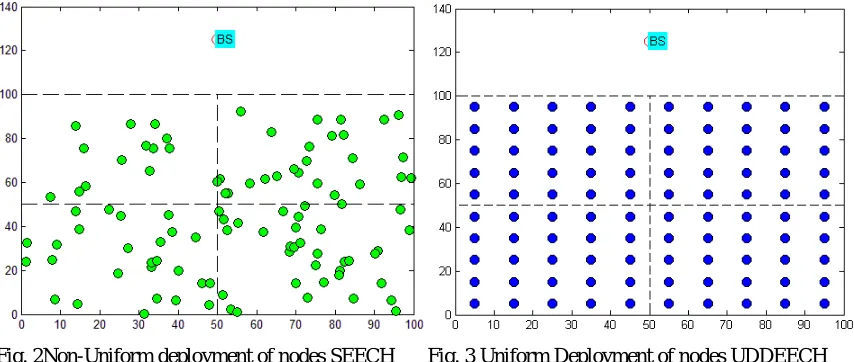
In this case we deploy 100 nodes are non-uniformly in SEECH(Fig.2) and then they are deploy uniformly in UDDEECH (Fig.3) in the 100X100 m area.
Fig. 2Non-Uniform deployment of nodes SEECH Fig. 3 Uniform Deployment of nodes UDDEECH
ISSN (Print) : 2320 – 3765 ISSN (Online): 2278 – 8875
I
nternational
J
ournal of
A
dvanced
R
esearch in
E
lectrical,
E
lectronics and
I
nstrumentation
E
ngineering
(An ISO 3297: 2007 Certified Organization)
Website: www.ijareeie.com Vol. 6, Issue 3, March 2017
Fig. 4Nodes 100 Number of nodes Alive per Fig. 5Nodes 100 Energy Consumed per round
Round in SEECH vs UDDEECH in SEECH Vs UDDEECH
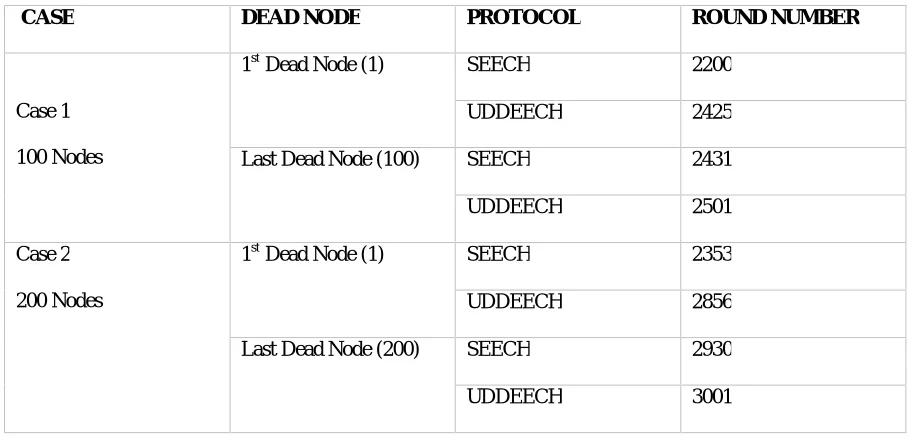
In Fig.3 and Fig.4 graph, it is observe that all the of nodes dead around 2431 but in case of its more then 2501 .so from their is it studied that it is also from simulation clear that the death of nodes occur not in long period but in very small periods .so UDDEECH have more life time then SEECH .
Case II: Node – 200, Area -100 x 100
In this case we deploy 200 nodes are non-uniformly in SEECH (Fig.6) and then they are deploy uniformly in UDDEECH(Fig.7) the 100 X100 m area.
Fig. 6: Non uniform Deployment SEECH Fig.7: Uniform Deployments in UDDEECH
ISSN (Print) : 2320 – 3765 ISSN (Online): 2278 – 8875
I
nternational
J
ournal of
A
dvanced
R
esearch in
E
lectrical,
E
lectronics and
I
nstrumentation
E
ngineering
(An ISO 3297: 2007 Certified Organization)
Website: www.ijareeie.com Vol. 6, Issue 3, March 2017
In Fig.7 uniform deployment it is studied that the nodes are at equal distance and nodes are at equal coverage of the nodes and hence here is less loose of energy due equal transmission from nodes to Base station is less than non-uniform deployment .here also the density of nodes area also non-uniform .
Fig. 8: Energy consumption SEECH vs UDDEECH Fig. 9: Alive node per round SEECH vs UDDEECH
In Fig.8 it is observe after simulation result the uniform deployment is shown and in the Fig. 9 graph is between alive nodes per round between SEECH and UDDEECH from simulation result.it is observe that all the of nodes dead around 2930 but in case of its more then 3001 .so from their is it studied that it is also from simulation clear that the death of nodes occur not in long period but in very small periods .so UDDEECH have more life time then SEECH .
TABLE I
CASE DEAD NODE PROTOCOL ROUND NUMBER
Case 1
100 Nodes
1st Dead Node (1) SEECH 2200
UDDEECH 2425
Last Dead Node (100) SEECH 2431
UDDEECH 2501
Case 2
200 Nodes
1st Dead Node (1) SEECH 2353
UDDEECH 2856
Last Dead Node (200) SEECH 2930
ISSN (Print) : 2320 – 3765 ISSN (Online): 2278 – 8875
I
nternational
J
ournal of
A
dvanced
R
esearch in
E
lectrical,
E
lectronics and
I
nstrumentation
E
ngineering
(An ISO 3297: 2007 Certified Organization)
Website: www.ijareeie.com Vol. 6, Issue 3, March 2017
VI. CONCLUSION
In the intensity-conscious distributed sensor monitoring of intelligent space and the extreme environmental and in the data group is relevant to to save energy. In WSNs are the key design issues in the research of routing protocols use of energy and power life time. A major challenge is to high stability time period for the supply area to preserve. In this paper as a zone has three-based the intensity performance layers protocol hierarchy (UDDEECH) during the member node group, where the network nodes move forward, group and the categorized relay header is proposed. UDDEECH suggested that a simple communication protocol of the low overhead approach for periodic information accumulated applications in harsh and remote offices, the network life time more than extend SEECH protocols in which network longevity three scenario studied. The simulation results showed that UDDEECH protocol, the network of life better than SEECH. The results also showed that the actions UDDEECH for networks of the large scale were used, a relevant question for room and degree of use. Simulation results showed that for UDDEECH protocol, the network life time better than SEECH-protocol.
REFERENCES
[1] T Book Areva, W Kanhere HU, S, B,N Ristic Gordan, T Bessell, M Rutten, S Jha, wireless sensor networks for battle field monitoring, 2006.
[2] D Dudek, C Haas, a Kuntz, M Zitterbart, D Krüger, P Roth ENPI EAFRD, D Pfisterer, S Fischer, wireless sensor network A for border surveillance, ACM conference on embedded networked sensor systems: 303304, 2009.
[3] Hirsch J K, K Martinez, climate sensor networks: a revolution in the earth system science: Earth Science repeatedly 78:177-191.
[4] M Kruggl Quaritsch, K, K WischonnigStrucl, D Bhattacharya, s-Shah, B Rinner, networked UAVs as air sensor network for disaster management applications: E and I, electrical engineering and information technology, 127(3): 56 - 63, 2010.
[5] Akyildiz, W, Y SU Sankara Subramanian, E Cayirci, an overview in the sensor networks IEEE communication magazine, 40(4): 102-114, 2002. [6] T Shu, M Krunz, Cover Time optimization for clustered wireless sensor networks: a power-balancing approach IEEE/ACM business networking 18(1): 202-215, 2010.
[7] M C Vuran, I F Akyildiz, spatial relationship-based cooperative medium access control in the wireless sensor networks. IEEE/ACM transport networking 14(2): 316329, 2006.
[8] K Akkaya, M Younis, a overview of routing protocols for wireless sensor networks, Elsevier Journal of ad hoc networks 3(3): 325-349, 2005. [9] K Kalpakis Dasgupta, K, P Namjoshi, powerful group-based heuristic for data acquisition and accumulation in sensor networks in IEEE wireless communications and network Conference, 2003.
[10] Y T Hou, Y Shi, H D Sherali, energy supply and relay node placement for wireless sensor networks IEEE Transactions on radio telephone communications 4(5): 2579 2590.
[11] M Younis, M Youssef and K Arisha, energy-conscious management in the group-based sensor networks. Computer networks 43(5): 649-668. [12] W Heinzelman, a Chandra Kazan, H Bala Krishnan, an application-specific protocol architecture for wireless micro sensor networks IEEE Transactions on wireless communication, 1(4): 660 670 2002.
[13] S Lindsey, C Raghavendra, Pegasis: drive powerful assembly into the sensor information systems in the aviation conference report, 3 (3): 11-24, 2002.
[14] O Younis, S Fahmy, Attention: a crossing, energy-efficient, distributed grouping approach for ad hoc sensor networks IEEE Transactions on mobile computing, 3(4): 366-379, 2004.
[15] A Manjeshwar, D P Agrawal, juvenile: a protocol for increased performance in the wireless sensor networks, international workshop on similarity and distributed computing are in wireless networks and mobile computing, 2001.
[17] V Mhatre, C Rosenberg, homogeneous against heterogeneous grouped sensor networks: a comparative study, IEEE International Conference on communications, 2004.
[18] F A Aderohunmu, J D Deng, SEP-E: An increased stable dialing protocol (SEP) for grouped heterogeneous WSN, pulse paper series, No 2009/07. Department of Information Science, University of Otago (ISSN: 1177 455X), 2010.
[19] G Emerald Akis, I Matta, a best Avro, Sept: a stable dialing protocol for grouped heterogeneous wireless sensor networks, international workshop on SANPA: 251 - 261, 2004.
[20] W Heinzelman, a Chandra Kazan, H Bala Krishnan, energy-saving transmission protocol for wireless micro sensor networks, Hawaii International Conference on System Sciences, 2000.
[21] L Qing, Q Zhu, M Wang, design of a distributed energy-saving grouping algorithm for heterogeneous wireless sensor networks. Computer communications: 2230 2237, 2006.
[22] B Elbhiri Saadane, R, B Aboutajdine, stochastic distributed energy-saving group for heterogeneous wireless sensor networks, ICGST-CNIR magazine, 9(2): 11-17.