3020
APPLICATION OF FUZZY LOGIC FOR EVALUATION OF
RESILIENT MODULUS PERFORMANCE OF STONE MASTIC
ASPHALT
HAMID SHIRMOHAMMADI1, FARHAD HADADI2
1
Assistant Professor, Highway and Transportation Engineering, Faculty of Engineering, Urmia University, Urmia, Iran
2
Master Student, Highway and Transportation Engineering, Faculty of Engineering, Urmia University, Urmia, Iran
E-mail: [email protected], [email protected]
ABSTRACT
Stone Mastic Asphalt (SMA) is a popular used asphalt on the main roads under heavy traffics. Due to its highly permanent age, excellent performance characteristics, road authorities, especially in European countries have selected it in arterial roads for pavements. But, some unexpected conditions might make the SMA improper, mainly because of the lack of enough evaluations. Another thing that should be examined is about the uncertain assessments of SMA performance. Uncertainty in engineering problems will cause incorrect evaluation. In recent years, new methods for assessing and analyzing were applied which include computational and artificial intelligence systems such as Artificial Neural Networks (ANN) and Fuzzy Logic (FL) in various engineering fields. The aim of this study focuses on the application of fuzzy logic for the assessment of Stone Mastic Asphalt (SMA) performance characteristic which is known as resilient module. It is evaluated under Stone Mastic Asphalt effective characteristics that are considered as air voids, bulk density, and permeability coefficient. In this study, standards for stone mastic asphalt have been gathered from the German and Australian tests. In the beginning, Fuzzy logic uses weighted average operations to enter input data, then the output will come into assessment by a mathematical model. Finally, results indicate as air void contents (%) increase, resilient modulus (Mpa) significantly decreases. Although
resilient modulus (Mpa) rises when bulk density (t/m 3) and permeability coefficient (cm/s) have a rise
trend. Moreover, the experimental results show that Fuzzy logic can be applied to improve the accuracy of this evaluation.
Keywords:Stone Mastic Asphalt, Performance Characteristic, Resilient Module, Fuzzy Logic
1. INTRODUCTION
Highways are rather expensive structures in the world. Millions of people are transported daily by these structures. These structures are importantly considered selecting appropriate materials and designs for safe, convenient and economical aspects of their pavements. Today, the utilization of Modern technology in pavement industry is a successful key to develop transport roads. It is needed to accelerate the development of the pavement of runways, highways by means of Stone Mastic Asphalt. Doughlas’ and Tons’ research has shown that bituminous mastic concrete has greater ultimate strength than conventional bituminous concrete and its strength basically depends on the viscosity and the film thickness of the asphalt
ISSN: 1992-8645 www.jatit.org E-ISSN: 1817-3195
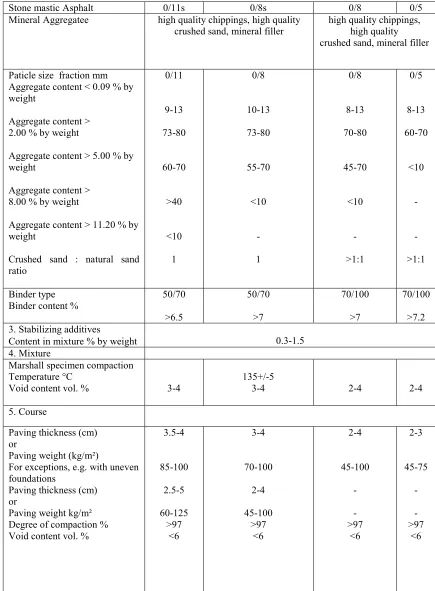
3021 by application of a probability managing system which detect any deformation and crack over its surface and texture. This probability systems operates automatically to alert engineers and help them for making a good decision to use additives, filers and repairs materials of paving to improve this asphalt performance. Stone mastic asphalt (SMA) is used significantly in Europe and other countries. This kind of asphalt has a good choice for bearing axle loads of vehicles in highways and freeways. The history of utilization of this asphalt relates to the 1960s in Germany by Dr. Zinchner who was an engineer and manager in the central laboratory of Road Construction at the Strabag Bau AG in Germany. The reason for making SMA is due to having high skid resistance to reduce wearing courses by studded tires of vehicles [2]. Stone Mastic Asphalt is also used largely on heavily trafficked roads and industrial areas roads such as at traffic lights, at intersections, on bridges, in bus lanes, on airport runways. SMA characteristics combines of stone layers with gap graded aggregate, specially bonded together by a high binder content which keeps the remaining aggregate [2]. Adding high binder content improves SMA stability and durability under heavy loads. Properties of SMA have remarkable effects on the operational performance of asphalt pavements [2]. In contrast to the utilization of SMA, It was perceived some disadvantages which include: (1) increased costs associated with the selection of higher binder and filler contents, and fiber additives, (2) adding higher filler may reduce productivity, (3) In the beginning of skid resistance performance, it might have low skid resistance till the thick binder film wears off the top of the surface by traffic. In recent years, researchers in laboratories have made innovative achievements in the improvement of stone mastic asphalt behavior by additives: Such as fillers, Fibers etc., According to the German method in designing SMA, all aggregates are bigger than 2 mm in the coarse aggregate skeleton (see Table 1) [2]. SMA mixture design requirements are shown in Figure 1[2]. The aim of this study is to apply an intelligent
management system derived from artificial
intelligence systems such as fuzzy logic for the
pavement of SMA to control contents,
compositions and their impacts on resilient modulus performance among other researches on evaluation of the SMA performance. In previous researches, all efforts were on introducing precuring principles and suggestions for preventing SMA against any deformation and crack over its surface and adding additives such as filers to
3022
Table 1: SMA standards in Germany.
Stone mastic Asphalt 0/11s 0/8s 0/8 0/5
Mineral Aggregatee high quality chippings, high quality
crushed sand, mineral filler
high quality chippings, high quality crushed sand, mineral filler
Paticle size fraction mm Aggregate content < 0.09 % by weight
Aggregate content > 2.00 % by weight
Aggregate content > 5.00 % by weight
Aggregate content > 8.00 % by weight
Aggregate content > 11.20 % by weight
Crushed sand : natural sand ratio
0/11
9-13
73-80
60-70
>40
<10
1
0/8
10-13
73-80
55-70
<10
-
1
0/8
8-13
70-80
45-70
<10
-
>1:1
0/5
8-13
60-70
<10
-
-
>1:1
Binder type Binder content %
50/70
>6.5
50/70
>7
70/100
>7
70/100
>7.2 3. Stabilizing additives
0.3-1.5 Content in mixture % by weight
4. Mixture
Marshall specimen compaction Temperature °C
Void content vol. % 3-4
135+/-5
3-4 2-4 2-4
5. Course
Paving thickness (cm) or
Paving weight (kg/m²)
For exceptions, e.g. with uneven foundations
Paving thickness (cm) or
Paving weight kg/m² Degree of compaction % Void content vol. %
3.5-4
85-100
2.5-5
60-125 >97
<6
3-4
70-100
2-4
45-100 >97
<6
2-4
45-100
-
- >97
<6
2-3
45-75
-
- >97
ISSN: 1992-8645 www.jatit.org E-ISSN: 1817-3195
3023
Using stone mastic asphalt cause low rutting by wheel trucks as it is presented in Table 2 [3]. However, not following requirements will make weakness in its performance. All specifications should be compatible with international standards [4]. There are different measurement methods to be used according to the European, the American (The U.S) standards, the German, the Austrian and the Swiss specifications. Our focus is on the evaluation of SMA Resilient modulus by a Fuzzy logic approach. In addition, all SMA samples tests were obtained under standard conditions on Australia roads [5]. Cost is an important key in asphalt pavement. Evidence has shown that in the United States and Australia, the initial costs of SMA are 20-40% higher than conventional dense graded asphalt in road pavements [8]. Stone Mastic Asphalt gradation covers at gap – graded aggregates which reduces noise emissions on heavily trafficked roads due to its macro texture absorption property (see Figure 1) [2].
Figure1: Position Of Gradation Curves Of Aggregate Mixtures: Solid Line, Asphalt Concrete; Dotted Line,
[image:4.612.312.519.151.223.2]SMA [2].
Table 2: Wheel Track Ruttiness (Mm/Hr) [3].
AC SMA Wheel Load
( N)
2.12 0.45 190
3.16 0.60 180
4.1 0.75 370
In Table 3 two types of used aggregates are montrose and granite that evaluate the flakiness index for determination of bituminous surfacing and also the Los Angeles abrasion value means that toughness and abrasion characteristics of samples. In more details, the aggregates whose flakiness index has been observed in a high value have
[image:4.612.90.303.558.648.2]higher fatigue life than non-flaky mixed aggregates [3].
Table 3: Aggregate Properties [5].
Aggregate property Aggregate A montrose Aggregate B granite
Flakiness index 17 21
Los Angeles
abrasion value 10 14
2. Research Questions
- Why is Stone Mastic Asphalt used?
- What are characteristics and compositions
of SMA considered to evaluate resilient modulus performance of SMA?
- What method is used to evaluating this
operational characteristic?
- What is the analytical method for the
evaluation of resilient modulus
performance of fuzzy logic?
3. Background
The rise of strength and the resilient modulus performance of SMA depends on increase over its compositions such as Bulk density and permeability coefficient and reduction over Air void contents which are required to be defined according to the laboratory conditions and standards in this paper. For obtaining these results, evaluating the direct impacts of Bulk density, permeability coefficient and Air void contents on resilient modulus of SMA is done by the fuzzy logic system. This study has done already to develop intelligent pavement management systems in road maintenance for reducing extra costs and accurate monitoring of SMA characteristics such as resilient modulus to implement this asphalt in highways and runways of airports in the first time.
3.1 Concept of SMA Bulk Density Measurement
The measurement of bulk density is critical for assessing the mixture design of stone mastic asphalt that is generally determined by equation (1):
3024 There are four bulk density determination methods:
1-Wax coating: The sample becomes fully sealing within a wax coating.
2- Presaturation method: The sample becomes suspended in water, sometimes saturated surface dry method (SSD).
3- Vacuum sealing test: Sealing the sample in a plastic bag which determines the volume after removing the air voids according to the Main Roads Western Australia standard test (MRWA) and also AASHTO (T 209-05:2011) standard was used to validate the vacuum sealing test. For measuring the bulk density, two plastic were applied with different bulk densities. The samples are categorized to the grey and red sample as indicated in Table 4 [5]. In the bulk density concept, it can be described that usual method for measuring the amount of air voids remaining in the SMA samples obtains similarly the air voids remaining in equation (2) [6].
Voids filled with asphalt =
[image:5.612.310.523.276.384.2](2)
Table 4: Bulk Density Results For Two Plastic Samples [5]
4- Water Saturation Method
Generally, the concept of water saturation relates to the ratio of water to pore volume. Moreover, It can be understood that as volume per volume units, percent or saturation units. During the permeability test, a sample needs to be saturated. For the implementation of this test, it needs demolition hammer, Marshal Drop (50
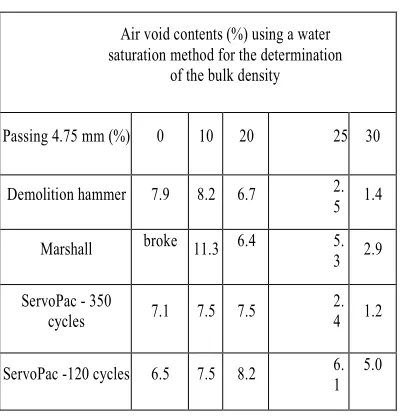
[image:5.612.90.291.409.617.2]blows per side) and Servo Pac Gyratory Compactor at 120 and 320 cycles. The water saturation task is to measure the buoyant mass under water after saturation time. Then, the sample weight determined with the interconnected void spaces is filled with water. Although in large interconnected voids, water may drain out before weighing begins. This effect is not significantly clear. Mixture designs for aggregate A have been indicated in Table 5. Aggregate A involves fine aggregates (passing 4.75 mm) from 0% to 30% [5].
Table 5: Air Void Contents (%) Using A Water Saturation Method For The Determination Of The Bulk
Density By Different Compactors.
3.2 Concept of Permeability and Resilient Modulus of Stone Mastic Asphalt
Permeability or hydraulic conductivity is an important property of materials in pavements. There are common design procedures for the calculation of drainability characteristics in terms of hydraulic conductivity and effective porosity [7]. When aggregates are subjected to mix in SMA samples, they induce issues for mixing designs. Mixture designers of asphalts attempt to create a highly textured surfacing by preparing samples with low air void contents whether or not affecting SMA permeability. All samples have been tested in laboratories by different compactors and hammers such as Gyropac - Gyratory Compactor, Segmental
Wheel Compactor, Servopac - Gyratory
Compactor, demolition hammer and Marshall hammer and also tests results were obtained [3 -8] (see Table 6). Table 8 illustrates that how the resilient modulus (Mr) was measured on one sample from five compactors. Conventionally, this modulus represents an estimation of modulus of elasticity (E) which determines by the triaxial test under dynamic traffic loading. In addition, resilient modulus represents the internal resistance of aggregates and fines [9]. Laboratory tests of samples are compatible with the Australian Air void contents (%) using a water
saturation method for the determination of the bulk density
Passing 4.75 mm (%) 0 10 20 25 30
Demolition hammer 7.9 8.2 6.7 2. 5 1.4
Marshall broke 11.3 6.4 5. 3 2.9
ServoPac - 350
cycles 7.1 7.5 7.5
2. 4 1.2
ServoPac -120 cycles 6.5 7.5 8.2 6. 1
5.0
Bulk density test
method Red sample bulk density
Grey sample bulk density
(t/m3) (t/m3)
MRWA 1.071 1.340
AASHTO (2005) 1.071 1.341
ISSN: 1992-8645 www.jatit.org E-ISSN: 1817-3195
[image:6.612.90.299.156.500.2]3025 standards (AS 1995) which are summarized in Table 7.
Table 6: Permeability Coefficient And Resilient Modulus Results By Different Compactors [5].
Table 7: The Australin standard labaratory condition.
4. ARTIFICIAL INTELLIGENCE SYSTEM
4.1 Concept of Fuzzy Logic
Several technologies in the artificial
intelligence fields such as fuzzy logic and genetic algorithms can predict different situations [10]. Fuzzy theory was introduced by lotfi zadeh in 1965 with the perception of uncertainty and certainty which has significant applications [11, 12, 13]. Fuzzy theory can be used for evaluation uncertain problems in engineering views. It has also more flexibility with unsharp and vague boundaries [14]. In recent years, Fuzzy logic in washing machines, microwave ovens and industrial process control has been used dramatically [15]. In highways, freeways pavements because there is no exact evolutionary systems, all efforts are used to apply fuzzy logic systems in managing pavements under different conditions [16, 17]. Fuzzy set theory is a precise mathematical method to model and simulate incomplete knowledge [18, 19] Fuzzy logic methods compose of the fuzzy inference system (FIS), membership functions (MF), fuzzy rules, a ruler viewer and a surface viewer for evaluating all involved parameters in inputs and outputs [20].
4.2 Fuzzy Inference System (FIS) and Membership Function
Fuzzy logic system composes of membership function, fuzzy logic operators are divided as and, if- then rules. Generally, there are two FIS membership functions which involve of Mamdani and Sugeno types [3, 9]. Fuzzy logic inputs and outputs variables are defined in the range of 0 and 1 value [21]. Defuzzification operation converts results from fuzzy interference engine to numerical values [22]. From fuzzy logic inference concept linguistic, variables are defined for inputting parameters such as permeability coefficient (cm/s), air void contents (%), and bulk density (t/m3) (see Tables 9, 10 and 11) and an output data such as resilient modulus (Mpa) (see Table 12). Input data
are defined as Air void contents (x1), Bulk density
modules (x2), permeability (x3) and output data
(Resilient module) is obtained by simulating Fuzzy engine. In this paper, A Mamdani FIS was used to model the evaluation of the Stone Mastic Asphalt resilient modulus performance. In addition, for simulating and achieving experimental results, amongst member functions of fuzzy logic, Gaussian member function was designed in Matlab software. In fuzzy engine, it is important to categorize laboratory tests of SMA in Low, Medium and High. Permeability
Air void contents
coefficient Resilient
Compactor (%) (x10·5 cm/s) modulus
(MPa) Aggregate A Gyropac (gyratory
compactor) 4.0 0.038 5920
Servopac (gyratory
compactor) 2.5 0.029
4530
Segmental wheel
compactor 3.0 0.000 5270
Demolition hammer 3.1 0.000 5310
Marshall 2.9 0.355 6100
Aggregate B Gyropac (gyratory
compactor) 4.9 0.155 6980
Servopac (gyratory
compactor) 3.5 0.000 5060
Segmental wheel
compactor 2.9 0.195 5790
Demolition hammer 3.0 0.000 5290
Marshall 3.0 0.000 5680
test temperature 25 ± 0.5 °C
loading time 40 ± 5 ms
loading cycle 3000 ± 5 ms
load pulse haversine
3026 For the evaluation of the resilient modulus of SMA, input parameters are described as Bulk density
(t/m3), Air void contents and Permeability
[image:7.612.170.443.174.304.2]coefficient and output parameter is defined as resilient modulus (Mpa) as they are indicated in Figure 2.
Figure 2: Mammdani Inferrence Fuzzy System.
4.3 Application of Fuzzy rules for the evaluation of the resilient modulus of SMA
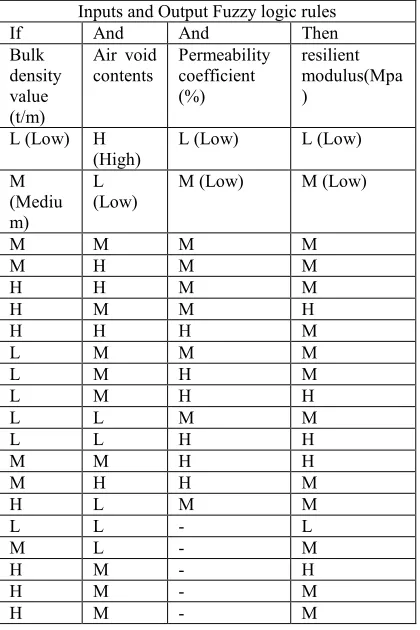
Fuzzy logic is applied for the assessment of the resilient modulus of SMA. Fuzzy logic rules are used in the basis of a human export. Also, they are explained in the following statements as indicated in Table 8.
R: IF variable x1 is Low and variable x2 is “medium
[image:7.612.314.524.359.674.2]“then result Y is “medium”. So, according to expert system of fuzzy logic 19 logic rules are selected (see Table 8).
Table 8: Fuzzy Logic Rules For Inputs And Outputs. Inputs and Output Fuzzy logic rules
If And And Then
Bulk density value (t/m)
Air void contents
Permeability coefficient (%)
resilient modulus(Mpa )
L (Low) H (High)
L (Low) L (Low)
M (Mediu m)
L (Low)
M (Low) M (Low)
M M M M
M H M M
H H M M
H M M H
H H H M
L M M M
L M H M
L M H H
L L M M
L L H H
M M H H
M H H M
H L M M
L L - L
M L - M
H M - H
H M - M
H M - M
ISSN: 1992-8645 www.jatit.org E-ISSN: 1817-3195
3027
2-If Bulk density (t/m3) is medium and Air void
contents are medium and Permeability coefficient (%) is medium then resilient modulus is medium. 3- If Bulk density (t/m) is high and Air void contents are moderate and Permeability coefficient (%) is medium then resilient modulus is high.
[image:8.612.97.525.62.493.2]Table 9: Category of permeability coefficient of SMA based on fuzzy logic.
Table 10: Category of Air void contents value of SMA based on fuzzy logic.
Table 11 indicates bulk density values linguistic categorization of samples in fuzzy logic. Similarly, Output values of resilient modulus (Mpa) are categorized according to the linguistic approach of fuzzy logic inference (see Table 12).
Table 11: Categorization of Bulk density values according to Fuzzy logic.
Bulk density values in SMA based on fuzzy logic
Low [0.36 - 0.5]
Medium [0.34 – 1]
High [0.35 – 2]
Table 12: Categorization of Resilient modulus (MPa) values according to Fuzzy logic.
Resilient modulus (MPa) values in SMA based on fuzzy logic
Low [849 - 2000]
Medium [900 – 4500]
High [950 – 7000]
5. Evaluation of model’s performane
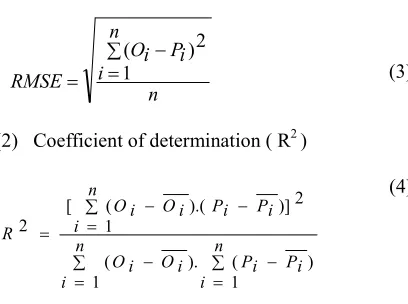
To evaluate the performance of the fuzzy logic resilient modulus model and measurement values, the following statistical criteria were selected:
(1) root-mean-square error (RMSE)
(3)
(2) Coefficient of determination ( R2 )
(4)
In equations (3) and (4) subscripts Oi, Pi, indicate
measured and predicted values of resilient modulus of SMA respectively.
6. RESULTS AND DISCUSSION
The innovation of this paper has this effort to examine the performance of the resilient modulus of SMA with application of fuzzy logic as a
management system instead of traditional
management systems in road maintenance centers. It significantly identifies a high accuracy resilient modulus value for predicting under different circumstances. Obtained results are interpreted by engineers within figures, tables and statistical tests without any delay because of accessing data. In addition, all input and output variables for evaluation of resilient modulus of SMA are introduced and designed to give an acceptable concept of an intelligent management system. Category Permeability
coefficient
Description
(x10-5 mis)
Low [0 - 0.12] Low permeability
Medium [0.0623 - 0.242] Moderately permeable. Some water infiltrating under traffic.
High [0.074 - 0.5] Free draining.
Air void contents value in SMA bsed on fuzzy logic
low [1.24-3]
Medium [1.24 -6.6] Very high [2.04-12]
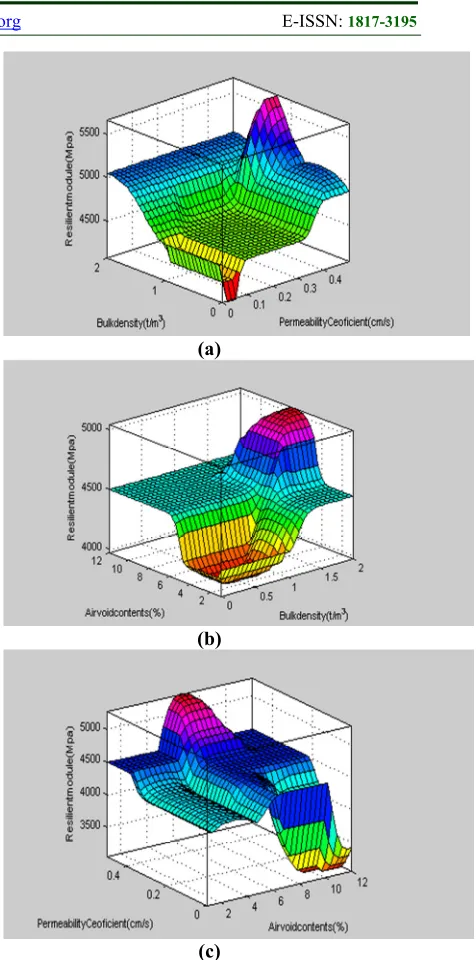
[image:8.612.316.520.340.492.2]3028 Efficiency of this method under uncertainty and sudden circumstances becomes increased because sampling and evaluating in place for SMA might take a long time in comparison with evaluating from remote distances by fuzzy logic which has a faster and better performance. We analyzed Fuzzy logic model for SMA resilient modulus (Mpa) performance based on three inputs parameters. Fuzzy logic decision surface for the evaluation of resilient modulus which is shown in Figure 3 for the combination of Bulk density (%) and Permeability coefficient (cm/s) (Figure 3(a)), Bulk density and Air void contents (%) (Figure 3(b)), Permeability coefficient (cm/s) and Air void contents (%) (Figure 3(c)). It is obvious From Figure 3(a) that the amount of Resilient Modulus increases by increasing Bulk density (%) and it is also significant that Permeability Coefficient (cm/s) has a positive influence on the increase of Resilient Modulus (Mpa). It can be understood from Figure 3(b) that air void contents (%) have a prominent influence on resilient modulus (Mpa). This represents if the amount of Air voids Contents (%) were high, they will reduce resilient modulus (Mpa) in comparison with resilient modulus (Mpa) in Figure 3(a). The same thing can be seen from Figure 3(c), furthermore, it indicates the effect of air void contents is more drastic at higher Bulk density (%). The performance of Fuzzy logic model for the evaluation of Resilient Modulus (Mpa) was simulated in Matlab Software and obtained results were examined from the view of statistical criteria such as RMSE and the coefficient of determination
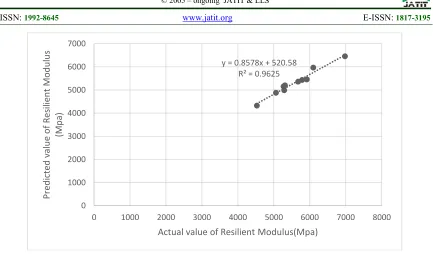
R2. The result values indicated RMSE and R2 as
308.2397 and 0.962, respectively. As a result, resilient modulus value of SMA could be predicted practically with low error rates. The predicted value resilient modulus is indicated in Figure 4 in the form of scatter plot. From Figure 3(b), it can be understood that by increasing Bulk density and reducing air void contents, an increase trend in resilient modulus will be observed. However, an increase in bulk density and air void contents has a reducing trend in the resilient modulus of SMA.
(a)
(b)
[image:9.612.313.551.68.548.2](c)
Figure 3: Fuzzy Logic Decision Surface For The Resilient Modulus Of SMA According To (A) Bulk Density (%) And Permeability Coefficient (Cm/S), (B)
Bulk Density And Air Void Contents (%), (C) Permeability Coefficient (Cm/S) And Air Void Contents
(%)
7. CONCLUSION
Today, with the increase use of new asphalts in roads, the use of Stone Mastic Asphalt (SMA) in pavements have become popular in different countries because of its high performance characteristics under heavy traffic loads, and weather conditions like snow, rain, dust etc.
ISSN: 1992-8645 www.jatit.org E-ISSN: 1817-3195
3029
conditions needs economical and accurate
technologies. Stone Mastic Asphalt has shown superior on heavily trafficked highways. The use of SMA is rising because of its high resistance, strength under heavy traffic loads in highways and runways of airports. In addition, its structure tends to have high strength, resilient modulus and stability because of high binder, low air void contents in aggregates, high bulk density and proper permeability coefficient satisfies all road authorities to use it in all over the world. Hence this study has focused on evaluating the influence of these characteristics and compositions on resilient modulus performance with understanding of graphical concepts and analytical methods such as regression equation for predicting real value of resilient modulus in comparison with observed value from standards tests in laboratories. The application of intelligence methods facilitate this work more quickly than other monitoring controllers. The utilization of intelligence methods in this study mainly concentrate on Fuzzy logic which determines the density of each variable. Firstly, input and output variables are obtained from standard tests of German and Australian laboratories. After consideration of Fuzzy logic rules, Fuzzy system is designed to evaluate resilient modulus performance of SMA. Results from Figure 3(b) illustrate when Bulk density increases and Air void contents reduce, resilient modulus samples will be significantly increased. However resilient modulus decreases as air void contents increase and Bulk density decreases. By applying this systems in pavements maintenance centers with the online monitoring control of SMA, experts and engineers precisely evaluate the behavior of SMA resilient modulus performance. So, the aim of this paper is to introduce an intelligent method to help road engineers for making economical and efficient decision for repairing and controlling SMA pavement. In order to have better understanding of the performance characteristic of SMA (Resilient Modulus (Mpa) under various conditions such as Air void contents (%), Bulk density and Permeability Coefficient (cm/s), these effective parameters are tested in an intelligent approach. Based on the result obtained in this study the
following conclusions can be obtained:
(1)- The amount of Air voids contents (%), Bulk density and Permeability Coefficient (cm/s) effect the resilient modulus (Mpa) of SMA.
(2)- Resilient modulus (Mpa) decreases by adding Air void Contents (%).
(3)- Air void contents (%) have a prominent influence on resilient modulus (Mpa). This represents if the amount of air void contents (%) were high, they will reduce resilient modulus (Mpa).
(4)- Generally, Fuzzy logic approach can predict Resilient Modulus (Mpa) with high estimation accuracy. In the future, Application of fuzzy logic in asphalt management systems will be increased. Because they will enable exports to repair and improve other performance characteristic of SMA with optimum contents and quick accessibility. Additionally, it will have a more accuracy for controlling of asphalt behaviors under heavy traffic loads circumstances such as pavements of runways and roads. Fuzzy logic has high accuracy of predicting characteristics of asphalts such as SMA, it means that predicted values are close to observed values from field tests with Regression Coefficient (R2) 0.9625. Furthermore, it will control and assess distortions, distresses and cracks on other kinds of asphalts. It will precisely conclude in the best solution for technical repairs because of detecting the reason of these damages over them by adding additives, filers and reconstructing layers for bearing heavy traffic loads.
(5)- Application of Fuzzy logic indicated better
understanding of the application of new
3030
Figure 4: Performance Of Fuzzy Logic For Prediction Of Resilient Modulus (Mpa) of SMA
8. THE LIMITATIONS OF THIS STUDY
In this study, simulating resilient modulus characteristics and its behavior were done by personal computers. However, with application of powerful computers in road maintenance centers can obtain accurate data of SMA, experimentally. In addition, this work has been done according to standards of SMA in Australia and Germany not national standards because of the lack of these specifications for national maintenance centers. Samples were obtained from Tables, Some limitations are explained in the following:
-Need export engineers to analyze resilient modulus of SMA from obtained results and figures.
-For implementing of this intelligent method, high costs of installing infrastructures are considered.
-Observed results from application of this artificial intelligence could challenge engineers to adjust
their knowledge about this science with
combination of SMA resilient modulus
performance.
REFERENCES
[1] A Douglas and E Tons, “Strenght Analysis of Bitumen Mastic Concrete,” A.A.P.T, 30, 1961, pp. 238-262.
[2] K Blazejowski, “Stone Matrix Asphalt Theory And Practice”, CRC Press, 2011, New York.
[3] ER Brown, JE Haddock, RB Mallick and
Lynn, TA, “Development of a mixture design
Procedure for stone matrix asphalt (SMA)”,
Report, no. 97–3, 1997, National Center for
Asphalt Technology (NCAT), Auburn
University, Albama, USA.
[4] L Drüschner and V Schäfer, “Stone Mastic
Asphalt”, German Asphalt Association, 2005,
pp. 1-31.
[5] C Harrison, “Compaction and Permeability of Stone Mastic Asphalt in the labaratory”, AP- T220 – 13, Austroad Technical Report, 2013,
ARRB Group, Sydney.
[6] Ptti, “Air voids for laymen”, retrived October 19, 2016, from http://theasphaltpro.com/air voids-for-laymen.
[7] American Association of State Highway and Transportation Officials, “Guide for Design of Pavement Structures”, 1993, Washington, D.C.
[8] PB Blankenship, KC Mahboub and GA Huber. Rational method for laboratory compaction of
hot-mix asphalt. Transportation Research
Record 1454, 1994, pp. 144–153.
[9] JS Chen, W Hsieh and MC Liao, “Effect of Coarse Aggregate Shape on Engineering Properties of Stone Mastic Asphalt Applied to
y = 0.8578x + 520.58 R² = 0.9625
0 1000 2000 3000 4000 5000 6000 7000
0 1000 2000 3000 4000 5000 6000 7000 8000
P
re
d
ic
te
d
v
a
lu
e
o
f
R
e
si
li
e
n
t
M
o
d
u
lu
s
(M
p
a
)
ISSN: 1992-8645 www.jatit.org E-ISSN: 1817-3195
3031
Airport Pavements”, International Journal of
Pavement Research and Technology, 2013;
6(5): 596-601.
[10] S. Sundin, C. Braban-Ledoux, “Artificial
intelligence-based decision support
technologies in pavement management.”
Comput.Aided Civ. Infrastruct. Eng., 2001; 16(2):143–157.
[11] E H Mamdani, “Application of fuzzy algorithms for control of simple dynamic
plants”, Proc IEEE 121, 1976, pp. 1585– 1588.
[12] L.A. Zadeh, “Probability Theory and Fuzzy
Logic”, Computer Science Division
Department of EECS UC Berkeley, April 24, 2003.
[13] L.A. Zadeh, “fuzzy sets, information and control”, information and technology, 1965; 8(3): 338-353.
[14] K. Wang, F. Liu, “Fuzzy set-based and
performance-oriented pavement network
optimization system.” J. Infrastruct. Syst.,
1997; 3(4): 154–159.
[15] H. Is¸ik and S. Arslan, “The design of ultrasonic therapy device via fuzzy logic”,
Expert Systems with App, 2011 38, 7342–7348.
[16] H Tanyildizi, “Fuzzy logic model for
prediction of mechanical properties of
lightweight concrete exposed to high
Temperature”, Materials and Design 30, 2009,
pp. 2205–2210.
[17] D. Moazami, H. Behbahani and R. Muniandy,
“Pavement rehabilitationand maintenance
prioritization of urban roads using fuzzy
logic”, Expert Systems with Applications,
201138, 12869–12879.
[18] K. J. Schmucker, “Fuzzy Sets, Natural Language Computations, and Risk Analysis”, Computer Science Press, Rockville, Md., 1984.
[19] L.A Zadeh, J. Kacprzyk, “Fuzzy logic for the management of uncertaint”, 1992.
[20] H. Kusan, O. Aytekin and I. O¨ zdemir, “The use of fuzzy logic in predicting house
selling price”, Expert Systems with
Applications, 2010 37 , 1808–1813.
[21] R Hainin, W F Reshi and H Niroumand, “The Importance of Stone Mastic Asphalt in
Construction,” The Electronic Journal of
Geotechnical Enineering, 17, 2012, pp. 49-56.
[22] M. Omid, “Design of an expert system for sorting pistachio nuts through decision tree and
fuzzy logic classifier”, Expert Systems with
![Table 3: Aggregate Properties [5].](https://thumb-us.123doks.com/thumbv2/123dok_us/8906588.957122/4.612.90.303.558.648/table-aggregate-properties.webp)
![Table 6: Permeability Coefficient And Resilient Modulus Results By Different Compactors [5]](https://thumb-us.123doks.com/thumbv2/123dok_us/8906588.957122/6.612.90.299.156.500/table-permeability-coefficient-resilient-modulus-results-different-compactors.webp)