758 |
P a g e
AN EXPERIMENTAL STUDY ON CONCRETE WITH
PARTIAL REPLACEMENT OF CEMENT BY USING
HYPO-SLUDGE
Aravind B.Patil
1 ,R.H.Yadav
2, Mahesh D
31
Assistant Professor, Department of Civil Engineering,
V.P. Dr.P.G.Halakatti
College of Engineering and Technology,Vijayapur, Karnataka, (India)
2 ,3
B.E.(Civil),
Department of Civil Engineering,
V.P.
Dr.P.G.Halakatti
College of of Engineering and Technology, Vijayapur,Karnataka, (India)
ABSTRACT
Over 300 million tones of industrial wastes are being produced per annum by chemical and agricultural process in India. These materials possess problems of disposal and health hazards. The wastes like phosphogypsum, fluorogypsum, hypo-sludge and red mud contain obnoxious impurities which adversely affect the strength and other properties of building materials based on them. To reduce disposal and pollution problems emanating from these industrial wastes. it is most essential to develop profitable building materials from them. This project is concerned with experimental investigation on strength of concrete and optimum percentage of the partial replacement. By replacing the cement by 0%, 10%, 20%, 30%, 40%, 50%, 60%, and 70% of Hypo-sludge. And testing compression and split tensile strength of the cubes and cylinder's.
Keywords: Concrete, Compression Test, Hypo-Sludge, Industrial wastes, Split Tensile Strength
I INTRODUCTION
1.1 General
Some companies burn their sludge in incinerators, contributing to our serious air pollution problems. To reduce
disposal and pollution problems emanating from these industrial wastes, it is most essential to develop profitable
building materials from them. Keeping this in view, investigations were undertaken to produce low cost
concrete by blending various ratios of cement with hypo sludge. Paper making generally produces a large
amount of solid waste. Paper fibers can be recycled only a limited number of times before they become too short
759 |
P a g e
1.2 Hypo Sludge
Hypo sludge is one of the by- product from the paper industry .The use of these by-products offers
environmental advantages divert the material from the waste stream, reduce the energy used in processing virgin
materials, use of virgin materials, and decreases pollution.
India is a resourceful country for generation of the industrial wastes with an annual output of over 300 million
tones, but utilization is still below 20 % in spite of quantum jump in last three to four years. Availability of
consistent quality Hypo sludge across the country and awareness of positive effects of using Hypo sludge in the
concrete.
1.3 Need For Hypo Sludge Utilisation.
While producing paper the various wastes are comes out from the various processes in paper industries. From
the preliminary waste named as hypo sludge, due to its low calcium is taken out for our project to replace the
cement utilization in concrete.
Due to the cement production green house gases are emitted in the atmosphere. For producing 4 million T, of
cement 1 million T green house gases are emitted. Also, to reduce the environmental degradation this sludge has
been avoided in mass level disposal in land.
II OBJECTIVES
1. To investigate the utilization of Hypo Sludge as Supplementary Cementitious Material (SCM) and
influence of this hypo sludge on the Strength of concrete.
2. Influence on the cost of concrete made with different Cement replacementlevels.
III SCOPE
1) To find the optimum strength of the partial replacement of cement with hypo sludge.
2) Minimize the max degradation in environment due to cement and safeguard ozone layer.
3) Using the wastes in useful manner.
4) To reduce the cost of the construction.
5) It should be easily adopted in construction field.
6) To provide a most economical concrete.
7) Minimize the maximum demand for cement.
IV METHODOLOGY
a) Mix design for concrete proportion has been developed as per IS10262 – 2004
b) Casted and cured the concrete specimens as per Indian standards procedures.
760 |
P a g e
d) Finding the optimum strength of partial replacement of hypo sludge as cement.
e) Comparing the results of conventional concrete with partial replacement concrete.
V DETAILS OF THE EXPERIMENTAL STUDY'S
Concrete cubes of size 150 mm × 150 mm × 150 mm were casting using M20 Grade of concrete. Specimens with
ordinary Portland cement (OPC) and OPC Replaced with hypo sludge at 10%, 20%, 30%, 40%, 50%, 60% and
70% levels were cast.
During casting the cubes were mechanically vibrated by using a table Vibrator. After 24 h the specimens were
removed from the mould and subjected to water curing for 14 and 28 days. After curing, the specimens were
tested for Compressive strength using a calibrated compression testing machine of 2,000kN capacity.
5.1 Compressive Strength Test
Compression test is the most common test conducted on the hardened concrete, partly because it is an easy to
perform, and partly because most of desirable properties of concrete are qualitatively to its compression
strength.
The compression test is carried out on a specimen cubical or cylindrical in shape. Prism is also sometimes used,
(Ref.8) but it is not common in our country.
The cube specimen of the size 150×150×150 mm, if the largest nominal size of the does not exceed 20mm, 100
mm size cubes may be used as an alternative. Cylindrical test specimens have a length equal to twice the
diameter.
Compressive Strength=Load/Area
5.2 Split Tensile Strength
Direct measurement of tensile strength of concrete is difficult. Neither specimens nor testing apparatus have
been designed which assure uniform distribution of the pull applied to the concrete while a number of
investigations involving the direct measurement of tensile strength have been made. Beam tests are found to be
dependable to measure flexural strength property of concrete.
Calculation:
Calculate the splitting tensile strength of the specimen as follows:
T=(2 P)/(PI x L x D) Where:
T = Splitting tensile strength, Mpa
P = Maximum applied load indicated by the testing machine, KN
l = Length, in m
761 |
P a g e
VI RESULTS AND DISCUSSION
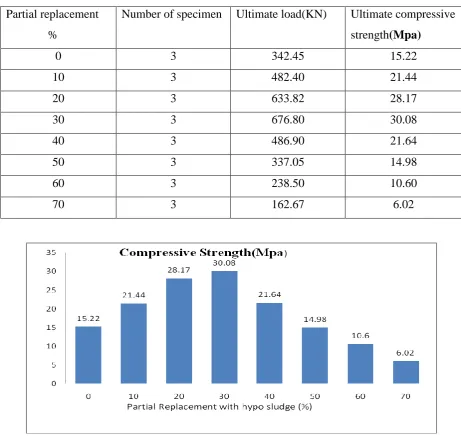
Table No 6.1.1 Compressive Strength of cubes at 14 days
Partial replacement
%
Number of specimen
Ultimate load(KN)
Ultimate compressive
strength
(Mpa)
0
3
342.45
15.22
10
3
482.40
21.44
20
3
633.82
28.17
30
3
676.80
30.08
40
3
486.90
21.64
50
3
337.05
14.98
60
3
238.50
10.60
70
3
162.67
6.02
Fig 6.1.1 Compressive strength of at 14 days of curing
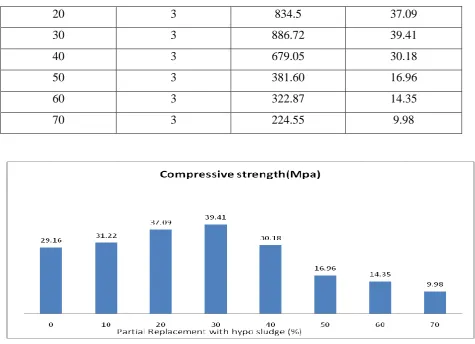
Table No 6.1.1.2 Compressive Strength of cubes at 28 days
Partial replacement
%
Number of specimen
Ultimate load(KN)
Ultimate compressive
strength(Mpa)
0
3
656.10
29.16
762 |
P a g e
20
3
834.5
37.09
30
3
886.72
39.41
40
3
679.05
30.18
50
3
381.60
16.96
60
3
322.87
14.35
70
3
224.55
9.98
Fig 6.1.1.2 Compressive strength of concrete at 28 days of curing
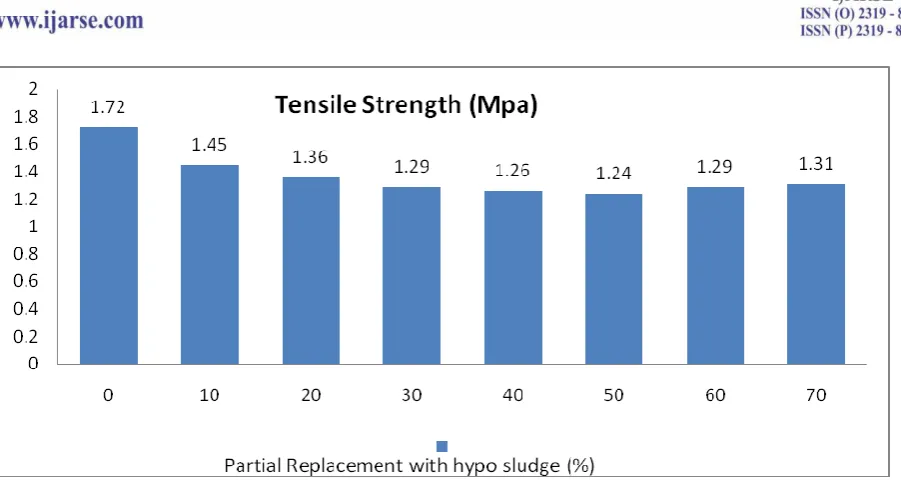
Table No 6.2.1 Split Tensile Strength of Cylinder at 28 days
Partial
replacement
%
Number of
specimen
Ultimate
load(KN)
Ultimate compressive
strength(Mpa)
0
3
121.57
1.72
10
3
102.49
1.45
20
3
96.132
1.36
30
3
91.18
1.29
40
3
89.06
1.26
50
3
87.65
1.24
60
3
91.18
1.29
70
3
91.89
1.31
763 |
P a g e
Fig.6.2.1 Split tensile strength of concrete at 28 days of curing
VII ECONOMIC FEASIBILITY
Cost analysis is carried out for the optimum proportion of percentage of hypo sludge in concrete. This project
was carried out in our college campus. The cost is compared to the conventional concrete.
A) Cost of materials
Cost of cement per bag = 340 Rs
Cost of sand per cum = 1060 per cum
Cost of hypo sludge per kg = 1 Rupee
Cost of coarse aggregate per cum = 883 per cum
Table No 7.1 Cost of material of normal concrete per cum
Description
Quantity,(kg/m^3)
Cost,(Rs)
Cost of material,(Rs)
Cement
394
6.8 per kg
2679.2
Hypo sludge
-
1 Rupee per kg
-
Sand
648
1060 per cum
429.3
Coarse aggregate
1116
883 per cum
447.92
764 |
P a g e
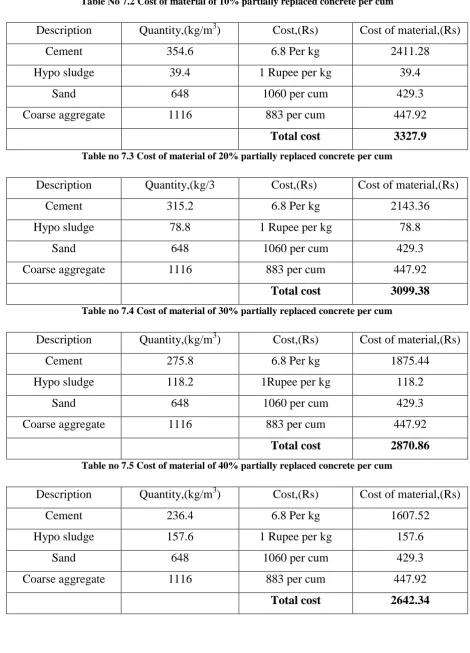
Table No 7.2 Cost of material of 10% partially replaced concrete per cum
Description
Quantity,(kg/m
3)
Cost,(Rs)
Cost of material,(Rs)
Cement
354.6
6.8 Per kg
2411.28
Hypo sludge
39.4
1 Rupee per kg
39.4
Sand
648
1060 per cum
429.3
Coarse aggregate
1116
883 per cum
447.92
Total cost
3327.9
Table no 7.3Cost of material of 20% partially replaced concrete per cum
Description
Quantity,(kg/3
Cost,(Rs)
Cost of material,(Rs)
Cement
315.2
6.8 Per kg
2143.36
Hypo sludge
78.8
1 Rupee per kg
78.8
Sand
648
1060 per cum
429.3
Coarse aggregate
1116
883 per cum
447.92
Total cost
3099.38
Table no 7.4 Cost of material of 30% partially replaced concrete per cum
Description
Quantity,(kg/m
3)
Cost,(Rs)
Cost of material,(Rs)
Cement
275.8
6.8 Per kg
1875.44
Hypo sludge
118.2
1Rupee per kg
118.2
Sand
648
1060 per cum
429.3
Coarse aggregate
1116
883 per cum
447.92
Total cost
2870.86
Table no 7.5 Cost of material of 40% partially replaced concrete per cum
Description
Quantity,(kg/m
3)
Cost,(Rs)
Cost of material,(Rs)
Cement
236.4
6.8 Per kg
1607.52
Hypo sludge
157.6
1 Rupee per kg
157.6
Sand
648
1060 per cum
429.3
Coarse aggregate
1116
883 per cum
447.92
765 |
P a g e
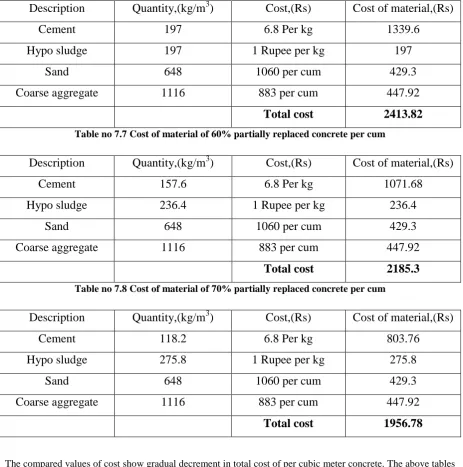
Table no 7.6 Cost of material of 50% partially replaced concrete per cum
Description
Quantity,(kg/m
3)
Cost,(Rs)
Cost of material,(Rs)
Cement
197
6.8 Per kg
1339.6
Hypo sludge
197
1 Rupee per kg
197
Sand
648
1060 per cum
429.3
Coarse aggregate
1116
883 per cum
447.92
Total cost
2413.82
Table no 7.7 Cost of material of 60% partially replaced concrete per cum
Description
Quantity,(kg/m
3)
Cost,(Rs)
Cost of material,(Rs)
Cement
157.6
6.8 Per kg
1071.68
Hypo sludge
236.4
1 Rupee per kg
236.4
Sand
648
1060 per cum
429.3
Coarse aggregate
1116
883 per cum
447.92
Total cost
2185.3
Table no 7.8 Cost of material of 70% partially replaced concrete per cum
Description
Quantity,(kg/m
3)
Cost,(Rs)
Cost of material,(Rs)
Cement
118.2
6.8 Per kg
803.76
Hypo sludge
275.8
1 Rupee per kg
275.8
Sand
648
1060 per cum
429.3
Coarse aggregate
1116
883 per cum
447.92
Total cost
1956.78
The compared values of cost show gradual decrement in total cost of per cubic meter concrete. The above tables
show cost values up to 30% replacement and the difference in cost from normal concrete to partially replaced
concrete was 685.56 Rs
VIII CONCLUSIONS
Based on limited experimental investigation concerning the compressive
And split tensile strength of concrete, the following observations are made regarding the resistance of partially
replaced hypo sludge:
1) Compressive strength of the concrete can be increased when the Percentage of replacement is increased up to
766 |
P a g e
2) The split tensile strength of concrete has decreased when the percentage of the replacement with hypo sludge
is increased.
3) Use of hypo sludge in concrete can save the paper industry disposal costs and produces a greener’ concrete
for construction.
4) Disposal problem of the hypo sludge can be minimized by this project now days as it is a big problem of
getting the landfill.
5) Environmental effects from wastes and residual amount of cement manufacturing can be reduced through this
low cost concrete.
6) From this level, replacement of cement with this waste of hypo sludge Material provides maximum
compressive strength at 30% replacement
7) Cost of cement has become low from this project.
8) A better measure by a New Construction Materialis formed out through this project.
9) The cost analysis indicates that percentage of cement reduction decreases the cost of concrete, but at the same
time the strength also decreases beyond optimum addition of 30% hypo sludge.
10) This research concludes that hypo sludge can be innovative supplementary Cementitious Construction
Material
REFERENCE
[1] Udoeyo F.F., Inyang H., Young D.T., Oparadu Ed.E., Potential of Wood Waste Ash As an Additive in
Concrete. J. of Msater. in Civil Engng., ASCE, 605-612 (2006).
[2] Shi Cong Kou, Chi Sun Poon, Dixon Chan, Influence of Fly Ash as Cement replacement on the Properties of
Recycled Aggregate Concrete. J. of Mater. InCivil Engng. ASCE, 709 (2007)
[3] Ganesan K., Rajagopal K., Thangavelu K., Effects of the Partial Replacement of Cement with Agro Waste Ashes on Strength and Durability of Concrete. Proc.of Internat. Conf. on Recent Adv. in Concrete a.
Constr. Technol., organised byDept. of Civil Engng, S.R.M. Engng. College, Chennai, Dec. 7-9, 2005.
[4] Specifications for Coarse and Fine Aggregates from Natural Sources for concrete. Bureau of Indian
Standards, New Delhi, IS 383 -1970.
[5] IS Method of Mix Design. Bureau of Indian Standards, New Delhi, IS 10262–2009.
[6] Concrete Technology by M.S SHETTY.
[7] Properties of concrete by Neville A.M – ELBIS Edition, Long man ltd London
[8] Methods of Tests for Strength of Concrete. Bureau of Indian Standards, New Delhi, IS 516 –1959.
[9] Code of Practice for Plain and Reinforced Concrete. Bureau of Indian Standards, New Delhi, IS 456 -2000. [10] Jayraj Vinodsinh Solanki GRA - GLOBAL RESEARCH ANALYSIS X 40 Volume : 2 | Issue : 1 | Jan