c
Owned by the authors, published by EDP Sciences, 2017
Physical models from noncommutative causality
Nicolas Franco1,2,a
1Namur Center for Complex Systems (naXys) & Department of Mathematics, University of Namur, rue de Bruxelles 61, 5000 Namur, Belgium
2Copernicus Center for Interdisciplinary Studies, ul. Sławkowska 17, 31-016 Kraków, Poland
Abstract. We introduced few years ago a new notion of causality for noncommutative spacetimes directly related to the Dirac operator and the concept of Lorentzian spec-tral triple. In this paper, we review in a non-technical way the noncommutative causal structure of many toy models as almost commutative spacetimes and the Moyal-Weyl spacetime. We show that those models present some unexpected physical interpretations as a geometrical explanation of the Zitterbewegung trembling motion of a fermion as well as some geometrical constraints on translations and energy jumps of wave packets on the Moyal spacetime.
1 Introduction
We call noncommutative causality the introduction of a causal order on noncommutative spacetimes. Such an order should exactly correspond to the traditional notion of causality when noncommutativity is removed. The establishment of a well-defined notion of causality on noncommutative spacetimes is clearly not obvious. As an example, the traditional tools of noncommutative quantum field theory fail to define a valid causal structure (without violation) on the Moyal spacetime [1–3]. However, the theory of noncommutative geometry based on spectral triples and initially developed by Connes [4, 5] allows us to define a valid notion of causality which can be applied on several physical models. Such a notion of causality requires an extension of the theory to spaces with Lorentzian signatures, called Lorentzian noncommutative geometry, which we review in the next section. Then, we present some results obtained on three different physical models: the first two one are almost commutative
spacetimes and correspond to some partial models coming from the noncommutative Standard Model of particle physics [6] and the last one is the well-known Moyal-Weyl spacetime using the noncom-mutative-product and canonical commutation relations.
2 Lorentzian Spectral Triple and noncommutative causality
Traditional tools for (Riemannian) noncommutative geometry are spectral triples (A,H,D). In Lorentzian noncommutative geometry, they are replaced by Lorentzian spectral triples. The exact set of axioms of Lorentzian spectral triples is still an active research subject, but the current propos-als have many similarities [7–10]. We present here the version proposed in [11] since it is the most suitable for guaranteeing the existence of a causal structure.
A Lorentzian spectral triple is given by the data (A,A,H,D,J) with: • A Hilbert spaceH,
• A non-unital dense∗-subalgebraAof aC∗-algebra, with a faithful representation onH,
• A preferred unitizationAofA, which is also a dense∗-subalgebra of aC∗-algebra, with a faithful representation onHand such thatAis an ideal ofA,
• An unbounded operatorD, densely defined onH, such that: – ∀a∈A, [D,a] extends to a bounded operator onH,
– ∀a∈ A,a(1+D2)−21 is compact, withD2= 12(DD∗+D∗D),
• A bounded operatorJonHwithJ2=1,J∗=J, [J,a]=0,∀a∈Aand such that: – D∗=−JDJon Dom(D)=Dom(D∗)⊂ H,
– there exist a densely defined self-adjoint operatorT with Dom(T)∩Dom(D) dense inH and with1+T2−
1 2
∈A, and a positive elementN∈Asuch thatJ=−N[D,T].
We say that a Lorentzian spectral triple is even if there exists aZ2-gradingγofH such thatγ∗ =γ,
γ2 =1, [γ,a]=0∀a∈A,γJ=−JγandγD=−Dγ.
The operatorJis called the fundamental symmetry. Its role is to turn the positive definite inner product of the Hilbert space·,·into an indefinite inner product (·,·)=·,J·(Krein space [12]). In fact, the natural inner product for the spinors on a Lorentzian spin manifold is the indefinite one, and the Hilbert space can be constructed using the fundamental symmetry·,·=(·,J·). The traditional condition onDto be selfadjoint is recovered here by requestingDto be skew-selfadjoint within the Krein space (D·,·)=(·,−D·) which is equivalent to requestD∗ =−JDJonH [13]. However, for a too general operatorJ, the signature can correspond to a pseudo-Riemannian one [8]. Hence we impose here the additional conditionJ=−N[D,T] which guarantees that the signature is Lorentzian
[9, 11].
Let us see what happens to this definition when the algebra is commutative. If we consider a locally compact complete1globally hyperbolic spacetimeMof dimensionnwith a spin structureS,
then we can always construct a commutative Lorentzian spectral triple in the following way:
• HM = L2(M,S) is the Hilbert space of square integrable sections of the spinor bundle overM (using the positive definite inner product on the spinor bundle),
• DM=−i(ˆc◦ ∇S)=−ieaµγa∇Sµis the Dirac operator2associated with the spin connection∇S, • AM⊂C∞0(M) andAM⊂C∞b(M) with pointwise multiplication are some appropriate sub-algebras
of the algebra of smooth functions vanishing at infinity and the algebra of smooth bounded functions respectively, withAMbeing be such that∀a∈A, [D,a] extends to a bounded operator onH, • JM=iγ0, whereγ0is the first flat gamma matrix.
Ifnis even, thenγis given by the chirality operator.
1By complete we understand the following: Let us consider the split metric of the globally hyperbolic spacetime
g=−N2d2T+g
T, thenMis complete under the Riemannian metricgR=N2d2T+gT.
2Conventions used in the paper are (−,+,+,+,· · ·) for the signature of the metric and{γa, γb}=2ηabfor the flat gamma
matrices, withγ0anti-Hermitian andγaHermitian fora>0.e µ
A Lorentzian spectral triple is given by the data (A,A,H,D,J) with: • A Hilbert spaceH,
• A non-unital dense∗-subalgebraAof aC∗-algebra, with a faithful representation onH,
• A preferred unitizationAofA, which is also a dense∗-subalgebra of aC∗-algebra, with a faithful representation onHand such thatAis an ideal ofA,
• An unbounded operatorD, densely defined onH, such that: – ∀a∈A, [D,a] extends to a bounded operator onH,
– ∀a∈ A,a(1+D2)−21 is compact, withD2= 12(DD∗+D∗D),
• A bounded operatorJonHwithJ2=1,J∗=J, [J,a]=0,∀a∈Aand such that: – D∗=−JDJon Dom(D)=Dom(D∗)⊂ H,
– there exist a densely defined self-adjoint operatorT with Dom(T)∩Dom(D) dense in H and with1+T2−
1 2
∈A, and a positive elementN∈Asuch thatJ=−N[D,T].
We say that a Lorentzian spectral triple is even if there exists aZ2-gradingγofHsuch thatγ∗=γ,
γ2=1, [γ,a]=0∀a∈A,γJ=−JγandγD=−Dγ.
The operatorJis called the fundamental symmetry. Its role is to turn the positive definite inner product of the Hilbert space·,·into an indefinite inner product (·,·)=·,J·(Krein space [12]). In fact, the natural inner product for the spinors on a Lorentzian spin manifold is the indefinite one, and the Hilbert space can be constructed using the fundamental symmetry·,·=(·,J·). The traditional condition onDto be selfadjoint is recovered here by requestingDto be skew-selfadjoint within the Krein space (D·,·)=(·,−D·) which is equivalent to requestD∗ =−JDJ onH [13]. However, for a too general operatorJ, the signature can correspond to a pseudo-Riemannian one [8]. Hence we impose here the additional conditionJ=−N[D,T] which guarantees that the signature is Lorentzian
[9, 11].
Let us see what happens to this definition when the algebra is commutative. If we consider a locally compact complete1globally hyperbolic spacetimeMof dimensionnwith a spin structureS,
then we can always construct a commutative Lorentzian spectral triple in the following way:
• HM = L2(M,S) is the Hilbert space of square integrable sections of the spinor bundle overM (using the positive definite inner product on the spinor bundle),
• DM =−i(ˆc◦ ∇S)=−ieaµγa∇Sµis the Dirac operator2associated with the spin connection∇S, • AM⊂C∞0(M) andAM⊂C∞b(M) with pointwise multiplication are some appropriate sub-algebras
of the algebra of smooth functions vanishing at infinity and the algebra of smooth bounded functions respectively, withAMbeing be such that∀a∈A, [D,a] extends to a bounded operator onH, • JM=iγ0, whereγ0is the first flat gamma matrix.
Ifnis even, thenγis given by the chirality operator.
1By complete we understand the following: Let us consider the split metric of the globally hyperbolic spacetime
g=−N2d2T+g
T, thenMis complete under the Riemannian metricgR=N2d2T+gT.
2Conventions used in the paper are (−,+,+,+,· · ·) for the signature of the metric and{γa, γb}=2ηabfor the flat gamma
matrices, withγ0anti-Hermitian andγaHermitian fora>0.e µ
a stand for vierbeins.
Our goal is to characterize the natural causal order between the points ofM. By causal order, we mean that two points are causally related, with p q, if and only if there is a future directed causal curve fromptoq, i.e. a curve whose tangent vector is causal (almost)-everywhere. This idea is purely geometric and needs to be algebraized using the elements of a Lorentzian spectral triple. The solution comes from the notion of smooth causal functions, which are the smooth real-valued functions non-decreasing along every future directed causal curve. SinceMis globally hyperbolic, the causal structure is completely determined by the cone of smooth causal functionsCin the following way [14]:
∀p,q∈ M, pq⇔ ∀f ∈ C, f(p)≤ f(q). (1) The causal functions f have a necessary and sufficient characterization in term of the Dirac operator
and the fundamental symmetry with the condition [15] (see also [16] for a shorter proof):
∀φ∈ H,φ,J[D,f]φ ≤0. (2)
Since noncommutative spacetimes are non-local, hence pointless, we need an alternative definition of the notion of point. Thanks to Gelfand’s theory, we can use the concept of pure states on the algebra A(and their extension to the unitizationA) as our points on noncommutative spacetimes since their are in one-to-one correspondence with the points of the manifold in the commutative case using the evaluation mapξ∼pif and only if∀f ∈A, ξ(f)= f(p). Hence we can use the following definition
of a causal structure for an arbitrary Lorentzian spectral triple:
∀χ, ξ∈P(A), χξ ⇐⇒ ∀a∈ C, χ(a)≤ξ(a), (3)
withC=a∈A | a=a∗,∀φ∈ H φ,J[D,a]φ ≤0. (4) When the Lorentzian spectral triple is commutative and constructed from a globally hyperbolic spacetime (or even a causally simple spacetime [17]), the relationcorresponds to the usual causal relation onM(the unitization process adds some extra points located at infinity which can just be ignored). This definition can be naturally extended to non-pure states on the algebra, which can represent non-local events or wave packets [18, 19].
3 First model: The almost commutative spacetime
M ×
M
2(
C
)
Almost commutative spacetimes are a tool to naturally integrate gauge theories to usual spacetimes using noncommutative geometry. It is a kind of Kaluza-Klein product between a continuous space and a discrete space. The continuous space (AM,AM,HM,DM,JM) is a commutative even Lorentzian spectral triple representing the spacetimeMwhile the finite space (AF,HF,DF) is built from a non-commutative discrete algebraAF. The product space is defined as:
A=AM⊗ AF, A=AM⊗ AF, H=HM⊗HF, D=DM⊗1+γM⊗DF, J=JM⊗I. (5)
If the finite algebra is chosen to beAF =Mn(C), the inner automorphisms of the discrete part of the model behave as the gauge groupU(n). From this statement comes the noncommutative Standard Model where the discrete space is chosen in order to reproduce the groupsU(1)×S U(2)×S U(3) [6]. For this first model, we define an almost commutative spacetime integrating aU(2) gauge field constructed asAF = M2(C),HF =C2 andDF =diag(d1,d2) withd1,d2 ∈ R,d1 d2. In order to
specific pure state on the product spacetime can be identified byωp,ξwithp∈ Mandξ∈S2 so the
product spacetimes is point by point equivalent to the cartesian product ofMand a sphere.
Then we have the following result coming from [20]: Two pure statesωp,ξ andωq,ϕare causally
related, withωp,ξ ωq,ϕ, if and only if:
• pq(hence there is no causality violation onM),
• They are located on the same parallel of latitude onS2 (henceξandϕcan be described by the variation of they angleθϕ−θξon the given parallel),
• τ(γ)≥ |θϕ−θξ|
|d1−d2| whereτ(γ) represents the proper time of a particle moving along a curveγ: p→ q
(cf. Figure 1).
Figure 1.Representation of the causal relations on the almost commutative spacetimeM ×M2(C)
This first model is a completely toy-model with no direct physical application, except that it can be considered, up to a reduction to the special group, as a part of the noncommutative Standard Model. However, the obtained constraint on the proper time has a physical interpretation as a maximal speed (a kind of speed of light limit) within the internal space. Indeed, sinceθϕ−θξis a distance on the
parallel, we have a fixed boundary for the internal speed:
θϕ−θξ
τ(γ) ≤ |d1−d2| (6)
entirely defined by the eigenvalues of the finite Dirac operator. Such an internal speed of light limit is recurring among models of noncommutative causality.
4 Second model: The two-sheeted spacetime
The second model is also an almost commutative spacetime but where the discrete algebraAF is
reduced to the simple non-trivial one: AF = C⊕C. Here the internal space is reduced to two
separated points and the product space is just two exact copies of the spacetimeM.AFis represented
onHF =C2andDF =m0∗m0
is just defined by a parameterm∈Cwhere 1
|m| represents the distance
between the two points.
Then we have a similar result than for theM×M2(C) model [21]: The causal structure is preserved on each sheet and two pointspandqon separated sheets (+,−) are causally related with p qif
and only if:
• They are causally related if considered on the same sheet (pq), • τ(γ) ≥ π
2|m| whereτ(γ) represents the proper time of a particle moving along a curveγ : p → q
specific pure state on the product spacetime can be identified byωp,ξwithp ∈ Mandξ∈S2so the
product spacetimes is point by point equivalent to the cartesian product ofMand a sphere.
Then we have the following result coming from [20]: Two pure statesωp,ξandωq,ϕare causally
related, withωp,ξ ωq,ϕ, if and only if:
• pq(hence there is no causality violation onM),
• They are located on the same parallel of latitude onS2 (henceξ andϕcan be described by the variation of they angleθϕ−θξon the given parallel),
• τ(γ)≥ |θϕ−θξ|
|d1−d2| whereτ(γ) represents the proper time of a particle moving along a curveγ: p→ q
(cf. Figure 1).
Figure 1.Representation of the causal relations on the almost commutative spacetimeM ×M2(C)
This first model is a completely toy-model with no direct physical application, except that it can be considered, up to a reduction to the special group, as a part of the noncommutative Standard Model. However, the obtained constraint on the proper time has a physical interpretation as a maximal speed (a kind of speed of light limit) within the internal space. Indeed, sinceθϕ−θξis a distance on the
parallel, we have a fixed boundary for the internal speed:
θϕ−θξ
τ(γ) ≤ |d1−d2| (6)
entirely defined by the eigenvalues of the finite Dirac operator. Such an internal speed of light limit is recurring among models of noncommutative causality.
4 Second model: The two-sheeted spacetime
The second model is also an almost commutative spacetime but where the discrete algebraAF is
reduced to the simple non-trivial one: AF = C⊕C. Here the internal space is reduced to two
separated points and the product space is just two exact copies of the spacetimeM.AFis represented
onHF =C2andDF =m0∗m0
is just defined by a parameterm∈Cwhere 1
|m| represents the distance
between the two points.
Then we have a similar result than for theM×M2(C) model [21]: The causal structure is preserved on each sheet and two pointspandqon separated sheets (+,−) are causally related with p qif
and only if:
• They are causally related if considered on the same sheet (pq), • τ(γ) ≥ π
2|m| whereτ(γ) represents the proper time of a particle moving along a curveγ : p → q
(cf. Figure 2).
Figure 2.Representation of the causal relations on the two-sheeted spacetime
M ×C2
Once more we recover an internal speed of light limit related to the distance between the two sheets. Of course a pure state does not "jump" from one sheet to another, but goes continuously through a path of mixed-states. This model can easily be extended to a non-constant distance between the sheets with the introduction of a scalar fieldψreplacingm. Such a scalar field has the behavior of a
Higgs field in almost commutative models [5, 6]. Indeed, the internal speed of light limit is preserved but the proper time is now computed using the Higgs field as a kind of weight:
τψ(γ)= q
p ds|ψ|
−g(˙γ,γ˙)≥ π2. (7)
The question is now: can such a model correspond to some specific physical phenomenon, where a particle is able to switch between two given states (+,−) but with a constraint on the rate of change? As shown in [22], the answer is given by the "Zitterbewegung". Zitterbewegung, which means "trembling motion", is a rapid oscillation of the value of the velocity and position operator of a fermion obeying the Dirac equation [23]. There exist two interpretations of this movement: an oscillation between positive and negative energy states [24] or an oscillation in chirality [25, 26]. It has been simulated twice [27–29], with a period of oscillation for a free particle given by:
TZB=mcπ2. (8)
Our two-sheeted spacetime can be used directly to model the Zitterbewegung behavior, assuming the oscillations occur between the two sheets. We can equip our almost commutative spacetime with the fermionic action:
SF =ψ,JDψ=
M
ψ∗+DMψ++ψ∗−DMψ−+m(ψ∗+ψ−+ψ∗−ψ+) (9)
where we make the distinction between the chirality eigenstatesψ±. This is the action describing a
single Dirac fermion of massmpropagating in a curved spacetimeM. If we restore the physical dimensions on the causality constraint, we get:
(p,+)(q,−) ⇐⇒ pq and τ(γ)≥2π |m|c2 =
TZB
2 (10)
where we recover the exact frequency of the Zitterbewegung (8).
Besides describing in a geometrical way the Zitterbewegung effect on a curved spacetime, the two-sheeted model can go one step ahead. Indeed, we can introduce the inner fluctuations of the Dirac operator [21]:
DA =(DM+γµAµ)⊗1+γM⊗ 0 ψ
ψ∗0
. (11)
The additional vector field Aµ has absolutely no impact on the causality constraint (10) while the
observable impact from a variation of the mass of the particle, which should be of the order 10−20s,
while the model predicts that there should be no impact from an electromagnetic field.
However, on can point the fact that the frequency of the Zitterbewegung for a free particle is exactly recovered while taking the maximal speed inside the internal space, as if the particle was forced to follow the maximal speed. This could bring us to rethink about the interpretation of particles in almost commutative models. Indeed, a similar result is obtained in [30] where a two-sheeted flat spacetime is used in order to study the energy-momentum dispersion relation in a noncommutative geometrical way. It is shown that the boundary of the causal conditionτ(γ) = 2π|m| reproduces the
relativistic energy-momentum relation for massive and massless fermions, but not when the inequality is relaxed.
So why not making a new postulate that, on almost commutative spacetimes, every particles should "move" at a maximal constant speed c, where this speed is calculated from a kind of pythagorean relation between the continuous spacetime and the internal space. If we adopt such a postulate, then massive particles on almost commutative spacetimes can move freely on the contin-uous spacetime, at a speed with value between zero and strictly less than the light speed, while the "remaining speed" is performed at the level of the internal space, giving the trembling motion of Zit-terbewegung as well as the relationE2=(pc)2+(mc2)2wherepccorresponds to some energy on the
continuous space whilemc2 is the energy on the internal space (hence the energy at rest, as a direct
consequence of the Higgs fieldm=ψ, with a completely geometrical origin). Also for massless
par-ticles, the postulate automatically implies a constant speedcon the continuous spacetime, since the internal space is then reduced to disconnected points and does not allow any movement, as well as the energy relationE = pc. However, two models are certainly too few to have any validation of such a
postulate, but this could help us in the future to better understand almost commutative spacetimes and make a potential distinction between physical phenomena and mathematical behaviors coming only from the models.
5 Third model: The Moyal spacetime
The Moyal-Weyl spacetime is a very interesting space on a physical point of view since the non-commutativity given by the star product is total and reproduces the canonical commutation relation [xµ,xν]=iθ. Also, the pure states are naturally non-local and we don’t need to go to the mixed-states to introduce wave packets. Moreover, Moyal planes fit very well into spectral triples formalism [31]. For this model we consider a two-dimensional Minkowski spacetimeR1,1with the following
non-commutative Lorentzian spectral triple: H = L2(R1+1)⊗C2 with the usual positive definite inner
product,Ais the space of Schwartz functionsS(R1,1) with the-product defined as:
(f g)(x) := 1
(πθ)2
d2yd2z f(x+y)g(x+z)e−2iyµΘ−1
µνzν, (12)
withΘµν :=θ 0 1
−1 0
, the unitizationA=(B, ) is the unital algebra of smooth functions which are
bounded together with all derivatives,D=−i∂µ⊗γµis the usual flat Dirac operator whereγ0=iσ1, γ1 =σ2are the flat Dirac matrices andJ=iγ0is the fundamental symmetry.
Functions and states on the Moyal spacetime can be easily described using as orthonormal basis the Wigner eigenfunctions of the two-dimensional harmonic oscillatora=mnamnfmnwhere:
fmn= 1 (θm+nm!n!)1/2z
m f
00znwith z= x0√+ix1
2 andf00 =2e −x20+x21
observable impact from a variation of the mass of the particle, which should be of the order 10−20s, while the model predicts that there should be no impact from an electromagnetic field.
However, on can point the fact that the frequency of the Zitterbewegung for a free particle is exactly recovered while taking the maximal speed inside the internal space, as if the particle was forced to follow the maximal speed. This could bring us to rethink about the interpretation of particles in almost commutative models. Indeed, a similar result is obtained in [30] where a two-sheeted flat spacetime is used in order to study the energy-momentum dispersion relation in a noncommutative geometrical way. It is shown that the boundary of the causal conditionτ(γ) = 2|πm| reproduces the relativistic energy-momentum relation for massive and massless fermions, but not when the inequality is relaxed.
So why not making a new postulate that, on almost commutative spacetimes, every particles should "move" at a maximal constant speed c, where this speed is calculated from a kind of pythagorean relation between the continuous spacetime and the internal space. If we adopt such a postulate, then massive particles on almost commutative spacetimes can move freely on the contin-uous spacetime, at a speed with value between zero and strictly less than the light speed, while the "remaining speed" is performed at the level of the internal space, giving the trembling motion of Zit-terbewegung as well as the relationE2=(pc)2+(mc2)2wherepccorresponds to some energy on the continuous space whilemc2 is the energy on the internal space (hence the energy at rest, as a direct consequence of the Higgs fieldm=ψ, with a completely geometrical origin). Also for massless
par-ticles, the postulate automatically implies a constant speedcon the continuous spacetime, since the internal space is then reduced to disconnected points and does not allow any movement, as well as the energy relationE = pc. However, two models are certainly too few to have any validation of such a postulate, but this could help us in the future to better understand almost commutative spacetimes and make a potential distinction between physical phenomena and mathematical behaviors coming only from the models.
5 Third model: The Moyal spacetime
The Moyal-Weyl spacetime is a very interesting space on a physical point of view since the non-commutativity given by the star product is total and reproduces the canonical commutation relation [xµ,xν]=iθ. Also, the pure states are naturally non-local and we don’t need to go to the mixed-states
to introduce wave packets. Moreover, Moyal planes fit very well into spectral triples formalism [31]. For this model we consider a two-dimensional Minkowski spacetimeR1,1with the following non-commutative Lorentzian spectral triple: H = L2(R1+1)⊗C2 with the usual positive definite inner
product,Ais the space of Schwartz functionsS(R1,1) with the-product defined as:
(f g)(x) := 1 (πθ)2
d2yd2z f(x+y)g(x+z)e−2iyµΘ−1
µνzν, (12)
withΘµν :=θ 0 1
−1 0
, the unitizationA=(B, ) is the unital algebra of smooth functions which are bounded together with all derivatives,D=−i∂µ⊗γµis the usual flat Dirac operator whereγ0=iσ1,
γ1=σ2are the flat Dirac matrices andJ=iγ0is the fundamental symmetry.
Functions and states on the Moyal spacetime can be easily described using as orthonormal basis the Wigner eigenfunctions of the two-dimensional harmonic oscillatora=mnamnfmnwhere:
fmn= 1
(θm+nm!n!)1/2z
m f
00znwith z= x0√+ix1
2 andf00 =2e
−x20+x21
θ . (13)
The pure states are all the normalized vector states on the matrix representation:
ωψ(a)=2πθ
m,n
ψ∗mamnψn, 2πθ
m
|ψm|2=1. (14)
Since the amount of vector states is huge, we need to restrict to some particular kinds of pure states. In a first time, we only consider the coherent states, which are the vector states defined, for any
κ∈C, by:
ϕm= √1
2πθe −|κ|2
2θ κ m
√
m!θm. (15)
The coherent states correspond to the possible translations under the complex scalar √2κof the ground state|0of the harmonic oscillator, using the correspondenceκ∈CR1,1. They are the states that minimize the uncertainty equally distributed in position and momentum. The classical limit of the coherent states, whenθ→0, corresponds to the usual pure states onR1,1, hence to the points of the usual Minkowski spacetime [32].
For the coherent states, we find the following causal structure [33]: Let us suppose that two coherent statesωξ, ωϕare defined by the two complex scalarsκ1, κ2 ∈ C, then those coherent states are causally related, withωξωϕ, if and only if∆κ=κ2−κ1is inside the convex cone ofCdefined byλ= 1√+i
2 andλ= 1√−i2 (i.e. the argument of∆κis within the interval [−
π
4,π4], cf. Figure 3).
Figure 3.Representation of the causal relations by translation between coherent states on the Moyal spacetime
Hence, with the identification betweenCandR1,1, we recover the exact future and past light cones of Minkowski, but with the difference that we do not consider movements of points but translations of Gaussian functions. Hence we are naturally dealing with non-local states. In such a case, we can define a kind of "time direction" as translations under positive real scalarsκ.
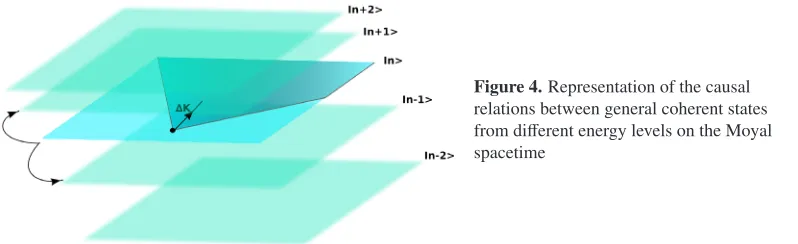
However, the ground state|0is not the only one which can be translated, since every energy level |nproduces a similar causal structure. Those translations of the basic eigenstates of the harmonic oscillator, which we can writeακ|nfor aκtranslation, are called generalized coherent states. Hence,
those states behave like a infinite number of copies of the Minkowski spacetime. The study of the complete causal structure of the generalized coherent states, and especially the causal relations be-tween the different energy levels, is a work in progress and will be the subject of a future paper, but we can already mention the following nice result:
If∆κ∈Ris such that:
∆κ≥π2
θ
2 1 √
n+1, (16)
then|n α∆κ|n+1and|n+1 α∆κ|n.
Hence we recover a similar result than for the two-sheeted model which is reproduced between each pair of energy level (the causal relations between every sheet is deduced by transitivity) with a distance between consecutive energy levels|nand|n+1being equal to
√
θ
√
Figure 4.Representation of the causal relations between general coherent states from different energy levels on the Moyal
spacetime
When taking the limitθ→0, we recover the usual causality on Minkowski with all sheets merged and usual translations of points.
This model represents in a completely geometrical way waves packets under causal translations with a lower bound on time in order to change the energy level. However, the testability of this lower bound is out of sight since it should be of the order of the Plank time, which is somehow logical from a quantum point of view.
References
[1] O.W. Greenberg, Physical Review D73, 045014 (2006),hep-th/0508057 [2] M.A. Soloviev, Physical Review D77, 125013 (2008),0802.0997
[3] A.P. Balachandran, A. Joseph, P. Padmanabhan, Foundations of Physics 40, 692 (2010), 0905.0876
[4] A. Connes,Noncommutative Geometry(Academic Press, San Diego, 1994), ISBN 978-0-1218-5860-5
[5] A. Connes, M. Marcolli,Noncommutative Geometry, Quantum Fields and Motives, Vol. 55 of Colloquium Publications(American Mathematical Society, 2008), ISBN 978-0-8218-4210-2 [6] K. van den Dungen, W.D. van Suijlekom, Reviews in Mathematical Physics24, 1230004 (2012),
1204.0328
[7] M. Paschke, A. Sitarz (2006), preprint arXiv:math-ph/0611029
[8] K. van den Dungen, M. Paschke, A. Rennie, Journal of Geometry and Physics73, 37 (2013), 1207.2112
[9] N. Franco, Reviews in Mathematical Physics26, 1430007 (2014),1210.6575 [10] F. Besnard, N. Bizi, Journal of Geometry and Physics (2017),1611.07830
[11] N. Franco, M. Eckstein, inMathematical Structures of the Universe, edited by M. Eckstein, M. Heller, S. Szybka (Copernicus Center Press, 2014), pp. 315–340, ISBN 978-8-3788-6107-2, 1409.1480
[12] J. Bognár,Indefinite Inner Product Spaces(Springer, 1974), ISBN 978-3-642-65569-2 [13] A. Strohmaier, Journal of Geometry and Physics56, 175 (2006),math-ph/0110001 [14] F. Besnard, Journal of Geometry and Physics59, 861 (2009),0804.3551
[15] N. Franco, M. Eckstein, Classical and Quantum Gravity30, 135007 (2013),1212.5171 [16] N. Franco (2017), preprint arXiv:1710.10959
[17] E. Minguzzi (2017), preprint arXiv:1709.06494
Figure 4.Representation of the causal relations between general coherent states from different energy levels on the Moyal
spacetime
When taking the limitθ→0, we recover the usual causality on Minkowski with all sheets merged and usual translations of points.
This model represents in a completely geometrical way waves packets under causal translations with a lower bound on time in order to change the energy level. However, the testability of this lower bound is out of sight since it should be of the order of the Plank time, which is somehow logical from a quantum point of view.
References
[1] O.W. Greenberg, Physical Review D73, 045014 (2006),hep-th/0508057 [2] M.A. Soloviev, Physical Review D77, 125013 (2008),0802.0997
[3] A.P. Balachandran, A. Joseph, P. Padmanabhan, Foundations of Physics 40, 692 (2010), 0905.0876
[4] A. Connes,Noncommutative Geometry(Academic Press, San Diego, 1994), ISBN 978-0-1218-5860-5
[5] A. Connes, M. Marcolli,Noncommutative Geometry, Quantum Fields and Motives, Vol. 55 of Colloquium Publications(American Mathematical Society, 2008), ISBN 978-0-8218-4210-2 [6] K. van den Dungen, W.D. van Suijlekom, Reviews in Mathematical Physics24, 1230004 (2012),
1204.0328
[7] M. Paschke, A. Sitarz (2006), preprint arXiv:math-ph/0611029
[8] K. van den Dungen, M. Paschke, A. Rennie, Journal of Geometry and Physics73, 37 (2013), 1207.2112
[9] N. Franco, Reviews in Mathematical Physics26, 1430007 (2014),1210.6575 [10] F. Besnard, N. Bizi, Journal of Geometry and Physics (2017),1611.07830
[11] N. Franco, M. Eckstein, inMathematical Structures of the Universe, edited by M. Eckstein, M. Heller, S. Szybka (Copernicus Center Press, 2014), pp. 315–340, ISBN 978-8-3788-6107-2, 1409.1480
[12] J. Bognár,Indefinite Inner Product Spaces(Springer, 1974), ISBN 978-3-642-65569-2 [13] A. Strohmaier, Journal of Geometry and Physics56, 175 (2006),math-ph/0110001 [14] F. Besnard, Journal of Geometry and Physics59, 861 (2009),0804.3551
[15] N. Franco, M. Eckstein, Classical and Quantum Gravity30, 135007 (2013),1212.5171 [16] N. Franco (2017), preprint arXiv:1710.10959
[17] E. Minguzzi (2017), preprint arXiv:1709.06494
[18] M. Eckstein, T. Miller, Annales Henri Poincaré18, 3049 (2017),arXiv:1510.06386
[19] M. Eckstein, T. Miller, Phys. Rev. A95, 032106 (2017),arXiv:1610.00764
[20] N. Franco, M. Eckstein, Symmetry, Integrability and Geometry: Methods and Applications10, 010 (2014), special Issue on Noncommutative Geometry and Quantum Groups in honor of Marc A. Rieffel,1310.8225
[21] N. Franco, M. Eckstein, Journal of Geometry and Physics96, 42 (2015),1502.04683 [22] M. Eckstein, N. Franco, T. Miller, Phys. Rev. D95, 061701R (2017),1610.10083
[23] E. Schrödinger, Sitzungsberichte der Preubetaischen Akademie der Wissenschaften. Physikalisch-mathematische Klasse24, 418 (1930)
[24] B. Thaller,The Dirac Equation, Vol. 31 of Theoretical and Mathematical Physics (Springer-Verlag Berlin, 1992), ISBN 978-3-662-02753-0
[25] S. De Leo, P. Rotelli, International Journal of Theoretical Physics 37, 2193 (1998), hep-ph/9605255
[26] A.E. Bernardini, The European Physical Journal C-Particles and Fields 50, 673 (2007), hep-th/0701091
[27] L. LeBlanc, M. Beeler, K. Jiménez-García, A. Perry, S. Sugawa, R. Williams, I. Spielman, New Journal of Physics15, 073011 (2013),1303.0914
[28] R. Gerritsma, G. Kirchmair, F. Zaehringer, E. Solano, R. Blatt, C. Roos, Nature463, 68 (2010), 0909.0674
[29] F. Dreisow, M. Heinrich, R. Keil, A. Tünnermann, S. Nolte, S. Longhi, A. Szameit, Physical Review Letters105, 143902 (2010)
[30] A. Watcharangkool, M. Sakellariadou, Phys. Rev. D95, 025027 (2017),1611.05810
[31] V. Gayral, J. Gracia-Bondía, B. Iochum, T. Schücker, J. Várilly, Communications in Mathemat-ical Physics246, 569 (2004),hep-th/0307241
[32] P. Martinetti, L. Tomassini, Communications in Mathematical Physics 323, 107 (2013), 1110.6164