1608 | P a g e
A Review on Thermal Unit Commitment using
Optimization Techniques
Er. Sukhpal Singh
Assistant Professor, SUSCET, Tangori (Mohali),Punjab, (India)
ABSTRACT
In an interconnected power system, the power requirement is mainly supplied by thermal power plants. Load
patterns exhibits utmost variation between peak and off-peak hours. So, there is need of sufficient energy
generation to meet the exacerbate energy demand. The problem confronting the system operator is to determine
which unit should be taken offline and for how long or in other words scheduling of thermal units.
Therefore, thermal unit commitment problem (TUCP) is defined as committing some enough units to supply a
power to network or a system with respect to load demand optimally. It is mixed integer non-linear optimization
problem subjected to various constraints. In this paper, various conventional and random search techniques are
discussed for the solution of TUCP
Keywords: Power Requirement, Thermal Unit Commitment, Optimum Commitment
I.INTRODUCTION
In power industry fuel expenses constitute a significant part of overall generation cost. So, it’s being necessary
put some limitation on the usage of fuel for generating power. This can be achieved by proper scheduling of
generating of units termed as unit commitment (UC). Therefore, unit commitment is an essential step in
scheduling and dispatching of electric power [1]. So, UC is forward positive step to make a balance between
generating power and load demand. So broadly UC is defined as committing an enough unit to supply a power
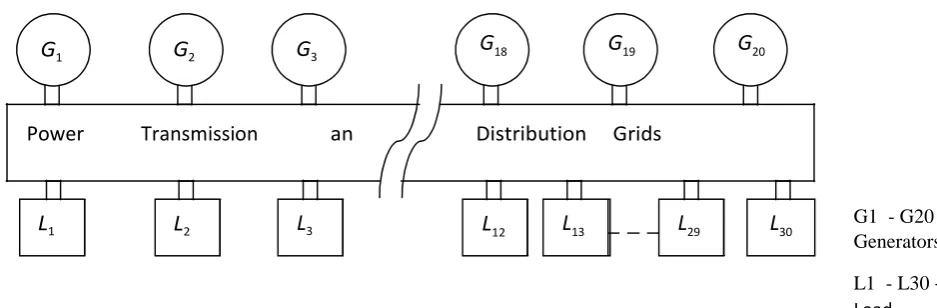
to network or a system with respect to load demand. Consider a simple power system coupled to generating
station or units at one end and consumer end or load end on the other end as shown in figure (1).
Figure 1 A Simple Power System
G
1G
2G
3G
18G
19G
20Power
Transmission
an
d
Distribution Grids
L
1L
2L
3L
12L
13L
29L
30 G1 - G20 –Generators
1609 | P a g e
It means that power system operation is continuously varying with respect to the consumers demand. Thedemand varies between weekdays and weekends and also between peak and off-peak hours. So therefore, it is
not economical to run all the generating units all the time i.e. keeping them online all the time as it gives high
impact to economics [2]. So, UC provides a proper coordination between generating power and its demand.
Ultimately, it’s been concluded that load demand and power reserve requirement are considered as global
constraints and rest all the operating characteristics are the local constraints. It means that unit commitment is
time dependent problem. So therefore, UC is the problem of scheduling of the generating units to keep online or
offline as per the demand of electricity but subjected to various constraints. Various optimization techniques are
applied to solve this problem deterministic techniques branch and bound method (BABM), priority list method
(PLM) and dynamic programming (DP), lagrangian relaxation method (LRM) [3-4]. Out of these PLM, DP and
LRM techniques are mostly used in power plants to solve unit commitment problem. But having a drawback of
being more computational and expensive as the optimization problem grown in both dimensionality and
complexity [5]. Advancement in computation and the searching for better results for complex optimization
problems leads to the development of random search techniques like evolutionary programming (EP), ant
colony search method (ACSM), particle swarm optimization (PSO), genetic algorithm (GA) and simulated
annealing (SA) [6]. Evolutionary programming method has convergence rate to find the global optimum
solution for optimization problems is much better as it than earlier optimization techniques. Moreover, it also
provides fast and more accurate results as close to conventional methods in a reasonable time [7]. So, it can be
easily implemented to practical problems. In Electrical power system unit commitment is nonlinear mixed
integer optimization problem of deciding that which unit should be running to satisfy a demand of
electricity requirement [8]. At one extreme nuclear power plants can provide electricity at low incremental
cost for additional megawatt hour of energy but it has high start-up cost as it is once shutdown it will take
a while to bring back it to a full power. Hydro power plants have high capital cost but low operating cost.
So therefore, it is optimum to make the proper utilization of optimum mix of generation unit to generate
electricity but taking into consideration the local as well as global constraints [9]. Therefore, UC is the
problem of determining the schedule of the generating units to keep online or offline as per the demand of
electricity but subjected to the device as well as the constraints. Unit commitment problem (UCP) resolved
by lot of techniques and number of papers were presented by various researchers pertaining the solution to
UCP. Happ, et al. [10] presents a approach of sub optimizer and optimizer for obtaining the online optimal solution for UCP and require less computation time with satisfaction of operating constraints. Cohen and
Yoshimura [11] presented a technique of branch and bound to find the feasible optimal solution to UCP
with decision variables as start, stop times and generation level of the generating units and implemented
without the incorporation of priority ordering criteria for the generating units. Snyder, et al. [12] suggested
dynamic programming approach to UCP with incorporating of special feature of controlling the
optimization problem size and provides an economic allocation of fuel cost to generating units. Huang, et
al. [13] proposed a combination of logic programming with operating constraints satisfaction and branch
bound technique to provide a flexible and efficient approach to UCP. Chowdhury and Billinton [14]
1610 | P a g e
risks criteria for the feasible solution of UCP for continually varying load demand. Bender decompositionmethod for obtaining the feasible optimal solution to UCP and reactive power and voltage constraints for
confirmed convergence to optimality discussed by Ma and Shahidehpour [15]. Dillon, et al. [16] provides
the method for determining the optimum generating schedule by incorporating some alternations in branch
and bound method for integer programming approach and considering satisfaction of power reserve
constraint. Unit commitment problem can be solved by linear programming approach (LP) [17-18]. Gray
and Sekar [17] discussed a unified approach of LP with direct current network model (DCNM) for solving
UCP and considering power security constraint. Tight description of feasible generating schedules for
solving UCP with LP considering ramp constraint proposed by Ostrowski, et al. [18]. Chang, et al. [19]
presented a mixed integer linear programming (MILP) for solution to UCP of a simple combined cycle
generating model prevailing all the operating constraints satisfaction.
Short term UCP leads to feasible optimum solution considering satisfaction of all operating constraints
using PLM approach suggested by Keong and Teshome [20]. A solution to UCP considering the satisfaction
of all the operating constraints using LRM are discussed [21-28]. Virmani, et al. [21] provides an LRM
approach to most feasible optimize solution to UCP and discussed LRM implementation aspects to realistic
UCP. A transmission constrained UCP of DCNM leads to the optimal solution using LR M Tseng, et al.
[22]. Bertsekas, et al. [23] and Merlin and Sandrin [24] provides a reliable optimal solution to large scale
UCP within the realistic time constraints by LRM implementation. A three phase i.e. maximized and find
optimal solution to UCP and economic load dispatch (ELD) using LRM presented by Zhuang and Giliana
[25].
Conventional techniques for solving thermal unit commitment problem are
Classical
1. Exhaustive Enumeration
2. Priority Listing
3. Dynamic Programming
4. Branch and Bound
5. Integer Programming
6. Linear Programming
7. Simulated Annealing
8. Lagrangian Relaxation
9. Tabu Search
10. Interior Point Optimization
Non-Classical
1. Expert Systems
2. Fuzzy Systems
1611 | P a g e
4. Genetic Algorithms5. Evolutionary Programming
6. Particle Swarm Optimization
Hybrid Models Methods based on Artificial Intelligence(AI) like Neural Network (NN), Genetic Algorithms (GA), Simulated Annealing (SA), Ants Algorithms, Taboo Search (TS), Particle Swarm Optimization (PSO)
etc. are advanced growing methods
II.FORMULATION OF UNIT COMMITMENT PROBLEM
Objective function: -To minimize the cost as under
J I
P t
J I S t
J L J I
F t
J L
tFcos , cos , cos 1, ; , cos 1, (1)
where
J I tFcos ,
= Least total cost at state
J,I
J L
t
Fcos 1,
= Minimum total cost to arrive at state
J,II = No of successful combinations
J = Total no of hours.
L = Reduced number of strategies that depends on the experimenting with a particular program (discarding the
highest cost schedules at each time interval and saving only the lowest N paths or strategies).
N = No of strategies, or paths, to save at each step = (2no of units - 1) = 2N – 1
J I tPcos ,
= Production cost for state
J,I.
J L J I
t
Scos 1, ; ,
= Transition cost from state
L1,L
to state
J1,I
.
State
J,I=
Ithcombination at hour
J.
Subjected to various constraints which are required to be satisfied for electric power generation and power flow
are as under: -
Spinning Reserve constraint describes the total amount of generation available from all units synchronised on power syste, subtracting the present load supplied and losses being incurred during that period.
NG
i
r j i i
ijP PD P
U 1
max
(2)
1612 | P a g e
NG = Total number of generating units.max
i
P = Maximum power generated by ithunit.
r i
P = Spinning reserve requirement at jthhour.
i
PD = Total power demand at jth hour.
ij
U = Commitment by ithunit at jthhour.
Thermal unit constraint can be treated with two approaches as first approach is cooling and second approach is banking or hot start-up cost.
Start-up cost when cooling is given as under
f t
c e F F
F
1 (3)
where
c
F = Cold start cost.
F = Fuel cost.
f
F = Fixed cost (Crew cost & Maintenance cost).
t = Time (h) the unit was cooled.
= Thermal time constant for the unit.
It may be economical to keep the unit in hot standby. The choice between shutting down and hot standby is
depending on the two cost curves and length of the time a unit is to be out of service. Generally constant fuel is
required to maintain the temperature and pressure in the boiler. Thus, standby cost is assumed to be linear
function of shut down time [27].
Start-up cost when banking or hot start-up is considered is
t t
c e F F
F
1
(4)
where
t
1613 | P a g e
1 2 3 4 5 6 7 8 9No of Hours
Figure 2 Time dependent start-up cost curve.
Fuel Constraint - A system in which some units have limited fuel, or else have constraints that require them to burn a specified amount of fuel in a given time, presents a most challenging unit commitment
problem. In case of unit commitment fuel cost is subdivide into two categories as production cost or
generation cost for power generation and transitional cost. The transitional cost is generally associated
with starting and shutdown of a generating unit. Production cost is the cost incurred for the generation of
power depends upon the load demand [16].
Transitional cost is the cost associated with shutdown and starting of a particular generating unit. Normally
shutdown cost is considered as fixed cost which is independent of length of time for which the unit is
running before shutdown. So ultimately transitional cost is considered as time dependent cost i.e. minimum
down time and cold start-up time. It depends upon two cost curves i.e. hot startup cost and cold startup cost
k
ij
t
Scos and length of time a unit is out of service. So, it is preferable to unit on hot standby instead of
shutdown as cost curve for hot standby is linear function of shutdown time [27, 28].
cold i i off
i MDT T
H
(5)
where
cold i
T = Cold start-up time for unit i.
i
MDT = Minimum downtime for unit i.
Then a start-up cost can be hot start-up cost or cold start-up cost as under.
if
MDTi Tioff Hioff
then hi k ij St
Scos ;
Tijoff Hioff
then Scostijk Sci(6)
Cooling
1614 | P a g e
wherehi
S = Hot start-up cost for unit i.
ci
S = Cold start-up cost for unit i.
off i
T = Unit ioff time during jth hour.
Production cost is the cost incurred on fuel for the generation of power by the generating cost to meet the
load demand. So main overall objective of unit commitment is to minimize the production cost. Numerous
methods of economic dispatch are there to minimize production cost. Units are assumed to have linear piece
wise linear generation cost curves and loading is being carried with unit having lowest incremental cost and
dispatch continues until demand fulfill. Dispatching of power is carried out within the limit of generation
limits and satisfied all the operating constraints and also power reserve constraint [12,29].
2ij i ij i i ij
i P a bP c P
F
(7)
where
i i b
a , and ci = Cost coefficients.
ij i PF = Total fuel cost incurred for generating the power by ith unit in jth hour.
ij
P = Power generated by ith unit in jth hour.
Power equality constraint deals with total power generated at each hour should be equal to the load of the corresponding hour.
L j NG
i ij
ijU PD P
P
1
(8)
where
ij
P = Real power generation by ith unit in jth hour.
j
PD = Total Power demand at jth hour.
L
P = Transmission losses at jth hour.
ij
U = Unit commitment by ith unit in jth hour.
1615 | P a g e
max min
i ij ij i PU P
P (9)
where
max
i
P = Maximum real power generation limit of ithunit.
min
i
P = Minimum real power generation limit of ithunit.
Minimum up/Minimum down time constraint indicates that a unit must be on/off for a certain number of hours before it can be shut off or brought online, respectively. It means a unit cannot be shut or start
immediately as it required some minimum period of time to shut down from commit state or to start from
decommit state.
i off
ij MUT
T (10)
i off
ij MDT
T (11)
where
i
MUT = Minimum up time.
i
MDT = Minimum down time.
off ij
T = Time duration during which the ith unit is continuously off in jth hour.
on ij
T = Time duration during which the ith unit is continuously on in jth hour.
III.OPTIMIZATION TECHNIQUES
Dynamic Programming: it is a mathematical optimization technique which split the complex problem into simpler problems, solving each problem and stores its solution. If same subproblem occurs again then previous
solution can be referred to save computation time. Therefore, this technique works in recursive manner.
Branch and Bound Technique: It is mathematical optimization technique which enumerates the optimal solution of problem by means of state space search method. In this technique a rotted tree of solutions is created.
With the help of this technique tree is explored to an upper and lower bounded limit for optimal solution of
problem.
1616 | P a g e
positions in the search-space, which are updated as better positions are found by other particles leads to movethe swarm toward the best solutions.
Genetic Algorithm: It is metaheuristic technique to get a high-quality solution of complex problem by relying on bio-inspired operators as mutation, crossover and selection. Best solution is selected by evaluating its fitness
level. It is an iterative method to generated population of solution which are evaluated on the basis of fitness to
optimize the objective function. This technique is terminating to best solution if required fitness level achieved.
Evolutionary Programming: Evolutionary programming is a stochastic optimization strategy, which places
emphasis on the behavioral linkage between parents and their offsprings. It is powerful optimization
technique which does not first and second derivates of objective function [30]. The main stages of EP are
initialization, creation of offspring vectors by mutation and finally competition and selection to evaluate
the optimal solution, so common underlying idea that come out is given a population of individuals or
parents, environmental pressure causes the natural selection based on survival of fittest and finally reach
the global optimum point [31]. In EP recombination or mutation is applied to each candidate or parent
resulted into one or more new candidates (offspring) which competes with main parents on the basis of
their fitness values and selected to undergo mutation for the next generation. This process repeats until
search reaches the global optimal point.
Algorithm for Evolutionary Programming
1. Initially generates the population of individuals randomly.
2. Evaluate the fitness of each individual in that population (time limit, sufficient fitness achieved, etc.)
3. Repeat the above steps until termination:
4. Select the best-fit individuals for reproduction. (Parents)
5. Breed new individuals through crossover and mutation operations to give birth to offspring.
6. Re-evaluate the individual fitness of new individuals.
7.
Replace least-fit population with new individuals.
IV.RELATED WORK
S.M.Hassan Hosseini, H.Siahkali and Y.Ghalandaran (2012) [32] Unit Commitment problem consists of two decisions: “Unit Scheduled” decision and “Economic Dispatch” decision. Unit Scheduled is a combinational
programming optimization problem. In this paper PSO is hybridised with GA for optimal unit commitment.
Results are presented in this work.
Aditya parashar, Kuldeep Kumar Swankar (2013) [33]: In this a genetic algorithm based approach to resolve the thermal unit commitment (UC). The model during this study contains four-generation units and also
the 8-hour daily load demand. The results are compared between the dynamic programming (DP) and genetic
algorithm the achieved results obtained using MATLAB tool box prove the effectiveness, and validity of the
planned approach to unravel the large-scale UC. In the results indicating comparison of the cost solutions is
1617 | P a g e
D.P. Kadam, S.S. Wagh & P. M. Patil (2007) [34]: This paper describes the application of genetic algorithm and fuzzy logic for determining short-term commitment of thermal units in electrical power generation.
Feasibility of these methods is examined and preliminary results to determine near optimal commitment order of
thermal units in studied power system over short term are reported. The results obtained from genetic algorithm
and fuzzy logic based approach are compared with the priority list method solution to unit commitment
problem. The comparison proves that genetic algorithm and fuzzy logic based approach are powerful tools for
solving such highly non-linear, multi constrained optimization problems in electrical power systems.
Yun-Won Jeong , Jong-Bae Park , Joong-Rin Shin & Kwang Y. Lee (2009) [35]: In this article a new approach for solving unit commitment problems using a quantum-inspired evolutionary algorithm. Unit
commitment problem is a complicated non-linear and mixed-integer combinatorial optimization problem with
heavy constraints. An improved quantum evolutionary algorithm to effectively solve unit commitment
problems. The quantum-inspired evolutionary algorithm is considered a novel evolutionary algorithm inspired
by quantum computing, which is based on the concept and principles of quantum computing such as the
quantum bit and the superposition of states. Proposed improved quantum evolutionary algorithm adopts both the
simplified rotation gate and the decreasing rotation angle approach in order to improve the convergence
performance of the conventional quantum-inspired evolutionary algorithm. The suggested simplified rotation
gate can determine the rotation angle without a lookup table, while the conventional rotation gate requires a
predefined lookup table to determine the rotation angle. In addition, the proposed decreasing rotation angle
approach provides the linearly decreasing magnitude of rotation angle along the iteration. Furthermore, it also
includes heuristic-based constraint treatment techniques to deal with the minimum up/down time and spinning
reserve constraints in unit commitment problems. The excessive spinning reserve can incur high operation costs,
the unit de-commitment strategy is also introduced to improve the solution quality. This technique is tested on
large-scale power systems of up to 100-unit with 24-hr demand horizon.
V.CONCLUSION
This paper presents a review of work done by various innovative optimization techniques for solving unit
commitment problem. However, in today’s platform various advance techniques are already developed to
minimize the cost of generating units and maximize the profit.
REFERENCES
S.M.Hassan Hosseini, H.Siahkali and Y.Ghalandaran
Islamic Azad University, South Tehran Branch
[1] Kerr. R.H., Scheidt, J.L, Fontana. A.J and Wiley. J.K, Unit commitment, IEEE transactions on power
systems, vol. 85, No. 5, pp. 417-421, May 1966.
[2] Wood. A.J and Wollenberg. B.R, Power generation operation and control, Wiley and sons Inc., Delhi,
2006.
[3] Salam. S., Unit commitment solution methods, World academy of science, engineering and technology,
1618 | P a g e
[4] Cohen. A.I and Sherkat. V.R, Optimization based methods for operations scheduling, Proceedings ofIEEE, vol. 75, No. 2, pp. 1574-1591, Dec. 1987.
[5] Tong. S.K and Shahidehpour. S.M, Combination of lagrangian-relaxation and linear- programming
approaches for fuel-constrained unit commitment problems, IEE Proc.-Gener. Transm. Distrib., vol. 136,
No. 3, pp.162-174, May 1989.
[6] Chang. W and Luo. X, A solution to unit commitment using hybrid genetic algorithm, IEEE conference
TENCON, pp. 1-6, Nov. 2008.
[7] Wong. K.P and Yuryevich. J, Evolutionary- programming- based algorithm for environmentally-
constrained economic dispatch, IEEE transactions on power systems, vol. 13, No. 2, pp. 301-306, May.
1998.
[8] Lee. F.N and Chen. Q, Unit commitment risk with sequential rescheduling, IEEE transactions on power
systems, vol. 6, No. 3, pp. 1017-1023, Aug. 1991.
[9] Hussian. K, Solution method for unit commitment limitations and utility constraints, IEEE computer
application in power, vol.4, No. 1, pp. 16-20, Jan. 1991.
[10] Happ. H.H., Johnson. R.C and Wright. W.J, Large scale hydro-thermal unit commitment methods and
results, IEEE summer power meeting and extra high voltage conference, Los Angeles, pp. 1373-1384,
Feb. 1970.
[11] Cohen. A.I and Yoshimura. M, A branch-bound algorithm for unit commitment, IEEE transactions on
power systems, vol. PAS-102, No. 2, pp. 444-451, Feb. 1983.
[12] Snyder. W.L., Jr. Powell. H.D and Rayburn. J. C, Dynamic programming approach to unit commitment,
IEEE transactions on power systems, vol. 2,No. 1 pp. 339-347, May 1987.
[13] Huang, K.Y., Yang. H.T and Huang. C.L, A new thermal unit commitment approach using constrained
logic programming, IEEE international conference of power industry computer application, pp. 176-185,
May. 1997.
[14] Chowdhury. N and Billinton. R, Unit commitment in interconnected generating systems using a
probabilistic technique, IEEE transactions on power systems, vol. 5, No.4, pp. 1231-
1238, Nov. 1990.
[15] Ma. H and Shahidehpour. S. M, Decomposition approach to unit commitment with reactive constraints,
IEE Proc.-Gener. Transm. Distrib., vol. 144, No. 2, pp. 113-117, March 1997.
[16] Dillon. T.S., Edwin. K.W., Kochs. H.D and Taud. R.J, Integer programming approach to the problem of
optimal unit commitment with probabilistic reserve determination, IEEE transactions on power systems,
vol. PAS-97, No. 6, pp. 2154-2166, Dec. 1978.
[17] Grey. A and Sekar. A, Unified approach of security constrained unit commitment problem using linear
programming methodology, IET Gener. Tansm. Distrib, vol.2, No. 6, pp. 856-867, Nov. 2008.
[18] Ostrowski. J., Anjos. M.F and Vannelli. A, Tight mixed integer linear programming formulations for the
unit commitment problem, IEEE transactions on power systems, vol.27, No.1, pp. 399-46, Feb. 2012.
[19] Chang. G.W., Chaung. G.S and Lu. T.K, A Simplified combined-cycle unit model for mixed integer linear
1619 | P a g e
[20] Keong. W.T and Teshome. A, Short term unit commitment, IEEE conference on Midwest symposiumcircuits and systems, vol. 3, pp. 1034-1037, 1996.
[21] Virmani. S., Adrian. E.C., Imhof. K and Mukherjee. S, Implemention of lagrangian based unit
commitment problem, IEEE transactions on power systems, vol. 4, No. 4, pp. 1373-1380, Oct. 1989.
[22] Tseng. C.L., Oren. S.S., Cheng. C.S., Li. C., Svoboda. A.J and Johnson. R.B, A transmission constrained
unit commitment method in power system scheduling, Decision support system, vol. 34, pp. 397-310,
1997.
[23] Dr. Bertsekas. D.P., Dr. Lauer. G.S., Dr. Sandell. N.R and Posbergh. T.S., Optimal short term Scheduling
of large scale power systems, IEEE decision and control including the symposium on adaptive process,
vol. 20, pp. 432-443, 1981.
[24] Merlin. A and Sandrin. P, A new method for unit commitment at electricite de france, IEEE electricite de
france, vol. 82, pp. 38-39, May. 1983.
[25] Zhuang. F and Giliana. F.D, Towards a more rigorous and practical unit commitment by lagrangian
relaxation, IEEE transactions on power systems, vol. 3, No. 2, pp. 763-773, May. 1988.
[26] Cohen. A.I, A method for solving fuel constrained unit commitment problem, IEEE transactions on
power systems, vol. PWRS.2, No. 3, pp. 608-614, Aug. 1987.
[27] Zhao. B., Guo. C.X., Bai. B.R and Cao. Y.J, An improved particle swarm optimization algorithm to
unit commitment, Electrical power and energy systems, vol. 28, pp. 482-490, 2006.
[28] Wong. K.P and Algie. C, Evolutionary programming approach for combined heat and power
dispatch, Electric power systems research, vol. 61, No. 3, pp. 227-232, 2002.
[29] Song. Y.H and Johns. A.T, Application of fuzzy logic in power system, Power engineering journal,
vol. 11, No. 5, pp. 219-222, Oct. 1997.
[30] Eiben. A.E and Smith. J.E, Introduction to evolution computing, Springer, 2003.
[31] Yao. X., Liu. Y and Lin. G, Evolutionary programming made faster, IEEE transaction on
evolutionary computation, vol. 3, No. 2, pp-82-102, July. 1999.
[32] S.M.Hassan Hosseini, H.Siahkali and Y.Ghalandaran, Thermal Unit Commitment Using Hybrid
Binary Particle Swarm Optimization and Genetic Algorithm,Power and Energy Engineering Conference
(APPEEC), 2012 Asia-Pacific, At China
[33] Aditya parashar, Kuldeep Kumar Swankar, A Genetic Algorithm Approach to Solve Unit Commitment
Problem, IOSR Journal of Electrical and Electronics Engineering (IOSR-JEEE), vol. 7, issue 3, pp-60-64,
Oct. 2013.
[34] D.P. Kadam, S.S. Wagh & P. M. Patil, Thermal Unit Commitment Problem by Using Genetic
Algorithm, Fuzzy Logic and Priority List Method ICCIMA '07 Proceedings of the International Conference
on Computational Intelligence and Multimedia Applications (ICCIMA 2007), vol. 1, pp-468-472, Dec. 15.
[35] Yun-Won Jeong , Jong-Bae Park , Joong-Rin Shin & Kwang Y. Lee, A Thermal Unit Commitment
Approach Using an Improved Quantum Evolutionary Algorithm, Journal Electric Power Components and