1078 | P a g e
COMPARATIVE STUDY OF GENETIC ALGORITHM
BASED ENERGY EFFICIENT CLUSTERING
AND Q-LEACH IN WIRELESS SENSOR NETWORKS
Miss Mayuri Mokale
1, Dr.Achala Deshmukh
21,2Department of E&TC Engineering, Sinhagad College of Engineering, Pune (India)
ABSTRACT
In this paper, we take a gander at an inherited computation based procedure (GABEEC) and Q-LEACH
methodology to enhance the lifetime of remote sensor frameworks. GABEEC approach the proposed system is a
gathering based approach like LEACH. Genetic estimation is used to open up the lifetime of the framework by
strategies for rounds. The technique has 2 phases which are Set-up and Steady-state arrange. In the set-up
stage, the bundles are made and are not changed all through the framework. In each round, there are static
gatherings with effectively changing bundle heads. In the multiplication, 100 center points are erratically
passed on in 50x50 square meters go. The results exhibit that the proposed procedure is seen to be more gainful
than LEACH. In Q-LEACH approach Wireless Sensor Networks (WSNs) with their dynamic applications
grabbed a huge thought of experts. Reliable checking of essential conditions pulled in researchers to utilize
WSNs at enormous stages. Different philosophies in perspective of batching are proposed for perfect
helpfulness. In this work, we propose Quadrature-LEACH (Q-LEACH) for homogenous frameworks which
overhauls quality period, arrange life-time and throughput quiet in a general sense.
Keywords- energy-efficient, genetic algorithm, Homogenous Energy, Throughput, WSNs,
I. INTRODUCTION
Wireless Sensor Network (WSN) is utilized as a part of numerous application conditions. Most known applications are target following, living space checking, observation and security [1][3]. A WSN contains sensor hubs that are little, battery compelled, and minimal effort.
A. Background
1079 | P a g e
B. Motivation
The WSN consists of nodes from a few to several hundreds or thousands, where each node is connected to sensor (one or many). Each sensor node has a radio transceiver, a microcontroller, a GPS, an electronic circuit for interfacing with the sensors and a passive energy source, mostly a primary battery [4]. The size of the sensor nodes may vary from that of a cricket ball down to the particle of dust. The topology of WSN may vary from simple tree topology to complex advanced multi-hop wireless mesh network topology. Cluster-based routing algorithm is more energy efficient than a non-cluster routing algorithm. A wireless sensor network system usually consists of sensor nodes, sink node or base station. The energy, the storage capacity and communication capability of sensor nodes are very limited. Base station is connected to the wired world through computers. Unlike sensor nodes deployed in field the base station has no limitation of energy. The data sensed by sensor nodes is transmitted either directly or along other nodes one by one, that will reach the base station after a single-hop or multi-hop routing and finally reach the base station, through the wireless network. Random deployment of the nodes in the region makes battery recharge or exchange very difficult or nearly impossible. Due to their energy limitation, wireless sensors can transmit up to a finite range, so multi hop data routing is more energy efficient than direct transmission to the base station. A primary design goal of WSN is to use the energy efficiently. The principle of clustering is to use the data aggregation in the cluster head to reduce the amount of data transmitted and hence number of transmissions to the base station, thereby, lower the energy consumption in communication network. In the clustering hierarchy for wireless sensor networks, LEACH protocol is the most popular routing protocol in wireless sensor network because it is the simplest and most efficient routing protocol.
II. RELATED WORK
In [4], Heinzelman et al. depict LEACH (Low-Energy Adaptive Clustering Hierarchy), which is a bunch based vitality productive steering convention. The application field is partitioned into a few bunch in an irregular mold, where the quantity of CHs are pre-decided. The convention is divided into two stages. The stage one is "Set-up Phase".Here bunches are framed and group heads are chosen in view of a specific likelihood. Stage two is "Consistent state Phase", where hubs transmit their information to the CHs in light of a TDMA plan. Hussain and Matin [6] depict a various leveled group based steering convention (HCR) where hubs self sort out into bunches and each group is overseen by an arrangement of partners called head-set. Each partner capacities as a CH by utilizing round robin procedure. After partner CHs are chosen, all the present bunches are annihilated and another set-up stage is performed. In recreation comes about they demonstrate that this CH determination technique is more vitality productive than LEACH and LEACH-C. Additionally, idea of hierarchal and multi-jump grouping appropriates vitality stack all the more equally. It is seen that confined plans perform well when contrasted and brought together calculation in grouping based methodologies.
1080 | P a g e
base station) that combine the data from the sensor nodes and this data is processed by the microprocessor and then transmitted to the base station. LEACH uses a randomize rotation of high-energy cluster heads rather than selecting them in a fix manner, so that every node should get opportunity to become cluster head at least one time and this avoid the drain of battery of each sensor node and also avoid the quick death of node as in case of direct communication, in which the node nearest to the base station drain energy rapidly [1].Thus load is distributed equally among all the nodes and enhancing network life time. Sensor nodes choose themselves to be local cluster heads at a particular time instant with a certain probability. On the basis of minimum communication energy requirement each sensor node chooses the cluster it wants to be a part of. Once all the nodes are arranged into clusters, each cluster-head creates a cluster task for the nodes in its cluster. This allows the radio transceiver of each sensor node to be turned off at the times when not in use. Once the cluster-head has received the data from all the nodes in its cluster, the cluster-cluster-head fuses the data and then transmits the fused data to the base station. As the base station is located far away from the sensor nodes, it requires higher energy for transmission. However, due to small number of cluster-heads, only a few nodes are affected.
As already discussed, being a cluster-head more energy depletion of that node. In order to uniformly distribute the energy load over multiple nodes, the cluster-head position is not fixed; rather, this position is self-chosen by the node at different time instant. Thus a set T of sensor nodes might choose themselves cluster-heads at time instant t, but at time instant t + b a new set T1 of nodes choose themselves as cluster-heads, as shown in Figure 2 [1]. The decision to become a cluster-head depends on the amount of energy left at the node. In this way, nodes with more energy remaining become the cluster heads and will perform the energy loading functions of the network. Each node have a choice to take its decision to be a cluster head independently of the other sensor nodes in the cluster and thus no extra efforts are required to find the cluster-heads.
III. GENETIC ALGORITHM BASED ENERGY EFFICIENT CLUSTERS (GABEEC) AND
Q- LEACH APPROACH
1. Gabeec
Here in paper, we proposed a Genetic Algorithm based method to increase the lifetime of WSN. The method is cluster-based approach like LEACH. This method introduces 2 phases in the proposed method. The first one is set-up phase and other one is steady-state phase.
1.1 Set-up Phase
The first phase of this algorithm is the set up phase which is executed once. In this phase, previously defined Number of sensor nodes are selected as cluster heads. The CHs numbers states the clusters numbers in the network. The nodes which are not CH nodes are transfered to the clusters depend on the distance between clusters to the CHs. Other nodes join into the clusters.
1.2 Steady-state Phase
1081 | P a g e
point when all CHs send their information to BS, a round is finished. Toward the finish of each round the BS checks the energies of CHs. On the off chance that the vitality of a CH is under the normal vitality of the part hubs of its group, a partner CH is chosen from the part hubs of the bunch. The part hub which has the most noteworthy vitality is chosen as the new CH and the old CH turns into a part hub. The groups are not reproduced as is done in [4] and [8]. The individuals from each bunch remains same and they are situated in a similar group. In this strategy, the groups that are made in the set-up stage remains same throughout the system. The determination of the new CH depends on the lingering vitality of the existing CH and its part hubs. The groups are not reproduced for each round. So in each round, there are static groups with powerfully changed CHs.2.Q-LEACH
In this algorithm, we are discussing our proposed work named as Q-LEACH. For energy efficient performance of network we discuss the network characteristics and working principle of proposed method. This algorithm presents concept of proposed network . As per the approach sensor nodes are established in an enclave. While taking possession of better clustering network forms four quadrants. Due to this, spreading of the whole network is accomplished. Network is split up into four quadrants and transmit the information to nodes. Depending on the threshold level nodes are choosen as CH in each division. Other nodes choose their CHs within their own quadrant depend on RSSI. For joining nodes send their requests to CHs. TDMA slots are appointed to each node for proper communication without obstruction. Each node communicates in its granted slot with its predefined CH.
IV.EXPERIMENTAL SET UP
In this paper, we compare a genetic algorithm based method (GABEEC) and Q-LEACH method to optimize the lifetime of wireless sensor networks. GABEEC approach is a cluster based approach like LEACH. Genetic algorithm is used to maximize the lifetime of the network by means of rounds. In the first phase, the clusters are generated and are not changed until the end of the network. The clusters are not regenerated for each round. In each round, there are consistent clusters with effectively changing cluster heads. In the simulation, 100 nodes are randomly scatered in 50x50 square meters area.The results show that the proposed method is found to be more efficient than LEACH.
Table 1. Simulation parameter
Parameter Value
Number of Nodes 100
Area Terrain 200m x 200m
Packet Size 32 Bytes
Protocol TCP/IP
1082 | P a g e
Figure 1. Throughput computation 2.Delay Ratio
This graph shows packet transmission delay ratio. This delay is reduced due to energy efficient packet data transmission using spatial available routing.
figure 2.delay computation 3. Loss Ratio
1083 | P a g e
figure 3. packet loss ratio4. PDR Ratio
This graph shows that packet delivery before false data injection attack in wireless network.
Figure 4. Packet delivery ratio
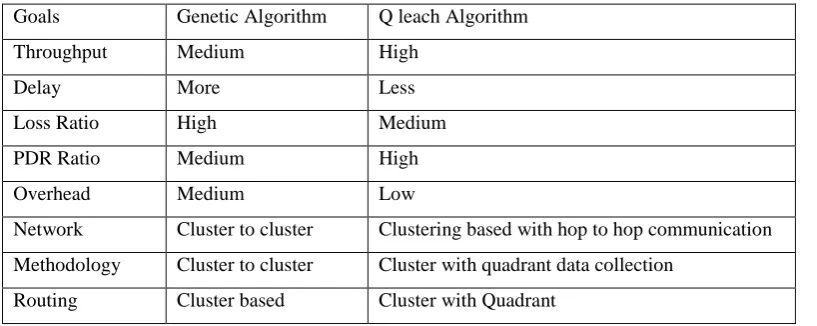
V. COMPARISON TABLE
1084 | P a g e
Table 2. comparision table
Goals Genetic Algorithm Q leach Algorithm
Throughput Medium High
Delay More Less
Loss Ratio High Medium
PDR Ratio Medium High
Overhead Medium Low
Network Cluster to cluster Clustering based with hop to hop communication Methodology Cluster to cluster Cluster with quadrant data collection
Routing Cluster based Cluster with Quadrant
VI. CONCLUSION
We compare a genetic algorithm based method (GABEEC) and Q-LEACH method to amplify the lifetime of wireless sensor networks in First part. The proposed method (GABEEC) raises the lifetime. The simulation observation suggest that GA based method elevate the lifetime of the network. The method appears with randomly created nodes in a network to be cluster-heads. Simulation results show that the proposed method is an energy efficient way to expand the lifetime of the network. In both homogenous and heterogeneous networks, the best distribution is achieved from protocol design. The main intension of this work is to magnify existing protocol such that more vigorous and optimized results can be achieved. Q-LEACH, exceptionally improved network parameters and appear to be an appealing choice for WSNs by widening and magnifying overall network excellence parameters.
REFERENCES
[1] Akyildiz IF, W. Su, Y. Sankarasubramaniam, Cayirci E. Remote sensor arranges: An overview. PC Networks, vol. 38, no. 4, pp. 393–422, March 2002.
[2] Heinzelman W. R, Chandrakasan A, Balakrishnan H. Vitality proficient correspondence convention for remote microsensor systems.
[3] Hussain S, Matin AW. Base station helped various leveled group based steering. in IEEE/ACM International Conference on Wireless and Mobile correspondences Networks(ICWMC), July 2006. [4] Hussain S, Matin AW, Islam O. Hereditary calculation for vitality productive groups in remote sensor
systems. in Fourth International Conference on Information Technology: New Generations (ITNG 2007), April 2007.
[5] W. Heinzelman, A. Chandrakasan, and H. Balakrishnan, Energy-proficient correspondence convention for remote microsensor systems, in System Sciences, 2000. Procedures of the 33rd Annual Hawaii International Conference on, pp. 10pp, IEEE, 2000.
1085 | P a g e
[7] Naveen Kumar, Jasbir Kaur,“Improved LEACH Proto col for Wireless Sensor Networks”, In Proceedingsof 7’th International Conference on Wireless Communications Networking and Mobile Computing, Wuhan, China- 2011.
[8] Hasan Al-Refai, Ali Al-Awneh, Khaldoun Batiha, Amer Abu Ali, Yehia M. El. Rahman,“Efficient Routing LEACH (ERLEACH) enhanced on LEACH Protocol in Wireless Sensor Networks”, InternationaL Journal Of Academic Research” Vol. 3, No. 3., pp. 42-48, May 2011.
[9] Nikhil Marriwala, Priyanka Rathee,“An Approach to Increase the Wireless Sensor Network Lifetime”, World Congress on Information and Communication Technologies-2012.