A Simple Reduction from State Machine Replication to
Binary Agreement in Partially Synchronous or Asynchronous
Networks
Abhinav Aggarwal
∗,†, Yue Guo
∗ ∗Cornell University, Ithaca, NY†University of New Mexico, Albuquerque, NM
Abstract
The recent advent of blockchains has spurred a huge interest in the research and development of numerous cryptocurrencies as well as understanding the fundamental concepts that underly this technology. At the heart of this design is the classic state machine replication protocol in which a group ofnmachines (out of whichf are Byzantine) want to agree on an ever-growing log of transactions.
In this paper, we present a simple blackbox reduction from state machine replication (SMR) to the classical binary agreement (BA) protocol on top of a fully decentralized network. We consider both synchronous and partially synchronous/asynchronous settings for our reduction. We also present an algorithm for a reduction from BA to SMR, thus establishing an equivalence between the two. In each of these settings, we analyze our algorithms with respect to the required security properties.
Although there is prior work that establishes these reductions, our solutions are simpler (at the cost of efficiency) and useful from a pedagogical point of view.
1
Introduction
The Internet today has provided a fast and reliable way of communication between any group of people independent of time and their location. With high guarantees of success, this communication is, on an average, a textbook example of what modern technology can aim to achieve with respect to bringing the world closer. However, there exist certain applications for which this feat of technology is just not enough until some demanding conditions are met. One such example, amongst many others, is the recently introduced and highly popular cryptocurrency technology where thousands of people have invested billions of dollars on a purely digital form of monetary exchange that at its very best demands strict assumptions on the underlying network it can securely and efficiently run on. At the heart of these assumptions is the knowledge of the exact (or an upper bound on the) timing delay for a message to propagate across the network. As shown independently by Garay et al. and Pass et al. [Gar+16; PSS17] in their analysis of the underlying blockchain protocol, this assumption is in fact a fundamental requirement for any cryptocurrency to function securely and avoid attacks by a clever network adversary. Such a model in which the knowledge of network delay forms a parameter for the design of algorithms (and is hence, assumed to be known to all participating nodes) is known as the synchronousmodel of communication in the distributed computing parlance.
synchrony has since been a popular choice of communication model that allows flexibility against assuming strict message delivery times by requiring the participating nodes to know that a finite bound on the message delay exists while being oblivious to the actual value of this bound. This lies somewhere in the spectrum between pure synchrony and asynchrony, where the latter only promises eventual message delivery without any guarantee on the delivery times of the messages sent.
In this partially synchronous world, it then becomes obvious to ask if certain fundamental prob-lems like Byzantine agreement or State machine replication become inherently harder than their synchronous analogs. While the former forms the basis of any distributed decision making in the strongest possible fault model (Byzantine), the latter is a more practically motivated problem that achieves fault tolerance through appropriate replication of the working elements of a system that constitute itsstatein the given protocol execution. Ever since it was first introduced and studied in depth [Sch90], state machine replication has formed the basis of many large scale protocols includ-ing the modern blockchain technology. Keepinclud-ing the financial aspect of the cryptocurrency aside, the blockchain underlying the ledger maintenance is essentially a replicated state machine, which is updated by thousands of nodes in parallel in a tamper evident undirectional manner. We, thus, seek an answer to the following basic question:
Is it fundamentally harder to achieve state machine replication than byzantine agreement in the absence of network synchrony?
This question was first answered in the negative by Liskov et al. [CL+99] in their celebrated paper on practical byzantine fault tolerance where they gave an algorithm to realize state machine replication under partial synchrony using Byzantine agreement as a primitive, thus establishing an equivalence in terms of computational hardness of the two problems (the reverse reduction is (comparatively) trivial). However, the protocol in the paper is highly complex to understand and unfortunately, falls victim to highly error-prone implementations as a result. Just short of two decades later, a cleaner and highly optimized reduction was provided by Miller et al. [Mil+16] for asynchronous networks. We take motivation from these two breakthrough papers and all the followup research to seek a simple, cleaner reduction without any optimization primitives to study the fundamental connection between state machine replication and byzantine agreement and ask ourselves the fundamental requirements and complexities of such an equivalence. Our algorithms on one hand may seem far less efficient and resource intensive than the ones provided in [Mil+16] or other papers, nevertheless, our reduction enjoys simplicity and easy adaptability with numerous scope of parameter tuning given any application at hand.
2
Preliminaries
2.1
Model
In this report, we focus mainly on partial synchronous communication, which refers to a network environment with message delay bounded by an unknown upper bound ∆ in terms of number of rounds or real time. There are other versions of partially synchronous setting. As proven and first introduced in [CL+99], these versions are essentially equivalent. We also assume that this bound on the message delay holds no matter how long the messages are. Commensurate with the reasoning by Pass and Shi in [PS17], such as assumption is justified by assuming that the network is sufficiently connected and has sufficiently many honest nodes to ensure ∆ delivery time for the messages. Furthermore, assuming that the lengths of all the inputs provided by the environment are bounded by some function of a security parameter, the assumption of ensured bound on the delivery time by the sufficiently connected network is justified.
is known from the beginning of the protocol to all other nodes. We assume the existence of a public key infrastructure (PKI) to allow message authentication. This is akin to the permissioned-classical setting from [PS17], in which the environment is required to spawn all nodes upfront and inform all honest nodes the identities of all nodes spawned. Henceforth, without loss of generality, we assume that the spawned nodes have identities 0,1, . . . , n−1 respectively.
As the protocol is event driven rather than real time, we use the termepoch to denote the time unit of protocol execution. We purposely avoid the use of the termround here, since it usually refers to a certain fixed length of real time in the distributed computing parlance.
2.2
Building Blocks
In our reduction from state machine replication to binary agreement, we use reliable broadcast (RBC) and binary agreement (BA) as the building blocks for the state machine replication protocol. We define each of these primitives and give the abstractions and properties for these protocols in the partially synchronous setting. In the reduction from binary agreement to state machine replication, we use the same abstractions and definitions.
2.2.1 Reliable Broadcast
Reliable broadcast (RBC), first introduced as theByzantine Generals Problemby Lamport [LSP82], provides a way for a designated node (called the sender) to send a message to all other nodes. We work with the following input and output abstraction for RBC.
• Input: The sender (known a priori) receives an input valuevfrom environment.
• Output: If the sender is honest, then every honest nodePi outputs a valuev0i.
Note that RBC only guarantees an output when the sender is honest. A protocol for RBC requires that all honest parties deliver the same set of messages and that this set includes all messages broadcast by honest parties, without guaranteeing anything about the order in which messages are delivered [Cac+01]. Thus, except with negligible probability of the execution traces, the following security properties are guaranteed.
• Consistency: If any two honest nodes outputsvandv0, then v=v0.
• Ttot-Totality: If some honest node outputs v in epoch t, then every honest node outputs v
before epocht+Ttot.
• Tval-Validity: If the sender is honest and inputsv in epoch t, then all honest nodes outputs
v before epocht+Tval.
We let TRBC = max{Ttot, Tval} to denote the maximum time it takes for an instance of RBC to
complete.
For our reduction in Section 4.1, we instantiate RBC with Bracha’s reliable broadcast protocol from [Bra84] which works for asynchronous networks and toleratesf ≤ dn−1e/3 Byzantine failures. The different steps of this protocol are presented in Fig. 1. The sender begins by sending the message to everyone. Each honest node, upon the receipt of this message, echoes it to everyone else and starts collecting the echoes from other nodes. Once sufficiently many echoes have been collected, the (honest) node believes that enough honest nodes have received the message from the sender and it sends a message to indicate that it is ready to produce an output. When a required number of ready messages have been received, the honest node produces the output and sends a notification to everyone about this. It terminates the protocol thereafter.
The notification of delivery (output) is sent in the final step purely for the knowledge of the
other honest nodes that have not terminated yet. As will be seen in our reduction, such
The senderPssends the message (send, v) to everyone. Each honest player does the following:
• Upon receiving (send, v) fromPs, send (echo, v) to everyone.
• Upon receiving 2f+1 messages (echo, v) and not having sent (ready, v), send (ready, v) to everyone.
• Upon receivingf+1 messages (ready, v) and not having sent (ready, v), send (ready, v) to everyone.
• Upon receiving 2f + 1 messages (ready, v), send (deliver, v) to everyone, output v
and terminate.
Figure 1: Bracha’s Reliable Broadcast Protocol [Bra84]
2.2.2 Binary Agreement
The standard notion of Byzantine agreement seeks a binary decision value derived off the inputs of its participating nodes. Such protocols, referred to as Binary agreement protocols (BA), often form fundamental building blocks for more involved distributed algorithms. The binary agreement protocols have the following input and output abstraction:
• Input: Every nodePi receives an input bitbi from environment.
• Output: Every honest nodePi outputs a bitb0i.
Except with negligible probability over the execution traces, a binary agreement protocol satisfies the following properties. As is usual with
• Agreement: If any honest node outputs the bitb. then every honest node outputsb.
• TBA-Termination: If all honest nodes receive input in round T, then every honest node
outputs a bit before roundT +TBA.
• Validity: If any honest node outputsb, then at least one honest node receives bas input.
We instantiate this algorithm with the randomized binary byzantine agreement protocol given by Toueg in [Tou84]. Although they assume a trusted dealer who distributed a common random bit to all the players as required, such a functionality can be realized using private coins as well [CGR11]. Thus, we assume that each playerPihas a private coincoiniwhich produces a random binary output each time it is called.
2.3
State Machine Replication
State machine replication (SMR) (for Byzantine faults), also referred to asatomic broadcast ortotal order, was first introduced by Lamport in [Lam84] and abstracted as a general protocol for fault tolerance and decentralized control by Schneider in [Sch90]. In a state machine replication protocol, a set of nodes seek to continuously agree on an ever-growing linearly ordered log over time. The input and output abstraction for such protocols is defined as following:
• Input: Every node keeps receiving transactionstxfrom the environment.
• Output: Every honest nodePi outputs a sequence of batchs of transactions as the loglog`i
at the end of every epoch`.
Each honest playerPi with inputbi does the following:
• r←0
while not decided, do:
– Send the message (ready, r, vi) to everyone.
– Upon, receiving (ready, r, vj) messages fromn−f players, let Π←set of received (ready, r, vj) messages.
– Letv←majority value in Π.
– Using reliable broadcast, send the message (commit, r, vi,Π) to everyone.
– Upon receiving (n−f) messages (deliver,(commit, r, vj,Π)) from the reliable broadcast, setm ← valuev0 that is contained most often among the these
mes-sages,c←the number of messages that contain valuemand r←coini.
– Ifc=n−f, then updatev←m, else v←r.
– Ifc≥t+ 1 andm=r, then send the message (decide, v) to everyone. Outputv
and terminate. Else,r←r+ 1.
• Upon receivingf+ 1 messages (decide, v) and not having sent (decide, v) so far, send the message (decide, v) to everyone. Outputv and terminate.
Figure 2: Toueg’s Binary Agreement Protocol [Tou84]
the end of the round. Except with negligible probability over the execution traces, SMR ensures both
consistency (all honest nodes’ logs agree with each other although some nodes may progress faster than others) and liveness property (transactions received by honest nodes as input get confirmed in all honest nodes’ logs quickly). We formally define these properties below. The notationhere denotes the “is a prefix of” relation.
• Consistency:
– (Common Prefix) For all nodei which is honest by the end of epochr, and for all node nodej which is honest by the end of epocht, eitherlogri logjt orlogtjlogri.
– (Future Self-Consistency) For each nodei which is honest by the end of epoch r and t
wherer≤t, we havelogri logti.
• Tconf-Liveness: Ifnodejthat is honest in epochrreceives some set of transactionstxin epoch
r, or iftx ⊂logrj, then for allPi which is honest in epoch t≥r+Tconf, it must be the case
thattx⊂logti.
2.4
Reduction in Synchronous Network
• The n players initiate n instances of the Dolev-Strong protocol, DS`j for j ∈ {1, . . . , n}, si-multaneously. Pi acts as the sender of the i-th instanceDS`i with the input received from the environment.
• Every playerPi collects its outputs of allDS`j intobatch `
i and updateslog ` i =log
`−1
i ∪batch
` i.
The consistency and liveness property of this reduction trivially follows from the security properties of the Dolev-Strong protocol. We omit details of the proof here, however we note the the reduction above makes use of multiple instances of the multi-valued agreement protocol (DS), which requires each instance to be spawned with a unique session identifier for secure protocol composition. We do not include the identifiers in the protocol above for sake of clarity, but the detailed reduction is available in Section 2.4.2 of [PS17]. The paper also shows that assuming a secure signature scheme, this reduction preserves the properties of state machine replication.
3
Related Work
The concept of partial synchrony was introduced in 1988 by Dwork, Lynch and Stockmeyer in their seminar paper [DLS88] for consensus without any knowledge of the bound on the message delay over the network. The paper also presents tight lower bounds and optimal algorithms for consensus in this model as well as for the alternate definitions of partial synchrony, which were proved to be essentially equivalent. Unlike asynchrony, approximate notions of time can be achieved in this model and hence, it forms a strictly stronger assumption. Moreover, algorithms that parametrize themselves with the network delay and thus assume synchrony can fail to work under partial synchrony if the assumed bound on the message delay is conservative. This renders partial synchrony strictly weaker than the synchronous communication model.
Shifting gears from the network communication model, a core distributed protocol used in nu-merous practical and pedagogical applications is state machine replication, which was first studied in detail by Schneider in 1990 [Sch90]. Also known astotal order oratomic broadcast [Cri+95], this protocol is used to make a set of participating nodes agree on an ever growing linearly-ordered log that satisfies consistency and liveness under appropriately defined settings. For more than a decade, companies like Google and Facebook have deployed Paxos-style protocols [Bur06; JRS11; Lam06] to replicate a significant part of their computing infrastructure. With the advent of cryptocurren-cies, large scale deployment of state machine replication is in high demand, which causes a clear distinction in the classical approach to state machine replication with the modern blockchain-style
approach [PS17]. While the former uses celebrated protocols like PBFT [CL+99] and Byzantine-Paxos [Lam06], it often suffers from poor implementation, maintenance and reconfiguration for large scale settings as a result of their notoriously complicated descriptions. As a contrast, the modern setting for blockchain-style state machine replication, represented by Nakamoto’s original blockchain [Nak08], are relatively simple and tolerate minority corruptions as opposed to the super-majority of honest nodes required by the classical protocols.
Variants of atomic broadcast were subsequently proposed to realize the protocol under different practical requirements. In the early years of the millenium, two papers [KS05; RC05] studied atomic broadcast from the perspective of reducing communication cost by optimistically running a broadcast
protocol undernormal network conditions and switching to a slower mode when under attack. The
novelty of the works lie in consistency and liveness preserving recovery from the slow mode while preserving the average or amortized cost of communication.
agreement primitive [SB12] were proposed. Further optimizations were made by Miller et al. in their paper [Mil+16] which provides a clean modular realization of atomic broadcast using the asyn-chronous common subset primitive realized off a simple binary agreement protocol. Being closest to our work, this paper tries to address an attack on partially synchronous protocols by exploiting their sensitivity on bounded network delay and provides a cryptographically-aided reduction in the purely asynchronous setting. The follow up work by Malkhi et al. [AM+17] discusses this reduction in the blockchain setting.
Although most of the reductions discussed above along with the numerous other attempts (that we omit mentioning for the lack of space) work in the strictly weaker communication model of asynchrony that will also extend to the partially synchronous setting, we seek to work with the minimal requirements for such a reduction or equivalence to hold in the stronger model and ask ourselves if liveness guarantees that are better than eventual deliveries (like in the asynchronous model) can be provided with a simple protocol. We note that our reduction is not entirely novel in its problem statement, however, its simplicity and lack of distracting optimizations are helpful from a pedagogical standpoint, which is quintessential in understanding the foundations of consensus in this setting.
4
Reduction in in Partially Synchronous Network
4.1
From State Machine Replication to Binary Agreement
As shown in Section 4.3, there exists a reduction from reliable broadcast to binary agreement. So in this section, we give a reduction from state machine replication to binary agreement by describing a
SMR algorithm built with binary agreement protocolBAand reliable broadcast protocolRBCwith
nnodes, f of which are corrupted. The building blocks are used as black box.
Assumptions. Except with the assumptions made by the specific RBC and BA protocol used,
the following reduction assumes that n > 2f . However, as proven in [DLS88], BA in partially synchronous setting with Byzantine faults requires n >3f. So we are going to use the assumption
n > 3f rather than honest majority. The reduction works in permissioned model, in which the participants are determined at the beginning of execution, with both static and dynamic corruption withn−f ever-honest nodes.
High level idea. Using BA, which is assured to terminate, to determine whether the output of
the corresponding RBC instance should be (waited for and) collected into the final log or not.
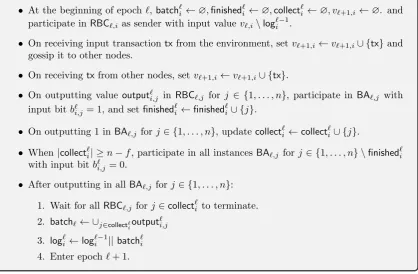
The reduction is given in Figure 4. In this reduction, each nodePiparticipates innRBC protocols and nBA protocols in each epoch `, and maintains three local sets:
• finished`i: contains all indices of RBC protocols thatPi has already output in.
• collect`i: contains all indices of RBC protocols, the output of which need to be collected into thebatch`i.
• batch`i: contains all transactions that will be finally included in the log.
Proof In the proofs in this section, we only consider the execution paths that all of the properties
of RBC and BA protocols hold. The cases where some of the properties do not hold only happens with negligible probability, we can just take union bound and the probability is still negligible.
Here we give the proof for consistency and liveness properties of this protocol in static corruption setting.
Theorem 4.1 (Common Prefix). Except with negligible probability, for any two honest nodes Pi
Figure 3: Example of the reduction for four nodesP1−P4 of which nodeP4 is corrupt (and hence, its state is not shown). The blue bars indicate an ongoing instance of RBC, the yellow bars indicate theinstance of BA and the pink boxes indicate the ongoing epoch.
Proof. Here we show that, there is no transactiontxwhich is included inlog`i0 and not included in log`i1 for and two honest nodesPi0 andPi1.
For the sake of contradiction, assume that there is a transaction tx included in log`i
0 and not
included inlog`i
1. Then there must be a tuple (tx, j, `
0)∈batch`00
i0 for some`
00≤`, which means this
tuple must be included inoutput`00
i0,j0 for somej
0∈collect`00
i0. And (tx, j, `
0)∈/batchl00 i1.
There are following two cases:
• Case I: (j0 ∈/ collect`i100): This implies that b`00
i0,j0 = 1 and b
`00
i1,j0 = 0. However, according to
the definition of binary agreement protocol, for the instance BA`j000, honest nodesPi0 andPi1
should output the same bit value. So there is contradiction.
• Case II (j0 ∈ collectli001 and (tx, j, l0) ∈/ output`00
i1,j0): According to the definiton of
reli-able broadcast protocol, for the instance RBC`j000, if Pi0 outputs output
`00
i0,j0, and Pi1 outputs output`i001,j0, then output`
00
i0,j0 =output
`00
i1,j0. So there is contradiction.
Theorem 4.2 (Future Self-Consistency). Except with negligible probability, for any honest nodePi
and any two epoch`1< `2,log`i1 is the prefix oflog `2
j .
Proof. This theorem trivially follows the protocol description because there is no step in the protocol execution that modifies the existing log.
Lemma 4.3 (Epoch Synchronization). If an honest node is in epoch`, then no honest node is in
epoch `+ 2 or higher.
Proof. For the sake of contradiction, assume there is an honest node Pi0 in epoch`+ 2 when there
is another honest nodePi1 in epoch`for some`. This assumption implies thatPi0 has output in all
BA`+1,j, j ∈ {1, . . . , n} instances, otherwise it won’t enter epoch`+ 2. At the same time, Pi1 has
not input in all BA`+1,j, j ∈ {1, . . . , n} instances because it is still in epoch`. However, according to the definition of binary agreement protocol,Pi0 inBA`+1,j, j∈ {1, . . . , n} won’t output anything
ifPi1 has not participated in yet. So there is contradiction.
Lemma 4.4 (Epoch Progress). Except with negligible probability, if an honest node Pi changes its
current epoch to ` in roundT, then Pi will outputlog`i and change its epoch number to `+ 1 before
The protocol starts with `= 0 and all v0,i =∅. For epoch`, the node Pi in SMR runs as following.
• At the beginning of epoch `,batch`i ←∅,finished`i ←∅,collect `
i ←∅, v`+1,i←∅. and
participate inRBC`,i as sender with input valuev`,i\log`i−1.
• On receiving input transactiontx from the environment, setv`+1,i←v`+1,i∪ {tx}and gossip it to other nodes.
• On receivingtxfrom other nodes, setv`+1,i←v`+1,i∪ {tx}.
• On outputting value output`
i,j in RBC`,j forj ∈ {1, . . . , n}, participate inBA`,j with input bitb`i,j= 1, and setfinished`i ←finished`i∪ {j}.
• On outputting 1 inBA`,j forj ∈ {1, . . . , n}, update collect`i←collect`i ∪ {j}.
• When|collect`i| ≥n−f, participate in all instancesBA`,j forj ∈ {1, . . . , n} \finished`i with input bitb`i,j= 0.
• After outputting in allBA`,j forj∈ {1, . . . , n}:
1. Wait for allRBC`,j forj∈collect`i to terminate.
2. batch`← ∪j∈collect` ioutput
` i,j
3. log`i ←log `−1
i ||batch
` i
4. Enter epoch`+ 1.
Figure 4: Reduction from SMR to BA and RBC
Proof. As described in the protocol,Pi will change its epoch number to`+ 1 when all of theBA`,j instances terminates and allRBC`,j forj ∈collect`i terminates. In the worst case, the corrupt nodes does not send anything, and the waiting time is maximized.
AsPiis already in epoch`,Pishould have collected outputs of allBA`−1,j, j∈ {1, . . . , n}, which implies that every nodes has already input to all BA`−1,j instances. According to the termination property of binary agreement protocol, all nodes will output in all BA`−1,j instances before round
T +TBA.
Let’s consider the “slowest” nodePi0in epoch`−1, which is the last one enters epoch`. For the worst case, it wait forTBA rounds to collect outputs of allBA`−1,j instances, and it may still need to wait for some RBC`−1,j0 afterBA`−1,j0 outputs 1. So the maximum time it takes for Pi0 to enter epoch`is max{TBA, TRBC}. ThenPi0 will input toRBC`,i0. It takes at mostTRBC+TBArounds for
Pi to finish instanceRBC`,i0 andBA`,i0. Piwill output in all other instances before this time point. SoPi will enter epoch`+ 1 before roundT+ max{TRBC, TBA}+TRBC+TBA.
As described in the protocol, if a transactiontxis input to some honest node Pi in roundT,Pi will broadcasttxto all other nodes by gossiping network. So at roundT+ ∆,txwill be known by all honest nodes, and is ensured to be included in thebatch?j for the next epoch. Therefore, Lemma 4.4 implies the liveness property of this state machine replication protocol.
Theorem 4.5 (Liveness). Except with negligible probability, if Pi that is honest in round r
4.2
From Binary Agreement to State Machine Replication
Here we introduce a trivial way to implement binary agreement with SMR in hand. This reduction works in permissioned model with PKI in the presence of dynamic corruption, assuming n > 3f, and n−f nodes are ever-honest.
All nodes inBAstarts an instance ofSMRat beginning. Denote the output ofPiin SMRin (local) round`withlog`i. Letbatch`i :=logi`−log`i−1. The nodePi in BAruns as following.
• On receiving input bit bi from environment, participates in the SMR with input set
{vote(i, bi)}.
• For index ` from 1, on outputting the batch`i, collects all fresh votes vote(j, bj) into pooli. For convenience, denotepooliafter collecting fresh votes frombatch`i withpool`i.
A votevote(j, bj) isfresh ifpooli does not contain any votevote(j,·).
• If for some l, |pool`i−1| < n−f and |pool`i| ≥n−f, then outputs the bit with more votes inpool`i.
If there is a tie, output a pre-determined bit, like 0.
Figure 5: Reduction from BA to SMR
Proof In the proofs in this section, we only consider the execution paths that all of the properties
of SMR protocols hold. The cases where some of the properties do not hold only happens with negligible probability, we can just take union bound and the probability is still negligible.
Here we give the proof for the three properties of this protocol in static corruption setting.
Theorem 4.6(Agreement). Except with negligible probability, if any honest node outputs the bitb,
then every honest node outputs b.
Proof. For the sake of contradiction, assume that there are two honest nodes,Pi0 outputting 0 and Pi1 outputting 1. Then for the epochl0 in whichPi0 makes decision, the majority of votes inpool
`0
i0
are for bit 0, and for the epoch l1 in whichPi1 makes decision, the majority of votes inpool
`1
i1 are
for bit 1.
There are two cases:
• `06=`1. This implies that|pool`i00| 6=|pool
`1
i1|or|pool
`0−1
i0 | 6=|pool
`1−1
i1 |. However, according to
the common prefix property of SMR protocol, |pool`0
i0|=|pool
`1
i1| and|pool
`0−1
i0 |=|pool
`1−1
i1 |.
Here is the contradiction.
• `0 =`1 =`, but numbers of votes for 0 are for 1 are different in pool`i0 andpool
`
i1. However,
according to the common prefix property of SMR protocol, For the two honest nodesPi0 and Pi1,pool
`
i0=pool
`
i1 for any`. Then there is a contradiction.
Theorem 4.7(Termination). Except with negligible probability, If all honest nodes receive input in
round T, then every honest node outputs a bit before round T+Tconf .
Proof. This is trivially guarenteed by the liveness property of SMR protocol. As each honest node will only input one vote to the SMR protocol, and at most one vote from each node will be accepted by honest node, according to the liveness property of SMR, all of the inputs of honest nodes will be included in the log before round T+Tconf. Therefore, all of honest nodes will have output before
Theorem 4.8 (Validity). Except with negligible probability, If any honest node outputs b, then at least one honest node receives b as input.
Proof. Assume for the sake of contradiction that some honest node Pi outputs b which is not the input of any honest node. Then we know that inPi’s finalpoolb, the majority of votes vote for the bitb. As required in the protocol description,|pool`b| ≥n−f, which means the number of votes for bit bis larger than or equal to (n−f)/2, which is greater thanf. Then thepool`b contains at least one vote forbfrom an honest node. Then there is contradiction.
4.3
From Reliable Broadcast to Binary Agreement
In this reduction, we assume the existance of authenticated channel, and that the length of input valuev is known a priori. If|v| is not pre-determined, the protocol can first have all node agree on
|v|, then agree on the input valuev. The reduction is presented in Figure 6. It also works in both static and dynamic corruption settings with n−f ever-honest nodes.
Denote the input value from environment to the sender withv.
• Fork = 1 to|v|, the sender diffuse vk, the k-th bit of v, to every node, and all nodes run a binary agreement instanceBAk tagged with the index k.
• For index k from 1 to |v|, on outputting the bit bk
i, Pi concatenate bki to the output value, i.e. outputi=outputi||bk
i.
Figure 6: Reduction RBC to BA
In this reduction, consistency is guaranteed by the agreement property of binary agreement. As defined in the property of RBC protocols, this reduction does not guarantee termination when the sender is corrupt. For example, if the corrupt sender skips some index k, then the execution of the protocol can be suspended. If the sender is honest, then the termination is guaranteed by the termination property, and validity is guaranteed by the validity property of binary agreement.
5
Conclusion and Future Work
In this report, we gave two-way reduction algorithms between state machine replication and binary agreement in the partially synchronous setting. The existence of reduction implies the equivalence between these two consensus protocols when we assume the existence of PKI.
In the next step, we want to figure out if there exists reduction from BA to SMR with assumption of authenticated channel rather than PKI. We also plan to find reduction algorithms that work in permissionless model.
References
[AM+17] Ittai Abraham, Dahlia Malkhi, et al. “The Blockchain Consensus Layer and BFT”. In:
Bulletin of EATCS 3.123 (2017).
[Bra84] Gabriel Bracha. “An asynchronous [(n-1)/3]-resilient consensus protocol”. In:Proceedings of the third annual ACM symposium on Principles of distributed computing. ACM. 1984, pp. 154–162.
[Bur06] Mike Burrows. “The Chubby lock service for loosely-coupled distributed systems”. In:
[Cac+01] Christian Cachin et al. “Secure and efficient asynchronous broadcast protocols”. In: An-nual International Cryptology Conference. Springer. 2001, pp. 524–541.
[CGR11] Christian Cachin, Rachid Guerraoui, and Luis Rodrigues. Introduction to reliable and
secure distributed programming. Springer Science & Business Media, 2011.
[CL+99] Miguel Castro, Barbara Liskov, et al. “Practical Byzantine fault tolerance”. In: OSDI. Vol. 99. 1999, pp. 173–186.
[Cri+95] Flaviu Cristian et al. “Atomic broadcast: From simple message diffusion to Byzantine
agreement”. In: Information and Computation 118.1 (1995), pp. 158–179.
[DLS88] Cynthia Dwork, Nancy Lynch, and Larry Stockmeyer. “Consensus in the presence of
partial synchrony”. In: Journal of the ACM (JACM) 35.2 (1988), pp. 288–323.
[DS83] Danny Dolev and H. Raymond Strong. “Authenticated algorithms for Byzantine
agree-ment”. In: SIAM Journal on Computing 12.4 (1983), pp. 656–666.
[Gar+16] Juan A Garay et al. “Bootstrapping the Blockchain-Directly.” In: IACR Cryptology
ePrint Archive 2016 (2016), p. 991.
[JRS11] Flavio P Junqueira, Benjamin C Reed, and Marco Serafini. “Zab: High-performance
broadcast for primary-backup systems”. In: Dependable Systems & Networks (DSN),
2011 IEEE/IFIP 41st International Conference on. IEEE. 2011, pp. 245–256.
[KS05] Klaus Kursawe and Victor Shoup. “Optimistic Asynchronous Atomic Broadcast.” In:
ICALP. Springer. 2005, pp. 204–215.
[Lam05] Leslie Lamport.Generalized consensus and paxos. Tech. rep. Technical Report
MSR-TR-2005-33, Microsoft Research, 2005.
[Lam06] Leslie Lamport. “Fast paxos”. In:Distributed Computing 19.2 (2006), pp. 79–103.
[Lam84] Leslie Lamport. “Using time instead of timeout for fault-tolerant distributed systems.” In:ACM Transactions on Programming Languages and Systems (TOPLAS) 6.2 (1984), pp. 254–280.
[LSP82] Leslie Lamport, Robert Shostak, and Marshall Pease. “The Byzantine generals problem”.
In:ACM Transactions on Programming Languages and Systems (TOPLAS) 4.3 (1982), pp. 382–401.
[Mil+16] Andrew Miller et al. “The honey badger of BFT protocols”. In: Proceedings of the 2016
ACM SIGSAC Conference on Computer and Communications Security. ACM. 2016, pp. 31–42.
[Nak08] Satoshi Nakamoto.Bitcoin: A peer-to-peer electronic cash system. 2008.
[PS17] Rafeal Pass and Elaine Shi. Thunderella: blockchains with optimistic instant
confirma-tion. 2017.
[PSS17] Rafael Pass, Lior Seeman, and Abhi Shelat. “Analysis of the blockchain protocol in asyn-chronous networks”. In:Annual International Conference on the Theory and Applications of Cryptographic Techniques. Springer. 2017, pp. 643–673.
[RC05] HariGovind V Ramasamy and Christian Cachin. “Parsimonious asynchronous
byzantine-fault-tolerant atomic broadcast”. In:OPODIS. Springer. 2005, pp. 88–102.
[SB12] Jo˜ao Sousa and Alysson Bessani. “From Byzantine consensus to BFT state machine
replication: A latency-optimal transformation”. In: Dependable Computing Conference
(EDCC), 2012 Ninth European. IEEE. 2012, pp. 37–48.
[Sch90] Fred B Schneider. “The state machine approach: A tutorial”. In: Fault-Tolerant
Dis-tributed Computing. Springer, 1990, pp. 18–41.
[Tou84] Sam Toueg. “Randomized byzantine agreements”. In: Proceedings of the third annual
![Figure 2: Toueg’s Binary Agreement Protocol [Tou84]](https://thumb-us.123doks.com/thumbv2/123dok_us/7987803.1325541/5.595.80.510.78.326/figure-toueg-s-binary-agreement-protocol-tou.webp)