Wireless Control of Pick and Place Robotic
Arm Using an Android Application
Muhammed Jabir.N.K
1, Neetha John
2, Muhammed Fayas
3, Midhun Mohan
4, Mithun Sajeev
5, Safwan.C.N
6Undergraduate Student, Dept. of EEE, MA College Engineering, Kothamangalam, Kerala, India 1
Assistant Professor, Department of EEE, MA College Engineering, Kothamangalam, Kerala, India 2
Undergraduate Student, Dept. of EEE, MA College Engineering, Kothamangalam, Kerala, India 3
Undergraduate Student, Dept. of EEE, MA College Engineering, Kothamangalam, Kerala, India 4
Undergraduate Student, Dept. of EEE, MA College Engineering, Kothamangalam, Kerala, India 5
Undergraduate Student, Dept. of EEE, MA College Engineering, Kothamangalam, Kerala, India 6
ABSTRACT:The work is designed to develop a pick and place robotic arm vehicle with a softcatching gripperthat is designed to avoid extra pressure on the suspected object (Like Bombs) for safetyreasons. The robotic vehicle is android application controlled for remoteoperation. At the transmitting end using android application device, commands are sentto the receiver to control the movement of the robot either to move forward, backwardand left or right etc. At the receiving end four motors are interfaced to the microcontrollerwhere two of them are used for arm and gripper movement of the robot while the othertwo are for the body movement of the vehicle. The main advantage of this robot is its softcatching arm that is designed to avoid extra pressure on the suspected object for safetyreasons. The android application device transmitter acts as a remote control that hasthe advantage of adequate range, while the receiver end Bluetooth device is connectedto the microcontroller to drive DC motors via motor driver IC for necessary operation.Remote operation is achieved by any smart-phone/Tablet etc., with Android OS; upon aGUI (Graphical User Interface) based touch screen operation.
KEYWORDS:Pick and Place Robot, Soft catching Arm, Atmega328, Android, Blue Control.
I.INTRODUCTION
Robots are indispensable in many manufacturing industries. The reason is that the costper hour to operate a robot is a fraction of the cost of the human labour needed to performthe same function. More than this, once programmed, robots repeatedly perform functionswith a high accuracy that surpasses that of the most experienced human operator. Humanoperators are, however, far more versatile. Humans can switch job tasks easily. Robotsare built and programmed to be job specific. Today's most advanced industrial robotswill soon become dinosaurs.Robots are in the infancy stage of their evolution. As robots evolve, they will become more versatile, emulating the human capacity and ability to switch job tasks easily.While the personal computer has made an indelible mark on society, the personal robothasn't made an appearance. Obviously there's more to a personal robot than a personalcomputer. Robots require a combination of elements to be effective: sophistication ofintelligence, movement, mobility, navigation, and purpose. In the beginning, personal robots will focus on a singular function (job task) or purpose.Building a useful personal robot is very difficult. But recent days Robots occupies a goodplace in community.The main functioning of robotics in recent days are.
Hazardous duty
nuclear. They can work in environments so hazardousthat an unprotected human would quickly die. The nuclear industry was the first todevelop and use robotic arms for handling radioactive materials. Robotic arms allowedscientists to be located in clean, safe rooms operating controls for the robotic arms locatedin radioactive rooms.
Relevance
There are so many hazardous situations in day to day life. There are so many occasionswhere the human can't work .In that situations without a considerable amount of safetyprecautions like, the disposal of hazardous wastes, radioactive substances, remote handling of explosive devices and righting and hostage situations among others. It cansafely work at hazardous conditions. These robots ensures the human safety and replacemassive human work force.It can be also applied in medical science, surgeries, and defence purposes, with artificialintelligence, super market field, and manufacturing field. These are compact and efficientrobotic systems.
Figure1: Some first robot in the world. From left: Mars Path Finder, Sojourner Rover.Hazbot.Photo courtesy of NASA
LiteratureSurvey.
John Iovine [1],inthis book various aspects of designing a Robot is described. It deals with different types of Arm design, controlling techniques, vehicle design etc… In the remaining references different types controlling technique are explained. The Idea about the Android software „Blue control‟ and its application in controlling Robotics is described in the Google play store website. From all these we find a different controlling technique using android device and software with a different approach for soft catching arm (electronic pressure sensor).
II. WORKING OF PICK AND PLACE ROBOT
The block diagram of the proposed system is shown in Figure2 .It consists of an Atmega328Micro controller IC, Bluetooth module, four DC Motors with driver IC and power supply.The pick and place robotic arm consists of arobotic arm placed on a moving vehicle.The vehicle is able to move along any type of surfaces irrespective of it is smooth or rough.It uses two motors for the operation and a belt type tyre is attached to the vehicle likein the tanks, for the smooth and reliable operation. The pick and place robot uses fourmotors for the operation of the system, two for the operation of moving vehicle and twofor the pick and place operation.The pick and place arm consists of an arm assembly with a jaw, which is only able tomove in up and down direction.There are two motors are for the arm assembly, one forthe up and down motion and other for jaw opening and closing.The maximum upward and downward motion is limited by a mechanical push buttontype switches. It breaks the motor circuit when the arm is at its maximum position beyondwhich the motor does not rotates.
Figure 2: Circuit Diagram of Pick and Place Robot
Pin
Description
E A B
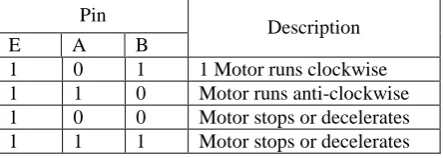
1 0 1 1 Motor runs clockwise 1 1 0 Motor runs anti-clockwise 1 0 0 Motor stops or decelerates 1 1 1 Motor stops or decelerates
Table I: Truth table of L293D motor driver
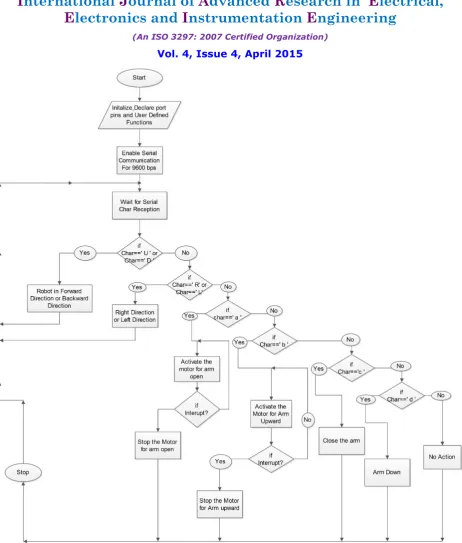
Figure 3. Flow Chart of Pick and Place Robot
The program is so written i.e., while executed it sends commands to the motor driverIC as per its requirement for running the motor for the movement of the robot as explainedin the subject above in L293D. The android phone screen is used for sending commands forleft, right, forward and backward and centre is for stop through its inbuilt Bluetooth system.
withany smart phone communicates with this Bluetooth device for taking appropriate actionas per the touch operation made on the smart phone.
The work uses another motor driver IC working on similar technology for the arm up and down / open and close duly interfaced to the microcontroller with duly pulled up resistors.The program is so written that for touch screen operation from the smart phone resultsin command being sent through the Bluetooth module, on A=open, B=close, C=up andD=down number upon MC developing appropriate rotation of the motor.
Now consider the operation of soft catching arm.It sense pressure in the arm bymeasuring current. The motors used for an operation up and down and gripper operationopen and closed pass through series resistor of 10 ohms/ 2 watt from the output of the secondmotor driver IC L293D.While motor is operating the returning current from Driver IC isgrounded through this resistance . And the voltage across it is proportional to the currentowing through it and this current is proportional to the load at the motor or pressure inthe arm jaws. Thus by measuring the voltage we can measure the amount of pressure. Theinbuilt ADC in the Atmega328 continuously measuring this voltage.
Thus while motor operates in normal condition the running current results normalvoltage drop across the 10R/2W ohm resistor as the motor can run in clockwise (or)anti-clockwise. When load increases the voltage across resistor get increased and is continuously monitored by micro controller. When it increases above a certain value, interruptis produced thus stopping the motor. The program is so written that once interrupt zero occurs low, no such command wouldgenerate any input to the motor driver IC for any direction for that motor movement. Onlythe other direction rotation is possible from the command. This helps in soft catchingarrangement of the arm gripper.
III.DESIGN AND PROGRAMMING
The main components used in this work are the DC motors, Microcontroller (Atmega328), Bluetooth interfacing device and user interfacing device (Android phone) and Android application (Blue control).
Atmega328 Micro controller
The Atmel AVR ATmega8 is a low-power CMOS 8-bit microcontroller based on the AVR RISC architecture. By executing powerful instructions in a single clock cycle, the ATmega8 achieves throughputs approaching 1MIPS per MHz, allowing the system designed to optimize power consumption versus processing speed.
DC Motors
DC motors with built in gearing Arrangement is used in this work. It is because it is simple to control and have higher torque compared to servomotors. To use a DC motor, we need motor driver IC.To drive the motor simply connect the one wireto one of the driver terminals and the other to other terminal.
Bluetooth Device
The Serial port Bluetooth module is fully qualified Bluetooth V2.0+EDR (Enhanced Data Rate) 3Mbps Modulation with complete 2.4GHz radio transceiver and base band.It uses CSR Blue core 04-External single chip Bluetooth system with CMOS technologyand with AFH (Adaptive Frequency Hopping Feature). It has a footprint as small as12.7mmx27mm.
Figure 4.DC Motor Figure 5. Bluetooth device Arduino Programmer
These systems providesets of digital and analog I/O pins that can be interfaced to various extension boardsand other circuits. The boards feature serial communications interfaces, including USBon some models, for loading programs from personal computers. For programming themicrocontrollers, the Arduino platform provides an integrated development environment(IDE) based on the Processing work, which includes support for C and C++ programming languages.
Blue control
Blue Control is a basic universal Remote Control for Blue-Tooth enabled serial devicessuch as Blue Tooth modules connected to a micro-controller. For each button pressed the corresponding ASCII code for the label will be sent. For example pressing buttons A-Hwill send the characters "a" - "h". The up, down, left, right, and center buttons will send "U","D","L","R", and "C" characters.
Figure 6 . (From Left)Bluecontrol application,Android symbol and Android phone
IV. RESULTS AND DISCUSSION
In this work we made a Pick and place robot controlled by an Android application.We know that the whole the digital devices in the world are transformed in to Android OSbased systems ,as it is more versatile ,flexible and easy tocontrol and it is an open sourcesoftware.Here The Pick and place robot is controlled wirelessly by an Android applicationcalled Blue control through a blue tooth module. The Android OS as well as Arduinosoftware are open source soft wares. The main feature of this pick and place robot is the soft catching arm or soft catchingGripper. We know that when handling the explosive items like bomb it should be handledcarefully. Excessive pressure will cause explosion. Soit is very essential to have a softcatching arm .This robot has microcontroller based electrical pressure sensor which has higher sensitivity than mechanical pressure sensors.
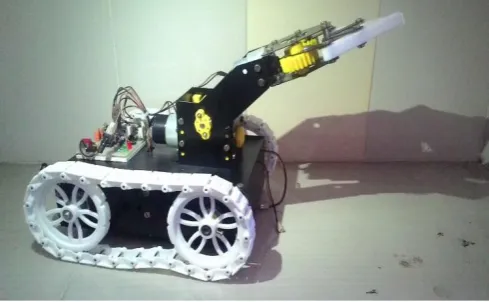
The hardware model functioned as desired and is shown in Figure7 .This is designed to handle a maximum weight of 2 kg.The weight handling capacity of Pick andPlace Robot is determined by the capacity of DC motors used. Very useful and interesting can be made by interfacing the „Pick and Place Robot‟ withexplosive detectors, metal detectors, wireless cameras, night vision cameras...Etc. forfindingthe bombs and proper visual assistance.
V.CONCLUSION
The aim of this work is the development of wireless control of a pick and place robot using Android application .It is controlledby an android application called blue control. The micro controller used is an Atmega328 and Arduino software is used toprogram it. Number of joints on the arm determines the type of object it can handle.
The main feature of this is the soft catching arm. We know that when handling the explosive items like bomb it will be handled smoothly. Excessive pressure will cause explosion. So this robot has microcontroller based electrical pressure sensor which has higher sensitivity than mechanical pressure sensors.The maximum weight that can be carried by this model is depends on the capacity of DC motors used. Very useful and interesting can be made by interfacing the „Pick and Place Robot‟ with explosive detectors, metal detectors, wireless cameras, night vision cameras...Etc. for findingthe bombs and proper visual assistance.
REFERENCES
[1] John Iovine.,“Robots,Androids, andAnimations 12 Incredible Projects You Can Build”, Second Edition,McGraw-Hill.2002
[2] Mohamed Naufal bin Omar,“Pick and place robotic arm controlled by Computer”, UniversititeknikalMalaysia, Melaka April 2007.
[3] Yanjianghuang, ryosukechiba, tamioarai, tsuyoshiueyama and junota. ,“Integrateddesign of multi-robot system for pick-and-place tasks”,
Proceeding of theIEEE International conference on robotics and biomimetic (ROBIO) Shenzhen, china, December 2013.
[4] Sungwookmoon ,youngjinkim, ho junmyeong , changsookim, namjucha,and dong hwankim . ,“Implementation of smart phone environment
remote controland monitoring System for android operating system-based robot platform” ,The 8thinternational conference on ubiquitous robots and
ambient intelligence (URAI 2011) Tc1-1 Nov. 23-26, 2011 in songdoconventia, incheon, korea 978-1-4577-0723-0 / 11 /$26.00 2011 IEEE
[5] ATMEL ATmega48A/PA/88A/PA/168A/PA/328/P [DATASHEET] 2 Atmel-8271I-AVR- ATmega-Datasheet10/2014.
[6] SGS Thomson Microelectronics L293D - L293DD [DATASHEET] PUSH-PULLFOUR CHANNEL DRIVER WITH DIODE .June 1996.
[7] Fairchild semiconductor KA78XX/KA78XXA 3-Terminal 1A Positive Voltage Regulator Data sheet.2001 Fairchild Semiconductor
Corporation.
[8] http://en.wikipedia.org/wiki/Android_(operating_system). April 2015.
[9] https://play.google.com/store/apps/details?id=com.gundel.bluecontrol&hl=en .April 2015. [10] http://en.wikipedia.org/wiki/Arduino Programmer. April 2015.
BIOGRAPHY
Muhammed Jabir.N.K is an under graduate student at the Mahatma Gandhi University of Kerala. Currently he is majoring in Electrical and Electronics Engineering at Mar Athanasius College of Engineering, Kothamangalam, Kerala, India. He is interested in pursuing a career in Space Research or Defence Research and Development Organisation.
He received the Diploma in Electrical and Electronics Engineering from the Department of Technical Education of Kerala in 2012. His first Project was the development of „Synchronizing Panel Board for a Distributed Generation system. Vehicle density controlled Traffic light was his second project.His current research interests include Development of Software application to control Electrical appliances and embedded systems.
Neetha Johnis Assistant Professor at Department of Electrical and Electronics Engineering at Mar Athanasius College of Engineering, Kothamangalam, Kerala, India.
Muhammed Fayasis an under graduate student at the Mahatma Gandhi University of Kerala. Currently he is majoring in Electrical and Electronics Engineering at Mar Athanasius College of Engineering, Kothamangalam, Kerala, India.
Midhun Mohanis an under graduate student at the Mahatma Gandhi University of Kerala. Currently he is majoring in Electrical and Electronics Engineering at Mar Athanasius College of Engineering, Kothamangalam, Kerala, India.
MithunSajeevis an under graduate student at the Mahatma Gandhi University of Kerala. Currently he is majoring in Electrical and Electronics Engineering at Mar Athanasius College of Engineering, Kothamangalam, Kerala, India.