Diffusion behaviour of multivalent ions at low pH through a MFI-type
zeolite membrane
Bo Zhu a, Gayle Morris b, Il-Shik Moon c, Stephen Gray a and Mikel Duke a1
a Institute for Sustainability and Innovation, College of Engineering and Science, Victoria University, Werribee Campus, PO Box 14428, Melbourne, VIC 8001, Australia.
[email protected], [email protected], [email protected].
b Research Services Office, Flinders University, Adelaide 5001, Australia.
c Department of Chemical Engineering, Sunchon National University, Maegok Dong, Suncheon 540-742, Republic of Korea.
ABSTRACT
Zeolite membranes have been widely examined for desalination. Work to date has shown effective performance in monovalent rich solutions, but the understanding of the unique ion-zeolite interactions for multivalent ion rich solutions, such as those found in acidic mining wastewaters, has not yet been studied. Filtration performance of MFI-type zeolite membrane was evaluated on a model multivalent ion, Fe3+, Al3+, Ca2+ and Mg2+, solution with total
dissolved solids (TDS) of 97,000 mg L-1 and pH 2.03 at between 3 MPa and 7 MPa and 21 °C to 70 °C. At 7 MPa and 21°C, rejection for Fe3+ was 97%, 80% for Al3+ and Mg2+,and 50%
for Ca2+. This behaviour followed the rejection of ions with larger hydrated diameter, except for Al3+ which was attributed to its unique strong interaction with zeolites. However, an unusual trend of increasing rejection with increasing temperature was observed. Instead of activated transport which occurs with monovalent or dilute solutions, temperature accelerated the infiltration of multivalent ions into the zeolite structure to further block ions and synergistically increased rejection. Zeolite membranes exhibited unique effects in multivalent ion rich solution
1Corresponding author at: Institute for Sustainability and Innovation, College of Engineering and Science,
that could be further utilised in niche desalination applications or benefit other applications such as sensors.
Keywords: Zeolite membrane; MFI-type; Ion diffusion; Multivalent ions; Filtration.
1. Introduction
Ceramic membranes made from zeolites are good candidates for desalination as they possess
the required small pore properties to reject ions while diffusing water [1, 2]. Zeolite membranes, especially MFI-type, have been widely examined for desalination [2-11], and may
offer an alternative option for desalination of acidic, metal- and sulphate containing mining wastewaters, where they may have extended service life and increased cleaning ability compared to current polymer membrane technology. The MFI-type zeolite has orthorhombic crystal symmetry with nearly cylindrical, 10-member ring channels. The aperture size of the MFI-type zeolite is around 0.56 nm [4, 12-14] , which is smaller than the sizes of hydrated ions (e.g. Ca2+ 0.824 nm, Mg2+ 0.856 nm, Fe3+ 0.914 nm, Al3+ 0.950 nm, [15]) but larger than the kinetic diameter of water (0.276 nm, [15]).
MFI-type zeolite membranes have demonstrated high ion rejections, even for the smallest ions (e.g. Na+) when working as a reverse osmosis (RO) membrane [8, 10], and also showed great ability to separate dissolved organics from aqueous solution [10, 16]. Our recent work [11] also demonstrated the possibility of avoiding the pre-treatment needed for polymeric RO membranes by using MFI-type zeolite membranes for desalination of saline recycled wastewater. The zeolite membrane also showed no deterioration after extreme chlorine or acid cleaning, enabling simplified cleaning and biofouling control techniques.
The performance of MFI-type zeolite membranes, however, was found not always constant. For example, high rejection (>93%) was achieved for Ca2+, Mg2+ and Na+ from 0.3wt%
respectively) have been achieved on MFI-type zeolite membranes by vacuum membrane distillation [17], fluxes (e.g. 0.5 – 1.4 L m-2 h-1 at a pressure of 2.76 MPa [19]) of MFI-type zeolite membranes when working as a RO membrane are lower than polymer RO membranes possibly due to their greater active layer thickness. Membrane water transport resistance is proportional to the dense surface layer thickness and hydrophilic properties. Zeolite membranes (3 – 10 µm) [2, 3, 11] are much thicker than commercial RO membranes (0.2 µm) [20, 21]. For MFI-type zeolite membranes to be used commercially, further study is needed to understand the cause of the inconsistent ion rejections and fluxes need to be significantly
increased.
Apart from inconsistent ion rejections and low flux of MFI-type zeolite membranes, recent studies also showed that MFI-type zeolites exhibited dynamic behaviour associated with ion interactions in different ion complexes (e.g. seawater, or multivalent ion solution) [18, 22-24]. For example, monovalent cations (e.g. K+, Na+) can enter the zeolite lattices, while divalent cations (e.g. Ca2+, Mg2+) can be absorbed into the grain boundaries of zeolites [22, 23]. The strong uptake of Fe3+and Al3+ from a multivalent ion solution containing Fe3+, Al3+, Ca2+ and Mg2+ into MFI-type zeolite powders resulted in changes to crystal structure and the porous properties [18]. These changes in structure and porosity could impact on diffusion properties of ions in this material when used as a membrane [18, 22, 23]. Temperature was also found to have an impact on membrane performance. Increasing the testing temperature resulted in an increase in permeate flux, but a decrease in ion rejection [7, 8]. Despite ion diffusion through MFI-type zeolite membranes following the hydrated size of ions, more work is needed to correlate ion diffusion with their size and potentially other factors, such as dynamic ion interactions in different ion complexes and operating temperature. In exploring the unique behaviour of ions within MFI zeolite, we recently reported on the beneficial function of multivalent ions to block defects [18]. However no work has been conducted to date exploring the behaviour of these ions in continuous filtration, in particular, with mining wastewaters which contain solutions rich in multivalent ions. Considering the strong interaction with
In this study, we deposited MFI-type zeolite seeds on the outer surface of a tubular α-alumina substrate using the rubbing method [7, 11, 25, 26], and then used the secondary hydrothermal growth to prepare the MFI-type zeolite membrane [7, 11]. The prepared membrane underwent filtration performance testing on a model multivalent ion solution containing Fe3+, Al3+, Ca2+ and Mg2+ with TDS of 97,000 mg L-1 and pH 2.03. The effects of applied pressure, role of
operating temperature and influence of acid cleaning on membrane performance were investigated. The dependence of osmotic pressure on the impact of ion diffusion is discussed. Scanning electron microscopy (SEM) was also used to develop a better understanding of the
effect of multivalent ion solution exposure on membrane structure and surface morphology.
2. Experimental and methods
2.1 Preparation of MFI-type membrane
The MFI-type membrane was prepared by the seeded secondary growth method [7, 11], which involved depositing MFI-type zeolite seeds on the outer surface of a α-Al2O3 support
using a rubbing method [25, 26] followed by growth of the membrane under hydrothermal conditions. This seeded secondary growth method has recently attracted attention as it decouples the nucleation and growth from seed growth, whilst also reducing the demand for the costly structure directing agents [6, 27, 28]. The porous α-Al2O3 tubular support (95.7%
Al2O3, apparent porosity 34.9%, external diameter 15 mm, internal diameter 10 mm, length 25
mm, mean pore size ~12.2 µm) used in this study was supplied by Chosun Refractories Co. Ltd, Korea. The MFI-type zeolite seeds (ZSM-5, SiO2/Al2O3 = 360) were purchased from ACS
Material, USA. The particle size distribution of the MFI-type zeolite seeds was measured to be between 1,000 nm and 3,000 nm (peaking at ~1,800 nm) by Zetasizer (Malvern Instruments-nano-series) [7]. The secondary growth was conducted by placing the seeded support into a Teflon lined stainless steel autoclave and adding the desired growth solution of 2 mL of 1M tetra-propyl ammonium hydroxide (TPAOH) (Aldrich), 2 mL of tetraethyl orthosilicate
2.2 Filtration test
Filtration performance of the prepared MFI-type zeolite membrane was analysed for the ion complex model of mining wastewater, using a high pressure test system used in our previous work [7]. The membrane was installed into the stainless steel membrane housing, and model multivalent ion solution was fed at a flow rate of 5 mL min−1 by a high pressure piston pump (Series 1, LabAlliance, USA) with an applied gauge pressure of up to 7 MPa. The ion complex used in this study was prepared by adding 138 g Al2(SO4)3∙18H2O (AJAX Chemicals,
Australia), 205 g MgSO4∙7H2O (Merck, Australia), 58 g Fe2(SO4)3∙9H2O (AJAX Chemicals,
Australia) and 1.7 g CaCl2∙2H2O (Merck, Australia) into 2 L DI water. The solution was filtered
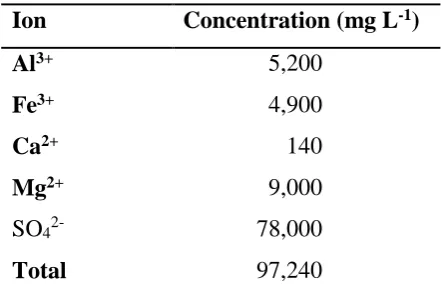
by a 0.45 µm membrane filter to remove undissolved solids prior to filtration test. The ion concentrations of the pre-filtered solution were determined by inductively coupled plasma-optical emission spectrometry (ICP-OES) (Shimadzu ICPE-9000) and are shown in Table 1. Cl− was not measured as it is assumed to be minor (estimated to be ~400 mg L-1 based on the mount of CaCl2∙2H2O added) in comparison to other ions (e.g. Fe3+, Al3+, Mg2+and SO42-)
present in the multivalent ion solution. The pH of the pre-filtered multivalent ion solution was measured to be 2.03.
Table 1 ICP-OES measured ion concentrations present in the pre-filtered multivalent ion feed solution.
Ion Concentration (mg L-1)
Al3+ 5,200
Fe3+
Ca2+
Mg2+
SO42-
Total
4,900 140 9,000 78,000
97,240
cross flows has little effect on flux and rejection, as concentration polarisation is not significant at the currently low fluxes of zeolite membranes. Filtration performance of the prepared zeolite membrane was determined by the electrical conductivity (EC) (measured with a portable conductivity meter, Sension 156, HACH) and ICP-OES measured ion concentrations of the multivalent ion feed solution and collected permeate samples. The water samples were diluted prior to measurements. Rejections of EC (rEC) and ion j (rj) were calculated by equation (1) and (2), respectively:
100 ) ( (%) f p f EC EC EC EC
r (1)
100 ) ( (%) , , , f j p j f j j c c c r (2)
where ECf and ECp are measured electrical conductivity for the feed and permeate samples, respectively.Cj,f and Cj,p are ICP-OES measured concentrations of ion j (j = Fe3+, Al3+, Ca2+
and Mg2+) in the feed and permeate solutions, respectively. Flux (J, L m−2 h−1) was calculated
according to:
At v
J (3)
where v (L) is the volume of the collected permeate over a given time period, t (h), and A the membrane’s area (m2).
The osmotic pressures, effective pressures (driving pressure after overcoming the osmotic pressure) and specific flux for filtration of the multivalent ion feed solution (TDS ~97,000 mg L-1) can be determined using known equations [7, 8, 29]:
iMRT
(4)
) ( feed permeate total
effective p
effective s
p J
J (6)
where π is the osmotic pressure (MPa), i is the van’t Hoff factor of the solute, M is the molarity
of the salt in solution, R is the universal gas constant (0.008315 L MPa mol-1 K-1) and T is the system temperature (K), peffective is the effective pressure (MPa), ptotalis the applied gauge pressure when operating under ambient permeate pressures, πfeed and πpermeate are the osmotic pressure (MPa) estimated from equation (4) for the feed solution and permeate, respectively,
Js is the specific flux (L m-2 h-1 MPa-1), and J is the flux(L m-2 h-1) calculated from equation (3). The van’t Hoff factor (i) expresses how may ions and particles are formed (on an average) in a solution from one formula unit of solute. The van’t Hoff factor approaches a whole number (2, 3, and so on) only for very dilute solutions. For example, the ideal numbers of the van’t
Hoff factor are 5 for both Al2(SO4)3 and Fe2(SO4)3, 3 for CaCl2 and 2 for MgSO4. However,
actual values of the van’t Hoff factors are generally less than the predicted number of ions due
to the ion pairing effect. The multivalent ion solution used in this study is a mixture of Al2(SO4)3, Fe2(SO4)3, CaCl2 and MgSO4, which makes calculation of a van’t Hoff factor more
complicated. Based on previous work reported by others (e.g. van’t Hoff factor values of 4.4 for Fe2(SO4)3 and 1.21 forMgSO4 were used to calculate boiling point elevation of a solution
containing Fe2(SO4)3, NaCl and MgSO4 [30]; van’t Hoff factor values of ~2.6 for CaCl2 and
~1.2 forMgSO4 were used to determine surface vapour pressure of droplets at various solution
concentrations [31]), the present study used the van’t Hoff factor values of 4.4 for both Fe2(SO4)3 and Al2(SO4)3, and 2.6 and 1.2 respectively for CaCl2 and MgSO4.
2.3 SEM
SEM was employed to investigate any changes in the morphology of the zeolite membrane after filtration testing with multivalent ion solution. Prior to characterisation, the filtration tested membrane underwent acid cleaning and DI water permeation to remove weakly adsorbed material (including ions). The SEM images were obtained from the secondary electron detector of a CamScan MX2500 microscope (CamScan Optics, Cambridge, UK) using a 10 kV electron beam with a working distance of 2.2 mm.
3. Results and discussion
3.1. Filtration performance for ions with different hydrated sizes
Prior to filtration of the multivalent ion solution, salt rejection performance of the prepared MFI-type zeolite membrane was evaluated by a NaCl solution (3,000 mg L-1 TDS). The membrane was initially tested with DI water at an applied pressure of 7 MPa and room temperature (21°C) and the membrane showed a constant flux of 5.6 L m-2 h-1. Following the initial DI water testing, the membrane was tested with NaCl solution (3,000 mg L-1 TDS) under the same conditions. The membrane showed an average salt rejection of 31% with a flux of 2 L m-2 h-1 at an applied pressure of 7 MPa and room temperature (21°C). This is lower than that expected for zeolite desalination membranes, where >90% salt rejections are expected [8, 10], but shows an intact zeolite coating with some non-selective water flux through defects. This membrane may be suitable for NF applications to reject larger cations and anions.
After testing with NaCl solution, the membrane was flushed with DI water and filtration of the multivalent ion solution (TDS ~97,000 mg L-1; Table 1) was then carried out under the
same conditions (7 MPa and 21°C). ICP-OES was used to measure the concentrations of the major ions present in the feed (multivalent ion solution) and permeate samples obtained from
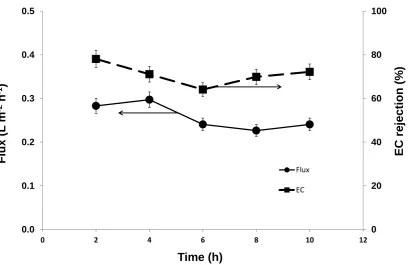
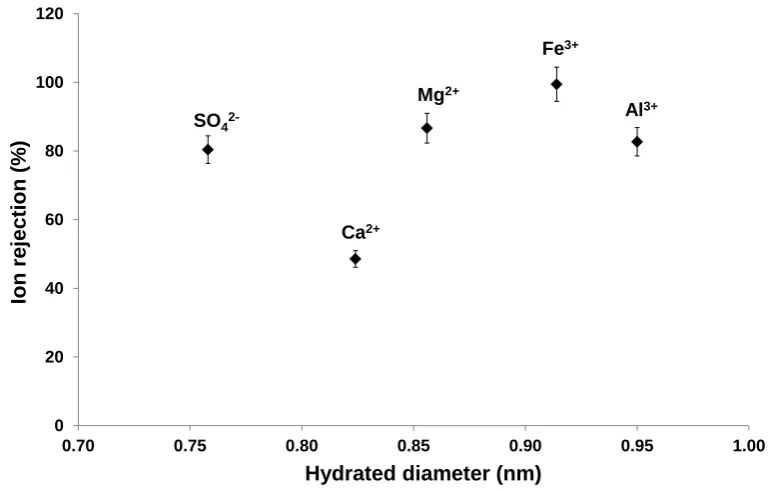
the filtration testing. Figure 1 shows the EC rejection and water flux achieved on the prepared MFI-type zeolite membrane for the multivalent ion solution. The ion rejections calculated from the ICP-OES results are shown in Figure 2. Both flux and rejection over the 8 hour test period varied slightly. The membrane achieved an EC rejection of 71 % and water flux of ~0.25 L m
-2 h-1 at an applied pressure of 7 MPa (Fig. 1). The ICP-OES results showed a high rejection for
all the major ions (99 % for Fe3+, 83 % for Al3+, 87 % for Mg2+ and 80 % for SO
the synthetic mining water except for Ca2+ (48 %) (Fig. 2). These rejections are higher than that obtained above for the NaCl solution (3,000 mg L-1 TDS) (31%) at the same operating conditions. This is expected as these ions (Ca2+ 0.824 nm, Mg2+ 0.856 nm, Fe3+ 0.914 nm, Al3+ 0.950 nm, [15]) present in the ion complex are all larger than Na+ (0.716 nm, [15]) in hydrated form. Interestingly it was also found that the largest ion Al3+ did not show the highest rejection,
while the smallest ion SO42- showed a relatively high rejection (Fig. 2). This interesting finding
will be discussed later. For Ca2+, it should be pointed out that its concentration (140 mg L-1) is
significantly lower than other cations (~5000 mg L-1 or above) in the feed (Table 1), and the
water samples were diluted prior to measurements (Section 2.2). For the cations having concentration of (~5000 mg L-1 or above) to be measured by ICP-OES, a larger dilution factor
(e.g. 1:50 to 1:100) is needed compared to that required for Ca2+. This large dilution factor resulted in greater errors (5 – 10%) to the calculation of rejection for Ca2+ compared to the error for the metals in higher concentration based on the measurement uncertainty of ICP-OES at low concentrations.
Fig. 1 EC rejection and water flux on the prepared MFI-type zeolite membrane
with the pre-filtered multivalent ion solution (Table 1) fed at 7 MPa at 21 ºC.
0 20 40 60 80 100
0.0 0.1 0.2 0.3 0.4 0.5
0 2 4 6 8 10 12
E
C rej
ection
(%
)
Flux
(L
m
-2
h
-1 )
Time (h)
Flux
Fig. 2 Rejection of ions with different hydrated sizes on the prepared MFI-type
zeolite membrane fed with multivalent ion solution at an applied pressure of 7
MPa and 21 °C.
It is well known that the MFI-type zeolite has an effective intra-crystal pore diameter of approximately 0.56 nm [3, 4, 14], which is smaller than the size of hydrated Na+ (0.716 nm)
[15]. A molecular dynamics simulation study showed that complete rejection of hydrated Na+
may be achieved on a perfect membrane without inter-crystalline pores [1]. However, another
molecular dynamics simulation study on MFI-type zeolites identified that multivalent cations cannot enter the intrinsic zeolite pores, while monovalent cations such as K+ and Na+ can but are hindered by the inability of the counter ion (Cl−) to enter yielding a desalination effect via the need for charge neutrality [32]. Hence, desalination by size exclusion can occur for transport through the intrinsic zeolite pores.
However, for the larger inter-crystalline pores that are also present on an actual membrane, transport of both hydrated cations and anions can occur [3]. Considering the sizes of the cations in the present case, it is noted that Al3+, Fe3+, Ca2+ and Mg2+ have sizes of 0.950 nm, 0.914 nm, 0.824 nm and 0.856 nm, respectively [15]. None of these ions would physically fit into the MFI pores (0.56 nm) as they are all approximately double the pore size and rejection of divalent ions present in seawater by the crystal was confirmed in previous work [8, 23]. However, the contribution of the inter-crystalline spaces probed with positron annihilation lifetime
0 20 40 60 80 100 120
0.70 0.75 0.80 0.85 0.90 0.95 1.00
Ion
rejection
(%
)
Hydrated diameter (nm) Fe3+
Al3+ Mg2+
2-spectroscopy has been explored previously and revealed that small grain boundaries are around 1 nm in diameter [22, 23]. At this size the inter-crystalline spaces allow the entrance of these < 1 nm ions. However in solutions containing electrolytes, zeolite surface charge plays an important role in individual ion diffusion. Noack and co-workers explored the surface charge of zeolite powders down to pH 3 [33], an effect which will govern the selectivity of diffusing ions in solution because the electrostatic potential has an effect to change the effective pore size conditional to the charge of the ion. Since alumina can be incorporated into the zeolite framework during membrane preparation due to the dissolution of the Al2O3 surface in the high
NaOH concentration synthesis solution and solid-state diffusion of Al3+ during calcinations [34], Al2O3-supported MFI membranes are generally not Al free in their frameworks despite
the use of Al-free synthesis solutions [3, 35]. At low pH, alumina containing zeolites exhibited a weaker negative charge which would suggest anions would be more weakly repelled. SO4
2-was the most dominant anion (0.758 nm, [15]) in this system, and at pH 2 conditions may be more favourably permeated as the counterion than Cl− to any permeated cation. This anion appeared with the smaller hydrated size of Ca2+ which also showed the lowest rejection in the system (Fig. 2). The highest rejection was observed for Fe3+ and correlated with its relatively larger hydrated size (Fig. 2). However, the largest ion, Al3+, exhibited a smaller rejection than Fe3+ and Mg2+ (Fig. 2). Li et al. [3] investigated RO separation of ions from aqueous solutions and found that complete rejection is possible for hydrated Al3+ by size exclusion on a MFI-type membrane, but not for the other hydrated ions including Na+, K+, Mg2+ and Ca2+. In their study, the tests were conducted at pH 7 where the membrane would be strongly negatively charged leading to the highest rejections for Al3+. For this work modelled from a mining water solution with pH closer to 2 (leading to a slightly positively charged membrane) a low rejection of Al3+
was obtained when compared to Fe3+ and Mg2+ (Fig. 2). It would seem size exclusion of the largest ion is consistent with Li’s results [3], but in this case the larger Al3+ was favoured to
diffuse relative to Fe3+ in the membrane. Lower rejection of Al3+ in comparison with Fe3+ on
zeolite membranes has also been reported by other researchers [36-38]. Basumatary [36] used FAU zeolite membrane to separate Al3+ and Fe3+ from an aqueous solution with pH of 2, and
found that Al3+ (e.g. 75%) had a lower rejection than Fe3+ (e.g. 81%). FAU zeolite has pores formed by a 12-membered ring with a diameter of 0.74 nm, which is larger than that of MFI zeolites but smaller than the sizes of hydrated ions (e.g. Fe3+ 0.914 nm, Al3+ 0.950 nm, [15]). Shukla and co-workers [37] studied analcime zeolite–clay composite membranes for separation of chloride salts of trivalent cations (FeCl3 and AlCl3). Analcime zeolite has irregular channels
observed a lower rejection of AlCl3 (e.g. 90%) when compared to FeCl3 (e.g. 96%). They
suggested that this may be due to accumulation of AlCl3 in the boundary layer on the upstream
side of the membrane, as the surface concentration increases the permeate concentration is also increased, thus leading to a lower value of the observed rejection for AlCl3. Our previous study
on the uptake of multivalent ions Fe3+, Al3+, Ca2+ and Mg2+ into MFI-type zeolite powders [18]
found Al3+ was adsorbed the most by the zeolites amongst the cations present in the solution in terms of their molar quantity normalised to the weight of the zeolites. This supports the higher surface concentration effect of Al3+ concluded by Shukla and co-workers [37], where although
the materials were different, both still possessed an aluminosilicate chemistry which may lead to a similar mechanism of dissolved alumina attraction to the solid surface. We also observed
from the same study [18] that the binding strength of ions adsorbed by the zeolites were different, and Al3+ and Ca2+ appeared to be relatively more easily washed out by HCl cleaning or DI water flushing when compared to Fe3+and Mg2+. Therefore, if a solubility-diffusivity mode of transport through the membrane is considered, it suggests Al3+ has a larger solubility and diffusion within the zeolite membrane compared to Fe3+ and Mg2+ leading to greater permeability.
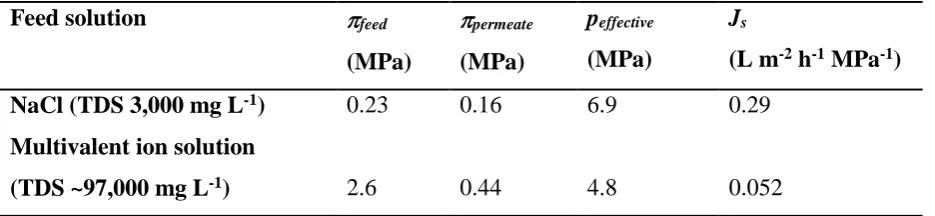
It was also found that the flux (~0.25 L m-2 h-1) achieved for the multivalent ion solution (Fig. 1) was 8-fold lower than that obtained for NaCl solution (3,000 mg L-1 TDS) at the same operating conditions (2 L m-2 h-1). The lower flux compared to NaCl solution testing can be attributed to the reduced driving force for the relatively higher ionic strength solution, and in turn higher osmotic pressure needed to be overcome in order for RO to occur. Table 2 shows the osmotic pressures of the feed (πfeed) and permeate (πpermeate), effective pressure (peffective) and specific flux (JS) determined according to Equations 4 to 6. The feed osmotic pressure, πfeed, of
the NaCl solution (3,000 mg L-1 TDS) was estimated to be 0.23 MPa. The osmotic pressure for
the multivalent ion feed solution (97,000 mg L-1 TDS) was calculated to be 2.6 MPa (Table 2).
The corresponding effective pressure, peffective, was determined to be ~6.9 MPa and ~4.8 MPa, respectively, at a total applied pressure of 7 MPa and operating temperature of 21 ºC. In our
specific flux calculated for the multivalent ion solution was 5-fold smaller than that for the NaCl solution (Table 2). While the driving force was lower for the multivalent ion solution (~4.8 MPa) compared to the NaCl solution (~6.9 MPa), the specific flux of the multivalent ion solution based on net driving pressure should remain almost unchanged if no other effects are involved [7]. Significant low specific flux observed for the multivalent ion solution in this study indicated that the membrane pores have been blocked during testing with the multivalent ion solution, and is indeed the case where in our previous work a similar solution effectively caused a flux reduction tested on the same NaCl solution (before and after exposure to the
multivalent ion solution) due to blocking by the multivalent ions (e.g. Fe3+ and Al3+) [18].
Table 2 Osmotic pressures of feed, πfeed, and permeate, πpermeate , effective pressure, peffective,
and specific flux, JS, determined for the NaCl solution (TDS 3,000 mg L-1) and multivalent ion solution (TDS ~97,000 mg L-1) used in this study. Values determined for tests performed
at 7 MPa and 21 ºC.
Feed solution feed
(MPa)
permeate
(MPa)
peffective
(MPa)
Js
(L m-2 h-1 MPa-1)
NaCl (TDS 3,000 mg L-1) 0.23 0.16 6.9 0.29
Multivalent ion solution
(TDS ~97,000 mg L-1) 2.6 0.44 4.8 0.052
3.2. Filtration performance under different applied pressures
that higher applied pressure (up to 7 MPa) gave higher ion rejection. As expected the membrane achieved a high rejection for Fe3+ when the operating pressure was applied at 5 MPa or above (from ~84% at 5 MPa up to ~97% at 7 MPa), a good rejection for Al3+ and Mg2+ (from ~70% at 5 MPa to ~80% at 7 MPa) but less rejection for Ca2+ (up to 50%) at the same operating conditions (Fig. 4).
Fig. 3 EC rejection and water flux achieved on the prepared MFI-type zeolite membrane, fed with multivalent ion solution at different applied pressures (3 –
7 MPa) and 21 °C.
20 30 40 50 60 70 80
0.00 0.05 0.10 0.15 0.20 0.25 0.30
2 3 4 5 6 7 8
E
C rej
ection
(%
)
Flux
(L
m
-2
h
-1)
Applied pressure (MPa)
Fig. 4 Ion rejections on the prepared MFI-type zeolite membrane fed with multivalent ion solution at different applied pressures (3 – 7 MPa) and 21 °C.
The results obtained from filtration performance testing under different applied pressures (3 – 7 MPa) appear to follow the effect related to change in net driving pressure after overcoming
the osmotic pressure [7]. Similar trends were observed from our previous study on the desalination of saline recycled wastewater, where EC reduction increased from ~56% to ~80% and the flux increased an order of magnitude when the applied pressure was increased from 1
MPa to 7 MPa [11]. The effective pressures (Table 3) calculated based on the ion rejections (Fig. 4) achieved by the membrane confirmed a significant increase in effective pressure when
increasing the applied pressure from 3 MPa to 7 MPa. However, there was a slight decrease in specific flux (Table 3) although the flux increased with an increase of the applied pressure (Fig. 3). This indicated that the zeolite membrane pores might have been blocked by infiltration of ions under higher pressure operation. Our earlier work [18, 22, 23] has identified that monovalent cations (e.g. K+, Na+) can enter the zeolite lattices, while divalent cations (e.g. Ca2+, Mg2+) and trivalent cations (e.g. Fe3+, Al3+) can occupy the grain boundaries of zeolites upon exposure to ion solutions, and this can result in changes to crystal structure and the porous properties of zeolites. While this effect was observed at ambient pressure, increasing in pressure at least can cause flow through the membrane to ensure penetration of ions into the zeolite film, thus enhancing the blockage of membrane pores. It is also possible that grain boundaries of zeolites are compacting under relative high pressure (e.g. 7 MPa). Although it
0 20 40 60 80 100 120
3 4 5 6 7
Ion
rejection
(%
)
Applied pressure (MPa) Fe
Al
Mg
has been reported that the zeolites unit cell can expand under extremely high pressures (e.g. at GPa scales) [39, 40], to our knowledge, no existing research addressed compressibility of the grain boundaries of zeolites under pressures at MPa scales, possibly because it is unmeasurable under such pressure level.
Table 3 Osmotic pressures of feed (πfeed) and permeate (πpermeate), effective pressure
(peffective), and specific flux (Js) estimated for desalination of the multivalent ion feed solution (TDS ~97,000 mg L-1) under different applied pressures (ptotal = 3 – 7 MPa) at 21 ºC. Values
determined based on the ion rejections (Fig. 4).
ptotal (MPa) feed (MPa) permeate (MPa) peffective (MPa) Js
(L m-2 h-1 MPa-1)
3 2.6 1.2 1.6 0.060
4 5 6 7 2.6 2.6 2.6 2.6 0.97 0.70 0.53 0.44 2.4 3.1 3.9 4.8 0.049 0.043 0.040 0.037
3.3. Effect of temperature on filtration performance
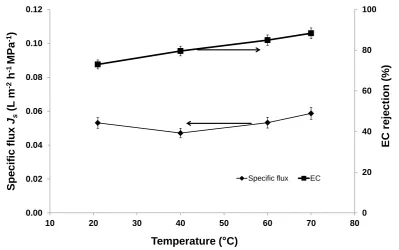
temperature (Fig. 6). The ion rejections confirmed that higher operating temperature (up to 70 °C) gave higher ion rejection, in particular Ca2+ which has the smallest hydrated diameter but showed a largest increase in rejection (Fig. 7). The membrane achieved a high rejection for Fe3+ (99%), Al3+ (92%) and Mg2+ (91%) but less rejection for Ca2+ (66%) at an applied pressure of 7 MPa and feed temperature of 70 °C (Fig. 7).
Fig. 5 EC rejection and specific flux on the prepared MFI-type zeolite
membrane, fed with multivalent ion solution at different temperatures under an
applied pressure of 7 MPa.
0 20 40 60 80 100
0.00 0.02 0.04 0.06 0.08 0.10 0.12
10 20 30 40 50 60 70 80
EC rej
ect
ion
(%
)
S
peci
fic
flux
Js
(L
m
-2
h
-1
MP
a
-1)
Temperature ( C)
Fig. 6 Water and Ion fluxes on the prepared MFI-type zeolite membrane fed
with multivalent ion solution at an applied pressure of 7 MPa and different
temperatures.
Fig. 7 Rejection of ions with different hydrated sizes on the prepared MFI-type
zeolite membrane fed with multivalent ion solution at an applied pressure of 7
MPa and different temperatures.
0 5 10 15 20 25 0.000 0.010 0.020 0.030 0.040 0.050
10 20 30 40 50 60 70 80
W at er flux (mol m -2 h -1 ) Ion
flux ( m
ol
m
-2
h
-1 )
Temperature ( C)
Mg Al Ca Fe Water
a
40 50 60 70 80 90 100 110 1200.824 0.856 0.914 0.950
Ion
rejection
(%
)
Hydrated diameter (nm) 70 °C
60 °C 40 °C
21 °C Fe
Al Mg Ca 0.0000 0.0002 0.0004 0.0006 0.0008
10 20 30 40 50 60 70 80
Ion flux ( mol m -2 h -1)
Temperature ( C)
Ca Fe
It is known that osmotic pressure is also a function of temperature shown in Equation 4 [29], so net driving pressure after overcoming the osmotic pressure (effective pressure) will also depend on the test temperature. When the testing temperature was increased from 21 °C to 70 °C at a total applied pressure (ptotal) of 7 MPa, the feed osmotic pressure, πfeed, of the multivalent
ion solution (97,000 mg L-1 TDS) increased from 2.6 MPa to 3.1 MPa, while the corresponding
effective pressure, peffective, decreased from 4.8 MPa to 4.1 MPa (determined according to Equations 4 – 5). Lower effective pressure generally results in lower water flux and ion rejection if no other effects are involved [11]. For the results here, however, it seems that
increasing the temperature decreased ion fluxes (Fig. 6) but increased the overall ion rejection (Fig. 7) and had no significant impact on specific flux and the absolute water flux (Figs 5 and
6). Our previous study on desalination performance of a MFI-type zeolite membrane for a NaCl feed solution (TDS 3000 mg L−1) under an applied pressure of 7 MPa showed that flux doubled when the testing temperature was increased from 21 °C to 90 °C [7]. Our another study on desalination of sea salts solution also showed that the specific flux increased 2.5-fold when the operating temperature was increased from 22 °C to 90 °C [8]. Increase in permeate flux with increasing temperature is typical for microporous materials, especially MFI-type zeolites as observed in pervaporation studies which is attributed to activated transport [9, 41]. Activated diffusion was also observed by Li et al. [4] in desalination through the same structures. In their study both water and ion fluxes were found to increase significantly when raising the feed temperature from 10 °C to 50 °C. However, the changes in absolute water flux and specific flux in this study were insignificant when compared to that observed in our previous work [7, 8]. The same studies [7, 8] also showed a decrease in the rejection of cations when increasing the testing temperature. Therefore, in our work concerning the higher valency ions, another effect is dominating giving the observed unique behaviour. It is known that increasing temperature could reduce the apparent size of hydrated ions [42] and increase the zeolite intrinsic pores with the upper limit of pore size of around 0.6 nm (approaching the size of the hydrated Na+ and Cl−)as determined by positron annihilation lifetime spectroscopy (PALS)
[8]. This means that the hydration diameter decreases at the same time as the zeolite intrinsic
and Fe3+) (Fig. 7). The significant increase in rejection of the smallest ion Ca2+ (although it did not reach 90%) with increasing in temperature as observed here (Fig. 7) suggested that the small pore tail of the membrane pore size distribution might be also reduced. Al3+ also showed an increase in rejection when temperature was increased, however, it was not the most rejected ion in the system which was Fe3+ (Fig. 7). This was unusual because Al3+ (0.950 nm) is
reported to have a larger hydrated diameter compared to Fe3+ (0.914 nm) [15], however it may be apparently smaller due to its known strong uptake into the zeolite like iron but weaker interaction with zeolite material compared to Fe3+ [18]. At pH 2, both Fe3+ and Al3+ can strongly
adsorbed on the silica surface and have a greater tendency to form covalent bonds than Ca2+ and Mg2+ [43], therefore theybothcan strongly chelate with the silicalite surface [44, 45].
However, Al3+ might be easy to release due to its relatively weaker interaction than Fe3+ [18]. Al3+ has slightly stronger hydration energy [46] than Fe3+ [47] (-4665 kJ mol-1 and -4430 kJ mol-1 respectively), therefore can retain water molecules more strongly than Fe3+. This enables Fe3+ to preferentially interact with the silicalite network and be retained by the membrane. Al3+ on the other hand diffuses more freely as it strongly retains water molecules instead of networking with silicalite.
Thermal energy effects on molecule interactions may also explain the lower Al3+ rejection than expected. Increasing temperature can influence the ion-water interactions and water-water interactions in an ion solution [42]. For example, the water-water interactions can be weakened by increasing temperature, and this will result in an effect where the ions hold the water molecules more tightly and the ion-water distance contracts [48]. However, when temperature was raised, Al3+ would tightly hold the water molecules and together with the ion-water
distance contraction, the apparent size of its hydrated form is reduced. The apparent size of Al3+ here appeared closer to Mg2+ in terms of rejection. Al is only one atomic unit larger than
Mg, and very similar in terms of atomic weight (27 g mol-1 vs 24 g mol-1), and much lighter
compared to Fe (56 g mol-1). The increase in overall ion rejection and insignificant changes in
specific flux observed here might be also attributed to the blockage of membrane pores by deep
membranes [18]. For the results here, it seems that increasing temperature might accelerate ions to enter the zeolite pores as is expected from activated diffusion observed in the previous studies [4, 9, 41]. The simultaneous decrease in the size of the microporous grain boundaries with increasing temperature as observed by PALS [8] for these ions uniquely very close to their hydrated diameter caused enhanced ion blocking. This translated ultimately to a decrease in ion flux (Fig. 6) and an increase in ion rejection (Fig. 7) even though the effective pressure decreased when increasing temperature.
Water behaviour within zeolites has been well documented by both experiment and simulation [4, 32, 49, 50]. Temperatures can affect the phase condition of water molecules inside the zeolite pores during the mass transfer. For example, in MFI-type silicalite zeolites,
water appears to be mostly in form of amorphous solidlike clusters at very low temperatures (< 225 K); at intermediate temperatures (e.g. 225 – 350 K), the behavior of water is almost liquidlike, whereas at higher temperatures, it shows a vaporlike features [49]. Based on the temperatures (294 – 343 K) tested on a MFI-type zeolite membrane in our study, the phase condition of water molecules is almost liquidlike [49].
3.4. Effect of acid clean on filtration performance
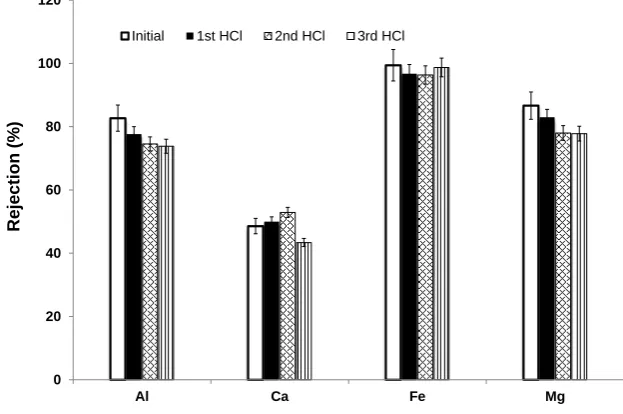
During filtration testing on the multivalent ion feed solution, the membrane pores were blocked several times due to interactions between ions (e.g. Fe3+, Al3+) present in the feed solution and the zeolite material [18]. Each time the flux dropped significantly due to the blockage of membrane pores, the membrane was cleaned using 1 M HCl and was then retested for filtration of the multivalent ion solution. Figure 8 compares the ion rejections achieved by the zeolite membrane from the initial test and after several HCl cleans of the multivalent ion solution tested membrane at an applied pressure of 7 MPa and 21 °C. It can be seen from Figure 8 that the ion rejection for Fe3+ achieved by the membrane after the third HCl clean showed a similar level of removal to those obtained from the initial filtration testing and after the previous two HCl cleans on the same multivalent ion solution under the same operating conditions. A slight decrease in rejections for the other ions was observed after the third HCl clean when
compared to the results obtained from the initial filtration testing. Ca2+ showed a slight higher rejection after the second acidic cleaning when compared to the initial results. This might be
error range of 5 – 10% (Section 3.1). These results indicate that acid (1 M HCl) cleaning of the multivalent ion solution tested membrane did not have a significant impact on the membrane’s ion rejection ability. However, the DI water fluxes at an applied pressure of 7 MPa
and 21 °C after the acid (1 M HCl) cleans (ranged from 1.0 to 1.4 L m-2 h-1) were significantly smaller than the initial DI water flux (5.6 L m-2 h-1), indicating that the water flux was not fully
recovered after 1 M HCl cleaning due to the tight binding of the cations (in particular Fe3+)in the zeolite material [18]. Our previous study on membrane performance on saline recycled wastewater showed that the MFI-type zeolite membrane can withstand strong chlorine
exposure (168,000 ppm h) demonstrating its high chemical tolerance [11]. High chemical stability of MFI-type zeolite membranes was also demonstrated in other applications such as
gas separation [51] and pervaporation [52]. The results obtained here provide evidence of the strong chemical stability of MFI-type zeolite and its suitability for robust NF membrane applications. While here we reported the preliminary work of using acid to clean ion-blocked membrane and to check membrane’s chemical stability, optimising the cleaning procedure is
necessary for future work when applied for treatment of real mining wastewater.
Fig. 8 Comparison of ion rejections achieved by the zeolite membrane from the
initial test and after 1 M HCl cleans following filtration of multivalent ion
solution at an applied pressure of 7 MPa and 21 °C. 0
20 40 60 80 100 120
Al Ca Fe Mg
Re
jection
(%
)
3.5. SEM
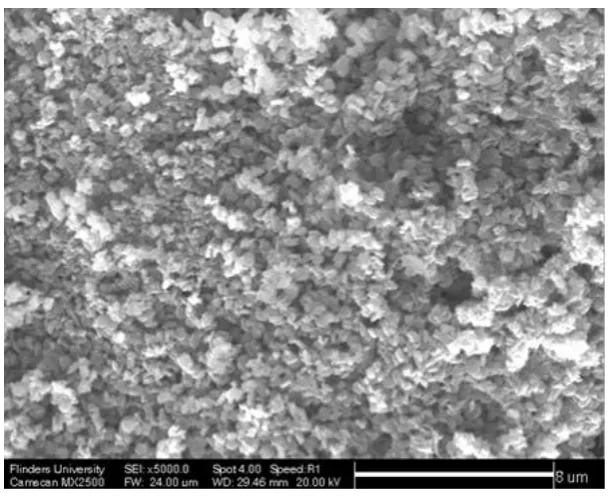
Figure 9 shows the SEM images taken on the surface of the MFI-type zeolite membrane after filtration testing with the multivalent ion solution. The filtration tested membrane was cleaned with HCl solution followed by DI water permeation prior to SEM measurements to remove weakly adsorbed material (including ions). The SEM image showed typical randomly orientated MFI-type zeolite crystals [7, 8, 11, 23], indicating that a zeolite membrane layer was grown on the surface of the Al2O3 support. The zeolite crystals formed disorderly on the surface
of the α-Al2O3 support and the surface of the Al2O3 support was completely covered by
MFI-type zeolite crystals. The size of the crystallites (~0.5 µm) making up the zeolite membrane
Fig. 9 SEM measured surface morphology of multivalent ion solution exposed
MFI-type zeolite membrane.
3.6. Implications of the practicalities of the application of MFI-type zeolite membranes to
mining wastewaters
The first critical challenge refers to a significant improvement in fluxes of zeolite membranes in order to reduce capital cost and increase desalination capacity. As mentioned earlier, water fluxes of polymer membranes are much higher than those through zeolite membranes possibly due to the significant difference in membrane thickness (typical thickness of 3 – 10 µm for zeolite membranes [2, 3, 11] is much thicker than commercial RO membranes (0.2 µm) [20, 21]) as membrane resistance to water transport is proportional to the dense surface layer thickness. While zeolite membrane thickness was mentioned as a potential reason for reduced
flux, studies have shown that the flux of zeolite membranes could be improved by changing the hydrophobicity of the membrane [53] or through a single crystal zeolite nano-membrane
[54]. For example, water flux of the zeolite membrane was increased by 10 times when the hydrophobicity of the membrane was decreased by adjusting the Si/Al ratio to 50 [19]. A recent molecular dynamics stimulation study [54] also showed that a nanoscale single crystal zeolite (FAU or MFI-type) membrane with uniform pore size and high pore density can potentially achieve higher specific flux than state of the art polymer membranes.
In addition, the effects of trace cations present in wastewaters on the reliably of zeolite membranes should also be carefully considered. As mentioned earlier, a computational study has identified that multivalent cations cannot enter the intrinsic pores of zeolites, while monovalent cations (e.g. K+ , Na+) can but are hindered by the inability for Cl- to enter yielding a desalination effect [32]. Trace amounts of divalent cations (e.g. Ca2+) in seawater can occupy the grain boundaries of MFI-type zeolites [22] but are also blocked in defect free zeolite membranes. Trivalent cations (e.g. Fe3+ and Al3+) can plug the large defect pores of MFI-type
zeolites and this could potentially be utilised to inhibit non selective flux in pore defects but maintain water permeation through the intrinsic pores [18]. Although we did not see any negative effect or accumulation of Fe in our previous study on the application of MFI-type zeolite membrane for desalination of real municipal wastewater [11], the importance of interactions between these cations in trace amounts and the zeolite material cannot be
underestimated as these interactions can alter the structure and porosity of zeolite material thus affecting membrane performance [8, 22-24]. Further study is needed to determine the effect of these cations on long term performance of MFI-type zeolite membranes.
While rejections (e.g. ~99% for Fe3+, ~80 % for Al3+, Mg2+ and SO
42-) achieved in this study
reported 30 – 86% for Mg2+ and 28 – 85% for SO
42- on polymer NF membranes; Mullett et al.
[56] reported > 94% for both Mg2+ and SO
42- on polymer NF membranes), fluxes (e.g. ~0.3 L
m-2 h-1), the flux of MFI-type membranes were significantly low compared to state of the art polymer membranes used for mining wastewater (e.g. 16 – 25 L m-2 h-1 [55]). However, zeolite membranes exhibited unique effects in multivalent ion rich solution that could be further utilised in potential other applications such as niche desalination applications or sensors [57].
4. Conclusion
A MFI-type zeolite membrane was prepared on a tubular α-alumina substrate via the seeded
and secondary hydrothermal growth method. The prepared MFI-type zeolite membrane was tested for filtration of an ion complex model of mining water containing Fe3+, Al3+, Ca2+ and Mg2+ (TDS ~97,000 mg L-1, pH 2.03). The effects of applied pressure, temperature and acid cleaning on membrane performance were investigated. The results obtained from filtration performance testing showed that the prepared MFI-type zeolite membrane achieved good ion rejections for Fe3+ (~99%), Al3+ and Mg2+ (both ~80%) but lower rejection for Ca2+ (~50%) at
7 MPa and 21 °C. Higher operating temperature (e.g. 70 °C) resulted in higher ion rejection possibly due to the blockage of membrane pores by accelerated interactions between ions present in multivalent ion feed solution and zeolite materials. However, the blocking effect further contributed to some loss of membrane flux as observed for each temperature tested. Acid (1 M HCl) cleaning had no impact on ion rejection behaviour. The SEM results showed an intact membrane after exposure to multivalent ion solution. Regardless, the filtration performance of this range of ions at low pH had an interesting effect related to ion size and membrane charge.
Acknowledgment
This research was funded by the Australian Research Council (Australia), Chosun Refractories Co. Ltd. (Korea) and C.I. Ceramics (Aust.) Pty. Ltd. (Australia) through a Linkage Project (LP100200242). The authors would like to thank Dr Yong-Han Na and Mr Jin-Wook
Shin (Chosun Refractories Co. Ltd.), and Mr Takanori Oishi and Mr Yoshito Muraki(C.I. Ceramics (Aust.) Pty. Ltd.) for their ongoing support and willingness to discuss project related
References:
[1] J. Lin, S. Murad, A computer simulation study of the separation of aqueous solutions using thin zeolite membranes, Molecular Physics, 99 (2001) 1175-1181.
[2] L.X. Li, J.H. Dong, T.M. Nenoff, R. Lee, Desalination by reverse osmosis using MFI zeolite membranes, Journal of Membrane Science, 243 (2004) 401-404.
[3] L.X. Li, J.H. Dong, T.M. Nenoff, R. Lee, Reverse osmosis of ionic aqueous solutions on a
MFI zeolite membrane, Desalination, 170 (2004) 309-316.
[4] L.X. Li, J.H. Dong, T.M. Nenoff, Transport of water and alkali metal ions through MFI
zeolite membranes during reverse osmosis, Separation and Purification Technology, 53 (2007) 42-48.
[5] M. Duke, J. O'Brien-Abraham, N. Milne, B. Zhu, Y.S. Lin, J.C. Diniz da Costa, Seawater desalination performance of MFI type membranes made by secondary growth, Separation and Purification Technology, 68 (2009) 343-350.
[6] M. Kazemimoghadam, T. Mohammadi, Synthesis of MFI zeolite membranes for water desalination, Desalination, 206 (2007) 547-553.
[7] B. Zhu, J.H. Kim, Y.-h. Na, I.-S. Moon, G. Connor, S. Maeda, G. Morris, S. Gray, M. Duke, Temperature and pressure effects of desalination using a MFI-type zeolite membrane, Membranes, 3 (2013) 155-168.
[8] B. Zhu, Z. Hong, N. Milne, C.M. Doherty, L. Zou, Y.S. Lin, A.J. Hill, X. Gu, M. Duke, Desalination of seawater ion complexes by MFI-type zeolite membranes: temperature and long term stability, Journal of Membrane Science, 453 (2014) 126–135.
[9] M. Drobek, C. Yacou, J. Motuzas, A. Julbe, L. Ding, J.C. Diniz da Costa, Long term pervaporation desalination of tubular MFI zeolite membranes, Journal of Membrane Science, 415–416 (2012) 816-823.
[10] N. Liu, L. Li, B. McPherson, R. Lee, Removal of organics from produced water by reverse osmosis using MFI-type zeolite membranes, Journal of Membrane Science, 325 (2008)
357-361.
[11] B. Zhu, D.T. Myat, J.-W. Shin, Y.-H. Na, I.-S. Moon, G. Connor, S. Maeda, G. Morris, S. Gray, M. Duke, Application of robust MFI-type zeolite membrane for desalination of saline wastewater, Journal of Membrane Science, 475 (2015) 167-174.
[13] J. Li, J. Sun, Z. Li, H. Peng, D. Gidley, R. Todd, E., Y. Yan, Evaluation of pore structure in pure silica zeolite MFI low-k thin films using positronium annihilation lifetime spectroscopy, Journal of Physical Chemistry B, 108 (2004) 11689-11692.
[14] C. Baerlocher, L.B. McCusker, Database of zeolite structures, in: http://www.iza-structure.org/databases/.
[15] E.R. Nightingale Jr., Phenomenological theory of ion solvation. Effective radii of hydrated ions, The Journal of Physical Chemistry, 63 (1959) 1381-1387.
[16] L. Li, N. Liu, B. McPherson, R. Lee, Influence of counter ions on the reverse osmosis
through MFI zeolite membranes: implications for produced water desalination, Desalination, 228 (2008) 217-225.
[17] A. Garofalo, M.C. Carnevale, L. Donato, E. Drioli, O. Alharbi, S.A. Aljlil, A. Criscuoli, C. Algieri, Scale-up of MFI zeolite membranes for desalination by vacuum membrane distillation, Desalination, 397 (2016) 205-212.
[18] B. Zhu, X.R. Hu, J.-W. Shin, I.-S. Moon, Y. Muraki, G. Morris, S. Gray, M. Duke, A method for defect repair of MFI-type zeolite membranes by multivalent ion infiltration, Microporous Mesoporous Materials, 237 (2017) 140-150.
[19] L. Li, N. Liu, B. McPherson, R. Lee, Enhanced Water Permeation of Reverse Osmosis through MFI-Type Zeolite Membranes with High Aluminum Contents, Industrial & Engineering Chemistry Research, 46 (2007) 1584-1589.
[20] Introduction to Reverse Osmosis Membrane, in:
http://www.csmfilter.com/csm/upload/TechManual/Types.pdf.
[21] FILMTEC™ Reverse Osmosis Membranes Technical Manual, The Dow Chemical
Company ("Dow"), Form No. 609-00071-1009.
[22] B. Zhu, C.M. Doherty, X. Hu, A.J. Hill, L. Zou, Y.S. Lin, M. Duke, Designing hierarchical porous features of ZSM-5 zeolites via Si/Al ratio and their dynamic behavior in seawater ion complexes, Microporous and Mesoporous Materials, 173 (2013) 78-85.
[23] B. Zhu, L. Zou, C.M. Doherty, A.J. Hill, Y.S. Lin, X.R. Hu, H.T. Wang, M. Duke, Investigation of the effects of ion and water interaction on structure and chemistry of silicalite
MFI type zeolite for its potential use as a seawater desalination membrane, Journal of Materials Chemistry, 20 (2010) 4675 - 4683.
[25] J.S. Lee, J.H. Kim, Y.J. Lee, N.C. Jeong, K.B. Yoon, Manual Assembly of Microcrystal Monolayers on Substrates, Angewandte Chemie International Edition, 46 (2007) 3087-3090. [26] W.C. Yoo, J.A. Stoeger, P.-S. Lee, M. Tsapatsis, A. Stein, High-Performance Randomly Oriented Zeolite Membranes Using Brittle Seeds and Rapid Thermal Processing, Angewandte Chemie International Edition, 49 (2010) 8699-8703.
[27] M.C. Lovallo, M. Tsapatsis, T. Okubo, Preparation of an Asymmetric Zeolite L Film, Chemistry of Materials, 8 (1996) 1579-1583.
[28] L.C. Boudreau, M. Tsapatsis, A Highly Oriented Thin Film of Zeolite A, Chemistry of
Materials, 9 (1997) 1705-1709.
[29] Osmosis Equation, in: http://www.chemteam.info/Solutions/Osmosis-Equation.html.
[30] Species Table 9.3 - Liquid Properties,
http://help.syscad.net/index.php/Species_Table_9.3_-_Liquid_Properties.
[31] B.A. Kunkel, Comments on “a generalized equation for the solution effect in droplet growth”, Journal of the Atmospheric Sciences, 26 (1969) 1344-1345.
[32] Z.E. Hughes, L.A. Carrington, P. Raiteri, J.D. Gale, A Computational Investigation into the Suitability of Purely Siliceous Zeolites as Reverse Osmosis Membranes, The Journal of Physical Chemistry C, 115 (2011) 4063-4075.
[33] M. Noack, P. Kölsch, A. Dittmar, M. Stöhr, G. Georgi, R. Eckelt, J. Caro, Effect of crystal intergrowth supporting substances (ISS) on the permeation properties of MFI membranes with enhanced Al-content, Microporous and Mesoporous Materials, 97 (2006) 88-96.
[34] J. Dong, K. Wegner, Y.S. Lin, Synthesis of submicron polycrystalline MFI zeolite films on porous ceramic supports, Journal of Membrane Science, 148 (1998) 233-241.
[35] E.R. Geus, M.J. Den Exter, H. Van Bekkum, Synthesis and characterization of zeolite (MFI) membranes on porous ceramic supports, Journal of the Chemical Society, Faraday Transactions, 88 (1992) 3101-3109.
[36] A.K. Basumatary, Fabrication, Characterization of Zeolite-Ceramic Composite Membranes and Their Application in Separation of Metal Ions from Aqueous Solution, in: Department of Chemical Engineering, PhD Thesis, , Indian Institute of Technology Guwahati
2015.
[38] A.K. Basumatary, R. Vinoth Kumar, K. Pakshirajan, G. Pugazhenthi, Removal of trivalent metal ions from aqueous solution via cross-flow ultrafiltration system using zeolite membranes, Journal of Water Reuse and Desalination, 7 (2017) 66-76.
[39] W.H. Baur, Microporous materials: Frameworks under pressure, Nat Mater, 2 (2003) 17-18.
[40] Scientists Discover New Material That Expands Under Pressure, Brookhaven National Laboratory, in: https://www.bnl.gov/bnlweb/pubaf/pr/2001/bnlpr121301.htm.
[41] T.C. Bowen, H. Kalipcilar, J.L. Falconer, R.D. Noble, Pervaporation of organic/water
mixtures through B-ZSM-5 zeolite membranes on monolith supports, Journal of Membrane Science, 215 (2003) 235-247.
[42] M. Chaplin, Water Structure and Science: Ion Hydration and Aqueous Solutions of Salts, in: http://www1.lsbu.ac.uk/water/ion_hydration.html.
[43] T. Wakatsuki, H. Furukawa, K. Kawaguchi, Specific and non-specific adsorption of inorganic ions I. Evaluation of specific adsorbability by means of minimum concentration for specific adsorption, Soil Science and Plant Nutrition, 20 (1974) 353-362.
[44] R.K. Iler, The Chemistry of Silica: Solubility, Polymerization, Colloid and Surface Properties and Biochemistry of Silica, John Wiley and Sons., New York, 1979.
[45] P.W. Schindler, B. Fürst, R. Dick, P.U. Wolf, Ligand properties of surface silanol groups. I. surface complex formation with Fe3+, Cu2+, Cd2+, and Pb2+, Journal of Colloid and Interface Science, 55 (1976) 469-475.
[46] C. Chieh, Enthalpy of Hydration, in:
http://www.science.uwaterloo.ca/~cchieh/cact/applychem/hydration.html.
[47] Enthalpies of hydration and enthalpies of ionization for some ions, in: http://higheredbcs.wiley.com/legacy/college/mason/1405160489/tables/c03.pdf
[48] T.M. Seward, C.M.B. Henderson, O.M. Suleimenov, J.M. Charnock, X-ray absorption spectroscopic studies of halide ion hydration in hydrothermal solutions, Geochimica et Cosmochimica Acta, 70 (2006) A573.
[49] P. Demontis, G. Stara, G.B. Suffritti, Behavior of Water in the Hydrophobic Zeolite
Silicalite at Different Temperatures. A Molecular Dynamics Study, The Journal of Physical Chemistry B, 107 (2003) 4426-4436.
[50] M.U. Arı, M.G. Ahunbay, M. Yurtsever, A. Erdem-Şenatalar, Molecular Dynamics
[51] H. Wang, X. Dong, Y.S. Lin, Highly stable bilayer MFI zeolite membranes for high temperature hydrogen separation, Journal of Membrane Science, 450 (2014) 425-432.
[52] M.-H. Zhu, I. Kumakiri, K. Tanaka, H. Kita, Dehydration of acetic acid and esterification product by acid-stable ZSM-5 membrane, Microporous and Mesoporous Materials, 181 (2013) 47-53.
[53] United States Environmental Protection Agency, Membrane Filtration Guidance Manual, Diane Publishing, Darby, PA, 2003.
[54] Y. Liu, X. Chen, High permeability and salt rejection reverse osmosis by a zeolite
nano-membrane, Physical Chemistry Chemical Physics, 15 (2013) 6817-6824.
[55] S.J. Macnaughton, J.K. McCulloch, K. Marshall, R.J. Ring, Application of nanofiltration
to the treatment of uranium mill effluents, in: Technologies for the treatment of effluents from uranium mines, mills and tailings. Proceedings of a technical committee meeting, 1 - 4 November 1999, Vienna, Austria. International Atomic Energy Agency (IAEA) Report, 2002, pp. 55-65.