Nearly Optimal Robust Secret Sharing
Mahdi Cheraghchi∗
Department of Computing Imperial College London
London, UK
Abstract
We prove that a known approach to improve Shamir’s celebrated secret sharing scheme; i.e., adding an information-theoretic authentication tag to the secret, can make it robust fornparties against any collusion of sizeδn, for any constantδ∈(0,1/2). This result holds in the so-called “non-rushing” model in which the n shares are submitted simultaneously for reconstruction. We thus finally obtain a fully explicit and robust secret sharing scheme in this model that is essentially optimal in all parameters including the share size which isk(1 +o(1)) +O(κ), where k is the secret length andκis the security parameter. Like Shamir’s scheme, in this modified scheme any set of more thanδnhonest parties can efficiently recover the secret.
Using algebraic geometry codes instead of Reed-Solomon codes, the share length can be decreased to a constant (only depending onδ) while the number of sharesncan grow indepen-dently. In this case, whennis large enough, the scheme satisfies the “threshold” requirement in an approximate sense; i.e., any set ofδn(1 +ρ) honest parties, for arbitrarily smallρ >0, can efficiently reconstruct the secret.
1
Introduction
Secret sharing, introduced by the seminal works of Shamir [Sha79] and Blackley [Bla79], is the following problem (in its most basic formulation): Suppose we wish to encode and distribute a secret s ∈ Fk
2 among n parties in such a way that i) the n parties can reconstruct the original
secret s by revealing their respective shares; and, ii) for some integer parameter t >0 (called the
privacy parameter), any group oftparties cannot infer any information about the secret from their
collection of shares. In coding-theoretic terms, the goal is to encode s (using randomness) into a sequence Y1, . . . , Yn over some alphabet of size Q, in a way that s can be reconstructed from the
encoding and moreover, for any i1, . . . , it∈[n], the sequenceYi1, . . . , Yit has the same distribution
regardless of the messages.
∗
Shamir proposed a beautiful scheme that provides an optimal solution to the problem. The scheme regards the secret as an element of the finite field FQ, for some prime power Q ≥n, and
then samples a uniformly random univariate polynomial of degree t over FQ with the constant
term set to be s. The coding-theoretic interpretation of this solution is that s is amended witht
uniformly random and independent elements ofFQand the result is encoded using a Reed-Solomon
code of lengthnand dimensiont+1. Shamir’s solution works even if the adversary uses an adaptive strategy; i.e., when each of the query positions i1, . . . , it depends on the observation outcomes at
the previous locations. Adaptive security is a property that is generally sought after for secret sharing schemes.
Due to its coding-theoretic nature, Shamir’s scheme provides at least two additional benefits. First, any group of parties is able to recover s as long as the size of the group is larger than t. This so-called “threshold property” is due to the fact that the Reed-Solomon code is an MDS code.
Second, any Reed-Solomon code of rateR is able to tolerate any fraction of errors up to (1−R)/2 and this can be achieved by an efficient decoder (such as the Berlekamp–Massey decoding algorithm,
cf. [Rot06, Chapter 6]). As a result, a straightforward calculation shows that Shamir’s secret sharing scheme is robust, in the sense that it can tolerate any less than 1/3 fraction of dishonest parties. That is, the correct secret scan be reconstructed even if any less than 1/3 fraction of the parties
reveal their shares incorrectly. In fact, this holds true even if the malicious parties are able to arbitrarily communicate with each other and choose the incorrect shares adversarially.
More strongly, Shamir’s scheme is secure against the so-called “rushing” adversaries. In the
rushing setting (also known as “secret sharing with reconstructor”), reconstruction is done by each party broadcasting their (possibly corrupted) shares in an order determined by the protocol.
This means that the adversary may attempt to, adaptively, manipulate shares at any point in the reconstruction phase (up to its allotted budget) based on its (adaptive) observation of up to t shares as well as all the shares (including those of the honest parties) that are revealed so far.
Naturally, the requirement is then that each party should be able to correctly reconstruct the secret in isolation, with high probability, from the information received from the n parties. The
error resilience of Shamir’s scheme is based on the minimum distance of Reed-Solomon code, and thus the power of the adversary is irrelevant for this scheme as long as the number of manipulations is less than the minimum distance of the code. In fact in the reconstruction phase the adversary may
observe everyone’s shares and then decide which ones to corrupt, and the set of corrupted shares may or may not overlap with the set of t shares observed by the adversary before reconstruction
1.1 Previous work
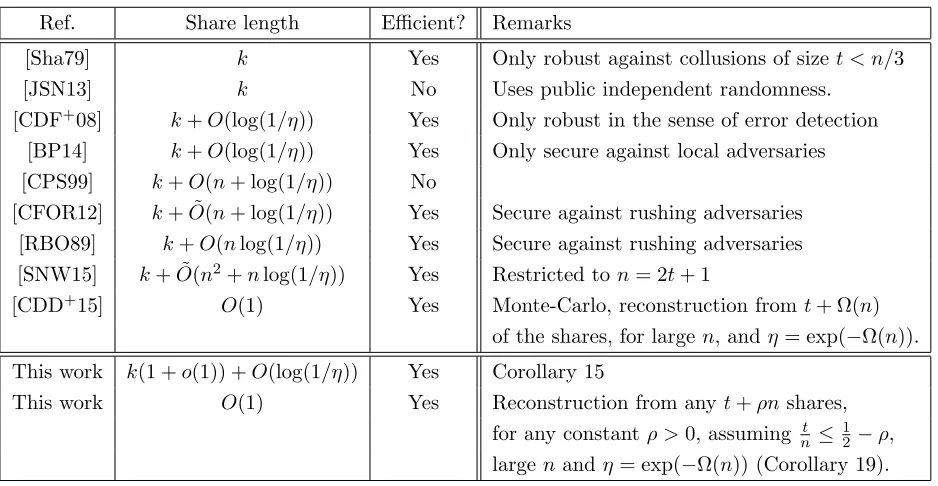
The robust notion of secret sharing has been studied in the literature, and some of the key results in the area are summarized in Table 1. It is known that robust secret sharing is impossible when
the fraction of dishonest parties is at least 1/2 [IOS12]. It is also impossible to always reconstruct the secret correctly (i.e., with probability 1) when the fraction of dishonest parties may be 1/3
or larger, in which case a small probability of error η is unavoidable. Therefore, Shamir’s scheme provides optimal robustness for a scheme with zero probability of error.
When an honest majority exists, Rabin and Ben-Or [RBO89] provide a secret sharing scheme
based on Shamir’s scheme combined with message authentication codes. The share lengthq:= logQ in this scheme is, ignoring small terms,k+ Ω(nlog(1/η)), whereη >0 is the probability of incorrect
reconstruction. In contrast, an appealing feature of Shamir’s scheme is that the shares arecompact; namely, the bit length of each share is equal to the bit length of the secret (under the natural assumption that n≤2k). This turns out to be optimal for schemes with perfect privacy satisfying
the threshold property [Sti92].
Another scheme, due to Cramer et al. [CDF01] (and based on [CPS99] and also using Shamir’s scheme) improves the share length to max{k, O(n+ log(1/η))}. However, the reconstruction time
for this scheme is in general exponential in n (more precisely, at least nt), and the scheme is insecure against rushing adversaries (cf. [CFOR12]).
Cevallos et al. [CFOR12] propose a scheme similar to [RBO89] that achieves more compact shares, namely of length k+O(log(1/η) +n(logn+ logk)). This scheme provides efficient share and reconstruction procedures and is also secure against rushing adversaries.
Jhanwar and Safavi-Naini [JSN13] consider a model in which all parties (including the adversary) have access to public, shared, randomness. They construct information-theoretically optimal secret
sharing schemes in this model by re-encoding Shamir’s shares using the available public randomness. This construction achieves the same share length as Shamir’s while providing privacy and robustness against any collusion of size less than n/2.
Cramer et al. [CDF+08] introduce the notion ofalgebraic manipulation detection (AMD) codes, which is a natural variant of error-detection codes in situations where the adversary’s perturbations
on a codeword are chosen independently of the codeword. By using this primitive as a pre-code in Shamir’s secret sharing scheme (or any secret sharing scheme with linear decoder), they are able to make the scheme robust against adversarial manipulations. The key difference in their model is
the notion of robustness; i.e., the requirement is that if the adversary corrupts any of the shares, the reconstruction shoulddetect the adversary and fail (rather than output the correct share) with high probability.
More recently, Lewko and Pastro [BP14] defined a variation of robust secret sharing in which the robustness requirement is againstlocal adversaries. That is, the error in each share corrupted
cor-responds to the case where a number of adversaries take control of different shares and have to decide on submitting an incorrect share only based on the local information that they possess (the
adversaries may agree on a strategy beforehand but cannot communicate after observing their re-spective shares). They show that even in this restricted model, the minimum required share length
isk+ log(1/η)−O(1) (under the standard threshold assumption that any set oft+ 1 must recon-struct the secret with probability at least 1−η). Furthermore, they construct efficient schemes in the local model that attains a nearly optimal share length ofk+O(log(1/η)).
In another recent work, Cramer et al. [CDD+15] combine AMD codes with universal hash functions and (folded) list decodable codes to construct a secret sharing scheme with potentially
constant share length (more precisely, share length Θ(1 + log(1/η)/n)). Their construction is with respect to a randomly chosen hash function from a universal family and is thus a Monte-Carlo construction. That is, the code construction relies on the probabilistic method (and thus may not
result in the desired secret sharing scheme with unfortunate choices of the randomness), however the encoder and decoders are efficient once the randomness of the code construction is set to an
appropriate choice. Moreover, this construction considers the “ramp model” in which it is not necessary to be able to reconstruct the secret from any t+ 1 of the shares. This relaxation is in fact necessary for any secret sharing scheme with share length smaller than the secret lengthk.
Finally, Safavi-Naini and Wang [SNW15] construct secret sharing schemes based on codes for the wiretap channel problem for the case n= 2t+ 1. This construction is based on wiretap codes that are in turn based on list decodable Reed-Solomon codes, subspace-evasive sets and AMD codes,
and attains a share length of k+O(n2(logn)(log logn) +nlog(1/η)).
1.2 Our contributions
In this work, we construct an essentially optimal robust secret sharing scheme against possibly adaptive, but non-rushing, adversaries. Somewhat surprisingly, our construction turns out to be
strikingly similar to some of the known constructions mentioned in§1.1.
More precisely, the construction first amends the secret with a tag using an AMD code (such as the one in [CDF+08]). Then, it uses Shamir’s scheme to encode the result into mn shares, for a carefully chosen integer parameter m > 1. Finally, the resulting shares are bundled into n groups of size m each which are distributed among the n parties. In other words, we use a
variant of Shamir’s scheme based on folded Reed-Solomon codes (instead of plain Reed-Solomon codes) combined with an AMD pre-code. This is very similar to what used in [CDF+08] to provide robustness in the sense of error-detection, as well as the coding-theoretic construction of
Safavi-Naini and Wang [SNW15] (the latter additionally uses subspace-evasive sets that we do not need). Combining Shamir’s scheme with some type of information-theoretic pre-code (such as a message authentication code) can also be seen as the underlying idea of other existing constructions such
The techniques that we use are remarkably simple to describe as well. To prove robustness, we first use an efficient list decoding algorithm of folded Reed-Solomon codes [GR08] to show that the
reconstruction procedure always outputs a short list containing an AMD encoding of the correct secret. Second, we use an elegant observation by Guruswami and Smith [GS10] that was used
by them to construct “stochastic” error-correcting codes. The observation is that, for any list decodable code that is linear over some base field, the list of potential messages corresponding to the any given received word is the translation of the original message by elements of a set that only
depends on the noise vector. In particular, the list of potential messages, shifted by the correct message, is only determined by the code and the error vector chosen by the adversary. For our
application in secret sharing, privacy of Shamir’s scheme implies that the perturbations of the adversary, and thus the set of error vectors in the message domain, must be independent of the original message and the internal randomness of the AMD code. As a result, the error detection
guarantee of the AMD code ensures that, with high probability, all the incorrect potential messages are correctly identified by the reconstruction procedure so that only the correct secret remains in
the end.
Our construction and underlying ideas share an overlap with the above-mentioned recent result
Ref. Share length Efficient? Remarks
[Sha79] k Yes Only robust against collusions of sizet < n/3
[JSN13] k No Uses public independent randomness.
[CDF+08] k+O(log(1/η)) Yes Only robust in the sense of error detection [BP14] k+O(log(1/η)) Yes Only secure against local adversaries [CPS99] k+O(n+ log(1/η)) No
[CFOR12] k+ ˜O(n+ log(1/η)) Yes Secure against rushing adversaries [RBO89] k+O(nlog(1/η)) Yes Secure against rushing adversaries [SNW15] k+ ˜O(n2+nlog(1/η)) Yes Restricted to n= 2t+ 1
[CDD+15] O(1) Yes Monte-Carlo, reconstruction fromt+ Ω(n)
of the shares, for large n, andη= exp(−Ω(n)).
This work k(1 +o(1)) +O(log(1/η)) Yes Corollary 15
This work O(1) Yes Reconstruction from any t+ρn shares,
for any constantρ >0, assuming nt ≤ 12−ρ, largen andη= exp(−Ω(n)) (Corollary 19).
of Cramer et al. [CDD+15] in which the authors construct a Monte-Carlo secret sharing scheme with small share length in the ramp model (where obtaining a sharp threshold; i.e., reconstructability
from any t+ 1 shares, is not a requirement). The construction in this work can be described as follows: First, the secret s is encoded with an AMD code, and then the result x is mapped to
a random element in h−1(x), where h is a fixed and appropriately chosen linear hash function. The resulting sequence is finally encoded using a list decodable code. Unfortunately, this result does not determine an explicit suitable choice for h. However it shows, using the probabilistic
method, that most functions in a universal family of hash functions are suitable choices for the hash functionh. In other words, ifhis randomly1picked from a universal family of hash functions, with high probability over the choice ofhthe resulting scheme is robust with the desired parameters. Therefore, the hash function h is determined by the code construction once and for all, and the probabilistic method shows that most choices of h would result in equally good secret sharing
schemes. It is not clear, however, whether one can efficiently and deterministically find a suitable choice for the hash functionhwithout running an exponential-time computation (as usual in random
coding arguments). Compared with this result, our work completely eliminates the need for the hash function, and thus we finally obtain a fully explicit construction of efficient secret sharing schemes with nearly optimal parameters in all aspects. Namely, our main result in this work can
be stated as follows.
Theorem 1. (Corollary 15, rephrased) Letδ <1/2 be any fixed constant. For any η >0, there is
an efficient, robust and perfectly private secret sharing scheme with n shares, secret length k, and share length q ≤k(1 +o(1)) +O(log(1/η)) that is secure with privacy parameter t=δn, attaining
a reconstruction error of at most η.
Same as Shamir’s scheme and [SNW15], our result does not necessarily require the observations of the adversary to coincide or overlap with the set of manipulated shares. In fact, the number of adaptive observations by the adversary may in general be different from the number of incorrect
shares, and this is allowed as long as the total fraction of observations and incorrect shares add up to a quantity sufficiently smaller than 1.
Although a share length of at least k bits is necessary for any robust secret sharing scheme
[Sti92] (even against local, or oblivious, adversaries [BP14]), it is possible to obtain smaller shares at cost of slightly relaxing the threshold property. That is, instead of requiring the secret to be
reconstructible (either with probability 1 or close to 1) from any set of more thantshares, we may require reconstructability from any set of more thant+gshares, for a small “gap” parameterg. A desirable level for the gap parameter is when g is a small fraction of the number of shares, and it
is reasonable to argue that a secret sharing scheme that attains such a relaxed threshold property
1It is important to not confuse the randomness of the choice ofhwith the internal randomness of the encoder; the
may be of interest to most applications.
We adapt our secret sharing scheme to nonzero gap parameters and, moreover, show that wheng
is a small fraction ofn, the alphabet size may be reduced to an absolute constant (depending on the fractiong/nand assuming thatt/nis smaller than 1/2 by some constant). This is achieved by using
folded algebraic geometry codes instead of folded Reed-Solomon codes and their corresponding list decoding algorithms (namely, the state-of-the-art algorithm due to Guruswami and Xing [GX14]). Using algebraic geometry codes, we can prove the following.
Theorem 2. (Corollary 19, rephrased) For any constant ρ > 0, and any δ ≤ 1/2−ρ, there is
a constant q =Oρ(1) such that the following holds. There is a robust and perfectly private secret sharing scheme with n shares, secret length k, and share length O(q), attaining a reconstruction error of η = exp(−Ω(ρnq)), provided that n≥k/(ρq). The scheme satisfies the threshold property
in an approximate sense; namely, that the secret can be reconstructed (with probability 1) given any set of t+ρn shares. The scheme is efficient given polynomial (in n) amount of pre-processed
information about the scheme.
Previously, the best known construction achieving small share length was due to Cramer et
al. [CDD+15] in which the share length is Θ(1 + log(1/η)/n) and thus grows with the security parameter (see Table 1). Moreover, as mentioned above, this construction is not fully explicit and
requires a randomly chosen hash function that is fixed once and for all and there is no clear efficient way of explicitly finding an appropriate hash function.
The efficiency of this scheme is dictated by the efficiency of the underlying list decoding
algo-rithm for algebraic geometry codes. The encoding and list decoding algoalgo-rithms in [GX14] that we use run in polynomial time provided that a polynomial amount of pre-processed information about
the code is available to the algorithms. Naturally, any subsequent improvements in list decoding algorithms of folded algebraic geometry (and for that matter, folded Reed-Solomon) codes would automatically improve the performance of the above secret sharing schemes.
We remark that the natural idea of reducing share length by using algebraic geometry codes rather than Reed-Solomon codes in secret sharing schemes dates back to a result of Chen and Cramer [CC06] and has been extensively studied since (cf. [CDN15]), especially in the context of
arithmetic secure multiparty computation.
Organization. The rest of the article is organized as follows. We explain the notation in §1.3.
Preliminaries, including the exact notion of secret sharing schemes that we use in this work, are discussed in §2. Our general construction is presented and analyzed in§3. We then instantiate the construction using folded Reed-Solomon codes in§4.1 and folded algebraic geometry codes in§4.2.
1.3 Notation
We use dH(x, y) to denote the Hamming distance between two vectors x and y. For a vector
Y = (Y1, . . . , Yn), and i ∈ [n], we use the notation Y(i) to denote Yi. Moreover, for a sequence
W = (W1, . . . , Wt) ∈[n]t, we use the notationY|W := (Y(W1), . . . , Y(Wt)). All logarithms are to
base two. For a functionf and a subsetS of the domain of f, we use the notation f(S) to denote
the set {f(s) :s ∈ S}. Moreover for two sets A, B over a group (G,+), we use A+B to denote {a+b:a∈A, b∈B}, and A+b (forb∈ G) to denote A+{b}.
2
Preliminaries
In this section, we describe the basic notions that are used throughout the paper, including the exact definition of robust secret sharing schemes that we use. The general notion of coding schemes is defined as follows.
Definition 3 (coding scheme). A pair of functions (Enc,Dec) where Enc: Fk2 ×F`2 → Fn2q, and
Dec: (F2q∪ {⊥})n →Fk2∪ {⊥}is called a coding scheme if for all s∈Fk2 and all z∈F`2, we have
Dec(Enc(s, z)) =s. The functionEnc and Dec are respectively called the encoder and thedecoder, and parameters k and q are respectively called the message length and the symbol length. We
use the notation Enc(s) to denote the random variableEnc(s, Z) when Z is sampled uniformly at random from F`2. The coding scheme is calledefficient ifEnc,Deccan be computed in polynomial
time in nq. The rate of the coding scheme is the quantity k/(nq). The coding scheme is binary if
q= 1.
Using the above definition, we may now define robust secret sharing schemes as a coding scheme satisfying the privacy and robustness requirements.
Definition 4 (robust secret sharing scheme). A robust secret sharing scheme with secret length
k, share length q, and number of shares nis a coding scheme (Share,Rec) with message lengthk,
symbol lengthq and block lengthn satisfying the following.
1. Adaptive privacy: For a parameter t (known as the privacy parameter), and for any
“secret” s∈ Fk
2, an adversary who (possibly adaptively) observes any up to t of the shares
gains (almost or absolutely) no information about the secrets. More formally, for aY ∈Fn
2q,
and a parametert, we define an observation strategy as follows. The strategy is specified by
an observation sequence W = (W1, . . . , Wt), where each Wi ∈[n] is distinct and determined
as a function ofY(W1), . . . , Y(Wi−1). Theobservation outcome with respect toY is then the
stringY|W. The privacy requirement is that for every observation strategy as above, there is
of the observation outcome Y|W is-close in statistical distance2 toD. The scheme satisfies perfect privacy if = 0.
2. Robustness: For a parameter d (known as the robustness parameter), an adversary who
arbitrarily corrupts up to any d of the shares (possibly after adaptively observing any t of the shares) cannot make Recoutput an incorrect secret with probability more thanη. More formally, consider any observation strategy resulting in an observation sequence W. Then,
for anys∈Fk
2 the following must hold. LetY :=Share(s), and suppose an adversary is given
(W, Y|W) and accordingly chooses an error vector ∆ ∈ Fn
2q of Hamming weight at most d.
Then it must be that, for somerobustness error parameterη≥0,
Pr(Rec(Y + ∆)6=s)≤η,
where the probability is taken over the internal randomness of Share. The scheme satisfies
perfect robustness ifη= 0.
The quantity log(1/max{η, }) is called the security parameter of the scheme. We say the scheme satisfies the threshold property with gap g if the following holds for alls∈Fk
2 and all sets
S ⊆[n] of size at leastt+g+ 1. LetY :=Share(s) and Y0 ∈(F2q∪ {⊥})n be so thatY0|S =Y|S
and Y0(i) =⊥for all i∈[n]\S. Then, it must be that
Pr(Rec(Y0)6=s)≤η,
where the probability is taken over the internal randomness of Share. That is, the correct secret can be reconstructed correctly from any set of t+g+ 1 shares. If g = 0, we say that the scheme
satisfies a sharp threshold
Secret sharing schemes that do not have a sharp threshold are known in the literature as ramp
schemes, and the parametert+g+1 is sometimes calledreconstructability parameter (cf. [CDD+15]). An important notion that we use in our constructions is the notion of algebraic manipulation
detection (AMD) codes, defined as follows.
Definition 5 (AMD code). [CDF+08] A binary coding scheme (Enc,Dec) with message length k
and block lengthnis anAMD code with errorη if for every messages∈Fk
2 and every ∆∈Fn2, we
have
Pr(Dec(Enc(s) + ∆)∈ {s,/ ⊥})≤η,
where the probability is taken over the internal randomness of Enc.
2 The statistical distance between two distributionsDandD0
over a finite support Ω is defined asdist(D,D0) :=
1 2
P
x∈Ω|D(x)− D
0
The following result is shown in [CDF+08], which we shall use in our constructions. Although, as stated in [CDF+08], the coding scheme is only defined for infinitely many values of the message
lengthk, it can be extended to all integersk >0 by trivial padding techniques without any loss in the asymptotic guarantees.
Theorem 6. [CDF+08] For every k and parameter η > 0, there is an efficient AMD code with
message length k and encoder of the form
Enc(s, z) = (s, z, f(s, z))
for some f:Fk2×F
q
2 →F
q
2 such thatq =O(log(1/η)).
The notion of folded codes, following a line of work in algebraic list decoding (originally defined
in [GR08]) is the following. Intuitively, a folded code is obtained from an error-correcting code by bundling groups of codeword symbols into “packets” of a certain size, thereby increasing the effective alphabet size in favor of better error resilience guarantees.
Definition 7. Let C ⊆ Fnm
Q be a code with message length km. The folded C at level m is the
code C0 ⊆Fn
Qm (with alphabet sizeQm) defined as
(c1, . . . , cn)∈ C0 ⇐⇒ ((c1(1), . . . , c1(m)), . . . ,(cn(1), . . . , cn(m))∈ C,
whereci∈FQm and (ci(1), . . . , ci(m)) is a natural embedding ofci∈FQm intoFmQ. Intuitively, the
code C is obtained by writing each symbol in C0 as a lengthm vector overFQ.
3
The construction
The following is the main technical tool used by our constructions, in which we prove that a combination of AMD codes with (folded) linear list decodable codes can be used to construct
robust secret sharing schemes.
Theorem 8. There is a constant c0 >0 such that the following holds for any integer k > 0 and
parameter η > 0. For some Q = 2q and m |q, let C ⊆ Fn
Q be an explicit FQ1/m-linear code with
rate R that is efficiently list decodable from anyδ fraction of errors with list size bounded byL and has minimum distance d > δn. Moreover, suppose C has a sub-code C0 ⊆Fn
Q that, over FQ1/m, is
linear with dual distance at least tm+ 1 and rate R0 ≤R−1/n satisfying
(R−R0)nq≥k+c0log(L/η). (1)
Then, there is an efficient and perfectly private robust secret sharing scheme(Share,Rec) with secret length k and n shares, share length q, privacy parameter t, robustness δn, and robustness errorη.
Proof. Let η0 :=η/L. We first instantiate the AMD code of Theorem 6 for message length k and block length
n0=k+O(log(1/η0))≤k+c0(log(L/η))
for some constantc0 >0. Let (Enc0,Dec0) be the resulting AMD coding scheme.
We can write the code C as a direct sumC=C0+C00 of complementary codes, whereC00⊆Fn Q
is an FQ1/m-linear sub-code of C of rate R−R0 >0. For the sake of clarity in the sequel we use
C0,C00 ⊆ (FQ1/m)nm to be the codes C,C0, respectively, when regarded as subspaces of (FQ1/m)nm
(in other words, C0,C0
0 are the unfolded representations of C,C0). Recall thatC0,C00 are linear codes
overFQ1/m.
Letf:Fn0
2 → C
00 be any efficient and
F2-linear invertible function. Such a function exists since
log2|C00| = (R−R0)nq ≥ n
0 by (1). Note that there is also an efficiently computable F2-linear
projection f0:FnQ→F n0
2 such that for anyw∈ C0, and any x∈F
n0
2 , we havef0(w+f(x)) =x.
We define the secret sharing scheme (Share,Rec) as follows:
• Share: Given s ∈ Fk
2, Share(s) first computes S0 := Enc0(s). Then, it samples a Z ∈ FnQ
according to the uniform distribution onC0 and outputs Y :=f(S0) +Z.
• Rec: Given Y0 ∈ Fn
Q, the procedure Rec(Y0) first uses the list decoding algorithm of C to
compute a list M ⊆ Fn
Q of size at most L consisting of all codewords of C that agree with
Y0 in at least 1−δ fraction of the positions. Let M0 ⊆Fn0
2 be the set M
0 := f0(M). If the
set Dec0(M0)\ {⊥} contains only one element, the algorithm outputs the unique element.
Otherwise, the algorithm returns⊥.
Let Y = Share(s) denote the correct shares and Y0 ∈ Fn
Q be the perturbation of Y according
to the strategy of the adversary. Note that Y is always a codeword of C. Furthermore, we are
guaranteed that Y0 differs from Y in at most δn positions (chosen arbitrarily according to the observation of the adversary). Since the minimum distance of C is larger than δn and since C is a linear code, given Y0 the decoder can efficiently check whether Y = Y0 and make sure that |M| = 1 if this is the case, so that there are no ambiguities when no perturbations occur (e.g.,
using the parity check matrix of C). Since Dec0(Enc0(s)) = s with probability 1, it follows that
Rec(Share(s)) =swith probability 1 as well. Therefore, it follows that (Share,Rec) is indeed a valid coding scheme.
In order to see the privacy requirement, we observe that since C0
0 has dual distance greater
than tm and Z ∈Fn
Q is a uniformly random codeword of C
0 (and thus, of C0
0 when unfolded), the
vector Z is (tm)-wise independent over (FQ1/m)nm (and t-wise independent over FnQ). That is,
restriction of Z ∈Fn
Q to any t coordinate positions (that may be chosen adaptively) is uniformly
distributed on FtQ. Therefore, sinceZ is independent of the randomness of the AMD code, we see
that regardless of the messages (and even more generally, conditioned on any particular outcome
no information about s (and in fact S0) by observing any up to t of the shares (note that this is true even if the adversary’s strategy may depend on s, see Remark 10 below).
In order to verify the threshold property, we first verify that n−t−d ≥ 0. In order to see this, note that by the Singleton bound [Rot06, §4.1], and since dimC0
0 < dimC0, we have
tm+ 1 ≤ nm−dimC0⊥0 + 1 = dimC00 + 1 = R0nm+ 1≤ Rnm−m+ 1. Again by the Singleton bound, we haveRn≤n−d+1, which combined with the previous bound givest≤n−d. Now, since the minimum distance of C isd, the vector Y can be uniquely recovered (in fact, with probability
1) from any set ofn−d+ 1 shares. Therefore, since the privacy parameter ist, we obtain a gap of g= (n−d+ 1)−t−1 =n−d−t.
Finally, we verify the robustness property. Let the random variable V denote the view of the adversary after (possibly adaptively) observing up tot shares. That is,V specifies the sequence of coordinate positions observed by the adversary (possibly adaptively and even given the knowledge
ofs) and the value of shares at each one of those positions. In the sequel, we consider the conditional probability space in which V attains a specific valuev; i.e., we condition all random variables on
V =v. Our goal is to show that under any such conditioning, the robustness guarantee is satisfied. Observe that because of the privacy argument, the two random variablesV andS0 (where we recall that S0 =Enc0(s) via the AMD code) are independent. Therefore, the distribution of S0 remains
unchanged under the conditioning V =v.
Now suppose given the observation V = v (and possibly the secret s), the adversary picks a fixed error vector ∆∈Fn
Q of Hamming weight at mostδn and perturbs Y toY0 =Y + ∆ (if the
adversary picks ∆ according to a randomized function ofv, we may use the following argument for any fixing of the internal randomness of the adversary; i.e., we may add the adversary’s randomness
to the conditioning).
We now follow an argument similar to Guruswami and Smith [GS10] to complete the robustness analysis. Let MY,∆ denote the set of all codewords of C that differ from Y0 in at at most δn
coordinate positions. That is,
MY,∆:={c∈ C:dH(c, Y + ∆)≤δn}
={c∈ C:dH(Y +c,∆)≤δn}
=Y +{c∈ C:dH(c,∆)≤δn}, (2)
where the last equality is due to the linearity of the code C. Recall that S0 = f0(Y) where f0 is an F2-linear projection function. Now, we apply f0 on every element of MY,∆ to obtain the set
M0⊆Fn0
2 that using (2) can be written as follows.
M0 :=f0(MY,∆)
=f0(Y) +{f0(c) :c∈ C ∧dH(c,∆)≤δn}
Observe that, by the above derivation, the set S0 +M0 is completely determined by the code C and the fixed shift vector ∆ and is otherwise independent of Y and, importantly, the internal
randomness of the AMD encoder Enc0.
Recall that the reconstruction function Rec applies Dec0 on all elements of M0 and outputs a
unique valid decoding if it exists (and otherwise, outputs ⊥). In other words, reconstruction is successful if and only if|Dec0(M0)\ {⊥}|= 1 (observe that it is already guaranteed that S0 ∈M0
according to list deocdability of C which ensures that the correct codeword is always on the list).
Let ∆0 ∈S0+M0 be any shift vector according to M0. Observe that
Pr(Dec0(S0+ ∆0)∈ {S/ 0,⊥})≤η0 (3)
from the definition of AMD codes. Here, the probability is taken under the conditioning V =
v, which we have shown to not affect the internal randomness of the AMD encoder (i.e., the distribution ofS0 remains unchanged under the conditioningV =v). Therefore, by a union bound,
Pr(|Dec0(M0)\ {⊥}| 6= 1)≤ |M0|η0 ≤Lη0 =η,
which concludes the robustness analysis. Observe that (3) in fact shows that, with probability at least 1−η, the decoder never outputs any secret other than the corrects(if it does not output⊥).
This is an interesting property as pointed out in Remark 11 below.
Remark 9. The minimum distance bound d > δn in Theorem 8 is only used to make sure that
the scheme (Share,Rec) is a valid coding scheme; i.e., that Pr(Rec(Share(s)) = s) = 1. If instead one wishes to have Pr(Rec(Share(s)) = s) ≥ 1−η (or if C has a decoder that produces a list of
size 1 given a correct codeword), this requirement can be eliminated.
Remark 10. As mentioned in the proof of Theorem 8, the theorem holds even if the adversary’s
observation and perturbation strategies depend on the secrets. This is a property that also holds true for the original Shamir’s scheme.
Remark 11. As observed in the end of the proof of Theorem 8, the secret sharing scheme of
Theorem 8 never outputs a wrong secret (except with probability at most η). That is, even if the fraction of adversarial perturbations exceeds the designated parameter δ and the scheme fails to
reconstruct the correct share s, it has to fail with probability at least 1−η. This is an appealing property that is not present in Shamir’s original secret sharing scheme.
4
Instantiations
4.1 Construction based on Reed-Solomon codes
In this section, we instantiate Theorem 8 using folded Reed-Solomon codes. When folding
of folded Reed-Solomon codes.
Definition 12. Letqbe a prime power. Afolded Reed-Solomoncode with block lengthn, alphabet
size Qm and message length k can be specified as the image of an encoder Enc: (FQm)k → (FmQ)n
whereEnc(f) interprets the inputf as a polynomial of degreemk−1 overFQand outputs a vector
(F1, . . . , Fn) (where Fi ∈ FmQ) such that Fi = (f(αi,1), . . . , f(αi,m)) and the sequence (αi,j:i ∈
[n], j ∈ [m]) is a sequence of distinct evaluation points over FQ explicitly specified by the code
design. Rate of the folded Reed-Solomon code is k/n, and the code is linear over FQ.
As shown in [GR08], folded Reed-Solomon codes attain an optimal trade-off between rate and list decoding radius. Specifically, the following is the main result proved3 in [GR08].
Theorem 13. [GR08, follows from Theorem 4.3] For any prime power p, integers n > k >0 and
integer c≥ 1 and constant parameter ρ >0, there is an Fp-linear folded Reed-Solomon code with
message length k and block length n such that for some L =nO(log2(1/ρ)/ρ2) and δ ≥1−k/n−ρ, the following hold: (1) The code is list decodable from anyδ fraction of errors with list size at most
L; (2) The alphabet size of the code is equal to Lc; (3) The code is linear over F p.
We now apply the above result in Theorem 8 to obtain the main result of this section, as follows.
Theorem 14. For every integers n > t≥1, g≥0 and real parametersδ, ν, η >0 such that
ρ:= 1−δ−t+g+ 1 n >0
there is a q0 = O(log
2(1/ρ)
νρ2 logn) such that for any integer q ≥ q0 the following holds. There is
an efficient and perfectly private secret sharing scheme (Share,Rec) with n shares, share length q, privacy parametert, threshold property with gapg, and secret length ksatisfyingk≥(1 +g−ν)q−
O(log(1/η)). Moreover, the scheme achieves a robustness parameter of δnand robustness error η.
Proof. Let c := bc0/νc, where c0 is the constant from Theorem 8. Let C ⊆ FnQ be an F2-linear
folded Reed-Solomon code, as obtained by Theorem 13, of lengthn, message lengthk0 :=t+g+ 1, rate R :=k0/n, alphabet size Q=Lc for someL=nO(log2(1/ρ)/ρ2) that is list decodable from any δ= 1−R−ρ fraction of errors with list size bounded by L.
We instantiate Theorem 8 with the code C to obtain a secret sharing scheme (Share,Rec) with share length q := logQ = clogL = O(logνρ2(12/ρ)logn). We now verify that the requirements of
Theorem 8 are satisfied.
First, note that since any folded Reed-Solomon code is on the Singleton bound, the distanced
of C satisfiesd=n−k0+ 1 = (1−R)n+ 1>(δ+ρ)n > δn.
3 As stated in [GR08], the result is not shown for all choices of the block length n. However, trivially one can
Let EncC:Fk
0
Q → FnQ be the natural encoder for the codeC. That is, EncC interprets the input
as a univariate polynomialf of degreek0m−1 over a subfield of FQof sizeQ1/m, for some integer
m >0, and evaluatesf atnmpoints, interpreting the result asnpoints overFQ, each consisting of
a bundle ofmevaluations (cf. Definition 12). We set the sub-codeC0needed by Theorem 8 to be the
code obtained by setting the lastk0−t(among the total ofk0) of the inputs ofEncC to be zeros (in
algebraic terms, we take the subcodeC0 to be the folded Reed-Solomon code formed by the space of univariate polynomials, overFQ1/m, of degree at mosttm−1). Thus, the subcodeC0 (as a code over
FQ1/m) is a Reed-Solomon code of dimensiontm and dual distancenm−(nm−tm) + 1 =tm+ 1.
Moreover, the rateR0 ofC0 is equal to t/n= (k0−g−1)/n≤R−1/n, and we thus have
(R−R0)nq= (k0−t)q= (g+ 1)q,
which, by (1) in the statement of Theorem 8, we wish to be at least
k+c0log(L/η) =kc0log(1/η) +
c0
cq ≥kc0log(1/η) +νq.
Therefore, by choosing k to be the largest integer satisfying the above, we may ensure that k ≥ (g+ 1−ν)q−O(log(1/η)) as desired.
Finally, to verify the threshold property, by Theorem 8 we have that the gap achieved by the code is upper bounded by n−t−d=n−t−(n−k0+ 1) =g.
We remark that for any (not necessarily robust) secret sharing scheme with threshold property
and gapg, it is known that the share lengthqmust satisfyq≥k/(1 +g) (cf. [CDD+15]). Therefore, the share length achieved by Theorem 14 is essentially optimal.
For the important special case ofδ=t/nandg= 0 we derive the following immediate corollary
from Theorem 14.
Corollary 15. Let δ <1/2be any fixed constant. For every integern >1/(1−2δ)and parameters
η >0 and ν >0, there is an efficient and perfectly private secret sharing scheme(Share,Rec) with
n shares, share length q = Oν(logn), and secret length k ≥ q(1−ν)−O(log(1/η)). The scheme attains a sharp threshold, privacy and robustnessδn, and robustness error η.
4.2 Reducing the share length using algebraic geometry codes
A slight drawback of the result in Corollary 15 is that the share length grows with the number of shares (i.e., q → ∞ as n → ∞). This is a direct consequence of the fact that the alphabet size of a Reed-Solomon must grow with its block length. In order to resolve this issue, we instantiate
Theorem 8 with a family of folded algebraic geometry (AG) codes as described in [GX14]. As we see in this section, for any fixed δ <1/2, this results in a secret sharing scheme with privacy and
Theorem 16. [GX14, Theoren 4.3] For any ρ > 0 and a real R ∈ (0,1), one can construct a folded algebraic geometry code over alphabet sizeQ= (1/ρ)O(1/ρ2) with rate at leastRand decoding
radius δ = 1−R−ρ such that the length n of the code tends to infinity and is independent of ρ. Moreover, the code is deterministically list decodable with a list size O(n1/ρ2). Given a polynomial (in n) amount of pre-processed information about the code, the algorithm runs in deterministic polynomial time.
Theorem 17. Let c0 be the constant from Theorem 8. For any constants ρ, δ > 0, there is an
integer q = Θ(log(1/ρ)/ρ2) and n0 = (1/ρ)O(1) such that for all integers t, k and n≥n0 and real
parameter η >0 that satisfy
k qn+
t
n+δ≤1−ρ−c0
log(1/η)
nq (4)
the following holds. There is an efficient and perfectly private secret sharing scheme (Share,Rec)
with n shares, share length q, privacy parameter t and secret length k. Moreover, the scheme achieves a robustness parameter of δn and error η, and satisfies the threshold property with gap
at most n(1− nt −δ). The scheme is efficient given polynomial (in n) amount of pre-processed information about the scheme.
Proof. The proof is similar to that of Theorem 14, but uses the folded algebraic geometry codes of Theorem 16 instead of folded Reed-Solomon codes.
Let ρ0 = Θ(ρ) to be a parameter to be determined later. Let C be a folded algebraic geometry code of length4 nand rateR= 1−δ−ρ0 over alphabet sizeQ= (1/ρ)Θ(1/ρ2)that is list decodable from anyδ fraction of errors with list sizeL=O(n1/ρ02). Let k0:=Rn be the message length ofC. We apply Theorem 8 on this code to obtain a secret sharing scheme (Share,Rec) with nshares of lengthq = logQ= Θ(log(1/ρ)/ρ2). Now we set up the parameters so as to satisfy the requirements
of Theorem 8.
We observe that the construction of Theorem 16 uses function fields over Garcia-Stichtenoth
towers, and the setup of the parameters is so that the genusGof the function field can be made to be at most ρ0nm, wherem is the depth of folding, or in other words, nmis the block length of the code before folding. Therefore, by the Riemann-Roch Theorem ([Sti09, Theorem 1.5.15 combined
with Corollary 2.2.3]), the minimum distance of C is greater than n−k0−G/m≥n−k0−ρ0n= n(1−R−ρ0) =δn.
Let C0 ⊆(FQ1/m)nm to be the unfolded representation of C (thus C0 is the original, unfolded,
algebraic geometry code). As is the case with Reed-Solomon codes, one can identify a subcode C0
(C0, over the same function field as C0, of dimension t0 := tm+d2ρ0nme+ 4 over FQ1/m. Let
4
R0 be the rate of C0. We will have R0 ≤R−1/n assuming that t0≤(k0−1)m. The dual of C0 has
dimension nm−dim(C0) = nm−t0 and, by [Sti09, Theorem 2.2.7 combined with Corollary 2.2.3
and Proposition 2.1.8], minimum distance at least
dim(C0)−2G−3 =t0−2G−3≥t0−2ρnm−3> tm.
In order to satisfy (1), noting that
(R−R0)nq≥(1−δ−ρ)nq−t0q/m≥nq 1−δ−ρ0−tm+ 2ρ
0nm+ 5
mn
≥nq(1−δ− t
n−3ρ
0−5),
it suffices to ensure that
k nq +
t n+δ+
c0log(1/η)
nq ≤1−3ρ
0−5 +c0logL
nq . (5)
Recall that logL ≤ (1/ρ02) logn+O(1). Thus by choosing an appropriate n0 = (1/ρ)O(1) and
ensuring that n ≥ n0, and ρ0 ≤ ρ/4 we can make the right hand side of (5) at least 1 −ρ.
Consequently, assuming (4), i.e.,
k+c0log(1/η)
nq +
t
n+δ ≤1−ρ,
we have (5) and, in turn, (1).
Finally, by Theorem 8, the scheme satisfies the threshold property with gap g = n−t−d≤ n(1− t
n−δ), as desired.
From this result, we obtain the following corollary.
Corollary 18. For any constantsδ, γ, ρ >0, there is aq0 =O(log(1/ρ)/ρ2)andn0 =O(1/ρ) such
that for all integers c≥1, the following holds. Let q :=cq0. For any integers k >0, n≥n0, and
parameter η >0 such that
k
qn+γ+δ≤1−ρ, (6)
There is a perfectly private secret sharing scheme (Share,Rec) with nshares, secret length k, share length q, privacy parameter at least γn, and threshold property with gap at most n(1−δ −γ).
Moreover, the scheme achieves a robustness parameter of δn and error η = exp(−Ω(ρnq)). The scheme is efficient given polynomial (inn) amount of pre-processed information about the scheme.
Proof. We simply apply Theorem 17 with constant ρ0 := ρ/2 (for the parameter ρ required by
Theorem 17) to obtain a secret sharing scheme (Share,Rec) with cn shares, secret lengthk, share lengthq0 =O(log(1/ρ)/ρ2), robustness δcn, and privacy parameter t:=dγcne.
Let c0 be the constant from Theorem 8. We choose the error parameterη = exp(−Ω(ρnq)) so
thatc0log(1/η)≤ρnq/2−1, and thus
k qn+
t
cn+δ+c0
log(1/η)
nq ≤1−ρ
as needed by Theorem 17. Next, we bundle disjoint groups ofcshares into shares of lengthcq0=q,
thus obtaining a scheme with nshares of lengthq and the desired parameters.
Corollary 18, in turn, immediately implies the following result on robust secret sharing with privacy and robustness parameter δnfor any δ <1/2.
Corollary 19. For any constant ρ >0, and any δ≤1/2−ρ, There is aq0 =O(log(1/ρ)/ρ2) such
that for any q ≥q0 and integers k > 0 and n ≥k/(ρq), the following holds. There is a perfectly
private secret sharing scheme (Share,Rec) with nshares, secret length k, and share length at most
2q. The scheme attains privacy and robustness parameters equal toδnand errorη = exp(−Ω(ρnq)),
and satisfies the threshold property with gap at most2ρn. The scheme is efficient given polynomial (in n) amount of pre-processed information about the scheme.
Compared with the result of Corollary 15 obtained from Reed-Solomon codes, we see that the share length q can be chosen to be a constant (depending on the difference 1/2−δ), and at the same time the number of shares can be made arbitrarily large as well. However, for this to be
possible when the designed share length is small, the number of sharesnneeds to be large enough5 so that n ≥ k/(ρq) . In Section 4.3 we show that this is necessary for any robust secret sharing scheme with share lengthq that attains privacy and robustness parameters close to n/2.
4.3 Optimality
In this section we briefly demonstrate that, for a general share length q, a robust secret sharing
scheme satisfying (6) for arbitrarily smallρ >0 is essentially optimal (even if the threshold property is not a concern). This can be shown by a straightforward reduction from the wiretap channel problem.
In the wiretap channel problem [Wyn75, CK78], the goal is to construct a coding scheme to encode a secret S ∈ Fk
2 to an encoding Y ∈ FnQ that is transmitted over a main channel to a
recipient. The encoding is additionally sent to an adversary over a wiretap channel that has a smaller channel capacity compared to the main channel. The secrecy requirement of the problem is that the adversary should not learn any information about the secret from the wiretap channel’s
observation, whereas the recipient observing the main channel should be able to reconstruct the correct secret (with probability at least 1 −η for arbitrarily small η > 0). There are various formulations of the problem that differ in the following aspects:
1. Whether the reconstruction and secrecy requirements are defined with respect to a uniformly random secretS or, more stringently, the worst case secret,
2. The choice of the main and wiretap channels, and
5
3. The notion of secrecy. In weak secrecy, the requirement is the mutual information security (cf. [BTV12]) of the form
I(S;Y0)≤k,
whereY0 is the wiretap channel’s output, for arbitrarily small >0. A much stronger notion issemantic security (formalized in [BTV12]) which requires that there must be a distribution
D, determined by the coding scheme, such that for every fixed secret s ∈ Fk
2, the wiretap
channel’s output is statistically-close to D.
An important parameter to characterize is thesecrecy capacity in this model, which is the highest achievable rateR:=k/(qn) by a coding scheme satisfying the above-mentioned reconstruction and
secrecy requirements. For our reduction, the main channel is the Q-ary erasure channel, where Q := 2q, with erasure probability p and, moreover, the wiretap channel is the Q-ary symmetric
channel with error probabilityp0, for given parametersp and p0. In this case, it is known that the secrecy capacity even with respect to a random secret and weak secrecy requirement is the difference between capacities of the two channels [CK78, LYC77], which is equal to (1−hQ(p0))−(1−p) =
p−hQ(p0)≤p−p0, wherehQ(·) is the Q-ary entropy function.
It is immediate that a robust secret sharing scheme (as formulated in Definition 4) satisfies the requirements of the wiretap channel problem formulated above, provided that the robustness
parameters is set to be δn:= (p0+ρ0)n, for an arbitrarily smallρ0 >0, and the privacy parameter is set to bet:=d(1−p+ρ0)ne.
In fact a secret sharing scheme is a stronger object than needed since it allows for the erasure positions and also perturbations to be adaptively chosen by the adversary. Moreover, it provides secrecy for worst-case secrets as well as semantic security (in fact, recall that our constructions
achieve perfect secrecy; i.e., semantic security with= 0).
By Chernoff bounds, the probabilityη0that the fraction of erasures for the adversary is less than
p−ρ0or the fraction of perturbations in the direct channel is more thanp0+ρ0 is exponentially small (i.e., at most η0 = exp(−Ω(n)) for any ρ0 >0 that is a constant). It follows that the correctness requirement of the wiretap channel problem can be satisfied with error at most η +η0 = o(1)
(provided thatη =o(1)) and, moreover, semantic secrecy is also satisfied with a statistical error of ≤η0 (where the choice ofDwould be the uniform distribution over FtQ).
Since the secrecy capacity of the above wiretap channel problem is at most p−p0, it must be that, defining γ :=t/n,
k
qn ≤p−p
0≤1−γ−δ+ (2ρ0+o(1)).
References
[Bla79] G.R. Blakley. Safeguarding cryptographic keys. In National Computer Conference, volume 48, pages 313–317. Springer, 1979.
[BP14] A. Bishop Lewko and V. Pastro. Robust secret sharing schemes against local adversaries. Cryptology ePrint Archive, Report 2014/909, 2014. http://eprint.iacr.org/.
[BTV12] M. Bellare, S. Tessaro, and A. Vardy. Semantic security for the wiretap channel. In
Proceedings of Advances in Cryptology CRYPTO 2012, volume 7417 of Lecture Notes in Computer Science, pages 294–311. Springer, 2012.
[CC06] H. Chen and R. Cramer. Algebraic geometric secret sharing schemes and secure multi-party computations over small fields. In Advances in Cryptology - CRYPTO 2006,
volume 4117 ofLecture Notes in Computer Science, pages 521–536. Springer, 2006.
[CDD+15] R. Cramer, I. Damg˚ard, N. D¨ottling, S. Fehr, and G. Spini. Linear secret sharing schemes from error correcting codes and universal hash functions. In Advances in Cryptology -EUROCRYPT 2015, volume 9057 ofLecture Notes in Computer Science, pages 313–336.
Springer, 2015.
[CDF01] R. Cramer, I. Damg˚ard, and S. Fehr. On the cost of reconstructing a secret, or VSS with optimal reconstruction phase. InProceedings of Advances in Cryptology CRYPTO 2001, volume 2139 ofLecture Notes in Computer Science, pages 503–523. Springer, 2001.
[CDF+08] R. Cramer, Y. Dodis, S. Fehr, C. Padr´o, and D. Wichs. Detection of algebraic manip-ulation with applications to robust secret sharing and fuzzy extractors. InAdvances in Cryptology - EUROCRYPT 2008, volume 4965 of Lecture Notes in Computer Science, pages 471–488. Springer, 2008.
[CDN15] R. Cramer, I. Damg˚ard, and J.B. Nielsen. Secure Multiparty Computation and Secret
Sharing. Cambridge University Press, 2015.
[CFOR12] A. Cevallos, S. Fehr, R. Ostrovsky, and Y. Rabani. Unconditionally-secure robust secret sharing with compact shares. InProceedings of Advances in Cryptology EUROCRYPT 2012, volume 7237 of Lecture Notes in Computer Science, pages 195–208. Springer,
2012.
[CK78] I. Csisz´ar and J. K¨orner. Broadcast channels with confidential messages. IEEE Trans-actions on Information Theory, 24(3):339–348, 1978.
[CPS99] S. Cabello, C. Padr´o, and G. S´aez. Secret sharing schemes with detection of cheaters for a general access structure. In Proceedings of Fundamentals of Computation Theory,
[GR08] V. Guruswami and A. Rudra. Explicit codes achieving list decoding capacity: Error-correction with optimal redundancy. IEEE Transactions on Information Theory,
54(1):135–150, 2008.
[GS10] V. Guruswami and A. Smith. Codes for computationally simple channels: Explicit constructions with optimal rate. In Proceedings of the 51st Annual IEEE Symposium on Foundations of Computer Science (FOCS 2010), pages 723–732, 2010.
[GX14] V. Guruswami and C. Xing. Optimal rate list decoding of folded algebraic-geometric
codes over constant-sized alphabets, pages 1858–1866. 2014.
[IOS12] Y. Ishai, R. Ostrovsky, and H. Seyalioglu. Identifying cheaters without an honest ma-jority. In Proceedings of Theory of Cryptography (TCC 2012), volume 7194 of Lecture Notes in Computer Science, pages 21–38. Springer, 2012.
[JSN13] M. Jhanwar and R. Safavi-Naini. Unconditionally-secure robust secret sharing with
min-imum share size. In Proceedings of Financial Cryptography and Data Security, volume 7859 of Lecture Notes in Computer Science, pages 96–110. Springer, 2013.
[LYC77] S. Leung-Yan-Cheong. On a special class of wiretap channels (corresp.). IEEE Trans-actions on Information Theory, 23(5):625–627, 1977.
[RBO89] T. Rabin and M. Ben-Or. Verifiable secret sharing and multiparty protocols with honest majority. In Proceedings of the Twenty-first Annual ACM Symposium on Theory of
Computing (STOC ’89), pages 73–85, 1989.
[Rot06] R.M. Roth. Introduction to Coding Theory. Cambridge University Press, 2006.
[Sha79] A. Shamir. How to share a secret. Communications of the ACM, 22(11):612–613, 1979.
[SNW15] R. Safavi-Naini and P. Wang. A model for adversarial wiretap channels and its
appli-cations. Journal of Information Processing, 23(5):554–561, 2015.
[Sti92] D.R. Stinson. An explication of secret sharing schemes. Designs, Codes and Cryptogra-phy, 2(4):357–390, 1992.
[Sti09] H. Stichtenoth. Algebraic Function Fields and Codes. Springer, second edition, 2009.