Are These Pairing Elements Correct? Automated Verification and
Applications
Susan Hohenberger
∗Satyanarayana Vusirikala
†December 2, 2019
Abstract
Using a set of pairing product equations (PPEs) to verify the correctness of an untrusted set of pairing elements with respect to another set of trusted elements has numerous cryptographic applications. These include the design of basic and structure-preserving signature schemes, building oblivious transfer schemes from “blind” IBE, finding new verifiable random functions and keeping the IBE/ABE authority “accountable” to the user.
A natural question to ask is: are all trusted-untrusted pairing element groups in the literature PPE testable? We provide original observations demonstrating that the answer is no, and moreover, it can be non-trivial to determine whether or not there exists a set of PPEs that can verify some pairing elements with respect to others. Many IBE schemes have PPE-testable private keys (with respect to the public parameters), while others, such as those based on dual-system encryption, provably do not.
To aid those wishing to use PPE-based element verification in their cryptosystems, we devised rules to systematically search for a set of PPEs that can verify untrusted elements with respect to a set of trusted elements. We prove the correctness of each rule and combine them into a main searching algorithm for which we also prove correctness. We implemented this algorithm in a new software tool, called AutoPPE. Tested on over two dozen case studies, AutoPPE found a set of PPEs (on schemes where they exist) usually in just a matter of seconds. This work represents an important step towards the larger goal of improving the speed and accuracy of pairing-based cryptographic design via computer automation.
1
Introduction
Computer automation is showing great potential to improve the speed and accuracy of the cryptographic design process. Over the past several years, a host of new software tools, e.g., [7, 6, 5, 15, 18, 16, 12, 13, 11, 17], were made public for handling a variety of cryptographic tasks, including design, proof generation, and proof verification. Automation is particularly compelling for these tasks, which are often both complex and tedious, and where a single error can compromise the entire system.
Many of these tools focus on the pairing-based algebraic setting, since it is popular both for its efficiency and functionality. In this work, we focus on automating anovel cryptographic design task in this setting, which we call pairing-product equation (PPE) testability. Let G1,G2 and GT be groups of prime order p. Recall that a pairing is an efficient map e : G1×G2 → GT, such that for all g ∈ G1, h ∈ G2 and a, b∈Zp, it holds thate(ga, hb) =e(g, h)ab. Following [33], apairing product equation(PPE) over variables Z,{Xi}m
i=1,{Yi} n
i=1 is an equation of the form
Z· n
Y
i=1
e(Ai, Yi)· m
Y
i=1
e(Xi, Bi)· m
Y
i=1 n
Y
j=1
e(Xi, Yj)γij = 1,
∗Johns Hopkins University. Email:
[email protected]. Supported by Office of Naval Research contract N00014-19-1-2294, NSF Frontier CNS-1414023, NSF Medium CNS-1908181, a Microsoft Faculty Fellowship and a Packard Foundation subaward via UT Austin.
†University of Texas at Austin. Email:
whereAi, Xi ∈G1, Bi, Yi∈G2, Z∈GT, γij ∈Zp.
Informally, PPE testability captures the commonplace task of figuring out a method of verifying one set of group elements with respect to another set using the pairing map. This is extremely useful when designing new pairing-based constructions. For instance, the need to verify a signature with respect to a public key and message; or to verify a verifiable random function output and proof with respect to a public key. Let’s see more examples after formalizing this concept more crisply.
In a nutshell, our research discovered examples illustrating that deciding whether a given cryptographic scheme supports PPE testability is highly non-trivial. There are natural examples where the answer is yes, provably no and even unknown. Our contributions in this work are: (1) formalizing the concept of PPE testability, (2) developing novel techniques to search for a PPE-based verification procedure (which we will call a PPE testing set), (3) proving the correctness of this searching algorithm, (4) implementing this algorithm as an open source software tool calledAutoPPE, (5) reporting on the performance and accuracy of AutoPPE on over two dozen case studies and (6) documenting provably non-PPE-testable instances.
1.1
Deciding PPE Testability is Non-Trivial
Let’s explore our objective in more detail. Let a PPE problem instancebe a set of pairing parameters, a set of multivariate polynomialsf = (f1, . . . , fm) over variablesu= (u1, . . . , un) in Zp, a sequence of pairing
group identifiersα= (α1, . . . , αm), a setFixed⊆[1, n] and a setTrusted∈[1, m]. This instance corresponds
to a set of group elements of the formF= (gf1(u)
α1 , . . . , g
fm(u)
αm ), where the variablesui∈ufori∈Fixedare chosen by the “trusted” source and the polynomialsfi∈Ffori∈Trustedare only over these fixed variables.
The goal of our work is that given a PPE problem instance, is there an efficient algorithm for deciding the existence of (and if yes, producing) a set of PPEs that will verify that Fj =g
fj(u)
αj , for allj 6∈Trusted, for any setting ofu. Intuitively, if we assume the trusted elements are correctly formed, can we verify that the untrusted ones are correctly formed too, using PPEs? (We will not concern ourselves with the case that the trusted elements are not well formed.) If the answer is yes, then we say that this PPE problem instance is PPE testable. In Section 2, we will provide formal definitions for a PPE problem instance and PPE testability.
Let’s explore these notions with some examples set in the Type I pairing setting, whereG1=G2. Suppose
we have public parameters (g, ga, gb) and want to verify if a value T is gab or not. Can we do this with a PPE? Easy: check that e(ga, gb) = e(T, g). Here, we’d have f = (f1 = 1, f2 = u1, f3 =u2, f4 = u1u2)
with α = (G1,G1,G1,G1), u = (u1, u2), Fixed = {1,2} and Trusted = {1,2,3}. Here’s another PPE
testable example with some variables not inFixed. Suppose the public parameters are (g, ga) and we want
to test the elements (T1, T2) = (gr, gar). Here, we’d have f = (f1 = 1, f2 = u1, f3 = u2, f4 = u1u2) with
α= (G1,G1,G1,G1),u= (u1, u2),Fixed={1}andTrusted={1,2}and the PPE ase(ga, T1) =e(T2, g).
Next, let’s see a simple example that isnotPPE testable. Suppose we have public parameters (g, ga, gb, gc)
and want to verify if a value T isgabc or not. Here, we’d have f = (f
1 = 1, f2=u1, f3=u2, f4=u3, f5= u1u2u3) withα= (G1,G1,G1,G1,G1),u= (u1, u2, u3),Fixed={1,2,3}andTrusted={1,2,3,4}. However,
this problem is the Decisional Bilinear Diffie-Hellman (DBDH) problem, so this would not be a PPE testable instance in any group where the DBDH assumption holds.
There are many encryption systems where an authority distributes private keys to users, and the user would like to verify that their key was correctly formed (i.e., per the key generation procedure). This comes up in IBE to signature design [22], realizing “blind IBE” to build oblivious transfer [32], and keep-ing the IBE authority “accountable” to the user [30, 31]. We discuss these applications in more detail soon, but think a moment about how the reader would approach PPE testing for the Waters dual system IBE [46]. Set in a Type I group, the Setup algorithm chooses random generators g, v, v1, v2, w, u, h and
exponents a1, a2, b, α ∈ Zp, sets τ1 = vv1a1 and τ2 = vv2a2, and then publishes the public parameters as
pp = (gb, ga1, ga2, gba1, gba2, τ
identityidof the form (D1, . . . , D7, K, t), where r1, r2, z1, z2, t∈Zp,r=r1+r2 and
D1=gαa1vr D2=g−αv1rgz1 D3= (gb)−z1
D4=v2gz2 D5= (gb)−z2 D6=gr2b
D7=gr1 K= (uidwth)r1
This is just the IBE scheme and not the HIBE! And lest the reader shrug this off as too complicated to actually be of interest for PPE testability, we counter that there are documented examples, e.g., Abe et al. [1], verifying derivatives of these private keys with PPEs to use as the base of a structure-preserving signature scheme. Indeed, when looking at IBEs of this complexity and even more advanced attribute-based encryption schemes, etc., we hope to persuade the reader to appreciate the value of having a software tool do this work rather than a human.
So, ultimately, why did Abe et al. [1] settle for a (less secure) derivative scheme instead of devising PPEs to test the Waters09 IBE private keys? To our surprise, we have the following:
Claim 1.1 (Informal). The public parameters and private keys for the Waters09 IBE [46] are not PPE testable, under the DBDH and Decision Linear assumptions.
Waters proves this IBE system secure under the DBDH and Decision Linear assumptions. However, as part of hisdual systemsecurity proof, he argues that under these assumptions no polynomial-time adversary can distinguish a real private key (generated by the key generation algorithm) from a “semi-functional” private key (used in the proof of security). In his construction, there is no overlap between the real and semi-functional key spaces. Thus, to be PPE testable, there must exist a PPE testing set that accepts all real private keys, but rejects all semi-functional keys. However, Waters argues that, under DBDH and Decision Linear, there is no efficient algorithm capable of making this bifurcation.
This is certainly a curious counterexample to the thinking that this problem would be easy, and it was not the only curious example we discovered (see the discussion of the Boyen-Waters anonymous IBE and the Dodis VRF in Section 5.6). However, we were encouraged by our results that show that the vast majority of our test cases were PPE testable and, moreover, that our searching algorithm was able to find them in usually a matter of seconds. We describe how we systemically search for a PPE testing set in Section 4.
1.2
Applications of PPE Testability
Pairing-based schemes are prevalent for their efficiency and functionality. There are a host of applications where one wants to verify someUntrusted pairing elements with respect to a set of Trusted elements. For starters, this is the basic goal of a signature scheme where the purported signature is Untrusted and the verification key and message areTrusted. Likewise, in a verifiable random function, one is given a function output with a proof that areUntrustedand one needs to verify them with respect to a Trusted public key. One can see expanding this to verifying anonymous credentials, e-cash and more.
There are also several interesting applications for this when using identity-based encryption (IBE) schemes. First, per Naor’s observation in [22], any identity-based encryption (IBE) scheme gives rise to a signature scheme, where the verification key is the public parameters and the signature on messagem is a private key for identitym. Naor’s suggested verification procedure is to encrypt a random message under identitymand then try to decrypt it using the purported signature as the private key. This randomized and rather inefficient verification procedure is often replaced in practice by a direct verification of the signature elements using a set of pairing-product equations. The signature schemes derived from IBEs with PPE-verification often possess a “structure-preserving” feature that make them particularly useful and efficient as a building block in larger systems, such as anonymous credentials.
A second example is the Blind IBE used to build adaptive oblivious transfer schemes by Green and Hohenberger [32]. In their oblivious transfer scheme, the Sender acts as the master authority in an IBE scheme and encrypts each messagemiunder identityi. To retrieve a messagemj, the Receiver engages in a
private key for identityj and the Sender does not learnj. As part of this blind key extraction protocol, the Receiver uses a set of PPEs to verify the correctness of the private key for identityj.
A third example isAccountable Authority IBEintroduced by Goyal [30] and expanded on by Goyal, Lu, Sahai and Waters [31], where should a decryption key or program for that user’s identity be found online, there exists a mechanism for the user to prove to a judge that it was the authority and not her that leaked this information. Again, since the user does not fully trust the authority that provides her with a private key, the authors require an efficient method (via a set of PPEs) to verify the well-formedness of the key she obtains.
Finally, this goal of having the user verify the private key given by a master authority translates over nicely as well to the ciphertext-policy attribute-based encryption setting, where the authority purports to give the user a key representing a set of attributes. As the complexity of the system increases (to ABE and beyond), the ability to derive the set of PPEsautomaticallybecomes increasingly attractive.
1.3
Related Work
The effort to automate cryptographic design and verification tasks has been gaining momentum and enjoying much success in the last few years.
In 2014, Barthe, Fagerholm, et al. [13] put forward the GGA tool for automatically analyzing (bounded) cryptographic assumptions in the generic group model. This tool was extended to unbounded assumptions by Ambrona, Barthe and Schmidt [10]. Shortly thereafter, Ambrona, Barthe, Gay and Wee [9] showed how to apply this computer-aided reasoning to the design of complex cryptographic constructions, such as attribute-based encryption systems. We use the GGA tool as one piece of the AutoPPE tool.
In other related work, Barthe, Fagerholm, Fiore, Scedrov, Schmidt and Tibouchi [14] built an automated tool to design optimal structure-preserving signatures in Type II pairing groups. As they state [14], their “tool can generate automatically and exhaustively all valid structure-preserving signatures within a user-specified search space, and analyze their (bounded) security in the generic group model.” Interestingly, some of the logic they employ in their synthesis algorithm closely resembles our Rule 1 presented in Section 4.2.1. The AutoPPE tool is designed to be interoperable with several existing open source automation tools, built by a community of authors, such as: AutoBatch [7, 8] (for batching the verification of PPEs), Au-toStrong [6] (for compiling a signature scheme secure under the standard definition into one that is strongly secure), AutoGroup+ [6, 5] (for translating a Type-I pairing scheme into a Type-III pairing scheme; we also note some nice work on alternative methods for this translation including IPConv [2, 3], although these are not available as open source at this time), AutoG&P [17] (for automatically proving security of cryp-tographic constructions based on pairing-based assumptions), and AutoLWE [15] (for semi-automatically proving security of cryptographic constructions based on the Learning with Errors assumption).
Most of the above examples are for the public key setting, although there have also been elegant automa-tion results for blockciphers [41] and authenticated encrypautoma-tion [35] as well.
There is also a large-body of impressive work on machine-based cryptographic proof verification, such as Cryptoverif [18], CertiCrypt [16], EasyCrypt [12] and other tools, e.g. [11]. Tying these two bodies of work together, Barthe et al. [17] provided a tool that translates the proofs output by AutoG&P into a format verifiable by EasyCrypt and similarly Akinyele et al. [4] showed that the proofs output by AutoBatch can be automatically verified by EasyCrypt.
2
Preliminaries
2.1
Pairings
LetG1,G2 and GT be groups of prime order p1. A map e:G1×G2 →GT is an admissiblepairing (also
called abilinear map) if it satisfies the following three properties:
1. Bilinearity: for all g1∈G1,g2∈G2, anda, b∈Zp, it holds thate(g1a, g b 2) =e(g
b 1, g
a
2) =e(g1, g2)ab.
2. Non-degeneracy: if g1and g2are generators of G1 andG2, resp., then e(g1, g2) is a generator ofGT.
3. Efficiency: there exists an efficient method that given any g1∈G1 andg2∈G2, computese(g1, g2).
A pairing generatorPGenis an algorithm that on input a security parameter 1λ, outputs the parameters
for a pairing group (p, g1, g2, gT,G1,G2,GT, e) such thatG1,G2andGT are groups of orderp∈Θ(2λ) where g1 generates G1, g2 generates G2 and e : G1×G2 → GT is an admissible pairing. The above pairing is
called anasymmetricor Type-III pairing. In Type-II pairings, there exists an efficient isomorphismψ from
G1toG2 or such an isomorphismφfrom G2 toG1but not both. Insymmetricor Type-I pairings, efficient
isomorphismsψandφboth exist, and thus we can consider it as thoughG1=G2. In this work, we support
any of these types of pairings. We will typically refer to Type III pairings in our text, since they are general and typically the most efficient choice for implementation, but our software tool in Section 5 can handle any type.
Given pairing parameters (p, g1,g2, gT,G1,G2,GT, e), we follow prior definitions [33] to define a pairing
product equationover variablesZ,{Xi}m i=1,{Yi}
n
i=1 as an equation of the form
Z· n
Y
i=1
e(Ai, Yi)· m
Y
i=1
e(Xi, Bi)· m
Y
i=1 n
Y
j=1
e(Xi, Yj)γij = 1,
whereAi, Xi ∈G1, Bi, Yi∈G2, Z∈GT, γij ∈Zp.
We sometimes rearrange the terms of a PPE to improve readability. The identity element for all groups
G1,G2,GT (which we here treat as multiplicative groups) will be defined as 1.
2.2
Notation
We let [1, n] be shorthand for the set {1, . . . , n}. We use v to denote a vector and vi to denote the i-th
element. For a vector v of length n and a subset U ⊆[1, n], we denote vU as the set of elements v i for i = 1, . . . , n where i ∈ U. Similarly vU denotes the subset of elements vi for i = 1, . . . , n where i 6∈ U.
Let us denote the set of pairing group identifiers {1,2, T} byI. Let x, y be polynomials over variables in (u1, . . . , un), then byx≡y, we mean thatxandy are equivalent polynomials.
3
Defining PPE Testing Concepts
Let us now formalize our focus problem from the introduction.
Definition 3.1 (PPE Problem Instance). A pairing product equation (PPE) problem instance Π consists of
• pairing parametersG=(p,g1,g2,gT,G1,G2,GT,e), • positive integers n, m,
• multivariate rational polynomials f = (f1, . . . , fm)overnvariables in Zp denotedu= (u1, . . . , un), • a sequence of pairing group identifiers in I={1,2, T} denoted α= (α1, . . . , αm),
• a set Fixed⊆[1, n] and
• a set Trusted⊆[1, m].
with the restriction that if i∈Trusted, thenfi is a multivariate rational polynomial over the set of variables
inuFixed.
The pairing parameters above can also indicate the type of pairing group (e.g., I, II or III). We remark that one can intuitively view the elements indicated by the Trusted set as a set of trusted (e.g., public) parameters and the set of elements not inTrustedas some elements one wants to verify with respect to the Trusted set (e.g., an IBE/ABE private key). The polynomials representing these elements are comprised of a set of variables; those variables in Fixed can be thought of as being chosen at public parameter setup time, while those variables not inFixedcorrespond to values chosen later (e.g., during private IBE/ABE key generation). We sometimes denote the set of polynomials not in Trusted by untrusted set, and the set of variables not inFixedby unfixed variables.
Definition 3.2 (PPE Challenge). Let Π = (G, n, m,f,α,Fixed, Trusted) be a PPE problem instance as in Definition 3.1. LetF= (F1, . . . , Fm)be comprised of pairing group elements, where eachFi is in groupGαi.
We say thatFis achallenge to PPE instanceΠ. We define classifications for this challenge as follows:
• F= (F1, . . . , Fm) is aYES challenge if there exists an assignment to variables u= (u1, . . . , un)∈Znp
such that for all i,Fi=g fi(u)
αi .
• F = (F1, . . . , Fm) is a NO challenge if it is not a YES challenge and there exists an assignment to u= (u1, . . . , un)∈Zpn such that for all i∈Trusted,Fi=g
fi(u)
αi .
• F= (F1, . . . , Fm) is anINVALID challenge if it is neither aYES norNOchallenge.
We view aYESchallenge as being a valid trusted/untrusted (e.g., public key/private key) pair, i.e., one that could have come from the distribution dictated by the instance parameters. We view a NOchallenge as having trusted information according to the instance distribution, but where the untrusted elements to be verified do not fall into their proper distribution space. In anINVALIDchallenge, the supposedly trusted elements are not drawn from the proper distribution (e.g., the public parameters are not correct), and therefore, we make no attempt to verify with this challenge.
Definition 3.3 (PPE Testable and Testing Set). A PPE problem instance Π is said to be PPE testableif and only if there exists a set of pairing product equationsT such that each equation inT is simultaneously satisfied for all YESchallenges and for allNOchallenges, at least one equation inT is not satisfied. (There are no conditions on the behavior for INVALID challenges.) For any PPE problem instanceΠ, we call such a set of pairing product equations T a testing set. A testing set for a PPE problem instance need not be unique.
Our subsequent goal will be to search for a testing set for a given PPE problem instance. In Section 1, we discussed how some natural constructions of cryptosystems exhibit pubic parameter and private key pairs that are PPE testable problem instances, whereas other natural examples (e.g., encryption systems based on dual system techniques) are provablynotPPE testable.
4
Searching for a PPE Testing Set
Recall from the introduction our high-level algorithm to search for a testing set Qof a PPE problem. The input is a PPE problem Π and there are two possible types of outputs. Either it will output that Π is PPE testable and, to confirm this, it will produce one testing set Qor it will output the special response unknown. In the latter case, no determination about whether Π is PPE testable or not can be concluded. This algorithm has one-sided correctness, where the guarantee for this algorithm is that if it outputs that Π has testing setQ, this will be true.
The algorithm proceeds in a sequence of steps, where in each step it (attempts to) “reduce the complexity” of its input, by adding a polynomialfi to the setTrustedand possibly adding a variableui to the setFixed.
4.1
Review on Computing Completion Lists for a List of Polynomials
Our rules will make use of completion lists in the pairing setting as described by Barthe et al. [13]. Consider any list f = [f1, . . . , fk] of polynomials along with a sequence of identifiers α1,· · ·, αk, where αi ∈ I = {1,2, T} for all i ≤ k. For any j ∈ I, let ti = {fj : αj = i}. We now recall the notion of completion
CL(f) = {s1,s2,sT} of the list f of polynomials with respect to a group setting [13]. Intuitively, CL(f) is
the list of all polynomials that can be computed by an adversary by applying pairing and isomorphism operations, when he has access to the elements in groupGi corresponding to the polynomials inti fori∈I
.
Reception List
Input: Pairing infoG, Lengths|t1|,|t2|,|tT|
Output: Reception listsr1,r2,rT
1. for eachi∈ {1,2, T}, initializeriwith|ti|number of fresh variables, i.e., letri={wi,1,· · ·, wi,|ti|}
2. If an isomorphismψ:G1→G2 exists, thenr2:=r2∪r1 3. If an isomorphismφ:G2→G1 exists, thenr1:=r1∪r2 4. rT:=rT∪ {h1h2 :h1∈r1, h2∈r2}
Figure 1: Algorithm to find reception list of a list of polynomials
We now describe an algorithm to compute the completion CL(f), which is taken from [13] and handles pairing groups. The algorithm proceeds in two steps. In the first step, it computes the reception lists{ri}i∈I.
The elements of the reception lists are monomials over variableswi,j fori∈ I,j∈ |ti|and are computed as
shown in Figure 1.
The monomials characterize which products of elements in t the adversary can compute by applying pairing operations. The result of the first step is independent of the elements in the liststand only depends on the lengths of the lists. In the second step, it computes the actual polynomials from the reception lists as
si= [m1(t), . . . , m|ri|(t)] for [m1, . . . , m|ri|] =ri,
where everymkis a monomial over the variableswi,jandmk(t) denotes the result of evaluating the monomial mk by substitutingwi,j withti[j] fori∈ I andj∈ |ti|.
4.2
Rules for “Reducing” the Complexity of a PPE Problem Instance
We now describe two rules for reducing the complexity of a PPE instance, whereby we mean reducing the number of items left to verify, i.e., corresponding to the elements represented by polynomials not in the set Trusted.
4.2.1 Rule 1: Move element toTrusted with all Fixed variables
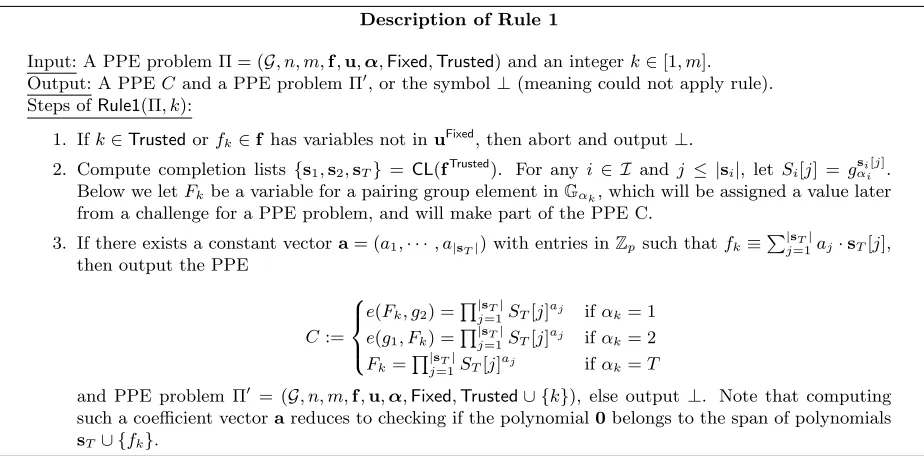
Rule 1 is described in Figure 2. We note that similar logic to this was previously employed in an automated tool focused on synthesizing optimal structure-preserving signature schemes in Type II pairing groups by Barthe, Fagerholm, Fiore, Scedrov, Schmidt and Tibouchi [14]. We generalize for our related, but different goal. Given a PPE problem Π = (G,n, m,f,u,α,Fixed,Trusted) and an indexk∈[1, m], Rule 1 can possibly be applied ifk /∈Trustedand the polynomialfk ∈f consists only of variables ui∈uwhere i∈Fixed (these
conditions are necessary, but not sufficient).
Let (C,Π0) =Rule1(Π, k) for an input on which the rule is successfully applied. Let the set of all possible testing sets of PPE problems Π and Π0 be denotedQΠ and QΠ0 respectively. We now prove that a testing
set for Π can be derived from any testing set inQΠ0; we call this the correctness of Rule 1. Informally, Rule
Description of Rule 1
Input: A PPE problem Π = (G, n, m,f,u,α,Fixed,Trusted) and an integerk∈[1, m]. Output: A PPECand a PPE problem Π0, or the symbol⊥(meaning could not apply rule). Steps ofRule1(Π, k):
1. Ifk∈Trustedorfk∈f has variables not inuFixed, then abort and output⊥.
2. Compute completion lists {s1,s2,sT} =CL(fTrusted). For any i ∈ I and j ≤ |si|, let Si[j] = gsαii[j].
Below we letFkbe a variable for a pairing group element inGαk, which will be assigned a value later
from a challenge for a PPE problem, and will make part of the PPE C.
3. If there exists a constant vectora= (a1,· · ·, a|sT|) with entries inZpsuch thatfk≡
P|sT|
j=1aj·sT[j], then output the PPE
C:=
e(Fk, g2) = Q|sT|
j=1ST[j] aj ifα
k= 1 e(g1, Fk) =Q|js=1T|ST[j]aj ifαk= 2 Fk=Q|js=1T|ST[j]aj ifαk=T
and PPE problem Π0 = (G, n, m,f,u,α,Fixed,Trusted∪ {k}), else output ⊥. Note that computing such a coefficient vectorareduces to checking if the polynomial0belongs to the span of polynomials sT∪ {fk}.
Figure 2: Procedure for moving certain elements with allFixed variables toTrusted.
Lemma 4.1(Correctness of Rule 1). LetΠ = (G, n, m,f,u,α,Fixed,Trusted)be a PPE problem instance as in Definition 3.1 and letk∈[1, m]. Suppose⊥6= (C,Π0) =Rule1(Π, k). Then:
1. Π0 is a PPE problem instance as in Definition 3.1 and 2. for every testing setT ∈QΠ0, it holds that(T∪ {C})∈QΠ.
Proof. We have that Π =(G,n, m,f,u,α,Fixed,Trusted). Since Rule1(Π,k)= (C,Π0)6=⊥, we know that the
rule was successfully applied, where Π0 = (G, n, m,f,u,α,Fixed,Trusted∪ {k}).
Condition 1: we observe that Π0 will also satisfy Definition 3.1, where the only non-trivial observation is that we must show that ifi∈Trusted∪ {k}, thenfiis a multivariate polynomial over the set of variables inuFixed
is maintained. This follows from the fact that a necessary condition for Rule1to movek to Trustedis that fk only has variables inuFixed.
Condition 2: let T be any testing set for Π0. By Definition 3.3, T is a set of pairing product equations
such that each equation in{T1, . . . , Tw}=T is simultaneously satisfied for allYESchallenges, and at least
one equation inT is not satisfied for all NOchallenges. Recall there are no conditions on the behavior for INVALIDchallenges.
We now argue by contradiction that ifT∪ {C}is not a testing set for Π, thenT cannot be a testing set for Π0. SinceT∪ {C}is not a testing set for Π, then either:
• Case 1: There exists aYESchallengeFfor Π such that at least one equation inT∪ {C}is not satisfied, or
• Case 2: There exists a NO challenge F for Π such that all equations in T∪ {C} are simultaneously satisfied.
We now analyze each of these cases.
know there exists an assignment to the variablesusuch thatFi=g fi(u)
αi for alli. EquationC tests thatFk is equal togfi(u)
αi , thus this equation being false contradicts the fact theFwas a YESchallenge.
In Case 2, since Fis aNOchallenge for Π where all equations in T∪ {C} are simultaneously satisfied, thenFis also aNOchallenge for Π0 where all equations inT are simultaneously satisfied. We argue this as
follows. By Definition 3.2 of aNOchallenge for Π, there exists an assignment tou= (u1, . . . , un)∈Znp such
that for all i ∈Trusted, Fi =g fk(u)
αk . To convert this to aNO challenge for Π
0, we also need to show that
Fk=g fk(u)
αk for this same assignmentu. This follows from the fact that PPECis satisfied by this challenge and thatC explicitly tests thatFk is computed this way, possibly with respect to an equivalent polynomial
forfk≡P
|sT|
j=1aj·sT[j]. Now sinceFisNOchallenge for Π0, it remains to see how it performs with respect
to the setT. However, since all equations inT∪ {C}are satisfied by this challengeF, then all equations in T are as well. This contradicts the original assumption thatT was a testing set for Π0.
4.2.2 Rule 2: Move element toTrusted by fixing an un-Fixed variable of form v·ud j
Rule 2 is described in Figure 3. Given a PPE problem Π = (G, n, m,f,u,α,Fixed,Trusted) and indices
j∈[1, n] andk∈[1, m], Rule 2 can possibly be applied ifj /∈Fixed,k /∈Trustedand the polynomialfk ∈f is
of the formc·ud
j+h, where the variableuj∈u, the polynomialhcontains only variables inuFixed, constant c∈Z∗p, and constantd∈Zp s.t. dis relatively prime top−1.
Description of Rule 2
Input: A PPE problem Π = (G, n, m,f,u,α,Fixed,Trusted) and integersj∈[1, n] andk∈[1, m]. Output: A PPE problem Π0or⊥(meaning could not apply the rule).
Steps ofRule2(Π):
1. If polynomialfk∈f is of the formc·udj+h, where
• j /∈Fixed,
• k /∈Trusted,
• the variableuj∈u,
• the polynomialhcontains only variables inuFixed,
• the constantc∈Z∗p and
• the constantd∈Zpis relatively prime top−1
then output the PPE problem Π0= (G, n, m,f,u,α,Fixed∪ {j},Trusted∪ {k}). 2. Otherwise, output⊥.
Figure 3: Procedure for moving certain elements toTrustedby fixing an un-Fixedvariable
Let ⊥6= Π0 = Rule2(Π, j, k). We now prove that a testing set for Π0 is also a testing set for Π, which ensures that Rule 2 does not “flip” a non-testable PPE problem into a testable one.
Lemma 4.2(Correctness of Rule 2). LetΠ = (G, n, m,f,u,α,Fixed,Trusted)be a PPE problem instance as in Definition 3.1, j∈[1, n] andk∈[1, m]. Suppose⊥6= Π0=Rule2(Π, j, k). Then:
1. Π0 is a PPE problem instance as in Definition 3.1 and 2. for every testing setT ∈QΠ0, it holds thatT ∈QΠ.
Proof. We have that Π =(G,n, m,f,u,α,Fixed,Trusted). SinceRule1(Π, j, k)= Π0 6=⊥, we know that the rule was successfully applied, where Π0= (G, n, m,f,u,α,Fixed∪ {j},Trusted∪ {k}).
Condition 1: we observe that Π0 will also satisfy Definition 3.1, where the only non-trivial observation is that we must show that if i∈Trusted∪ {k}, then fi is a multivariate polynomial over the set of variables
inuFixed∪{j}. This follows from the fact that a necessary condition forRule2to movektoTrustedis thatf
k
Condition 2: the PPE problems Π and Π0differ only in their last two items: theFixedandTrustedsets, where the Π0sets have the additional elements{j} and{k}respectively. As the definition of anYESchallenge has no dependence onTrusted andFixed sets, eachYESchallenge for Π is also anYESchallenge for Π0 and vice
versa. SinceT is a testing set for Π0, each equation inT is simultaneously satisfied for allYESchallenges of Π0, and therefore satisfied for allYES challenges of Π.
Similarly, we argue that any NOchallenge for Π is also a NO challenge for Π0, meaning that at least one equation in T is not satisfied in both cases. Consider any NO challenge F for the PPE problem Π. By definition, Fis not a YESchallenge for Π (or, by the above, for Π0), and there exists an assignment of u∗∈Zn
p such thatFi =g fi(u∗)
αi ∀i∈Trusted.
We want to show that Fk =g fk(u∗)
αk . SinceRule2(Π, j, k)6=⊥, we know that the polynomialfk was of the form c·ud
j+h, according to the constraints of Rule2, where j /∈Fixed. Thus, for this setting of Fk in the
challenge F, there exists only one setting of the variableuj ∈ Zp that is consistent with Fk being derived
via the polynomialfk and the settings ofui∈u∗ for alli∈Fixed. LetFk =gy for somey ∈Zp. Then we
have that:
uj= ( y−h
c modp)
1/d mod (p−1).
There is a unique solution to the above sincedis relatively prime top−1. Recall thathis derived over the set of variables inuFixed.
By Definition 3.1 of a PPE Problem, we have that ifi∈Trusted, thenfiis a multivariate polynomial over
the set of variables inuFixed. We observe thatRule2preserves this condition by only moving a polynomial’s index toTrustedif it over the set of variables inuFixedand the variableuj which it simultaneously moves to
Fixed.
Thus, for the same setting of variables u∗ ∈
Znp, it holds that Fi =g fi(u∗)
αi ∀i ∈ (Trusted∪ {k}). This allows us to conclude that ifT ∈QΠ0, thenT ∈QΠ.
4.3
Applying the Rules
We now show how to apply these rules in our main searching algorithm. WhenQSearch(Π) returns a testing setQ, we conclude Π is PPE testable. When the messageunknownis returned, the algorithm failed to find a testing set. It does not, however, allow us to conclude anything about Π’s PPE testability.
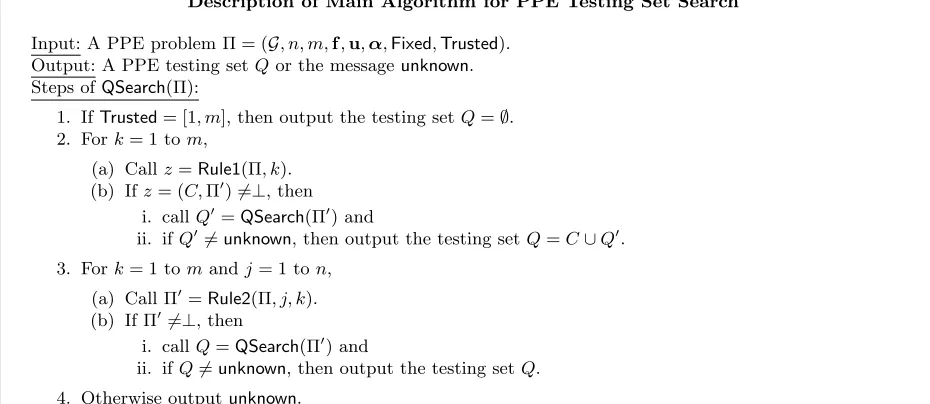
At a high-level, for input Π, if all elements are represented asTrusted, thenQSearch(Π) returns the trivial testing set ∅ and the PPE problem is trivially PPE testable. Otherwise, the algorithm attempts to apply Rule1, which seeks to move an un-Trustedelement intoTrustedvia a PPEC that can test it with respect to the otherTrusted elements. IfRule1can be applied, then the algorithm recurses on the PPE problem with one fewer un-Trusted elements and, if a testing set Q0 for this “smaller” problem is found, it outputs the joint testing set C∪Q0. If Rule1cannot be applied, then the search algorithm tries to applyRule2, which seeks to move an un-Trusted element into Trustedvia fixing an un-Fixed variable. If Rule2can be applied, then the algorithm again recurses on the smaller instance and, if a testing set for this instance is found, it outputs it likewise. We claim that while the order in which we attempt to applyRule1 doesn’t matter, the order forRule2possibly might; thus, our implementations will sometimes randomize the search order of the indices for this step (as opposed to the numerically increasing order we present here). We can explore other implementation options, such as first applyingRule2to variables with the smallest dconstants, etc.
Efficiency of QSearch. We now discuss about the asymptotic complexity of theQSearchalgorithm. First observe that the size of theTrustedset increases by one with each recursive call to QSearch. Consequently, the functionQSearch is called recursively at mostmtimes. During each call, all the untrusted polynomials are scanned to check if any rule is applicable. For the purpose of this analysis, let us denote the size of a polynomial to be the total number of additions and multiplications involved in the normal form of the polynomial (e.g., the size ofx2yz+ 3z3y3is 5). Therefore, multiplying 2 polynomials of sizes
1ands2 takes O(s1s2) time. Let the the maximum size of all polynomials f in the input be s. Executing Rule1 involves
Description of Main Algorithm for PPE Testing Set Search
Input: A PPE problem Π = (G, n, m,f,u,α,Fixed,Trusted). Output: A PPE testing setQor the messageunknown. Steps ofQSearch(Π):
1. IfTrusted= [1, m], then output the testing setQ=∅. 2. Fork= 1 tom,
(a) Callz=Rule1(Π, k). (b) Ifz= (C,Π0)6=⊥, then
i. callQ0=QSearch(Π0) and
ii. ifQ06=unknown, then output the testing setQ=C∪Q0. 3. Fork= 1 tomandj= 1 ton,
(a) Call Π0=Rule2(Π, j, k). (b) If Π06=⊥, then
i. callQ=QSearch(Π0) and
ii. ifQ6=unknown, then output the testing setQ. 4. Otherwise outputunknown.
Figure 4: Recursive procedure for searching for a PPE Testing Set
computing completion lists ofmpolynomials involves O(m2) polynomial multiplications taking O(m2·s2)
time. Checking if0lies in span ofO(m2) polynomials (number of polynomials in completion lists) involves
solving a system of O(m2·s) linear equations (upper bound on number of monomials in completion list)
each of sizeO(m2), which takes at mostO((m2·s)ω) time, wherenω is the complexity of multiplying two n×nmatrices. (Current best known value ofω is 2.3728639 [27]). Consequently, the time taken to execute Rule1 on an untrusted polynomial is O(m2ω·sω). The time taken to execute Rule2 on a polynomial f is only linear in terms of the size off. Consequently, every recursive call takes O(m2ω+1·sω) time to check for both the rules onm polynomials. AsQSearchinvolves at mostmrecursive calls, the total time taken is at mostO(m2ω+2·sω).
Theorem 4.1(Correctness of Testing Set from Algorithm in Figure 4). LetΠ = (G, n, m,f,u,α,Fixed,Trusted)
be a PPE problem instance as in Definition 3.1. LetQ=QSearch(Π). If Q6=unknown, then Qis a testing set forΠ.
Proof. We want to show that ifQSearch(Π) =Q6=unknown, thenQis a testing set for Π. We do this by induction.
Base Case: When Trusted= [1, m], thenQSearch(Π) =∅. In this case, all elements areTrusted; thus all PPE challenges for Π are eitherYESorINVALIDchallenges. The emptyset∅trivially satisfies Definition 3.3.
Induction Step: For any Π0 = (G, n, m,f,u,α,Fixed0,Trusted0) whereTrusted0 ⊆[1, m] andQ0 is a testing set for Π0, we prove that:
1. If Π00 = (G, n, m,f,u,α, Fixed0,Trusted00 =Trusted0\ {k}) and (C,Π0) = Rule1(Π00, k), for some k ∈
[1, m], thenQ00=C∪Q0 is a testing set for Π00.
2. If Π00 = (G, n, m,f,u,α, Fixed00=Fixed0
\ {j},Trusted00 =Trusted0\ {k}) and (C,Π0) =Rule2(Π00, k),
for some k∈[1, m], thenQ00=Q0 is a testing set for Π00.
We have two cases.
inspection ofRule1, we see that the PPEC allows for testing this element k. Thus, ifQ0 is a set of PPEs testing all untrusted elements exceptkandCis a PPE testing elementk, then together they form a testing set for all untrusted elements in Π00.
Case 2: SinceQ0 is a testing set for Π0, then we know it tests all`=m− |Trusted0|untrusted elements in Π0. We need to argue thatQ00=Q0 tests all`+ 1 =m− |Trusted00|=m− |Trusted0|+ 1 untrusted elements in Π00. In particular, the sole element they differ in is the element represented by index k. Since Rule2was successfully applied, elementkwas moved to the trusted set, because it contained an unfixed variable, whose value was fixed by the move. Since the variable was unfixed but is now being fixed by the move, no PPE is required to test this element as a trusted element. All future uses of this variable will now be tested against its fixed value. Thus, no new PPEs are required for the execution ofRule2andQ00=Q0 is a testing set for Π00.
Argument Summary: Since we have shown thatQSearch(Π)6=unknownreturns a testing set properly for the base case where all elements are trusted and we have shown the inductive step that for all Π0,Π00which differ by only one trusted element, according to the relationships ofRule1or Rule2called by QSearch, that QSearchcorrectly derives a testing set for Π00from a testing set for Π0, then by the principle of induction we have shown that any testing set output byQSearchis correct.
Corollary 4.1 (Correctness of PPE Testability from Algorithm in Figure 4). Let Π = (G, n, m,f,u,
α,Fixed,Trusted) be a PPE problem instance as in Definition 3.1. Let Q=QSearch(Π). If Q6=unknown, thenΠ is PPE Testable.
Proof. Follows directly from Theorem 4.1 and Definition 3.3.
5
Implementation and Case Studies
We now describe a new software tool, called AutoPPE, which implements the PPE searching algorithm presented in Figure 4. We ran AutoPPE on a number of IBE, ABE, VRF, signature schemes, and other type of pairing-based public/private parameters, including some that are PPE testable and some that are provably not PPE testable. We report on the design, results and performance of AutoPPE in this section.
5.1
AutoPPE Implementation
We implemented the AutoPPE tool using Ocaml version 4.02.3. We utilized the parsing tools and data structures (to store polynomials) from the Generic Group Analyzer (GGA)2. We used the SageMath package3
to solve systems of linear equations. We implemented the remaining logic ourselves.
AutoPPE takes as input pairing information (such as the Type I, II or III), a set of fixed/unfixed variables, and a set of trusted/untrusted polynomials along with their group identifiers. (While this is a slightly different format than we used in Definition 3.1, we stress that it is the same information.) In addition, the tool optionally takes as input information that allows the tool to help the user encode some cryptosystem parameters as a PPE problem instance. In particular, all trusted and untrusted elements (represented by polynomials) are bilinear group elements in G1,G2 or GT and Definition 3.1 does not allow including an
element in Zp in either set. However, since it is not uncommon for schemes to contain elements in the Zp
domain as part of their public or private parameters, we implemented a workaround for those schemes as described in Section 5.2. The tool runs the Figure 4 search algorithm, with a few optimizations detailed in Section 5.5 and a few limitations detailed in Section 5.6, and outputs either a set of PPEs or the special symbol unknown. After obtaining PPEs by running QSearch algorithm, the tool further runs an algorithm similar to [7] to produce equivalent PPEs which are more efficient to check.
Input:
AutoPPE
Output:
Set of PPEs
“unknown”
SageMath PPE Instance
- pairing Info - Fixed variables - Unfixed variables - Trusted polys - Untrusted polys - group ids 𝛂
+
- Variables in Zp
New PPE Instance
- pairing Info - Fixed’ variables - Unfixed variables - Trusted’ polys - Untrusted polys - group ids 𝛂’
QSearch
GGA
Figure 5: The workflow of the AutoPPE tool which follows the logic in Figure 4. It takes as input an intial PPE problem instance along with some additional information (i.e., variables inZp) that help the user
encode a given pairing-based scheme into a proper PPE problem instance, as we explain in the text. The tool utilizes and adapted portions of existing tools such as the Generic Group Analyzer (GGA) for handling polynomials and completion sets and the SageMath package for solving systems of linear equations. The output is either a set of Pairing Product Equations (PPEs), indicating that the instance is PPE Testable, or the special symbolunknown.
The source code for AutoPPE comprises about 3K lines of Ocaml code, and the input description of each pairing based scheme we tested consists of less than 10 lines of code. The ease of converting a given pairing based scheme into the input format for AutoPPE makes the tool highly practical and useful. We plan to make AutoPPE publicly available as open source code athttps://github.com/JHUISI/auto-tools.
5.2
Encoding “Well-formedness” of Cryptosystem Parameters as a PPE
Testa-bility Problem
In this subsection, we describe how to look at the public-private parameters of a pairing-based cryptosystem and then encode this as a PPE problem instance. Typically, the objective is to test that the private parameters are “well formed” with respect to the public parameters, where the definition of being “well formed” depends on the application. Let’s take identity-based encryption (IBE) as our starting example. For an IBE scheme IBE = (Setup,KeyGen,Enc,Dec), there are a number of different applications (see the discussion in Section 1) where one wants an efficient deterministic procedure (based on PPEs) that takes as input the public parameters pp, an identity id and a purported private key S, and verifies whether S is a possible output of theKeyGenalgorithm with respect toppandid. Recall that the critical point of our work isdiscoveringwhether a scheme’s parameters can be verified in this way or not.
We now formulate the problem of determining well-formedness of a pairing-based IBE secret key as an instance of the PPE Testability problem. Suppose for the given IBE scheme on group structure G, the public key is of the form (gf1
α1,. . . , g
fk
αk) and the secret key for an identity is of the form (g
fk+1
αk+1, . . . , g
fm
αm), where αi ∈ {1,2, T}∀i, {f1, . . . , fk} are polynomials on variables {u1, u2,. . . , ut} and {fk+1, . . . , fm} are
polynomials on variables {u1, u2, . . . un}. We formulate the corresponding PPE problem as (G, n, m,u = {u1, u2,. . . , un},f ={f1, f2,. . . , fm},α={α1,α2,. . . , αm},Trusted= [1, k],Fixed= [1, t]).
Although this encoding seems quite simple, many IBE constructions deviate from this form in several ways. We now describe several insights into converting a given IBE scheme into the above form.
(1) When multiple group elements are sampled randomly in a scheme, we first normalize the scheme by using a single generator for each group and replacing every random sampling of a group element bygv, where
thegis generator of the group andv is a fresh variable randomly sampled fromZp.
(2) Many constructions such as Boyen-Waters [24] and Waters dual system [47] include identity id or Hash(id) as part of the private key. In general, constructions which include variables {v1, v2, . . . , vs}in Zp
modifica-tions. Expand theTrusted set by includingfi·poly(v1,v2, . . . ,vs) with group identitiferαi for every trusted
polynomialfiand every polynomialpoly() of degree at mostd. We also include the variables{v1, v2, . . . , vs}
as part of theFixed set. The parameterdcan be easily configured in the tool. We usedd= 1 for our case studies and observed that it is sufficient for all the schemes that we tested.
(3) The Boneh-Franklin [22] and Gentry-Silverberg [29] constructions use a hash functionH that hashes identities to a group element. In this case, we reformulate the scheme by replacing H(id) with gh
α for an
appropriateα∈ I and a fresh variableh.
(4) The Boneh-Boyen [20] construction hashes identity into bit string H(id) =h1||h2||h3|| · · · ||hk, where k is the length of the bit string. The Waters/Naccache [42] construction hashes identity into blocks of bit strings H(id) = h1||h2||h3|| · · · ||hk, where each hi is a bit string block and k is the number of blocks in H(id). In either case, we first reformulate the problem by considering eachhi as a separate variable in Zp
and including it as a part of the secret key. We then reduce it to the PPE Testability problem as described earlier. Note that, this method results in a significant blowup in the number of polynomials in the input and can be tested efficiently only for modest values ofn. However, the output PPEs can be manually extended to higher values ofnby identifying a pattern.
Using the above encoding approaches, we tested 8 pairing-based IBE schemes for well-formedness of the private key and our tool was able to quickly output a testing set for all of the schemes which are testable.
We now look beyond IBE schemes. A signature scheme SIG = (Setup,Sign,Verify) is said to be well-formed if there exists an efficient deterministic procedure to verify that a given signature is a valid (possible) signature w.r.t. given message and public key. Similarly, a Verifiable Random Function (VRF) scheme VRF = (Setup,Eval,Verify) is said to be well-formed if there exists an efficient deterministic method to test that a given VRF output and proof are valid w.r.t. given verification key and input. Analogously, a Ciphertext-Policy Attribute Based Encryption (CP-ABE) schemeABE= (Setup,KeyGen,Enc,Dec) is said to have well-formed secret key if there exists an efficient deterministic way to check that a given ABE secret key is valid w.r.t. given public key and attributes. Testing whether a given pairing-based Signature/VRF/CP-ABE scheme is well-formed can be reformulated as a PPE testability problem analogous to the IBE case described above.
5.3
A Detailed Example for the Waters05 IBE
Before presenting all our cases studies in Section 5.4, we’d like to walk the reader through one detailed example. Let us consider the Waters05 IBE scheme [45] with the Naccache Optimization [42]. We would like to check if the private key for an identity is PPE Testable given the public parameters and the identity. As mentioned in the introduction, an IBE scheme with “private key” PPE Testability immediately implies a signature scheme with deterministic verification. Moreover, an IBE scheme with “private key” PPE Testability, and a few other properties, admits an adaptive oblivious transfer scheme [32]. For the sake of completeness, we recall this popular construction in Appendix A.
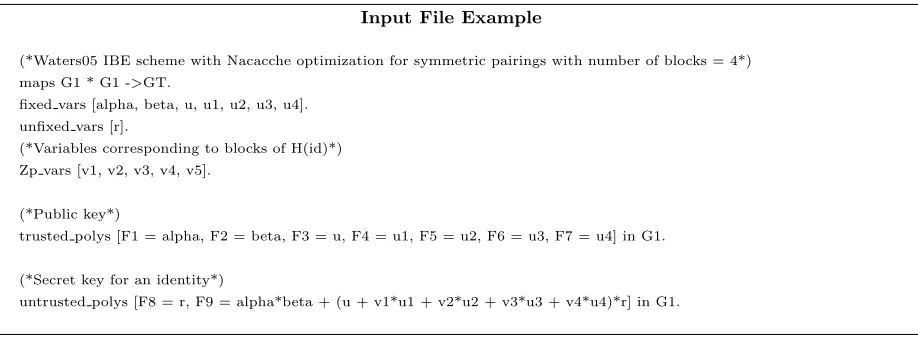
The input file for the tool is presented in Figure 6. For space reasons, we choose to illustrate this with a toy example of 4 as the identity block size; in practice one would likely use 8 or 32.4 The pairing information is specified using the linemaps G1*G1->GT, which denotes a Type I pairing. Alternately, a Type II pairing could be specified bymaps G1*G2->GT, isos G1->G2, and a Type III pairing could be specified by maps G1*G2->GT. In order to test the for well-formedness of an IBE private key, the public parameter elements (Trusted set) along with their group identifiers are specified by trusted polys [ ] in G , and the private key elements for an identity (Trusted set) along with their group identifiers are specified using untrusted polys[ ] in G . Every polynomial should be specified along with a unique identifier which will be used to output the PPEs in a compact form. The variables sampled in the Setupphase (Fixed set) are specified usingfixed vars [ ]. and the variables sampled during theKeyGenphase (Fixedset) are specified using unfixed vars [ ]. The IBE construction hashes identity id into blocks of bit strings, which can be
4Specifically, one would likely choose to support arbitrary-length identity strings by first hashing them to 256 bits using
Input File Example
(*Waters05 IBE scheme with Nacacche optimization for symmetric pairings with number of blocks = 4*) maps G1 * G1 ->GT.
fixed vars [alpha, beta, u, u1, u2, u3, u4]. unfixed vars [r].
(*Variables corresponding to blocks of H(id)*) Zp vars [v1, v2, v3, v4, v5].
(*Public key*)
trusted polys [F1 = alpha, F2 = beta, F3 = u, F4 = u1, F5 = u2, F6 = u3, F7 = u4] in G1.
(*Secret key for an identity*)
untrusted polys [F8 = r, F9 = alpha*beta + (u + v1*u1 + v2*u2 + v3*u3 + v4*u4)*r] in G1.
Figure 6: Input file for Waters05 IBE scheme with Nacacche Optimization.
treated as elements in Zp for our purposes. Each of the blocks is identified by a separate variable, and are
specified using Zp vars [ ]. Comments in the input file can be specified using (*....*).
The output of the tool on the above input is presented in Figure 7. The tool first converts the input specification to a PPE instance by multiplying every variable specified in Zp vars[ ] with every trusted polynomial and including them in trusted set. This expands the Trustedset from 9 polynomials (including the identity polynomials internally added by our tool) to 45 polynomials which are printed in the output. The tool later on applies the QSearch algorithm and outputs the PPEs in terms of the unique identifiers specified for each polynomial. Note that the tool also optimizes the PPEs to minimize the number of pairings used in the PPE. Further optimization can be achieved using AutoBatch tool [7, 8]5which can batch many
PPEs into few PPEs.
5.4
Case Studies
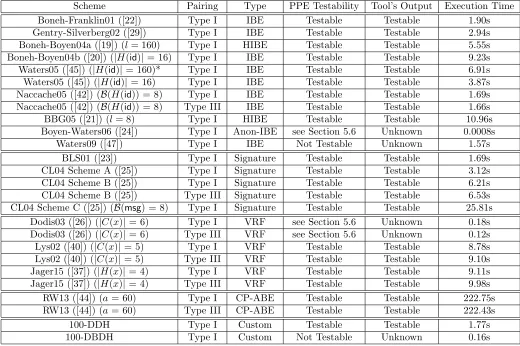
We evaluated AutoPPE on various types of pairing-based schemes using a MacBook Pro 2015 laptop with 2.7GHz Intel Core i5 processor and 8GB 1867MHz DDR3 RAM. We present the results along with average execution times over 10 runs in Table 1. In Appendix B, we include more details about the input and output of AutoPPE on some test schemes. We observe that the tool outputs a testing set for most of the standard schemes which are testable within a few seconds.
We note that in our implementation, we simplify checking whether the constant dis relatively prime to p−1 in Rule2, by checking whether dis a small prime (d∈ {1,3,5,7,11}). We made this simplification is because none of the schemes we encountered include a polynomial with degreed >2 for an unfixed variable. In order to mimic the schemes presented in the papers as they are, we tested most of the schemes in the Type I setting. To demonstrate the flexibility of the tool, we also translated several of these schemes into the Type III setting6). The Waters dual system IBE [47] is not PPE testable (see Section 1) and our tool
(correctly) output unknown (see the full output in Appendix B). The Boyen-Waters anonymous IBE [24] and the Dodis VRF [26] appear not to be PPE testable (see Section 5.6) and our tool also outputunknown for these.
The introduction motivated this problem by showing a connection between PPE testability for an IBE scheme and its suitability for use in blind and/or accountable authority IBE systems. We remark that we tested several such IBE schemes as part of our case study, including Boneh-Boyen [20], Waters [45] and Naccache [42] (which were employed in [32] to leverage this property to build OT).
5https://github.com/JHUISI/auto-tools/tree/master/auto batch 6We encoded elements into
Scheme Pairing Type PPE Testability Tool’s Output Execution Time
Boneh-Franklin01 ([22]) Type I IBE Testable Testable 1.90s
Gentry-Silverberg02 ([29]) Type I IBE Testable Testable 2.94s
Boneh-Boyen04a ([19]) (l= 160) Type I HIBE Testable Testable 5.55s
Boneh-Boyen04b ([20]) (|H(id)|= 16) Type I IBE Testable Testable 9.23s
Waters05 ([45]) (|H(id)|= 160)* Type I IBE Testable Testable 6.91s
Waters05 ([45]) (|H(id)| = 16) Type I IBE Testable Testable 3.87s
Naccache05 ([42]) (B(H(id)) = 8) Type I IBE Testable Testable 1.69s
Naccache05 ([42]) (B(H(id)) = 8) Type III IBE Testable Testable 1.66s
BBG05 ([21]) (l= 8) Type I HIBE Testable Testable 10.96s
Boyen-Waters06 ([24]) Type I Anon-IBE see Section 5.6 Unknown 0.0008s
Waters09 ([47]) Type I IBE Not Testable Unknown 1.57s
BLS01 ([23]) Type I Signature Testable Testable 1.69s
CL04 Scheme A ([25]) Type I Signature Testable Testable 3.12s
CL04 Scheme B ([25]) Type I Signature Testable Testable 6.21s
CL04 Scheme B ([25]) Type III Signature Testable Testable 6.53s
CL04 Scheme C ([25]) (B(msg) = 8) Type I Signature Testable Testable 25.81s
Dodis03 ([26]) (|C(x)|= 6) Type I VRF see Section 5.6 Unknown 0.18s
Dodis03 ([26]) (|C(x)|= 6) Type III VRF see Section 5.6 Unknown 0.12s
Lys02 ([40]) (|C(x)|= 5) Type I VRF Testable Testable 8.78s
Lys02 ([40]) (|C(x)|= 5) Type III VRF Testable Testable 9.10s
Jager15 ([37]) (|H(x)| = 4) Type I VRF Testable Testable 9.11s
Jager15 ([37]) (|H(x)| = 4) Type III VRF Testable Testable 9.98s
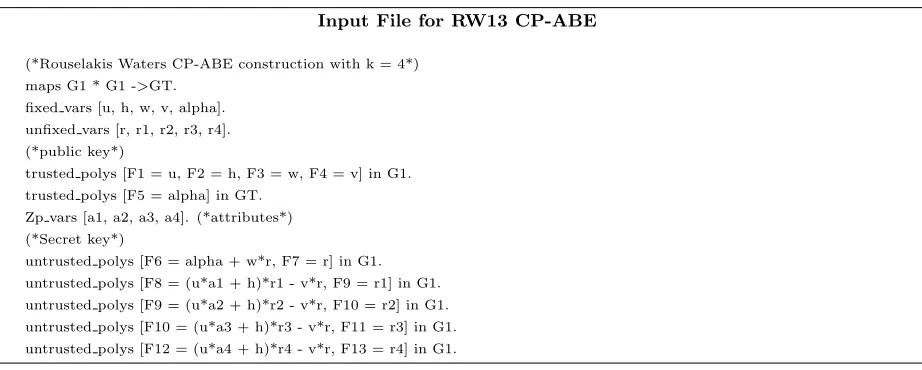
RW13 ([44]) (a= 60) Type I CP-ABE Testable Testable 222.75s
RW13 ([44]) (a= 60) Type III CP-ABE Testable Testable 222.43s
100-DDH Type I Custom Testable Testable 1.77s
100-DBDH Type I Custom Not Testable Unknown 0.16s
Table 1: The output of AutoPPE on various PPE testability problems. Here, l represents the number of delegation levels in a HIBE scheme, |H(id)| denotes the length of the hash of identityid,B(H(id)) denotes the number of blocks in the hash of identityid,B(msg) denotes the number of blocks in messagemsg,|C(x)|
Output of the Tool
F0 = 1 in G1 F0 = 1 in GT F1 = alpha in G1 F2 = beta in G1 F3 = u in G1 F4 = u1 in G1 F5 = u2 in G1 F6 = u3 in G1 F7 = u4 in G1 F8 = r in G1
F9 = alpha*beta + r*u + r*u1*v1 + r*u2*v2 + r*u3*v3 + r*u4*v4 in G1 F10 = v1 in G1 F11 = v2 in G1 F12 = v3 in G1 F13 = v4 in G1 F14 = v1 in GT F15 = v2 in GT F16 = v3 in GT F17 = v4 in GT
F18 = alpha*v1 in G1 F19 = alpha*v2 in G1 F20 = alpha*v3 in G1 F21 = alpha*v4 in G1 F22 = beta*v1 in G1 F23 = beta*v2 in G1 F24 = beta*v3 in G1 F25 = beta*v4 in G1 F26 = u*v1 in G1 F27 = u*v2 in G1 F28 = u*v3 in G1 F29 = u*v4 in G1
F30 = u1*v1 in G1 F31 = u1*v2 in G1 F32 = u1*v3 in G1 F33 = u1*v4 in G1 F34 = u2*v1 in G1 F35 = u2*v2 in G1 F36 = u2*v3 in G1 F37 = u2*v4 in G1 F38 = u3*v1 in G1 F39 = u3*v2 in G1 F40 = u3*v3 in G1 F41 = u3*v4 in G1 F42 = u4*v1 in G1 F43 = u4*v2 in G1 F44 = u4*v3 in G1 F45 = u4*v4 in G1
Processing untrusted polynomial F8 = r by rule2
F8 moved to trusted set and r moved to fixed set by rule 2
Processing untrusted polynomial F9 by rule1
Naive PPE e(F9,F0) = e(F1,F2) * e(F3,F8) * e(F8,F30) * e(F8,F35) * e(F8,F40) * e(F8,F45) Optimized PPE e(F9,F0) = e(F1,F2)*e(F3*F30*F35*F40*F45,F8)
F9 moved to trusted set by rule 1
Execution time : 2.578486s
PPEs : e(F9,F0) = e(F1,F2)*e(F3*F30*F35*F40*F45,F8) Ouptut : PPE Testable
Figure 7: Output of AutoPPE for Waters05 IBE scheme with Nacacche Optimization
In the [26, 40, 37] VRF schemes, the input is encoded as a bit string, which is treated as a vector ofZp
variables by our tool. We observe that the size of the polynomials in these schemes grow exponentially in size with respect to the length of encoding of the input. Consequently, we tested these schemes only with a short length encoding. However, for these schemes, we observe that the PPEs have a clear pattern which can be extrapolated to input encodings of arbitrary length.
In Section 5.2, we described a method to encode schemes which output elements in Zp as part of their
trusted or untrusted parameters as a PPE Testability problem. The na¨ıve method of reformulating such schemes blows up the size of the trusted set and is inefficient when there are large number of elements in Zp. However, for a few problems we can improve the run time by including only a subset of these additional
polynomials in the trusted set; one can always try a smaller set first and then expand the input iteratively. We demonstrate this using the Waters05 [45] example, which hashes identities to 160 bit strings and as a result would blow up the size of the trusted set toO(1602) polynomials when encoded na¨ıvely. We improve upon
the na¨ıve method by including only 480 polynomials in the trusted set and thereby achieving significantly faster run times.
We also tested our tool on a few custom examples with 100+ elements in them. In the 100-DDH example with Type I pairings, the trusted set contains polynomials{a1, a2,· · ·, a50}in group G1, the untrusted set
contains polynomials{a51, a52,· · ·,a100, b}in groupG1and the polynomial (a1+a2+· · ·+a100)∗bin group
GT. Clearly, this problem can be tested using the PPE gT(a1+a2+···+a100)∗b= e(
100
Q
i=1
g1ai,g1b). In the
100-DBDH example with Type I pairings, the trusted set contains{a1, a2,· · · , a50}in group G1, the untrusted
set contains polynomials{a51, a52,· · ·, a100, b, c}in groupG1and the polynomial (a1+a2+· · ·+a100)∗b∗c
in group GT. This problem is not PPE Testable under the Decisional Bilinear Diffie-Hellman (DBDH)
5.5
Optimizations
The QSearch algorithm discussed in Figure 4 has a high time complexity. It is particularly unacceptable for problems which include lot of elements in the Zp domain due to the blowup of the size of the trusted
set and thereby the size of completion list. We therefore implemented a few optimizations which drastically improve the run time. We first observe that the completion lists get updated only by a few elements every time a polynomial is added to the trusted set. Consequently, the algorithm computes the completion list in an incremental manner instead of computing it from scratch each it checks for Rule 1. The completion list is updated each time a polynomial is added to the trusted set.
We further optimized the algorithm to find coefficients in Rule 1 by removing a subset of the polynomials that trivially have zero coefficient. When applying Rule 1, suppose a polynomialginsT∪{fk}has a monomial
which is not present in any other polynomial, then trivially the coefficientg is zero when expressing0as a span of polynomials insT ∪ {fk}.
5.6
Limitations and Open Problems
This work represents a meaningful first step in defining, understanding and automating the PPE testability of many well-known pairing cryptosystems. We now remark on some limitations of the tool that are exciting areas for future research.
(1)Beyond Prime Order Pairings. First, we restrict ourselves to pairing-based constructions with prime order groups. It would be interesting to extend the tool to composite-order pairings, e.g., [38, 39], and even RSA-based constructions. In constructions based on composite-order pairings, elements are sampled from various subgroups. Verifying the validity of untrusted terms involves testing whether the terms are in their designated subgroups. Our current model of representing a term with a polynomial may not be enough to verify such relationships.
(2)Rational Polynomials and More. Second, the tool doesn’t work on schemes, such as Gentry’s IBE [28]
or Boneh-Boyen [19], which have group elements with exponents as rational polynomials (e.g., gp1(·)) or
schemes, such as Hohenberger-Waters [36], with polynomials with variable degree (e.g., gxy). While the GGA tool on which we built AutoPPE also does not handle rational polynomials, emerging new work by Ambrona et al. [9] does. While inspirational, it does not directly apply here. They work in the average case
setting, and thus can ignore the negligible probability that an element is “undefined” (e.g.,gp(1·) where p(·)
evaluates to zero on a randomly chosen input). Here we focus on the worst case setting – where a powerful adversary such as an IBE Master Authority might try to pass off an ill-formed private key to a user using any such loophole – and we need a set of PPEs that can catch any ill-formed key.
(3) Dependent Variables. Third, the algorithm works only on schemes which sample all the variables independently. For example, the framework doesn’t capture schemes which use hard-core predicate bits, schemes which use hash functions in complex ways (such as havinggxwithx=H(m||S), whereSis another
group element) [34] or schemes which sample two orthogonal vectors [43]. However, this seems to be more a limitation of what can be tested with PPEs rather than a limitation of this particular tool.
(4)Unbounded PPEs. Fourth, our scheme considers only constructions with concrete numbers of elements and parameters. One might consider extending this to the unbounded setting, as was done for the generic group assumption setting by Ambrona et al. [10].
(5)On Relaxing PPE Testability. Our automation outputsunknownon the Dodis VRF [26], which might seem surprising, since one might predict that the PPEs of the VRF verification algorithm would form a PPE testing set. In the case of this VRF, it does not appear to be PPE testable, even though its verification scheme is correct. Our Rule 1 does not apply because the PRF output F ∈ G1 being verified must be
paired with an element g2a ∈ G2 (as opposed to just g2) to be compared against other established values
such as anA∈GT, i.e., an equation is checked of the form e(F, ga2) =A. The problem is that ifa= 0 and A= 1, thene(F, ga
2) =Aforany value ofF, thus verifying nothing aboutF. In the scheme, ais chosen at
this scheme would include ones wherea= 0, but in this case the VRF’s verification equations do not appear to be sufficient. An interesting open direction could be to consider ways to relax our PPE testability notion to capture schemes such as Dodis [26], where one may be able to test most, but not all possible inputs.
(6) PPE Circuits. Lastly, and perhaps of most surprise to us, we look at what we learned from the Boyen-Waters anonymous IBE [24] example. This one again falls into a gray area – where we aren’t actually sure if it is PPE testable or not. However, we found evidence leading us tobelieve that this scheme is: (a) not PPE testable under Definition 3.3, but is (b) potentially testable under a broader definition that would encompass outputting a “PPE circuit” rather than a conjunction of PPEs.
Let’s dig in further. In an anonymous IBE system, the anonymity requirement is that theciphertextdoes not reveal the identity of the recipient. Thus, there does not seem be anything inherent in such a system (unlike with dual system encryption) that would make the private key not be PPE testable. The AutoPPE tool outputsunknown for this case, and it quickly rejects it by finding that it cannot applyRule2.
In Definition 3.3, we define testing sets to be a conjunction of PPEs. As a result, we needed to restrict the applicability of Rule2 only to polynomials of the formf(·) = f1(·)·ud+f2(·), where f1 is a non-zero
constant. In casef1 is a non-constant polynomial on fixed variables, the untrusted polynomialf could be
verified and moved to the trusted set, if we include conditional logic such as (F1=I) =⇒ (F =F2) in the
testing set. Here, F is the formal challenge variable corresponding to the untrusted polynomial f, I is an identity element,F1andF2are expressions on formal variables corresponding to trusted polynomials which
evaluate togf1
α andgαf2 respectively for an appropriate group identifierα. Essentially, the rule states that in
casef1 evaluates to 0 for the given challenge, thenf should evaluate to the value of f2. In order to include
such a rule, we will need to modify the definition of testing set to be a propositional logic on PPEs (or PPE circuit, rather than conjunction of PPEs). Extending the notion of PPE testability would appear to make the Boyen-Waters IBE scheme [24] PPE Testable, as its private key contains two polynomials of the form f1(·)·ui+f2(·), where ui is an unfixed variable and f1 is a polynomial on fixed variables. After both of
these ui variables are fixed (via some extended Rule2), all variables are fixed, and it seems feasible to test
the remaining polynomials with respect to the trusted set. Developing the theory and logic for PPE Circuits is an exciting future direction.
6
Conclusion
The ability to verify the well-formedness of a group of pairing elements (e.g., a private key) with respect to a set of trusted (e.g., public) parameters, by applying a set of pairing product equations, has numerous cryptographic applications. These include the design of basic and structure-preserving signature schemes, building oblivious transfer schemes from “blind” IBE, finding new verifiable random functions and keeping the IBE or ABE authority “accountable” to the user.
In this work, we provided original observations demonstrating that it is not always easy for a human to determine whether or not a public-private parameter pair can be verified using a set of PPEs. Many IBE schemes (e.g., [22, 29, 20, 45]) have PPE-testable parameters, but some IBE schemes in the literature, such as those based on dual-system encryption [47], provably do not.
Acknowledgments
The authors are grateful to Brent Waters for valuable technical discussions and also to the anonymous reviewers of CCS 2019 for helpful feedback, especially for pointing out the connection to the automated analysis of structured-preserving signatures in [14].
References
[1] Masayuki Abe, Melissa Chase, Bernardo David, Markulf Kohlweiss, Ryo Nishimaki, and Miyako Ohkubo. Constant-size structure-preserving signatures: Generic constructions and simple assumptions. Cryptology ePrint Archive, Report 2012/285, 2012. https://eprint.iacr.org/2012/285.
[2] Masayuki Abe, Jens Groth, Miyako Ohkubo, and Takeya Tango. Converting cryptographic schemes from symmetric to asymmetric bilinear groups. InAdvances in Cryptology - CRYPTO, pages 241–260. Springer, 2014.
[3] Masayuki Abe, Fumitaka Hoshino, and Miyako Ohkubo. Design in type-i, run in type-iii: Fast and scalable bilinear-type conversion using integer programming. InAdvances in Cryptology - CRYPTO, pages 387–415. Springer, 2016.
[4] Joseph A. Akinyele, Gilles Barthe, Benjamin Gr´egoire, Benedikt Schmidt, and Pierre-Yves Strub. Cer-tified synthesis of efficient batch verifiers. InIEEE 27th Computer Security Foundations Symposium, pages 153–165. IEEE Computer Society, 2014.
[5] Joseph A. Akinyele, Christina Garman, and Susan Hohenberger. Automating fast and secure trans-lations from Type-I to Type-III pairing schemes. In ACM SIGSAC Conference on Computer and Communications Security, pages 1370–1381. ACM, 2015.
[6] Joseph A. Akinyele, Matthew Green, and Susan Hohenberger. Using SMT solvers to automate design tasks for encryption and signature schemes. InACM SIGSAC Conference on Computer and Commu-nications Security, pages 399–410. ACM, 2013.
[7] Joseph A. Akinyele, Matthew Green, Susan Hohenberger, and Matthew W. Pagano. Machine-generated algorithms, proofs and software for the batch verification of digital signature schemes. In the ACM Conference on Computer and Communications Security, pages 474–487. ACM, 2012.
[8] Joseph A. Akinyele, Matthew Green, Susan Hohenberger, and Matthew W. Pagano. Machine-generated algorithms, proofs and software for the batch verification of digital signature schemes. Journal of Computer Security, 22(6):867–912, 2014.
[9] Miguel Ambrona, Gilles Barthe, Romain Gay, and Hoeteck Wee. Attribute-based encryption in the generic group model: Automated proofs and new constructions. In Proceedings of the 2017 ACM SIGSAC Conference on Computer and Communications Security, pages 647–664. ACM, 2017.
[10] Miguel Ambrona, Gilles Barthe, and Benedikt Schmidt. Automated unbounded analysis of crypto-graphic constructions in the generic group model. In Advances in Cryptology - EUROCRYPT, pages 822–851. Springer, 2016.
[11] Gilles Barthe, Juan Manuel Crespo, Yassine Lakhnech, and Benedikt Schmidt. Mind the gap: Modular machine-checked proofs of one-round key exchange protocols. In Advances in Cryptology - EURO-CRYPT, pages 689–718. Springer, 2015.