Secure Search via Multi-Ring Fully Homomorphic Encryption
Adi Akavia1, Dan Feldman2, and Hayim Shaul2
1 Cybersecurity Research Center, Academic College of Tel-Aviv Jaa [email protected]
2 Robotics & Big Data Lab, University of Haifa [email protected], [email protected]
Abstract. Secure search is the problem of securely retrieving from a database table (or any unsorted array) the records matching specied attributes, as in SQL SELECT. . .WHERE. . . queries, but where the database and the query are encrypted. Secure search has been the leading example for practical applications of Fully Homomorphic Encryption (FHE) since Gentry's seminal work in 2009, attaining the desired properties of a single-round low-communication protocol with semantic security for database and query (even during search). Nevertheless, the wide belief was that the high computational overhead of current FHE candidates is too prohibitive in practice for secure search solutions (except for the restricted case of searching for a uniquely identied record as in SQL UNIQUE constrain and Private Information Retrieval). This is due to the high degreeΩ(m) formthe number of database records of existing solutions, which is too slow even for moderate sizesmsuch as a few thousands.
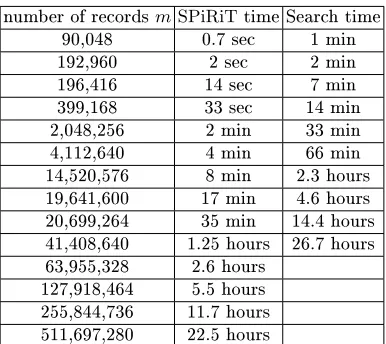
We present the rst algorithm for secure search that is realized by a polynomial of logarithmic degree logO(1)m. We implemented our algorithm in an open source library based on HElib, and ran experiments on Amazon's EC2 cloud with up to 100 processors. Our experiments show that we can securely search to retrieve database records in a rate of searching in millions of database records in less than an hour on a single machine.
We achieve our result by: (1) Designing a novel sketch that returns the rst strictly-positive entry in a (not necessarily sparse) array of non-negative real numbers; this sketch may be of independent interest. (2) Suggesting a multi-ring evaluation of FHE instead of a single ring as in prior works and leveraging this to achieve an exponential reduction in the degree.
1 Introduction
Storage and computation are rapidly becoming a commodity with an increasing trend of organizations and individuals (client) to outsource storage and computation to large third-party systems often called the cloud (server). Usually this requires the client to reveal its private records to the server so that the server would be able to run the computations for the client. With e-mail, medical, nancial and other personal information transferring to the cloud, it is paramount to guarantee privacy on top of data availability while keeping the correctness of the computations.
Fully Homomorphic Encryption (FHE) [39,16,17] is an encryption scheme with the special property of enabling computing on the encrypted data, while simultaneously protecting its secrecy; see a survey in [23]. Specically, FHE allows computing any algorithm on encrypted input (ciphertexts), with no decryption or access to the secret key that would compromise secrecy, yet succeeding in returning the encryption of the desired outcome.
Secure outsourcing of computation using FHE is conceptually simple: the client sends the ciphertext JxK encrypting the input x and receives the ciphertext JyK encrypting the output y = f(x), where the
computation is done on the server's side requiring no further interaction with the client. This gives a single round protocol and with low communication; specically the communication complexity is proportional only to the sizes of the input and output ciphertexts (in contrast to communication proportional to the running time of computing f() when using prior secure multi-party computation (MPC) techniques [46,19]). The
A main challenge for designing algorithms that run on data encrypted with fully (or leveled) homomorphic encryption (FHE) is to present their computation as a low degree polynomial f(), so that on inputs xthe
algorithm's output is f(x)(see examples in [35,20,31,48,12,34,15]). Otherwise, a naive conversion resulting
in a high degree polynomial f()would typically be highly impractical for the current state-of-the-art FHE
implementations, where running time is rapidly growing with degree and the multiplicative depth of the corresponding circuit.
Secure search using FHE has been the hallmark example for useful FHE applications since Gentry's break-through result construction the rst FHE candidate [16]. Use case examples are abundant: secure search for a document matching a retrieval query in a corpus of sensitive documents, such as private emails, classied military documents, or sensitive corporate documents; secure SQL SELECT WHERE query to a database, e.g., searching for a patient's record in a medical database based on desired attributes; secure search en-gine; etc. In all these use cases security means that both the searched data (documents, DB, etc.) and the search query are encrypted with semantically secure FHE, and that the data access pattern likewise reveal no information on the searched data or query.
The secure search problem at the core of all aforementioned use case examples can be captured as searching for an encrypted lookup value in an encrypted array (the array representing, for example, an encrypted table/column in a relational database, or a word-by-word encryption of a document for full text search); see Section 2 for details on the relation to the real-life use cases and further discussion. We focus on single round protocols, where the server requires no interaction with the client beyond receiving the encrypted input and returning the encrypted output.
Denition 1 (Secure Search). The server holds an unsorted array of encrypted values (previously uploaded to the server, and where the server has no access to the secret decryption key):
JarrayK= (Jx1K, . . . ,JxmK)
(here and throughout this work, JmsgK denotes the ciphertext encrypting messagemsg; the encryption can
be any fully, or leveled, homomorphic encryption (FHE) scheme, e.g. [7]). The client sends to the server an encrypted lookup value J`K. The server returns to the client an encrypted index and value
JyK= (JiK,JxiK)
satisfying the condition:
isMatch(xi, `) = 1
forisMatch()a predicate specifying the search condition (see discussion below on using generic predicates).
More generally, y may be a value from which the client can compute(i, xi) (decode).
We call the client ecient if its running time is polynomial in the output length|i|=O(logm)and|xi|and
in the time to encrypt/decrypt a single ciphertext. The server is ecient if the polynomialf(JarrayK,J`K)the
server evaluates to obtain JyK is of degree polynomial inlogmand the degree ofisMatch(), and of size (i.e.,
the overall number of addition and multiplication operations for computingf) polynomial inmand the size of isMatch. The protocol is ecient if both client and server are ecient. (We call the client/server/protocol
inecient if the running time/degree/either is at leastΩ(m).)
As an example consider searching for an exact match to the lookup value ` in the data array whose
entries are given in binary representationx1, . . . , xm∈ {0,1}tof lengthtbits. For this case we setisMatch
to be the equality test isMatch(xi, `) = 1 if-and-only-if xi = `, which can be realized for example by a
polynomial of degree and sizeO(t2)when using the equality test polynomialisEqual
tin Section 3.5. So in
this case we call the server ecient if the secure search polynomialy=f(array, `)is of degree polynomial
GenericisMatch predicate. The predicateisMatch()in the Denition 1 is a generic predicate that can be
instantiated to any desired functionality (with complexity aected accordingly, see Theorem 1). Moreover, a concise specication ofisMatch()can typically be used, e.g., by the client providing the function's name.
For example, most generally,isMatch()can be a universal circuit and`a full specication of the predicate
dening the matching values. Alternatively, giving a more concrete instantiation, we can extend the search query to provide the name for a particularisMatch()circuit to be used, chosen from a commonly known set
of options (for example, equality operator, conjunction/disjunction query, range query, similarity condition, and so forth). Even more concretely, we can x a particular predicate in advance, say, the equality condition
isMatch(xi, `) = 1if-and-only-ifxi=`.Looking ahead, our experiments are for the latter case; nonetheless,
our results are general and apply to any genericisMatch()condition (see Theorem 1).
Our main motivation in this paper is to answer armatively the following question: Is there an ecient secure search protocol?
1.1 Prior Works
Prior secure search protocols suer from one of the following shortcomings: (i) the protocol provides only a restricted search functionality, or (ii) the protocol is inecient in the sense of having at least linear dependence on the database size m for either the client's running time or the degree of the polynomial
computed by the server, or (iii) the security is weakened to leak vital search information; see details below.
Private Information Retrieval (PIR) provide a restricted search functionality, where the client's lookup value must be a unique identier for at most a single record xi in array (as in SQL UNIQUE constraint). The
standard PIR settings are when this unique identier is the indexi∈[m](where here and throughout this
work we use the notation [m] = {1, . . . , m}); the techniques however extend to any unique identier, i.e.,
any lookup value ` so that isMatch(xi, `) = 1 for at most a single record xi (0 otherwise). Low degree
polynomials realizing secure data retrieval for these unique identier settings have been shown in prior works [16,8,14]. Specically, the degree is essentially the degree ofisMatch which is in turnO(logm)when
the lookup value is the unique indexi∈[m].
We note that in cases where the server holds non-encrypted dataarrayand only the lookup value is secret,
indexing techniques can reduce the search problem to the unique identier settings by transforming the data into a table with a unique row for each lookup value`(i.e., the number of rows is the size of the spaceLof
possible lookup values), and where the entries of each row`consist of the list of all records matching`[9,40].
However, this transformation may incur a considerable time and memory overhead, because the produced table is of sizem· |L|for|L|the number of possible lookup values (rows), compared to sizemof the original
dataarray. This may be a considerable overhead since often|L| m; for example, for data an encrypted
document ofm = 1000words and lookup values the |L| ≥170,000 words in the English dictionary. More
importantly, this transformation assumes the data is given as plaintext (i.e., it is not encrypted), which is not the case in secure outsourcing settings as is the focus of this work. For these non-encrypted data settings, software and hardware implementations demonstrate a secure retrieval rate of processing millions of records in an hour [40] (when scaling up their results to a strong 64-cores machine as in our experiments; see Section 5).
Private set intersection (PSI). A recent work [10] following the preprint publication of our work [2] gave an FHE based Private Set Intersection (PSI). In the PSI problem, Alice has a setX, Bob has a setY and they
wish to compute the intersection X∩Y while revealing no additional information on their sets. The PSI,
while related to search, does not provide the desired output. Specically, thinking ofX as the lookup value
(with |X| = 1) and Y as a database column, the output only solves the decision problem of whether the
lookup value appears in the database, but without returning entire records (or handles to such records, as in returning the corresponding row indexi). Moreover, the modeling ofX, Y as sets (rather than multi-sets)
implies a UNIQUE constraint onY, and so the lookup value (X) is restricted to be a unique identier to
The natural (folklore) secure search solution for unrestricted settings (i.e., with no UNIQUE constraint) suers from an inecient server that evaluates a degreeΩ(m)polynomial (for m the number of records).
This is too slow with current FHE candidates and implementations, even for moderate sizemsuch as a few
thousands.
In secure pattern matching works [47,13,32,11,26,21,27] the client is inecient.3 In these works, the server
computes an encrypted array
JindicatorK←(JisMatch(x1, `)K, . . . ,JisMatch(xm, `)K)
specifying for eachi∈[m]the (encrypted) zero/one indicator of whether recordxi is a match to the lookup
value `. This encrypted vector JindicatorK is sent from the server to the client, who decrypts and scans indicator∈ {0,1}m to nd a indices of the records to be retrieved. To retrieve the records themselves, the
parties can now engage in a PIR protocol, requiring a second round of interaction. In these works, while the server is ecient (computes polynomials of degree deg(isMatch())), the client is not: the client's running
time is linear in the number of recordsΩ(m).
The searchable encryption approach takes a dierent route of exploring the eciency versus security tradeo. The approach is to deliberately leak information on the underlying data, which is then employed in vital ways to enable fast search and data retrieval. This approach has been extensively studied starting the pioneering work of Song, Wagner and Perrig, IEEE S&P 2000 [42], with famous examples as CryptDB [38] and subsequent works [37,30,29] giving practical search solutions albeit with information leakage; see a survey in [6].
The wide belief was that secure search on FHE encrypted data cannot achieve reasonable running times. This is because in contrast to the said low degree solutions for the case of searching for a uniquely identied record as in PIR, no low degree polynomials are known for realizing the (unrestricted) secure search problem. Consequently, to the best of our knowledge including [41] there is no prior art implementation for secure search on FHE encrypted data. Indeed, the folklore polynomial realizing secure search has degreeΩ(m)for
m the number of records, which is too slow with current FHE candidates and implementations even for
moderate sizemsuch as a few thousands. The common belief was that the computational overhead of FHE
is too prohibitive for secure search to be used in practice; see for example in [8,38,43,45,33,28].
1.2 Our Contribution
In this work we provide evidence that, counter to the common belief, secure search on FHE encrypted data may be of relevance to practice. Our contributions in this work are as follow.
The rst ecient protocol for secure search (see Protocol 2 and Figure 2) that is applicable to large datasets with unrestricted search functionality. Specically, our protocol provides:
Ecient client: The client's running time is proportional to the time to compute logO(1)m
encryp-tion/decryption operations plus the time to read the retrieved record(i, xi).
Ecient server: The server evaluates a polynomial of degree logO(1)(m)·deg(isMatch) and size m·
size(isMatch)(where we denote bydeg(f)andsize(f)the degree and size of the polynomialf).
Unrestricted search functionality: The protocol is applicable to any dataarrayand lookup value`, with
no restrictions on number of records in array that match the lookup value`.
Full security: The input dataarrayand lookup value`are encrypted with fully, or leveled, homomorphic
encryption (FHE) achieving the strong property of semantic security both for data at rest and during searching.
Furthermore, the protocol is single round protocol and with low-communication complexity, as is the focus of this work. This is summarized in Theorem 1 below, with proof given in Section 4.2.
Theorem 1 (Secure Search). Protocol 2 is an ecient secure search protocol (see Denition 1).
In contrast, prior works either have an inecient client with running time isΩ(m)(see pattern matching
solutions); or an inecient server evaluating a polynomial of degreeΩ(m)(see the natural folklore solution);
or restrict the search functionality by requiring the lookup value to be a unique identier to the data as in SQL UNIQUE constraint (see PIR and PSI solutions); or compromises security (see searchable encryption solutions). A summary of the comparison to prior works appears in Tables 1-2.
System and experimental results for secure search. We implemented our protocol into a system that runs on Amazon's EC2 cloud on 1-100 processors (cores). Our experiments demonstrating, in support of our analysis, that on a single 64-cores machine we can answer search queries on database with millions of entries in less than an hour; namely, we achieve a searching rate of millions of records per hour per machine; See Figure 1 and Section 5.
Fast parallel computation. Withm parallel processors, our algorithm requires only O(log logm)sequential
multiplication steps (in contrast to Ω(logm) in the folklore polynomial, even with unbounded number of
parallel processors). Our experimental results on up to 100 cores on Amazon's EC2 cloud indeed show that performance scales almost linearly with the number of computers. So we can answer, for example, search queries of a database of billions of entries in less than an hour, using a cluster of roughly 1000 machines; See Section 5.
High accuracy formulas for estimating running time that allow potential users and researchers to estimate the practical eciency of our system for their own cloud and databases; See Section 4.3 and Figure 1. Open Source Library for Secure-Search with FHE based on HELib [22] is provided for the community [1], to reproduce our experiments, to extend our results for real-world applications, and for practitioners at industry or academy that wish to use these results for their future papers or products.
Client's time Server's degree Protocol
Secure Pattern Matching Ω(m) (logm)O(1) inecient
Folklore Secure Search O(logm) Ω(m) inecient
This Work: Secure Search (logm)O(1) (logm)O(1) ecient
Table 1. Comparison of client, server, and protocol complexity (see Denition 1) in works supporting unrestricted search functionality, record retrieval, and full security.
1.3 Our Novel Techniques: First Positive Sketch (SPiRiT) and Multi-Ring FHE Evaluation We propose a novel low degree secure search polynomial for the server to evaluate on the data array = (array(1), . . . , array(m))and lookup value`to obtain, essentially, the binary representationb∗∈ {0,1}1+dlogme
of the indexi∗∈[m]of the rst match for` inarray (orb∗ = (0. . .0)if no match exists):
Protocols and Papers Ecient Ecient Supports unrestricted Retrieves Full Records per hour Client Server search functionality record security per machine
Searchable Encryption [6,42] X N/A X X × Gb
PIR [16,8,14,9,40] X X × X X Mb
PSI [10] X X × × X Mb
Secure Pattern Matching × X X ∼X X Kb
[47,13,32,11,21,27]
Folklore Secure Search X × X X X Kb
This work: Secure Search X X X X X Mb
Table 2. Comparison to single-round secure search protocols. 1st column lists the compared works, followed by indications to whether: client and server are ecient (X) or inecient (×) in columns 2-3; the scheme supports unrestricted search functionality (X) or requires a unique identier (×) in column 4; the client's output is both index
and record (X), only an index i(∼X), or only a YES/NO answer to whether the record exists (×), in column 5; the scheme is fully secure (X) in the sense of attaining semantic security for the data and lookup value both at rest and during search, as well as hiding the access pattern to the database, in column 6. Last column species number of processed records per hours per machine in reported experiments: thousands (Kb), millions (Mb), billions (Gb).
Fig. 1. Server's running time in Protocol 2 (y-axis) as a function of the number of records m in database array (x-axis), where each entryarray(i)is represented by 1 bit, 16 bits, 32 bits, 64 bits (curves). The graph depicts both measured running times (squares), and estimated running times (curves). Measured times are in executions on a single machine on Amazon's cloud; see Section 5. Estimated running times are based on Formula 1, Section 4.3.
The server evaluates this polynomial over encrypted inputs JarrayK,J`K and obtains encrypted output Jb∗K,
using homomorphic operations.
More precisely, the server computes and sends to the client a short list of candidates for the binary representationb∗ ∈ {0,1}1+dlogme ofi∗. From this list of candidates we show that the client can eciently
decode the correct valuei∗, essentially by choosing the smallest candidate; See Figure 2.
We note that to simplify the presentation we focus here on returning the index i∗ and not the value array(i∗). Nonetheless, using standard PIR techniques and with no further interaction, the server can
eas-ily return (index,value) pairs, in which case the client can eciently decode to obtain the desired pair
(i∗, array(i∗)).
At a high level the polynomial we propose is composed of two main parts. In the rst part, on inputarray, `
array(i)matches the lookup value`. Namely,
indicator= (isMatch(array(1), `), . . . , isMatch(array(m), `))
(we point out that here we can use any generic pattern matching polynomialisMatch()given as part of the
problem specication). In the second part, we'd like to output (the binary representationb∗∈ {0,1}1+dlogme
of) the rst positive index i∗∈[m]∪ {0} ofindicator∈ {0,1}m(i∗= 0ifindicatoris all zeros); namely, the
index so that
indicator(1) =. . .=indicator(i∗−1) = 0andindicator(i∗) = 1.
Observe thati∗ is precisely the index of the rst match inarray for`, namely, the rst index so that isMatch(array(i∗), `) = 1.
The challenge is that the natural polynomial for computing this rst positive index i∗ is of high degree Ω(m), resulting in an inecient protocol. Our main technical contribution is proposing a novel way to
compute this rst positive index i∗ via low degree polynomials of degreelogO(1)m, resulting in an ecient
protocol. For this purpose we introduce two novel techniques:SPiRiTsketch for rst positive and multi-ring
FHE evaluation, as discussed next.
The sketch for rst positiveSPiRiTm,p, parameterized by the lengthmof the input vector and the modulus
p for the arithmetic operations, is a degree (p−1)2 polynomial whose desired output in its evaluation
SPiRiTm,p(indicator) on indicator ∈ {0,1} m
is the rst positive index of indicator. That is, the binary
representationb∈ {0,1}1+dlogme of the index i∈[m]∪ {0} so thati∈[m] is the index of the rst positive
entry ofindicator, andi= 0if no positive entry exists.
The problem is that to guarantee that the output is the rst positive index, as desired, we require a large modulusp=Ω(m)which result in a polynomialSPiRiTm,p of high degreeΩ(m2).
To resolve this problem we suggest to replace the evaluation ofSPiRiTm,pon a single large ringp=Ω(m)
by few k = o(log2m) evaluations of such polynomials but on small rings moduli p1, . . . , pk = O(log2m);
namely, we suggest evaluating in parallelkpolynomials each of low degreeO(log4m). From an FHE point of
view, we didn't solve the original problem of returning the desired valueb∗ to the client. Instead, we return
thek values above. However, the additional time on the client side that is required to extract the desired
valuei∗from ourkoutputs is very fast with only a small overhead over receivingb∗ by a factor ofo(log2m).
In short, we redene a hard problem (that requires a single output from a large-ring polynomial) to an easier problem that uses multiple outputs (from few small rings polynomial), in the cost of additional but minor amount of computation on the client side.
Multi ring FHE evaluation. Our techniques of evaluating FHE over multiple rings is novel in the context of FHE, whereas prior works model the FHE evaluation as computing an arithmetic circuit over a single ring modulus p (namely, with gates computing addition and multiplication modulo a singlep). In those single
ring arithmetic circuits all known secure search solutions have multiplicative depth Ω(logm) (where the
multiplicative depth is essentially equivalent to the logarithm of the degree of the polynomial evaluated by the circuit), and are therefore not considered practical.
In this work we propose a multi ring FHE evaluation, that is, computing an arithmetic circuit with gates for additions/multiplication over several ring moduli p1, . . . , pk. Our result shows that there exists a multi
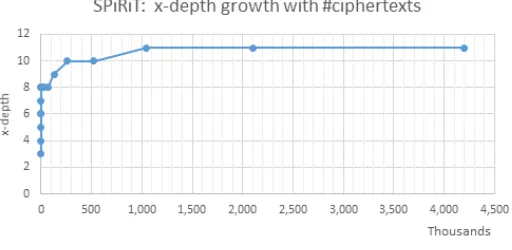
ring arithmetic circuit for secure search of multiplicative depthO(log logm). This presents an exponential
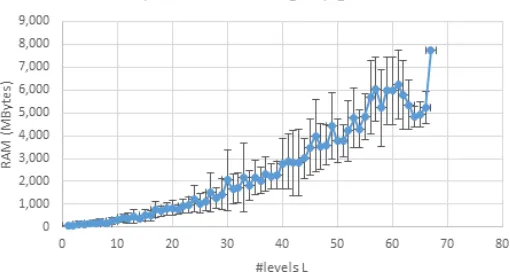
improvement over the prior art; See Figure 3. We hope that this novel technique will be used in future works to attack other computations in the context of FHE that currently have impractical solutions.
Overview of SPiRiT. OurSPiRiTsketch for rst positive is a novel low degree polynomial we introduce
for computing the rst positive index. This polynomialSPiRiTm,p()is parameterized by the lengthmof the
input vector and the moduluspfor the arithmetic operations, and is dened to be the composition
Fig. 2. Depicting our Secure Search Protocol 2 and the Data Upload Protocol 1. In the data upload protocol the client, whose input is the public key and the data array, encrypts the data and sends to the server. In the secure search protocol, the server's input is the evaluation key and the encrypted data that was previously uploaded; The client's input is the secret key and a lookup value; A common input (in both Protocols 1-2) is the set of prime numbersp1, . . . , pk. The client sends to the server the lookup value`encrypted inkciphertexts with plaintext moduli
p1, . . . , pk; where we use the notation JxKp to denote a ciphertext encrypting message x to enable homomorphic
addition and multiplication modulop. The server evaluates, for each moduluspj, the pattern matching polynomial
isMatch on the encrypted lookup value J`Kpj and data JarrayKpj to obtain an encrypted indicator vector JindKpj.
The server then evaluates on this encrypted indicator vector our SPiRiTm,pj sketch for rst positive to obtain a
candidate JbpjKpj for its rst positive index. The server sends to the client these k candidates JbjKpj together with
the correspondingkentries inind. The client decrypts and outputs the smallest candidatebjs.t.ind(bj) = 1.
Fig. 3. Single/Multi ring arithmetic circuit for secure search: the multiplicative depth of known single ring circuits is exponentially higher than in our proposed multi ring circuit.
of a Sketch, Pairwise, Roots, and Tree matrices, together with an operator i(x) = isPositivep(x) for
turning integer vectorsxto binary vectors accepting value 1on entries where xis nonzero, and value0 on
entries wherexis zero.
We elaborate on the components ofSPiRiTm,pand their roles. The role ofi◦R◦i◦T(indicator)which
is not always satised, see discussion below is to return the step functionu∈ {0,1}maccepting value0on
entries1, ..., i∗−1and value1on entriesi∗, . . . , m. For this purpose the tree matrixT computes the labels of
the labels of its children. These labels are then reduced to binary values using isPositivep operator. Next,
for each i ∈[m], the roots matrixR partitions the tree leaves1, . . . , i according to their deepest common
ancestor whose leaves are contained in the leaves 1, . . . , i, and sums up the labels of these ancestors; see
Figure 4. The resulting values are again reduced to binary values using isPositivep operator. The pairwise
dierence matrixP then computes the derivative ofu, which in the case where uis the said step function
results in a binary vector with a single non-zero entry at indexi∗. The sketch matrixS∈ {0,1}(1+dlogme)×m
is a standard sketch matrix for1-sparse vectors, i.e., a matrix that given a binary vector with at most a single
non-zero entry returns the binary representation of the index of this entry (or zero if none exists). Finally, to compute the isPositivep operator we rely on Fermat's Little Theorem: isPositivep(x1, . . . , xm0) = (xp−1 1
modp, . . . , xp−m01 modp). The degree ofSPiRiTm,p is(p−1)2(which can be lowered toplogmwith further
optimizations; see Lemma 2).
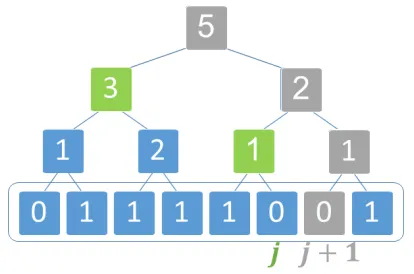
Fig. 4. The tree representation for a lengthm= 8binary vectorindicator= (0,1,1,1,1,0,0,1)is the full binary tree withmleaves labeled by entries ofindicator, and with internal nodes labeled by the sums of their children's labels. The array data structure for this tree is the length2m−1vectorw=T·indicator= (5,3,2,1,2,1,1,0,1,1,1,1,0,0,1). The prex sum of leaves' labels up to the j = 6th leaf from the left is v(6) = 0 + 1 + 1 + 1 + 1 + 0 = 4. More generally, the vector of prex sums ofindicatorisv= (0,1,2,3,4,4,4,5). The root matrixRhas the property that RT ·indicator = Rw = v. To construct sparse R we observe that every entry of v can be computed using only O(logm)labels; this is by summing the roots of subtrees forming a partition of the leaves in the considered prex. For example, to compute thej= 6thentryv(6)we sum two labels as follows: First identify all the ancestors of the j+ 1 = 7th leaf: labeled by 0,1,2,5 in the gure (colored in grey). Among these ancestors, select those who are right children: labeled by1and2in the gure. Finally, sum the labels of the left siblings of these selected ancestors: labeled by1and3in the gure (colored in green) to get the desired sum. Indeed,v(6) = 1 + 3 = 4. .
The problem we face is that on the one side, correctness requires a large modulusp=Ω(m); otherwise, we get
wrong outputs due to overow. For example, when using a smallpm, applying the isPositive operator
on the tree labels (i.e., computingi◦T(indicator)) reduces to zero all tree labels that are a multiple ofp,
instead of only labels that are zero over the integers; consequentlyumight not be a step function, and the
output will not be the desired indexi∗. On the other side, eciency requires a small modulusp= logO(1)m,
because the degree ofSPiRiTm,p is polynomial inp.
To resolve this problem we rst prove in our analysis a key property ofSPiRiTm,p as follows.
Key Property: If the labels of the ancestors of the rst positive leafi∗ in the tree T(indicator)are
not multiples ofp, thenSPiRiTm,p(indicator)returns the binary representation ofi∗; see Lemma 3,
Section 4.1.
Next, we observe that there are not too many primespthat are divisors of these labels, specically, at most
satisfy the above condition on the ancestors ofi∗. By the above key property, for thisp,SPiRiTm,p(indicator)
returns the correct output. Therefore, by computing SPiRiTm,p(indicator) (in parallel) fork primes p, we
obtain a list of candidatesb1, . . . , bk for the binary representationb∗ of the rst positive indexi∗, with the
guarantee that fori1, . . . , ik∈[m]∪ {0}the corresponding indices:
i∗= min
j∈[k]{ij s.t.indicator(ij) = 1}.
The decoding algorithm on the client side is therefore to choose from the list of candidates received from the server the smallest candidate that is veried to be a match (i.e.,indicator(ij) = 1). We remark that for
the purpose of this verication the server in our protocol sends to the client the valuesindicator(ij)for all
j∈[k](computed using standard PIR techniques), on top of sending the candidatesbpj.
More tightly, it in fact suces to set k = 1 + log2m/log logm by choosing only primes p larger than
logm. Furthermore, by the Prime Numbers Theorem, we can nd suchk=O(log2m/log logm)primes in
a suciently short interval to ensure that all the primes are of magnitude O(log2m). The degree of the SPiRiTm,p polynomials for these primespis thereforeO(plogm) =O(log3m).
In summary, we propose a new polynomial SPiRiT = (SPiRiTm,p1, . . . ,SPiRiTm,pk) for computing a
short list of k= o(log2m) candidates for the rst positive entry in a given non-negative length m vector.
Our analysis proves that the smallest of the veried candidates is the correct solution, that is, it is the binary representationb∗ ∈ {0,1}1+dlogme of the rst strictly positive entry i∗ ∈[m] of the input vector (and it is
b∗ = 0 if no such entry exists). We call this polynomial a sketch for rst positive. This sketch may be of
independent interest beyond the context of secure computation, and it is extraordinary in that unlike other Group Testing sketches (e.g. [25]) it can be applied on non-sparse input vectors.
Technical diculty: how to compute minimum when each ciphertext has a diering plaintext modulusp? We
now elaborate on the encryption we use and explain why we relay computing the minimum veried candidate to the client, instead of requesting the server to do it.
Observe that computing the minimum of k =o(log2m) values requires only a low degree polynomial,
so typically this could be accomplished eciently by the server. However, the guarantee of FHE schemes is to enable given ciphertexts JxK to execute computations on the underlying plaintext x with respect to
a single ring. For example, the plaintext space could be integers and the ring operations are addition and multiplication modulo a prime p(aka, the plaintext modulus). We denote by JxKp a ciphertext encrypting
the messagexso that we can apply on it homomorphic addition and multiplication modulop.
For some FHE candidates (e.g. [7]), given a ciphertext JxKp, it is possible to transform it to a ciphertext for
a plaintext modulusp0 which is a multiple ofp(or other related primesp0). However we do not know how to
achieve such a transformation for arbitraryp0 (unless using bootstrapping, which is considered impractical).
To evaluate SPiRiTm,p on encrypted data for k distinct primes p, we therefore use FHE scheme that
allows encrypting ciphertext with respect to these modulip(e.g. [7]), and require that each time the client
encrypts a messagexshe produces a tuple ofk ciphertexts JxK= (JxKp1, . . . ,JxKpk) corresponding to these
k distinct primes (specically, we use the smallest k primes that are larger than logm). The server then
evaluatesSPiRiTm,p1, . . . ,SPiRiTm,pk(in parallel), where eachSPiRiTm,pj is evaluated on the corresponding
ciphertexts J·Kpj. The output is the resulting list ofkcandidates Jb1Kp1, . . . ,JbkKpk.
Getting back to discussing the minimum function, computing the minimum of the veried of these candidates Jb1Kp1, . . . ,JbkKpk seems to require switching the plaintext modulus to a common primep0, which
we do not know how to accomplish eciently. This is why we relay computing the minimum to the client. We remark that the fact that we encrypt each message usingk ciphertexts incurs a factork=o(log2m)
overhead on the time and space complexity in comparison to when using a hoped FHE scheme where we could eciently switch between the plaintext moduli.
1.4 Extensions and Followups
(note that we assume here that the size of the data is known to the server). Likewise, update are a simple extension of PIR techniques, when given the unique index i for the record to be modied. Delete can be
implemented by updating a record to a reserved Deleted symbol, or by updating the value or recordi to
that of the last record and reducing the number of records by1(for cases when the dynamic size of the data
is either maintain by the client, or is not a secret and can be maintained by the server).
Extensions to multiple clients are immediate when all clients posses the secret key. For example, a group of users and a company can share the secret key and search/upload records independently and simultaneously, using existing db transactions locks mechanisms on un-trusted cloud. Moreover, uploading data does not even require sharing the secret key for the FHE scheme. Instead, it suces for the data owner (say, the company) to publish the public key, so that all participants can upload encrypted data.
Followup work on returning all matching database entries. In a recent work [3] following the preprint pub-lication of this work, it is shown how to return all database entries that match the lookup value, where the search is realized by a polynomial of degree polynomial inlogm. Their complexity naturally grows with the
number of matching records, but only in terms of the client's running time and the size of the polynomial evaluated by the server, whereas the degree of the polynomial computed by the server remains low even when the lookup value has many returned matches.
We point out that [3] is incomparable to this work: It may be undesirable to return all matching records if there are too many of them (as this incurs a communication and client complexity burden). Instead, our work allows the client to retrieve the matching records one-by-one (where each search query returns a single match as in SQL FETCH_FIRST, and repeated queries can retrieve the following matching records as in SQL FETCH_NEXT). Moreover, combining techniques of [3] with ours we can retrieve in each query the next s matches, for a parameter s (compared with s = 1 in this work, and s being the total number of
matches in [3]); details to appear in the full version of this work.
Followup work on reducing thek=o(log2m)client's overhead due to the multi-ring encryptions/decyptions.
Recall that the fact that we encrypt each message usingkciphertexts incurs a factork=o(log2m)overhead
on the time and space complexity. A followup work shows how to avoid such overhead [5], albeit with introducing a negligible probability of error.
2 Discussion of the Secure Search Problem Statement
In this section we discuss the secure search formulation of Denition 1 to demonstrate its wide applicability to real-life use case examples and remark on its properties.
2.1 Use case examples
The formulation in Denition 1, despite its simplicity, captures a wide variety of real-life problems; examples follow.
For securely searching a documents' corpus with a document-term matrix representation , the array entries correspond to the rows of the document-term matrix (where recall that this matrix has columns corresponding to terms, and each row indicates the terms appearing in the corresponding document), and the lookup value species the subset of matching documents, e.g., by specifying a list of terms so that the matching documents are those including the conjunction of these terms.
For securely searching a database table with rows corresponding to records and columns corresponding to their various attributes, each array entry corresponds to a database row, and the lookup value species the matching attributes, say an exact match query for a particular attribute (database column). We remark that our experimental results address this latter use case example.
2.2 Remarks on the Secure Search Denition
We continue with remarks on the various aspects of the secure search denition.
What pattern matching subroutines can be used? Importantly, to allow such a wide applicability for the above problem formulation, our solution works with any generic specication of what valuesxi constitute a
match to`. The specication is given by a pattern matching algorithm isMatch(·,·)that given pairs xi, `
returns1if they are a match and0otherwise (e.g. equality test, wildcard matching, conjunction/disjunction
queries, Hamming/Edit/Euclidean distance measures etc.), and our algorithm is generic in the sense we can plug-in any such specication. The overall complexity depends of course on the complexity of thisisMatch()
subroutine; our experimental results are for the case of exact equalityisMatch(xi, `) = 1if-and-only-ifxiis
identical`. For concreteness we focus throughout this work on the exact match case; the extension to generic isMatch()matching algorithm is immediate.
Why return one match and not all? We focus here on applications where there may be an unlimited abun-dance of matched values, so that returning all matches can pose an undesirable burden on the client, both in term of the communication complexity for receiving all matches, and in terms of the computational complexity for reading all of them. We require therefore to returning one matching value.
Which match to return? For concreteness we focus on the case of returning the indexi for the rst match
(as in SQL FETCH_FIRST). That is, we return (the binary representation of) the index
i∗= min{i∈[m]|isMatch(array(i), `) = 1}
(where here, and in the rest of the paper, we assume that the minimum of an empty set is 0). We stress
nonetheless that our framework easily extends to allow the client to retrieve the matching records one-by-one (as in SQL FETCH_NEXT); details to appear in the full version of this work.
Returning index i or record (i, xi)? For simplicity of the presentation we focus primarily on returning the
index i, because this is the challenging heart of the retrieval problem. This can trivially be extended to
returning the pair(i, xi)forxi the matched value (e.g. document, database row, etc.). This is because once
the unique index i is found, retrieving the entire value is easily solved by applying known PIR on FHE
encrypted data and index [16,8,14]. We stress that applying PIR here is done on the server side, using the vale JiK that the server has computed, and requires no interaction with the client.
How to employ secure search in secure outsourcing scenarios? The client uploads encrypted dataarray to
the server at an oine phase; only the client knows the secret decryption key. To initiate a secure search, the client submits an encrypted lookup value`, the server returns the encrypted resulty, so that there is an
ecient decoding algorithm to obtain fromy the matching indexi.
What is the complexity goal? Our primary complexity goal is to minimize the client's latency, that is, the wait time between sending a search query and obtaining the search result. This latency accounts for both the server's time for evaluating the search polynomial and the client's time for encryption, decryption, and decoding of the received evaluation outcome.
is, the multiplicative depth of the corresponding arithmetic circuit islogd. The sizesis a (typically non-tight)
upper bound on the width w of this arithmetic circuit. We ignore the homomorphic addition operations,
because they are much much cheaper than homomorphic multiplications, both with respect to the error they introduce in the context of homomorphic evaluation, and also with respect to running time.
The client's latency naturally depends on the number of parallel processors available to the server. In case the server haswparallel processors, the client's latency is essentially the multiplicative depthlogd(because
the server can employ the parallel processors to compute each layer of the circuit in unit time). In case the server has a single processor, the client's latency is upper bounded bywlogd(due to requiringO(w)time for
each of thelogdlayers). In general, for a server withtprocessors, the client's latency is essentially w t logd.
Our experimental results on the server's complexity measure the actual running time, which accounts for all executed operations: homomorphic additions on top of homomorphic multiplications. Moreover, most of our experimental results are done on a single computer, so the server's time in our experiments grows with the total number of operations, not only thelogdtime for aggregate multiplications.
Our analysis of the client's running shows that the decoding time is o(log2m), and the overall client's
running time is proportional to computing o(log2m)encryption and decryption operations. Note that our
theoretical analysis needs not specify the encryption/decryption times, because these are properties of the underlying encryption scheme (where any suitable FHE can be used), and not of the search algorithm we propose.
3 Our Secure Search Protocol
In this section we present our secure search protocol. We rst specify the requirements in our black-box use of fully (or, leveled) homomorphic encryption in Section 3.1; then describe the data upload protocol in Section 3.2; then present our secure search protocol in Section 3.3 with details of the components of
SPiRiTspecied in Section 3.4. In Section 3.5 we specify the particular pattern matching polynomial that we
implemented for our experimental results. Finally, in Section 3.6 we discuss a randomized variant of our secure search protocol introducing a probability of error for gaining a reduced overall number of multiplications.
3.1 Black Box Usage of Semantically Secure Fully Homomorphic Encryption (FHE)
Fully (or, leveled) homomorphic encryption (FHE) is used in this work in a black-box fashion: we require black-box use of the standard algorithms for FHE (key generation, encryption, decryption, and evaluation), and could use almost any FHE schemes (both public key schemes and symmetric schemes). The only re-quirement we make on the scheme is that we can choose as a parameter the plaintext modulus to be a prime numberpof our choice, so that the homomorphic operations are addition and multiplications modulop. This
is the case in many of the FHE candidates, for example, [7]. For security of our scheme we require that the scheme is semantically secure.
Notations. To emphasize the plaintext modulus p we use the following notations for the standard
algo-rithms specifying an FHE schemeE = (Gen,Enc,Dec,Eval)(dened here for the symmetric key settings for
simplicity):
Genis a randomized algorithm that takes a security parameterλas input and a primep, and outputs a
secret key skp= (p, sk)and a evaluation key ekp = (p, ek)for plaintext modulusp, denoted:
(skp= (p, sk), ekp= (p, ek))←Gen(1λ;p).
Enc is a randomized algorithm that takes skp and a plaintext message msg, and outputs a ciphertext
JmsgKp for plaintext modulusp, denoted:
Dec is an algorithm that takes skp and a ciphertext JmsgKp as input, and outputs a plaintext msg0,
denoted:
msg0←Decskp(JmsgKp).
Correctness is the standard requirement that msg0=msg.
Evalis a (possibly randomized) algorithm takesekp, a polynomialf(x1, . . . , xt), and a tuple of ciphertexts (Jm1Kp, . . . ,JmtKp), and outputs a ciphertextc, denoted:
c←Evalekp(f,Jm1Kp, . . . ,JmtKp).
Correctness is the requirement that decryption would return the message resulting from evaluating (modulo p) the polynomialf()on inputsm1, . . . , mt
Decskp(Evalekp(f,Jm1Kp, . . . ,JmtKp)) =f(m1, . . . , mt) modp.
Semantic security implies that the resulting ciphertext c is computationally indistinguishable from a
fresh ciphertext Jf(m1, . . . , mt)Kp.
3.2 Uploading Encrypted Data
Secure outsourcing of computation is the settings we address. For this purpose the client uploads to the server its encrypted data. The upload protocol is simple: the clients encrypt the data and sends to the server. The encryption is with a semantically secure FHE scheme, where for each message msg we produce a tuple of k= 1 + log2m ciphertexts(JmsgKp1, . . . ,JmsgKpk)for plaintext modulus p1, . . . , pk, respectively, chosen to
be the rstkprimes larger than logm. For simplicity of the presentation we assume the entire dataarray
is uploaded in a single round; this can easily be modied to incremental upload of the data. See Protocol 1.
Algorithm 1: Data Upload Protocol
Shared Input: An FHE schemeE = (Gen,Enc,Dec,Eval),
A numbermof data records inarray, where w.l.o.g. we assumemis a power of two, A setP={p1, . . . , pk}of the smallestk= 1 + log2mprimes that are larger thanlogm.
Inputs: The client's input is a security parameterλandarray= (array(1), . . . , array(m)) The server has no input.
Outputs: The client's output is a secret keysk= (skp1, . . . , skpk)(for the FHE and securityλ).
The server's output is the corresponding evaluation keyek= (ekp1, . . . , ekpk), and
the encrypted data JarrayK= (JarrayKp1, . . . ,JarrayKpk)
(wherearrayis encrypted entry-by-entry: JarrayKp= (Jarray(1)Kp, . . . ,Jarray(m)Kp)).
1. The client does the following:
Generate keys(skp1, ekp1)←Gen(1
λ;p1), . . . ,(sk
pk, ekpk)←Gen(1 λ;p
k). Denote
ek= (ekp1, . . . , ekpk).
Compute for alli∈[m]andj∈[k]:
Jarray(i)Kpj ←Encskpj(array(i)).
Send to server
ekand JarrayK= (JarrayKp1, . . . ,JarrayKpk),
3.3 The Secure Search Protocol
To securely search for a lookup value ` in the encrypted data JarrayK outsourced to the server, the client
encrypts `and sends the corresponding cipehrtexts J`K to the server. The server evaluates our search
poly-nomial which is the composition of the two parts (see the overview in 1.2): rst computing the (encrypted) binary vectorindicatorwith1in all entries ofarray that match`using a genericisMatch()pattern
match-ing protocol; and next returnmatch-ing a short list of candidates for the the indexi∗ of the rst positive entry in indicatorusing ourSPiRiTsketch for rst positive (with the corresponding recordarray(i∗), if so desired;
see Section 2). The client then decodes and chooses the smallest of the veried candidates as the output. Encryption of each value msg is by a tuple of k = 1 + log2m ciphertexts, one ciphertext for plaintexts
modulusp1, . . . , pk (where these moduli are chosen to be the rstkprimes larger thanlogm). See Protocol 2
and Figure 2 for the protocol, with details on the components ofSPiRiTsketch rst positive in Section 3.4.
Algorithm 2: Secure Search Protocol
Shared Input: An FHE schemeE = (Gen,Enc,Dec,Eval),
A power of twomdenoting the number of data records inarray,
A setP={p1, . . . , pk}of the smallestk= 1 + log2mprimes that are larger thanlogm.
A pattern matching polynomialisMatch(·,·).
Inputs: Client's input is the secret keysk= (skp1, . . . , skpk)and a lookup value`.
The server's input is the corresponding evaluation keyek= (ekp1, . . . , ekpk), and
the encrypted data JarrayK= (JarrayKp1, . . . ,JarrayKpk).
Outputs: The client's output is (the binary representation b∗∈ {0,1}1+logmof) the index
i∗= min{i∈[m]|isMatch(array(i), `)}.
The server has no output.
1. The client compute for allj∈[k]:
J`Kpj ←Encskpj(`).
and sends to the server
(J`Kp1, . . . ,J`Kpk),
2. The server does the following for eachj∈[k]: (a) Compute
JindicatorKpj ←(isMatch(Jarray(1)Kpj,J`Kpj), . . . , isMatch(Jarray(m)Kpj,J`Kpj)).
(b) Compute
JbpjK←SPiRiTm,pj(JindicatorKpj)
whereSPiRiTm,pj =S◦P◦i◦R◦i◦T forS, P, R, T andithe matrices and operator specied in
Section 3.4 below. (c) Send to the client
(Jbp1K, . . . ,JbpkK)and(Jindicator(bp1)Kp1, . . . ,Jindicator(bpk)Kpk)
(here we slightly abuse notation by addressing entries ofindicatorby the binary representation of the indices). To compute Jindicator(bpj)Kpj the server applies standard PIR techniques, namely, evaluating on
indicatorandbj the polynomialPmi=1indicator(i)·isEqual(i, bpj); see Section 3.5.
3. The client decrypts and outputs the minimum
b∗←min
j∈[k]
3.4 The Components of SPiRiT Sketch for First Positive
The heart of our secure search protocol is evaluating on a binary vectorx∈ {0,1}m(specically, the vector
indicator) our sketch for rst positive
SPiRiTm,p=S◦P◦i◦R◦i◦T.
In what follows we specify the components of S, P, R, T and iofSPiRiTm,p. Without loss of generality, we
assume thatmis a power of2 (otherwise we pad the inputarray by zero entries).
The Tree matrixT ∈ {0,1}(2m−1)×m is a binary matrix that, after right multiplication by a lengthmvector x= (x1, . . . , xm), returns the length 2m−1 array data structure representation w= (w1, . . . , w2m−1) for the tree representationT(x)ofx, as dened next.
The tree representation T(x) of xis the full binary tree of depth log2mwith labeled assigned to nodes
as follows: The label of theith leftmost leaf is x(i), for everyi∈[m]; The label of each inner node ofT(x)
is dened recursively as the sum of the labels of its two children. The array data structure forT(x) is the
vectorw= (w(1),· · · , w(2m−1)), wherew(1)is the label of the root ofT(x), and for everyj∈[m−1]we
denew(2j),w(2j+ 1)respectively to be the labels of the left and right children of the node whose label is
w(j); see Fig. 4. Observe that the valuew(i)is the sum of the labels of the leaves of the subtree rooted in
the tree node corresponding to array entryw(i).
The matrix T that satises w=T x can be constructed by letting each row k of T corresponds to the
nodeuinT(x)represented byw(k), and setting this row to have1in every columnjso thatuis an ancestor
of thejth leaf (0 otherwise). We point out that T is of course constructed obliviously to the input and is
independent ofx. Note that the lastmentries ofware the entries ofx= w(m),· · · , w(2m−1).
The Roots matrix R∈ {0,1}m×(2m−1) is a binary matrix with each row having O(logm)non-zero entries
that satises the following: its right multiplications by the tree representationw= (w(1), . . . , w(2m−1)of
a vector x= (x(1), . . . , x(m))returns the vector v =Rw of prex sums for x, namely, v(j) is the sum of
entriesx(1), x(2), . . . , x(j)ofx.
A naive implementation can produce these prex sumsvusingR0∈ {0,1}m×mwhoseith row(1, . . . ,1,0, . . . ,0)
consists ofiones followed bym−izeros for everyi∈[m]. ThisR0 however does not satisfy our requirement
forO(logm)non-zero entries in each row, implying that even when applies on binary vectors the result may
consist of values up tom; this in turn ruins the success ofSPiRiTm,p when using small primes pm.
To solve this issue, we implement R by summing labels of only O(logm) internal nodes of the tree
representationw ofx. We next set up terminology to facilitate specifying these internal nodes. Consider a
full binary tree withmleavesT. We identify indicesj∈[2m−1]with nodes of the tree, where the mapping
is according to the standard array data structure dened above. For each nodej∈[2m−1],
Ancestors(j)⊆[2m−1]is the set of indices corresponding to the ancestors in the tree of nodej(including j itself).
Siblings(j)⊆[2m−1]is the set of indices corresponding to the left-siblings of Ancestors(j).
We are now ready to dene R: Each rowi of the matrixR has values1 in all entriesj ∈Siblings(i+ 1) (0
otherwise); see Fig. 4. That is,
R(i, j) =
1 ifi∈[m]andj∈Siblings(i+ 1)
0 otherwise
This matrix R satises that properties we required above from the roots matrix: (1) each row having O(logm)non-zero entries, and (2)v=RT xbeing the vector of prex sums ofx), as formally stated in the
Lemma 1 (Roots sketch). LetT ∈ {0,1}2m−1×mandR∈ {0,1}m×(2m−1) be the matrices dened above.
Then each row of R has at most logm non-zero entries, and for every x = (x(1), . . . , x(m)), the vector
v=RT xis a lengthmvector so that for everyj ∈[m],
v(j) = j X
k=1
x(k).
The Pairwise matrixP ∈ {−1,0,1}m×m is a matrix whose right multiplication by a given lengthmvector u= (u(1), . . . , u(m))yields the vectort=P u of pairwise dierences between consecutive entries inu, i.e., t(j) =u(j)−u(j−1) for everyj ∈ {2, . . . , m} andt(1) =u(1). For this purpose every row i∈ {2, . . . , m}
of P has the form (0, . . . ,−1,1,· · · ,0) with 1 appearing at itsi-th entry; and the rst row is(1,0, . . . ,0).
For example, ifm= 8and u= (0,0,0,1,1,1,1,1) thent=P u= (0,0,0,1,0,0,0). More generally, ifuis a
binary vector that represents a step function, thenthas a single non-zero entry at the step location. Indeed,
this is the usage of the Pairwise sketch inSPiRiT.
The Sketch matrix S ∈ {0,1}(1+logm)×m is a matrix whose right multiplication by a binary vector
t = (0,· · ·,0,1,0,· · · ,0) ∈ {0,1}m with a single non-zero entry in its jth coordinate yields the binary
representation y =St ∈ {0,1}1+logm of j ∈ [m] (andy = 01+logm if t is the all zeros vector). (Note that
1 + logm output bits are necessary to represent the saidm+ 1distinct events.) This sketch matrix S can
be easily implemented by setting each columnj={1, . . . , m}to be the binary representation ofj.
The isPositive operator i() for a primep, denoted isPositivep(·)(ori(·)in short, whenpis clear from the
context), gets as input an integer vectorv= (v1, . . . , vm0), and returns a binary vector u∈ {0,1}m 0
where, for every j ∈[m0], we haveu(j) = 0 if and only if v(j)is a multiple of p. This is achieved using Fermat's
Little Theorem:
isPositivep(v(1), . . . , v(m0)) = (v(1)p−1 modp, . . . , v(m0)p−1 modp).
A crucial issue that we handle via our multi ring FHE evaluation technique is that, unlike the matrices
S, P, R, T that require from us no multiplication operations (specically, we compute the matrix vector
multiplication using only addition operations, this is by summing the subset of vector entries, or their negation, specied by the non-zero entries of the matrix), the degree of the polynomialxp−1that is used in
isPositivep isp−1imposing the requirement that we use only small modulip.
3.5 The Secure Pattern Matching in our Implementations and Experimental Results
Recall that to securely search for an encrypted lookup value`in an encrypted dataarray = (array(1), . . . , array(m)),
the server rst computes the encrypted binary vector:
indicator= (isMatch(array(1), `), . . . , isMatch(array(m), `)).
Our protocol is generic in the sense that we could plug here any pattern matching polynomialisMatch().
Naturally, in order to implement our protocol and produce experimental results we must run our protocol on some concreteisMatch()polynomial. The concrete implementation forisMatch used in our experiments
is the equality test, returningisMatch(array(i), `) = 1if-and-only-ifarray(i) =`. We assume the input is
given, as standard, in binary representation, and where encryption is bit-by-bit. Denoting bypthe plaintext
modulus we use and bya, b∈ {0,1}tthe patterns whose equality we wish to determine, the equality test we
implemented is dened by:
isEqualt(a, b) = Y
j∈[t]
1−(aj−bj)2
The degree of this test is2t. This is degree is independent from the number of entries in the dataarray, and
depends only on the binary representation lengthtfor each entry. This should be interpreted as one possible
example for a pattern matching polynomial that can be plugged in to our secure search protocol.
We remark that the above equality test diers from the standard equality test used when the plaintext modulus isp= 2(specically,Q
j∈[t](1 +aj+bj) mod 2), as is necessitated by working with higher modulus
p >2.
3.6 Monte Carlo Secure Search Protocol
In this section we briey discuss a variant of Protocol 2 introducing a probability of error for saving a factor
e
O(log2m)in the overall number of multiplications.
The randomized protocol is similar to Protocol 2 except for working over a single randomj∈[k], instead
of the repetition over all j ∈[k] in Protocol 2. We set the parameterk to control the success probability.
Specically, the success probability is set to 1−δ by taking k = 1δ · loglog2mm. The success analysis simply
follows by observing that the randomized protocol succeed whenever the sampled prime pj is good (see
Denition 3, Section 4.1), which happens with probability 1−δby our upper bound loglog2mm on the number
bad primes (see proof of Claim 4) and the choice ofk. This success probability can be amplied via parallel
repetition, as standard. The complexity saving is due to avoiding k repetitions. The degree growth is by a
factor of 1
δlog(1/δ), which isO(1)for anyδ=O(1).
4 Analysis of our Secure Search Protocol
In this section we analyze our secure search Protocol 2. First we prove Theorem 1 showing this protocol is an ecient secure search protocol; see Sections 4.1-4.2. Next we present Formula 1 specifying a concrete running time estimation for the protocol; see Section 4.3.
Elaborating on the former, we rst analyze the complexity and correctness ofSPiRiTm,p; see Lemma 2
and 3 in Section 4.1. Then we employ this analysis to prove the correctness and complexity of our Protocol 2; see Theorems 2 and 3 in Section 4.2. The security of Protocol 2 follows immediately by observing that the server processes only semantically secure ciphertexts; this is standard, details omitted.
4.1 Analysis of SPiRiT Sketch for First Positive
In this section we analyze the complexity and correctness ofSPiRiTm,p; see Lemmas 2-3. We begin with the
complexity analysis.
Lemma 2 (SPiRiTm,p complexity). SPiRiTm,p:{0,1}m→ {0,1}1+logm is a polynomial of degreeO(p2)
that can be evaluated using O(mlogp) multiplications. The degree of SPiRiTcan be reduced to O(plogm)
with implementation optimizations.
Proof. Computing the matrix-vector products when multiplying byS, P, R, T can be done using only
addi-tions/subtraction and no multiplications whatsoever, because their entries values in{−1,0,1}correspond to
summing subsets of the vector's entries (or their negation). So this part of the computation adds nothing to the degree or to the total number of multiplication.
The degree in each applications of the isPositivep operator is p−1, and since we compute it twice
the total degree is (p−1)2 (where we use here the standard fact that degrees multiply when composing polynomials).
Computing isPositivepfor a single entry requires onlylogpmultiplications, when using repeated
squar-ing. Since we apply isPositivep on a total of(2m−1) +m=O(m)entries, we get that the total number
of multiplications isO(mlogp).
The optimizations for reducing the degree to plogm are by introducing the following optimization in
up label in the roots as specied byR and reduces them to binary using isPositivep, we directly compute
the OR of these roots labels. The latter gives an identical result to the former, but with a polynomial of
degree proportional to the number of rootslogm, rather than to the modulusp. ut
We next analyze the correctness of SPiRiTm,p, showing a sucient condition for its success.
Denition 2 (First positive index). Let x = (x1, . . . , xm) ∈ [0,∞)m be a vector of m non-negative
entries. The rst positive index of x is the smallest index i∗ ∈ [m] satisfying that xi∗ > 0, or i∗ = 0 if
x= (0, . . . ,0).
Denition 3 (goodp). We call a prime numberpgood forx∈ {0,1}mif fori∗∈[m]∪{0}the rst positive
index of xthe following condition holds: for all nodes j ∈Ancestors(i∗) with non-zero labels T x(j)6= 0 in
the tree representation of x, their labelT x(j)is not a multiple ofp.
Lemma 3 (SPiRiTm,p correctness). Letpbe a prime,ma power of2,x∈ {0,1} m
,i∗∈[m]∪ {0}the rst
positive index ofx. Ifpis good forx, thenbp←SPiRiTm,p(x)is the binary representationb∗∈ {0,1}1+logm
of i∗.
Proof. The case i∗ = 0 is trivial: it is immediate to verify that when evaluated on x = (0, . . . ,0), bp ← SPiRiTm,p(x)is the zero vectorbp= (0, . . . ,0), as the matrix-vector products and application of isPositivep
operator all evaluates to0.
For the case i∗ ∈ [m], we prove the following. If p is good, then bp ← SPiRiTm,p(x) is the binary
representation ofi∗. Denote
u=i◦R◦i◦T(x).
It is easy to verify that ifu= (0, . . . ,0,1, . . . ,1)is a step function withi∗its rst non-zero, thenSP uis the
binary representation of i∗; see Claim 1. We next show that indeed this is the form of u, whenp is good.
Showing thatu(1) =. . .=u(i∗−1) = 0is simple; see Claim 2. The challenging part is to show that, ifpis
good, thenu(i∗) =. . .=u(m) = 1, as argued below. Put together we conclude that, ifpis good, thenbp is
the binary representationi∗.
Claim 1. Ifu= (0, . . . ,0,1. . . ,1) accepting values1 starting from itsi∗-th entry, then(SP·u modp)is
the binary representation ofi∗.
Proof. Multiplyinguby the pairwise dierence matrixP ∈ {−1,0,1}m×mreturns the binary vectort=P u
modpin {0,1}mdened byt(k) =u(k)−u(k−1) (foru(0) = 0). This vector accepts valuet(i∗) = 1 and
valuest(i) = 0elsewhere. Multiplyingtby the sketchS∈ {0,1}(1+logm)×mreturns the binary vectory=St
modpin {0,1}1+logm specifying the binary representation of i∗. We conclude that(SP·u modp) is the
binary representation ofi∗. ut
Claim 2. u(1) =. . .=u(i∗−1) = 0.
Proof. The denition of the tree matrix T and the roots matrix R implies that v =RT x is the vector of
prex sums ofx; See Lemma 1. Namely,
v(j) = X
k∈[j]
x(k).
Clearly, these prex sums are zero on all entriesj < i∗, asx(1) =. . .=x(i∗−1) = 0. Computing the vector
v diers from computing uin that we did not apply the isPositivep operator. Observe that isPositivep
has one-sided error in the sense that forz= 0 it always holds that isPositivep(z) = 0. Therefore, the rst
i∗−1entries remain zero even when applying isPositivep on the tree representationT xand on the roots
outputRiT(x). Namely,u(1) =. . .=u(i∗−1) = 0. ut
Proof. Fixj≥i∗. The key observation is that the intersection Ancestors(i∗)and Siblings(j+ 1)is non-empty:
∃k∗∈Ancestors(i∗)\Siblings(j+ 1).
The above holds because the left and right children vL, vR of the deepest common ancestor ofi∗ andj+ 1
must be the parents ofi∗ andj+ 1 respectively (becausei∗< j+ 1), implying thatvL is both an ancestor
of i∗ and a left-sibling of the ancestor v
R of j+ 1. Namely, vL is in the intersection of Ancestors(i∗) and
Siblings(j+1). Now, sincek∗∈Ancestors(i∗) =Athen when summing over the integer (i.e., without reducing
modulop),
T x(k∗) = X
js.t.k∗∈Ancestors(j)
x(j)≥x(i∗)≥1,
implying for goodpthat the above holds also when reducing modulop:
iT x(k∗) = 1 modp.
Now, when applying the roots matrix to computeu(j), sincek∗∈Siblings(j+1)then the summation includes
the summand iT x(k∗) = 1 modp, so it is strictly positive when computer over the integer. Moreover, the
sum remains strictly positive even when reducing it sum modulop, because the sum is smaller thanp(because
the sum is over at mostlogmvalues by the property thatRhas at mostlogmnon-zero entries in each row,
and all these values are bits by as they are entries ofiT x). We conclude therefore that
iRiT x(j) =isPositivep
X
k∈Siblings(j+1)
iT x(k)
= 1.
Namely, we've shown thatu(j) = 1for allj≥i∗. ut
u t
4.2 Analysis of our Secure Search Protocol 2
Consider an execution of Protocol 2 between two parties called client and server. Let the shared/client's/server's inputs be as specied there; denoted,(E, m,P ={p1, . . . , pk}),(sk, `), and(ek,JarrayK= (JarrayKp1, . . . ,JarrayKpk))
respectively. Then the following holds:
Theorem 2 (Correctness). Protocol 2 when executed by parties that follow the protocol specications (i.e., semi-honest) terminates with no output for the server, and with client's output being the binary representation
b∗∈ {0,1}1+logmof the index of the rst match for `inarray:
i∗= min{i∈[m]|isMatch(array(i), `)}.
Proof. Recall that the client's outputbis the smallest candidatebpj received from the server that is veried
to haveindicator(bpj) = 1:
b←min
bpj s.t.indicator(bpj) = 1 .
By denition of isMatch andindicatorany b withindicator(b) = 1 is the index a matching entry, i.e., so
that isMatch(array(b), `) = 1. It remains to prove thatbis the rst matchb∗. For this purpose it suces
to prove that b∗ ∈ {bp1, . . . , bpk}, because if b
∗ is in this set then it must be the smallest of the veried
matches in this set. By Lemma 3, to prove thatb∗ belongs to this set it suces to prove that there exists a p∈ {p1, . . . , pk} so thatpis good forindicator. The latter follows from Pigeonhole Principle together with
bounding the number of prime divisors for the ancestors of i∗ in the tree representation ofindicator; see
Claim 4.
Proof. Recall thatpis good forindicator∈ {0,1}mif it divides non of the non-zero labels of the ancestors of
thei∗-th leaf in the tree representationT·indicatorofindicatorfori∗the rst positive index of indicator.
Observe that there are at mostlogmancestors fori∗, each labeled by a number in the range{0, . . . , m}.
Recall that all primes pj are chosen to be larger than logm, so each label has at most loglogmm = logm/log logmdivisors inP. Taking the union over all labels we conclude that they have at mostlog2m/log logm
divisors inP. Now since|P|is greater than the former, then by Pigeonhole PrincipleP must contain a good
p. ut
u t
Theorem 3 (Complexity). Protocol 2 is a single round protocol with communication complexity ofo(log2m)
ciphertexts. The server evaluates o(log2m)polynomials (in parallel) each of degree O(log3m)·d and total
number ofOe(ms)homomorphic multiplications, for d ands the degree and total number of multiplications
of isMatch(). The client's decoding time is o(log2m), and the client's overall running time is proportional
to computing o(log2m) encryption and decryption operations.
Proof. It is straightforward to verify by inspection that Protocol 2 is a single round protocol with commu-nication complexity ofo(log2m)ciphertexts.
The server evaluates the composition of the polynomialisMatch with each of the polynomialsSPiRiTm,pj
for j ∈ [k], where computation is done on encrypted data using homomorphic operations. Recall that
P ={p1, . . . , pk} consists of the rstk= 1 + log2m/log logm=o(log2m)primes larger thanlogm.
The degree of this composition is the product of the degree dofisMatch and the degreeO(pjlogm)of SPiRiTpj. Assigning the upper bound
p1, . . . , pk =O(log2m)
on the magnitude ofp1, . . . , pk (see Claim 5), we get that the degree is at mostO(log3m)·d.
The total number of homomorphic multiplications computed by the server is the sum of that following: (1)
m·smultiplications in computingm applications ofisMatch, and (2) k·O(mlogp) =o(mlog2log logm)
multiplications in computing SPiRiTm,p1, . . . ,SPiRiTm,pk (where the latter holds by the choice of k =
o(log2mand the boundp=O(logm)in Claim 5). Put together we get that the server computes a total of e
O(ms)homomorphic multiplications.
The client's decoding algorithm simply selects the minimum of k = o(log2m) values satisfying a test
(indicator(i) = 1) that can be veried inO(1)time. So the decoding time isO(k) =o(log2m).
Claim 5. p1, . . . , pk =O(log2m).
Proof. We bound the magnitude of the primes p in P. Recall that by the Prime Number Theorem (see,
e.g., in [24]) asymptotically we expect to nd x/lnxprimes in the interval [1, x]. Thus, we expect to nd x
lnx− b
lnb =Ω( x
lnx) primes in the interval[b, x], where the last equality holds for every b =o(x). Assign
x=klnkfork= 1 + log2m/log logmandb= logm. For suciently largemthere arekprimes larger than bin the interval [b, tlnt]; so all the primes inP are of magnitude at mostp=O(klnk) =O(log2m). ut
u t
4.3 Formula for Concrete Running Time