on235U and 3) measurements of correlated data of fission observables. New projects include developments
of auxiliary detectors to improve the capability of DANCE. We are building a compact, segmentedNEUtron
detectorArray at DANCE (NEUANCE), which will be installed in the central cavity of the DANCE array.
It will provide experimental information on prompt fission neutrons in coincidence with the prompt fission
gamma-rays measured by 160 BaF2 crystals of DANCE. Unique correlated data will be obtained for neutron
capture and neutron-induced fission using the DANCE-NEUANCE experimental set up in the future.
1 Introduction
Current research at DANCE is focused on many areas of basic and applied nuclear science. Data on neutron cture and neutron-induced fission, essential for many ap-plications including nuclear energy, nuclear forensics and stockpile stewardship, were obtained in recent years at DANCE including the capture cross section of235U [1], 239Pu [2],237Np [3],241Am [4] and238U [5]. The DANCE
collaboration contributes significantly to improve our un-derstanding of photon strength functions (PSF) as well as nuclear level densities (NLD) through dedicated measure-ments of neutron capture reactions on selected isotopes. Detailed studies of the capture gamma-ray cascades from compound nucleus yielded many results on spins and par-ities of neutron resonances and models of PSF and NLD [6–13].
Currently, three major experimental programs are un-der way at DANCE. The first project includes a five-year long measurement campaign of Uranium isotopes. The precision cross section measurements with the DANCE array have been improved significantly for the major ac-tinides 235U [1] and 239Pu [2] in recent years. Tech-niques for ratio measurements were developed and proved to yield results up to 1 MeV of incident neutron energy. New measurements are underway to use ratio techniques for threshold fissioning actinides –234U,236U and238U. In addition, new experimental tools and mathematical meth-ods will be developed for determination of the capture cross section. Special care will be paid to development of a Monte-Carlo scheme for the total uncertainties in the determination of DANCE cross sections. Finally, we will
ae-mail: [email protected]
develop methodologies for absolute capture cross section measurements.
The second project is a three year long project focused on the role of the short-lived actinide isomers in a high neutron flux environment. In particular, we are interested in quantifying the population of two isomeric states in236U that were found to have an unexpectedly large yield in neu-tron capture on235U for resonance neutrons [14].
The third project is focused on the measurements of correlated data from neutron-induced and spontaneous fission. The prompt-fission gamma-ray (PFG) emission properties were measured at DANCE in recent years and fully correlated data on PFG energies and multiplicities were obtained for many actinides [15–17]. We have started studying a complicated de-excitation path follow-ing neutron-induced and spontaneous fission at DANCE using detailed models of fission fragment de-excitation [18–20] and also a semi-empirical model using parame-terized correlated distributions [16, 17]. In this project we will carry out measurements of fission fragment kinetic en-ergies in coincidence with the PFG at DANCE.
The review of these three projects will be given in fol-lowing sections.
2 Nuclear data for basic and applied
science
A ratio method is widely used in the measurements of neutron-induced reaction cross sections. Typically, the measurements with the sample of interest and neutron flux are carried out at the same time. In this case, the so-called "neutron monitors" use a sample with a very well known neutron-induced reaction cross section, such as3He,10B,
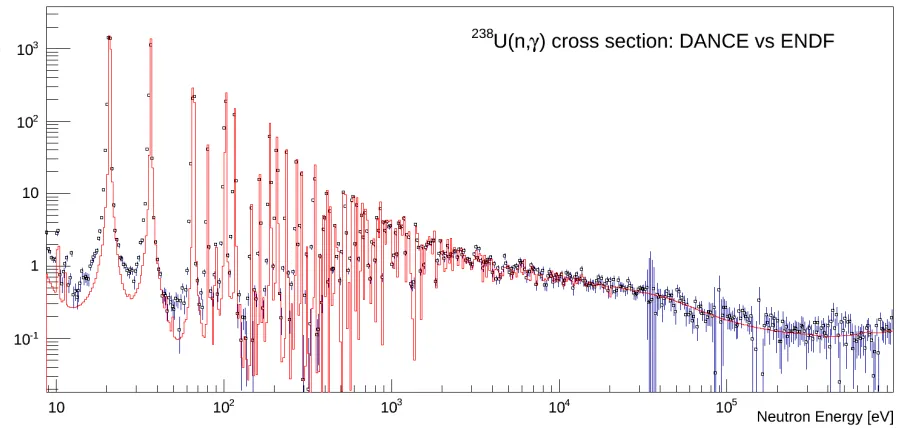
Figure 2.Capture cross section of238U obtained using a ratio of reaction rates238U(n,γ)/235U(n,f) from two independent measurements
[1] and [3]. Preliminary DANCE results (empty squares) are compared to ENDF-B/VII.0 evaluation (solid line).
h_out0
Entries 2.060178e+07 Mean 36.95 RMS 8.699
Neutron Energy (eV)
15 20 25 30 35 40 45
Intensity (arb. unit)
0 2 4 6 8 10 12 14
h_out0
Entries 2.060178e+07 Mean 36.95 RMS 8.699
h_out1
Entries 2.060178e+07 Mean 22.93 RMS 9.548
ICA Decomposition 236U(n,γ)
)
γ
U(n,
238
U(n,f)
235
)+
γ
U(n,
235
Figure 1. Separation of the different reaction rates using ICA method.
or6Li, and measure the neutron flux in such manner that it does not perturb the measurement of the reaction rate of interest. Cross section measurements can also be carried out in two independent measurements, using samples with the same diameter and the same position in the neutron flux. The neutron flux is assumed to not change for the two measurements. However, these methods suffer from un-certainties in the neutron flux normalization, sample uni-formity and neutron beam profile. In recent years, we have developed a methodology, where we take advantage ot the fact that in one sample, two neutron-induced reactions take place simultaneously. In the case of235U or239Pu samples, neutron capture and neutron-induced fission reactions oc-cur with the rates proportional to their cross section at each incident neutron energy. We have shown [1, 2], that the neutron-induced fission reaction rates can be obtained
with DANCE using the methods of gamma-ray calorime-try, where we used the tails of the prompt fission gamma-ray multiplicity and total energy distributions, which are much wider compared to these distributions from neutron capture and background. It is very convenient that the same number of sample atoms face the same neutron flux and the ratio of the two reactions completely removes the neutron flux from the analysis. However, for threshold fissioning actinides such as234U,236U and238U, the neu-tron induced fission is suppressed by few orders of mag-nitude compared to neutron capture for incident neutron energies below 1 MeV. In this case, our approach is to pre-pare mixed targets, where235U will be mixed in at a given concentration. This way we can control the amount of neutron-induced fission from235U in the sample and also use its neutron-induced fission reaction rate as a neutron flux monitor reaction. The chemistry of Uranium is not de-pendent on isotopic number and therefore the U isotopes are uniformly distributed in the sample. One complication remains, and that is the contribution from the neutron cap-ture on235U which needs to be removed.
208Pb sample measurements described in Ref. [1]. Further
work will include studies of scattering and self-shielding corrections to validate the ratio approach for independent measurements. The advantage of using the235U neutron-induced fission reaction is that we can identify this reac-tion without any background contribureac-tions up to 1 MeV of incident neutron energy. Using only prompt fission gamma rays to identify this reaction removes the need for fission fragment detectors and allows us to use thick sam-ples of235U and therefore reduce statistical uncertainties significantly.
3 Short-lived actinide isotope production
after neutron capture
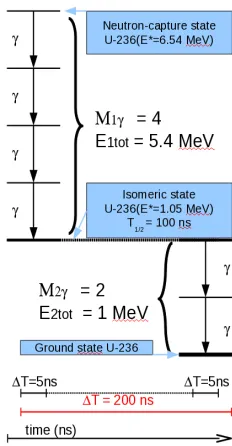
The preliminary studies of capture gamma-ray cascades after neutron capture of 235U revealed an unexpectedly large population of isomeric states in the236U compound nucleus [14]. At incident neutron energy of 8 eV, almost 20-30% of the capture cascades pass through one of the two isomeric states – one at 1 MeV (t1/2=100 ns) and one at 680 keV (t1/2=3.7 ns) of excitation energy. The decay scheme depicting the population of the 1 MeV isomer with the delayed emission of gamma-rays to the ground state of 236U is shown in Figure 3. The production of these isomers
may become important in a high neutron flux environment where the isomeric state lives long enough to capture a second neutron. In the case of236U isomers, the neutron-induced fission cross section below 1 MeV is expected to be 2 orders of magnitude higher than the cross section for the ground state of236U. A dedicated research and devel-opment started in 2013 to confirm the preliminary findings and quantify the yields of the236U isomers for different in-cident neutron energies. The most important development for this project is the design and construction of the new neutron detector array – NEUANCE. Using a liquid scin-tillator EJ-309, the detection of fission neutrons will be en-abled using a pulse shape discrimination (PSD) technique. A unique trigger will be obtained for the neutron-induced fission reaction. In this manner, measurements with thick foils will be possible. In the past, we were able to trig-ger the fission reaction only with the use of single thin foil measurements with PPAC detectors [14, 15]. In these measurements, the thickness of the actinide foils was lim-ited to a few hundredμg/cm2, and the counting statistics of these measurements were rather limited. With the cur-rent approach and NEUANCE in place, we will be able to
Figure 3. Schematics of the gamma-ray de-excitation from the
neutron-capture state at 6.54 MeV in the236U compound nucleus
down to isomeric states. On the x-axis we show the time of the gamma-ray emission. The last two gamma rays at the end of the cascades are shown to be emitted at a later time because of the isomeric nature of the state at 1.05 MeV.
increase the counting statistics of prompt-fission and cap-ture gamma-rays by two orders of magnitude, compared to previous measurements, over a wider range of incident neutron energies.
Geant4 simulations of NEUANCE have been devel-oped for two possible geometrical configurations. Calcu-lations are underway in order to estimate the efficiency of neutron detection, signal pileup, and the attenuation of gamma rays for different design configurations. Cas-cades of prompt fission neutrons and gamma rays are pro-duced by the CGMF code [19, 20] and simulated further in Geant4. The modules that can simulate the scintil-lation light response (such as pulse shape, detection ef-ficiency, etc.) are under development. A planned re-moval of the6LiH shell, currently installed in the center of the DANCE array, will introduce scattered-neutron back-ground. In order to mitigate this background, we are de-signing new shielding options using a 6Li and/or Boron loaded polyethylene.
(elec-Figure 4. Geant4 simulation of NEUANCE: a twelve-segment liquid scintillator neutron detector in the center of DANCE.
Figure 5. MCNP/Polimi calculations of the neutron detection
efficiency for the252Cf source. Left) Fission trigger efficiency.
Right) The number of NEAUNCE segments hit per fission.
tron deposition). For these events, the efficiency to detect at least one neutron in the event was very high: 52% and 42 %, for Eth >50 keVee andEth >100 keVee detection thresholds, respectively. Alternatively, other designs of NEUANCE are under consideration. The different config-urations will be tested off-line with a252Cf source, so the efficiency for fission neutron detection can be determined beforehand.
Similar simulations were performed using the MC-NPX/Polimi code for the252Cf neutron source and cylin-drical design of NEUANCE with 12 cells. The results are shown in Figure 4 where in the left panel we present the results of the detection efficiency of fission - detecting at least 1 neutron above the given threshold, shown on the x-axis. With the 100 keVee threshold, an efficiency of 70% is expected to detect at least one fission neutron.
Other major developments are under way with the sup-port of the Los Alamos National Laboratory Directed Re-search (LDRD) funding. A new data acquisition system is going to be implemented in the year 2014-2015. A pur-chase was made for new digitizers with 14-bit resolution, 500 MSample/s sampling rate, and FPGA on-board pro-cessing to allow for deadtimeless data acquisition from the BaF2detectors of the DANCE array and NEUANCE. The FPGA signal processing flexibility allows us to incorpo-rate different types of detectors, such as Si, HPGe or LaBr3 detectors. We refer the reader to the paper by A. Couture
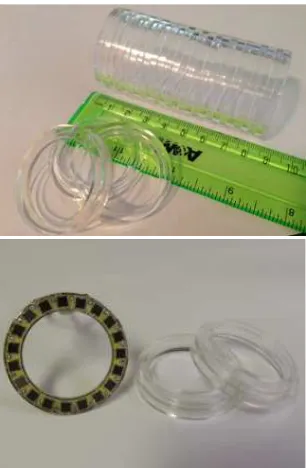
Figure 6. A prototype of the multifoil fission fragment tagging detector based on thin scintillator foils. Top panel) Acrylic light guide rings. Bottom panel) A ring of silicon photomultiplier sen-sors that will convert the light to electrical signals.
in these proceedings, for more detailed information on the new DANCE data acquisition development.
Work continues also on the development of new fis-sion fragment detectors which will be used for the mea-surements of 235U neutron-induced reactions within this project. Figure 6 shows a multi-foil design of the detector based on a thin scintillator foils (TSF), currently designed to hold 10 foils. The samples of235U will be deposited directly in the center of each TSF and will be placed in be-tween the acrylic rings serving both as a TSF holder and the light guide (shown in the top panel of Figure 6). The fission fragments will produce light in the TSFs and the photons will be converted to electric signals at both ends by silicon photo-multipliers populated on the the PCB ring as shown in the bottom panel of Figure 6.
4 Correlated data on fission observables
prompt fission gamma rays.
thus help constrain these models by providing information about pre-emission fragments which may otherwise be dif-ficult to measure.
The ultimate goal of our experiment is to measure prompt gamma-ray energy and multiplicity distributions of neutron induced fission in235U, simultaneously with the mass and kinetic energy of correlated fission fragments. We have constructed a fission fragment detector for use inside of the DANCE gamma-ray calorimeter. Initially, we plan to carry out measurements of total kinetic energy (TKE) of fission fragments emitted in the spontaneous fis-sion of252Cf. A simple detector setup using two Si detec-tors was designed for this purpose – see Figure 7. PFG properties will be measured in coincidence with fission fragments’ TKE for the first time. In 2015, we plan to ex-tend our measurements to neutron-induced fission of235U.
5 Summary
Many developments are in progress to improve the capa-bilities of the DANCE detector array. New methodologies to measure relative and absolute cross sections are cur-rently underway. The235U neutron-induced fission reac-tion is a candidate reference reacreac-tion for future measure-ments of capture cross section and was shown to work well in case of the238U capture cross section. Analysis of the systematic errors stemming from the data reduction, scat-tering corrections, and self-shielding is underway.
New data acquisition, the NEUANCE detector array, and fission fragment detectors will enable us to improve the accuracy and precision of new nuclear data. Most im-portantly, new capabilities developed upon completion of the three research projects described in this paper will pre-pare the ground for completely new measurements of cor-related data, both in neutron capture and neutron-induced fission.
of the Los Alamos Neutron Science Center and is based upon work supported by the U.S. Department of Energy, National Nuclear Security Administration under Contract Number DE-AC52-06NA25396.
References
[1] M. Jandelet al., Phys. Rev. Lett.109, 202506 (2012) [2] S. Mosbyet al., Phys. Rev. C89, 034610 (2014) [3] E.-I. Esch,et al., Phys. Rev. C77, 034309 (2008) [4] M. Jandelet al., Phys. Rev. C78, 034609 (2008) [5] J. L. Ullmannet al., Phys. Rev. C87, 044607 (2013) [6] S. A. Sheetset al., Phys. Rev. C79, 024301 (2009) [7] S. A. Sheetset al., Phys. Rev. C76, 064317 (2007) [8] A. Chyzhet al., Phys. Rev. C84, 014306 (2011) [9] B. Baramsaiet al., Phys. Rev. C85, 024622, (2012) [10] B. Baramsaiet al., Phys. Rev. C87, 044609 (2013) [11] G. Rusevet al., Phys. Rev. C87, 054603 (2013) [12] J. Krollet al., Phys. Rev. C88, 034317 (2013) [13] G. Rusevet al., Phys. Rev. C88, 057602 (2013) [14] M. Jandel et al., in Proceeding of the 5th
In-ternational Conference on "Fission and properties of neutron-rich nuclei" (ICFN5), Sanibel Island, Novem-ber 4-10 (2012), World Scientific, p. 416
[15] J. L. Ullmannet al., Phys. Rev. C87, 044607 (2013) [16] M. Jandel et al., in Proceedings from GAMMA2 Workshop on Emission of Prompt Gamma-rays in Fis-sion and Related Topics, Physics Procedia, submitted in 2014
[17] M. Jandel et al., in preparation for Phys. Rev C., 2015
[18] B. Becker, P. Talou, T. Kawano, Y. Danon, and I. Stetcu Phys. Rev. C87,014617 (2013)
[19] I. Stetcu, T. Kawano, P. Talou, M. Jandel,Phys. Rev. C88, 044603 (2013)
[20] I. Stetcu, T. Kawano, P. Talou, M. Jandel, Phys. Rev. C90, 024617 (2014)