International Journal of COPD
Associations between isokinetic muscle
strength, high-level functional performance,
and physiological parameters in patients
with chronic obstructive pulmonary disease
Scotty J Butcher1
Brendan J Pikaluk2
Robyn L Chura1
Mark J Walkner1
Jonathan P Farthing2
Darcy D Marciniuk3
1School of Physical Therapy, University
of Saskatchewan, Saskatoon, SK, Canada; 2College of Kinesiology,
University of Saskatchewan, Saskatoon, SK, Canada; 3Division of
Respiratory, Critical Care and Sleep Medicine, University of Saskatchewan, Saskatoon, SK, Canada
Correspondence: Scotty Butcher School of Physical Therapy, University of Saskatchewan, 1121 College Dr, Saskatoon, SK, Canada S7N 0W3 Tel +1 306 966 1711
Fax +1 306 966 6575 Email [email protected]
Abstract: High-level activities are typically not performed by patients with chronic obstructive pulmonary disease (COPD), which results in reduced functional performance; however, the physiological parameters that contribute to this reduced performance are unknown. The aim of this study was to determine the relationships between high-level functional performance, leg muscle strength/power, aerobic power, and anaerobic power. Thirteen patients with COPD underwent an incremental maximal cardiopulmonary exercise test, quadriceps isokinetic dyna-mometry (isometric peak torque and rate of torque development; concentric isokinetic peak torque at 90°/sec, 180°/sec, and 270°/sec; and eccentric peak torque at 90°/sec), a steep ramp anaerobic test (SRAT) (increments of 25 watts every 10 seconds), and three functional measures (timed up and go [TUG], timed stair climb power [SCPT], and 30-second sit-to-stand test [STS]). TUG time correlated strongly (P, 0.05) with all muscle strength variables and with the SRAT. Isometric peak torque was the strongest determinant of TUG time (r=−0.92). SCPT and STS each correlated with all muscle strength variables except concentric at 270°/sec and with the SRAT. The SRAT was the strongest determinant of SCPT (r= 0.91), and eccentric peak torque at 90°/sec was most significantly associated with STS (r= 0.81). Performance on the SRAT (anaerobic power); slower-velocity concentric, eccentric, and isometric contractions; and rate of torque development are reflected in all functional tests, whereas cardiopulmonary exercise test performance (aerobic power) was not associated with any of the functional or muscle tests. High-level functional performance in patients with COPD is associated with physiological parameters that require high levels of muscle force and anaerobic work rates.
Keywords: stair climb, sit to stand, timed up and go, steep ramp, isokinetic
Introduction
Patients with chronic obstructive pulmonary disease (COPD) often exhibit severe muscle wasting, which may be due to skeletal muscle dysfunction, deconditioning/ disuse, systemic inflammation, poor nutrition and energy conservation, and/or
corticosteroid use.1 This is of importance because leg muscle mass and strength have
been shown to predict mortality,2 morbidity,3,4 health status,5 and quality of life3 in COPD patients. Leg strength has even been shown to better predict mortality than
measures of lung function in this population.2 COPD patients also exhibit significant
reductions in functional mobility and balance that may affect their ability to perform
activities of daily living.6 It has been suggested that these reductions in functional
performance are related to the muscle dysfunction present in these patients.6
Dove
press
O R I g I N A L R E S E A R C h open access to scientific and medical research
Open Access Full Text Article
International Journal of Chronic Obstructive Pulmonary Disease downloaded from https://www.dovepress.com/ by 118.70.13.36 on 22-Aug-2020
For personal use only.
Number of times this article has been viewed
This article was published in the following Dove Press journal: International Journal of COPD
The majority of research that has focused on examining leg muscle function in patients with COPD has used either isometric or concentric quadriceps torque as correlates or
outcome measures.7–9 In healthy older adults and those with
disabilities, isokinetic strength using eccentric contrac-tions or fast-velocity contraccontrac-tions may be more important
as methods of assessing functional performance.10–13 Peak
eccentric muscle strength of the quadriceps has been found to
be moderately associated with climbing stairs.8 Conversely,
concentric strength has been demonstrated to have either a
smaller association with stair climbing8 or no relationship9
with other functional tasks. At the present time, the associa-tion between eccentric muscle strength, fast-velocity muscle contractions, and high-level functional and physiological performance has not been reported in COPD.
The objectives of this study were to determine the relative importance of isometric strength, and concentric and eccen-tric muscle strength at various velocities, in contributing to functional and physiological performance. Our hypotheses were three-fold: (i) that functional and physiological per-formance scores would correlate highly with measures of quadriceps muscle strength and power; (ii) that eccentric and fast-velocity (180°/sec or 270°/sec) concentric knee extension contractions would be associated with functional and physiological performance to a greater degree than slow-velocity concentric and isometric contractions; and (iii) that anaerobic power would be more strongly associated with functional performance than aerobic power.
Methods
This study employed a randomized, crossover design to assess the relative contributions of isokinetic and isometric torque to functional and physiological performance. Ethical approval was granted by ethics committees of the University of Saskatchewan, Saskatoon, Saskatchewan, Canada, and the Saskatoon Health Region, Saskatchewan, Canada. Thirteen patients (eight male) with moderate to severe COPD, as
defined by the Canadian Thoracic Society Guidelines,14
were recruited from the Saskatoon Pulmonary Rehabilitation Program and the Respirology Clinics at the Royal University Hospital in Saskatoon. Subjects were excluded if there was
evidence of resting hypoxemia (PaO2, 60 mmHg if available
or SaO2, 88%),15 if they required continuous supplemental
oxygen usage, if their oxygen desaturation decreased
to ,80% during exercise, if they had any contraindications
to exercise testing (per American Thoracic Society/American College of Chest Physicians exercise testing guidelines),15 and if there was a history of known or suspected cardiac disease or
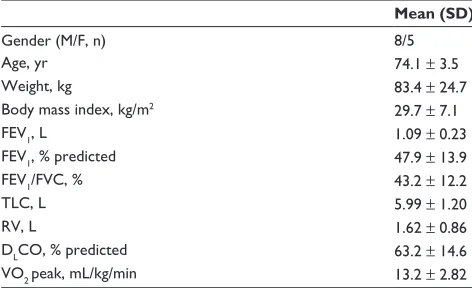
musculoskeletal concerns that might limit the ability of these subjects to perform active exercise. Subject demographics are presented in Table 1.
Measurements
Participants attended the laboratory on four occasions. Pulmonary function tests and a cardiopulmonary exercise test (CPET) were obtained in the first session. The next three sessions were randomized such that participants performed functional tests, quadriceps leg strength testing, or an anaero-bic performance test.
Pulmonary function tests
Spirometry (forced expiratory volume in 1 second, forced vital capacity), lung volumes (total lung capacity), and dif-fusion capacity for carbon dioxide tests were completed as
per American Thoracic Society standards16–18 using a V
max Autobox (SensorMedics, Yorba Linda, CA).
Cardiopulmonary exercise test
A maximal incremental cycle ergometry exercise test was performed to the standards of the American Thoracic
Society-American College of Chest Physicians15 as the
first physiological test. The test began with a 3-minute warm-up of unloaded cycling on an electronically braked cycle ergometer (800S, SensorMedics), followed by ramped increases in work rate by 5–15 W/min until symptom limitation. Respiratory gas analysis was performed using
a Vmax Metabolic Measurement System (SensorMedics).
Heart rate and oxygen saturation were recorded using pulse oximetry and electrocardiogram, respectively. Symptoms of dyspnea and leg fatigue were recorded using a modified
Borg scale for perceived exertion.19
Table 1 Subject demographics
Mean (SD)
gender (M/F, n) 8/5
Age, yr 74.1 ± 3.5
Weight, kg 83.4 ± 24.7
Body mass index, kg/m2 29.7 ± 7.1
FEV1, L 1.09 ± 0.23
FEV1, % predicted 47.9 ± 13.9
FEV1/FVC, % 43.2 ± 12.2
TLC, L 5.99 ± 1.20
RV, L 1.62 ± 0.86
DLCO, % predicted 63.2 ± 14.6
VO2 peak, mL/kg/min 13.2 ± 2.82
Abbreviations: DLCO, diffusion capacity for carbon dioxide; FEV1, forced
expiratory volume in 1 second; FVC, forced vital capacity; RV, residual volume; TLC, total lung capacity; VO2 peak, maximal oxygen consumption.
Dovepress
Butcher et al
International Journal of Chronic Obstructive Pulmonary Disease downloaded from https://www.dovepress.com/ by 118.70.13.36 on 22-Aug-2020
Steep ramp anaerobic test
The second physiological test was the steep ramp anaero-bic test (SRAT), which has been used to prescribe interval
training in patients with heart failure20,21 and COPD,22 and
has been shown to be a reliable measure of anaerobic power
in patients with COPD.23 This test is considered more
clini-cally appropriate than the Wingate Anaerobic Test.23 The
test began with a 2-minute unloaded warm-up on the cycle ergometer followed by ramped increases of 25 watts every 10 seconds until volitional fatigue, as per the protocol of
Meyer et al.21 The same measures used for the CPET were
recorded for the SRAT, and the primary outcome was peak work rate attained.
Functional tests
Tests that mimic higher-intensity activities of daily living were used. These tests included the stair climb power test (SCPT), timed-up-and-go test (TUG), and 30-second sit-to-stand test
(STS). The SCPT as per the protocol of Bean et al24 was used.
Subjects climbed a flight of ten steps as quickly as possible. Leg muscle power was calculated from body weight, stair
height, and time to perform the test, as previously described.8
The TUG was performed as described by Podsiadlo and Richardson.25 Subjects started seated in a chair and, upon command, rose, walked 3 meters, turned around, walked back to the chair, and sat down as fast as possible. The STS
was performed as described by Rikli and Jones.26 Subjects
started seated in a chair and, upon command, stood up and returned to sitting as many times as possible in a 30-second time period. Each functional test was performed twice, in a standardized order, with a 5-minute break between trials. The best score attained on each test was recorded.
Quadriceps measurements
Using an isokinetic dynamometer (Humac NORM, CSMi, Stoughton, MA), the dominant leg quadriceps muscle (knee extension) was tested for the following parameters: concentric contractions at 60°/sec, 90°/sec, 180°/sec, and 270°/sec, eccentric contractions at 90°/sec, and isometric
con-tractions at 0°/sec. Each test was randomized and performed
three times with a minimum 2-minute rest period between tests and trials. The reliability of this method in patients with
COPD has been demonstrated previously.27 Peak torque was
recorded for each trial, and the relative torque (peak torque
per kg of body mass) was used in the analysis.28 In addition,
the rate of torque development was recorded during the isometric contraction. The means of the two greatest values for each measure were used in the analysis.
Statistical analysis
Data were analyzed for normalcy. Pearson’s or Spearman’s correlation analyses were used as appropriate to determine significant relationships between all measures. The strengths
of correlations were low (0–0.25), moderate (.0.25–0.50),
strong (.0.50–0.75), and very strong (.0.75).8 Statistical
significance was set at α= 0.05. Data are presented as means
and standard deviations.
Results
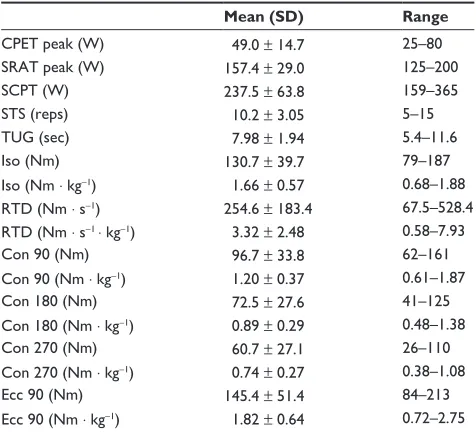
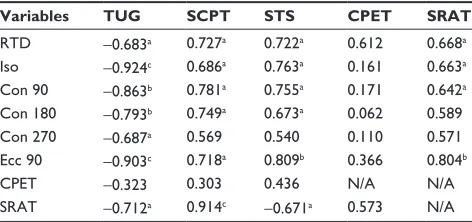
All subjects completed the various study procedures. Test scores for all data and correlation coefficients are presented in Tables 2 and 3, respectively.
Physiological tests
The SRAT and CPET were assessed for significant associa-tions with both the functional tests and the muscle strength tests. Performance on the SRAT was reflected by strong associations with the TUG and STS and by a very strong association with SCPT, whereas CPET performance was not significantly reflected in any of the functional tests. Slow-velocity concentric, isometric, and eccentric torque was associated with SRAT performance, whereas none of the muscle strength variables correlated with CPET performance.
Table 2 Mean scores for muscle, functional, and physiological measures
Mean (SD) Range
CPET peak (W) 49.0 ± 14.7 25–80
SRAT peak (W) 157.4 ± 29.0 125–200
SCPT (W) 237.5 ± 63.8 159–365
STS (reps) 10.2 ± 3.05 5–15
TUg (sec) 7.98 ± 1.94 5.4–11.6
Iso (Nm) 130.7 ± 39.7 79–187
Iso (Nm ⋅ kg−1) 1.66 ± 0.57 0.68–1.88
RTD (Nm ⋅ s−1) 254.6 ± 183.4 67.5–528.4
RTD (Nm ⋅ s−1 ⋅ kg−1) 3.32 ± 2.48 0.58–7.93
Con 90 (Nm) 96.7 ± 33.8 62–161
Con 90 (Nm ⋅ kg−1) 1.20 ± 0.37 0.61–1.87
Con 180 (Nm) 72.5 ± 27.6 41–125
Con 180 (Nm ⋅ kg−1) 0.89 ± 0.29 0.48–1.38
Con 270 (Nm) 60.7 ± 27.1 26–110
Con 270 (Nm ⋅ kg−1) 0.74 ± 0.27 0.38–1.08
Ecc 90 (Nm) 145.4 ± 51.4 84–213
Ecc 90 (Nm ⋅ kg−1) 1.82 ± 0.64 0.72–2.75
Abbreviations: Con 90, concentric peak torque at 90°/sec; Con 180, concentric peak torque at 180°/sec; Con 270, concentric peak torque at 270°/sec; CPET, cardiopulmonary exercise test; Ecc 90, eccentric peak torque at 90°/sec; Iso, isometric peak torque; RTD, rate of torque development; SCPT, stair climb power test; SRAT, steep ramp anaerobic test; STS, sit-to-stand test; TUg, timed up and go.
Dovepress Muscle strength and functional performance in COPD
International Journal of Chronic Obstructive Pulmonary Disease downloaded from https://www.dovepress.com/ by 118.70.13.36 on 22-Aug-2020
Functional tests
TUG time was significantly associated with all muscle strength variables and SRAT performance either strongly or very strongly. The strongest associations for the TUG were with isometric and eccentric peak torque, suggesting that TUG performance is related mostly to the ability to gener-ate high static forces and the ability to control the eccentric phase of muscle contraction. The strongest correlation with TUG performance was isometric peak torque.
SCPT performance was associated very strongly with SRAT performance and strongly or very strongly with all muscle torque variables except concentric contractions at
270°/sec. The anaerobic-based SRAT was the strongest
determinant of SCPT performance.
The number of STS repetitions was also strongly asso-ciated with the SRAT and with all muscle torque variables except concentric contraction at 270°/sec, with eccentric contractions demonstrating the strongest correlation.
Discussion
The primary purpose of this study was to determine the association between muscle strength, functional perfor-mance, and physiological performance in patients with COPD. We found evidence supporting our first hypothesis that functional performance and physiological performance measures would be associated with certain qualities of muscle strength, but the strongest associations depended on the measure. For the TUG and STS, performance was best determined by isometric and eccentric torque, respectively. For the SCPT, performance was best determined by the anaerobic SRAT performance. This is the first study to show strong relationships between high-level functional
performance, eccentric muscle contractions, and anaerobic exercise performance.
These findings support previous research demonstrating that isometric quadriceps strength is related to exercise performance in patients with COPD; however, most studies have examined measures of aerobic endurance such as the
6-minute walk test29 and the incremental shuttle walk test.30
Our measure of aerobic performance was of aerobic power (CPET) and not endurance, and our results suggest that isometric quadriceps strength is not significantly related to aerobic power. In assessing the role of concentric strength,
Roig et al9 found that slow-velocity quadriceps torque did
not correlate with the 6-minute walk test or STS, and only
to a small extent with the SCPT.8 In addition, these authors
found a much stronger association between eccentric strength
and performance on the SCPT8 – a finding supported by our
study results. One key difference between our present study and previous studies was the expression of quadriceps torque as a function of body mass, which is more consistent with
previous methodology and standardization.28
In support of our second hypothesis, eccentric contrac-tions were strongly associated with performance of all three functional measures, indicating that eccentric strength is a strong contributor of functional performance in patients with COPD. Eccentric peak torque was a strong predictor of per-formance on the STS, presumably because of the utilization of multiple eccentric contractions in this test. This finding confirms that the rate of control of the eccentric phase of an activity involving a quick change of direction strongly
determines performance on that activity.11,31 Contrary to our
expectations, however, high-velocity concentric contractions were not as strongly associated with functional or physi-ological performance as were slower-velocity concentric and eccentric contractions. There is some evidence in healthy adults that adequate functional performance is determined
by fast-velocity contractions,31 and using fast-velocity
(power) exercise during training results in greater functional
performance compared with slow-velocity training.32,33 It is
not apparent why these results are contradictory; however, because patients with COPD exhibit significant deficiencies
in functional performance6 and typically do not produce fast
contractions in their daily life, it is possible that high-velocity torque production using an isokinetic dynamometer was extremely unfamiliar. We controlled for any learning effects by allowing a significant amount of time and standardized instruction during the familiarization procedures for the dynamometer; however, patients still may not have been fully accustomed.
Table 3 Correlations of leg strength (expressed as values relative to body weight), functional performance, and physiological performance (torque variables in Nm ⋅ kg−1)
Variables TUG SCPT STS CPET SRAT RTD −0.683a 0.727a 0.722a 0.612 0.668a
Iso −0.924c 0.686a 0.763a 0.161 0.663a
Con 90 −0.863b 0.781a 0.755a 0.171 0.642a
Con 180 −0.793b 0.749a 0.673a 0.062 0.589
Con 270 −0.687a 0.569 0.540 0.110 0.571
Ecc 90 −0.903c 0.718a 0.809b 0.366 0.804b
CPET −0.323 0.303 0.436 N/A N/A
SRAT −0.712a 0.914c −0.671a 0.573 N/A
Notes:aP, 0.05; bP, 0.01; cP, 0.001, significant correlation.
Abbreviations: Con 90, concentric peak torque at 90°/sec; Con 180, concentric peak torque at 180°/sec; Con 270, concentric peak torque at 270°/sec; CPET, cardiopulmonary exercise test; Ecc 90, eccentric peak torque at 90°/sec; Iso, isometric peak torque; RTD, rate of torque development; SCPT, stair climb power test; SRAT, steep ramp anaerobic test; STS, sit-to-stand test; TUg, timed up and go.
Dovepress
Butcher et al
International Journal of Chronic Obstructive Pulmonary Disease downloaded from https://www.dovepress.com/ by 118.70.13.36 on 22-Aug-2020
Despite the lesser correlations between high-velocity concentric contractions and functional performance, there is some support for our hypothesis in regard to generating fast contractions. A high rate of torque development has been sug-gested to relate to an individual’s ability to perform function-ally at faster contraction speeds.32,33 Our findings support the relationship between rate of torque development and perfor-mance of all three functional tests in patients with COPD.
In addition to these findings, the results supported our third hypothesis that measures of muscle strength and functional performance were more highly associated with anaerobic power (as determined by the SRAT) than aerobic power (as determined by the CPET). This finding supports
previous assertions34 that high-level functional performance
is better determined by anaerobic energy utilization than the more typically measured aerobic energy utilization (through the standard CPET). As we23 and others22 have shown previously, the ability of the leg muscles to produce work in patients with COPD is grossly underestimated by the aerobically dominated CPET; however, when anaerobic performance is measured (by the SRAT, for example), this better reflects both high-level functional performance and qualities of muscle strength/power.
There are a few limitations of this study. First, our sample size may have contributed to some correlations being found nonsignificant. This limitation is less relevant given that the primary purpose was to examine which muscle strength and performance factors were most highly correlated. As hypoth-esized, the strongest correlations were, in every case, deemed to be statistically significant. A second limitation is our relatively homogeneous population of patients. Our patients were classified as mostly having moderate-severity COPD, and none required the use of supplemental oxygen. Previous research has demonstrated that patients with more severe COPD (independent of the use of supplemental oxygen)
demonstrated reduced functional performance;6 therefore,
our results may not be generalizable to patients with more severe COPD. Nonetheless, we have demonstrated meaning-ful and statistically significant results in our described study population. Third, physiological measures were assessed on a cycle ergometer. The results of our study may not be gener-alizable to walking exercise, as it is well known that treadmill exercise usually results in maximal oxygen consumption
about 10% higher than cycling.15 Finally, this study was a
cross-sectional, correlational study, and the results should not be interpreted to indicate any causal relationships between any of the muscle, functional, or physiological measures; they are merely associated with each other.
Conclusion
High-level functional performance in patients with COPD is best determined by eccentric and/or slow-velocity concentric (compared with fast-velocity) muscle contractions, and by anaerobic (compared with aerobic) performance. Exercise training studies that focus more on higher-intensity training (such as high-intensity interval training) or on changes in muscle strength/power should consider the addition of higher-level functional performance (such as the TUG, SCPT, or STS) tests and anaerobic power tests (such as the SRAT) as outcome measures.
Acknowledgments
The authors acknowledge the technical assistance of Mr Ron Clemens and Ms Nichole Heynen. The authors acknowledge the financial support for this study by the Canada Foundation for Innovation, the Canadian Lung Association, and the Royal University Hospital Foundation. Dr Marciniuk is the recipient of a Lung Association of Saskatchewan COPD Professorship.
Disclosure
The authors report no conflicts of interest.
References
1. American Thoracic Society/European Respiratory Society. Skeletal muscle dysfunction in chronic obstructive pulmonary disease. Am J Respir Crit Care Med. 1999;159:S1–S40.
2. Swallow EB, Reyes D, Hopkinson NS, Man WDC, Porcher R, Cetti EJ, et al. Quadriceps strength predicts mortality in patients with moderate to severe chronic obstructive pulmonary disease. Thorax. 2007;62:115–120. 3. Mostert RF. Tissue depletion and health related quality of life in
patients with chronic obstructive pulmonary disease. Respir Med. 2000;94:859–867.
4. Steiner MC. Sarcopaenia in chronic obstructive pulmonary disease. Thorax. 2007;62:101–103.
5. Montes de Oca M, Torres SH, Gonzalez Y, et al. Peripheral muscle composition and health status in patients with COPD. Respir Med. 2006;100:1800–1806.
6. Butcher SJ, Meske JM, Sheppard MS. Reductions in functional bal-ance, coordination, and mobility measures among patients with stable chronic obstructive pulmonary disease. J Cardiopulmonary Rehabil. 2004;24:274–280.
7. Maltais F, LeBlanc P, Jobin J, Casaburi R. Peripheral muscle dys-function in chronic obstructive pulmonary disease. Clin Chest Med. 2000;21:665–677.
8. Roig M, Eng JJ, MacIntyre DL, Road JD, Reid WD. Associations of the stair climb power test with muscle strength and functional performance in people with chronic obstructive pulmonary disease: a cross-sectional study. Phys Ther. 2010;90(12):1774–1782.
9. Roig M, Eng JJ, MacIntyre DL, Road JD, Reid WD. Deficits in muscle strength, mass, quality, and mobility in people with chronic obstructive pulmonary disease. J Cardiopulm Rehabil Prev. 2011;31:120–124. 10. Bottaro M, Machado SN, Nogueira W, Scales R, Veloso J. Effect
of high versus low-velocity resistance training on muscular fitness and functional performance in older men. Eur J Appl Physiol. 2007;99:257–264.
Dovepress Muscle strength and functional performance in COPD
International Journal of Chronic Obstructive Pulmonary Disease downloaded from https://www.dovepress.com/ by 118.70.13.36 on 22-Aug-2020
International Journal of COPD
Publish your work in this journal
Submit your manuscript here: http://www.dovepress.com/international-journal-of-copd-journal
The International Journal of COPD is an international, peer-reviewed journal of therapeutics and pharmacology focusing on concise rapid reporting of clinical studies and reviews in COPD. Special focus is given to the pathophysiological processes underlying the disease, intervention programs, patient focused education, and self management protocols.
This journal is indexed on PubMed Central, MedLine and CAS. The manuscript management system is completely online and includes a very quick and fair peer-review system, which is all easy to use. Visit http://www.dovepress.com/testimonials.php to read real quotes from published authors.
11. Gur H, Cakin N, Akova B, Okay E, Kucukoglu S. Concentric versus combined concentric-eccentric isokinetic training: effects on functional capacity and symptoms in patients with osteoarthritis of the knee. Arch Phys Med Rehabil. 2002;83:308–316.
12. Hruda KV, Hicks AL, McCartney N. Training for muscle power in older adults: effects on functional abilities. Can J Appl Physiol. 2003;28:178–189.
13. Lathum NK, Bennett DA, Stretton CM, Anderson CS. Systematic review of progressive resistance strength training in older adults. J Gerontol: Biol Sci. 2004;59A:48–61.
14. O’Donnell DE, Aaron S, Bourbeau J, et al. Canadian Thoracic Society recommendations for management of chronic obstructive pulmonary disease – 2007 update. Can Respir J. 2007;14:5B–32B.
15. American Thoracic Society/American College of Chest Physicians. ATS/ACCP statement on cardiopulmonary exercise testing. Am J Respir Crit Care Med. 2003;167:211–277.
16. MacIntyre N, Crapo RO, Viegi G, Johnson DC, van der Grinten CP, Brusasco V, et al. Standardization of the single-breath determination of carbon monoxide uptake in the lung. Eur Respir J. 2005;26:720–735. 17. Miller MR, Hankinson J, Brusasco V, Burgos F, Casaburi R, Coates A, et al.
Standardization of spirometry. Eur Respir J. 2005;26:319–338. 18. Wagner J, Clausen JL, Coates A, Pedersen OF, Brusasco V, Burgos F, et al.
Standardization of the measurement of lung volumes. Eur Respir J. 2005;26:511–522.
19. Noble BJ, Borg GAV, Jacobs I, Ceci R, Kaiser P. A category-ratio perceived exertion scale: relationship to blood and muscle lactates and heart rate. Med Sci Sports Exerc. 1983;15:523–528.
20. Meyer K, Samek L, Schwaibold M, Westbrook S, Hajric R, Beneke R, et al. Interval training in patients with severe chronic heart failure: analysis and recommendations for exercise procedures. Med Sci Sports Exerc. 1997;29:306–312.
21. Meyer K, Samek L, Schwaibold M, Westbrook S, Hajric R, Lehmann M, et al. Physical responses to different modes of interval exercise in patients with chronic heart failure – application to exercise training. Eur Heart J. 1996;17:1040–1047.
22. Puhan MA, Busching G, Schunemann HJ, vanOort E, Zaugg C, Frey M. Interval versus continuous high-intensity exercise in chronic obstructive pulmonary disease: a randomized trial. Ann Intern Med. 2006;145:816–825.
23. Chura RL, Marciniuk DD, Clemens R, Butcher SJ. Test-retest reliability and physiological responses associated with the steep ramp anaerobic test (SRAT) in patients with COPD. Pulm Med. June 6, 2012. [Epub ahead of print.]
24. Bean JF, Kiely DK, LaRose S, Alian J, Frontera WR. Is stair climb power a clinically relevant measure of leg power impairments in at-risk older adults? Arch Phys Med Rehabil. 2007;88:604–609.
25. Podsiadlo D, Richardson S. The timed up and go: a test of basic functional mobility of frail elderly persons. J Am Geriatr Soc. 1991;39:142–148.
26. Rikli RE, Jones CJ. Development and validation of a functional fitness test for community residing older adults. J Aging Phys Act. 1999;7:129–161.
27. Mathur S, Makrides L, Hernandez P. Test-retest reliability of isometric and isokinetic torque in patients with chronic obstructive pulmonary disease. Physiother Can. 2004;56:94–101.
28. Jaric S. Role of body size in the relation between muscle strength and movement performance. Exerc Sport Sci Rev. 2003;31(1):8–12. 29. Singer J, Yelin EH, Katz PP, et al. Respiratory and skeletal muscle
strength in chronic obstructive pulmonary disease: impact on exercise capacity and lower extremity function. J Cardiopulm Rehabil Prev. 2011;31:111–119.
30. Steiner MC, Singh SJ, Morgan MDL. The contribution of periph-eral muscle function to shuttle walking performance in patients with chronic obstructive pulmonary disease. J Cardiopulm Rehabil. 2005;25:43–49.
31. Anderson MA, Gieck JH, Perrin DH, Weltman A, Rutt R, Denegar C. The relationship among isometric, isotonic, and isokinetic concen-tric and eccenconcen-tric quadriceps and hamstring force and three com-ponents of athletic performance. J Orthopaedic Sports Phys Ther. 1991;14:114–120.
32. Hoff J, Tjonna AE, Steinshamn S, Hoydal M, Richardson RS, Helgerud J. Maximal strength training of the legs in COPD: a therapy for mechanical inefficiency. Med Sci Sports Exerc. 2007;39:220–226. 33. Hazell T, Kenno K, Jakobi J. Functional benefit of power training for
older adults. J Aging Phys Activity. 2007;15:349–359.
34. Butcher SJ, Jones RL. The impact of exercise training intensity on change in physiological function in patients with chronic obstructive pulmonary disease. Sports Med. 2006;36:307–325.
Dovepress
Dove
press
Butcher et alInternational Journal of Chronic Obstructive Pulmonary Disease downloaded from https://www.dovepress.com/ by 118.70.13.36 on 22-Aug-2020