493
FLOATING SOLAR PLANT
Akole Harshal U.
1, Prof.Jadhav Pallavi S.
21
Electrical Engineering ,Sandip Institute of Engineering &Management mahiravani,Nashik(MS)
2
Electrical Engineering ,Asst. professor, Sandip Institute of Engineering &Management
mahiravani,Nashik(MS)
ABSTRACT
Now a days the biggest challenges before India is the power crisis. The constant depletion of fossil fuels and
high energy demand focuses us to use renewable energy sources which are not only the future unlimited energy
sources, it is also eco-friendly and sustainable for the environment. Even though solar power generation has
several advantageous over other forms of electricity generation, the major problem is the requirement of land
which is scarcely available in the world and its cost. Also India being the seventh largest country in terms of
area and gifted with fairly well sunshine almost 300 days in year, solar has lots of potential in store of us.A new
era in solar power i.e. FLOATING SOLAR POWER plants will solve this issue. This floating solar plant can be
installed in any water bodies which will not only decreases cost of the land but also will raises the amount of
generation with the cooling effect of water. Studies have also shown that if the rear surfaces of solar panels are
kept cooler, then their ability to generate power goes up by 16%.
Keywords:
Efficiency, Floating solar, PV, Solar Panels, Water.
I. INTRODUCTION
Electricity crisis is the main problem in Bihar. Due to lack power, industries cannot open shops there. Bihar
doesn’t have enough coal to run thermal power plants. In India 65% of energy is generated with coal and Indian
industry consumes 70% of total coal of the country. It is high time India moves away from coal-intensive
electricity production and explores renewable energy resources like solar energy.
In recent years, renewable energy sources are growing rapidly all over the world. Solar energy is considered to
be one of the most promising energy alternatives due to its ubiquity and sustain-ability. The solar energy is
freely and enormously available throughout the world. The best way to use solar energy is PV system.
Photovoltaic (PV) modules are one of the most effective, sustain-able, and eco-friendly products in the field of
renewable energy. The main burden of land mounted solar system is availability of land. There is large water
bodies available in various parts of the country which can reduce the saving cost of land and operating cost for
power generation expenses. So the solar PV systems can become a very logical alternative for harnessing solar
energy by utilizing obtainable water bodies and help to increase the economic viability of solar projects. Energy
from photovoltaic's though a re-newable source, maintains a low efficiency of less than 15% in its long life use.
Floating solar generate more electricity than ground-mount and rooftop (solar) systems because of the cooling
effect of water. It also reduces reservoir evaporation and algae growth by shading the water. The floating
platforms are 100% recyclable, utilizing high-density polyethylene which can withstand ultraviolet rays and
494
II. PHOTOVOLTAIC SYSTEM
P-N junction made solar cells most commonly made from silicon. As a simplification, one can imagine
bringing a layer of n-type silicon into direct contact with a layer of p-type silicon. In practice N-junction Silicon
made cells made by doping an p-type region and n-type region.
If a piece of N-type region placed near the P-type region then, the recombination of electron and. holes
created. And when this combination of electron and hole pairs are done, electric filed is created. The electric
field promotes charge flow, known as drift cell, that opposes and eventually balances out the diffusion of
electrons and holes. The region where electrons and hoes are diffused is known as depletion region. Because it
contains practically no mobile charge carriers. It is also known as the space charge region, although space
charge extends a bit further in both directions than the depletion region.[4]
III. CONSTRUCTION
3.1 Pontoon
Pontoon is a floating device made up of Polymer and has enough buoyancy to float on water with heavy load
placed on it . The platform is design to hold suitable number of modules in series parallel combination according
to the requirement and space avail-ability.
Fig 3.1.1 pontoon
3.2 Floats
Multiple plastic hollow floats with effective buoyancy to self weight ratio are connected in series such as to
formed a giant pontoon. The floats are typically made of HDPE (high density poly-ethylene), known for its
tensile strength, maintenance free, UV and corrosion resistance. Glass fiber reinforced plastic (GRP) can also be
used for construction of floating plat-form. HDPE is commonly used for the fabrication of fuel tanks, milk
bottles, water pipes, and can be recycled as well.
Fig 3.2.1 Floating structure
1 Main float supporting PV module 2 Secondary float
3 Tab connection 4 Gasket to mount module
495
3.3 Mooring systemMooring system it is a permanent structure that holds the system at a placed. Examples include quays, wharfs,
jetties, piers, anchor buoys, and mooring buoys. In the case of a floating solar system, the mooring system keeps
the panels in the same position and prevents them from turning or floating away. The biggest challenge is that to
installed mooring system in deep water. Mooring system for floating platform can be done with nylon wire rope
slings which can be tied to bollards on bank and lashed at each corner. [1]
Fig.3.3.1 layout of plant
1Module 2structure
3substation 4Distribution line
5Buoyancy anchor 6Floater
7Weight 8Under water cable
VI. PROBLEM'S OF THIS SYSTEM
6.1 Shading on panels due to water?
Solar shading is the dirty phrase of the solar industry. Due to waves created in the water, sometimes water come
on the surface of the panels. so, due to this the PV cells acts as a load and the efficiency reduces, also the power
out decreases.
Because without getting the heat, electrons hole pairs cannot formed in the Solar cells and the energy cannot be
generated. So, to eliminate this effect panels tilted by some angle so, water can easily removed.
As compare to land mounted system the energy generation decreases only 2-3% of total energy that of in land
mounted it decrease 50% of total.
6.2 Effect of flood in rainy season?
As we know in rainy season more water come into the reservoir with more kinetic energy. So, due this more
waves created in the reservoir and system get displaced & some time it get damaged.
Mostly system is installed in the man-made pond. So there is no such causing. But if the system installed in
river, so we have to protect and eliminate this effect.
So, to eliminate this and to save our system mooring system must be strong enough to with stand and more
weights are connected to system.
6.3 How to transfer energy from panel to battery?
Cables used for this system should me robust and mechanically strong. High temperature resistance and
excellent weatherproofing characteristics provide a long service life to the cables used. The connectors with
high current capacity and easy mode of assembly are to be used for the connections of the power plant cables.
496
VII. CASE STUDY
India’s largest floating Solar Energy Plant at Kerla, capacity of 100Kwp SWELECT Energy Systems Ltd (a leading Manufacturer of Solar PV Modules & Integrator of High Quality Solar PV Power Systems) has
successfully built and commissioned India’s largest Floating Solar Energy plant at Rajiv Gandhi Combined
cycle power plant(RGCCPP in Kayamkulam, Kerala for NTPC. The floating structure was commissioned in
a short span of 22 days.This plant was constructed under campaign of 'Made in India'.
To reduce the cost of the system, a collaborative indigenous floater development project has been taken up by
NETRA with Central Institute for Plastic Engineering and Technology (CIPET), Chennai. NETRA, NTPC and
SWELECT Energy Systems Ltd worked jointly in this program. And system has 25 years of continues working
life.
7.1 Features:
Indigenously developed floaters
Cost effective (compared to commercially available floating PV system)
India’s Largest installation of its kind at NTPC
A good display of Make in India initiative
7.2 Benefits:
No land required (no land cost/availability/acquisition issues/no uprooting of trees)
Reduction of evaporation of water and algae growth in water bodies
Expected increased generation because of cooling effect on PV panels (water is at cool temperature when the
atmospheric air is hot – per day generating around 5.7 kWh / kWp)
Reduced installation time when compared to land
PV modules stay free from dust to large extent – resulting in lowmaintenance on cleaning.
7.3 PV Modules:
The CEA specifies design qualifications and quality standards for both crystalline (c-Si) and thin film modules.
In addition, the MNRE also specifies standards through the National Solar Mission. These standards are:
IEC 61215 for crystalline silicon PV modules
IEC 61730, that provides requirements for construction of the module, testing
and safety qualification.
IEC 61701, that specifies the salt mist corrosion testing for modules that are used in coastal corrosive
atmospheres.
The IEC standards apply to all modules, used in Indian solar PV projects, either manufactured in India or
imported into India. They, however, consider the environmental effects of the Indian weather conditions into
497
Table 5.3.1 Specification of solar panel
Nominal Max. Power
(Pmax)
310w
Opt. Operating
Voltage (Vmp)
36.4v
Opt. Operating Current
(Imp)
8.52A
Open Circuit Voltage
(Voc)
44.9V
Short Circuit Current
(Isc)
9.08A
Module Efficiency 16.16%
Operating Temperature -40°C ~ +85°C
Max. System Voltage 1000 V (IEC) or 1000 V
(UL)
Dimensions 1954x982x40mm
Weight 22Kg
Other Salt mist and blown sand
resistance, for seaside.
7.4 Power transfer:
Output shall be stepped up to 11 KV using KVA outdoor type ONAN transformer. Power from 11 KV side of
the transformer will be transferred through double circuit Double pole overhead transmission lines to the 11KV
transmission line, through a FIT Panel, operated by KSEBL located 1 km from the site.[2]
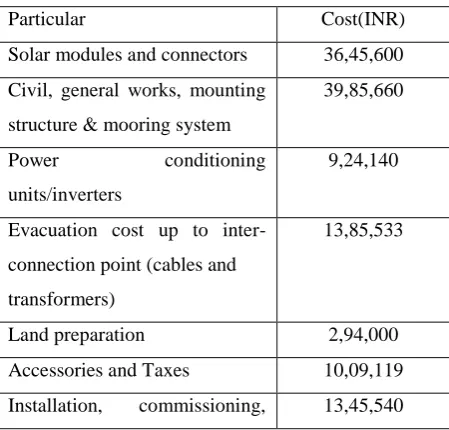
Table 5.4.1 Project capital cost(approx.)
Particular Cost(INR)
Solar modules and connectors 36,45,600
Civil, general works, mounting
structure & mooring system
39,85,660
Power conditioning
units/inverters
9,24,140
Evacuation cost up to
inter-connection point (cables and
transformers)
13,85,533
Land preparation 2,94,000
Accessories and Taxes 10,09,119
498
contingency & consultanciesFish hatcheries & inspection
alleys
3,10,000
12,899,592
VIII. CONCLUSION
Use of solar energy is efficient in nature as it is renewable energy source. By using such type of energies to
generate and environment can be protected from global warming. With such technology precious land is saved.
Comparing the land mounted system floating plant has more advantages. Efficiency also more which is main
consideration of any generating station. Maintenance also less in floating system.
As the solar panels are mounted on the water bodies the water surface are shaded so, water evaporation also
reduced to the 70%.
REFERENCE
[1]."Intrenational Journal Of software engineering and its Applications",Vol.8,No.1,pp.75-84,2014.
[2]"Floating Solar Power Plant at, Kerla",Kerla Irrigation Infrastructure development Corporation Ltd., 20th
AUG 2016.
[3]Mr.Samujjal Ganguly,"Renewable Energy and Floating Solar Plant", Solar cell.
[4]"Electrical and Electronics Engineering", An International Journal (ELELIJ) ,Vol 4, No 3, August 2015.
[5]"A single stage grid connected inverter topology for solar PV system with maximum power point tracking",
IEEE Transaction on Power Electronics, Vol.22,no.05,sept.2014.
[6]Matthew Wells, Stony Brook, "Model of smart solar PY charge controller",IEEE conference on System,