POPULATION GROWTH AND TRANSITIONAL DYNAMICS OF EGYPT THEORETICAL ANALYSIS & TIME SERIES ANALYSIS FROM 1981 TO 2007
Ghada Gomaa A. Mohamed1† --- Morrison Handley Schachler2
1
Faculty of Economics & Political Science; Future University in Egypt
1&2
ECO-ENA, Inc.®, Ottawa, ON, Canada
ABSTRACT
This paper tests the impact of the economic growth rate on the dynamism of the economy of Egypt. In this regard the paper applies the logic of the basic exogenous growth models and empirically controls for all other demographic
factors that believed in their intertwined effects on the economic growth rate. The results show an evidence of the short run effect but the impact of the population growth rate on the time path of the economic growth rate vanishes
over time. The paper gives a clear indication to policy makers in Egypt to modify their public policy toward the population growth and to adopt different apparoaches for resources balance rather than damping the population growth. The paper utilizes an intervention time series model with different steps to verify the adopted theoretical
model.
© 2017 AESS Publications. All Rights Reserved.
Keywords:Population growth, Demographics, Transitional dynamics, Economic growth, Exogenous growth, Egypt. JEL:A, C, E, O.
Received: 14 October 2015/ Revised: 8 February 2016/ Accepted: 17 August 2016/ Published: 6 September 2016
Contribution/ Originality
This paper adds to the literature that interest in the impact of an exogenous variable on the long run economic growth rate under a small open economy assumption. It also adds to the policy analysis in the matter of the impact of the population growth rate in Egypt and its consequences on the dynamism of the economy.
1. INTRODUCTION AND BRIEF LITERATURE REVIEW
This paper provides an empirical study of the influence of population growth rates on per capita income growth in Egypt, which is chosen as an example of a middle income country with a rapidly growing economy but also a rapidly increasing workforce. In this social and economic context, the risk that the economic welfare benefits of overall economic growth are outweighed by dilution among a rapidly growing population requires attention from economists and policy-makers. However, it is first essential to address the fundamental question of whether such a dilution effect really exists. It will exist in the event that population growth and economic growth are independent, but it may not exist where they are interdependent and closely correlated or where population growth can be predicted to remain below the level of economic growth.
International Journal of Asian Social Science
ISSN(e): 2224-4441/ISSN(p): 2226-5139
One exogenous source of economic growth at the national level is the level of net foreign borrowing, which influences both consumption and investment. It would be anticipated that the benefits of foreign borrowing would be diluted by population growth over time. However, if the level of net foreign borrowing itself diminishes with population or with population growth the effects on welfare of changes in the amount of foreign borrowing will in turn diminish as the population increases and foreign borrowing becomes less significant.
In this paper, we develop and test models which suggest that exogenous growth resulting from net foreign borrowing diminishes as population increases and that net foreign borrowing reaches equilibrium at zero, after which changes in foreign borrowing cease to have any impact on per capita income growth. These models suggest, not that the initial welfare loss from dilution cause by population growth is necessarily temporary, but that the welfare loss is limited and does not accelerate over time. The model is tested using demographic and economic data from Egypt for the period from 1991 to 2007.
Population growth is a function of birth, death, immigration and emigration rates and is determined by both endogenous and exogenous forces. The endogenous forces mostly affect birth rates and death rates, which are affected by the age profile and per capita income of the existing population. Endogenous forces affecting immigration and emigration include employment and labor remuneration rates, which may be a function of demography. Exogenous variables within the population concerned, such as medical factors, social security structures, culture, geography and tax and benefit incentives or penalties for child-bearing, also affect population growth, while external forces may have a minor impact in increasing birth rates (in anticipation of external opportunities and threats) and death rates (when opportunities and threats are actualized). However, exogenous forces are likely to affect immigration and emigration. These forces include relative employment and labor remuneration rates and public safety issues in neighboring populations, cultural and linguistic compatibility and internal and external immigration and emigration controls.
Although per capita economic growth may itself affect population growth (Becker et al., 1990; Rosenzweig,
1990; Kurtilla and Reuveny, 2006) for example, by providing additional resources to maintain additional future
population, by increasing the amount spent on improving the productivity of future generations or by influencing social security arrangements (UNWCED, 1987) this paper focuses on the effects of population growth on long-run per capita economic growth. It focuses on the influence of population growth on the exogenous impact of net inward investment on economic growth.
The paper is structured as follows: Section 2 reviews the literature relating to population growth and economic development. Section 3 discusses the policy implications of economic growth theories in their open economy versions, with particular reference to the impact of the population growth rate on long-run growth. Section 4 presents the empirical analysis. The conclusion and the implications of the paper follow in section 5.
2. BRIEF LITERATURE REVIEW
The theory of a negative influence on per capita income growth, caused by exogenous factors driving total economic growth while failing to influence population growth, has been extensively explored in the literature (see, for example, (Jackson, 1995; Ehrlich and Lui, 1997; Bhalachandran, 2011).
Kelley (1988) found that higher population growth had had a modestly negative effect on per capita income
attaching to excessive food surpluses in developed countries leading to aggressive dumping of surplus products on developing and middle-income countries, resulting in lower rural incomes and a retardation of development.
Yip and Zhang (1996) present a model which suggests that population growth is negatively correlated with per
capita income growth but not necessarily with exogenous growth. Our work uses a different model and enables us to go further in reaching the conclusion that per capita income growth is definitely not correlated with exogenous growth dependent on foreign borrowing after a transitional period. Aguirre (2002) finds that population control policies on their own can have unintended consequences in creating a demographic shift towards an older population, which may result in structural economic changes in service industries, and in reducing the market available to new start-up businesses. We therefore present a model which adjusts the population growth variable for demographic factors.
3. POPULATION AND BASIC ECONOMIC GROWTH THEORIES
This section mathematically summarizes the main implications of basic exogenous and endogenous economic growth theories for the impact of the economic growth rate on the transitional dynamics of a small open economy. The basic exogenous growth theory states that changes in population growth rates do not have a long run impact on the economic growth of the country but only affect the transitional dynamics, while the basic endogenous growth theory states that changes in population growth rates affect both the transitional dynamics and the long-run economic growth of the country. This section analyses those implications by utilizing the open economy versions of both basic models with perfect capital mobility.
The following equation is the fundamental equation in both the open economy version of the Solow-Swan model
(Solow, 1956; Swan, 1956)and the open economy version of the David Romer model – assuming zero depreciation
rates for simplicity:
b = i – s(y-rwd) – nd, (1)
where y = kAin the first model and y = Ak in the second model, k being opening capital per capita,
where b is per capita foreign borrowing, i is per capita net investment, s is the savings rate, y is per capita GDP,
rw is the foreign interest rate, d is the per capita foreign debt, n is the population growth rate and A is a constant factor of productivity.
With constant parameters, per capita foreign debt d accumulates with higher per capita net investment (Carlberg,
1997). However, in the absence of foreign borrowing and foreign debt, a higher population growth rate n leads to a
lower net per capita investment in the country and hence a lower growth rate.
According to the features of both models in their open economy versions with perfect capital mobility, k is pinned down by the constant foreign interest rate (Carlberg, 1997; Mohamed, 2004). As a result, the per capita output, y, is also pinned down by the constant rw in both models.
To check for the stability of the fundamental equation (1) in the long-run, we equalize it by zero and then we differentiate it with respect to the per capita foreign debt d., accordingly equation (2) arises:
d(b)/d(d) = rws – n, (2)
It is reasonable for this equation to be stable and d(b)/d(d) must be less than zero, because the national income (y-rwd) cannot be logically negative in the long run. Thus, the steady state of this economy does exist and hence the change of the parameters cannot affect the long run growth of the country in the open economy version of either the Solow-Swan basic exogenous growth model or the David Romer basic endogenous growth model under the assumption of perfect capital mobility.
borrowing in the long run. According to both models; the per capita foreign capital accumulation is the main source of the transitional dynamics in the economy and, since such accumulation stops in the steady state, the dynamism of the economy also stops in the steady state. Accordingly, the population growth rate has no impact on the long run economic growth rate under the assumptions of either model.
Section 4 tests this theoretical implication empirically by the utilization of time series data from Egypt during the period 1981 to 2007.
4. EMPIRICAL ANALYSIS: THE IMPACT OF THE POPULATION GROWTH RATE ON THE TRANSITIONAL DYNAMICS OF THE ECONOMIC GROWTH RATE OF EGYPT
4.1. Data and Variables
Time series data for Egypt are collected from the IMF International Financial Statistical Yearbook (2010) and the OECD demographic report (2010).
The variables in question are the economic growth rate of Egypt, growth, the population growth rate, popun, and other demographic variables such as: the gender structure, the age structure, the geographical structure, life expectancy, the labour force and the labour participation rate. The development of the key variables over time is shown in Appendix A.
4.2. The Hypotheses of the Study
This study tries to test two main hypotheses:
1. H1: The change of the population growth rate affects the economic growth rates of Egypt in both the transitional period and the long-run.
2. H2: Demographic changes in Egypt affect the relationship between the population growth rate and the economic growth rate.
4.3. The Methodology Used to Test the Hypotheses of the Study
4.3.1: We use the following time series model to test the impact of the population growth rate on the per capita economic growth rate of Egypt in both the short run and the long run in order to test the first hypothesis:
Model 1
growtht = a0 + A(L)Yt-1 + c0 popunt + B(L) εt, (3)
Where, A(L) [1 + a1L + a2L2 + … + aqLq] and B(L) [1 + b1L + b2L2 + …+ bqLq] are polynomials in lag
operator L. ε is a white noise disturbance term. t refers to time.
The lag operators are used to model the influence of prior period growth rates on current per capita income growth. Where growth correlates with the moving average of past growth, the influence of population growth will decrease over time as the cumulative effect of autoregressivity increases. A high correlation of growtht with functions of the lag operator L will therefore indicate a diminishing impact of popunt over time, consistent with the
theoretical conclusions of the mathematical model outlined above.
4.3.2. We use the same model but in two stages by including further demographic variables in an instrument I to control for their impacts in order to test the second hypothesis:
Model 2
growtht = a0 + A(L)Yt-1 + c0 popunt + B(L) εt, (3)
Subject to:
Where, gender refers to the gender structure, age refers to the age structure, geography refers to the geographical structure, life refers to life expectancy, laborforce refers to the labour force, laborpart refers to labour participation rate, arableland refers to the arable land per capita, moneygrowth refers to the growth rate of the money supply,
grants refers to the foreign grants and inflation refers to the inflation rate.
The first 6 variables are included in the instrument to control for various demographic variables. The seventh variable arableland is included in the instrument to control for the capacity of the land per person. The variable
moneygrowth is also included as a proxy for the internal stability of the economy, the variable grants is included to control for some external variables and inflation is included as a proxy for the business cycle.
4.4. Results of Both Models
No evidence was found for the existence of either the unit root or heteroscedasticity in the series growth. Accordingly, the Least Squares (LS) method has been used for regression to establish the best fit coefficients for the time series model illustrated in equations (3) and (4) (Enders, 2004).
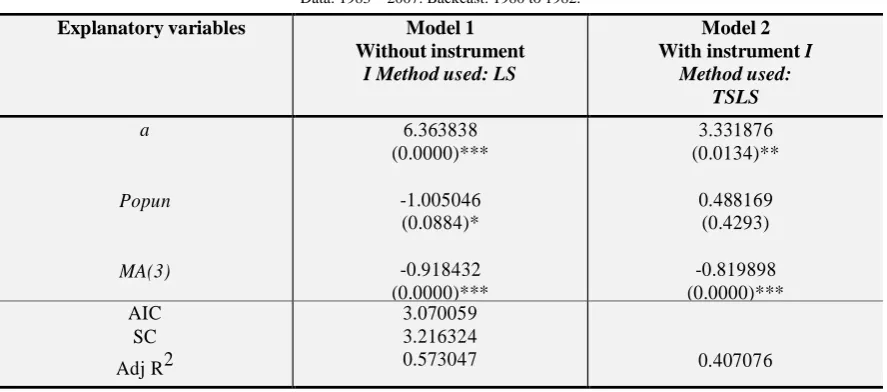
Table 1 shows the results of regressions of growtht on the explanatory variables in both models for the years 1981 to 2007. The second column shows the results of least squares (LS) regression of growtht on the variables included in equation (3) and the third column shows the results of two-stage least squares (TSLS) regression on the instrumental and other variables in vector (4).
Table-1: Results of best fit model with & without the instrumental variables Data: 1983 – 2007. Backcast: 1980 to 1982.
Explanatory variables Model 1
Without instrument
I Method used: LS
Model 2
With instrument I
Method used: TSLS a Popun MA(3) 6.363838 (0.0000)*** -1.005046 (0.0884)* -0.918432 (0.0000)*** 3.331876 (0.0134)** 0.488169 (0.4293) -0.819898 (0.0000)*** AIC SC Adj R2
3.070059 3.216324
0.573047 0.407076
Notes: * means the result is significant at p-value < 0.10. ** means the result is significant at p-value < 0.05. *** means the result is significant at p-value < 0.01.
MA = Moving Average (lag operator) AIC = Akaike Information Criterion. SC = Schwarz Criterion. The instrument I used for the second model is I =
f[gendermales, genderfemales, ageyouth, geographyrural, geographyurban, life, laborforce, laborpart, arableland, moneygrowth, grants, inflation].
Figure-4-1. The difference between the raw growth series (growth), and predicted growth using Model 1(growthf) and Model 2 (growthff). Source: IMF International Financial Statistical Yearbook (2010) & the OECD demographic report (2010) with predicted figures calculated using the coefficients from Table 1 above.
It is obvious from figure 4-1 that the impact of the population growth rate in the two models, with and without adjustments for finer demographic factors, converges steadily in the long run, although the two models give different levels of impact in the short-run. This result confirms the theoretical findings discussed in section 3 regarding the impact of the population growth rate on the long-run economic growth rate. This result could imply that the Egyptian policy regarding population growth rate reduction is not that significant in improving the per capita economic growth rate for the long run. Egyptian decision makers should rather focus on increasing productivity in order to stimulate the long-run economic growth rate in the country.
5. SUMMARY & CONCLUSION
This paper examined the impact of the population growth rate on the time path of the economic growth rate of Egypt, taking into consideration various demographic and economic variables. The results did not show evidence of a long run impact of the population growth rate on the economic growth rate of Egypt, which confirms the theoretical findings of the simple open economy versions of basic growth theories.
Our findings indicate that in the case of at least one country the impact of population growth rates on per capita income growth resulting from inward investment diminishes over time and eventually becomes insignificant compared with other factors. It does not necessarily indicate that per capita income recovers from the temporary loss of growth in the transitional stage of economic growth funded by foreign borrowing.
Further research is needed to test the model further for other middle income countries with high population growth. In addition, the model can be further developed and tested for developing countries and for post-industrial countries with either high population growth rates or ongoing net foreign borrowing. Further research is also required to examine the impact of population growth on other factors relating to economic growth.
Funding: This study received no specific financial support.
Competing Interests: The authors declare that they have no competing interests.
REFERENCES
Aguirre, M.S., 2002. Sustainable development: Why the focus on population? International Journal of Social Economics, 29(12):
923-945.
Becker, G.S., K.M. Murphy and R. Tamura, 1990. Human capital, fertility, and economic growth. Journal of Political Economy,
98(5, Part 2): S12-S37.
Bhalachandran, G., 2011. Kautilya’s model of sustainable development. Humanomics, 27(1): 41-52.
Carlberg, M., 1997. International economic growth. Hamburg: Physica-Verlag.
Ehrlich, I. and F. Lui, 1997. The problem of population and growth: A review of the literature from Malthus to contemporary
models of endogenous population and exogenous growth. Journal of Economic Dynamics and Control, 21(1): 205-242.
Enders, W., 2004. Applied econometric time series: User’s guide. 2nd Edn., Hoboken, NJ: Wiley.
Gupta, J., 2004. Global sustainable food governance and hunger: Traps and tragedies. British Food Journal, 106(5): 406-416.
Jackson, W.A., 1995. Population growth: A comparison of evolutionary views. International Journal of Social Economics, 22(6):
3-16.
Kelley, A.C., 1988. Economic consequences of population change in the third world. Journal of Economic Literature, 26(4):
1,685-681,728.
Kurtilla, K. and R. Reuveny, 2006. The systems dynamics of endogenous population growth in a renewable resource-based growth
model. Ecological Economics, 56(2): 256-267.
Mohamed, G.G.A., 2004. External shocks and sustainable development: A test of the interruption of foreign borrowings on a target
small open economy, world review of science, technology and sustainable development. Second International
Conference, Napier University, Edinburgh, Scotland, 10 November 2004.
Rosenzweig, M.R., 1990. Population growth and human capital investments: Theory and evidence. Journal of Political Economy,
98(5, Part 2): S38-S70.
Schneider, U.A., P. Havlík, E. Schmid, H. Valin, A. Mosnier, M. Obersteiner, H. Böttcher, R. Skalský, J. Balkovič, T. Sauer and
S. Fritz, 2011. Impacts of population growth, economic development, and technical change on global food production
and consumption. Agricultural Systems, 104(2): 204-215.
Solow, R.M., 1956. A contribution to the theory of economic growth. Quarterly Journal of Economics 70(1): 65-94.
Swan, T.W., 1956. Economic growth and capital accumulation. Economic Record, 32(2): 334-361.
UNWCED, 1987. Our common future (The Brundtland Report), New York: United Nations World Commission on Environment
and Development.
Yip, C.K. and J. Zhang, 1996. Population growth and economic growth: A reconsideration. Economic Letters, 52(3): 319-324.
Appendix-A.
Demographic Trends
A.1. Population Structure:
A.3. Other Demographic Indicators
2.4. Labor Force & Employment Trends