A Comparison of Summarization Methods
Based on Task-based Evaluation
MOCHIZUKI Hajime and OKUMURA Manabu
School of Information Science
Japan Advanced Institute of Science and Technology Tatsunokuchi, Ishikawa 923-1292, Japan
E-mail:fmotizuki,[email protected]
Abstract
A task-based evaluation scheme has been adopted as a new method of evaluation for automatic text summarization systems. It evaluates the performance of a summarization system in a given task, such as information retrieval and text categorization. This paper compares ten different summarization methods based on information retrieval tasks. In order to evaluate the system performance, the subjects’ speed and accuracy are measured in judging the relevance of texts using summaries. We also analyze the similarity of summaries in order to investigate the similarity of the methods. Furthermore, we analyze what factors can affect evaluation results, and describe the problems that arose from our experimental design, in order to establish a better evaluation scheme.
1.
Introduction
The importance of automatic text summarization re-search has been now increasing with the growing availabil-ity of on-line documents(Mani et al., 1998). Especially, the recent prevalence of information retrieval engines has cre-ated an important application for displaying retrieval results by using of the automatic summarization, whereby the user can quickly and accurately judge the relevance of texts re-turned as the result of a query. Here, rather than producing a generic summary, the summary that reflects the user’s in-formation need expressed in the query, ‘query-biased sum-mary,’ would be considered as more suitable.
The traditional evaluation method in summarization re-search has been to measure the similarity between sum-maries that are produced automatically and by hand. How-ever, this evaluation method has been criticized because it assumes that there is only one correct summary. A task-based evaluation scheme has been recently adopted as new way of evaluating summaries(Jing et al., 1998; Mani et al., 1998; Tombros and Sanderson, 1998). It evaluates the per-formance of a summarization system in a given task, such as information retrieval and text categorization.
This paper compares ten different summarization meth-ods based on information retrieval tasks. To evaluate the system performance, subjects’ speed and accuracy are mea-sured when they judge the relevance of texts using sum-maries. This evaluation method has the advantage that it can evaluate the utility of a summarization system in the environment in which it is actually used, and for the pur-pose for which it is built.
Previously, the TIPSTER Text Summarization Evalua-tion (SUMMAC)(Mani et al., 1998) adopted the task-based evaluation scheme and compared the performance of multi-ple systems. However, what features in a system contribute to producing a good (or bad) summary has not yet been clarified. Therefore, we implement ten different
summa-rization methods and compare them in the context of infor-mation retrieval tasks. From the results, we try to clarify what kinds of characteristics in summaries are good for in-formation retrieval tasks.
The summarization methods we use for the comparison are:
(1) use a full text itself;
(2) use a document title;
(3) extract a few leading sentences;
(4) extract paragraphs that are related to a query;
(5,6) produce a generic/query-biased summary by extract-ing sentences based on term frequency;
(7,8) produce a generic/query-biased summary by extract-ing sentences based on lexical chains;
(9) use a summary produced by a commercial summa-rizer; and
(10) extract a passage using lexical chains.
We fix the length of summaries as 20% sentences of the full texts. The methods can be classified along two dimen-sions: First, methods can be grouped based on the degree of continuity of their summaries. And second, methods can be grouped based on whether they reflect the user’s topic of interest (query-biased) or not (generic). We also analyze the similarity of the summaries in order to investigate the similarity of the methods.
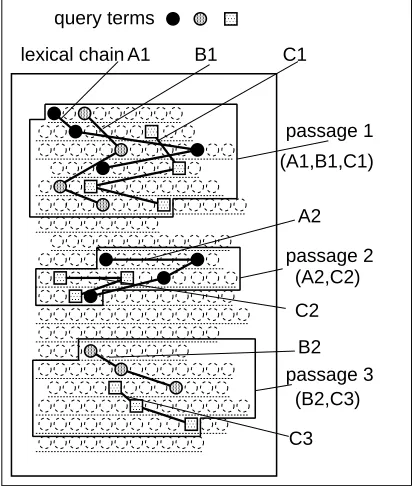
Passages are then fixed as the maximal fragments that are covered by overlapped lexical chains for query terms. Therefore, in Figure 1, three passages are ex-tracted based on the three query terms.
The passage is then scored and used to determine the best passage for a document. The score is based on two factors:
– the scores of lexical chains that are included in
the passage,
– the degree of the overlap of the lexical chains in
the passage.
Lexical chains are scored based on the number of words in the chain. The passage is then scored as the sum of the scores of the lexical chains in the passage, weighted by the degree of overlap of the chains. The weight is set to the square of the number of the over-lapped chains. Therefore, a passage in which many query terms densely co-occur will be extracted for the query. In Figure 1, passage 1 will be selected as the passage for the document, since it contains three long chains overlapping each other.
3.
Experiments
To compare the summaries made by the methods ex-plained in the last section, we performed a task-based uation experiment. It assumes that summaries can be eval-uated indirectly by the accuracy and speed of a given task, such as information retrieval and text categorization, where human subjects use the summaries for the task. We select information retrieval as the task for evaluation.
It measure the effectiveness of how the summaries help the users to judge the relevance of documents. Our task-based evaluation follows the summarization evaluation pro-posed for TIPSTER III(Hand, 1997; Mani et al., 1998).
We evaluated titles and summaries from 8 summariza-tion methods at 20% length1as well as full texts in an infor-mation retrieval task. We measure subjects’ accuracy and speed in judging relevance.
3.1. Material and methods
The documents that are used for evaluation are arti-cles from the BMIR-J2 test collection(Kitani et al., 1998). The BMIR-J2 consists of 5,080 articles from the Mainichi newspaper and 50 queries2. Ten queries are selected and 20 documents for each query are semi-automatically selected from the collection using an IR system. Manual interven-tion was needed to keep the percentage of documents rele-vant to the query higher than 50% because a smaller num-ber of relevant documents would make the results of the
1
We admit that we should make more thorough experiments with multiple summary lengths, since different summary lengths will yield different results(Jing et al., 1998; Mittal et al., 1999).
2BMIR-J2 was constructed by the SIG Database Systems of
the Information Processing Society of Japan, in collaboration with the Real World Computing Partnership.
experiments less reliable. The average length of the queries is 3.2 words, and the average length of the documents is 1,323.3 bytes. The average number of relevant documents is 12.8 in 20 documents.
We used 30 subjects (all are postgraduate students in the school of information science) and asked them to judge the relevance of documents to a query and write down the total time they spent on the 20 documents for each query. The subjects were also required to evaluate readability of the summaries as Japanese texts according to the four-grade evaluation: (1) the summary is readable; (2) a little read-able; (3) a little unreadread-able; and (4) unreadable.
Since the human subjects can read each query-document pair only once, the 30 subjects are divided into 10 groups (each group consists of 3 subjects) and the 10 groups rotate through the 10 forms of documents (includ-ing full texts) and the 10 queries.
The subjects are also instructed that they can access the full texts as well as the documents that are presented. The number of times that the full text is accessed is also recorded. Since the subjects are not told which one of the presented documents is the full text, they may try to access the full text even if they have already read it, if they think they need it.
3.2. Evaluation criteria
We use the following four criteria for comparison:
(1) accuracy of the judgments
Accuracy is measured by recall, precision, and F-measure. Recall (R) is the ratio of the number of rele-vant documents correctly judged by subjects to the to-tal number of relevant documents. Precision (P) is the ratio of the number of relevant documents correctly judged by subjects to the total number of documents that subjects judge as relevant. F-measure is calcu-lated by the following formula:
F measure=
2PR
P+R
: (9)
(2) time required for the task
The average times which the subjects spent in the task at each query are calculated and are compared.
(3) the number of times the subjects need the help of full texts
(4) readability of summaries as texts
Four-grade evaluation is scored as follows: ‘readable’ as 10, ‘a little readable’ as 5, ‘a little unreadable’ as -5, and ‘unreadable’ as -10.
4.
Results and Comparisons
4.1. Results
The distribution of subjects’ average F-measures is shown in Figure 2. Since, the performance of 21 out of 30 subjects is rather close (enclosed in the box), we used the results of those 21 subjects for evaluation.
0.65 0.7 0.75 0.8 0.85 0.9 0.95 F-Measure
Subjects
Figure 2: Distribution of F-measure values of subjects
The results of the experiments are summarized in Table 1. The results are shown as averages per query. ‘Readabil-ity’ is the average score which is calculated from the results of the four-grade judgment by subjects. ‘No. of references’ indicates the number of times when the full text is accessed. ‘Discontinuity’ indicates the average number of sentences in the full text between the adjoining two sentences in the summary. The summary is said to be continuous if its dis-continuity is close to0. ‘Sum. ratio in word number’ indi-cates the average length of summaries when it is calculated in the number of words.
We tested the statistical significance of the agreement among subjects. Using the same methodology as in (Jing et al., 1998; Passonneau and Litman, 1993), we performed Cochran’s Q-test(Degroot et al., 1981) on the data from the subjects. For our task, Cochran’s Q-test evaluates the null hypothesis that the total number of human subjects judging the same document as relevant is randomly dis-tributed. The results show that this hypothesis is false and that the agreement among subjects is significant. For all ten queries, the probability that subjects judge a document as relevant is much higher than would be expected by chance (p<10
5 ).
4.2. Comparisons
In this subsection, we analyze the results from the ex-periments. First, we compare the results among all methods in the four evaluation criteria. Next, we classify the meth-ods into groups based on the similarity of their summaries and compare the groups in the same criteria.
4.2.1. Comparison among all methods
When all the summarization methods are compared by the mean F-measure value, our method (lex) and J outper-form the full text (full), and lex is the best. The accuracy of others are almost same as or slightly lower than full. How-ever, when we perform the one-way ANOVA using their F-measures, the statistical significance is not reached in the result (p<0:9725). A major reason of the small difference
of accuracy can be considered that the subjects can access the full text if they need it during the judgment in the exper-iment. Accessing the full text might make the performance of a summary better than the real one with only the sum-mary. Therefore, we will have to adjust the accuracy score according to the number of times the full text is accessed. However, since it is difficult to guess the influence of the full text access, we have not adjusted it.
As for the times required for the task, it can be said that all summarization methods save time, since full takes the longest. The time is remarkably short with the title method while the other methods show similar times.
It can be considered that title shows the best overall performance, since it needs a considerably short amount of time for the task, although it is slightly inferior to lex in terms of accuracy. Therefore, as one of better design for the information retrieval system, we can adopt a system that displays the title as a summary and can access the full text if it is necessary. However, the title is not always attached to a text. Therefore, the title method can not always be used. On the other hand, it can be said that lex is the best overall in the automatic summarization methods which can be used for the text without the title.
As for readability, J, lead, and cf.idf can yield higher evaluation scores than full. The score of lex is same as full. The scores of other methods are lower than full. The score of title is the lowest. The methods which produce sum-maries with high readability tend to extract sentences from the leading part of the original text, as will be described later.
4.2.2. Comparison based on the similarity of summaries
Next, we classify the summarization methods into groups based on the similarity of their produced summaries, and compare the groups in the four criteria.
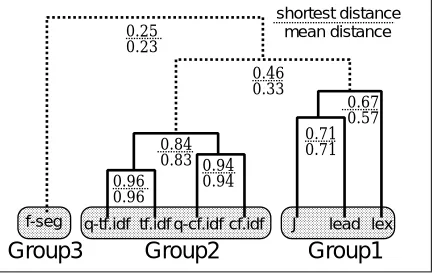
The summaries are classified by the following steps. First, each summary is expressed as a binary vector of an original document. Each element of the vector corresponds to each sentence in the document, and its value is 1 if the sentence is selected in the summary. Second, the similarity between each pair of vectors is calculated by the cosine dis-tance. Finally, we construct clusters of the summarization methods using this similarity. In calculating the similarity between two clusters, we use two different measurement methods, the shortest distance method and the mean dis-tance method. Figure 3 shows the resulting clusters.
In this figure, the summarization methods are classified into three groups with both measurement methods: Group
1 includes J, lead and lex; Group 2 includes tf.idf, cf.idff, q-tf.idf and q-cf.idf; and Group 3 includes f-seg. We don’t
consider full and title, since the comparison of the similar-ity with them does not make sense.
be-full title lead f-seg tf.idf q-tf.idf cf.idf q-cf.idf lex J Recall 87.1% 86.7 85.9 87.2 86.3 89.6 87.0 85.3 90.5 86.5 Precision 89.0% 89.1 88.9 88.8 89.7 85.3 85.3 87.0 88.5 91.3 F-measure 87.2% 87.0 86.6 87.1 87.2 86.6 84.9 84.9 89.1 87.6 Readability 4.1 1.8 4.6 3.7 3.8 4.0 4.3 3.9 4.1 5.5 Time (min:sec) 15:38 7:54 9:47 10:55 10:37 9:54 10:54 10:29 10:41 10:52 No. of references 0.6 4.8 3.8 2.8 2.6 1.7 2.0 1.5 1.9 2.0
Discontinuity 0.0 0.0 0.0 0.0 3.6 3.5 3.8 3.6 0.0 1.4 Sum. ratio in word number 100.0% 5.3 19.1 21.7 32.1 31.5 30.5 30.2 23.6 27.7
Table 1: Experimental results
q-tf.idf tf.idfq-cf.idfcf.idf J lead lex f-seg
0.96 0.94
0.84 0.71
0.67 0.25
0.96 0.94 0.83
0.57 0.46
0.71 0.33 0.23
Group1
Group2
Group3
shortest distance mean distance
Figure 3: Similarity among the summarization methods
tween lex and J is not so high. Therefore, it can be inferred that both summaries of lex and J include the leading part of an original text to a certain extent, and J also includes certain sentences which are distant from the leading part of the original document, although the detailed method of J is unknown.
In Group 2, all four summarization methods have the common feature that the summaries with low continuity are extracted. Although those methods can be classified in two ways: whether the score is calculated by taking into account a query, and which of the score of term frequency or lexical chains (tf or cf) is used for calculating a score, it can be said that these differences do not affect in this group of the summaries, since the similarity between summaries of any two methods are very high.
Group 3 consists only of f-seg. Similar to the
sum-marization methods in Group 1, f-seg extracts summaries with high continuity, though selected sentences are greatly different from those of any methods in Group 1.
Lex and J, which yield higher accuracy both belong to Group 1. However, it can be said that the summary that is
simply extracted from the leading part is not so effective, since the accuracy of lead in Group 1 is not so good.
We can also compare the summarization methods of each group from the point of view of query biasing. In both Group 1 and Group 3, the relevance judgment can be done more easily with query-biased summaries (less time required, and less full-text access), and the accuracy of the
judgment is also improved. In case of the methods which produce a summary with higher continuity, the summaries are effective in improving the accuracy if they are produced by taking into a query account. The methods in Group 1 also obtain relatively higher score in the evaluation of read-ability. In case of Group 2, the relevance judgment can be done more easily with query-biased summaries (less time required, and less full-text access), but the accuracy of the judgment is not necessarily improved.
5.
Conclusion and Future work
In this paper, we compared ten different summarization methods based on the task of information retrieval. From the experimental results, we got the following major find-ings:
The methods which produce the summaries of high readability tend to extract sentences from the leading part of the original text.
The summaries with high continuity are more readable and yield higher accuracy in general.
Relevance judgment can be done more easily with query-biased summaries (less time required, and less full text access), but the accuracy of the judgment is not always improved. In the case of methods which produce a summary with high continuity, the sum-maries are effective in improving the accuracy if they are produced by taking into account a query.
Any summarization method saves time.
From the experience of this evaluation experiment, we enumerated the followings as points that should be consid-ered for future evaluation experiments.
degree of the influence is difficult to estimate. There-fore, we should not allow the reference of the full text in the experiment of relevance judgment.
Separation of the evaluation of readability:
In the experiment, the difference of times required for the task among the summarization methods was not remarkable except for title. A major reason of the small difference can be considered that the evaluation of readability was done together with the relevance judgment.
Since the required time for evaluating readability is longer than the time for judging relevance, it can be in-ferred that the difference of the time for the relevance judgment has been narrowed by readability judgment. Therefore, we should separate two experiments com-pletely.
Selection of queries and documents:
We think the following combinations of a query and documents are not suitable for the comparative evalu-ation among summarizevalu-ation methods:
1. The combination of documents and a query where words in the query are scattered compar-atively equally in the documents.
In this case, summaries which are good for judg-ing the relevance are easily extracted from any part in the document.
2. The combination of documents and a query where words in the query occur in the documents frequently.
In this case, similar sentences tend to be extracted as a summary in both query-biased and generic methods.
To further clarify the difference among the summa-rization methods, we must choose a set of queries and documents by taking into consideration at least the above points. However, the criterion for the selection of the suitable evaluation set is a difficult problem and not clear at present.
6.
Acknowledgments
The authors would like to express our gratitude to Dr. Akihiko Takano, Dr. Yoshiki Niwa, Dr. Shingo Nishioka and other members in the Central Research Laboratory, at Hitachi co., Ltd. for their helpful suggestions and for allow-ing us to use their system for word association calculation. We are also grateful to the SIG Database Systems of the Information Processing Society of Japan for allowing us to use their test collection BMIR-J2.
7.
References
Brandow, R., K. Mitze, and L.F. Rau, 1995. Auto-matic Condensation of Electronic Publications by Sen-tence Selection. Information Processing &
Manage-ment, 31(5):675–685.
Degroot, M. H. et al. (eds.), 1981. Encyclopedia of
Statis-tical Sciences, volume 2. A Wiley-Interscience
Publica-tion, pages 24–26.
Halliday, H.A.K. and R. Hasan, 1976. Cohesion in English. Longman.
Hand, T.F., 1997. A proposal for task-based evaluation of text summarization systems. In Proc. of the ACL
Work-shop on Intelligent Scalable Text Summarization. pages
31–38.
Jing, H., R. Barzilay, K. McKeown, and M. Elhadad, 1998. Summarization Evaluation Methods: Experiments and Analysis. In Intelligent Text Summarization. AAAI Press, pages 51–59.
Kitani, T. et al., 1998. Japanese Test Collection for Eval-uation of Information Retireval Systems, BMIR-J2. In
IPSJ SIG-DBS-144-3. pages 15–22. In Japanese.
Luhn, H.P., 1958. The automatic creation of literature abstracts. IBM Journal of Research and Development, 2(2):159–165.
Mani, I. et al., 1998. The tipster summac text summariza-tion evaluasummariza-tion. Technical Report MTR 98W0000138, MITRE Technical Report.
Miller, G., 1990. Wordnet: An online lexical database.
In-ternational Journal of Lexicography, 3(4):235–312.
Mittal, V., M. Kantrowitz, J. Goldstein, and J. Carbonell, 1999. Selecting text spans for document summaries: Heuristics and metrics. In Proc. of the 16th National
Conference on Artificial Intelligence. pages 467–473.
Mochizuki, H., M. Iwayama, and M. Okumura, 2000. Passage-Level Document Retrieval Using Lexical Chains. In Proc. of the 6th RIAO Conference. To appear. Morris, J. and G. Hirst, 1991. Lexical Cohesion Computed by Thesaural Relations as an Indicator of the Structure of Text. Computational Linguistics, 17(1):21–48.
Passonneau, R.J. and D.J. Litman, 1993. Intention-based Segmentation: Human Reliability and Correlation with Linguistic Cues. In 31st Annual Meeting of the
Associa-tion for ComputaAssocia-tional Linguistics. pages 148–155.
Salton, G. and C. Buckley, 1988. Term-weighting ap-proaches in automatic text retrieval. Information
Pro-cessing and Management, 24:513–523.
Tombros, A. and M. Sanderson, 1998. Advantages of Query Biased Summaries in Information Retrieval. In
Proc. of 21st Annual International ACM Special Interest Group on Information Retrieval Conference on Research and Development in Information Retrieval. pages 2–10.
Zechner, K., 1996. Fast Generation of Abstracts from Gen-eral Domain Text Corpora by Extracting Relevant Sen-tences. In Proc. of 16th International Conference on