The Prior Knowledge Effect on the Processing of Vague Discourse
in Mandarin Chinese
Shu-Ping Gong National Chiayi University [email protected]
Kathleen Ahrens
Hong Kong Baptist University [email protected]
Abstract
This study investigates whether prior knowledge affects the processing of vague discourse in Mandarin Chinese. Vague discourse refers to the texts using vague references and neutral descriptors (e.g. 東西 dōngxī"thing", 事情 shìqíng "item", and 物件 wùjiàn "object"), rather than naming the referred to items at the basic level. Three conditions of discourse were tested: one was vague texts preceded by congruent titles, another was texts preceded by incongruent titles and the third was texts preceded without titles. An on-line self-paced reading task was conducted. Participants were instructed to read the vague texts and rate the level of comprehensibility. The rating scores for the level of comprehensibility and the reading time of the whole texts were measured. The experimental results show that people read texts preceded by congruent titles significantly faster than those preceded by incongruent and no titles. However, the reading time of texts preceded by incongruent titles was also significantly shorter than those preceded without titles. We conclude that when people simply read vague idea at a discourse level, the appropriate information is useful for text integration. Inappropriate information, however, can be paid little attention during the text processing and do not increase too much processing load.
Keywords: vague texts, congruency, self-paced reading task, background knowledge
1. Introduction
There are two basic approaches to text understanding: the top-down approach, in which the reader starts with a preexistent structure like a schema and tries to fit the text proposition into it, and the bottom-up approach, in which the reader starts with the text propositions and tries to create a new structure for them.
knowledge will not increase the processing load when participants simply read the texts without making judgment. We think that when people simply read vague texts preceded by incongruent titles, they will not concentrate on inappropriate background information occurring between titles and contents of vague texts. Readers would like to read texts as quickly as possible in order to grasp the main idea of the vague text. So, we postulate that incongruent titles may not elicit the processing difficulty in reading time.
The absence of titles, on the other hand, does not allow one to expect what the vague texts discuss and they have to guess the themes of the vague texts until the end of texts. When people read a text without any title, they have to construct a title first. In the middle of the text, they have to keep revising the title according to the text information. The trial-and-error processing can increase the processing load and the reading time will be longer.
First, when the rating scores on the level of comprehensibility across the three conditions of vague texts are compared, we expect that the rating scores for texts preceded by congruent titles should be significantly higher than those preceded by incongruent titles and no titles since the appropriate background information will facilitate the processing of vague texts. Furthermore, the rating scores for texts preceded without titles should be significantly higher than those preceded by incongruent titles since the inappropriate background information will produce an inhibitory effect when people make comprehension judgment.
Second, when the rating response times across the three text conditions are compared, we also predict that the response time for the vague texts preceded by congruent titles should be significantly shorter than those preceded by incongruent titles and no titles because of the advantage of the appropriate background information. Moreover, the response time for texts preceded without titles should be significantly shorter than those preceded by incongruent titles. It is the same reason that the inhibitory effects occur during the judgment task.
Finally, when the reading time of whole texts across the title condition are compared, we expect that the vague texts preceded by congruent titles will be read significantly faster than those preceded by incongruent titles and no titles because the relevant background information elicits facilitation effects. However, the vague texts preceded by incongruent titles will be read significantly faster than those preceded without titles. It is because the absence of background knowledge will cause much processing load than the inappropriate information during the reading of vague texts.
2.1 Method
2.1.1. Participants
63 undergraduate students of National Chiayi University (age range from 18 to 23 years old, mean age= 19.87 years old, SD = 1.30, 6 male and 57 female) participated in our task. They were tested individually and paid for their participation. All subjects were controlled for their language background (i.e. native speaker of Mandarin/Taiwanese).
2.1.2. Materials and Design
For the vague texts, each was created by using vague references and neutral descriptors (e.g. 東西 dōngxī "thing", 事情 shìqíng "item", and 物件 wùjiàn "object"), rather than naming the referred to items at the basic level. For instance, the example in Table 1 is a vague text discussing snowman. The content does not explicitly point out lexical items associated with these concepts "snow" or "snowman" or "winter". It uses vague descriptions or references such as 過程 guòchéng "procedure" and 成品 chéngpǐn"thing". In addition, the congruent title is堆雪人 duīxuěrén "a snowman", which provides relevant information what a text is discussed and the incongruent one is洗杯子 xǐbēizǐ "washing cups", which provides irrelevant information to the text. Both of the congruent and incongruent titles are controlled for the same syntactic structures, e.g., V+N, in this example.
Table 1: An Example of the Vague Texts in this Study
___________________________________________________________________________
A Vague Text:
這個過程很簡單也很有樂趣。整個過程可以在任何地方發生。平均大概要花費一小時或 甚至整天都有可能。過程中,時間長短取決於你是否要求最後成品要非常精緻。整個過 程只需要一個材料。材料不但要很充足而且越新鮮越好,因為這些原因可以決定成品的 壽命。另外,成品放置的位置也可以決定成品的壽命。如果你等待太久才使用材料,這 種材料是會消失的。這個過程幾乎每一個人都可以做。
Three Conditions of Titles:
A congruent Title: 堆雪人
An incongruent title: 洗杯子
No title: Ø
___________________________________________________________________________
In our 51 sets of titles, the length of texts in both congruent and incongruent condition was 161 characters (range from 160 to 161 characters) and the length of titles in both congruent and incongruent conditions was 3 characters (range from 2 to 5 characters). In addition, the structures of titles involved in both title conditions were the same. There are 8 titles using the “V” structure pattern (e.g., 慢跑 mànpǎo and 洗澡 xǐzǎo) and 43 titles using the “V+N” syntactic pattern (e.g., 剪指甲 jiǎnzhǐjiǎand 寫報告 xiěbàogào).
the correct or appropriate titles for the 51 vague texts.
In addition, 100 participants were instructed to judge the level of relevance of tiles in a YES/NO force choice task. Participants saw a paragraph that was preceded by a title and had to determine whether the title was suitable for this paragraph by selecting YES or NO, YES indicating “relevant” and NO indicating “irrelevant”. The purpose of this judgment task is to screen out the inappropriate titles. Congruent titles and incongruent titles were controlled for the level of relevance: the average for congruent titles on the level of relevance is 95% and for incongruent titles on the level of irrelevance is 97%.
In our self-paced reading task, the 51 sets of vague texts were counterbalanced into three lists. Each list included 51 trials in total: one third of vague texts preceded by congruent title, one third preceded by incongruent titles, and one third preceded without titles. Participants did not see the same vague text repeatedly and only saw each paragraph in one title condition once. Before the main task, participants were instructed to read 12 practice vague texts for getting familiar with the whole procedure of the self-paced reading task.
2.1.3. Procedure
The experimental stimuli were randomized in the three lists. At the beginning, participants were instructed to sit in front of a computer and gave an instruction and practice items. They were instructed to read the texts presented by titles or“XXXX” (indicating no titles). These texts were presented sentence by sentence and participants had to read them as quickly as possible but they could read them based on their reading speed. After they finished each sentence, they needed to press the button for the next sentence. The reading times from the onset of the first sentence to the button press by participants for reading the last sentence of texts were recorded by the computer. After the text reading, participants saw a 1-5 point scale on the screen and had to judge the level of comprehensibility of texts. If the text would be highly incomprehensible, they would rate 1 for “very incomprehensible”. If the texts would be very comprehensible, they would rate 5 for “very comprehensible”. If the texts would be partially comprehensible or incomprehensible, they could rate the number from 2 to 4 on a scale based on their intuition. The rating scores for each trial were recorded, too.
Figure 1. The procedure of the stimuli presentation
3. Results and Discussion
No data of participants were removed. The comprehensibility rating scores, the rating response time and the reading time of the whole texts were analyzed. Table 2 shows that the average rating scores on the level of comprehensibility of texts for the vague texts preceded by congruent, incongruent and no titles are 4.81, 2.27, and 3.36 scores, respectively. So, the vague texts preceded by congruent titles are the most comprehensible, followed by no title and those preceded by incongruent titles are the least comprehensible.
A one-way repeated ANOVA test for testing rating scores was conducted. The by-subject analysis shows there was significant difference in rating scores across the three conditions of vague texts (F1 (2, 189) = 246.12, p < .05). The post-hoc analysis shows that the rating scores
of the vague texts preceded by congruent title were significantly higher than those of texts preceded by incongruent titles and no titles (p < .05). Moreover, the rating scores of the text preceded by incongruent title were significantly lower than that those of the texts preceded without titles (p < .05). The by-item analysis also yielded consistent results as the by-subject analysis (F2(2, 150) = 330.97, p < .05). There were significant differences in rating scores
between the texts preceded by congruent texts and those by incongruent/no titles (p < .05). And the vague texts preceded by incongruent titles were significantly less comprehensible
+
+
Title
1st Line
2nd Line
.. Time 350ms
150ms 350ms
600ms
500ms
Self pace Self pace
..
Last Line
Rating Self pace
Self pace
than those of the texts preceded without titles (p < .05).
Table 2: Means of rating scores across the three conditions of discourse
Conditions of Texts Mean rating scores
Congruent Titles 4.8 (SD= 0.24)
Incongruent Titles 2.3 (SD= 1.07)
No Titles 3.4 (SD= 0.81)
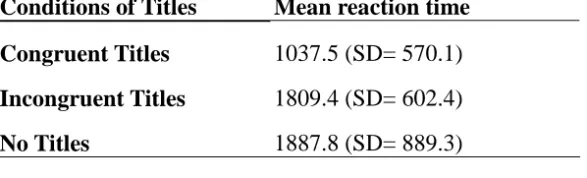
Additionally, the rating response time was analyzed. Table 3 shows that the average response times for the texts preceded by congruent title, incongruent title, and no titles are 1037.5 ms, 1809.4 ms and 1887.8 ms, respectively. The results show that the texts preceded by congruent titles were rated faster than the other two text conditions. Participants took longer time to rate the texts preceded without title than those preceded by incongruent titles.
Table 3: Means of rating response time across three conditions of discourse
Conditions of Titles Mean reaction time
Congruent Titles 1037.5 (SD= 570.1)
Incongruent Titles 1809.4 (SD= 602.4)
No Titles 1887.8 (SD= 889.3)
A one-way repeated ANOVA analysis for testing the rating response time was conducted. The by-subject analysis shows that the rating response time was significantly different across the three text conditions (F1 (2, 189) = 61.24, p < .05). A post-hoc analysis shows that the
response time of the texts preceded by congruent title was significantly shorter than those of the texts preceded by incongruent titles and no titles (p < .05). However, the reaction time of the texts preceded by incongruent titles was NOT significantly longer than those of the texts preceded without titles (p > .05). The by-item analysis also yielded the significant difference across the three conditions of texts as the by-subject analysis (F2(2, 150) = 41.90, p < .05).
The response time for the texts preceded by congruent titles was significantly shorter than that those preceded by incongruent/no titles (p < .05). Additionally, there was NO significant difference in reaction time between the texts preceded by incongruent titles and no titles (p > .05).
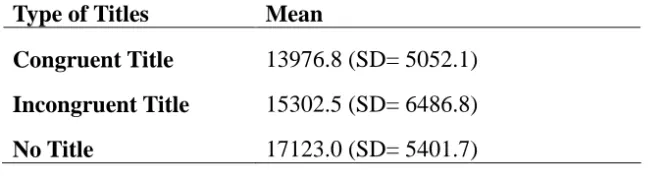
A one-way repeated ANOVA analysis for testing reading time was conducted. The by-subject analysis shows that there are significant difference across the three text conditions (F1 (2, 189) = 40.95, p < .05). A post-hoc test demonstrates that the reading time of the texts
preceded by congruent titles was significantly shorter than those preceded by incongruent titles or no titles (p < .05). In addition, the reading time of the texts preceded by incongruent titles was significantly shorter than the one of the texts preceded without titles (p < .05). The by-item analysis also yielded the same results as the by-subject analysis (F2(2, 150) = 28.60,
p < .05). The congruent condition was read significantly faster than the other two title conditions (p < .05). And, the vague texts preceded by the incongruent condition were read significantly faster than those preceded without titles (p < .05).
Table 4: Means of text reading time across three conditions of discourse
Type of Titles Mean
Congruent Title 13976.8 (SD= 5052.1)
Incongruent Title 15302.5 (SD= 6486.8)
No Title 17123.0 (SD= 5401.7)
To summarize, the results of the rating scores show that the vague texts preceded by congruent titles were processed with less effort than the other title conditions. Incongruent titles, however, provide inappropriate information and make the vague texts not easily to be understood. So, the texts preceded by incongruent titles were rated as the least comprehensible. The vague texts preceded without titles served as the baseline condition and rated as the neutral one (i.e., neither comprehensible nor incomprehensible). The results of rating scores are consistent with our prediction that the relevant background knowledge facilitates the comprehensibility level and irrelevant information results in the inhibitory effects in comprehension.
On the other hand, the results of the response time show a little different from our expectation. In our experiment, the vague texts preceded by congruent titles were responded faster than the other two title conditions. This also suggests the facilitation effects of appropriate background knowledge in text processing. However, we also found that the vague texts preceded by incongruent titles were responded as fast as those preceded without titles, which is different from our prediction that there would be no difference in response time between the no-title and incongruent conditions. The possible reason may be that each vague paragraph was read twice, which allowed one not to read the texts again when the text presented at the second time and directly made responses based on the memory of their previous reading. Thus, the repeated presentation of the vague texts results in the similar response times between the incongruent titles and no-title conditions.
To conclude, this psycholinguistic study is to determine whether the background knowledge influences the processing of vague texts. Our results show that relevant background knowledge can aid the processing of vague texts. The irrelevant background knowledge, however, does not necessarily inhibit the processing of vague texts. The inhibitory effect only occurs in the judgment task rather than in the reading task. Finally, the absence of background knowledge leads to much processing difficulty at a discourse level.
Acknowledgments
This research was supported by grants from the National Science Council of Taiwan (NSC
96-2411-H-415 -014 -MY3). We would like to thank two anonymous reviewers of
ROCLING2011 for their comments on earlier versions of this work. Remaining errors are our
sole responsibility.
References
[1] D. E. Rumelhart, &, A. Ortony.“The representation of knowledge in memory”. In R. C. Anderson, r. J. Spiro, & W. E. Montague (Eds.), Schooling and the acquisition of knowledge (pp 99-135). Hillsadale, NJ: Erlbaum. 1977.
[2] W. Kintsch &, T. A. van Dijk (1978).“Toward a model of text comprehension and production”. Psychological Review, 85, 363-394. 1978.
[3] J. D. Bransford, & M. K. Johnson.“Contextual prerequisites for understanding: some investigations of comprehensions and recall”. Journal of Verbal Learning and Verbal Behavior, 11, 717-726. 1972.
[4] J. D. Bransford &, M. K. Johnson.“Consideration of some problems of comprehension”. In W. G. Chase (Ed.), Visual information processing. New York: Academic. 1973.
[5] D. J. Dooling &, R. Lachman. Effects of comprehension on retention of prose. Journal of Experimental Psychology, 88, 216-222. 1971.
[6] E. Smith & D. Swinney.“The role of Schemas in reading text: a real-time examination.” Discourse Processes, 15, 303-316. 1992.
[7] N. S. Johnson, & J. M. Mandler.“A tale of two structures: underlying and surface forms in stories”. Poetics, 9-51-86. 1980.
[8] J. M. Mandler & M. S. Goodman.“On the validity of story structure.”Journal of Verbal Learning and Verbal Behavior, 21, 507-523. 1982.
[9] D. E. Rumelhart.“Understanding and summarizing brief stories”. In D. LaBerge & S. J. Samuels (Eds.), Basic Processes in Reading Comprehension: Perception and
Comprehension (pp. 230-265). Hillsdale, JJ: Lawrence Erlbaum Associates, Inc. 1977.
[10] P. W. Thorndyk.“Cognitive structures in comprehension and memory of narrative discourse.”Cognitive Psychology, 9, 77-110. 1977.
“Thematic maps improve memory for facts and inferences: a test of the stimulus order hypothesis.”Contemporary Educational Psychology, 19, 129-142. 1994
模糊語境理解歷程的先前知識效應
龔書萍 嘉義大學
安可思 香港浸會大學
摘要
本研究探討先前知識是否會影響人處理模糊不清的脈絡文章和語境。模糊的脈絡文章是
指語境使用含糊、非指涉特定物件、事件,使用中性的描述和詞彙 (例如:“東西、“事
情”、和“物件”), 而不使用特定的名稱。本研究中,測試了三種模糊語境文章。第一
是模糊語境使用了合諧 (congruent) 的標題 (titles);第二是模糊語境使用了不合諧
(incongruent) 的標題;第三種是模糊語境但沒有標題 (no titles)。我們執行了一個「線
上自主的閱讀作業」(on-line self-paced reading task) 的心理語言實驗,並測量了受試者
的這三種實驗材料的閱讀時間。實驗結果顯示,受試者在處理合諧標題的模糊語境時, 閱讀時間比不合諧或沒有標題的文章時,閱讀時間顯著性較短。另外,受試者在處理不 合諧標題的模糊語境時,也比沒有標題的實驗材料的閱讀時間顯著性較短,這顯示由不 合諧標題所引起的不相干背景知識並不會讓模糊語境處理時間較久,反而是沒有標題的 文章處理時間是最長的。本研究結論為:標題的作用為背景知識的激發,可以促進理解 模糊語境文章。但是,不合諧標題未必在模糊語境處理上會造成抑制效果。