Design of High Speed Blow Fish Algorithm Using S-Box
V. Venkata Sravanthi1, MS. C. Ruth vinutha2
1Mtech Student, Department of ECE, Shree Institute of Technical Education, Tirupathi, India 2Assistant Professor, Department of ECE, Shree Institute of Technical Education, Tirupathi, India
ABSTRACT
Information Security is prime focus for current computer data communications. Insecurity in data transmission has increased cybercrimes through hacking. Advanced Encryption Standard (AES) is the most secure symmetric encryption technique that has gainedworldwide acceptance. The AES based on the Rijndael Algorithm is an efficient cryptographic technique thatincludes generation of ciphers for encryption and inverse ciphers for decryption. For Higher security and speed ofencryption/decryption We are designing the Blow fish algorithm that the proposed architecture outperforms the existing techniques in terms of speed.Implementation of S-Box was synthesized and implemented using Xilinx ISE v14.3.
Keywords: S-Box, FPGA, AES, Blow fish algorithm.
I.
INTRODUCTIONThe purpose is to provide a standard algorithm for encryption, strong enough to keep U.S. government documents secure for at least the next 20 years. The earlier Data Encryption Standard (DES) had been rendered insecure by advances in computing power, and was effectively replaced by triple-DES. Now AES will largely replace triple-DES for government use, and will likely become widely adopted for variety of encryption needs, such as secure Transactions via the Internet. Byte substitution and Inverse Byte Substitution are the most complex steps in the encryption and decryption processes. In these steps each byte of the state array will be replaced with its equivalent byte in the S-box or the Inverse S-box. As AES algorithm use elements within the GF (2 8), each element in the state array represents a byte with a value that varies between 00H-FFH. The S-box has a fixed size of 256 bytes represented as
(16*16) bytes matrix. In this paper propose an optimized and pipelined architecture for Sbox block in AES based on combinational logic.
and protected XOR gate. In, a general method for sharing common subexpressions derived from the algebraic finite fields is proposed.
The Advanced Encryption Standard is the standard symmetric key block cipher certified by the National Institute of Standards and Technology (NIST) in Federal Information Processing Standard (FIPS) 197. A full AES implementation can be broken down into two main components: the cipher and the key expander. The cipher is the component which is responsible for performing encryption or decryption on blocks of input data, while the key expander is responsible for preparing the input key for use by the cipher in each round. The function SubBytes is the only non-linear function in AES, operating on each of the state bytes independently as shown in Fig It substitutes all bytes of the State using a look-up table called S-Box as in Table I. The hardware complexity of the AES cryptographic module is dominated by the S-box because it is the most essential part of
AES.
II.
ADVANCED ENCRYPTION STANDARD (AES)The more popular and widely adopted symmetric encryption algorithm likely to be encountered nowadays is the Advanced Encryption Standard (AES). It is found at least six time faster than triple DES.A replacement for DES was needed as its key A wide variety of approaches to implementing AES have appeared, to satisfy the varying criteria of different applications. Some approaches seek to maximize throughput, others minimize power consumption, and yet others minimize circuitry, andFor the latter goal, Rijmen suggested using 192 bits, or 256 bits, and the corresponding number of rounds for each is 10 rounds, 12 rounds, or 14 rounds, respectively. From the original key, a different “round key” is computed for each of round.
A. ENCRYPTION PROCESS
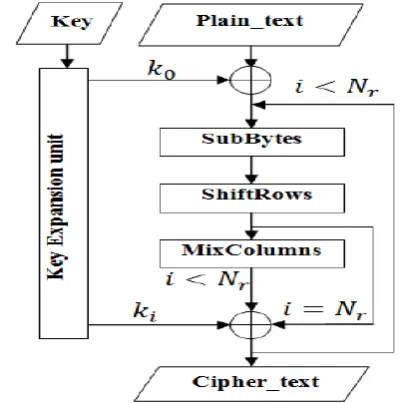
AES algorithm uses a round function that is composed of four different byte oriented transformations: SubBytes, ShiftRows, MixColumns and Add Round Key.
Figure 1. AES encryption algorithm Structure
Pseudo code for generating the expanded key from the actual key. The key is copied into the first four words of the expanded key. The remainder of the expanded key is filled in four words at a time.
B. BYTE SUBSTITUTION (SUBBYTES)
This is simply a table lookup using a 16×16 matrix of bytevalues called an s-box. This matrix consists of all the possible combinations of an 8 bitsequence
Figure 2. SubBytes function operates on state
The Inverse substitute byte transformation makes use of an inverse s-box.
C. SHIFT ROWS
This is a simple permutation an nothing More.
The first row of state is not altered.
The second row is shifted 1 bytes to the left in a circular manner.
The third row is shifted 2 bytes to the left in a circular manner.
Figure 3. Shift rows
A one byte shift is therefore a linear distance of fourbytes. The transformation also ensures that the four bytes of one column are spread out to four different columns.
D. MIX COLUMNS
This stage is basically a substitution but it makes use of arithmeticof GF(28). Each column is operated on individually.
Figure 4. mix columns
The transformation can be determined by the following matrix multiplication on state
E. ADD ROUNDKEY
Figure 5. AES key expansion
The round constant is a word in which the three rightmost bytes are always 0. Thus theeffect of an XOR of a word with Rcon is to only perform an XOR on the leftmost byteof the word.
III.
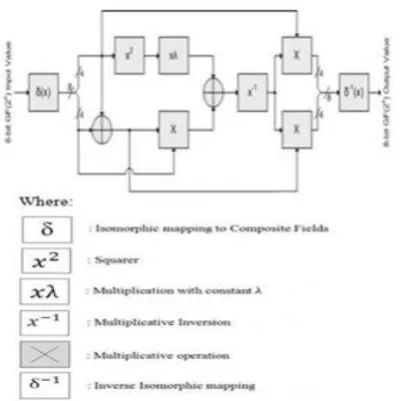
THE S-BOX CONSTRUCTIONThe content of the S-Box can be computed based on performing two transformations; 1.Multiplicative inverse 2. Affine Transformation
Figure 6. The data flow diagram for the S-Box
A. AFFINE TRANSFORMATION
The affine transformation f is defined in a matrix
polynomial multiplication, followed by the XOR with a constant as outlined in.
B. MULTIPLICATIVE INVERSION
The composite field mechanism used for calculating Multiplicative inverses in AES S-Boxes is an efficient method which was proposed early.
C. MAPPING AND INVERSE ISOMORPHIC MAPPING
Figure 7. Multiplicative inversion module for the S-Box
D. SQUARING
The formula for computing the squaring Operation is acquired as shown in.
E. MULTIPLICATION WITH CONSTANT ʎ
As has been done to drive the formula for computing the squaring operation, Let k = sʎ, where k = {k3 k2 k1 k0}, s = {s3 s2 s1 s0} and ʎ = {1100} are elements. The kH and kL terms can be further broken down and
the result of the decomposition is shown in
F. MULTIPLICATIVE INVERSION IN GF(24) The multiplicative inversion. Let k be an element of GF(24) so the multiplicative inversion of k-1={(k3)-1 (k2)-1 (k1)-1 (k0)-1}.
G. MULTIPLICATION IN GF (24)
It can be observed that there are addition, multiplication operations in GF (22) and multiplication with constant _. The multiplication in GF (22), requires decomposition to GF (2) to be implemented in hardware.
IV.
BLOWFISH ALGORITHMBlowfish is a symmetric block cipher algorithm. It had been designed by Bruce Schneier in 1993. It takes 64-bit plaintext and variable-length key, from 32 bits to 448 bits, as inputs and 64-bit cipher text as an output .Blowfish is a symmetric block cipher. It has a fixed 64-bit data block size and a variable secret key range from 32 bits to 448 bits.
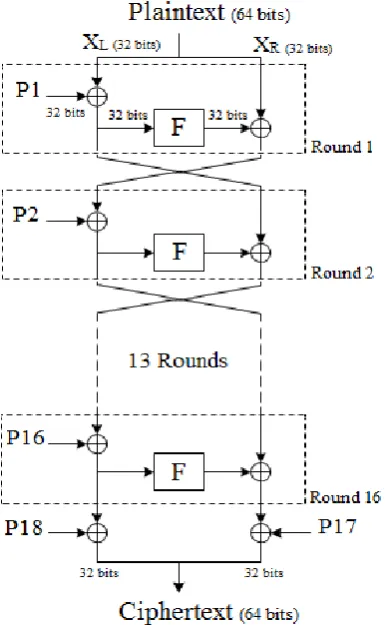
The algorithm consists of two parts: key expansion and dataencryption. The key expansion converts a key of at most 448 bits into several subkey arrays totaling 4168 bytes. The data encryption occurs via a 16-round Feistel network.
Figure 9. Block diagram of Blowfish algorithm
As mentioned previously, Blowfish is aFeistel network consisting of 16 rounds, the inputs are 64-bit
Function F is calculated by Itdivides XL into four eight-bit quarters: a, b, c, andd. These quarters are used as input to the S-boxes.The outputs are added (modulo 232) and XORed toproduce the final 32-bit output. Decryption is exactly same as encryption, except that P1, P2 ... P18 are used in the reverse order.
F(XL)=((S1,+S2,bmod 232)XORS3,c)+S4,d mod232 (1)
The proposed Blowfish design aimed to increase the throughput. Thus, pipeline technique is adopted. The pipeline strategy modifies the critical path by increasing, It consists in parallelizing the data inputs and outputs with the processing.
Figure 10. Function F
algorithm using S-Box is more efficientthan the previous system.
V.
RESULTSBLOCK DIAGRAM
Figure 11 RTL SCHEMATIC
Figure 12
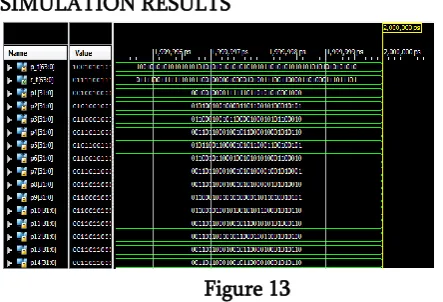
SIMULATION RESULTS
Figure 13
VI.
CONCLUSIONThe aim of paper is design and implementation of the optimized combinational logic based Rijndael S-Box on FPGA. Proposed methodis based on Algorithm, thus it is low power and number of logic gates is very low. The approach used for increase performance is Blowfish Algorithmwe use this design.This method has more speed.
VII.
REFERENCES
[1]. Announcing the Advanced Encryption Standard (AES), Federal Information Processing Standards Publication 197, November 2001. [2]. J. Daernen and V.Rijrnen, "Specification of
Rijndael," in The Design of Rijndael: AES - The Advanced Encryption Standard, Berlin; New York: Springer-Verlag Berlin Heidel- berg, 2002, pp.31-35
[3]. A. Satoh, S. Morioka, K. Takano and S. Munetoh, "Acompactrijndael hardware architecture with S-box optimization," Springer- Verlag Berlin Heidelberg, 2001. [4]. Yibo Fan, Takeshi Ikenaga, YukiyasuTsunoo,
[5]. William Stallings, "Cryptography and Network Security", Third Edition, www.williamstallings.com/Crypto3e.html [6]. P. Chodowiec, P. Khuon and K. Gaj,(2001) "Fast
Implementations of Secret-Key Block Ciphers Using Mixed Inner- and Outer-Round Pipelining," Proc. ACM/SIGDA Int. Symposium on Field Programmable Gate Arrays, FPGA'01, Monterey, CA..
[7]. M. McLoone and J. McCanny,(2001) "Single-chip FPGA Implementation of the Advanced Encryption Standard Algorithm," in Proc. 11th Int. Conf. Field-Programmable Logicand Applications (FPL 2001), LNSC 2147, pp. 152-161.
[8]. N. Sklavos and O. Koufopavlou,(2002) "Architectures and VLSI Implementations of the AES-Proposal Rijndael," IEEE Trans.on Computers, vol. 51, Issue 12, pp. 1454-1459. [9]. J. H. Shim, D. W. Kim, Y. K. Kang, T.W. Kwon
and J. R. Choi,(2002) "A Rijndael Crypto processor Using Shared On-the-fly Key Scheduler,", pp147-150, 2002.
[10]. Refik Sever, A. NeslinIsmailoglu, Yusuf C. Tekmen, Murat Askar, BurakOkcan,(2004)"A High
[11]. w. Stalling, "Cryptography and NetworkSecurity Principles and Practices", Prentice Hall, 4th ed., 2005.
[12]. A. Kahate, "Cryptography and NetworkSecurity", Tata McGraw Hill, 2nd ed., 2007.
[13]. National Institute of Standards andTechnology, Federal Information ProcessingStandards Publication 46-3: Data EncryptionStandard, 1999.
[14]. National Institute of Standards andTechnology, Federal Information ProcessingStandards Publication 197: AdvancedEncryption Standard, 2001.
[15]. D.Joan and R. Vincent, "AES Proposal:Rijndael", National Institute of Standards andTechnology, 1999.
[16]. B.Schneier,"The Blowfish EncryptionAlgorithm-One Year Later", Dr. Dobb'sJournal, 1995.
[17]. B. Schneier, "Applied Cryptography:Protocols,
Algorithms, and Source Code in C,Applied Cryptography", John Wiley
Author’s profile:
V. Venkata sravanthi Received B.tech Degree in (ECE). Currently she is Doing M.tech (VLSI Design) in SHREE Institute of technical education, Tirupati. Her General Area of Interest is Digital design, Testing.