Pattern Comments
IDp1 Expressions headed by a verb taking a direct object NP that consists of a determiner and a singular noun.
IDp2 ...
Table 1: An example of an idiom pattern description.
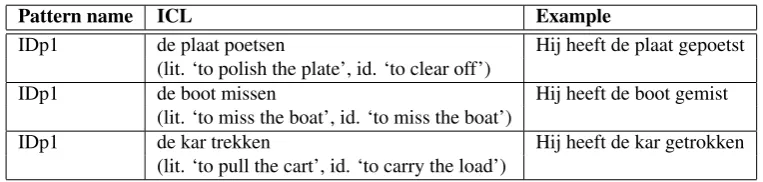
Pattern name ICL Example
IDp1 de plaat poetsen Hij heeft de plaat gepoetst
(lit. ‘to polish the plate’, id. ‘to clear off’)
IDp1 de boot missen Hij heeft de boot gemist
(lit. ‘to miss the boat’, id. ‘to miss the boat’)
IDp1 de kar trekken Hij heeft de kar getrokken
(lit. ‘to pull the cart’, id. ‘to carry the load’)
Table 2: List of idiom descriptions.
cially within the ISLE2 and XMELLT3 projects. Odijk argues that these attempts are unlikely to be successful, because the structures assigned to the MWEs are highly theory-dependent and even within one grammatical frame-work, there will be many differences from implementa-tion to implementaimplementa-tion. Since most syntactic structures are fully specified tree structures, they are difficult to cre-ate and maintain. Copestake et al. (2002) outlined an ap-proach to represent MWEs in a form which can support precise HPSG, and which is also claimed to be reasonably transparant and reusable. Though their approach may work for certain types of MWEs, they fail to come up with a sat-isfying solution for representing idioms.
The parameterized ECM should offer a theory- and implementation-independent solution to the problem of lex-ical representation of idioms.
2.
The Equivalence Class Method for idioms
Instead of describing the structure of an idiom, the ECM re-quires that it is specified which idioms have the same struc-ture.Odijk proposes that an idiom description should consist of the following parts:
1. An idiom pattern name: an identifier that uniquely identifies the structure of the idiom.
2. A list of idiom components (Idiom Component List: ICL).
3. An example sentence that contains the idiom.
The equivalence classes are defined with the help of the idiom patterns, i.e. idioms with the same pattern belong to the same equivalence class. The ICL takes the form of a sequence of strings, each string representing the lexicon citation of an idiom component. The order of the sequence is free, but the standard requires that the same order is used for each idiom in the same equivalence class. As for the
2
www.ilc.cnr.it/EAGLES96/isle/
3
www.cs.vassar.edu/∼ide/XMELLT.html
example sentence, the standard requires that its structure should be identical for each example sentence within the same equivalence class.
Besides the idiom description, there must be a list of idiom pattern descriptions. Each idiom pattern description con-sists of two parts:
1. An idiom pattern.
2. Comments, i.e. free text in which the uniqueness of the pattern is described.
In Table 1 and 2 an illustration is given of the proposed stan-dard. Table 1 shows one idiom pattern description and Ta-ble 2 shows three instances of the same equivalence class, i.e. with the same idiom pattern.
Given a class of idiom descriptions, representations for a specific theory and implementation can be derived. The procedure is that one instance of an equivalence class must be converted manually. By defining and formalizing the conversion procedure, the other instances of the same equivalence class can be converted in a fully automatic manner. In other words, having the equivalence classes consisting of idioms with the same pattern, it requires some manual work to convert one instance of each equivalence class into a system specific representation, but all other members of the same equivalence class can be done in a fully automatic manner.
A potential problem of the ECM as proposed is the risk that the number of equivalence classes will run into thou-sands of which the majority contains only a small number of idioms.4 Since the ECM concentrates on minimizing
the manual work when incorporating a large number of id-ioms in a specific system, the method will be less success-ful if there are many equivalence classes with only a few instances.
In order to reduce the number of equivalence classes and to increase the number of members within each equivalence class, Odijk (2004a) introduced the parameterized equiva-lence classes.
4This problem was also raised by Copestake et al. (2002),
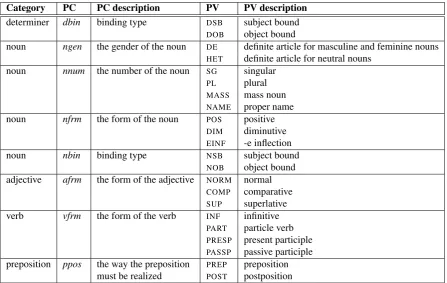
Category PC PC description PV PV description determiner dbin binding type DSB subject bound
DOB object bound
noun ngen the gender of the noun DE definite article for masculine and feminine nouns HET definite article for neutral nouns
noun nnum the number of the noun SG singular PL plural MASS mass noun NAME proper name noun nfrm the form of the noun POS positive
DIM diminutive EINF -e inflection
noun nbin binding type NSB subject bound
NOB object bound adjective afrm the form of the adjective NORM normal
COMP comparative SUP superlative verb vfrm the form of the verb INF infinitive
PART particle verb PRESP present participle PASSP passive participle preposition ppos the way the preposition PREP preposition
must be realized POST postposition
Table 3: Overview of parameters, with descriptions of the parameter category (PC) and the parameter value (PV).
3.
Parameterized ECM
The central idea behind the parameterized ECM is that many idiom patterns describe structures that are for a large part identical. As shown in Table 1, the description of id-iom pattern IDp1for idioms such as de plaat poetsenis: ‘Expressions headed by a verb taking a direct object NP that consists of a determiner and a singular noun.’
In the ECM another idiom pattern such asIDp2is required for entries such as de benen nemen (lit. ‘to take (away) the legs’, id. ‘to escape’): ‘Expressions headed by a verb taking a direct object NP that consists of a determiner and a plural noun.’
And also another idiom pattern such asIDp3is required for idioms such ashet loodje leggen(lit. ‘to lay down the piece of lead’, id. ‘kick the bucket’): ‘Expressions headed by a verb taking a direct object NP that consists of a determiner and a diminutive singular noun.’
The only difference between the three idiom patterns is the form of the noun it requires. The use of parameter-ized equivalence classes reduces the number of idiom pat-terns, i.e. instead of four different unrelated idiom patterns
IDp1...IDp4, one might assume a single idiom patternIDp5
that takes two arguments (parameters), one to specify the number of the noun, and one to specify whether the diminu-tive form should be used.
Reducing the number of idiom patterns means reducing the number of equivalence classes. As a result, the number of idioms that have to be dealt with manually minimizes, whereas the number of idioms that can be incorporated into an NLP system in a fully automatic manner increases.
3.1. An overview of parameters for Dutch
In the previous section, I mentioned four potential param-eters, viz. singular and plural with respect to the number of the noun, and diminutive and positive with respect to the form of the noun. There is, however, more variation within the individual components of idioms, we can parameterize. In this subsection, I give an overview of the parameters ap-plicable to Dutch idioms.
Recall that the main goal of parameterizing the equivalence classes is to reduce the number of classes, yielding less manual work in the conversion procedure. When deter-mining the aspects we want to parameterize, we must take into account (1) many different frameworks and implemen-tations, and (2) the complexity of the aspect and thus the time we gain with the potential parameter, i.e. each pa-rameter added to the method reduces the number of equiva-lence classes, but slightly complicates the conversion from the standard representation into a system specific one. The Rosetta MT system and the Alpino parser5 were used to examine potential parameters. Both Rosetta and Alpino are Dutch NLP systems. Rosetta is the result of seven years of research on machine translation started in 1985 at the Philips Research Laboratories in Eindhoven. This system is meant to translate between English, Dutch and Spanish and has been developed using compositional translation as guiding principle. The type of grammar used in Rosetta is calledM-grammar, a computationally feasible variant of
Montague Grammar.
Alpino is a dependency parser for Dutch, developed in the context of the NWO PIONIER projectAlgorithms for
Lin-guistic Processing. Alpino is based on the Head-Driven
5
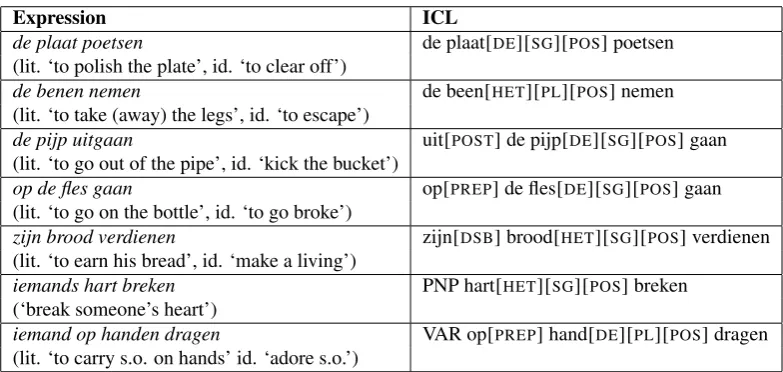
Expression ICL
de plaat poetsen de plaat[DE][SG][POS] poetsen
(lit. ‘to polish the plate’, id. ‘to clear off’)
de benen nemen de been[HET][PL][POS] nemen
(lit. ‘to take (away) the legs’, id. ‘to escape’)
de pijp uitgaan uit[POST] de pijp[DE][SG][POS] gaan
(lit. ‘to go out of the pipe’, id. ‘kick the bucket’)
op de fles gaan op[PREP] de fles[DE][SG][POS] gaan
(lit. ‘to go on the bottle’, id. ‘to go broke’)
zijn brood verdienen zijn[DSB] brood[HET][SG][POS] verdienen
(lit. ‘to earn his bread’, id. ‘make a living’)
iemands hart breken PNP hart[HET][SG][POS] breken
(‘break someone’s heart’)
iemand op handen dragen VAR op[PREP] hand[DE][PL][POS] dragen
(lit. ‘to carry s.o. on hands’ id. ‘adore s.o.’)
Table 4: The ICLs of some idioms extended with parameters.
Phrase Structure Grammar (HPSG).
In this approach, the term parameteris defined as an oc-currence of the pairhparameter category,parameter valuei, where parameter category refers to the aspect we want to parameterize, and parameter value to the value a pa-rameter category takes. Table 3 gives an overview of the parameter categories and corresponding parameter val-ues distinguished in this research. Given the parame-ter categories and parameparame-ter values, parameparame-ters such as hnnum,SGi,hnnum,PLi, andhafrm,SUPican be formed.
3.2. Representation of parameters
The use of parameters in this approach becomes visible in the Idiom Component List (ICL) of the lexical entry of the idiom. Each idiom component in the ICL is represented in thecanonical form. Since each parameter value is unique, i.e. belongs to only one parameter category, we only rep-resent the parameter value of each parameter. The parame-ter values are realized between square brackets directly on the right of the item they parameterize. Because of their uniqueness, there is no restriction on the order of values at-tached to the noun. In the ICL, a preposition-component always precedes its complement, even if it must be real-ized as a postposition. Determiners are represented with the form they take in the idiom, e.g. the determiner is rep-resented as deif the idiom component is a plural definite noun, irrespective of the gender of the noun. In the case of possessive NPs, we use the variable PNP, and VAR is used for obligatory free arguments.
In Table 4 we find some examples of ICLs with parameters. It must be noted that these examples do not necessarily oc-cur in the same equivalence class.
4.
Evaluation
Extending the ECM with parameters contributes to reduc-ing the number of equivalence classes and increasreduc-ing the number of members within each equivalence class. As a result the number of idioms that have to be dealt with man-ually decreases, whereas the number of idioms that can be incorporated into an NLP system in a fully automatic
manner increases. Since the method proposed here catego-rizes idioms into equivalence classes, the successfulness of the method depends on (1) how many different equivalence classes are distinguished (the less the better), and (2) how many instances each equivalence class contains (the more the better).6
In order to determine the effectiveness of the method, I car-ried out measurements on a database of Dutch idioms. The source I used is an electronic version of the Van Dale Id-iom dictionary for Dutch (de Groot, 1999) that contains ap-proximately 6,300 multiword expressions, which includes, besides idioms, also a small number of proverbs and collo-cations.
The measurements include only three- and four-word id-ioms. Since the expressions were not grouped according to their type, all three- and four-word expressions – a total of 2,835 – were extracted from the source.
Next, the Alpino parser was used to assign a part-of-speech tag to the components of each expression. The patterns of the idioms, i.e. the equivalence classes, were determined using these part-of-speech tags. For the purpose of this pa-per, the equivalence classes without a verb were further ig-nored.7 All classes with a verb were manually checked for part-of-speech errors, and expressions with a finite verb in canonical form (usually proverbs) were filtered out. Besides basic part-of-speech tags, Alpino specified other properties, such as the number of the noun, the form of the adjective, etc. This information was used to semi-automatically determine the parameters for each compo-nent within an idiom.
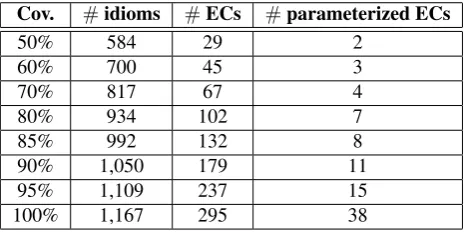
In order to measure the number of equivalence classes with-out parameters, I counted the number of unique parameter combinations from each parameterized equivalence class. For example, in the parameterized ECM the ICL ofde plaat
6The successfulness of the method also depends on the
com-plexity of the incorporation of a parameter into a specific system, which varies from system to system. This point is further ad-dressed in Section 5.
7With the risk that idioms do occur in these classes, due to
of syntactic variation a given idiom can undergo (Sag et al., 2001). More research is needed to give a sophisticated analyses of the syntactic flexibility of Dutch idioms.
7.
Acknowledgements
This research is carried out as part of the IRME project, fi-nanced by STEVIN (http://taalunieversum.org/stevin). The data were kindly provided by Van Dale Lexicografie.
8.
References
Ann Copestake, Fabre Lambeau, Aline Villavicencio, Francis Bond, Timothy Baldwin, Ivan Sag, and Dan Flickinger. 2002. Multiword expressions: Linguistic precision and reusability. In Proc. of the 3rd Interna-tional Conference on Language Resources and
Evalua-tion (LREC 2002), pages 1941–7, Las Palmas, Canary
Islands.
Hans de Groot. 1999. Van Dale Idioomwoordenboek. Van Dale Lexicografie, Utrecht.
M. Everaert, E-J. van der Linden, A. Schenk, and R. Schreuder, editors. 1995. Idioms: Structural and
Psy-chological Perspectives. Lawrence Erlbaum Associates,
Hove, UK.
Geoffrey Nunberg, Ivan Sag, and Tom Wasow. 1994. Id-ioms.Language, 70:491–538.
Jan Odijk. 2003. Towards a standard for multi-word ex-pressions. ISLE Project Report, February.
Jan Odijk. 2004a. A proposed standard for the lexical rep-resentation of idioms. InEURALEX 2004 Proceedings, pages 153–164. Universit´e de Bretagne Sud, July. Jan Odijk. 2004b. Multiword expressions in NLP. Course
presentation, LOT Summerschool, Utrecht, July. M.T. Rosetta. 1994. Compositional Translation. Kluwer
Academic Publishers, Dordrecht.