A Self-Referring Quantitative Evaluation of the
ATR Basic Travel Expression Corpus (BTEC)
Kyo Kageura
†and Genichiro Kikui
‡ †Graduate School of Education, University of Tokyo,7–3–1 Hongo, Bunkyo-ku, Tokyo, 113-0033, Japan. [email protected]
‡ATR Spoken Language Translation Research Laboratories, 2–2–2 Hikaridai, Seika-cho, Soraku-gun, Kyoto, 619-0288, Japan.
Abstract
In this paper we evaluate the Basic Travel Expression Corpus (BTEC), developed by ATR (Advanced Telecommunication Research Laboratory), Japan. BTEC was specifically developed as a wide-coverage, consistent corpus containing basic Japanese travel expressions with English counterparts, for the purpose of providing basic data for the development of high quality speech translation systems. To evaluate the corpus, we introduce a quantitative method for evaluating the sufficiency of qualitatively well-defined corpora, on the basis of LNRE methods that can estimate the potential growth patterns of various sparse data byfitting various skewed distributions such as the Zipfian group of distributions, lognormal distribution, and inverse Gauss-Poisson distribution to them. The analyses show the coverage of lexical items of BTEC vis-`a-vis the possible targets implicitly defined by the corpus itself, and thus provides basic insights into strategies for enhancing BTEC in future.
1. Introduction
In this paper we present a quantitative method for evalu-ating the sufficiency of qualitatively well-defined corpora, and evaluate the Japanese part of the Basic Travel Ex-pression Corpus (BTEC), developed by ATR (Advanced Telecommunication Research Laboratory), Japan. BTEC is a wide-coverage, qualitatively well-examined and con-sistent corpus that contains basic travel expressions with strong orientation toward real world conversation. It was constructed in order to provide basic data for developing high quality speech translation systems (Takezawa, 1999; Takezawa, et. al. 2002), and was used as a basic corpus for the development of speech translation systems at ATR.
Although BTEC has been evaluated as basic data for de-veloping speech translation systems (for instance, Kikui, et. al. (2003) observe the cross-perplexity of BTEC and other corpora), the position of the corpus within the domain of travel conversations has not been examined so far and such an examination is long overdue. As afirst step in this di-rection, we defined a self-referring method for evaluating the status of the corpus quantitatively, and observed some quantitative characteristics of lexical items in BTEC.
2. Basic Framework of Evaluation
Though many evaluations of various aspects of cor-pora have been reported (cf. papers in LREC conferences; Atwell, et. al., 2000; Han, et. al., 2002; Paik, et. al., 2005), there exists no standard procedure for evaluating corpora because different corpora constructed for different aims need to be evaluated from different points of view.
As the main aim of BTEC is to collect basic travel ex-pressions for the development of high quality speech trans-lation systems, the following points of evaluation are espe-cially important:
(1) Sufficiency of the corpus vis-`a-vis the domain of ba-sic travel expressions;
(2) Sufficiency of the corpus for developing application systems (e.g. sufficiency of the corpus as training data for machine learning, etc.).
In the present study we focus on (1), because (a) it is necessary to obtain insight into the status of the corpus in terms of the varieties of real-world travel expressions in order to make strategic decisions about how to extend the corpus, and (b) (2) has been examined more than (1), in relation to the development of application systems.
Ideally, the current status of the corpus should be evalu-ated with respect to the overall range of actual and potential language expressions in the domain of travel conversations. This, however, is unfortunately not possible, because, in its bare state, any real-world language phenomenon is by defi -nition potentially infinite and changes over time. However, there is a way of measuring the current status of a corpus, assuming that it is qualitatively well-designed vis-`a-vis the idiosynchronic state of language. To the extent that a cor-pus qualitatively reflects what is assumed to be the proper characteristics of the whole range of relevant language phe-nomena in a given domain, the corpus itself can provide basic insights into the potential range of relevant language expressions in the domain, at least for the quantitative eval-uation of the corpus.
The basic idea of self-referring quantitative evaluation of a corpus is simple:
(1) Extrapolate the corpus size to infinity and estimate the point of saturation of given points of observa-tion; this can be used as the “model” of the observed language phenomenon within the domain that the corpus addresses;
(2) Evaluate the current status of the corpus vis-`a-vis that saturated “model” point.
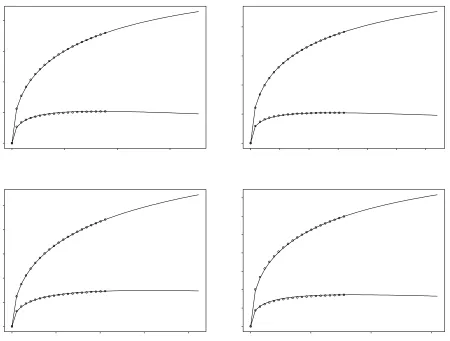
Figure 1. Growth curve of lexical items in BTEC corpus.
type, 144 verb tokens should be added to obtain a new verb type, and 227 adjective tokens should be added to obtain a new adjective type. Alternatively, the existing items should be repeated these numbers of times.
all-words nouns verbs adjs Growth rate 0.00294 0.00815 0.00690 0.00444
Table 4. Growth ratio of BTEC.
Figure 2 traces the transitions in the growth rate up to twice the original BTEC size.Nmeans the BTEC size, and alpha (0.0–2.0) indicates the relative size to the originalN. The lines show, moving from top to bottom, nouns, verbs, adjectives and all-words. The left-hand panel of Figure 2 shows the overall pattern, and the right-hand panel limits the observation range to 0.0–0.03. Although the right-hand panel shows that we can still observe changes in the growth rate in accordance with the corpus size if we observe the transitions up close, the left-hand panel shows that the cur-rent growth rates are in fact very close to zero within the overall transition patterns. If we wish to enrich the vocab-ulary in the corpus, therefore, it may not be a good idea to try to enlarge BTEC in accordance with the same policy used to construct it.
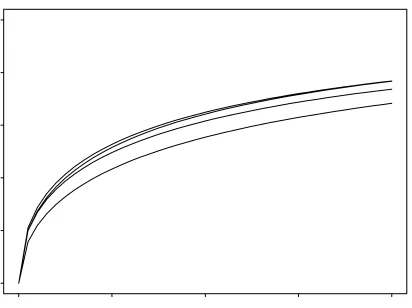
Let usfinally examine the changes in the coverage ratio, which is particularly important when planning the improve-ment and/or enlargeimprove-ment of a corpus. Table 5 and Figure 3 show the transitions in the coverage ratio of all-words, nouns, verbs and adjectives up to twice the original sample size.
token size !all-words !nouns !verbs !adjs 0.5N 51.55% 52.75% 43.35% 49.62% N 64.24% 64.92% 55.46% 61.59% 1.5N 71.67% 71.99% 62.97% 68.75% 2N 76.72% 76.80% 68.31% 73.71%
Table 5. Changes in the coverage ratio.
Figure 2. Growth rate of lexical items in BTEC.
Figure 3. Coverage ratio of lexical items.
instance, assuming for simplicity that the growth of cov-erage does not flatten out further (which is far from the reality), it is still necessary to more than triple the corpus size in order to achieve coverage of 90% for overall lexical items.
Whether this is worthwhile attempting or whether other methods for enriching the lexical coverage should be adopted depends on additional factors concerning the cor-pus. One such factor is the coverage of grammatical or for-mal patterns. To obtain a rough sense of this coverage, we analysed the growth patterns of POS bigrams (151 types in the corpus) as a rough approximation to the status of gram-matical patterns in the corpus, by adopting the second level POS categories of ChaSen. Figure 4 shows the transition in the number of bigram patterns up to BTEC’s current size.
As can be expected from the small number of patterns (151), the growth almost flattens out at BTEC’s current size. In fact, only 5 new bigram patterns occur when the
Figure 4. Transitions in POS bigrams
corpus size is extended from 0.5NtoN. This suggests that covering a greater variety of grammatical patterns would not be a strong driving force for enlarging BTEC in accor-dance with the current construction policy, either.
4.4. Summary of Observations
We have so far depicted the lexical status of BTEC using the following methods:
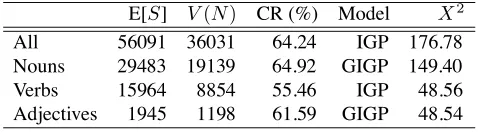
ob-served that at present BTEC covers 64% of the esti-mated population for all words, 65% for nouns, 55% for verbs and 62% for adjectives. We also demon-strated that enlarging the corpus to twice its current size contributes to only about a 12% to 13% cov-erage increase, if we assume that the enlargement is done in accordance with the current BTEC construc-tion policy.
For secondary reference, we also checked the status of grammatical patterns by means of POS bigrams, which suggests the rough saturation of grammatical patterns.
5. Conclusions
By introducing a self-referring method of quantita-tively evaluating qualitaquantita-tively well-designed corpora, we have characterised the current status of the Japanese sec-tion of BTEC. With respect to the methodology, the self-referring method crucially depends on the qualitative well-foundedness of the corpus. If we introduce some sound viewpoints for comparing different corpora using this method, this condition of qualitative well-foundedness on the side of the corpora could be loosened. We would like to examine to what extent this can be done in the next stage, by using other corpora for comparison.
With respect to BTEC, we have only dealt with the Japanese section; examination of the other language sec-tions of BTEC by the same methodology reported here is a task for the immediate future.
In terms of actual examination of the corpus, the obser-vations made in this paper provide some concrete quantita-tive information that can be used when planning the strate-gic enhancement and/or enlargement of BTEC. For this in-formation to be properly used in corpus extension, how-ever, the basic strategic framework should be defined in ad-vance, e.g. how much coverage of lexical items is needed; for what purpose are they to be used; whether the preferable level of coverage could be achieved in the current corpus or could be dealt with by some other means, etc. The same information — an estimated 12% increase in coverage by doubling the corpus, for instance — might well lead to dif-ferent conclusions if these external conditions vary. At this point, we need to go back to the qualitative consideration of corpus construction.
Acknowledgements
This research was supported in part by the National Institute of Information and Communication Technology (NiCT).
References
Atwell, E. et. al. (2000). A comparative evaluation of mod-ern English corpus grammatical annotation schemes. ICAME Journal, 24, 7–24.
Baayen, R. H. (2001). Word Frequency Distributions. Dor-drecht: Kluwer.
Efron, B. and Thisted, R. (1976). Estimating the number of unseen species: How many words did Shakespeare know? Biometrika, 63(4), 435–447.
Good, I. J. (1953). The population frequencies of species and the estimation of population parameters. Biometrika, 40(3), 237–264.
Han, C-H. et. al. (2002). Development and evaluation of a Korean treebank and its application to NLP. Language and Information, 6(1), 123–138.
Kageura, K. (1998). A statistical analysis of morphemes in Japanese terminology. In Proceedings of the 36th An-nual Meeting of the Association for Computational Lin-guistics and 17th International Conference on Computa-tional Linguistics (pp. 638–645).
Kikui, G., Sumita, E. Takezawa, T. and Yamamoto, S. (2003). Creating corpora for speech-to-speech trans-lation. In Proceedings of the 8th European Confer-ence on Speech Communication and Technology (EU-ROSPEECH) (pp. 381–382).
Mizutani, S. (1983). Goi. Tokyo: Asakura.
National Language Research Institute (1958). Research on Vocabulary in Cultural Reviews. Tokyo: National Lan-guage Research Institute.
National Language Research Institute (1989). Research on Vocabulary in School Textbooks. Tokyo: National Lan-guage Research Institute.
Paik, K. et. al. (2005). Quantitative analysis of corpora with different source languages. Journal of Natural Lan-guage Processing, 12(4), 117–136.
Shibuya, M. (2003). Number of categories with a singleton in sample and population. Proceedings of the Institute of Statistical Mathematics, 51(2), 261–295.
Takezawa, T. (1999). Building a bilingual travel conver-sation database for speech translation research. In Pro-ceedings of the 2nd International Workshop on East-Asian Language Resources and Evaluation — Oriental COCOSDA Workshop ’99 (pp. 17–20).
Takezawa, T. et. al. (2002). Toward a broad-coverage bilin-gual corpus for speech translation of travel conversation in the real world. In Proceedings of the 3rd International Conference on Language Resources and Evaluation (pp. 147–152).