Proposal of a Signature Scheme based on
STS Trapdoor
Shigeo Tsujii† Masahito Gotaishi† Kohtaro Tadaki† Ryou Fujita†
† Research and Development Initiative, Chuo University
1–13–27 Kasuga, Bunkyo-ku, Tokyo, 112–8551 Japan
Abstract. A New digital signature scheme based on Stepwise Triangular Scheme (STS) is proposed. The proposed trapdoor has resolved the vulnerability of STS and secure against both Gr¨obner Bases and Rank Attacks. In addition, as a basic trapdoor, it is more efficient than the existing systems. With the efficient implementation, the Multivariate Public Key Cryptosystems (MPKC) signature public key has the signature longer than the message by less than 25 %, for example.
Key words: public key cryptosystem, multivariate polynomial, multivariate public key cryptosystem, stepwise triangular scheme, digital signature
1
Introduction
Various kinds of Multivariate Public Key Cryptosystem (MPKC) are actively developed worldwide. Like traditional cryptosystems such as RSA or ElGamal, MPKCs are used both for encryption and signature. Historically most of them are based on either of the two basic trapdoors:
(i) MI-HFE Trapdoor (Matsumoto, Imai, Patarin)
The development of the first MPKC in the world had been launched around 1983 by Mat-sumoto and Imai [24]. The new cryptosystem, which is widely known as “MatMat-sumoto-Imai cryptosystem” (MI), was proposed in EUROCRYPT in 1988 [25]. MI was successfully crypt-analyzed by Patarin [27]. Patarin has extended the idea of MI further and proposed Hidden Field Equation (HFE) cryptosystem in 1996 [28]. Both MI and HFE are applied to signature schemes, resulting in SFLASH and QUARTZ [7, 31]. Although SFLASH was accepted as one of the final selections for the NESSIE, it was cryptanalyzed by Shamir et al. [14] in 2007. QUARTZ was one of the candidates for short digital signatures of NESSIE, but it consumes so much memory that it is difficult to implement in a practical system.
(ii) STS Trapdoor (Tsujii, et al. Shamir, Kasahara, et al.)
Table 1: Taxonomy of MPKC
Basic Scheme Encryption Signature
MI- MI Scheme A or C∗ [25] SFLASH [7]
HFE Hidden Field Equation [28] QUARTZ [31]
ℓ-IC [11] ℓ-IC− [11]
Square [4] Square-Vinegar [1]
STS Sequential Solution Method [34] Birational
[17, 42] Permutation [32, 19]
TTM [26] TTS [3, 43]
RSE [20], RSSE [21] Our Proposal
Tractable Rational Map [39], TRMS [40]
MFE [41]
UOV Unbalanced
None Oil and Vinegar [23],
Rainbow [10]
published on the Cryptology ePrint Archive [36] in 2004, was cryptanalyzed by Ding et al. in PQCrypto 2008 [12].
Afterwards Kasahara et al. actively published various schemes including RSE, generalizing the concept of Sequential Solution Method [20, 21]. Moh et al. proposed their scheme utilizing the Sequential Solution Method [26, 39, 41]. When Wolf, et al. attacked Kasahara’s scheme with Rank Attack, they specified the family of the cryptosystems which Kasahara’s group proposed as “Stepwise Triangular System” (STS) [42]. Here the family of MPKCs based on the trapdoor of Sequential Solution Method is called “STS scheme” in this paper.
2
Preliminaries
2.1 General Design of MPKC
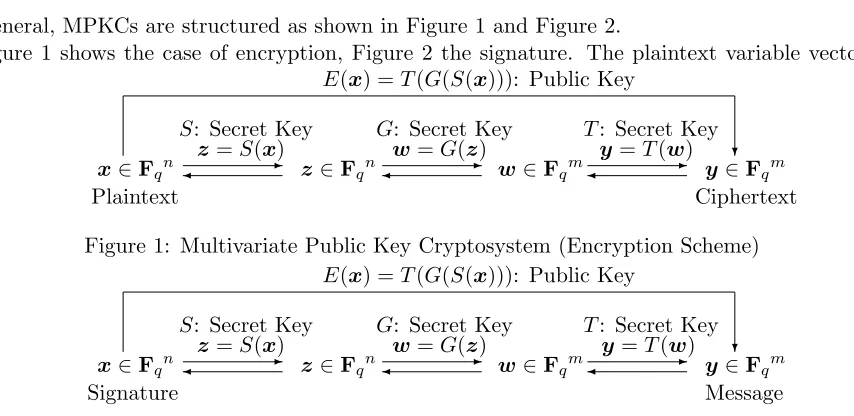
In general, MPKCs are structured as shown in Figure 1 and Figure 2.
Figure 1 shows the case of encryption, Figure 2 the signature. The plaintext variable vector is
x∈Fqn
Plaintext
-z=S(x) S: Secret Key
¾ z∈Fqn
-w=G(z) G: Secret Key
¾ w∈Fqm
-y=T(w) T: Secret Key
¾ ?
E(x) =T(G(S(x))): Public Key
y∈Fqm
Ciphertext
Figure 1: Multivariate Public Key Cryptosystem (Encryption Scheme)
x∈Fqn
Signature
-z=S(x) S: Secret Key
¾ z∈Fqn
-w=G(z) G: Secret Key
¾ w∈Fqm
-y=T(w) T: Secret Key
¾ ?
E(x) =T(G(S(x))): Public Key
y∈Fqm
Message
Figure 2: Multivariate Public Key Cryptosystem (Signature Scheme)
transformed to intermediate variable vector by the initial affine transformationS in the encryption scheme. On the other hand, in signature schemes, it is the message variable vector that is trans-formed. Subsequently, the central map part transforms the intermediate vector with the system of polynomials (usually quadratic) which has some trapdoor structure. Finally, intermediate poly-nomial vector is transformed by the affine transformation T to form the polynomial vector. The resulting polynomial vector is the public key.
2.2 Summary of STS Scheme and its Security
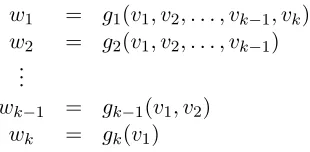
Sequential Solution Method [34] is a cryptosystem for encryption. The equation system obtained by inverting the affine transformation is shown in Figure 3, where the last polynomial is univariate. And the number of variables increases as the sequential number of the polynomial decreases. When the i variables up to vi are obtained by solving the n-th to (n−i+ 1)-th equation, the (n−
i)-th equation becomes univariate by substituting i)-the variables up to vi with solution. The system
is thus solved by solving the sequence of univariate equations one by one, as shown in Figure 3. Random Singular Simultaneous Equation (R(S)SE) cryptosystem [20][21] proposed by Kasahara et al. is a system where the equation is solved by solving eachr-variate determined equation system, instead of the univariate equation. Kasahara et al. published various encryption system for the case ofr= 4 andr = 5. In the case ofr= 4, the legitimate receiver solves the 4-variatedetermined random equation in the L-th step. (L−1)-th step has 4 polynomials with 8 variables. Among them, 4 variables are obtained by solving the 4-variate determined system of equation in theL-th step. In this way, the overall system is solved by solving the subsystems of equation step by step. It should be noted that both RSSE, one of the variants of STS scheme, and MI are bijections, while the majority of MPKCs are not.
w1 = g1(v1, v2, . . . , vk−1, vk)
w2 = g2(v1, v2, . . . , vk−1) ..
.
wk−1 = gk−1(v1, v2) wk = gk(v1)
Figure 3: Non-linear Transformations in the Sequential Solution Method
(i) Vulnerability to the Gr¨obner Bases Attack [6, 15]
It is possible to solve multivariate algebraic equation systems by computing the Gr¨obner bases of the ideal generated by the public key. This is the Gr¨obner bases attack, which successfully cryptanalyzed various MPKCs including HFE [15]. According to the ideal theory, the affine transformation, which seems to effectively disguise the structure of the central map, does not influence the complexity of computing Gr¨obner bases. The structure of the STS polynomials in the central map is vulnerable to Gr¨obner bases algorithm and easily computed. According to our experiments, the time complexity of computing Gr¨obner bases of the STS scheme is roughly the same as MI scheme.
(ii) Vulnerability to the Rank Attack [17, 42]
Since public key and central map polynomials of MPKCs are quadratic, Since elements of the 1st layer have n variables, In the STS scheme where r is 4, the linear space spanned by the central map polynomials has 4 linearly independent polynomials with the rank less than 4. Likewise, it has 8 polynomials with the rank up to 8. If the public key is 100-variatedetermined polynomial system, the linear space spanned by the polynomials has 25 subspaces with the dimension 4. The central map polynomial vector is hidden by the affine transformation T. However, it is possible to compute a transformation equivalent for the inverse transformation T−1. If it is found, low-rank central equations, which are easy to solve, are computed from the public key [17, 42]. Therefore it should be possible to compute the bases of the linear space equivalent for the central map vectors. Although the effectiveness of the Rank Attack should be discussed more in detail, we have to consider the countermeasure against Rank Attack in designing MPKCs. It has been pointed out that STS scheme is also vulnerable to Rank Attack.
3
Enhanced STS Scheme
3.1 The Key Idea
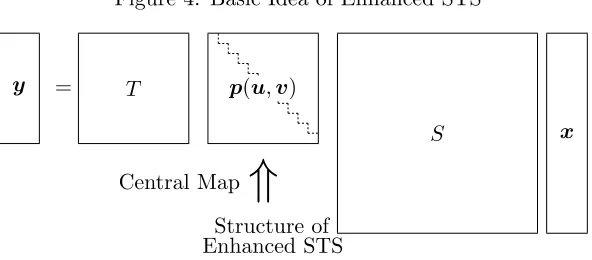
The vulnerability is resolved by combining two symmetric STS schemes. The consequent system does not have difference of ranks and therefore secure against both Gröbner and Rank attacks. Conventional STS is vulnerable because
of the difference of the rank
Figure 4: Basic Idea of Enhanced STS
y = T p(u,v)
⇑
Central MapStructure of Enhanced STS
S x
Figure 5: Structure of Enhanced STS
Figure 5 is to describe the essentials of our idea and therefore we prioritized the understandability over the preciseness, i.e. the definition and description ofu,vis not accurate. Precise definition of polynomials and variables are provided in the next subsection.
3.2 Enhanced STS Trapdoor
Enhanced STS Signature Scheme is described as follows:
u:= (u1, . . . , um) andv:= (v1, . . . , vm−r) are sets of variables. The number of the stepsLis equal
tom/r, hencemmust be divisible byr. Let the polynomial vectorsp∈Fq[u,v]mbe a polynomial
vector described in the formula (1). The length of the variablex(signature length) isn(= 2m−r). Polynomials in the step 1 of p include r variables u1, . . . , ur ∈ u and all variables of v, with the
atm. Hence the polynomials in the last stepL:=m/r have all variables ofuand no variable of v. Step 1
p1(u1, . . . , ur, v1, . . . , vm−r)
.. . pr(u1, . . . , ur, v1, . . . , vm−r)
.. . Step i
p(i−1)r+1(u1, . . . , uir, v(i−1)r+1, . . . , vm−r)
.. .
p(i−1)r+r(u1, . . . , uir, v(i−1)r+1, . . . , vm−r)
.. .
Step L−1
p(L−2)r+1(u1, . . . , um−r, vm−2r+1, . . . , vm−r)
.. .
p(L−2)r+r(u1, . . . , um−r, vm−2r+1, . . . , vm−r)
Step L
p(L−1)r+1(u1, . . . , um)
.. . p(L−1)r+r(u1, . . . , um)
(1)
All polynomials of phave the rankm, but when constant valuec:= (c1, . . . , cm−r) are assigned to
v, the consequent polynomial vectorp′ =p(u,c) has STS structure (formula (2)).
Step 1
p′1(u1, . . . , ur)
.. . p′r(u1, . . . , ur)
.. . Stepi
p′(i−1)r+1(u1, . . . , uir)
.. .
p′(i−1)r+r(u1, . . . , uir)
.. .
StepL−1
p′(L−2)r+1(u1, . . . , um−r)
.. .
p′(L−2)r+r(u1, . . . , um−r)
StepL
p′(L−1)r+1(u1, . . . , um−r, . . . , um)
.. .
p′(L−1)r+r(u1, . . . , um−r, . . . , um)
(2)
The central map of the Enhanced STSwis created by substitutinguwithz1:= (z1, . . . , zm) andv
(z1(x), . . . , zn(x)) is the image of the affine transformationS(x).
w := p(z1,z2) =
p1(z1, . . . , zr, zm+1, . . . , zn)
.. .
pr(z1, . . . , zr, zm+1, . . . , zn)
.. . .. .
pm−2r+1(z1, . . . , zm−r, zn−r+1, . . . , zn)
.. .
pm−r(z1, . . . , zm−r, zn−r+1, . . . , zn)
pm−r+1(z1, . . . , zm)
.. . pm(z1, . . . , zm)
(3)
Finally, the public key yis created by applying affine transformation T to the central map w
y:=T(w) (4)
Public Key:
• Polynomial Vectory
Secret Key:
• Central Mapw
• Affine Transformations S and T
3.3 Signature and Verification
The message m:= (m1, . . . , mm) is signed as follows:
Signature
(i) Apply the inverse affine transformation T−1 to the messagem.
(ii) Substitute each element ofv with random number.
(iii) Since thus computed set of polynomials
p1(u1, . . . , ur), . . . , pm(u1, . . . , um) has the structure of m-variate STS, u is computed by
de-crypting the STS cryptosystem.
(iv) Value of x is computed by inverting the affine transformation S to the vector u||v. Thus obtained vector (s1, . . . , sn) is the signature ofm.
Verification
Signature verification is done by assigning the signature (s1, . . . , sn) to x of the public key and
4
Discussion of the Security
Following attacks for MPKCs should be possible both to encryption and signature schemes:
(i) Gr¨obner Bases Attack [6, 15]
(ii) Rank Attack [17, 42]
(iii) Differential Attack [16, 13, 14]
(iv) Other attacks exploiting other Vulnerability of the Trapdoor
Security against these attacks is discussed.
4.1 Security against Gr¨obner Bases Attack
Besides the constraint on the rank of the two STS systems, quadratic polynomials in the central map are all random. Since coefficients are randomly determined, there is not a structural vulnerability for Gr¨obner Bases algorithm to exploit. Consequently, it is expected that the system is secure against Gr¨obner Bases Attack. The above assumption is validated by experiment by a computer.
4.1.1 Experiment
The above Enhanced STS Signature System is implemented in the script language of Magma, the computational algebra system. The public keys generated by the above program were tested the time complexity of Gr¨obner Bases Attack and compared with the random system of n-variate system with mpolynomials.
Since the signature polynomials are underdetermined, usually Gr¨obner Bases Attacks are done after excess variables are eliminated. In this experiment random values were assigned to the variables xm+1, . . . , xn. Thus obtainedm-variatedetermined polynomial sets are the generators of the ideals.
Computing Environment
We perform the experiments using the computational algebra system Magma. Gr¨obner bases are computed by F4 algorithm implemented in Magma as the functionGroebnerBasis(). The attack is repeated 10 times for each condition. All computer experiments are performed with the following environment:
(i) Computer: Japan Computing System (JCS) VC98220WSA-4U/T workstation, with CPU AMD Opteron 8220 (2.80 GHz) quadcore and 128 Gbyte Memory
(ii) Magma ver. 2.15-15 running on Red Hat Enterprise Linux Advanced Platform Standard. The computation time is counted by the functionCputime() of Magma.
Condition
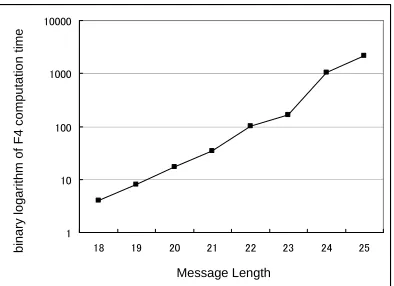
The parameter r is fixed at 4 and the message length m is varied from 18 to 25. The signature lengthnis set 2m−r. The public key is generated under the above condition.
Table 2: F4 computation time vs. the size of the signed messages
F4 Computation Time in Second
Message Enhanced Random
Length STS System
18 4.06 4.32
19 8.05 8.24
20 17.04 16.47
21 34.44 33.25
22 103.41 99.99
23 166.10 159.57
24 1038.48 1020.04
25 2159.80 2125.24
1 10 100 1000 10000
18 19 20 21 22 23 24 25
b in a ry l o g a ri th m o f F 4 co m p u ta ti o n t im e Message Length
Figure 6: Relationship between the size of the message and binary logarithm of F4 computa-tion time
Not only the time complexity of computation increases exponentially as the message length in-creases, the F4 computing time is almost equal to the random system. Hence the signature system is expected to be sufficiently secure against Gr¨obner bases attack.
4.2 Security against Rank Attack
As discussed above, all polynomials in all steps of the central map have the same rank. Since there is not a difference of rank between each polynomial, the public key is entirely inoculate to Rank Attacks.
4.3 Security against Differential Attack
Differential Attack was designed to attack internally perturbed system such as PMI [8] and IPHFE [9], both of which are created by modifying existing trapdoors such as MI and HFE. Since our scheme does not depend on any trapdoors of MI or HFE, it is not applicable.
4.4 Attacks Exploiting Other Vulnerabilities of the Trapdoor
We are going to further investigate its security and discuss whether there is not any such vulnera-bility.
5
Efficiency of the Basic Trapdoor Scheme
the signature as short as a twice of the message. Therefore the implementation of the proposed scheme is expected to be more compact than the Unbalanced Oil and Vinegar. Besides, Oil and Vinegar scheme has the constraint that a product of two Oil variables does not exist. Nevertheless, the proposed scheme is not restricted in such a way.
Consequently, our scheme is closer to random polynomials than existing MPKCs and therefore it should be highly secure. Since the time complexity of attacks increases more steeply than existing systems, use of computing resources such as CPU and memory would be more efficient than the existing MPKC signature schemes.
6
Improvement in the Practical Implementation
The new idea of applying the STS cryptosystem to signature scheme is proposed. The structure of the central map was described above. Here we propose further improvement to employ in implementation. One is to shorten the signature (number of variables) and thereby making the public key more compact. Another one is an idea to further improve the security.
6.1 Further Improving the Efficiency of the Public Key
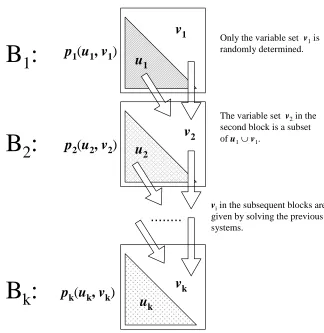
The advantage of the Enhanced STS over existing trapdoors has been described above. Although, the signature is still at least twice (precisely, (2−r/m) times) as long as the message. Now we propose to divide the overall polynomial system into several blocks. The central mapwis divided intok blocksB1, . . . , Bk, each of which has b:=m/k polynomials. Sow:=B1||B2, . . . ,||Bk
:= [p1(u1,v1), . . . ,pk(uk,vk)]T. Each block Bi has the structure of Enhanced STS, where the
polynomial system pi(ui,vi) becomes STS when random values are assigned to vi. The elements
of each block are algebraic function of (ui,vi), where u := u1||u2||. . .||uk. The variable set u1 and v1 are given initially and vi (2 ≤ i ≤ k) is defined such that the (b−r) dimensional linear
space spanned byvi is contained in the one spanned byu1∪v1∪u2. . .ui−1∪vi−1. As illustrated in Figure 7, the value of vi is given by solving all systems B1, . . . , Bi−1. In this case the set of variablesu1∪u2. . .∪uk∪v1. . .∪vkhas the dimensionm+b−r, i.e. the signature length exceeds
the message length byb−r. Therefore the ratio of signature to message length is 1 + (b−r)/m. Generally the system takes the above structure. A message is signed as follows.
6.1.1 Signing a Message
(i) Give random values to the variables v1.
(ii) Equation systemB1, which becomes STS, is solved to find the values of u1.
(iii) Since the value of v1 and u1 is found, v2 is known.
(iv) Step 2 to 3 are repeated until the last block.
p
1(u
1, v
1)
p
2(u
2, v
2)
p
k(u
k, v
k)
...
Only the variable set v1is randomly determined.
viin the subsequent blocks are given by solving the previous systems.
v
1u
1v
2u
2u
kv
kThe variable set v2in the second block is a subset of u1∪v1.
B
1
:
B
2
:
B
k
:
Figure 7: Implementation of Enhanced STS and operation of signing
6.1.2 Example
If a system has the message lengthm= 256 and the STS step sizer= 4, and divided into 4 blocks (k= 4), each block hasm/k= 64 polynomials. Each variable setui has 64 elements andvi has 56.
In this case the signature length is 256 + 64−4 = 316, which is approximately 1.23 times as long as the message. Although characteristic of the finite field is 2 in the above discussion, we think that the base ring should be GF(28). Other environmental factor should have to be considered in the actual implementation.
6.2 Security Improvement by Check Polynomial System
6.2.1 Vulnerability of Underdetermined MPKC signature scheme
STS signature, there can be more than qm−r valid signatures. We propose here a further security improvement by appending extra polynomials.
It should be noted that most of the MPKC signature public keys have subsets of the variable set. Messages are signed by assigning value to the elements of one subset and solving the consequent equation. Therefore typically the structure of the subsets constitutes an important part of the secret key. In the case of Enhanced STS, variables are specified into subsets u and v. Most of the attacks to MPKC signatures are done by finding the elements of the subsets, like done to the Balanced Oil and Vinegar [29]. In case an attack should be developed to distinguish the variables of ufrom the ones of v, the signature scheme is in serious jeopardy.
6.2.2 System of Check Equations
In case even either one of the two linear spaces spanned by the set of vectors u and the one spanned by v should be found by any remote chance, the signatures would be forged by solving the equation. Although, it is possible to further improve its security by limiting the acceptable value of the variables in v. Together with the public key p(x), the system of check equations
g(x) is published. It is specified as a rule that the valid signature must satisfy both the system of equation p(x) = mand g(x) = o. The difference of the signing and verifying procedure between the conventional MPKC signature and the one using the check polynomials is illustrated in Figure 8
6.2.3 Generation of the System of Check Equation
It is possible to create a polynomial set g(x), all elements of which become 0 when v is equal to the pre-defined vector α ∈Fm2 −r. Let f(u,v) ∈F2[u,v]m−r be a set of random polynomials of
x. Then the polynomial setg(x) =f(u,v)−f(α,v) satisfies the condition. The system of check equations is one-time use. The system is renewed every time a message is signed.
Then messages are signed in the following way:
Signing a Message
(i) Invert the Affine transformation T−1 to the messagem
(ii) Assign the value α to the variablesu
(iii) The consequent STS polynomials are solved. The solution is s0 ∈Fn2
(iv) The Affine transformation is inverted to the solution. s:=S−1s0
Verification
(i) It is checked whether p(s) is equal tom
p1(x)
p2(x)
...
pm(x)
p(x)
Public Key
m
Message
p(s)=m s=(s1,s2,,,sn)
Signer
Verifier
p(s)=m
?
(m, s)
(1) Conventional MPKC signature scheme:
There are a number of valid signatures to a given message.
p1(x)
p2(x)
... pm(x)
g1(x)
... g2m-r(x) p(x)
Public Key
m
Message
p(s)=m g(s)=O
s=(s1,s2,,,sn)
Signer
Verifier
p(s)=m
?
g(s)=O?
(m, s)
(2) MPKC signature with check equations:
Most of the solution of the equation are excluded from the set of valid signatures. Only the solution which satisfy the n equations are accepted.
g(x)
Figure 8: Comparison between conventional Signature and the Signature with Check Equation System
7
Conclusion
Based on the above concept, we proposed a signature system where the signature is still shorter. Consequently this system has a compact public key.
We are going to study further to evaluate and improve the proposed system.
Acknowledgment
This work is supported by the Strategic Information and Communications R & D Promotion Programme (SCOPE) from the Ministry of Internal Affairs and Communications of Japan.
References
[1] J. Baena, C. Clough, and J. Ding. Square-Vinegar signature scheme. Proc. PQCrypto 2008, Lecture Notes in Computer Science, Vol.5299, pp.17–30, Springer, 2008.
[2] A. Braeken, C. Wolf, and B. Preneel. A study of the security of unbalanced oil and vinegar signature schemes.Proc. CT-RSA 2005, Lecture Notes in Computer Science, Vol.3376, pp.29– 43, Springer, 2005.
[3] J. M. Chen and B. Y. Yang. A more secure and efficacious TTS signature scheme.Proc. ICISC 2003, Lecture Notes in Computer Science, Vol.2971, pp.320–338, Springer, 2003.
[4] C. Clough, J. Baena, J. Ding, B. Y. Yang, and M. S. Chen. Square, a new multivariate encryption scheme.Proc. CT-RSA 2009, Lecture Notes in Computer Science, Vol.5473, pp.252– 264, Springer, 2009.
[5] D. Coppersmith, J. Stern, and S. Vaudenay. Attacks on the birational permutation signa-ture schemes.Proc. CRYPTO ’93, Lecture Notes in Computer Science, Vol.773, pp.435–443, Springer, 1994.
[6] N. Courtois, M. Daum, and P. Felke. On the security of HFE, HFEv- and Quartz.Proc. PKC 2003, Lecture Notes in Computer Science, Vol.2567, pp.337–350, Springer, 2003.
[7] N. Courtois, L. Goubin, and J. Patarin. SFLASHv3, a fast asymmetric signature
scheme. Cryptology ePrint Archive, Report 2003/211, October 2003. Available at URL: http://eprint.iacr.org/2003/211.
[8] J. Ding. A new variant of the Matsumoto-Imai cryptosystem through perturbation.Proc. PKC 2004, Lecture Notes in Computer Science, Vol.2947, pp.305–318, Springer, 2004.
[9] J. Ding and D. Schmidt. Cryptanalysis of HFEv and internal perturbation of HFE.Proc. PKC 2005, Lecture Notes in Computer Science, Vol.3386, pp.288–301, Springer, 2005.
[10] J. Ding and D. Schmidt. Rainbow, a new multivariable polynomial signature scheme. Proc. ACNS 2005, Lecture Notes in Computer Science, Vol.3531, pp.164–175, Springer, 2005.
[12] J. Ding and J. Wagner. Cryptanalysis of rational multivariate public key cryptosystems. Proc. PQCrypto 2008, Lecture Notes in Computer Science, Vol.5299, pp.124–136, Springer, 2008.
[13] V. Dubois, L. Granboulan, and J. Stern. Cryptanalysis of HFE with internal perturbation. Proc. PKC 2007, Lecture Notes in Computer Science, Vol.4450, pp.249–265, Springer, 2007.
[14] V. Dubois, P. A. Fouque, A. Shamir, and J. Stern. Practical cryptanalysis of SFLASH. Proc. CRYPTO 2007, Lecture Notes in Computer Science, Vol.4622, pp.1–12, Springer, 2007.
[15] J. C. Faug`ere and A. Joux. Algebraic cryptanalysis of hidden field equation (HFE) cryptosys-tems using Gr¨obner bases.Proc. CRYPTO 2003, Lecture Notes in Computer Science, Vol.2729, pp.44–60, Springer, 2003.
[16] P. A. Fouque, L. Granboulan, and J. Stern. Differential cryptanalysis for multivariate schemes.Proc. EUROCRYPT 2005, Lecture Notes in Computer Science, Vol.3494, pp.341–353, Springer, 2005.
[17] L. Goubin and N. Courtois. Cryptanalysis of the TTM cryptosystem. Proc. ASIACRYPT 2000, Lecture Notes in Computer Science, Vol.1976, pp.44–57, Springer, 2000.
[18] S. Hasegawa and T. Kaneko. An attacking method for a public-key cryptosystem based on the difficulty of solving a system of non-linear equations.Proc. 10th SITA, JA5-3, November 1987. In Japanese.
[19] Y. Hashimoto and K. Sakurai. On construction of signature schemes based on birational per-mutations over noncommutative rings. Proceedings of the First International Conference on Symbolic Computation and Cryptography (SCC 2008), pp.218–227, 2008.
[20] M. Kasahara and R. Sakai. A construction of public key cryptosystem for realizing ciphertext of size 100 bit and digital signature scheme. IEICE Transactions on Fundamentals, E87-A, No.1 (2004), 102–109.
[21] M. Kasahara and R. Sakai. A construction of public-key cryptosystem based on singular si-multaneous equations.IEICE Transactions on Fundamentals, E88-A, No.1 (2005), 74–80.
[22] A. Kipnis and A. Shamir. Cryptanalysis of the oil and vinegar signature scheme. Proc. CRYPTO ’98, Lecture Notes in Computer Science, Vol.1462, pp.257–266, Springer, 1998.
[23] A. Kipnis, J. Patarin, and L. Goubin. Unbalanced Oil and Vinegar signature schemes. Proc. EUROCRYPT ’99, Lecture Notes in Computer Science, Vol.1592, pp.206–222, Springer, 1999.
[24] T. Matsumoto, H. Imai, H. Harashima, and H. Miyakawa. A class of asymmetric cryptosystems using obscure representations of enciphering functions. 1983 National Convention Record on Information Systems, IECE Japan, S8-5, 1983. In Japanese.
[26] T. T. Moh. A public key system with signature and master key functions. Communications in Algebra, 27(5), pp.2207–2222, 1999.
[27] J. Patarin. Cryptanalysis of the Matsumoto and Imai public key scheme of Eurocrypt’88. Proc. CRYPTO ’95, Lecture Notes in Computer Science, Vol.963, pp.248–261, Springer, 1995.
[28] J. Patarin. Hidden fields equations (HFE) and isomorphisms of polynomials (IP): two new fam-ilies of asymmetric algorithms. Proc. EUROCRYPT ’96, Lecture Notes in Computer Science, Vol.1070, pp.33–48, Springer, 1996.
[29] J. Patarin. The oil and vinegar signature scheme. Presented at the Dagstuhl Workshop on Cryptography, September 1997. transparencies.
[30] J. Patarin, L. Goubin, and N. Courtois. C−∗+ and HM: Variations around two schemes of T. Matsumoto and H. Imai. Proc. ASIACRYPT ’98, Lecture Notes in Computer Science, Vol.1514, pp.35–49, Springer, 1998.
[31] J. Patarin, N. Courtois, and L. Goubin. QUARTZ, 128-bit long digital signatures.Proc. CT-RSA 2001, Lecture Notes in Computer Science, Vol.2020, pp.282–297, Springer, 2001.
[32] A. Shamir. Efficient signature schemes based on birational permutations.Proc. CRYPTO ’93, Lecture Notes in Computer Science, Vol.773, pp.1–12, Springer, 1994.
[33] S. Tsujii. Public key cryptosystem using nonlinear equations. Proc. 8th SITA, pp.156–157, December 1985. In Japanese.
[34] S. Tsujii, K. Kurosawa, T. Itoh, A. Fujioka, and T. Matsumoto. A public-key cryptosystem based on the difficulty of solving a system of non-linear equations.IEICE Transactions (D), J69-D, No.12 (1986), 1963–1970. In Japanese.
[35] S. Tsujii, A. Fujioka, and Y. Hirayama. Generalization of the public-key cryptosystem based on the difficulty of solving a system of non-linear equations.IEICE Transactions (A), J72-A, No.2 (1989), 390–397. In Japanese. An English translation of [35] is included in [36] as an appendix.
[36] S. Tsujii, K. Tadaki, and R. Fujita. Piece in hand concept for enhancing the security of multivariate type public key cryptosystems: public key without containing all the information of secret key. Cryptology ePrint Archive, Report 2004/366, December 2004. Available at URL: http://eprint.iacr.org/2004/366.
[37] S. Tsujii, K. Tadaki, M. Gotaishi, R. Fujita, and M. Kasahara. Proposal of PPS multivariate public key cryptosystems. Cryptology ePrint Archive, Report 2009/264, June 2009. Available at URL:http://eprint.iacr.org/2009/264 .
[38] S. Tsujii, K. Tadaki, M. Gotaishi, R. Fujita, and M. Kasahara. Proposal of integrated MPKC: PPS — STS enhanced by perturbed piece in hand method —. Technical Report of IEICE, ISEC2009-27, SITE2009-19, ICSS2009-41 (2009-07), July 2009. In Japanese.
[40] L. C. Wang, Y. H. Hu, F. Lai, C. Y. Chou, and B. Y. Yang. Tractable rational map signature. Proc. PKC 2005, Lecture Notes in Computer Science, Vol.3386, pp.244–257, Springer, 2005.
[41] L. C. Wang, B. Y. Yang, Y. H. Hu, and F. Lai. A “medium-field” multivariate public-key encryption scheme.Proc. CT-RSA 2006, Lecture Notes in Computer Science, Vol.3860, pp.132– 149, Springer, 2006.
[42] C. Wolf, A. Braeken, and B. Preneel. Efficient cryptanalysis of RSE(2)PKC and RSSE(2)PKC. Proc. SCN 2004, Lecture Notes in Computer Science, Vol.3352, pp.294–309, Springer, 2004.