On the Broadcast and Validity-Checking
Security of
pkcs
#1 v1.5
Encryption
⋆Aur´elie Bauer1, Jean-S´ebastien Coron2, David Naccache1, Mehdi Tibouchi1,2,⋆⋆, and Damien Vergnaud1
1 Ecole normale sup´erieure – C.N.R.S. – I.N.R.I.A.´
D´epartement d’informatique, Groupe de cryptographie 45, rue d’Ulm,f-75230 ParisCedex 05, France
{aurelie.bauer, david.naccache, mehdi.tibouchi, damien.vergnaud}@ens.fr
2 Universit´e du Luxembourg
6, rue Richard Coudenhove-Kalergi
l-1359 Luxembourg, Luxembourg
Abstract. This paper describes new attacks onpkcs#1 v1.5, a depre-cated but still widely usedrsaencryption standard.
The first cryptanalysis is a broadcast attack, allowing the opponent to reveal an identical plaintext sent to different recipients. This is nontrivial because different randomizers are used for different encryptions (in other words, plaintexts coincide only partially).
The second attack predicts, using asinglequery to a validity checking oracle, which of two chosen plaintexts corresponds to a challenge cipher-text. The attack’s success odds are very high.
The two new attacks rely on different mathematical tools and underline the need to accelerate the phase out ofpkcs#1 v1.5.
Keywords:pkcs#1 v1.5, Encryption, Broadcast Encryption, Cryptanal-ysis.
1 Introduction
pkcsstands forPublic-Key Cryptography Standards[14].pkcsis a large corpusof specifications coveringrsaencryption, Diffie-Hellman key agree-ment, password-based encryption, syntax (extended-certificates, crypto-graphic messages, private-key information and certification requests) and selected attributes. pkcs was initially developed by rsa Laboratories, Apple, Digital, Lotus, Microsoft, mit, Northern Telecom, Novell and Sun
⋆ An extended abstract of this paper will appear atacns2010. This is the full version. ⋆⋆ This research was completed while the fourth author was visiting the Okamoto
and regularly updated since. Today, pkcs has become part of several standards and of a wide range of security products including Internet Privacy-Enhanced Mail.
Amongst thepkcscollection, pkcs#1 v1.5 describes a particular en-coding method forrsa encryption calledrsaEncryption. In essence, the protected data is first encrypted under a randomly chosen key κ using a symmetric block-cipher (e.g. a triple des in cbc mode) then κ is rsa -encrypted (wrapped) with the recipient’s public key.
In 1998, Bleichenbacher [4] published an adaptive chosen-ciphertext attack against pkcs#1 v1.5 capable of recovering arbitrary plaintexts from about half a million ciphertexts. Although active adversary models are generally regarded as theoretical concerns, Bleichenbacher’s attack makes use of an oracle that only detects conformance with respect to the padding format, a real-life assumption that resulted in a practical threat. pkcs#1 v1.5 was subsequently updated (release 2.0 [15]) and patches were issued to users wishing to continue using the old version of the standard. As we write these lines3 and despite its vulnerabilities, pkcs#1 v1.5 is
still widely used. Millions of (patched) pkcs#1 v1.5 programs remain deployed. Provably secure algorithms such as rsa-oaep [10] and rsa-kemare recommended replacements, but not widespread yet [16].
Independently, there exist several well-known chosen-plaintext attacks onrsa-based encryption schemes [7, 5]. These typically enable an attacker to decrypt ciphertexts at moderate cost without factoring the public mod-ulus. The most powerful cryptanalytic tool applicable to low exponent rsa is certainly an attack due to Coppersmith [6]. As a matter of fact, one major reason for adding randomness to encrypted messages4 is to thwart such attacks.
The last publication concerningpkcs#1 v1.5’s security [8] presented a somewhat atypical attack allowing the opponent to retrieve plaintexts ending by enough zero bits.
This paper describes two new weaknesses inpkcs#1 v1.5:
– The possibility to predict,using a single decryption query, which of two chosen plaintexts corresponds to a challenge ciphertext. The at-tack’s success odds are very high.
– A broadcast attack allowing to decrypt an identical message sent to several recipients.
3 November 2009
From a mathematical perspective, the two techniques are totally dif-ferent. The authors regard these as a wake-up call to accelerate the phase out of pkcs#1 v1.5.
2 pkcs#1 v1.5 Encryption
We assume that the reader is familiar with the traditional public-key encryption definitions and security model preliminaries. For the sake of completeness we refer the reader to Appendix A.
2.1 The pkcs#1 v1.5 Encoding Function
pkcs#1 v1.5 describes a particular encoding method (rsaEncryption) forrsaencryption [19]. Consider anrsamodulusN, and letkdenote its byte-length (i.e.28(k−1) < N <28k). Let m be an|m|-byte message with
|m|< k−11. Thepkcs#1 v1.5 paddingµ(m) ofm is defined as follows:
1. A randomizerrconsisting ink−3−|m| ≥8 nonzero bytes is generated uniformly at random;
2. µ(m) =µ(m, r) is the integer converted from the octet-string:
µ(m, r) =000216||r||0016||m (1)
(the leading00octet guarantees that the encryption block is an integer smaller thanN).
The encryption of a messagem of |m|< k−11 bytes is defined as
c=µ(m, r)emodN
for some randomizer r of k−3− |m|nonzero bytes.
To decryptc∈Z∗N, computecdmodN, convert the result to ak-byte
octet-string and parse it according to equation (1). If the string cannot be parsed unambiguously or ifr is shorter than eight octets, the decryption algorithm Doutputs⊥; otherwise, Doutputs the plaintextm.
2.2 Previous attacks on pkcs#1 v1.5
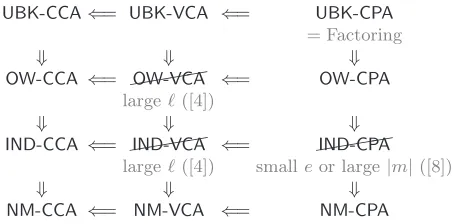
validation queries. This attack established that pkcs#1 v1.5 is not ℓ -GOAL-ATTACK for a large5 ℓ, GOAL ∈ {OW,IND,NM} and ATTACK ∈
{VCA,CCA} (see Appendix A.3 for definitions of these security notions). In 2000, Coron, Naccache, Joye and Paillier [8] introduced two new CPAs on pkcs#1 v1.5. The first attack can be considered as a IND-CPA when e is small (for plaintext ending by sufficiently many zeroes). The second attack applies to arbitrarye, provided that|m|is large and most message bits are zeroes. Thuspkcs#1 v1.5 is notGOAL-CPAfor a small
eor a large |m|, forGOAL∈ {IND,NM}.
UBK-CCA⇐= UBK-VCA ⇐= UBK-CPA
= Factoring
⇓ ⇓ ⇓
OW-CCA ⇐= ((( (
OW-VCA ⇐= OW-CPA
largeℓ([4])
⇓ ⇓ ⇓
IND-CCA ⇐= ((( (
IND-VCA ⇐= ((( (
IND-CPA
largeℓ([4]) smalleor large|m|([8])
⇓ ⇓ ⇓
NM-CCA ⇐= NM-VCA ⇐= NM-CPA
Fig. 1.pkcs#1 v1.5 Security
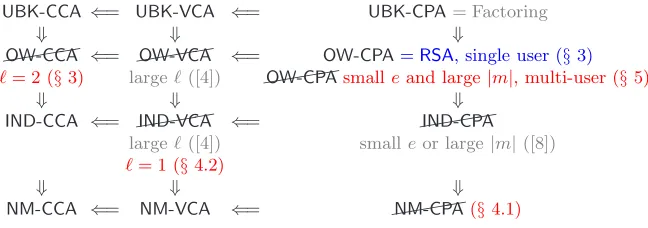
The previous crytanalytic results are summarized in Figure 1. UBK-CPA is equivalent to Factoring but establishing the UBK-VCAand UBK-CCAsecurity is equivalent to proving (or refuting) the equivalence of the factoring and the RSAProblem (which is a long-standing open question in cryptography). In the rest of the paper, we will study the remaining security notions and prove that pkcs#1 v1.5 is:
– OW-CPAassuming the intractability of theRSAproblem (§ 3); – notOW-CCAfor ℓ= 2 (§ 3);
– notNM-CPA(§ 4.1);
– notIND-VCAforℓ= 1 (§ 4.2);
– notOW-CPAin a multi-user setting (§ 5).
3 On pkcs#1 v1.5’s OW-CPA-Security
In this paragraph, we prove the following result:
5 3·105< ℓ <2·106 for 512<log
Proposition 1. The OW-CPA security of pkcs#1 v1.5 is equivalent to the RSA Problem.
In [9, Lemma 2], Coron, Joye, Naccache and Paillier proved that for suitable parameters, the existence of an algorithm that on input y ∈
Z∗N outputs the k1 least significant bits of ydmodN is equivalent to
the existence of an rsainverter. Following their approach, we prove the following lemma:
Lemma 1. Let A be a OW-CPA-adversary against pkcs#1 v1.5 with success probability ε within time τ, with uniformly distributed messages of (maximum) length k−11. There exists an algorithm B that solves the RSA Problem with success probability ε′ within time τ′, where:
(
ε′ ≥η2·ε2−2−kε
τ′ ≤2·τ+poly(k)
where η is a constant independent of k and η≥5·10−8.
Proof. Let Abe aOW-CPA-adversary againstpkcs#1 v1.5 with success probability ε within timeτ. We construct an algorithm B that on input
y∈Z∗N outputsyd with success probabilityε′ within timeτ′:
1. Bpicks α∈Z∗
N uniformly at random;
2. Bsets y0 =y and y1 =y·αe
3. Let us denote, fori∈ {0,1}:
ydi =ωi·2β+mi
with β = 8(k−11). yi is a valid pkcs#1 v1.5 ciphertext if ωi =
0002||ri||00 whereri is a 8-(nonzero)-octet string. This happens with
probability η ≥ (255/256)8 ·2−24. If this happens, then with
proba-bilityε,Awill returnmi on input yi (for i∈ {0,1}).
4. Therefore with probability at least (ηε)2, we obtain:
α(ω0·2β+m0) =ω12β+m1 modN.
Lettingc1 = 2−β(αm0−m1) modN, we get the equation in (ω0, ω1):
ω1−α·ω0 =c1 modN (2)
From [9, Lemma 3], there exists an algorithm that given this system will output a solution (ω0, ω1) (should such a solution exist) with
Using the same technique, this can be extended to messages of differ-ent length, with a possibly higher constant loss in the reduction.
As a byproduct of the previous proof one immediately gets that:
Proposition 2. pkcs#1 v1.5 is not2-OW-CCA.
Proof. Thanks torsa’s homomorphic properties, an adversary can mask the challenge ciphertext c as c′ = cre for some random r and with two
decryption oracle queries, compute thee-th rootx′ofc′as in the previous proof. Then x = x′/r is the e-th root of c from which, the adversary
retrieves readily the plaintext. ⊓⊔
4 pkcs#1 v1.5 Malleability and Indistinguishability
We now show thatµis neitherNM-CPA-secure norIND-VCA-secure. The general idea is the following. Let m be some message to be encrypted, and µ(m) a correspondingpkcs#1 v1.5 padded encryption block. If m has Z > 2 trailing zero bits, then µ(m) is divisible by 2Z, and µ(m)−
µ(m)/2Z modN has a good probability of still being a valid encryption
block. This is not usually the case when theZ lsbs ofmare not all zero. Let c= µ(m)emodN be a ciphertext of some message m. If m has
Z > 2 trailing zeroes, c′ = c·(1 −2−Z)emodN will often be a valid
ciphertext of some other message m′ which can be related to m: this contradicts non-malleability under chosen plaintext attack. Moreover, if one is granted onequery to a validity oracle, it is possible to distinguish ciphertexts of plaintexts with trailing zeroes and ciphertexts from plain-texts whose lsbs are not all zero: this contradicts indistinguishability under validity checking attack. Note that ifiqueries are allowed, the dis-tinguishing success odds can quickly approach one by iterating the test withc′
i =c·(i−2−Z)emodN fori= 1,2, . . .
We will develop this idea in further detail in the coming sections.
4.1 On pkcs#1 v1.5’s NM-CPA Security
Let kbe the byte-size of N,Z = 4k, andM a positive integer such that
M +Z+ 1 is a multiple of 8 and (M +Z + 1)/8< k−11. We consider messages of the following form:
m= m¯ |{z}
M bits
k12k 0· · ·02
| {z }
Let M denote the uniform distribution over messages of this form. Furthermore, we define a relation R over messages of length l = M +
Z+ 1 as follows: for anyl-bit two messagesm1, m2 (not necessarily of the
previous form), R(m1, m2) holds if and only if the M msbs of m1 and
m2coincide. In particular, for any given messagem2, there is exactly one
m1∈ M such thatR(m1, m2).
Now, considerm← M. We can writeµ(m)·(1−2−Z) as:
000216krk0016km¯k12k0· · ·02
− 000216krk0016km¯k12
=000216krk0016km¯k02ksome digits· · · some digits
Hence, µ(m)·(1 −2−Z) = µ(m′) for some message m′ 6= m such that
R(m, m′).
Consider, theNM-CPAadversaryAwhich outputs sampling algorithm
M in the setup stage, and transforms a challenge ciphertext c into c′ =
c·(1−2−Z)emodN.A’s advantage is:
AdvNM-CPAA = Pr[R(m, m′)]−Pr[m0← M$ ;R(m0, m′)] = 1−2−M ≥1/2
which is non-negligible. Therefore, pkcs#1 v1.5 encryption is not NM-CPA-secure.
Noted thatA’s advantage is, in fact∼1. For a 1024-bit modulus and a 128 bit randomizer, we have M = 383, making it exceedingly unlikely that Awill ever fail.
4.2 On pkcs#1 v1.5’s IND-VCA Security
We now show how to contradict ciphertext indistinguishability under va-lidity checking attack using a single oracle query. There are two natural types of validity oracles: one which determines whether a given query is a valid ciphertext associated to a plaintext of any length, and the other which also checks message length. We can always contradict IND-VCA-security in the non-length-checking case (which is the one considered in Bleichenbacher’s attack [4]) with a single oracle query. Furthermore, if the byte-length of the randomizer is constant, as permitted by the pkcs#1 v1.5 standard, it is also possible to breakIND-VCA-security with a single query to a length-checking oracle. Both attacks stem from the following result.
Proposition 3. Let c = µ(m)emodN be the ciphertext associated to
some byte-string message m, ω the byte-length of the randomizer and
1. If the least significant nibble of m is not 016, then c′ is never a valid
ciphertext.
2. If m is a message consisting of a string of 0016 bytes, then c′ is a
valid ciphertext with probability at least 0.47. c′ is a valid ciphertext
corresponding to a message of the same length as m with probability at least:
64 1445
239 255
ω−1
Proof. Starting with the first assertion, consider a message m such that
c′ is a valid ciphertext. This implies that µ(m)−µ(m)·2−4 modN is a valid encoding string that, in particular, begins with the same 000216
pattern asµ(m).
If, for an integerx, we denote by ¯x the only integer in (−N/2, N/2) such thatx≡x¯ mod N, it follows that:
|µ(m)·2−4 modN|<28k−16
Consider the setS of residue classesxmodN such that|x¯|<28k−16. Clearly, |S|= 28k−15−1. On the other hand, let T+be the set consisting ofk-byte strings of the form00016kuk016, and T be the union of T+and
−T+ (where opposites are taken modN). We also have |T|= 28k−15−1 and T maps into S under multiplication by 2−4modN. Since multipli-cation by 2−4 is a permutation ofZN, we infer that (y·2−4 modN)∈S
if and only if y∈T.
In particular, ifc′ is a valid ciphertext, we getµ(m)∈T. By inspection of its top bits, we see thatµ(m) cannot be in−T+, so it has to be inT+. Its least-significant nibble must thus be016 as required.
Turning now to the second assertion, let m be the zero-message of some fixed byte-length. Write the encryption block µ(m) as follows:
µ(m) =000216kr2ω−1kr2ω−2k · · · kr1kr0k0016k00· · ·0016
wherer0, . . . , r2ω−1 are randomizer’s nibbles. Recall that the randomizer
bytesr2jkr2j+1 are chosen uniformly and independently at random in the
range 0116, . . . , FF16.
Assuming that r2ω−1 is at least 4 (which happens with probability
(256−4×16)/255 = 64/85, and which we will henceforth assume), we can write (1−2−4)µ(m) as:
000216kr2ω−1kr2ω−2k · · · kr1kr0 k 0016 k00· · ·0016
−000016k 216 kr2ω−1k · · · kr2kr1 kr0k016k00· · ·0016
wherer′j ≡rj−rj+1−κj mod 16 for some carry bit κj.
Then,µ′= (1−2−4)µ(m) is a valid encoding block if and only if the first 8 randomizer bytes, namely r′2ω+1−2jkr′2ω−2j, j = 1, . . . ,8, are all nonzero.µ′ is a valid encoding block for a message of the same length as
m (or for short, “strongly valid”) if and only ifs= 0 and all the padding bytes r′2j+1kr2j′ , j = 0, . . . , ω−1, are nonzero. We will find an explicit lower bound for the probability of these events.
Note first that a sufficient condition for r2j+1′ kr′2j to be nonzero is that r′
2j+1 6= 0. This nibble is zero if and only ifr2j+2 ≡r2j+1−κ2j+1.
Nowr2j+2 is picked independently ofr2j+1, since they belong to different
bytes; it is also independent ofκ2j+1, which only depends on lower order
bytes. Consequently:
Pr[r′2j+1 = 0] =
15
X
ρ=0
Pr[r2j+2 =ρ]·Pr[r2j+1−κ2j+1 ≡ρ mod 16]
≤max
ρ Pr[r2j+2 =ρ] =
16 255
and this bound still holds conditionally to any assignment of the lower order nibbles r′
2i+1,i < j. Therefore:
Pr[µ′ is valid]≥Pr[r2ω−1≥4∧r2ω′ −3 6= 0∧r′2ω−5 = 06 ∧ · · · ∧r2ω′ −156= 0]
≥ 6485 ·
1− 16 255
7
≥0.47
Furthermore:
Pr[µ′ is strongly valid]≥Pr[r2ω−1 ≥4∧r2ω′ −3 6= 0∧ · · · ∧r1′ 6= 0∧r0= 0]
≥ 6485 ·
1− 16
255 ω−1
·25515 = 64 1445 ·
239 255
ω−1
The corresponding validity assertions forc′ follow immediately. ⊓⊔
Consider the IND-VCA adversary A defined as follows. In the setup stage, A outputs two equal-length messages m0, m1 with m1 not
zero-terminated (e.g.00· · ·000116) andm0consisting of0016bytes only. Then,
upon receiving a challenge ciphertext c = µ(mb)emodN, A makes a
single oracle query and outputs b′ = 0 or 1 according to whether c′ =
c·(1−2−4) modN is a valid ciphertext or not. Its advantage is then: AdvIND-VCAA = Pr[b′= 0|b= 0]−Pr[b′ = 1|b= 0] = Pr[b′ = 0|b= 0]−0
≥
(
0.47 if the oracle doesn’t check message length
64 1445· 239255
ω−1
which is non-negligible. In the length-checking case, it is over 2.8% (resp. 1.6%) for 64-bit (resp. 128-bit) randomizers.
In the non-length-checking case, we can obtain an even better advan-tage usingc′ =c·(1−2−8) modN (shifting by 8 bits instead of 4). The proof works similarly provided that N satisfiesN > 28k−7, which is not required by thepkcs#1 v1.5 standard but is usually verified in practice. This yields an advantage of at least:
252 255 ·
254 255
7
>0.96
5 Broadcast Attacks on pkcs#1 v1.5
We now examine the security ofpkcs#1 v1.5 in a multiple users context. In such a scenario, i.e. when broadcast encryption is performed, the sender wishes to transmit the same message m to ℓ parties P1, . . . , Pℓ.
As each party has its own key pki = (e, Ni) (with a common public
exponent e), the sender encrypts m using all the pki’s and sends the resulting ciphertextsc1, . . . , cℓto the corresponding recipients. It has long
been known that textbook rsa encryption should not be used in such a context, since an attacker can easily recover the plaintext using the Chinese Remainder Theorem as long as ℓ ≥ e. Therefore, m has to be padded before applying the rsa function, and the padding has to be different for each recipient.
In 1988, H˚astad [11] showed that using different linear paddingsµi(m)
for all parties is not enough to guarantee security. Indeed, wheneis small,
eciphertexts are again sufficient to efficiently recovermprovided that the encoding functions µi are known to the attacker. To achieve this result,
H˚astad expressed the attack in terms of finding small roots of a uni-variate modular polynomial, which he accomplishes using Coppersmith’s techniques [6].
H˚astad’s attack does not apply to pkcs#1 v1.5, since the padding used for a given recipient is random, and is thus unknown to an attacker. The following sections will overcome this difficulty. Our main result is as follows:
Proposition 4. Let c1, . . . , cℓ be ℓ pkcs#1 v1.5 ciphertexts of the same
message m, of byte length |m|. Each ci is encrypted for a receiver
hav-ing pki = (e, Ni). All Ni are k-byte long. Then there exists a heuristic
algorithm which, given c1, . . . , cℓ, outputsm, if:
ℓ > e|m|
Its complexity is polynomial ine,|m|andkbut exponential in the number of ciphertexts ℓ.
We describe this algorithm in the coming sections. The core idea is to reduce the problem to finding small modular roots of a multivariate poly-nomial equation, which can be achieved using a standard generalization of Coppersmith’s techniques. As usual, this generalization relies on an assumption concerning independence between polynomials, which makes the algorithm heuristic.
5.1 The Multivariate Polynomial of Broadcast pkcs#1 v1.5
Recall (section 2.1) that to encrypt messagemfor recipientPi, apkcs#1
v1.5 sender first generates an |ri|-byte randomizerri, and then computes
the encoding function:
µ(m, ri) =000216krik0016km
Numerically, this gives:
µ(m, ri) =m+ 28|m|+8ri+ 28|m|+8|ri|+9
The ciphertext ci is then computed asci =µ(m, ri)emodNi.
Consider then an adversary A who obtains c1, . . . , cℓ. Since the Ni
are of the same size, the randomizers ri have a common byte length |r|.
Therefore, the ciphertexts collected byA can be written as:
c1= (m+Ar1+B)e modN1, . . . , cℓ= (m+Arℓ+B)e mod Nℓ
where A = 28|m|+8 and B = 28|m|+8|r|+9. Obviously, the N
i are pairwise
co-prime (otherwise, the factorization of some of the Ni could easily be
recovered). Thus, the Chinese Remainder Theorem ensures that the previ-ous equations can be rewritten as a single congruence modN =N1· · ·Nℓ:
u1c1+· · ·+uℓcℓ=u1(m+Ar1+B)e+· · ·+uℓ(m+Arℓ+B)e mod N
where the constantsu1, . . . , uℓ are given by the extended Euclidean
algo-rithm. It follows that the tuple (m, r1, . . . , rℓ) is a root of the multivariate
modular polynomial:
f(x, y1, . . . , yℓ) =u1(x+Ay1+B)e+· · ·+uℓ(x+Ayℓ+B)e−C mod N
where C = u1c1 +· · ·+uℓcℓ. This root is small in the sense that all
of its components are bounded by quantities that are small compared to N: m is smaller than 28|m| and each r
i is bounded by 28|r|. Under
suitable conditions on |m| and |r| which will be detailed below, it will thus become feasible to recover this root, and hence m, in polynomial time using Coppersmith’s techniques, as recalled in Appendix B.
In particular, we show in section B.3 that the lattice construction of Jochemsz and May [13] yields a heuristic polynomial time algorithm for recovering the small root of f under the following condition:
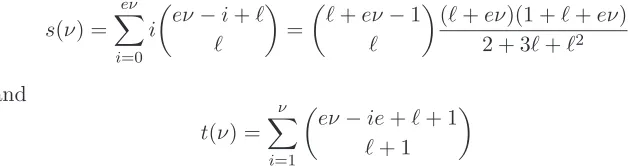
ℓ|r|+|m|< t(ν) s(ν)·ℓk
where ν is a parameter which determines the attack’s complexity, and
s(ν), t(ν) are defined as:
s(ν) =
eν
X
i=0
i
eν−i+ℓ ℓ
=
ℓ+eν−1
ℓ
(ℓ+eν)(1 +ℓ+eν) 2 + 3ℓ+ℓ2
and
t(ν) =
ν
X
i=1
eν−ie+ℓ+ 1
ℓ+ 1
We also prove in the same section that t(ν)/s(ν) → 1/e as ν tends to +∞, so that the best achievable bound on |m| and |r| for which the attack applies is:
ℓ|r|+|m|< ℓk e
Since |r|=k− |m| −3 in pkcs#1 v1.5 we obtain the bound announced in Proposition 4. As usual when using Coppersmith’s techniques, the complexity of the attack is polynomial in the dimension of the constructed lattice and in the size of the entries (see Appendix B for details on these parameters).
Givenpkcs#1 v1.5’s widespread use and the heuristic nature of mul-tivariate Coppersmith-like techniques, it is important topractically assess our attack. We report practical experiment results in Appendix C.
6 Conclusion
UBK-CCA ⇐= UBK-VCA ⇐= UBK-CPA= Factoring
⇓ ⇓ ⇓
(((
(
OW-CCA ⇐= ((( (
OW-VCA ⇐= OW-CPA=RSA, single user (§3) ℓ= 2 (§3) largeℓ([4]) (((
(
OW-CPAsmalleand large|m|, multi-user (§5)
⇓ ⇓ ⇓
IND-CCA ⇐= (IND-VCA((( ⇐=
(((
(
IND-CPA
largeℓ([4]) smalleor large|m|([8])
ℓ= 1 (§4.2)
⇓ ⇓ ⇓
NM-CCA ⇐= NM-VCA ⇐= ((( (
NM-CPA(§4.1)
Fig. 2.Updated Security Status forpkcs#1 v1.5
References
1. O. Baudron, D. Pointcheval, J. Stern,Extended notions of security for multicast public key cryptosystems, inAutomata, Language and Programming, lncs, vol. 1853, Springer-Verlag, 2000, pp. 499–511.
2. M. Bellare, A. Boldyreva, S. Micali,Public-key encryption in a multi-user setting: Security proofs and improvements, Proceedings of Eurocrypt 2000,lncs, vol. 1807,
Springer-Verlag, 2000, pp. 259–274.
3. M. Bellare, A. Desai, D. Pointcheval and P. Rogaway,Relations among notions of security for public-key encryption schemes, Proceedings of Crypto 1998,lncs, vol. 1462, Springer-Verlag, 1998, pp. 549–570.
4. D. Bleichenbacher,Chosen ciphertext attacks against protocols based on thersa encryption standard, Proceedings of Crypto 1998,lncs, vol. 1462, Springer-Verlag, 1998, pp. 1–12.
5. D. Coppersmith,Finding a small root of a univariate modular equation, Proceed-ings of Eurocrypt 1996,lncs, vol. 1070, Springer-Verlag, 1996, pp. 155–165. 6. D. Coppersmith, Small Solutions to Polynomial Equations, and Low Exponent
RSA Vulnerabilities, Journal of Cryptology, 10(4), 1997, pp. 233–260.
7. Y. Desmedt, A.M. Odlyzko, A chosen text attack on thersa cryptosystem and some discrete logarithm schemes, Proceedings of Crypto 1985, lncs, vol. 218, Springer-Verlag, 1985, pp. 516–522.
8. J.-S. Coron, D. Naccache, M. Joye and P. Paillier, New attacks onpkcs#1 v1.5 encryption, Proceedings of Eurocrypt 2000,lncs, vol. 1807, Springer-Verlag, 2000, pp. 369–381.
9. J.-S. Coron, D. Naccache, M. Joye and P. Paillier, Universal Padding Schemes for rsa, Proceedings of Crypto 2002, lncs, vol. 2442, Springer-Verlag, 2002, pp.
226–241.
10. E. Fujisaki, T. Okamoto, D. Pointcheval and J. Stern,rsa-oaepis secure under thersaassumption, Journal of Cryptology, 17(2), 2004, pp. 81–104.
11. J. H˚astad,Solving simultaneous modular equations of low degree,siamJournal on Computing, vol. 17(2),siam, 1988, pp. 336–341.
12. N. Howgrave-Graham,Finding small roots of univariate modular equations revis-ited, Proceedings of Cryptography and Coding,lncs, vol. 1355, Springer-Verlag,
13. E. Jochemsz, A. May,A strategy for finding roots of multivariate polynomials with new applications in attackingrsa variants, Proceedings of Asiacrypt 2006, lncs, vol. 4284, Springer-Verlag, 2006, pp. 267–282.
14. B. Kaliski, pkcs#1: rsa Encryption Standard, Version 1.5, rsa Laboratories,
November 1993.
15. B. Kaliski, pkcs#1: rsa Encryption Standard, Version 2.0, rsa Laboratories, September 1998.
16. B. Kaliski,rsaLaboratories, personal communication, October 2009.
17. A. K. Lenstra, H. W. Lenstra and L. Lov`asz,Factoring polynomials with rational coefficients, Math. Annalen, vol. 261, pp. 513–534, 1982.
18. D. Pointcheval, Provable security for public-key schemes, inContemporary cryp-tology, Advanced courses in mathematics, Birkh¨auser Basel, 2005, pp. 133–190. 19. R.L. Rivest, A. Shamir, L. Adleman, A method for obtaining digital signatures
and public-key cryptosystems, Communications of theacm, vol. 21(2),acm, 1978,
pp. 120–126.
A Preliminaries
In this appendix we recall a few basic definitions necessary for an accurate description of our attack:
A.1 Public-Key Encryption
A Public-Key Encryption Scheme P = (K,E,D) is a collection of three (probabilistic) algorithms:
A Key Generation Algorithm K: Given a security parameter k∈N,
the algorithm K produces a pair (pk,sk) of matching public and private keys (which implicitly define a message space M).
An Encryption Algorithm E: Given a message m∈ M and a public
key pk,E produces a ciphertextc=E(pk, m).
A Decryption Algorithm D: Given a ciphertextcand the private key
sk,D(sk, c) recovers a plaintext m or a special symbol⊥∈ M/ .
For all m ∈ M and for properly generated {pk,sk}, the following correctness condition holds:
D(sk,E(pk, m)) =m
A.2 rsa Encryption
In [19], the algorithm K produces a pair (pk = (N, e),sk = d) where
N = pq is the product of two large primes and e and d are such that
ed= 1 modϕ(N). The encryption of a messagem∈ M=Z∗
N, is simply
c=memodN. ccan be easily decrypted usingd:m=cdmodN.
A.3 Security Definitions
Security is traditionally defined by combining an adversarial goal and an attack model. We refer to classical texts on provable security, such as [18], for precise statements of security definitions. Intuitively, a public-key encryption schemeP is:
Unbreakable (UBK) If no adversaryA can computesk given pk.
One-Way (OW) If no adversaryAcan recover m∈ Mgiven cand pk.
Indistinguishable (IND) If no adversaryAcan derive significant
infor-mation aboutm∈ Mgiven onlycandpk.INDis sometimes alternatively referred to as ”semantically secure”.
Non-Malleable (NM) If no adversaryAcan, produce, given cand pk,
a new ciphertext corresponding to a plaintext m′ meaningfully related to
m.
In the above, ”no adversary” should be read as ”an efficient adversary succeeding with a significant probability”. The terms ”efficiently”, ”signif-icant probability”, ”signif”signif-icant information” and ”meaningfully related” admit formal definitions which are beyond our scope.
Security notions for encryption schemes are obtained by combining an adversarial goal with anattack model:
Chosen-Plaintext Attack (CPA) A is given nothing more thanpk.
Validating-Checking Attack (VCA) A is given access to a
validity-checking oracle indicating only if a given ciphertext is a valid or not (i.e.
Chosen-Ciphertext Attack (CCA) Ahas access to a decryption
ora-cle.
Whenever oracle access is used A cannot submit to the oracle the challenge ciphertext he has to attack. These definitions are classical and we refer the reader to [18] for more details.
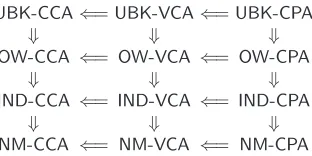
We denote security notions positively:e.g.OW-VCA[S] is the problem of contradicting the one-wayness of schemeS under validity-checking at-tack. This convention permits the easy description of hierarchies between security notions using reductions (see Figure 3). When oracle access is permitted (i.e.either forVCAorCCA), we denote byℓ-GOAL-ATTACK[S] the problem of contradicting GOAL∈ {UBK,OW,IND,NM} in less than
ℓoracle queries under an ATTACK∈ {VCA,CCA}.
UBK-CCA⇐=UBK-VCA⇐=UBK-CPA
⇓ ⇓ ⇓
OW-CCA ⇐= OW-VCA ⇐= OW-CPA
⇓ ⇓ ⇓
IND-CCA ⇐= IND-VCA ⇐= IND-CPA
⇓ ⇓ ⇓
NM-CCA ⇐= NM-VCA ⇐= NM-CPA
Fig. 3.Public-Key Encryption Security Hierarchy
A.4 rsa Security
Single UserrsaSecurity rsaencryption isUBK-CPA-secure assuming the hardness of factoring. Contradictingrsa’sOW-CPAsecurity is known astheRSAProblem and is believed to be intractable.
rsa’s determinism makes the validity-checking oracle useless andrsa is therefore OW-VCA-secure relative to the RSA problem as well. Unfor-tunately, because of this determinism,rsacannot be semantically secure: given the encryptioncof eitherm0orm1, the adversary simply computes
c0 =me0 modN and checks whetherc0 =c. Many variants of this basic
Multiple User rsa Security The previous definitions do not cap-ture security in a multicast context. In the early 1990s, attacks against low-exponent rsa highlighted the danger of multi-user security threats left uncaptured by single-user models. In independent works, Baudron, Pointcheval and Stern [1] and Bellare, Boldyreva and Micali [2] proved that for strong security notions (namelyINDorNM), schemes with reduc-tionist security in the multi-user setting are exactly those permitting se-curity proofs in the single-user setting. However, encryption one-wayness (OW) in a multi-user setting is not guaranteed only when the plaintexts are somehow correlated.
For rsa encryption, if a common e is used, then e encryptions of a given message under different public keys N1, . . . , Ne lead to an easy
plaintext recovery. Again, several countermeasures have been proposed (e.g. padding the message with random bits) but with an unclear security guarantees. The second part of this paper explores broadcast attacks on pkcs#1 v1.5.
B Finding Small Modular Roots of a Multivariate Polynomial
The problem of solving modular polynomial equations is believed to be difficult in the general case. Nevertheless, when we restrict the problem to finding small roots only, the problem becomes easier to solve. Indeed, in 1996, Coppersmith [5] introduced a technique, based on lattice reduction, allowing to recover the root of a univariate modular polynomial provided that this root is small enough. This construction was reformulated in sim-pler terms by Howgrave-Graham [12] and its extensions to more variables found numerous cryptanalytic applications.
B.1 Coppersmith’s Technique.
Starting from a polynomial f modulo a known composite integer N, the idea behind Coppersmith’s method is to construct a set of polynomials
h1, . . . , hnsharing the same sought root over the integers. If the number of
these generated polynomials is sufficiently large (greater than the number of variables) and under the assumption that all resultant computations lead to non-zero results, then the root can easily be recovered. Note that this assumption makes the method heuristic.
A sufficient condition ensuring that the polynomialsh1, . . . , hn share
Lemma 2 (Howgrave-Graham [12]). Let h∈Z[x1, . . . , xn]be an
in-teger polynomial that consists of at most ω monomials. Suppose that 1. h(x01, . . . , x0n)≡0 modN for some |x01|< X1,. . . ,|x0n|< Xn
2. kh(x1X1, . . . , xnXn)k< √Nω.
Then h(x01, . . . , x0n) = 0 holds over the integers.
The problem can thus be reduced to finding polynomialsh1, . . . ,hnof
small norm having the same modular root as f. This can be achieved by representing polynomials as coefficient vectors (using a suitable ordering on monomials) and using lattice reduction techniques such aslll [17] to search for small vectors in a lattice spanned by polynomials which are known to have the sought modular root.
IfLis a lattice of polynomials consisting of at most ωmonomials and all having the same modular root as f, then the condition
2 ω(ω−1)
4(ω+1−n)det(L)(ω+11−n) < √N
ω (4)
ensures first n polynomials obtained by applying lll to the lattice L match Howgrave-Graham’s bound. In the analysis, we let terms that do not depend on N contribute to an error term ε, and simply use the de-terminant condition det(L)≤Nw+1−n.
B.2 Lattice Construction
A variety of methods for constructing the lattice L have been proposed in the literature. In what follows, we choose to rely on the technique introduced by Jochemsz and May in [13].
Recall that we have a polynomial f with an unknown root x0 = (x01, . . . , x0n) modulo some composite integer N whose factorization is
unknown. This root is small in the sense that each of its components is bounded:|x0i|< Xi fori∈ {1, . . . , n}. We denote byλthe leading
mono-mial of the polynomono-mial f and by M(f) the set of monomials appearing in f. Of course, λ can be assumed to be monic as otherwise one simply has to multiply f by the modular inverse of its initial coefficient.
Givenε >0, we fix an integerν =ν(ε) and without loss of generality we assume that M(fj)⊆ M(fν) forj∈ {1, . . . , ν−1}. Ifkis an integer
between 0 and ν + 1, we define the set Mk asM(fν)∩λkM(fν−k) (in
particular M0 = M(fν) and Mν+1 = ∅). Next, we define the following
shift polynomials:
gi1...in(x1, . . . , xn) =
xi1
1 · · ·xinn
for k ∈ {0, . . . , ν} and xi1
1 · · ·xinn ∈ Mk\Mk+1. By definition, all
poly-nomials g have the root (x01, . . . , x0n) modulo Nν. We can now define
L as the lattice generated by the coefficient vectors of all polynomials
gi1...in(x1X1, . . . , xnXn). If the monomial ordering has been chosen cor-rectly, the matrix corresponding to that lattice is lower triangular and the determinant becomes easy to compute. Indeed, the diagonal elements are those corresponding to the monomialλkinfkfor each row. Therefore, the diagonal terms of the matrix are Xi1
1 · · ·XninNν−k fork∈ {0, . . . , ν}and
xi1
1 . . . xinn ∈ Mk\Mk+1. By doing a simple computation and neglecting
low order terms, one can finally reduce the condition (4) to the following new one:
n
Y
j=1
Xsj
j < N
sN for (
sj =Pxi1
1 ···xinn∈M0ij (1≤j≤n)
sN =Pνk=1|Mk|
(5)
This formula expresses an asymptotic condition on the boundsX1, . . . , Xn
allowing to recover the root in polynomial time.
Remark 1. The method outlined above is what Jochemsz and May called the “basic strategy”; they also proposed an “extended strategy” in which we can use extra shifts of a certain variable and replace Mk for instance
byMk=Stj=1x j
1 M(fν)∩λkM(fν−k)
for some well-chosen parameter
t.
B.3 The Jochemsz-May Lattice in Broadcast pkcs#1 v1.5
Let us examine what the lattice L looks like in the particular setting of broadcast pkcs#1 v1.5 encryption.
Recall from section 5.1 that recovering m from c1, . . . , cℓ reduces to
finding the root (x0, y0,1, . . . , y0,ℓ) = (m, r1, . . . , rℓ) of the following
mod-ular polynomial:
f(x, y1, . . . , yℓ) =u1(x+Ay1+B)e+· · ·+uℓ(x+Ayℓ+B)e−C mod N
We know that this root satisfies the bounds |x0|< X and |y0i| < Y for
Form of the Sets Mk. The analysis’ first step consists in describing the sets Mk. Note first that the set of monomials M(f) is included in
{xayb1
1 · · ·y bℓ
ℓ | a+b1 +· · ·+bℓ ≤ e}. In other words, the geometrical
shape of the polynomialf is included in a “pyramid” of dimensionℓ+1 of monomials with total degree less thane. We choose the deglexmonomial order, according to which the leading monomial of f isxe. The sets M
k
can then be described as follows:
M0 ={xayb11· · ·yℓbℓ |a+b1+· · ·+bℓ≤eν}
M1 ={xayb11· · ·y bℓ
ℓ |a+b1+· · ·+bℓ≤eν with a≥e}
.. .
Mν ={xayb11· · ·yℓbℓ |a+b1+· · ·+bℓ≤eν with a≥eν}
which makes it easy to count the number of monomials in each of them.
Condition on the Bounds. Given the above description, we can evalu-ate the quantitiessjandsN of equation (5) as follows. First, by symmetry,
si, sj1, . . . sjℓ are all equal to:
s(ν) =
eν
X
i=0
i(eν−i+ 1)(eν−i+ 2)· · ·(eν−i+ℓ)
ℓ!
Furthermore, we have:
sN =t(ν) = ν
X
i=1
(eν−ie+ 1)(eν−ie+ 2)· · ·(eν−ie+ℓ+ 1) (ℓ+ 1)!
Condition (5) can then be rewritten as Xs(ν)Yℓs(ν)< Nt(ν), and since N
is of byte size ℓk, this gives:
ℓ|r|+|m|< t(ν) s(ν)·ℓk
Asymptotic Bound. The functionss(ν) andt(ν) are polynomials inν. Hence, it suffices to evaluate their leading coefficients to obtain an asymp-totic estimate asν →+∞. Note further thats(ν) and t(ν) are easily ex-pressed in terms of the antidifference operator, which takes a polynomial
j∈N. Indeed:
s(ν) =
eν
X
i=0
(eν−i)P(i) =eν·σ(P)(eν)−σ(XP)(eν) +eν
with P(X) = (X+ 1)· · ·(X+ℓ)
ℓ!
t(ν) =
ν
X
i=1
Q(i) =σ(Q)(ν)
with Q(X) = (eX −e+ 1). . .(eX−e+ℓ+ 1) (ℓ+ 1)!
Now it is easily seen that if the leading coefficient ofPiscdXd, the leading
coefficient ofσ(P) iscdXd+1/(d+1). It follows that, asν →+∞, we have:
s(ν)∼eν· (eν)
ℓ+1
ℓ!(ℓ+ 1) −
(eν)ℓ+2
ℓ!(ℓ+ 2) =
(eν)ℓ+2
(ℓ+ 2)! and t(ν)∼
eℓ+1νℓ+2
(ℓ+ 2)!
In particular,t(ν)/s(ν)→1/ewhenν →+∞. Thus, the best asymptotic bound on|m|and |r|for which the attack is theoretically possible is:
ℓ|r|+|m|< ℓk e
C Broadcast Attack Experimental Results
Givenpkcs#1 v1.5’s widespread use and the heuristic nature of Copper-smith’s techniques in the multivariate case, it is important to practically assess our attack. In particular, one of the main questions remains to know how many ciphertexts an attacker really needs in practice to re-cover m. In the particular instance {log2N = 1024, e = 3}, the number of required ciphertexts is, in fact, really low.
Corollary 1. If a pkcs#1 v1.5 user encrypts the same message m with 64-bit randomizers to multiple recipients using1024-bit moduli ande= 3, then there exists a heuristic polynomial time algorithm that recovers m
from ℓ= 4 ciphertexts.
Proof. This is a direct consequence of Proposition 4, given that, for 1024-bit moduli and 64-1024-bit randomizers, message size is equal to 936 1024-bits.
C.1 Partial Information.
Consider an attacker who does not collect all the ℓrequired ciphertexts. In that specific case, even ifmcan not be fully recovered, the attacker can nevertheless obtain partial information onm. In particular, in a scenario wheremwould not be of full size and would have been previously padded with zero bits (e.g. using an aeskey), the attack can still be performed.
C.2 Practical Implementations.
To check the applicability of the attack, we investigated three configu-rations: An attacker having access to two, three and four ciphertexts. Before implementing the attack in each scenario, we first evaluated the dimension of the corresponding lattices (for reasonably small values of the parameterν) and then expressed the number of bits onmthat should be recovered in practice. The results obtained for 1024-bit moduli ande= 3 are shown in the following table.
ℓ= 2 ℓ= 3 ℓ= 4
ν dim(L) |m| dim(L) |m| dim(L) |m|
2 84 213 210 246 462 249
3 220 306 715 395 2002 451
4 455 359 1820 483 6188 578
5 816 394 3876 542 15504 664
6 1330 418 7315 584 33649 726
7 2024 435 12650 615 65780 773
10 5456 469 46376 675 324632 863
As we can see, the number of bits ofmthat we are able to recover in-creases withν, and approaches 936 bits for (ℓ, ν) = (4,10). Unfortunately, the dimensions of the constructed lattices are often quite impractical. In many cases, matrix size turns out to exceed 1000, making lattice reduction unfeasible in practice. As a result, and because we had limited processor time at our disposal, we only ran practical experiments in the small cases, namely ℓ= 2 and ν = 2,3.
was claimed by thelll-reduction step (approximately 3 hours for (ℓ, ν) = (2,3)). With 1024-bit moduli and 64-bit randomizers, we managed to recover a 115-bit message (padded with zero msbs).
C.3 Toy example.
To better illustrate the attack process, we present here a toy example for 150-bit moduli and 5-bit message m. Once the polynomial f had been constructed and the lattice generated (the lattice is of dimension 84 in this case), lll-reduction was performed. Here the first 50 vectors corresponded to polynomials having the desired root over the integers. We then took all these polynomials and computed a Gr¨obner basis of the ideal they generated. The results were the following:
Ni = 150 bits, m= 5 bits, r= 6 bits, e= 3, ν = 2
f(x, y, z) with modular root (24,58,34)
p1 =z4+ 512z3 + 98304z2 + 86093442y−94710946z−1908346880
p2 =yz2−8981z3+ 256yz−793627 z2+ 16384y−57344027 z−3378332881
p3 =y2−6227yz+961729z2−102427 y+31744729 z+ 262144729
p4 =x−55297y+ 63489z+ 1048576
The Gr¨obner basis computation does not allow us to directly recover the message m, since the corresponding subvariety is not of dimension zero, as was usually the case in most experiments. In fact, we commonly faced problems of algebraic dependence between the resulting polynomials (hence our choice to take a large number of polynomials, rather than the first few, to compute the Gr¨obner basis). Nevertheless, it was usually possible to recover the message, as the polynomials in the Gr¨obner basis had a very simple form. In this particular case, for instance, p4 is affine
and p3 can be written as (ay+bz+c)2, making it easy to recover the