Available Online atwww.ijcsmc.com
International Journal of Computer Science and Mobile Computing
A Monthly Journal of Computer Science and Information Technology
ISSN 2320–088X
IJCSMC, Vol. 4, Issue. 6, June 2015, pg.345 – 353
RESEARCH ARTICLE
A GENETIC IMPROVED CLUSTERING
TO OPTIMIZE WIRELESS SENSOR
NETWORK COMMUNICATION
Sonal Chawla Manju Sugandha Singh M.Tech Scholar,CSE Deptt. Asstt. Prof., I.T. Deptt Asso. Prof.
PDM College of Engg, PDM College of Engg PDM College of Engg. Bahadurgarh Bahadurgarh Bahadurgarh [email protected] [email protected], [email protected]
ABSTRACT
A sensor network consists of large number of tiny sensors defined with limited resources. The problem occur in sensor nodes contains limited sensing range, energy, memory etc. To Effective use of these limited resources effectively and to give the effective communication throughput, the network is provide under specific architecture. One of such architecture is clustered network form. In this paper, we introduce a two stage genetic model is presented to optimize the clustering process for sensor network. In this we divide our work in two stages, first stage of this model in which the cluster formation is done. In second stage, the communication over the network is performed. The results show that the work has improved the network lifetime and communication throughput. Finally, a short conclusion is provided.
General Terms
Wireless Sensor Network
Keywords
Wireless Sensor Network, Clustering, Genetic Approach
1. INTRODUCTION
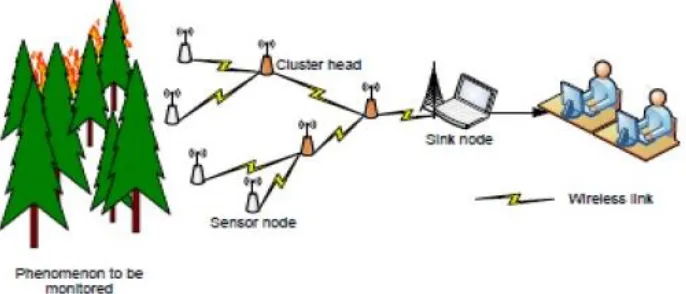
the cluster head, which in then send it to a specialized node called sink node (or base station) through a multi-hop wireless communication as shown in Figure 1.
Fig 1. Architecture of Wireless Sensor Network
This paper is organized as follows: Section 2 describes literature survey. In section 3 the proposed work protocol is presented. Simulation results are given in section 4. Section 5 in which comparative analysis between existing and proposed approach are given and finally, Section 6 is the conclusion.
A sensor network is specialized wireless network that is used in real time application with inclusion of electromechanical components. These sensor nodes are defined with certain limitations and specifications in terms of energy, power, sensing range, size etc. [1, 2]. These Sensors are small with limited Processing and computing resources and they are inexpensive. Designing the WSNs is very difficult because the sensor nodes have limited computation capability, limited power and small memory size[3][4]. Among these three factors, the energy consumption is the most important one because the battery is not changeable if once the sensor nodes are deployed. The energy is also the major problem in designing the routing of the WSNs .Hierarchical protocols reduce energy consumption in the networks by clustering. In these protocols, nodes are divided into some clusters and some nodes that have more energy than others are the selected as cluster heads[5].
2. LITERATURE SURVEY
The work done by the earlier researchers on sensor networks and route generation is defined. The following section is part of the literature review that discusses previous research findings.
Zhe Zang (2011) has defined effective route generation in sensor network. Author improved the routing under the reliability and low cost communication in sensor network. Author defined hop effective communication so that the reliable communication will be drawn. Author improves the hop effective routing policy so that the effective route quality will be improved. The work is here based on the topological analysis applied over the network at the prior stage. Author estimate the packet communication as the cost vector and take the decision based on reliability and efficiency. The work is analyzed under maximum load constraints as well as overhead situations[6].
Shuguang Xiong (2012) has defined an effective routing in sensor network for structured communication. Author defined the sensor deployment specific communication in sensor network. Author defined the work to perform effective deployment of nodes and network. Author defined the deployment of nodes in classified sensor network. Author upgrade the communication under location specific and deployment specific communication network. Author defined the route generation and optimization in effective structured sensor network. A coverage range analysis is performed on deployed nodes so that the constraint specific solution will be taken in terms of optimized path [8].
M. M. Chandane (2012) has defined a quality aware routing in sensor network. Author defined the communication for effective route generation so that the route optimization will be achieved. Author defined the multipath fading over the network. Author defined a path analysis approach for energy effective route generation[9].
Amir Hossein Mohajerzadeh (2012) has presented an optimal routing approach in sensor network under energy specification analysis and optimal route generation. Author defined a quantize mechanism for effective route generation[10].
Ting Lu (2013) has defined work to reduce the energy consumption while performing the multicast route generation in sensor network. Author has defined a genetic approach to optimize the network communication. Author defined a delay analysis based approach to generate the effective route. Author defined the comparative analysis in terms of error rate and execution time analysis[11].
3.
PROPOSED WORK
In our proposed work, a genetic improved approach is given to perform clustering in sensor network. The optimization is here achieved at two different stages. In first stage, the optimization is selection of the cluster head mechanism. The cluster head selection is here defined under genetic based fitness rule. Based on this integrated rule, the energy specification, sensing range and load analysis is executed for cluster head selection. Once the clusters selection are performed , the cluster members are recognize based on sensing range analysis. In second stage of this model, the communication is executed. The first level communication is performed between the nodes and cluster heads. This communication is either single hop or multihop communication based on node criticality. In second level, the multihop communication is performed between the cluster heads. The genetic adaptive route is generated between clusters heads to produce effective and reliable communication. The work is here implemented in MATLAB environment. The work is about to optimize the network architecture so that network throughput and network lifetime will be improved.
Algorithm 3.1: Clustering Model
1. Start
2. Generate the network with N Nodes
3. Define the fitness rule under energy, load distance parameters 4. Generate distance matrix and set as the population vector 5. Apply the genetic process for N number of iterations
6. Perform the selection of set of nodes and perform the analysis under fitness rules 7. The nodes that verified the fitness rule will be considered as the cluster head 8. Perform distance based analysis to identify the cluster members
9. Perform the clustered communication over the network.
10. Stop
3.1 Initialization
At the primary stage of this model, the node initialization is done. This stage given n number of nodes at randomly position. The nodes are also defined with random energy vector. Once the nodes are defined, the distance analysis is performed between the nodes and the distance matrix is obtained. This distance matrix is considered as the initial population defined for clustering model.
3.2 Fitness Rule
Once the population set is established, the work is to be performed in the clustering. In this work, genetic fitness rule is defined for cluster head selection. The cluster head selection is performed under Distance analysis, Energy analysis, Probability Vector, Density Vector, Load Vector.
3.3 Genetic Approach
The genetic approach uses three main types of rules at each step to create the next generation from the current population:
3.3.1 Selection rules
The selection of nodes are chosen from the population in the current generation based on their fitness value. The nodes with higher fitness values are more likely to be selected as the individuals of population for the next generation.
3.3.2 Crossover rules
Crossover is a genetic operator used to change the programming of a chromosome or Chromosomes from one generation to the next. Cross over is a procedure of taking more than one parent solutions and producing a
child solution from them. Combine two parents to form children for the next generation.
3.3.3 Mutation rules
Apply random changes to individual parents to form children. The solution may change entirely from the previous solution. Hence Genetic Approach can come to better solution by using mutation. Mutation occurs during evolution according to a user-definable mutation probability.
4. SIMULATION RESULT
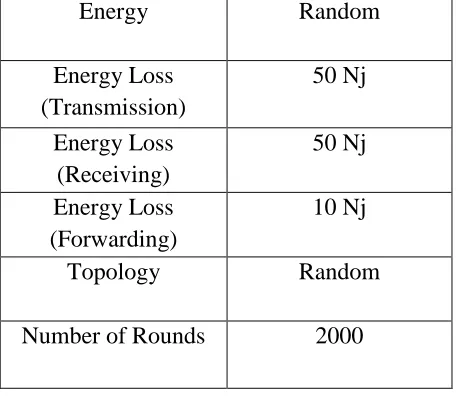
PARAMETER
VALUE
Network Area
100x100m
2Nodes
100
Communication
Rounds
Energy
Random
Energy Loss
(Transmission)
50 Nj
Energy Loss
(Receiving)
50 Nj
Energy Loss
(Forwarding)
10 Nj
Topology
Random
Number of Rounds
2000
Table: Simulation Parameters
Figure 3.1 Cluster Formation
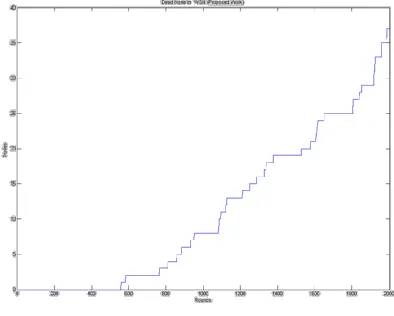
Figure 3.2 Dead Node Analysis
Here figure 3.2 shows the dead node analysis for this proposed work. Here x axis denotes number of communication rounds and y axis denotes the dead nodes. The results show that initially no node is dead upto 550 rounds. As the communication performed, nodes start losing the energy and start getting dead. After 2000 rounds about 37 nodes are dead.
Figure 3.3 Round Based packet Communication
Here figure 3.3 displays the round based packet communication performed in the network. When all the nodes are alive, the communication rate is higher, as the nodes starting dead, the communication rate is decreased. Here x axis is showing the communication rounds and y axis is showing the packet communication in each round.
5.
COMPARATIVE ANALYSIS
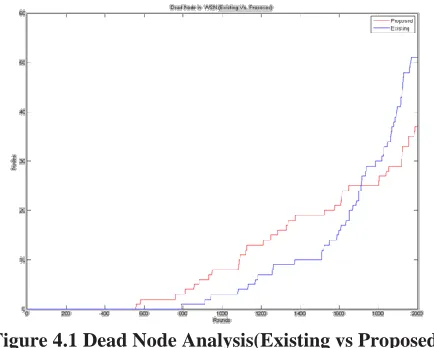
The comparative analysis on these two approaches is here done based on network life and network communication parameters. The network life is here defined in terms of dead node analysis. The communication is analyzed for each round and overall network communication.
Parameters Existing
Approach
Proposed Approach Clustering
Parameters
Energy, Distance, Probability
Vector
Genetic Based Fitness
Rule under Energy,
Load, Density
Balanced No Yes
Routing Algorithm
Distance Based
Genetic Adaptive Clustering
Type
Round Based Stable
Table 4.1 Comparative Analysis Between Existing vs Proposed Approach
Figure 4.1 Dead Node Analysis(Existing vs Proposed)
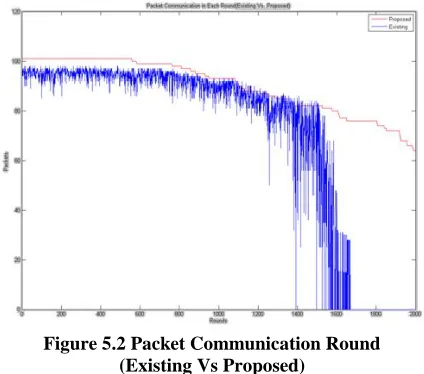
Figure 5.2 Packet Communication Round (Existing Vs Proposed)
Here figure 4.2 shows the comparative analysis between existing and proposed approach in terms of packet communication in each round. Here x axis is showing the communication rounds and y axis is showing the packet communication. The figure shows that the number of packet communication in case of proposed approach is higher. It shows that the work has improved the network communication and the communication rate is higher to send the data in an effective manner as compared to existing work.
6.
CONCLUSION
In an energy critical sensor network one of the major requirements is to perform the optimized communication. Such kind of communication depends on multiple vectors such as network architecture, communication scenario, communication parameters, communication approach etc. In this present work, a genetic optimized model is defined to optimize the clustering. The genetic is here applied to optimize the cluster selection process and the route generation model. The fitness rule is defined to perform the selection of cluster head under multiple parameters. The parameters considered in this work are energy, distance, density and load. Once the cluster head formation is done, the next work is to perform route generation under under genetic approach. The genetic improved model is here defined to optimize the network. The obtained results shows that the work has improved the network communication and network life.
REFERENCES:
[1] I.F. Akyildiz, W. Su, Y. Sankara subramaniam, E. Cayirci, “Wireless sensor networks: a survey”, Proceedings of International Conference on Computer Networks , pp 393–422, 2002.
[2] Ajay Jangra, priyanka, Swati, richa, “Wireless Sensor Network Architectural Design issues and Challenges”, Proceedings of International Journal on Computer Science and Engineering, pp 3089-3090, 2009.
[3] I.F. Akyildiz, W.Su, Y. Sankasubramaniam, and E. Cayirci, “WirelessSensor Networks: A Survey”, IEEE Communications Magazine, pp.102-114, August 2002.
[4] J.N. Alkaraki and A.E. Kamal, “Routing Techniques in Wireless Sensor Networks: A Survey”, IEEE Wireless Communication, pp. 6-23, December 2004.
[6] Zhe Zang,"A Robust Routing Protocol in Wireless Sensor Network",International conference on Wireless Sensor
Networks pp 276-279, 2010.
[7] Jinbao Li, “Joint Routing, Scheduling and channel assignment in Multi-Power Multi-Radio Wireless Sensor Networks”, International Conference on Performance Computing and Communication, pp 1-8, 2011.
[8] Shuguang Xiong, “Efficient Algorithms for Sensor Deployment and Routing in Sensor Networks for Network-structured Environment Monitoring”, Proceedings IEEE INFOCOM, pp 243-248, 2012.
[9] M. M. Chandane, “Distributed Link Quality Aware Routing in Wireless Sensor Network", International Conference on Computer Science and Automation Engineering, pp 528-532, 2012. [10] Amir Hossein Mohajerzadeh, “Optimum Routing and Scheduling for Estimation in Wireless
Sensor Networks", International Conference on Computer and Knowledge Engineering (ICCKE) , pp 243-247, 2012.