ISSN: 1992-8645 www.jatit.org E-ISSN: 1817-3195
MODEL-DRIVEN DECISION SUPPORT SYSTEM FOR
ESTIMATING NUMBER OF AMBULANCES REQUIRED
DURING EARTHQUAKE DISASTER RELIEF OPERATION
1EBRAHIM ESMAILI, 2HALINA MOHAMED DAHLAN, 3MOHAMMAD ISHAK DESA
1 2
Department of Information System, Universiti Teknologi Malaysia, Johor, Malaysia
3
Department of Industrial Computing, Universiti Teknikal Malaysia Melaka, Melaka, Malaysia
E-mail: [email protected], [email protected], [email protected]
ABSTRACT
Most of human life has been encountered danger due to natural disasters nowadays. One of these natural disasters that endanger human lives and which causes lot of damages is earthquake. A proper emergency response after an earthquake happening is important and has high priority in earthquake emergency management to reduce number of damages. Decision making for critical resources in the phase of response, is one of the main concerns for managers. Ambulance, as one of the critical resource that can help to reduce earthquake losses and costs, needs to be planned. Confusion in the number of victims in the early stages of earthquake, access complexity to the required data of different organizations by the pressing time, complicated nature of estimation, diversity of models and limitation of time for decision making are the main problems associated with estimating ambulances during earthquake disaster which makes estimation too difficult. In addition, there is a call for research in determining the number of required ambulances during earthquake emergency management, due to high error in estimating the number of ambulances in the current methods, which leads to unnecessary expenses and thereby helping to ensure that disaster sites are not overcrowded with emergency workers impeding each other's effectiveness. Such complexity suggests the introduction of Decision Support System (DSS). More accurate estimation of the number of required ambulances using a decision support system can help managers to speed up the process of decision making and thus reducing error and costs. Since the number of ambulances needed during a disaster is directly proportional to the number of victims requiring hospital treatment and in order to reach the first objective of this study, factors determining the number of human casualties in earthquake disaster i.e. population, modified Mercalli, age, time, building occupancy and gender are selected as the most relevant factors which have high probability in creating human casualties. The collected data from various relevant sources is used in proposing the model of this research. After testing different approaches, Fuzzy rule-based approach is being used, after defining the rules for each aforementioned factors and optimization is conducted in order to minimize the error for estimating the number of human casualties. Finally, by using de Boer formula and obtained number of human casualties, the number of required ambulances is estimated accurately. The results indicate that the error is decreased by more than 50% in the proposed method. A prototype of Model-Driven Decision Support System was developed based on the proposed model that can be used to aid emergency response planners for their decision making process prior to take any action during earthquake emergency management.
Keywords: Model-Driven Decision Support System, Earthquake Disaster Relief Operation, Fuzzy System,
Human Casualties, Ambulance Estimation
1. INTRODUCTION
Much human life has encountered danger due to natural disasters recently. One of the natural disasters that endangers human lives and causing lots of damage is earthquake. Disasters’ mitigation is an assignment usually with phases like preparation, response and recuperation; therefore, it
ISSN: 1992-8645 www.jatit.org E-ISSN: 1817-3195 management usually need a large amount of
resources and analysis and is not an easy task. For reducing the damage and optimizing the overall performance of government, responsible leaders have to make decisions quickly and effectively. Planning and decision making for the resource requirements in earthquake disaster relief is one of the main concern of managers, in the phase of response [1]. One of these concern which needs consideration is planning about the number of required ambulances during earthquake disaster relief operation.
The importance of this planning can be investigated from different aspects; first we are talking about human being lives and based on many researches the first day of earthquake, known as the “golden day”, and decision needs to be done quickly in that timeframe, otherwise the probability of saving human casualties after that period is very low [2]. Secondly, more accurate estimation can prevent vehicles from being withdrawn unnecessarily from their "normal" duties in hospitals or other locations as a result can reduce needless expenses and helping to ensure that disaster sites are not overcrowded with emergency workers impeding each other's effectiveness. Thirdly no mistakes are acceptable, especially in the case of disasters resulting in large number of injured people. Finally, more accurate estimating the number of ambulances is required in earthquake disaster relief operation, help managers to have better concentration on distribution of ambulances to the affected areas.
Therefore, in this research at first we will investigate the relevant literatures that is available in estimating ambulances during disaster. Secondly the current research problems with solutions in the phase of planning will be discussed. Then the data collection process will be investigated and finally a proper Model-driven decision support system prototype will be developed to help emergency response planners in decision making. The proposed specific model-based decision support system can also help managers to analyze the disaster and assist the leaders in making sensible decisions by means of a tool capable of offering the assessment, based on the available information in limited time frame.
2. LITERATURE REVIEW
There are lots of researches which investigated in estimating the number of ambulances, but few researches investigated this issues in the disaster areas especially earthquake disaster which is very
complicated in nature. Bayram et al. [3] in their research investigated the number of ambulances required in trauma-related multiple casualty events. They proposed a new quantitative model for estimation the number of ambulances needed during the pre-hospital response during a trauma-related multiple casualty events. Estimating ambulance requirements in Auckland is another research in this area conducted by Henderson and Mason [4]. They established a preliminary study using queuing theory. However, the assumptions required in their proposed queuing model were such that a more realistic modelling approach was deemed necessary to verify and refine the queuing model results. Singh et al. [5] also estimated the total number of ambulances required by hospital using operational research.
Confusion in the number of victims during the early stages of earthquake, access complexity to the required data of different organizations by the pressing time, complicated nature of estimation, diversity of models and limitation of time for decision making are the main problems associated in estimating ambulances during earthquake disaster which makes estimation too difficult. One of the most relevant researches was conducted by De Boer, which proposed a formula for estimating the number of required ambulances [6]. Based on his assumption, the number of ambulances (X) is directly proportional to the number of victims requiring hospital treatment (N), and the average traveling time between the disaster site and the surrounding hospitals (t), and is inversely proportional to the number of victims who can be transported during each journey (n) and the total time (T) available for the transportation of N. Therefore, the following formula can be applied:
However, considering the disaster, it is very difficult to determine the number of victims requiring hospital treatment (N) at the early stages when disaster occurs. Therefore, there is a need of technique to estimate the number of human casualties in order to estimate the number of required ambulances as described in the next section.
Effective factors on estimating the number of human casualties during earthquake disaster relief is considered by many researchers from different aspects; some studies have investigated the
ISSN: 1992-8645 www.jatit.org E-ISSN: 1817-3195 relationship of earthquake human casualties with
different seismic factors such as the magnitude of the earthquake [7], [8], shaking intensity and distance from epicenter [9], ground motion parameters such as peak ground acceleration [10], [11]. Based on current researches, the most important factor causing injury and death in earthquake events worldwide is damage to the buildings [12]–[17].
Furthermore, the populations that occupy buildings, plays a vital role in impeding or enhancing vulnerability to earthquakes, eventually influencing the number of casualties. These nonstructural variables include individual characteristics, such as gender, physical disabilities, age and behavioral strategies; household characteristics, such as socioeconomic status (usually household income): and community characteristics, such as the existence of search and rescue teams and the medical aid response [18], [19].
Many studies consider the earthquake magnitude/intensity, number of residents in the study area, and certain derived casualty rates (mostly empirical in nature) to calculate the number of casualties, but ignores all the other aspects, e.g., Wald et al. [20]; Jaiswal et al.[13]; and Wyss [21].
Tierney [22], also created a list for these factors. Partial list of these factors based on his research include (1) characteristics of the earthquake itself; (2) features of the built environment; (3) population and victim characteristics (Information on residential density and various population characteristics); (4) the presence or absence of secondary hazards; (5) community emergency response capability; and (6) situational factors (ex time of EQ).
At the individual level, age is probably a significant risk factor [23]. (It should be noted that these researchers have found that mortality rates were high for both young children and elderly persons.) Within the U. S., poor people are more likely than people with higher incomes to live in the kind of structure that will collapse or be severely damaged during the event of earthquake. For example, in California's urban area, unreinforced masonry buildings constitute a significant segment of the low-cost rental housing stock [24].
Based on the research conducted by Yamazaki and colleagues, it was found that the collapse of transportation structures and buildings were the major causes of deaths, non-trauma deaths, for example heart failure, had a significant ratio. It is
also pointed out that, since the occurrence time of earthquake affects the number and circumstances of human casualties, daily activities and locations of residents should be considered for casualty estimation. It is suggested that the mobility of people should be considered in estimating human casualties due to urban earthquakes [25].
In addition to earthquake severity, numerous factors influence the human consequences. These include distance from the epicenter, the time of the day the event occurred, secondary events triggered by the earthquake, urbanization grade, building standards and regulations, and access to medical care, as well as social and behavioral customs [9], [15], [26], [27].
ISSN: 1992-8645 www.jatit.org E-ISSN: 1817-3195 other factors such as season and time or poverty and
building type, the most comprehensive one was considered. Environmental or behavioral factors that have low effect and possibility based on previous researches and make the estimation complicated is not under the scope of this research.
As a conclusion population of affected area, age, time of earthquake, modified Mercalli scale (scale used for measuring the intensity of an earthquake which includes strength of earthquake, type of soil, building age, material of building and other factors), gender, building occupancy are the selected factors which are used in estimating the number of human casualties in this research.
3. RESEARCH METHODOLOGY
This current research is conducted using fuzzy system based on the effecting factors which was discussed in the previous section for estimating the number of human casualties during earthquake disaster relief operation. Fuzzy rule-based approach to modelling is based on verbally formulated rules that overlapped throughout the parameter space. They used numerical interpolation to handle complex non-linear relationships. The rules in fuzzy system in this research are defined based on the selected factors. For example, for the age factor, classification is conducted based on 4 ranges. Then based on vulnerability of these four ranges, the weight is considered. For example, the ages between 0-4 are the most vulnerable group and have higher rate of deaths or injuries, in comparison to young people. In addition, another research, people over 70 years had 6.1 × risk of injury or death than 30–39 years-old. An emerging and consistent findings indicate that increasing age is associated with higher injury or mortality and there are many possible reasons for this: more fragile, less mobility, less able to avoid falling objects, more prone to falling, living alone and with less assistance, less will to live. As a summary and based on literature the classification and weight is defined according to vulnerability and range of risk, for each of aforementioned factor. Data from 50 cases of previous earthquakes in Iran was collected and optimization carried out based on the following formula in order to reduce the error of estimation:
N= W1P+ W2A+ W3T+ W4M+ W5G+ W6B
Which:
N is the number of victims requiring hospital treatment
P is population of affected area
A is age
T is time of earthquake
M is modified Mercalli scale
G is gender
B is building occupancy type and
W1 to W6 indicate the weight of each relevant factor
ISSN: 1992-8645 www.jatit.org E-ISSN: 1817-3195
4. CASE STUDY
The data of this research is gathered from 50 cases of previous earthquakes that occurred in Iran. Iran is well known for its long history of disastrous earthquake activity. Iran is one of the most seismically active countries in the world, being crossed by several major fault lines. As a result, earthquakes in Iran occur regularly and are destructive. Referring to the Iranian case, currently, however, according to the researches and primary data which is gathered in this research through interview, decisions are usually made based on prior experiences and personal judgment of leaders or experts, rather than basing on factual evidence in different stages of relief efforts and therefore the accuracy level of estimation is too low [28]. In addition, the information at the first moment just after disaster occurs tends to be confused, imprecise and incomplete [28]. Besides the lack of accurate information, the situation is further complicated by the pressing time. At an emergency moment, time is life and decision makers need to make decision quickly. In addition, Iran is selected as a case in this research in order to check the validation of the proposed DSS.
5. RESULTS AND DISCUSSION
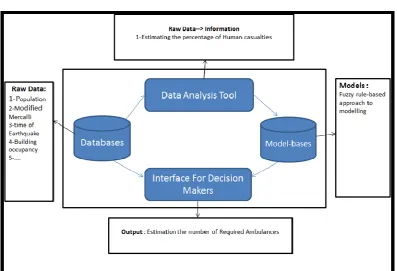
As mentioned in the research methodology section, in order to facilitate and speed up the process of decision making by managers, a model based decision support system for estimating the number of required ambulances in earthquake disaster relief was developed. Figure 2 shows the proposed prototype of this research.
This initial prototype is designed using MATLAB in order to assist in understanding the system. This prototype includes 4 modules. In the “Data” tab, the database is designed based on the required data for estimation which investigated before and future data can be key in to the system. Figure 2 shows the Analysis modules which is capable of estimating the number of human casualties based on the selection of different inputs. The estimated human casualties can help in estimating the number of required ambulances based on the methods which is discussed before. The Model tab provides this ability to the emergency planner to see details of the estimation and give capability What-IF analysis. Finally, in distribution module, the ambulances can be
ISSN: 1992-8645 www.jatit.org E-ISSN: 1817-3195 distributed to the affected area based on the
population and vulnerability of the area.
This prototype of Model-Driven Decision Support can be used to aid emergency response planners during their decision making process prior to take any action in earthquake emergency management.
The test for validation of this prototype was conducted using 5 recent earthquakes in Iran. As it shown in table 1, the data of five recent earthquakes in Iran is gathered for the effecting factors which is discussed in this paper previously. Based on the defined classification, data for each range is calculated and then based on the proposed rule-based approach of this research, the number of human casualties is estimated and the number of required ambulances is also calculated using De Boear formula and the obtained number of human casualties. For example, in the third case, with the population of 3549 and the Mercalli scale of 6 and other details which can be seen in table 1, the number of human casualties is estimated to be 700 people by the proposed method of this research, while this number is estimated that only 200 people through the analysis team (conventional method).
Therefore, based on De Boer formula the number of required ambulances is calculated as 15 by the proposed method of this research compared with 5
by the analysis team (conventional method) while the actual required number of ambulances is 18 (calculated in the post-earthquake phase).
Although in this case there seems to be the presence of error (18-15= 3), but the estimation error is less than the current conventional method error (18-5= 13).
Finally, as it can be seen in table 1, the root mean square error (RMSE) of the proposed system is almost 7.5 for the 5 cases, while this number shows higher error in the current Iranian estimation (RMSE = 40.5). The importance of this research is more obvious, when compared to the results of more powerful earthquakes which has caused more damage and human casualties. In addition, the proposed system of this research, speeds up the decision making process by the managers and also reduces the overall cost. Furthermore, by decreasing the error of estimation, managers are able to have more accurate distribution of ambulances in the affected area.
Figure-1. Proposed Model-Based Decision Support System for Estimating the Number of
ISSN: 1992-8645 www.jatit.org E-ISSN: 1817-3195
Table-1.Comparison of the Current System and the Proposed System of This Research
N o C as e P o p u la tio n A g e T im e M o d if ie d M er ca lli G en d er B u ild in g O cc u p an cy T h e ac tu al n u m b er o f a m b u la n ce s T h e cu rr en t c o n v en tio n al s y st em e st im at io n T h e p ro p o se d s y st em o f t h is r es ea rc h e st im at io n
1 Case 1 828
(0-4) = 18%
(4.1 – 9) = 15 %
(9.1- 70) = 65%
(above 70.1) = 2 %
7:00 7
M = 45
F= 55
Educational = 15 %
Governmental= 25%
Commercial= 10%
Residential= 40%
Others = 10%
19 4 14
2 Case 2 3491
(0-4) =13%
(4.1 – 9) =11%
(9.1- 70) =62%
(above 70.1) =14%
7:02 6 M =32
F=68 Educational =17% Governmental=18% Commercial=13% Residential=40% Others =12%
34 70 29
3 Case 3 3549
(0-4) =19%
(4.1 – 9) =9%
(9.1- 70) =35%
(above 70.1) =37%
17:00 6 M =72
F=28 Educational =10% Governmental=12% Commercial=16% Residential=48% Others =14%
18 5 15
4 Case 4 58652
(0-4) =14%
(4.1 – 9) =22%
(9.1- 70) =48%
(above 70.1) =16%
15:14 8 M =68
F=32 Educational =19% Governmental=8% Commercial=15% Residential=50% Others =8%
91 50 80
5 Case 5 85782
(0-4) =12%
(above 70.1) =15%
(4.1 – 9) =43%
(9.1- 70) =30%
16:53 6 M =65
F=35 Educational =13% Governmental=9% Commercial=13% Residential=57% Others =8%
270 200 280
ISSN: 1992-8645 www.jatit.org E-ISSN: 1817-3195
6. COCLUSION
As a summary the general goal of this research is to formulate the architecture for a Model-Driven DSS framework by considering certain issues that can be used for emergency response planners in their decision making process prior to take any action during the earthquake emergency management. The future research can be conducted on the distribution of ambulances based on the estimation of this research. Other researchers may investigate other types of disaster such as flood or hurricane by the methods provided in this research.
REFRENCES
[1] E. Zebardast, “The housing domain of quality of life and life satisfaction in the spontaneous settlements on the Tehran Metropolitan Fringe,” Soc. Indic. Res., vol. 90, no. 6, pp. 307–324, 2009.
[2] R. Spence, C. Scawthorn, and E. So, Human casualties in earthquakes: progress in modelling and mitigation. 2011.
[3] J. Bayram, S. Zuabi, and I. Subbarao, “Disaster metrics: quantitative benchmarking of hospital surge capacity in trauma-related multiple casualty events,” Heal. Prep., 2011.
[4] S. Henderson and A. Mason, “Estimating ambulance requirements in Auckland, New Zealand,” Conf. Proceedings, 1999.
[5] V. Singh, A. Chandran, and B. Dey, “Operation research for estimation of ambulance requirement in a hospital,” methods programs Biomed, 1990.
[6] J. de Boer, “An attempt at more accurate estimation of the number of ambulances needed at disasters in The Netherlands,” Prehosp. Disaster Med., 1996.
[7] E. Samardjieva and J. Badal, “Estimation of the expected number of casualties caused by strong earthquakes,” Bull. Seismol. Soc., 2002. [8] D. Alexander, “Death and injury in
earthquakes,” Disasters, 1985.
[9] N. Liang, Y. Shih, F. Shih, and H. Wu, “Disaster epidemiology and medical response in the Chi-Chi earthquake in Taiwan,” Ann. Emerg. …, 2001.
[10] M. Mahue-Giangreco and W. Mack, “Risk factors associated with moderate and serious injuries attributable to the 1994 Northridge earthquake, Los Angeles, California, Epidemiol” 2001.
[11] K. Shoaf, H. Sareen, L. Nguyen, and L. Bourque, “Injuries as a result of California earthquakes in the past decade,” Disasters, 1998.
[12] E. Noji, G. Kelen, and H. Armenian, “The 1988 earthquake in Soviet Armenia: a case study,” Emerge. Med., 1990.
[13] K. Jaiswal, D. Wald, and M. Hearne, “Estimating casualties for large earthquakes worldwide using an empirical approach: US geological survey open-file report, OF 2009-1136, 78 p,” 2009.
[14] K. Porter, K. Jaiswal, and D. Wald, “Fatality models for the US geological survey’s prompt assessment of global earthquake for response (PAGER) system,” 2008.
[15] M. Ramirez and C. Peek-Asa, “Epidemiology of traumatic injuries from earthquakes,” Epidemiol. Rev., 2005.
[16] R. Spence, J. Bommer, and D. Del Re, “Comparing loss estimation with observed damage: a study of the 1999 Kocaeli earthquake in Turkey,” Bull. Earthq. …, 2003.
[17] D. Wald, K. Jaiswal, and K. Marano, “Advancements in casualty modelling facilitated by the USGS prompt assessment of global earthquakes for response (PAGER) system, “Casualties Earthquakes, 2011.
[18] Shapira, Aharondon-Daniel, Shohet, Peek-Asa, and Bar-Dayan, “Integrating epidemiological and engineering approaches in the assessment of human casualties in earthquakes,” Nat. Hazards, pp. 1–16, 2015.
[19] S. Zahran, S. Brody, and W. Peacock, “Social vulnerability and the natural and built environment: a model of flood casualties in Texas,” …, 2008.
[20] D. Wald, P. Earle, and T. Allen, “Development of the US Geological Survey’s PAGER system (prompt assessment of global earthquakes for response),” Proc. …, 2008.
[21] M. Wyss, “Human losses expected in Himalayan earthquakes,” Nat. Hazards, 2005. [22] K. Tierney, “Developing multivariate models
for earthquake casualty estimation,” 1990. [23] and L. R. Glass, Roger I., Juan J. Urrutia,
ISSN: 1992-8645 www.jatit.org E-ISSN: 1817-3195 [24] M. Comerio, “Seismic Costs and Policy
Implications,” City Los Angeles, Community Dev. …, 1989.
[25] F. Yamazaki, A. Nishimura, and Y. Ueno, “Estimation of human casualties due to urban earthquakes, “earth. Eng., 1996.
[26] and H.-J. C. Chou, Yiing-Jenq, Nicole Huang, Cheng-Hua Lee, Shu-Ling Tsai, Long-Shen Chen, “Who is at risk of death in an earthquake?,” … Epidemiol., vol. 7, pp. 688– 695, 2004.
[27] H. Armenian, “A case-control study of injuries arising from the earthquake in Armenia, 1988.” Bull. World Heal, 1992.