Copyright1999 by the Genetics Society of America
Genetic Variation Maintained in Multilocus Models of Additive Quantitative
Traits Under Stabilizing Selection
Reinhard Bu
¨rger* and Alexander Gimelfarb
†*Institut fu¨r Mathematik, Universita¨t Wien, A-1090 Vienna, Austria and†Department of Zoology, University of Maryland,
College Park, Maryland 20742-4415
Manuscript received October 29, 1998 Accepted for publication March 15, 1999
ABSTRACT
Stabilizing selection for an intermediate optimum is generally considered to deplete genetic variation in quantitative traits. However, conflicting results from various types of models have been obtained. While classical analyses assuming a large number of independent additive loci with individually small effects indicated that no genetic variation is preserved under stabilizing selection, several analyses of two-locus models showed the contrary. We perform a complete analysis of a generalization of Wright’s two-locus quadratic-optimum model and investigate numerically the ability of quadratic stabilizing selection to maintain genetic variation in additive quantitative traits controlled by up to five loci. A statistical approach is employed by choosing randomly 4000 parameter sets (allelic effects, recombination rates, and strength of selection) for a given number of loci. For each parameter set we iterate the recursion equations that describe the dynamics of gamete frequencies starting from 20 randomly chosen initial conditions until an equilibrium is reached, record the quantities of interest, and calculate their corresponding mean values. As the number of loci increases from two to five, the fraction of the genome expected to be polymorphic declines surprisingly rapidly, and the loci that are polymorphic increasingly are those with small effects on the trait. As a result, the genetic variance expected to be maintained under stabilizing selection decreases very rapidly with increased number of loci. The equilibrium structure expected under stabilizing selection on an additive trait differs markedly from that expected under selection with no constraints on genotypic fitness values. The expected genetic variance, the expected polymorphic fraction of the genome, as well as other quantities of interest, are only weakly dependent on the selection intensity and the level of recombination.
M
ANY quantitative characters in natural popula- vestigated. In principle, variation can be maintained tions are apparently subject to stabilizing selec- either by mechanisms acting directly on the considered tion toward an intermediate optimum (e.g., Endler trait or as a side effect of polymorphisms that are inde-1986). This means that extreme phenotypes have lower pendent of the observed character. Among the direct fitness than those near the population mean. Therefore, mechanisms are migration, mutation, frequency-depen-stabilizing selection is expected to exhaust genetic varia- dent selection, genotype-environment interaction, and tion. This view has been substantiated by classical analy- epistasis. Considerable progress has been made in eluci-ses based on the assumption that loci are independent dating the potential and the limitations of these mecha-and each allele contributes only an extremely small nisms to maintain genetic variation (cf., Lewontin amount to the total genetic variance (Fisher1930;Hal- 1974; Lande 1975; Barton and Turelli 1989; Gim-dane 1932; Robertson 1956). Further support came elfarb1989;Falconer andMackay1995;Maynard fromWright’s(1935) study of the so-called quadratic Smith1998).optimum model in which two diallelic loci contribute However, relatively little is known about the ability of additively to the character whose fitness deviates in a stabilizing selection per se to maintain polymorphisms quadratic way from its maximum value. By contrast, and genetic variability in quantitative traits controlled most quantitative traits exhibit relatively high levels of by more than one locus acting additively. Conflicting genetic variability in nature. results have been obtained, depending on model as-This apparent contradiction has been a fundamental sumptions about the number of involved loci, magni-problem in evolutionary genetics, and several mecha- tude of allelic effects, and linkage equilibrium. nisms that can potentially contribute genetic variability All the classical analyses of additive quantitative traits under stabilizing selection have been proposed and in- assumed many loci in linkage equilibrium, with each locus having a very small effect on the trait. We review these first followingBulmer’s(1971, 1980)
generaliza-Corresponding author: Reinhard Bu¨ rger, Institut fu¨ r Mathematik,
Uni-tion and formalizaUni-tion of the approaches of Fisher
versita¨t Wien, Strudlhofgasse 4, A-1090 Vienna, Austria.
E-mail: [email protected] (1930),Haldane(1932), andRobertson(1956). The
model assumes that at each locus contributing to the effects are sufficiently diverse. They also noted that the amount of diversity required to maintain the polymor-trait, there are two alleles with sufficiently small effects
on the phenotype, such that the density function of the phism decreases as linkage becomes tighter.Nagylaki (1989) investigated two-locus diallelic models of stabiliz-trait in the subpopulation with genotype AiAjis simply
shifted by the amount gij, where gij is the deviation of ing selection under the assumption of linkage
equilib-rium, but with rather general fitness functions that have the genotypic contribution of AiAj from the mean (cf.
Nagylaki1984 for proof that, in the absence of linkage their optimum at the value of the double heterozygote and decrease monotonically and symmetrically from the disequilibrium, this approximation is correct to first
order). Assuming additionally that the phenotypic dis- optimum. For a large class of such fitness functions, both loci may be stably polymorphic if the ratio of the tribution is normal, Bulmer (1971) showed that the
polymorphic equilibria are unstable under stabilizing effect of the “major” locus to that of the “minor” locus exceeds a critical value. Gavrilets and Hastings selection with allelic frequencies converging to either
zero or one. Therefore, no genetic variability can be (1993, 1994) investigated an extended version of Wright’s (1935) quadratic optimum model that in-maintained under these assumptions.
Further support for the view that stabilizing selection cludes linkage and disposes of the assumption of equiva-lent loci. They showed that for sufficiently tight linkage alone cannot maintain genetic variation in additive
traits comes from analyses of mutation-selection-balance and unequal allelic effects, stable two-locus polymor-phisms may exist. Thus, several analyses of two-locus models that assume n loci in linkage equilibrium and
with mutational effects drawn from a continuous proba- systems suggest that substantial amounts of genetic varia-tion can be maintained under stabilizing selecvaria-tion. bility distribution (cf.Crow andKimura1964;Lande
1975;Fleming1979;Turelli1984;Bu¨ rger1986;Tur- A number of interesting and unresolved questions emerge from the above results: How many loci have to elliandBarton1990).Bu¨ rgerandHofbauer(1994)
proved for such a model under quite general assump- contribute to an additive quantitative trait in order for no (or almost no) genetic variance to be maintained at tions that the genetic variance at any equilibrium
de-creases to zero as the per-locus mutation rates decrease equilibrium by stabilizing selection per se? How does this depend on the distribution of allelic effects and the to zero.
Wright (1935, 1952) studied a model in which a strength of stabilizing selection? What is the role of linkage? More generally, what can be said about the quantitative trait is determined additively by two diallelic
loci with equal and symmetric effects with respect to equilibrium structure of multilocus systems under stabi-lizing selection on an additive quantitative trait? the optimum. The fitness of the trait was assumed to
decrease quadratically as the phenotype deviates from In this article, we address these questions by studying diallelic two-, three-, four-, and five-locus models with its optimum value. He showed that no stable
polymor-phic equilibrium could exist under these assumptions, arbitrary recombination and allelic effects varying be-tween loci. We assume the quadratic optimum model thus supporting the view that stabilizing selection
de-pletes genetic variation. Barton (1986) generalized in which the optimum coincides with the totally hetero-zygous genotype. For two loci, the equilibrium structure Wright’s quadratic optimum model to many unlinked
equivalent loci and omitted the assumption that allelic can be determined explicitly, while for three, four, and five loci, we follow the approach ofGimelfarb(1998) effects are symmetric with respect to the optimum. He
showed that for half of the possible positions of the and perform numerical iterations of the recursion equa-tions for large sets of randomly chosen recombination optimum (within the range of genotypic values)
selec-tion maintains no genetic variaselec-tion at all, while for the rates and allelic effects. In this way, we obtain informa-tion on how the expected equilibrium properties under other half of the positions variation is maintained at
exactly one locus. stabilizing selection depend on the number of loci and can compare the properties of multilocus systems under In general, it might be expected that in a genetic
system with very many loci contributing additively to a stabilizing selection with the properties of systems hav-ing the same number of loci but randomly assigned trait and the effects of alleles varying among loci, the
optimum phenotype can be matched closely by the ge- genotypic fitness, i.e., under selection without con-straints on the genotypic fitnesses.
notypic value of some homozygote and, hence, either no genetic variation will be maintained by such a system or at most a polymorphism will be maintained at just
THE GENERAL MODEL one locus.
In contrast to the classical view and to the results In an infinite, randomly mating diploid population, a quantitative character that is controlled additively by discussed above, several analyses of two-locus systems
that allowed for linkage or nonequivalent loci arrived n diallelic loci is considered. The contribution of one allele at each locus,is zero, whereas the contribution, at very different conclusions.GaleandKearsey(1968)
andKearseyandGale(1968) observed that in a two- b,, of the other allele is a random number between zero and one. It is assumed that the minimum and maximum locus diallelic additive model with a triangular fitness
the actual contribution by the second allele at locus, (1993, 1994) calculated all equilibria and explored the transient dynamics of the mean genotypic value and the is scaled to be a,5 1⁄2b,/Rnk51bk. This implies that the
genotypic value of the total heterozygote is always 1⁄2, genetic variance.
Our aim here is to study not only the equilibrium and the average allelic effect among the n loci
control-ling the trait isa 5 1/(2n). Environmental variance is structure of this model, but in particular the amount of genetic variance that can be maintained through ignored, so that genotypic values and phenotypic values
are identical. We assume the quadratic optimum model; selection, as well as the magnitude of further quantities, like mean fitness, deviation of the mean phenotype from i.e., the fitness of an individual with genotypic valueG
is the optimum, and linkage disequilibrium. Proofs of the
results presented below are given in theappendix, and W(G)512s(G21⁄
2)2. (1) a graphical representation is shown in Figure 1.
There are four types of equilibria: (i) a fully polymor-The strongest possible selection occurs for s54, when
phic equilibrium that is symmetric with all allele fre-the minimum and maximum phenotypes are rendered
quencies equal to1⁄2 (in theappendix, this is denoted lethal. This normalization has the advantage that the
by F1); (ii) a pair of fully polymorphic equilibria that, strength of selection on genotypes can be compared for
in the language of the symmetric viability model, are different numbers of contributing loci.
called unsymmetric because their coordinates satisfy no Let gametes be designated by i, their frequencies
simple symmetry relations (they are denoted by F2 and among zygotes in consecutive generations by pi and p9i,
F3); (iii) a pair of equilibria (denoted F4 and F5) with and the fitness of a zygote consisting of gametes j and
the major locus polymorphic and the minor locus fixed; k by Wjk. Further, let R(i|j,k) denote the probability that
(iv) two monomorphic equilibria corresponding to fix-a rfix-andomly chosen gfix-amete produced by fix-a ( j,k)
individ-ation of A1B2or A2B1(these are denoted by F6 and F7). ual is i. The function R is determined by the pattern of
The existence and stability of these equilibria depend recombination between loci. With these ingredients, the
on the relation between the parametersa2/a1and r/s, well-known system of recurrence equations describing
where r is the recombination rate. For consistency with the dynamics of the distribution of gametes under
viabil-the multilocus results, we use viabil-the standard deviation of ity selection followed by recombination is given by
allelic effects,sa51⁄2(a12 a2)51⁄42 a2, as a measure for the disparity of effects. An important value issa5 p9i 5
1 W
o
jo
kpjpkWjkR(i|j,k), (2)
1⁄12, which is equivalent toa
152a2. The ranges of stability are displayed in the bottom of Figure 1 for r/s # 1⁄8, where W5 Rj,kpjpkWjkdenotes mean fitness.
which covers the full range of parameters if selection is as strong as possible (s54). For weaker selection, larger values of r/s can occur. Fully polymorphic equilib-ANALYTIC THEORY FOR TWO LOCI
ria can be stable only if r/s # 1⁄
12. Only one class of For two loci, fairly complete analytical results of the equilibria can be stable for a given parameter combina-above general model can be obtained. If the alleles at tion. The unsymmetric equilibria are stable whenever the first and second locus are denoted by A1, A2, and they exist, while the other equilibria always exist but B1, B2, respectively, the genotypic values of the four may be unstable.
possible gametes, A1B1, A1B2, A2B1, A2B2are 0,a2,a1, and For each equilibrium, mean fitness, absolute devia-a1 1 a25 1⁄2, respectively. For definiteness, we assume tion of the mean phenotype from the optimum, genetic a1 $ a2 and refer to these loci as major and minor, variance, and linkage disequilibrium can be calculated respectively. With the fitness assignments as above, the (seeappendix). For a range of recombination rates, the fitness values of the nine possible genotypes are given top and middle parts of Figure 1 display the equilibrium
by genetic variance and the deviation of the mean
pheno-type from the optimum as function ofsa.
The following is a summary of the main findings: B1B1 B1B2 B2B2
A1A1 12d 12 b 12 a
A1A2 12c 1 12 c
A2A2 12a 12 b 12 d
, 1. Substantial genetic variance is maintained for any recombination rate if the effects of the alleles at the (3)
two loci are sufficiently different (sa.1⁄12), in which case one or both loci, depending on the
recombina-1
2
tion rate, are stably polymorphic. The reason is that no homozygote genotype is close to the optimum and, from double heterozygotes, a high recombina-where a5s(a12 a2)2, b5sa21, c5sa22, d51⁄4s. This is
the symmetric viability model that has been intensively studied (seeKarlinandFeldman1970 for an extensive equilibrium analysis and further references). The
pa-tion rate would generate many complete homozy-rameters satisfy the additional relation a1d 5 2(b1
gotes with extreme phenotype and low fitness. There-c), which is of technical importance. Wright (1935,
fore, if recombination is strong relative to selection, 1952) was the first to investigate this model of stabilizing
polymorphic by overdominance. With tight linkage, 5. The mean phenotype evolves rapidly to its equilib-rium value (Hastings1987). However, for unequal both gametes A1B2and A2B1are maintained at high
frequency. effects the equilibrium does not coincide with the
optimum unless linkage is extremely tight. Conver-2. If the effects of the two loci are not very different
(sa,1⁄12), very tight linkage (r ,4ss2a) is necessary gence of the genetic variance and of the genotype frequencies may be very slow (Gavriletsand Has-to maintain genetic variation. In this case, a
homozy-gote (A1A1B2B2or A2A2B1B1) is close to the optimum tings1993, 1994). Therefore, if there is substantial initial genetic variability and the selection regime is and, therefore, fixed unless linkage is extremely
tight. such that it eventually depletes genetic variability,
this process may be very slow even for relatively strong 3. For any value of r, the equilibrium genetic variance
selection. decreases from its maximum value1⁄2(a2
11 a22)51⁄8 to 0 assadecreases from its maximum value1⁄4to 0. 4. For fixed sa, the genetic variance has a maximum
THE STATISTICAL APPROACH value for intermediate recombination rates. If the
effects are not very different (sa , 1⁄12), then the Usually, parameters of genetic systems controlling variance is lower under loose linkage than under quantitative traits are unknown or can be inferred only very tight linkage, while the reverse is true if the indirectly. In addition, because the dimensionality of effects are sufficiently different. Thus, tighter linkage the parameter space and of the space of gamete frequen-may increase the degree of polymorphism at equilib- cies increases rapidly as the number of loci increases, an explicit and analytical characterization of the equilib-rium but at the same time reduce the genetic
vari-rium properties of multilocus models in terms of all ance.
parameters and initial conditions would be of limited value, even if the necessary analytical methods were available. Therefore, we used a different approach to evaluate the quantities of interest for randomly chosen parameter sets and initial conditions and, consequently, to obtain statistical results.
For a genetic system with a given number of loci (n 5 2, 3, 4, 5), we constructed 4000 parameter sets (allelic effects of loci, coefficients of recombination be-tween adjacent loci, the strength of stabilizing selec-tion). For each parameter set, allelic effects were ob-tained by generating values b, ( 5 1, 2, . . . , n) as independent random variables uniformly distributed
Figure1.—Equilibrium properties of two-locus two-allele systems under stabilizing selection. (Top) The ratio of the equilibrium genetic variance, sˆ2
G to the maximum possible variance, Vmax51⁄2(a2
11 a22), as a function of the standard deviation of allelic effects,sa51⁄42 a2, for five different rates of recombination and s 5 4. (Middle) The corresponding absolute deviation of the mean from the optimum. (Bottom) The regions of stability of the four types of equilibria. The following abbreviations are used for the regions of stability. 0, two monomorphic equilibria; 1, two equilibria with one (the major) locus polymorphic; 2a, the symmetric equilibrium with both loci polymorphic; 2b, two asymmetric equilibria with both loci polymorphic. The upper boundary of region 2a is given by r1/s (A9) and the upper boundary of 2b by r2/s (A10). Atsa, we have r1/s5r2/s51⁄12. The boundary between the
regions 0 and 1 is atsa51⁄12and intersects with region 2b at
r/s 51⁄36. The horizontal lines correspond to the curves in the top and middle parts. It should be noted that the areas indicating the different types of equilibria are not propor-tional to their respective probabilities, because the horizontal scale issa. It may be noted that 0#r/s#1⁄8covers the whole
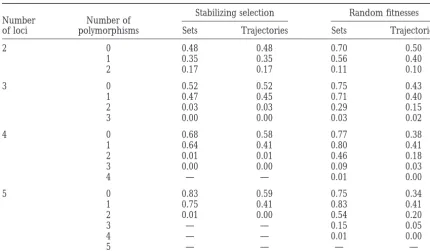
between 0 and 1 and transforming them into the actual Table 1 shows the proportion of parameter sets for which there was at least one equilibrium with a given allelic effectsa,51⁄2b,/Rkbk. The strength of stabilizing
selection, s, was obtained as a random variable uniformly number of polymorphic loci (e.g., among 4000 of four-locus systems under stabilizing selection, 68% yielded distributed between 1 and 4, with s54 corresponding
to the strongest possible quadratic selection (the fitness at least one monomorphic equilibrium, while only 1% of such sets yielded at least one equilibrium with two of extreme phenotypes is zero), while s51 represents
“weak” selection (the fitness of extreme phenotypes is polymorphic loci). Also shown in Table 1 are the pro-portions of trajectories that, starting from a random 75% of the fitness of the best fit phenotype). On the
basis of such obtained values of allelic effects and the initial distribution, converge to an equilibrium with a given number of polymorphisms (e.g., 58% of trajector-strength of selection, genotypic fitnesses, Wij, were
calcu-lated and substituted into the recursion equations (2). ies for four-locus genetic systems under stabilizing selec-tion converged to a monomorphic equilibrium). Recombination coefficients between adjacent loci,
r,,,11(,51, . . . , n21), were obtained as independent Table 2 presents some of the parameters
characteriz-ing stable equilibria that are expected for genetic sys-random variables (no interference) uniformly
distrib-uted between 0 and 0.5. For four-locus genetic systems, tems with a given number of loci: the number of differ-ent stable equilibria per parameter set; the polymorphic we also constructed 4000 parameter sets with random
allelic effects and random recombination, but with fraction of the genome (the probability for a locus to be polymorphic); and the mean fitness. For stabilizing “strong” (s5 4) and weak (s5 1) selection, as well as
with random allelic effects and random selection but selection, Table 2 also presents the expected deviation of the mean from the optimum; the genetic variance with free recombination, r,,,1151⁄2. In addition, we
con-structed 4000 parameter sets for two-, three-, four-, and at equilibrium; the ratio of the genetic variance at equi-librium to the maximum genetic variance that can be five-locus systems with random recombination between
adjacent loci and with genotypic fitness values, Wij, cho- maintained by the given genetic system; and the ratio
of the allelic effect at a polymorphic locus to the average sen as independent random variables uniformly
distrib-uted between 0 and 1, as described by Gimelfarb allelic effect among all loci in the system. The maximum genetic variance that can be maintained in linkage equi-(1998).
For each of the 4000 parameter sets, the recursion librium by an additive trait controlled by n loci with allelic effects {a,} is Vmax51⁄2R,a2,, while the average allelic
equations (2) were numerically iterated starting from
20 random initial distributions of gametes. To make effect among loci isa 51/(2n).
Table 3 compares parameters of stable equilibria for the initial distributions more evenly distributed in the
gametic space, they were chosen such that the (Euclid- four-locus genetic systems with different recombination rates and under stabilizing selection of different ean) distance between any two of them was no less than
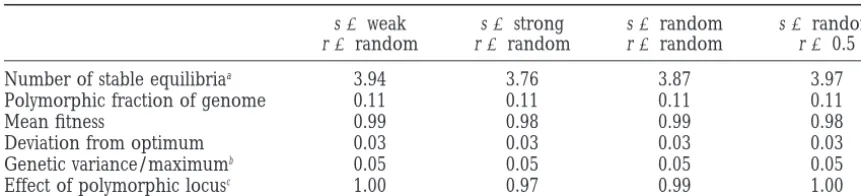
a predetermined value (0.25, 0.30, 0.35, and 0.30 for 2, strength.
Equilibrium structure: The data in Table 1 demon-3, 4, and 5 loci, respectively). Starting from an initial
distribution, the recursion equations (2) were iterated strate that, while the probability for a genetic system under stabilizing selection to maintain a monomor-until either equilibrium was reached or the number
of iterations exceeded 300,000. In the latter case, the phism or a one-locus polymorphism is higher for systems with more loci, the probability of maintaining more parameter set was excluded from the analysis. For each
parameter set, the number of different equilibria, the than one polymorphic locus drops rapidly for systems with more loci. In fact, for a five-locus genetic system, gametic frequencies at each equilibrium, and the
num-ber of trajectories (initial distributions) converging to the probability of maintaining a polymorphism in two or more loci is negligible. The same is not true under each equilibrium were recorded. Using this database,
the equilibrium properties of multilocus genetic systems selection with randomly assigned fitnesses, in which case the probability of maintaining more than one locus were analyzed.
For two-locus genetic systems, results can be obtained polymorphic is higher for genetic systems with more loci. In addition, Table 2 shows that with increasing not only by the statistical approach, but also by numeric
integration of equations in the appendix, as well as number of loci, the polymorphic fraction of the genome decreases at a much higher rate under stabilizing selec-by placing a fine grid over the parameter space and
averaging over the appropriate quantities whose equa- tion than under selection with random fitness. Indeed, as a function of n, the polymorphic fraction of the ge-tions are given in the appendix. All three methods
yielded, within statistical and numeric accuracy, identi- nome under stabilizing selection is very closely approxi-mated by 0.99n21.58, while for random fitnesses it de-cal results.
creases proportionally to n20.45.
For two loci, we proved in theappendixthat different STATISTICAL RESULTS
types of equilibria cannot stably coexist (except for r5 0), and the maximum number of coexisting stable equi-Results obtained by the statistical approach are
TABLE 1
Equilibrium structure
Stabilizing selection Random fitnesses Number Number of
of loci polymorphisms Sets Trajectories Sets Trajectories
2 0 0.48 0.48 0.70 0.50
1 0.35 0.35 0.56 0.40
2 0.17 0.17 0.11 0.10
3 0 0.52 0.52 0.75 0.43
1 0.47 0.45 0.71 0.40
2 0.03 0.03 0.29 0.15
3 0.00 0.00 0.03 0.02
4 0 0.68 0.58 0.77 0.38
1 0.64 0.41 0.80 0.41
2 0.01 0.01 0.46 0.18
3 0.00 0.00 0.09 0.03
4 — — 0.01 0.00
5 0 0.83 0.59 0.75 0.34
1 0.75 0.41 0.83 0.41
2 0.01 0.00 0.54 0.20
3 — — 0.15 0.05
4 — — 0.01 0.00
5 — — — —
Proportion of parameter sets yielding a stable equilibrium maintaining a given number of polymorphisms, and the proportion of trajectories converging to such an equilibrium under stabilizing selection of random strength, 1.0#s#4.0, and under selection with random genotypic fitnesses (recombination is random; 0.00 entry indicates that the corresponding proportion is,0.005, whereas a dash indicates that the corresponding number of polymorphisms was not observed).
in the column “sets” for stabilizing selection in Table 1 increases. Also, Table 2 shows that with increasing num-ber of loci in the genetic system, the expected numnum-ber of are 1.00, 1.02, 1.33, and 1.59 for 2, 3, 4, and 5 loci,
respectively. This indicates that the probability of several simultaneously stable equilibria increases faster under stabilizing selection than with randomly assigned fit-simultaneously stable equilibria with different degrees
of polymorphism, while zero for 2 loci and very low nesses, and for 4 and 5 loci, it is actually higher under stabilizing selection. The maximum numbers of stably for 3 loci, becomes substantial if the number of loci
TABLE 2
Stable equilibria and their genetic variability
Stabilizing selection Random fitnesses (Number of loci) (Number of loci)
2 3 4 5 2 3 4 5
Number of stable equilibriaa 1.85 2.35 3.87 5.52 1.90 2.72 3.53 3.88
Polymorphic fraction of genome 0.34 0.17 0.11 0.08 0.30 0.26 0.22 0.20 Mean fitness 0.89 0.98 0.99 0.99 0.87 0.87 0.87 0.87 Deviation from optimum 0.07 0.05 0.03 0.02
Genetic variance 0.031 0.007 0.002 0.001 Genetic variance/maximumb 0.27 0.11 0.05 0.03
Effect of polymorphic locusc 1.48 1.06 0.99 0.85
Parameters of stable equilibria expected for genetic systems with a given number of loci under stabilizing selection of random strength, 1.0#s#4.0, and under selection with random genotypic fitnesses (recombination is random). Entries are averages over all trajectories unless indicated otherwise.
aAverage over all parameter sets.
TABLE 3
The role of selection intensity and recombination
s5weak s5strong s5random s5random
r5random r5random r5random r50.5
Number of stable equilibriaa 3.94 3.76 3.87 3.97
Polymorphic fraction of genome 0.11 0.11 0.11 0.11
Mean fitness 0.99 0.98 0.99 0.98
Deviation from optimum 0.03 0.03 0.03 0.03
Genetic variance/maximumb 0.05 0.05 0.05 0.05
Effect of polymorphic locusc 1.00 0.97 0.99 1.00
Effect of strength of stabilizing selection, s, and of recombination, r, on the expected parameters of equilibria for four-locus genetic systems (weak selection, s51.0; strong selection, s54.0; random selection, 1.0#s#
4.0). Entries are averages over all trajectories unless indicated otherwise (no equilibria with more than one polymorphism were observed under random selection and r50.5).
aAverage over all parameter sets.
bRatio of equilibrium genetic variance to the maximum genetic variance for a given genetic system. cRatio of the average allelic effect among polymorphic loci to the average allelic effect among all loci.
coexisting equilibria detected by numerical iteration except for smallsaand very small r. Furthermore, for any particular value of s, the equilibrium genetic vari-starting with 20 initial distributions were 6, 12, and 15
for n53, 4, and 5, respectively, and there was exactly ance, VG, averaged over all trajectories and all parameter sets {r,a1, a2} is almost independent of s. It decreases 1 polymorphic locus at all these equilibria. These results
indicate that historic effects may be of paramount im- from VG5 0.0311 for s5 4 to VG5 ln3⁄223⁄8 ≈0.0305 as s→0. However, as shown by Figure 1 and discussed portance in the evolution of populations under
stabiliz-ing selection. in analytic theory for two loci, the number of
polymorphic loci at a stable equilibrium is strongly ef-Because recombination rates between adjacent loci
in our parameter sets were generated as independently fected by r/s.
Employing the statistical approach, we investigated and uniformly distributed random variables, the
proba-bility of obtaining an n-locus system with all loci tightly the effect of the strength of stabilizing selection and of recombination in the case of four loci. The results are linked decreases exponentially as n increases.
There-fore, we also performed some iterations for four-locus summarized in Table 3 and demonstrate that, indeed, many expected equilibrium properties, notably the aver-genetic systems with completely linked loci. All
trajector-ies converged to fully polymorphic equilibria. However, age number of equilibria, the average degree of poly-morphism, and the average genetic variance at equilib-only two complementary types of gametes, e.g., 0110
and 1001, were present at these equilibria and at equal rium, are almost independent of selection intensity and recombination rate. This is further supported by addi-frequency. Such equilibria correspond to the symmetric
equilibrium F1 in the two-locus case. Sometimes conver- tional iterations with s5 4 and r 5 0.5 (not shown). Presumably, this is so because most genetic variance gence to such equilibria was extremely slow. By
pertur-bation arguments (KarlinandMcGregor1972), these comes from single-locus polymorphisms that are stable because of overdominance. In this case, allele frequen-findings should extend to sufficiently small
recombina-tion rates. cies are independent of s but depend only on the relative
disadvantage of the two homozygotes. Different results
Linkage disequilibrium:The average amount of
link-age disequilibrium was calculated for equilibria with at are observed only if all loci are completely (or very tightly) linked, in which case, as mentioned above, all least two polymorphic loci and was found to be very
small (data not shown). Given that the probability of a trajectories converge to fully polymorphic equilibria with gametes of only two complementary types present. stable equilibrium with two or more polymorphic loci
is very small if more than two loci control the trait, The explored values of selection intensities (1#s# 4) cover the range from weak to the strongest possible linkage disequilibrium can be neglected in multilocus
systems under stabilizing selection. selection but not extremely weak or no selection. Inclu-sion of values s,1 would change our results very little
Strength of selection and recombination: As is well
known and shown by Figure 1, for two loci the equilib- because it would not much increase our parameter range and because all our results indicate that the equi-rium structure depends on the relative magnitude, r/s, of
recombination rate and selection intensity. For a given librium structure is nearly unaffected by changes in s unless selection is very strong relative to recombination. standard deviation of allelic effects,sa, the equilibrium
Figure3.—Deviation of the expected mean genotypic value Figure2.—Ratio of the expected equilibrium genetic
vari-from the optimum as a function of the standard deviation of ance, VG, to the maximum genetic variance under linkage
allelic effects,sa.
equilibrium, Vmax, as a function of the standard deviation of allelic effects,sa. Each data point represents the average over
all trajectories for the given parameter set. Allelic effects,
re-combination rates between adjacent loci, and strength of stabi- Genetic variance:Given that our scaling is such that lizing selection are independently drawn from uniform distri- the average allelic effect, a 5 1/(2n), is smaller for butions as described inthe statistical approach.
systems with more loci controlling a trait, it is expected that the genetic variance at equilibrium, VG(n), aver-aged over all trajectories and parameter sets (s, tion. Thus, purely on the basis of observation, one might
{r,}, {a,}), must decline with increasing number of loci,
conclude that these populations are under weak
selec-n. Table 2 shows that this indeed is the case. However, tion even if, in fact, selection is strong.
the decline occurs at a rate much faster than expected.
Deviation from the optimum: In general, the mean
To a close approximation, we have VG(n)5 0.52n24.0. genotypic value deviates from the optimum. This
devia-If the genetic variance is scaled relative to the maximum tion is displayed in Figure 3. It may be substantial for
genetic variance that can be maintained for a given certain sets of parameters (see also below). However,
genetic system in linkage equilibrium, Vmax5 1⁄2R
,a2,, the
as shown in Table 2, the average deviation from the
resulting overall average value of VG(n)/Vmax[with VG(n) optimum decreases as the number of loci increases. This
being the variance for a given parameter set, averaged is due to the fact that the optimum can be matched
over all trajectories] still decreases in proportion to n22.4. more closely in systems with more loci of varying effects.
What is the reason for such a fast decline? First, we The present data quantify this statement and show that
have already seen that under stabilizing selection the the deviation from the optimum declines slightly faster
polymorphic fraction of the genome decreases with in-than the average allelic effect a. The ratio of the
ex-creasing number of loci at a rate of approximately n21.58, pected deviation from the optimum to the average
al-which is much higher than under selection with random lelic effect is 0.29, 0.31, 0.26, and 0.22 for n52, 3, 4,
i.e., contributes to the genetic variance, the allelic effect between the standard deviation of allelic effects and the genetic variance. However, they also indicate that for of such a locus (as compared toa, the average effect
sufficiently largesa, the equilibrium behavior is similar among all loci) is smaller for systems with more loci. If
to the two-locus case. Assa decreases from sa,max, the a trait is controlled by two loci then, as we have seen
effect of the major locus decreases from its maximum above, it is either the major locus or both loci that are
value of1⁄2, and alleles with smaller effects are present segregating at a polymorphic equilibrium. If n53 or
at other loci. Therefore, the genetic variance declines. 4, Table 2 shows that the effect of a polymorphic locus
In analogy with the two-locus case, we suspect that if is expected to be approximately equal to the average
the loci are loosely linked, then it is the major locus allelic effect,a, whereas if n 5 5, it is expected to be
that is polymorphic while the other loci are monomor-smaller than the average (0.85a). For comparison, if
phic. In the parameter range below sa,max, the mean n55, the expected minimum allelic effect among
poly-increasingly deviates from the optimum as is illustrated morphic loci is 0.4a, while the expected maximum
ef-by the almost straight lines ascending fromsa,maxto the fect is 1.6a. It is also interesting to note that, in contrast
left in the two-, three-, and four-locus panels of Figure to the two-locus case, for n $ 3 the expected genetic
3. The deviation is caused by the asymmetries intro-variance at an equilibrium is higher if this equilibrium
duced by the monomorphic loci, because for such values maintains several loci polymorphic. For example, with
ofsa, no homozygote genotype will closely match the n54, the expected genetic variance at equilibria with
optimum. The scattered points below these lines repre-two polymorphic loci is almost four times as large as at
sent parameter sets with linked loci. For sufficiently tight equilibria with one polymorphic locus (data not shown).
linkage, two or more loci may be polymorphic and, Figure 2 displays the ratio VG/Vmaxaveraged over all
as in the two-locus case, at such equilibria the mean trajectories for a given parameter set as a function of
genotypic value may be close to or coincide with the the standard deviation,sa, of allelic effects in the given
optimum. This, however, is rarely the case if the number set. The maximum genetic variance is attained ifsais
of loci is larger than three (see Table 1 and Figure 3). maximal, which is the case if one locus has maximum
If the number of loci is greater than two, a problem effect (5 1⁄2), while the others have zero effect. The
arises in that the same value of sa can be caused by maximum value of sa is sa,max5
√
(1/4n )(12 1/n),different sets of allelic effects, and the smaller sa is, which is 0.25, 0.236, 0.217, 0.2 for n52, 3, 4, 5,
respec-i.e., the more similar the effects of loci are, the more tively. Ifsais maximum, then both alleles at the major important this problem becomes. Ass
adecreases fur-locus are segregating at equal frequency and the mean
ther, the genetic variance declines and eventually be-phenotypic value coincides with the optimum.
comes 0. As shown in Figure 2, there is an interval of Let us next discuss the properties of stable equilibria,
values ofsa where this happens (for n5 3, 4, 5, this in particular the equilibrium genetic variance and the interval is contained in the range 0.11, s
a,0.14). It deviation of the mean from the optimum as affected by is the same interval where the maximum deviation of the diversity of allelic effects measured bysa. First, we the mean from the optimum occurs (cf. Figure 3). For concentrate on two-locus systems with loci not very a range of smallers
a values, the figures indicate that tightly linked (r/s.1⁄36, which is the value at which the
most stable equilibria are monomorphic and that the regions 0, 1, and 2b in the bottom of Figure 1 intersect). deviation of the mean now decreases. The few data In such a system, the major locus or both loci are segre- points in this range of s
a values that have a positive gating if1⁄
12# sa #1⁄4. The genetic variance decreases genetic variance come from tightly linked loci; their from its maximum value to zero, assadecreases from number decreases as n increases. Assadecreases further 1⁄4to1⁄12, while the deviation from the optimum increases
coincides with the optimum because of the symmetries uniform distribution, while the mean, a, remains un-changed. [For instance, with n55, the expectedsafor of the model.
uniformly distributedb,is 0.057, while for exponentially
distributedb,, it is 0.082. For n→ ∞, it can be shown
DISCUSSION
that the expectedsa converges tosb/(2nb), wheresb is the standard deviation of the distribution of the b,,
While previous analyses, assuming a quantitative trait
controlled additively by a large number of loci of indi- and b is its mean.] Therefore, there would be more data points in Figures 2 and 3 with largersa; in particu-vidually very small effects, indicated that stabilizing
se-lection on such a character depletes genetic variation, lar, it would be more likely to obtain a system with one major and many minor loci. As indicated by Figure 2, several two-locus analyses showed the contrary (see
In-troduction). Because analyses of the first kind are based this might increase the expected genetic variance at equilibrium by increasing the average effect of a poly-on assumptipoly-ons such as linkage equilibrium and
equiva-lent loci, it has not been obvious if their conclusions morphic locus (Table 2), but it could not offset the decline caused by the rapidly decreasing polymorphic would still be valid without these assumptions. We
dem-onstrated that under our model assumptions, which fraction of the genome.
Little is known about linkage relations between loci include linkage and loci with different effects, the
ex-pected genetic variance maintained under stabilizing affecting quantitative traits. If quantitative trait loci tended to be tightly linked, polymorphisms at several selection declines very rapidly from a high value in
two-locus systems to an extremely low value in five-two-locus loci could be maintained. Except for the two-locus case, this would lead to higher levels of genetic variance. systems, thus providing quantitative support for the
clas-sical results. In particular, already four- and five-locus Our analysis, as well as most previous analyses, is based on the assumption of additive loci. However, recent systems exhibit equilibrium properties as expected
un-der the infinitesimal model. In addition, with more than experimental results indicate that typical quantitative traits may be under control of loci with substantial epi-three loci, the probability of equilibria involving at least
two polymorphic loci is almost negligible, implying that static effects (Mackay and Fry 1996; Routman and Cheverud 1997). Theoretical analyses of multilocus in such systems no linkage disequilibrium is to be
ex-pected. A further interesting finding is that many quanti- models under stabilizing selection have shown that with epistasis, high degrees of genetic variation can be main-ties, e.g., the average number of stable equilibria, the
average polymorphic fraction of the genome, the aver- tained (Gimelfarb1989). Future theoretical investiga-tions of multilocus systems underlying quantitative traits age deviation of the mean phenotype from the
opti-mum, and the average genetic variance are virtually should definitely pay more attention to epistatic effects. Because to date, only little is known about the nature independent of the strength of stabilizing selection and
the level of recombination. of epistatic effects, such investigations had to be based on ad hoc assumptions.
What are the implications of these findings for the
classical problem of how genetic variation is maintained Following the tradition in population genetics, we have explored the equilibrium properties of our model. in traits that apparently experience stabilizing selection?
Obviously, our results suggest that it is very unlikely, But are natural populations ever in or close to equilib-rium? The more loci are affecting a trait, the more likely although not impossible, that appreciable levels of
ge-netic variation are maintained at equilibrium by the it is that transient polymorphisms are contributing to genetic variation. Such transient polymorphisms can selective forces resulting from direct stabilizing selection
if the loci controlling the trait act additively. From this, be present for a variety of reasons, for instance, new mutations sweeping through the population or balanc-however, no support can be deduced for any of the
theories about the maintenance of genetic variation, be ing selection caused by forces that may be independent of the character under consideration. We have no quan-it by mutation-selection balance or by pleiotropic effects
of polymorphisms maintained independently of the ob- titative information about the transient properties of our model populations, but we have observed that in served character.
First, our model provides a kind of null hypothesis some cases, particularly for tightly linked loci, conver-gence to equilibrium may be exceedingly slow, on the in assuming that allelic effects at loci as well as
recombi-nation rates between “adjacent” loci are drawn from a order of tens of millions of generations. Therefore, it might prove useful to devote more consideration to uniform distribution. There is empirical evidence that
allelic effects have a highly leptokurtic distribution evolving populations and to study nonequilibrium prop-erties.
(Mackayet al. 1992;Lo´ pezand Lo´ pez-Fanjul1993),
and it has been suggested that a (reflected) gamma Keeping all these reservations in mind, let us compare the amount of genetic variation that can be maintained distribution may be adequate to approximate
distribu-tions of mutational effects (HillandRasbash 1986). under stabilizing selection alone with that maintained under mutation-selection balance. It is well known that How would this change our results? Probably just a little.
Barton, N. H.,and M. Turelli, 1989 Evolutionary quantitative
is approximately 2nm/s, provided the loci are not very
genetics: How little do we know? Annu. Rev. Genet. 23: 337-370.
tightly linked and the expected squared effect, a25
Bulmer, M. G.,1971 The stability of equilibria under selection. Heredity 27: 157–162.
(1/n)R,a2,, is larger than 10m/s (cf. Latter 1960;
Bulmer, M. G.,1972 The genetic variability of polygenic characters
Bulmer1972;Turelli1984;Bu¨ rgerandLande1994;
under optimizing selection, mutation and drift. Genet. Res. 19:
cf.Bu¨ rger1998, for a review). In our simulations, we 17-25.
Bulmer, M. G.,1980 The Mathematical Theory of Quantitative Genetics.
havea250.0132 if n55, anda2is larger if n is smaller.
Clarendon Press, Oxford.
If there are only two loci and if the character is not
Bu¨ rger, R.,1986 On the maintenance of genetic variation: global
nearly neutral, then for all realistic mutation rates, the analysis of Kimura’s continuum-of-alleles model. J. Math. Biol.
24:341–351.
equilibrium genetic variance maintained by
mutation-Bu¨ rger, R., 1998 Mathematical properties of mutation-selection
selection balance is much lower than the average value,
models. Genetica 102/103: 279–298.
VG5 0.031, that is maintained under pure stabilizing Bu¨ rger, R.,andJ. Hofbauer,1994 Mutation load and mutation-selection-balance in quantitative genetic traits. J. Math. Biol. 32:
selection. If there are five loci, however, then the
aver-193-218.
age genetic variance maintained in our model is only
Bu¨ rger, R.,andR. Lande,1994 On the distribution of the mean
approximately VG≈0.001. Such an amount of variance and variance of a quantitative trait under mutation-selection-drift balance. Genetics 138: 901–912.
can be easily maintained by mutation-selection balance,
Crow, J. F.,andM. Kimura,1964 The theory of genetic loads, pp.
namely wheneverm/s. 0.0001. This argument is not 495–505 in Proceedings of the XI International Congress of Genetics, intended to imply that mutation-selection balance is the edited byS. J. Geerts.Pergamon, Oxford.
Endler, J. A.,1986 Natural Selection in the Wild. Princeton University
primary mechanism for maintaining genetic variation
Press, Princeton, NJ.
in quantitative traits (see Barton and Turelli 1989 Falconer, D. S.,andT. F. C. Mackay,1995 Introduction to Quantita-andBu¨ rgerandLande1994 for discussions). It shows, tive Genetics, Ed. 4. Addison Wesley Longman, New York.
Fisher, R. A.,1930 The Genetical Theory of Natural Selection. Clarendon
however, that pure stabilizing selection can be excluded
Press, Oxford.
as an important mechanism, unless genetic systems are Fleming, W. H.,1979 Equilibrium distributions of continuous poly-very different from those assumed in this article. genic traits. SIAM J. Appl. Math. 36: 148–168.
Gale, J. S.,andM. J. Kearsey,1968 Stable equilibria under
stabilis-In accordance with previous theoretical investigations
ing selection in the absence of dominance. Heredity 23: 553–561.
(cf. Turelli and Barton 1990; Bu¨ rger and Lande Gavrilets, S.,andA. Hastings,1993 Maintenance of genetic vari-1994), our results show that the average level of linkage ability under strong stabilizing selection: a two-locus model.
Ge-netics 134: 377–386.
disequilibrium is exceedingly low. The main reason is
Gavrilets, S.,andA. Hastings,1994 Dynamics of genetic
variabil-that with more than three loci affecting the trait and ity in two-locus models of stabilizing selection. Genetics 138: independent, uniformly distributed recombination 519–532.
Gimelfarb, A.,1989 Genotypic variation for a quantitative character
rates, polymorphisms involving two or more loci are so
maintained under stabilizing selection without mutations:
epista-rare. sis. Genetics 123: 217–227.
Gimelfarb, A.,1998 Stable equilibria in multilocus genetic systems:
Finally, we draw attention to the multitude of stable
a statistical investigation. Theor. Popul. Biol. 54: 133–145.
equilibria that may exist under stabilizing selection. We
Haldane, J. B. S.,1932 The Causes of Evolution. Longmans, Green,
not only found that the expected number of coexisting London (reprinted with a new introduction and afterword by
E. G. Leigh, Jr., by Princeton University Press, 1992).
stable equilibria is higher under stabilizing selection
Hastings, A.,1987 Monotonic change of the mean phenotype in
than under selection with randomly assigned fitnesses
two-locus models. Genetics 117: 583–585.
(see Table 2), but we also found that in a five-locus Hill, W. G.,andJ. Rasbash,1986 Models of long-term artificial
selection in finite population. Genet. Res. 48: 41–50.
system, up to 15 of 20 randomly chosen initial conditions
Karlin, S.,andW. M. Feldman,1970 Linkage and selection: two
converged to different equilibria. This implies that
his-locus symmetric viability model. Theor. Popul. Biol. 1: 39–71.
toric effects may play an important role for populations Karlin, S.,andJ. L. McGregor,1972 Application of method of
small parameters to multi-niche population genetic models.
under stabilizing selection. Therefore, it cannot be
ex-Theor. Popul Biol. 3: 186–208.
pected that closely related (but isolated) populations
Kearsey, M. J.,and J. S. Gale,1968 Stabilising selection in the
that have experienced similar selective regimes are ge- absence of dominance: an additional note. Heredity 23: 617–620.
Lande, R.,1975 The maintenance of genetic variability by mutation
netically identical at all or most loci contributing to
in a polygenic character with linked loci. Genet. Res. 26:
221-traits under stabilizing selection, even if the populations
235.
are large so that effects of random drift are negligible. Latter, B. D. H.,1960 Natural selection for an intermediate
opti-mum. Aust. J. Biol. Sci. 13: 30-35. We thank Ellen Baake and an anonymous reviewer for their
com-Lewontin, R. C.,1974 The Genetic Basis of Evolutionary Change.
Co-ments. R.B. was supported by the Austrian Science Foundation (FWF),
lumbia University Press, New York.
Project P12865-MAT, and by the Adaptive Dynamics Network of the Lo´ pez, M.A.,andC. Lo´ pez-Fanjul,1993 Spontaneous mutation for International Institute of Applied Systems Analysis (IIASA) in Laxen- a quantitative trait in Drosophila melanogaster. II. Distribution of burg, Austria. A.G. was supported by National Science Foundation mutant effects on the trait and fitness. Genet. Res. 61: 117–126. Research Training Grant DBI9602266. Mackay, T. F. C.,andJ. D. Fry,1996 Polygenic mutation in
Drosoph-ila melanogaster : Genetic interactions between selection lines and
candidate quantitative trait loci. Genetics 144: 671–688.
Mackay, T. F. C., R. F. LymanandM. S. Jackson,1992 Effects of P element insertions on quantitative traits in Drosophila melanogaster.
LITERATURE CITED
Genetics 130: 315–332.
Maynard Smith, J.,1998 Evolutionary Genetics, Ed. 2. Oxford Univer-Barton, N. H., 1986 The maintenance of polygenic variation
through a balance between mutation and stabilizing selection. sity Press, Oxford.
306 in HumanPopulation Genetics: The Pittsburgh Symposium, edited byA. Chakravarti.Van Nostrand, New York.
Nagylaki, T.,1989 The maintenance of genetic variability in
two-x15
11x12x 4 , x25
12 z12y
4 ,
x35
12 z22y
4 , x4 5
11z2 2x
4 .
locus models of stabilizing selection. Genetics 122: 235–248.
Robertson, A.,1956 The effect of selection against extreme
devi-ants based on deviation or homozygosis. J. Genet. 54: 236–248. (A4)
Routman, E. J.,andJ. M. Cheverud,1997 Gene effects on a
quanti-tative trait: two-locus epistatic effects measured at microsatellite Because of the specific form of the selection parameters markers and at estimated QTL. Evolution 51: 1654–1662.
a, b, c, and d in (3), the quadratic polynomial in Equation
Turelli, M.,1984 Heritable genetic variation via mutation-selection
A7 of Karlin and Feldman simplifies dramatically (with
balance: Lerch’s zeta meets the abdominal bristle. Theor. Popul.
Biol. 25: 138-193. a little help from Mathematica;Wolfram1991) and
be-Turelli, M.,andN. H. Barton,1990 Dynamics of polygenic
charac-comes a linear expression in z. Its root, zˆ, is given in
ters under selection. Theor. Popul. Biol. 38: 1-57.
(A6c) below. Implementing this value into Equation A2
Wolfram, S.,1991 Mathematica, Ed. 2. Addison Wesley, Redwood
City, CA. of Karlin and Feldman yields two possible values for the
Wright, S.,1935 Evolution in populations in approximate
equilib-equilibrium mean fitness at the prospective
unsymmet-rium. J. Genet. 30: 257–266.
ric equilibria. It turns out that only the value
Wright, S.,1952 The genetics of quantitative variability, pp. 5–47 in Quantitative Inheritance, edited byE. C. R. ReeveandC. H.
We5129⁄8r1 1⁄4rs(a211 a22)2 1⁄8s2(a212 a22)2 (A5)
Waddington. Her Majesty’s Stationary Office, London.
Communicating editor:W. Stephan leads to equilibria in S
4. Inserting these expressions in (A3) and (A4) of Karlin andFeldman (1970) yields the desired solutions. These are
APPENDIX
Let x1, x2, x3, x4 denote the frequencies of the four F2: xˆ5 (a11 a2)[r 2s(a12 a2) 2]
√
R8s1/2r3/2a 1a2
(A6a) gametes, A1B1, A1B2, A2B1, A2B2, respectively. Collectively,
all quadruples (x1, x2, x3, x4) satisfying 0 # xi # 1 and
yˆ5 (a11 a2)[2r1s(a11 a2) 2]
√
R8s1/2r3/2a 1a2
(A6b)
Rixi 51 form the 4-dimensional simplex S4. This is the
state space for the two-locus two-allele dynamics. Let
D5x1x42 x2x3be the linkage disequilibrium measure zˆ5 2
1
a1 a21 a2 a1
2
1 3r 4sa1a2
1sa1a2 4r
1
a1 a2
2 a2 a1
2
2 , (A6c) and let Widenote the marginal fitness of gamete i. Then,
the well-known recursion equations can be written as
where Wx9i 5xiWi2 hirD, i 51, . . . , 4, (A1)
R5 3r21 2rs(a2
11 a22)2s2(a21 2 a22)2. (A7) where h1 5 h4 5 2h2 5 2h3. The equations in this Substituting xˆ, yˆ, and zˆ into (A4) gives the coordinates of appendix are written without the constrainta1 1 a2 5 the unsymmetric equilibria in terms of the chromosome 1⁄
2. However, it is assumed that the fitness optimum coin- frequencies x1, x2, x3, and x4. The equilibrium F3 is sym-cides with the value of the double heterozygote, i.e.,
metric to F2 upon interchanging xˆ1with xˆ4and xˆ2with
W(G)512s[G2 (a11 a2)]2. xˆ
3(or, equivalently, taking2xˆ and2yˆ). It is not difficult
Equilibria:We assume r. 0. Then there exist up to
to show that F2 and F3 exist if and only if nine equilibria, seven of which may be stable (but not
r1, r,r2, (A8)
simultaneously). We denote the possibly stable ones by F1–F7.
where There always exists a symmetric equilibrium, F1,
which is calculated to be given by r15 21⁄3s(a2
11 a22)12⁄3s
√
a142 a21a221 a42 (A9)F1: xˆ15 xˆ451⁄4 1Dˆ1, xˆ25xˆ3 51⁄42 Dˆ1, (A2a) is the positive root of the equation R50 and
where r25 min{s(a12 a2)2,1⁄3s(a2
12 a22)}. (A10)
The reader may observe that Dˆ15 1
4sa1a2
3
r2
√
s2a21a221 r2
4
. (A2b)s(a12 a2)2$1⁄3s(a212 a22) Two further interior equilibria, F2 and F3, may exist
if and only if that are unsymmetric. They can be calculated explicitly
using the results ofKarlin andFeldman (1970). Let a1$2a2 us introduce the coordinates
and
x5x12x4, y5x22 x3, z5x11 x42x22x3. 1⁄3s(a12 a2)2 ,r1, 1⁄3s(a212 a22). (A11) (A3)
yˆ22xˆ2). This expression can be factorized and is nega- Also, the eigenvalues of the boundary equilibria F4 and F5 can be calculated explicitly and are given by tive between r1and r2.
Next, there may exist two edge equilibria, F4 and F5,
12s(a2 123a22)
121⁄
2s(a2122a22)
with the major locus polymorphic:
and F4: xˆ15 xˆ3 50, xˆ2 51⁄21 a2
a1
, xˆ451⁄22 a2 a1
, (A12)
1 [121⁄
2s(a2122a22)]f
121⁄
2r21⁄2sa216√r228a22rs14a21a22s2g.
F5: xˆ25 xˆ4 50, xˆ1 51⁄22 a 2 a1
, xˆ351⁄21 a 2 a1
, (A13)
Again, all these eigenvalues must be less in modulus than one. The first one satisfies this condition if and These exist (i.e., are in S4) if and only ifa1.2a2.
Finally, there are four corner (vertex) equilibria cor- only ifa1 . 2a2, i.e., if and only if the equilibria exist (in S4). The expression under the square root of the responding to fixation of one of the chromosomes.
These always exist but only the vertices corresponding second and third eigenvalue is always $(r24sa22)2 if a1$2a2. Therefore, these are real and it follows easily to fixation of A1B2 or A2B1 can be stable. These are
denoted by F6 and F7, respectively, and their coordi- that F4 and F5 are locally stable if and only if they exist (a1. 2a2) and
nates are
F6: xˆ251, xˆ15xˆ35 xˆ450, (A14) r$1⁄3s(a122 a22). (A18)
F7: xˆ351, xˆ15xˆ25 xˆ450. (A15) The stability analysis of the unsymmetric equilibria is rather complicated because, in general, the eigenvalues If r5r1then F15F25F3 and if r5r2then F2 and cannot be determined explicitly. However, the determi-F3 coincide either with F4 and F5 (if a1 . 2a2) or nant of the Jacobian matrix (which is the constant term with F6 and F7 (otherwise). All equilibria exhibit either
of the characteristic polynomial) is of relatively simple negative linkage disequilibrium (the three interior
equi-structure. It is a polynomial in r of degree six and decom-libria) or are in linkage equilibrium (the boundary
equi-poses into six linear factors. Among the zeroes of this libria). Indeed, more can be proved, namely that all
polynomial are r1, s(a12 a2)2, and1⁄3s(a212 a22). Hence, orbits eventually enter the region where D # 0. We
if r5 r1or r 5 r2, the eigenvalues can be determined consider the function Z5x2x3/x1x4and show that Z9 .
explicitly. The largest eigenvalue is one and the others Z if D . 0 [note that D 5 x1x4(1 2 Z)]. This follows
are less in absolute value than one (and agree either from
with those of F1 or those of F4, F5 or F6, F7). Taking the derivative of the determinant of the Jacobian with Z9 5x92x93
x91x94
5(x2W21 rD)(x3W3 1rD)
(x1W12 rD)(x4W42 rD) respect to r and evaluating at r1 and r2 shows that all three eigenvalues are less in modulus than unity if r is slightly larger than r1or slightly smaller than r2. Numeri-.x2x3
x1x4 ·W2W3
W1W4
5ZW2W3
W1W4 cal calculations suggest that the unsymmetric equilibria are stable whenever they exist, i.e., if r1 ,r,r2. and a straightforward calculation that reveals that
Thus, if 0 , r # r1 then F1 is locally stable (and W2W3$W1W4.
apparently globally stable). When r 5 r1, F1 loses its Next, we investigate the stability properties of these
stability and the unsymmetric equilibria F2 and F3 arise equilibria.
by a pitchfork bifurcation. Then these are stable and
Stability: The precise condition for local stability of
converge to F6 and F7 as r→ s(a1 2 a2)2 ifa1 # 2a2, the symmetric equilibrium in the case a1 d5 2(b1
while they converge to F4 and F5 as r→1⁄3s(a2
12 a22) if c) was derived byKarlin andFeldman (1970). Their
a1. 2a2. In the first case the equilibria F4 and F5 do condition (4.6) implies that F1 is locally stable if and
not exist. When the pair of unsymmetric equilibria hits only if
a pair of boundary equilibria (either F4 and F5 or F6 and r# r1. (A16) F7), a transcritical bifurcation occurs and the boundary equilibria become stable and remain stable for all larger The eigenvalues of F6 and F7 are readily calculated
values of r, while the unsymmetric equilibria leave the and are
simplex.
Therefore, in this model no more than two equilibria 12sa2
1 12s(a12 a2)2
, 12sa 2 2 12s(a12 a2)2
, 12r
12s(a12 a2)2 .
can be simultaneously stable. As long as linkage is suffi-ciently tight, i.e., if
Local asymptotic stability requires that these eigenvalues
r, r2, (A19)
are less in modulus than one. Therefore, the equilibria F6 and F7 are locally stable if and only if
then no two-locus polymorphism can be maintained.
√
R/(2√
rs)a2, anda12 a2for F1, F2 and F3, F4 and F5, Because r2, 1⁄3 always holds (sa21# 1), no stable two- and F6 and F7, respectively. locus polymorphism exists if r . 1⁄3. If r . r
2 and the The (additive) genetic variance is given by disparity between the allelic effects of the two loci is
s2
G52(a22x21 a21x31(a11 a2)2x42Gh2). (A21) sufficiently large (a1 . 2a2), then the major locus is
kept stably polymorphic by marginal overdominance This yields the equilibrium genetic variances while the other is monomorphic. If the disparity of
ef-sˆ2G(F1)51⁄2(a2
11 a22)14a1s2Dˆ1, (A22) fects is not large enough (a1#2a2), no polymorphism
can be maintained and either chromosome A1B2or A2B1
sˆ2G(F2, F3)5 3 8rs[r
222rs(a2
11 a22)1s2(a212a22)2], (A23) becomes fixed (cf.GavriletsandHastings1993).
Genetic variance:The genetic variance and all other
quantities are measured before selection, so that the sˆ2G(F4, F5)51⁄2(a2
124a22), (A24)
population is in Hardy-Weinberg equilibrium.
There-and fore, it is sufficient to calculate the genetic variance
among gametes and multiply it by two. The mean hap- sˆ2
G(F6, F7)5 0. (A25) loid genotypic value,Gh, is simply
Although two equilibria may be simultaneously stable,
Gh5 a2x21 a1x31(a11 a2)x4. (A20)
it is important to note that alternative stable equilibria have the same mean phenotype and the same genetic From this, the deviation of the mean genotypic value