Mutations that Improve the
p,,
Promoter of Coliphage Lambda
Michael E. Mahoney and Daniel
L.Wulff
Department of Biological Sciences, State University of New York, Albany, New York 12222
Manuscript received January 20, 1986 Revised copy accepted December 15, 1986
ABSTRACT
T h e dya5 mutation, a C+T change at position -43 of the X p R E promoter, results in a twofold
increase in P R E activity in vzvo. Smaller increases in
pRE
activity are found for the dya2 mutation, a T+C change at position -1 of PRE, and the dya3 mutation, an A+G change at +5 of
p,.
T h e mutantpRE
promoters retain complete dependence on cII protein for activity. These observations argue, atleast for pRE-like promoters, that promoter activities are influenced by nucleotide sequences at least eight nucleotides to the 5'-side of the conventional -35 region consensus sequence, and by nucleotide
sequences near the start-site of transcription. Although HAWLEY and MCCLURE (1983) found A. T
pairs more frequently than G ' T C pairs in the region of -40 to -45 of prokaryotic promoters, other
mutations that change a G . T C pair to an A . T pair at positions -41, -44 2nd -45 of P R E do not
result in increased promoter activity. We also found that a T+C change at position -42 results in a
mild decrease in promoter activity. These observations argue that T s at positions -42 and -43 of
p,
are required for maximum promoter activity, but d o not support the hypothesis that As and T s in
the -40 to -45 region generally lead to higher promoter activities.
ROKARYOTIC promoters generally have two
P
regions of sequence similarity, located at approx- imately ten bases (the -10 region) and 35 bases (the -35 region) before the initial base of the mRNA (ROSENBERG and COURT 1979; SIEBENLIST, SIMPSON and GILBERT 1980; HAWLEY and MCCLURE 1983). Most mutations that affect promoter activity lie in one of these two regions.T h e X p R E promoter is activated by binding of the
X
cZZ
protein to the promoter region (SHIMATAKE and ROSENBERG 198 1). T h e P R E promoter sequence agreeswith the prokaryotic consensus sequence in only three of six positions in the -10 region, and shows no homology with the consensus sequence in the -35 region (Figure 1) (SCHMEISSNER et al. 1980). This is perhaps not surprising since P R E is not recognized as
a promoter in the absence of cZZ protein. DNA binding and chemical protection studies indicate that the
cZZ
protein recognizes and binds to a 5 '-TTGCNGTTGC- 3' repeat sequence in the -35 region of $RE (Figure1) (Ho, WULFF and ROSENBERG 1983). Binding of
cZZ
protein facilitates binding of RNA polymerase to the opposite face of the DNA double helix, where it makes contacts with the region of six intervening nucleotides between the two TTGC sequences (Ho, WULFF and ROSENBERG 1983). Mutations in the -35 region that affectpRE
function extend over most of the 5'- TTGCNsTTGC-3' repeat sequence, a considerably longer region than that spanned by promoter muta- tions in the -35 regions of other promoters (WULFFet al. 1984). Mutations in the TTGC sequences greatly reduce binding by
cZZ
protein, while mutations in theGenetics 115: 591-595 (April, 1987)
intervening six nucleotides affect RNA polymerase contacts (Ho, WULFF and ROSENBERG 1983).
No promoter mutations in the -40 to -45 region have been isolated in P R E or in any prokaryotic pro-
moter, although HAWLEY and MCCLURE (1983), in their compilation of prokaryotic promoter sequences, found that A . T base pairs are somewhat preferred over G . T C base pairs in this region. Similarly, no promoter mutations in the -5 to
+5
region have been isolated in any prokaryotic promoter, although HAW-LEY and MCCLURE (1983) found a weak consensus
sequence of CAT at the adjacent positions
-
1,+
1 and +2. In this paper we report the isolation and proper- ties of mutations with up to twofold increases in pro- moter activity which are located at positions -43, -1 and +5 ofpRE.
MATERIALS AND METHODS
Bacteria: All strains are derivatives of Escherichia coli.
Strain C600 (CAMPBELL 196 1) was used for standard phage
work, and for determination of plaque morphologies. For the galactokinase assay systems, plasmids were transformed into UC6183(Xint6 cZts857 cro27 Pam3) and UC6183(Xint6
cZts857 cro27 ~113067 P a m 3 (FIEN et al. 1984).
Phage: T h e PRE- strain Xctrl cy3008 is described in PLACE
et al. (1984). T h e dya2 and dya3 mutations are described by
DUL, MAHONEY and WULFF (1987). T h e cZI- strains used in
this work are from a collection of mutant strains for which
DNA sequence changes have been determined.
General: Media, general phage techniques and phage crosses are described in WULFF (1976).
Mutagenesis: Lambda ctrl cy3008 was passed through an
E. coli mutD mutator strain (FOWLER, DEGNEN and COX
1974) by the method of ENQUIST and WEISBERC (1977).
592
c n
F f f i VIL An6 IN Lrs A AEY C u 111 A U = - 3 ’
BUTT
se5 ’ - C A A T T G T T A T C - A A T A C T T A C A T A T G G T T C G T C
3’- G T T A A C A A T A G A T T c c T T f t
4E
IT
G T A T A C C A A G c C G T TPEP
?{E
c G T T G c T c c G A-
5’PRE JJ -loregion -35 r e s m
FIGURE 1.-DNA sequence of the pRE promoter and NHZ-ter- mina1 region of the c l l gene (SCHWARZ et al. 1978; ROSENBERG et al. 1978; SCHMEISSNER et al. 1980). The 6-base consensus sequences for the - 10 and -35 regions of prokaryotic promoters are indicated between strands (ROSENBERG and COURT 1979; SIEBENLIST, SIMP-
SON and GILBERT 1980; HAWLEY and MCCLURE 1983). The TTGC
sequences recognized by c l l protein are outlined. Transcription from pRE initiates at either of two sites, as indicated by the arrow (SCHMEISSNER et al. 1980). The c l l gene is transcribed from the P R promoter, which lies several hundred nucleotides to its left. The line labeled “S.D.” indicates the SHINE and DALCARNO (1974) ho- mology for the c l l gene. Hyphens have been omitted from the sequence for clarity.
2 &G%GG w w I w w
-
g
gg”$n
I
I
I I I I I
I 0 0 -IC
c .
, -5
:=
C G A A T G A A T
G C T T A C T T A
I
SO. An6 A L A ASN LYS An6 ASN GLU A L A $ . a ’G & 1
5’- T G T T A T C T A A G G A * . * * * . * C G T G C A A A C A A C G A G G C T - 3’ 3‘-A C A A T A C A T T C C T * . * * . * . G C A C G T T T G T T T G C G T T G C T C C G A
-
5‘t 5 SE -I - 5 -25 -30 -35 -40 -45
C G
I . . U 1 I
-E
I IF
It
I IFIGURE 2.-DNA sequence changes for dya-2, dya-3 and dya-5,
and other mutations used in this study. The cy3008 alteration is from WULFF et al. (1980), the ctrl alteration from PLACE et al.
(1984), and the cl13623 and cl13085 alterations from WULFF et al.
(1984). The cl13104 and cl13091 alterations are from unpublished data on cZZ- mutations. The numbers below the line indicate the interval from the pRE start site as designated in Ho, WULFF and ROSENBERG (1983). Hyphens have been omitted for clarity.
derivatives of Xctrl cy3008 dya5 and Xdya5 were determined according to the method of MAXAM and GILBERT (1 980) as described previously (WULFF et al. 1980, 1984).
Plasmids: The plasmid pKM2, in which the X
p ,
pro- moter governs expression of the E. coli galK gene, is de- scribed in FIEN et al. (1984). Derivatives of pKM2 with various mutations in thePRE
DNA fragment were con- structed in an identical fashion, using the appropriate mu- tant phage as sources ofpRE
DNA.Galactokinase measurements: Galactokinase was assayed
at 30 min after shifting a lysogenic UC6183[pKM2] deriv- ative from 32”, at which cII gene expression is repressed, to
42 O f as described by FIEN et al. (1 984).
RESULTS
Isolation and properties of PRE promoter-up mu- tations: T h e clear plaque Pm- strain Xctrl cy3008,
which has a mutation in each of the 5‘- TTGCN6TTGC-3
’
repeats, was mutagenized by pas- sage through an E. coli mutD mutator strain, and the strain Xctrl cy3008 dya5 was isolated as a variant which forms plaques with lightly turbid centers. DNA se- quence analysis showed that the mutant strain, in addition to retaining the original mutations, had ac- quired a C+T change in position -43 ofPRE
(Figure 2), four bases to the 5’-end of the 5’-TTGCNsTTGC- 3’ sequence that is the principle determinant in the-35 region for binding by c l l protein and RNA polymerase (Ho, WULFF and ROSENBERG 1983). T h e
PRE
promoter and the clZ structural gene overlap (SCHMEISSNER et al. 1980), and the dya5 mutation also results in a GAG+GAA change in codon 10 of theclZ gene. Since both GAG and GAA are glutamic acid codons which are recognized by the same iso-accept- ing species of tRNA (IKEMURA 198 la,b), it is unlikely that the dya5 phenotype results from any change in the c l l gene.
Suitable genetic crosses were performed to separate the dya5 mutation from its original genetic back- ground, and a recombinant strain of genotype Xdya5
was easily isolated because it forms plaques with more deeply turbid centers than X+. T h e genotype of Xdya5
was confirmed by DNA sequence analysis.
T h e strains Xdya2 ctrl cy3008 and Xdya? c t r l cy3008
were also isolated following mutD mutagenesis, and differ from Xdya5 c t r l cy3008 in that they form plaques with more lightly turbid centers (DuL, MA-
HONEY and WULFF 1987). T h e dya2 and dya? muta- tions are T 4and A-G changes at positions
-
1 and4-5, respectively, of p R E (Figure
2 ) .
The dya2 and dya3mutations lie in the region of overlap between p R E and
the ribosome recognition region of the c l l gene. Both mutations decrease the potential secondary structure which may be formed by c l l mRNA, and dya2 also changes the sequence of c l l mRNA which is comple- mentary to the 3‘-end of 16 S mRNA from 5’-
UAAGGA-3’ to 5’-UGAGGA-3’ (DuL, MAHONEY
and WULFF 1987). The dya2 mutation, but not the
dya3 mutation, partially reverses the translation de- fects of certain cII- mutations that are characterized by inefficient translation of c l l mRNA (DuL, MAHO-
NEY and WULFF 1987). Strains of genotype Xdya2 and
Xdya? have been constructed, and, unlike Xdya5, form plaques which are indistinguishable from those of A+
(DuL, WULFF and MAHONEY, 1987).
We used the pKM2 system of FIEN et al. (1984) in order to establish that the dya2, dya? and dya5 muta- tions confer increased promoter activity in vivo. In this system, c l l protein from a derepressed defective prophage activates galactokinase expression on the multicopy plasmid pKMP, in which the X p R E promoter
governs expression of the E. coli galK gene. We con- structed pKM2 derivatives of Xctrl cy3008 dya5 and
Xdya5, as well as pKM2 derivatives of the correspond- ing dya2 and dya3 strains, and the parental Xctrl cy3008 strain. These plasmids were then introduced into the appropriate lysogenic host strain, and galac- tokinase activities were determined following activa- tion of c l l gene expression. A $RE- plasmid of genotype
c t r l cy3008 yields about 4% of the wild-type
pRE+
activity (Table l ) , which is increased two- to threefold by a dya2, dya3 or dya5 mutation. A plasmid with a593
TABLE 1
Effects of dyu mutations on promoter activity
Relative galactokinase activity Mutations on p , fragment cll+ prophage c l l - prophage
None @RE+) 100 C0.5
ctrl cy3008 4 C0.5
ctrl cy3008 dya2 9 <0.5 ctrl cy3008 dya3 1 1 <0.5
ctrl cy3008 dya5 12 C0.5
dya2 127 <0.5
dya3 153 <0.5
dya5 202 <0.5
Derivatives of the plasmid pKM2 carrying the designated muta- tions were transformed into UC6 183(Xint6 cIts857 cro27 Pam3) and
UC6183(Xint6 clts857 cro27 ~113067 Pam3) (FIEN et al. 1984).
Galactokinase was assayed 30 min after shifting a log phase culture from 32" to 42", as described by FIEN et al. (1984). A relative activity of 100 equals 440 units of galactokinase.
than a wild-type P R E + plasmid, and plasmids with dya2
pRE
and dya3 p, genotypes show somewhat smaller increases over a wild-type plasmid. All of these results are consonant with the plaque morphologies described above. These results establish that the dya2, dya3 and dya5 mutations confer increased promoter activity, both in the original c t r l cy3008 genetic back- ground and in a A+ background.In order to ascertain if the increased promoter activities conferred by the dya mutations are depend- ent upon cZZ function, we repeated the above galac- tokinase measurements with the plasmids in a cZZ- host strain of identical construction to the cZl+ host, except for the cZZ3067 mutation, a AUG+ACG alteration in the initiation codon of the cZZ gene (WULFF et al.
1984). The results show that the promoter activities associated with the dya mutations are fully dependent upon cZZ function (Table 1).
Effects of other mutations in the -40 region of
Pm on PRE function: Four additional mutations have been obtained in the -40 region of
PRE
as cZZ muta- tions in the region of overlap between the cZZ geneand $RE, and we wished to see if these had effects on
p,
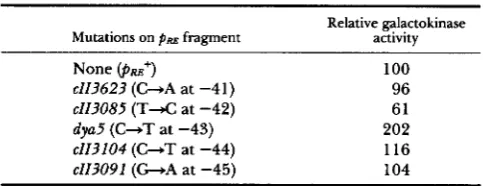
function similar to that of the dya5 mutation. These mutations were tested in the galactokinase assay system as above. The results (Table 2) show little effect for a C+A change at position -41 of #RE (cZZ3623, see Figure 2), a C+T change at position -44 (cZZ3104) and a G + A change at position -45 (cZZ3091). In contrast a T - S change at position -42 (cZZ3085) resulted in about a 40% decrease in pro- moter activity.DISCUSSION
The conclusion that the dya2, dya3 and dya5 muta- tions confer increased activity to the P R E promoter, rather than create a new promoter activity with a new transcriptional start site, is based upon three consid-
TABLE 2
Effects of various mutations on promoter activity
Relative galactokinase
Mutations on p ~ s fragment activity
None ($RE+)
cII3623 (C-A at -41)
cII3085 (T-S at -42)
dya5 (C-T at -43)
cII3104 (C-T at -44)
~113091 (&A at -45)
100 96 61 202 116 104
Experiments were performed as described in Table 1. The mutations are depicted in Figure 2.
erations. (1) The mutations do not result in sequences with any semblance of a promoter sequence, or of a binding site for cZZ protein. (2) The increased activities associated with the mutations are fully dependent upon cZZ protein (Table 1). (3) The cZZ protein binds to the 5'-TTGCN6TTGC-3' sequence which flanks the -35 region of the promoter. If a dya mutation were creating a new promoter with a different tran- scriptional start site, then the positioning of cZZ protein with respect to this new start site and to RNA polym- erase would have to be different from that in every other cZZ-dependent promoter, an exceedingly un- likely possibility. That the increased transcription as- sociated with the dya mutations is indeed caused by binding of cZZ protein to the identical binding site as in $RE is argued by (a) no other cZZ binding site is present in this region of DNA, and (b) the c t r l and
cy3008 mutations, which decrease the binding affinity of cZZ protein for the TTGCNsTTGC site (Ho, WULFF and ROSENBERG 1983; PLACE et al. 1984), cause a large decrease in the absolute magnitude of the dya
effect on galactokinase activity (Table 1).
The dya5 mutation, at position -43 ofp,, is outside of the region implicated for cZZ protein contact by methyl protection studies, and on the periphery of the region implicated for contact by RNA polymerase in the presence of cZZ protein (Ho, WULFF and ROSEN-
BERG 1983). Thus, in the presence of cZZprotein alone,
the Gs at positions -36 and -37 are fully protected from methylation, the G at position -40 is partially protected, and the Gs at positions -4 1, -43 and -44 are not protected at all. The cZZ protein makes contact with the major groove of the DNA helix, but the major groove at position -43, the site of the dya5
mutation, is on the opposite face of DNA double helix from the site of cZZ binding. In the presence of RNA polymerase and cZZ protein, the Gs at positions -40
594
- 5 -10 -15 -20 -25
-10 ~ 35
FIGURE 3.-Nucleotide sequences of XPRE (SCHWARZ et al. 1978;
ROSENBERG et al. 1978; SCHMEISSNER et al. 1980), X PI (ABRAHAM
et al. 1980; HOESS et al. 1980; DAVID 1980; SCHMEISSNER et al.
1981), X p , (HOOPES and MCCLURE 1985; H o and ROSENBERC
1985), 21 PRE (SCHWARZ 1980), and P22 p , (BACKHAUS and PETRI 1984; POTEETE, HEHIR and SAUER 1986). The consensus sequences at the -10 and -35 regions (HAWLEY and MCCLURE, 1983) are also included.
All of the PRE- mutations in the -35 region are found between positions -27 and -39, and promoter mutations in the -35 region of prokaryotic promoters in general are confined to the -35 consensus region itself (corresponding to positions -30 to -35 of P R E )
(HAWLEY and MCCLURE 1983). T h e dya5 mutation demonstrates that the
PRE
promoter is influenced by nucleotide sequence at least eight nucleotides to the 5'-side of the region in which promoter mutations are confined in other prokaryotic promoters.HAWLEY and MCCLURE (1 983), in their compilation of prokaryotic promoter sequences, found a mild pref- erence for A. T over G
.
C pairs in the region of -40 to -45. Although one might suppose that GC+AT changes in this region would generally result in pro- moter-up mutations like dya5, we found that GC- A T changes at positions -45, -44, -41 were all without measureable effect on flRE activity (Table2).
T h e G in the G.C pair that is altered in the -41 mutation is one of the bases that RNA polymerase protects from methylation, indicating that the protein makes close contact with this base pair even though the transcriptional activity is independent of whether it is a G.C or a T - A pair. A similar situation was previously found for the ctrl mutation, which affects a nucleotide pair that cZZ protein protects from meth- ylation (PLACE et al. 1984). In contrast to the above results, a T 4 change at position -42 resulted in about a 40% decrease in activity.It is interesting to compare the sequence of the X
pRE
promoter with other promoters activated by cZZprotein or a cZZ-like protein. We note in Figure 3 that of five such promoters (A PRE, X p,, X pa^, 21 p R E and
P22 P R E ) , three have T at position -43, one has A and only X has C. T h e dya5 mutation therefore represents a mutation to the consensus nucleotide for $,,-like promoters at position -43. In contrast, of the three mutations in the -40 region that were found to have no effect on
pRE
activity, none is a mutation to a consensus nucleotide. T h e T-C change at position -42 that results in a 40% decrease in promoter activ- ity eliminates the agreement of XpRE
with the consen- sus T (found in three of the five promoters) at thisposition. T h e mutational studies and the comparisons with PRFlike promoters therefore lead to the conclu- sion that Ts at both positions -42 and -43 are re- quired for maximum promoter activity, but they do not support the idea that As and T s in the -40 to -45 region generally lead to higher promoter activi- ties.
T h e dya2 and dya3 mutations, at positions -1 and
+5 of pm, are far from the site of cZZ binding and must affect interaction with RNA polymerase. Pro- moter mutations near the start sites of transcription have not previously been reported in prokaryotic pro- moters, but we suspect that the isolation of promoter mutants in these positions of $RE is due to our ability
to detect variants with small differences in promoter activity, rather than to a difference between pRa and other kinds of promoters. HAWLEY and MCCLURE (1983) found a weak consensus sequence of CAT at start sites of prokaryotic promoters, and we note that the dya2 mutation represents a TAG-CAG change in the corresponding #RE sequence, which makes it conform more closely to the consensus sequence. However, HAWLEY and MCCLURE find no preferred sequences in the +5 region of prokaryotic promoters, and would not have predicted that the dya3 mutation, an A 4 change at +5 of
p,,
would have an effect on promoter activity. Comparison with other pro- moters activated by cZZ protein or a cZZ-like protein does not lead to prediction of the increased promoter activities associated with the dya2 and dya3 mutations. Both mutations decrease the agreement of the Xpromoter with the consensus sequence for pRE-like promoters, and one might have predicted decreased, rather than increased promoter activities.
The two dya5 plasmids were constructed by L. BOGARAD. We thank G. PINCHBECK for technical assistance and K. SCHUFF for
typing the manuscript. This research was supported by grant GM28370 from the National Institutes of Health.
LITERATURE CITED
ABRAHAM J., D. MASCARENHAS, R. FISCHER, M. BENEDIK, A. CAMP-
BELL and H. ECHOLS, 1980 DNA sequence of the regulatory region for the integration gene of bacteriophage A. Proc. Natl. Acad. Sci. USA 77: 2477-2481.
BACKHAUS H. and J. B. PETRI, 1984 Sequence analysis of a region
from the early right operon in phage P22 including the repli- cation genes I8 and 12. Gene 32: 289-303.
Sensitive mutants of bacteriophage X. Virol-
DNA sequence of the Int-.&-PI region of bacteriophage lambda: overlap of the int and xis genes. Nucleic Acids Res. 8: 1765-1 782.
DUL, E., M. E. MAHONEY and D. L. WULFF, 1987 Mutations that affect the efficiency of translation of mRNA for the cII gene
of coliphage lambda. Genetics 115 585-590.
A genetic analysis of
the att-inbxis region of coliphage lambda. J. Mol. Biol. 111:
FIEN, K., A. TURCK, I . KANG, S. KIELTY, D. L. WULFF, K. Mc- CAMPBELL, A., 1961
DAVID, R. W., 1980 ogy 14: 22-32.
ENQUIST, L. W. and R. A. WEISBERG, 1977
KENNEY and M. ROSENBERG, 1984 CIIdependent activation of the pRe promoter of coliphage lambda fused to the Escherichia coligalK gene. Gene 32: 141-150.
FOWLER, R., G. DEGNEN and E. COX, 1977 Mutational specificity of a conditional Escherichia coli mutator, mutD5. Mol. Gen. Genet. 133: 179-191.
Compilation and analysis of Escherichia coli promoter DNA sequences. Nucleic Acids Res. 11: 2237-2255.
Ho, Y. S. and M. ROSENBERG, 1985 Characterization of a third, cIIdependent coordinately activated promoter on phage X
involved in lysogenic development. J. Biol. Chem. 260 1 1838-
1 1844.
Ho, Y. S., D. L. W u ~ m a n d M. ROSENBERG, 1983 Bacteriophage
X protein cII binds promoters on the opposite face of the DNA helix from RNA polymerase. Nature 304: 703-708.
HOW, R. H., C. FOELLER, K. BIDWELL and A. LANDY, 1980 Site- specific recombination functions of bacteriophage X: DNA sequence of the regulatory regions and overlapping structural genes for Int and Xis. PrOc. Natl. Acad. Sci. USA 77: 2482- 2486.
HOOPES, B. C. and W. R. MCCLURE, 1985 A cIIdependent pro- moter is located within the Q gene of bacteriophage X. Proc. Natl. Acad. Sci. USA 82: 3134-3138.
IKEMURA, T., 1981a Correlation between the abundance of Esch- erichia coli transfer RNAs and the Occurrence of the respective codons in its protein genes. J. Mol. Biol. 146 1-21.
IKEMURA, T., 1981b Correlation between the abundance of Esch- erichia coli transfer RNAs and the occurrence of the respective codons in its protein genes: a proposal for a synonymous codon choice that is optimal for the E. coli translation system. J. Mol. Biol. 151: 389-409.
MAXAM, A and W. GILBERT, 1980 Sequencing end-labelled DNA with base-specific chemical cleavages. Methods Enzymol. 6 5 499-559.
PLACE, N., K. FIEN, M. E. MAHONEY, D. L. WULFF, Y. S . Ho, C. DEBOUCK, M. ROSENBERG, M.-C. SHIH and G. N. GUSSIN, 1984 Mutations that alter the DNA binding site for the bacteriophage X cII protein and affect the translation efficiency of the cII gene. J. Mol. Biol. 1 8 0 865-880.
Bacteriophage P22 Cro protein: sequence, purification and properties. Bio- chemistry 25: 251-256.
HAWLEY, D. K. and W. R. MCCLURE, 1983
POTEETE, A. R., K. HEHIR and R. T. SAUER, 1986
ROSENBERG, M. and D. COURT, 1979 Regulatory sequences in- volved in the promotion and termination of RNA transcription. Annu. Rev. Genet. 13: 319-353.
ROSENBERG, M., D. COURT, H. SHIMATAKE, C. BRADY and D. L. WULFF, 1978 The relationship between function and DNA sequence in an intercistronic regulatory region in phage lambda. Nature 2 7 2 414-423.
SCHMEISSNER, U., D. COURT, H. SHIMATAKE and M. ROSENBERG, 1980 Promoter for the establishment of repressor synthesis in bacteriophage A. Proc. Natl. Acad. Sci. USA 77: 3191-3195. SCHMEISSNER, U., D. COURT, K. MCKENNEY and M. ROSENBERG,
1981 Positively activated transcription of X integrase gene initiates with UTP in vivo. Nature 2 9 2 173-175.
SCHWARTZ, E., 1980 Sequenzanalyse der DNA lambdoider Bak- teriophagen: Gene and Signalstrukturen der Transkription- skontrolle and der DNA-Replikation. Ph.D. thesis, University of Freiburg.
SCHWARZ, E., G. SCHERER, G. HOBOM and H. KOSSEL, 1978 Nucleotide sequence of cro, cII and part of the 0 gene in phage X DNA. Nature 272: 410-414.
Purified X regulatory protein cII positively activates promoters for lysogenic devel- opment. Nature 29% 128-132.
SHINE, J. and L. DALGARNO, 1974 The 3'-terminal sequence of Escherichia coli 16s ribosomal RNA: complementarity to non- sense triplets and ribosome binding sites. Proc. Natl. Acad. Sci. USA 71: 1342-1346.
SIEBENLIST, U., R. B. SIMPsoNand W. GILBERT, 1980 E. coli RNA polymerase interacts homologously with two different pro- moters. Cell 2 0 269-281.
WULFF, D. L., 1976 Lambda cin-1, a new mutation which en- hances lysogenization by bacteriophage lambda, and the ge- netic structure of the lambda cy region. Genetics 8 2 401-416. WULFF, D. L., M. BEHER, S. IZUMI, J. BECK, M. MAHONEY, H.
SHIMATAKE, C. BRADY, D. COURT and M. ROSENBERG, 1980 Structure and function of the cy control region of bacteriophage lambda. J. Mol. Biol. 1 3 8 209-230.
WULFF, D. L., M. MAHONEY, A. SHATZMAN and M. ROSENBERG, 1984 Mutational analysis of a regulatory region in bacterio- phage X that has overlapping signals for the initiation of tran- scription and translation. Proc. Natl. Acad. Sci. USA 81: 555- 559.