IJSRR, 8(2) April. – June., 2019 Page 550
Research article Available online www.ijsrr.org
ISSN: 2279–0543
International Journal of Scientific Research and Reviews
Phase Changes Under Heat Treatment During Synthesis of α
-Al
2O
3Nanoparticles by Sol Gel Method
Dhawale Vijaya Pandurang
1*, Mohite Kakasaheb Chandrakant
2. and Kulkarni
Satish Damodar
31
New Arts Commerce and Science College, Parner, Ahmednagar- 414 302, M.S. INDIA E-mail: [email protected]
2
C.T. Bora College Shirur, Dist. Pune- 412 210, M.S. INDIA E-mail: [email protected]
3
New Arts Commerce and Science College, Ahmednagar- 414 001, M.S. INDIA E-mail: [email protected]
ABSTRACT
In the present study, α-Al2O3 nanoparticles synthesized using alcoholic solution of AlCl3,
25% NH3 and Polyvinyl alcohol (PVA). PVA act as a capping agent. All these chemicals were
inexpensive raw materials. Stable crystalline phase of α-Al2O3 nanoparticles occurred at a
temperature 11000C. During heat treatment, stableα-Al2O3 can be obtained through the series of
phase transformations from boehmite, γ, δ, θ to α- phase of Al2O3. Crystalline nanoparticle formation
of the dried sol was investigated using x-ray diffractometry (XRD). XRD shows crystal size increases from 25 nm to 32 nm when calcination temperatures increases from 5000C to 11000C. It
was shown that crystal size increases during the heat treatment. The morphology of α-Al2O3
nanoparticles was studied using Transmission Electron Microscopy (TEM), Scanning Electron Microscopy (SEM), along with energy- dispersive X-ray analysis (EDAX). TGA and DTA shows,
77% weight loss and phase transformations. Synthesized α-Al2O3nanoparticles were applied in
waste water treatment as an adsorbent.
KEYWORDS
: Sol-gel method, phase change, heat treatment,calcination.*
Corresponding Author:
Dhawale V. P.
Associate Professor
Post Graduate Department of Physics,
New Arts Commerce and Science College,
Parner, Ahmednagar, 414 302- India
E-mail: [email protected]
IJSRR, 8(2) April. – June., 2019 Page 551 of transitions until the most stable corundum structure α-Al2O3 -forms at high temperatures.4During
the thermal treatment, stable α-Al2O3 phase can be obtained through the following series of phase
transformations before conversion to α- Al2O3 .
Hydrous alumina bohemite γ δ θ α5
The aim of the present paper is to study phase changes through TGA,DTA and XRD obtained
at different temperatures.
2.EXPERIMENTAL SECTION
α- Al2O3 nanoparticles were synthesized by using aluminum chloride as a precursor,25%
ammonia and polyvinyl alcohol (PVA). Alcoholic solution 0.5 M AlCl3 was prepared,25%NH3 was
added drop by drop till resulting solution turned to a white sol, PVA was added until it becomes a
transparent sticky gel. The gel was allowed to maturate for 24 hours at room temperatures and heat
treated at 1000C for 24 hours. The driedgel was divided into 4 parts and were heat treated at
5000C,7000C,9000C and 11000C for 4 hours respectively.
3.RESULTS AND DISCUSSION
3.1. SEM/TEM and EDAX of Al
2O
3nanoparticles
SEM image of the Al2O3 NPs gives the distributionpattern and size of the nanoparticles(Fig.
1A,B). The TEM micrographsshows slight agglomeration with spherical morphology and their
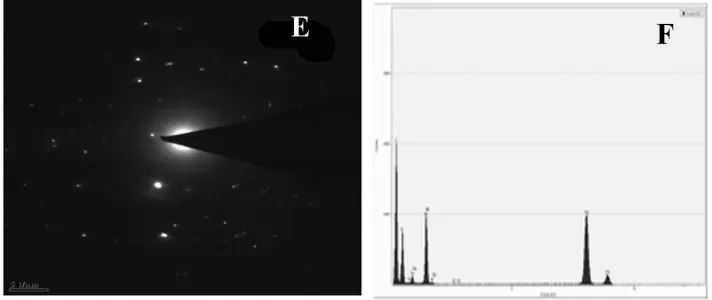
average particle size were 77.7 nm (Fig. 1C,D)The SAED pattern of Al2O3 NPsshows that the rings
are composed of dots suggesting the crystalline nature of these particles(Fig. 2E).The quantitative
analysis ofthe Al2O3 nanoparticle was done using EDAX spectroscopymeasurement and it shows Al
IJSRR, 8(2) April. – June., 2019 Page 552
Figure 1. Scanning electron micrographs (SEM) (A, B) and Transmission electron micrographs (TEM) of Al2O3
nanoparticles (C, D).
Figure2. Selected area electron diffraction pattern (E) and EDAX of Al2O3 nanoparticles (F).
3.2.
Thermal analysis
The % weight loss with temperature of TGA curve shows that nanoparticle formation
temperature is 7620C and transition temperature 8000C with one step weight loss of 77% .The DTA
curve shows endothermic reaction attributed to moisture loss and to hydroxyl loss from the
decomposition of hydrated aluminum chloride and aluminum hydroxide (Graph 1a,b) The
endothermic effects at about 8000C and 9000C may be due the transformations of polymorphous
enantiotropy γ- Al2O3 in α- Al2O3. Transformation temperature γ- Al2O3 to α- Al2O3is less than
IJSRR, 8(2) April. – June., 2019 Page 553
Graph 1(a).Thermal analysis (DTA and TGA)of α- Al2O3 nanoparticles obtained by Sol-gel method, calcined at
11000C temperature for 4h
Graph 1(b). The %weight loss of α- Al2O3 nanoparticles
IJSRR, 8(2) April. – June., 2019 Page 554
Graph 3. X-ray Diffraction pattern of α- Al2O3 nanoparticles
3.3. XRD analysis
Graph 2 shows the comparable XRD patterns of powders prepared by different calcination
temperatures from 5000C to11000C.X-ray diffraction images for the powders obtained from
precursors AlCl3 and dried at 24 hours after maturation of 24 hours,heat treated for four hours from
5000C to11000C separately. It shows that thermal treatment leads to its decomposition with the
formation of a mixture of γ- Al2O3phase(JCPDS - 47-1308) and α- Al2O3 phase (JCPDS
file-71-1678).6
XRD at temperatures 5000C and 7000C, shows there are 4-5 broad peaks in the pattern for the
sample sol- gel sample which are difficult to index according to the JCPDS data indicating that the
powder is possibly amorphous. Powder at this temperature shows the existence of organic materials
and confirms XRD pattern, where these compounds have prevented particles from forming crystal
structure. However, the diffraction peaks are a little sharper and attributed to γ- Al2O3 for the sol-gel
sample.7 All diffraction peaks exhibit high degree of broadness due to formation of nanocrystals.
The characteristic peaks of γ- Al2O3 is improved for the sol-gel sample with increasing calcination
temperature upto 10000C.8The diffraction peaks of δ and γ are very close to each other, in fact
overlapping in some positions. It can indicate that γ- Al2O3 co-exists with δ - Al2O3.9 Increasing
temperature of heat treatment upto11000Cfor four hours results in the formation of only α- Al2O3
(JCPDS file-71-1683) (Graph 3). At11000C single phase α- Al2O3 is completely formed. The
diffraction pattern is extremely sharp indicating the existence of highly crystalline material which is
shown by the curve at temperature 11000C.Average crystal size calculated from Debye scherrer
formula was found to be increasing from 25 nm to 32 nm of dried gel when calcination temperature
IJSRR, 8(2) April. – June., 2019 Page 555
ACKNOWLEDGEMENT
Smt. Dhawale V.P. is thankful to University Grants Commission (WRO), Pune, India for
providing the Teacher Fellowship under Faculty Development Program.
REFERENCES
1. Mirjalili F, Abdullah LC, Mohamad Het al. Proceess for nano-alpha-alumina powder. ISRN
Nanotechnology, 2011; 2011: 1-5.
2. Rogojan R, Andronescu E, Ghitulica Cet al. Synthesis and characterization of alumina
nano-powder obtained by sol-gel method. UPB Sci. Bull Series B.,2011; 73: 67-76.
3. Gocmez H and Ozcan O. Low temperature synthesis of nanocrystalline α- Al2O3 by a tartaric
acid gel method. Mater Sci. Eng. A., 2008; 475:20-33.
4. NaoufalBahlawane and Tadahikon Watanabe. New sol-gel Route for the preparation of pure
α- alumina at 950 0C.J.Am.Ceram. Soc., 2000; 83(9): 23- 26.
5. Arami H, Mazloumi M, Khalifehzadeh K et al. Bundles of self-assembled boehmitenano
strips from a surfactant free hydrothermal route.Journal of Alloys and Compounds, 2008;
461(1-2): 551–554.
6. Hongyu Liu, Guiling Ning, Zhihong Gan et al. A simple procedure to prepare spherical α
-alumina powders.Materials Research Bulletin, 2009; 44(4): 785-788.
7. RajaeiyanA and Bagheri-Mohagheghi MM. Comparison of sol-gel and co-precipitation
methods on the structural properties and phase transformation of c and a-Al2O3
nanoparticles, Adv.Manuf. 2013; 1:176–182. DOI 10.1007/s40436-013-0018-1.
8. Banerjee S and Sujatha P. Effect of citrate to nitrate ratio on the decomposition
characteristics and phase formation of alumina. J. Therm Anal Calorim.. 2007; 90:699–706.
9. Zhan X, Honkanen M, andLeva E.Transition alumina nanoparticles and nanorods from