
EXPERIMETAL VALIDATION OF VIBRATION REDUCTION IN
ROTATING MECHANICAL SYSTEM BY USING VISCOELASTIC
MATERIAL
SagarKarkhilea
G B Pokalea ([email protected])
aDr D Y Patil School of Engineering,Pune,India-411035
Abstract
Recently, viscoelastic damping materials have also been used in rotor dynamic applications. For rotor stability improvement, viscoelastic bearing supports have been studied by some researchers. The dynamic behavior of visco-elastically supported bearing applications has been analyzed in this field.In day today life in most of the companies balancing and noise reduction problems are absolute due to better designing techniques of manufacturing. Vibration isolators are used for the reduction of machine vibration in every industry, so we are implementing isolation method.
1 INTRODUCTION
Vibration is a mechanical phenomenon
hereby oscillations occur about
an equilibrium point. The oscillations may be periodic such as the motion of a
pendulum or random such as the
movement of a tire on a gravel road.Vibratory systems comprise means for storing potential energy (spring), means for storing kinetic energy (mass or inertia), and means by which the energy is gradually lost (damper). The vibration of a system involves the alternating transfer of energy between its potential and kinetic forms.
1.3 Methods of Reducing Undesirable Vibration
Following basic methods exists for vibration control of industrial equipment, as detailed below;
1. Force Reduction 2. Mass Addition 3. Tuning
4. Isolation
5. Damping
2. LITERATURE REVIEW
Panda K. C., Dutt J. K. [3] In their paper frequency dependent characteristics of the polymeric supports have been found
by simultaneously minimizing the
unbalanced response and maximizing the stability limit speed. Dutt, J.K. and Toi T. [4] They used polymeric material in the form of sectors as bearing supports for improving the dynamic performance of rotor–shaft systems, which often suffer from two major problems (a) resonance and (b) loss of stability, resulting in excessive vibration of such systems. Polymeric material in the form of sectors has been considered in their work as bearing supports. Espindola J. J., et.al. [6] Introduced a new approach for characterization of viscoelastic materials
via generalized derivatives. N.
energy dissipation model. Carlos Alberto Bavastri, et.al.[2] In their paper presented a numerical methodology for predicting the dynamic response of a simple rotor system in steady state, with bearings
containing layers of viscoelastic
material. H.G. Tillema,[5]The excitation behavior of a bearing application under operating conditions can be efficiently simulated with a harmonic response analysis using a hybrid modeling approach.
2.1 Problem Definition
Presently all the mechanical system experiences vibration, in a varying magnitude. In today’s world production reduction calls for speed increment. System working at higher speed faces
service vibrations. Generation of
vibration leads to mechanical failure, reduced performance & quality of product. This has become serious issue at all places. Till date engineers, designers & manufacturer are voyaging for the cost effective solution to arrest vibration. Many theories have been put forwarded so far & stepping success also being achieved. Furthermore a damping method using viscoelastic material is gaining attraction of researcher. A optimistic approach is still under investigation.
3.VISCOELASTIC MATERIALS:
3.1 Viscoelasticity:
Viscoelasticity is the property of materials that exhibit both viscous and elastic characteristics when undergoing
deformation. Some phenomena in
viscoelastic materials are:
1. If the stress is held constant, the
strain increases with time
(creep)(9)
2. If the strain is held constant, the
stress decreases with time
(relaxation)(9)
3. If cyclic loading is applied, hysteresis (a phase lag) occurs, leading to a dissipation of mechanical energy(9)
4 PLANNING OF EXPERIMENT
The selection of viscoelastic material is based on the properties, installation, replacement and cost. Out of this two, natural rubber is used for several applications. But flexible PVC is not used yet.
When Young’s modulus was observed, it was found that flexible PVC having less value than natural rubber. Then this material was tested for stiffness in FEA. There it was found that natural rubber is stiffer than flexible PVC
Fig. 1 Viscoelastic material used for experimentation
Natural Rubber
Flexible PVC
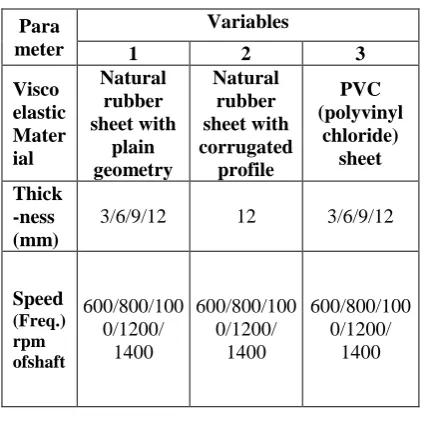
A Monthly Double-Blind Peer Reviewed Refereed Open Access International e-Journal - Included in the International Serial Table 1: Configuration of parameters under
study
Para meter
Variables
1 2 3
Visco elastic Mater ial
Natural rubber sheet with
plain geometry
Natural rubber sheet with corrugated
profile
PVC (polyvinyl
chloride) sheet
Thick -ness (mm)
3/6/9/12 12 3/6/9/12
Speed
(Freq.) rpm ofshaft
600/800/100 0/1200/
1400
600/800/100 0/1200/
1400
600/800/100 0/1200/
1400
4.1 EXPERIMENTAL SETUP
Fig. 1 Experimental setups block dia.
4.2 EXPERIMENTAL PROCEDURE
To increase the unbalance of system little mass of 20gm is added in the hole near circumference of disc. Readings are taken at motor, bearing 1 & bearing 2 on exciter & receiver side simultaneously.
So that difference of vibration
acceleration magnitude can be observed there itself.
5 RESULTS
5.1 Setup vibration Acceleration Magnitude without Isolator
Initially vibration acceleration magnitude of setup in without isolator condition is found out. Those magnitudes are then compared with vibration acceleration magnitudes with isolator condition.
(Note: All the readings tabulated in Exc. & Rec. column are vibration acceleration magnitudes in m/s2)
5.2 Setup vibration Acceleration Magnitude with Natural Rubber as Isolator
Natural rubber is used as isolator and readings are taken.
5.3 Setup vibration Acceleration Magnitude with Flexible PVC as Isolator
Using similar cases for natural rubber, readings were taken for flexible PVC.
5.4 Setup Vibration Acceleration Magnitude with Corrugated Profile of Natural Rubber as Isolator
In this case, similar operations for previous two materials are carried out and readings are taken for 12 mm thickness.
Table 2 : Vibration acceleration magnitude in without isolator condition.
CASE RPM
Motor Bearing 1 Bearing 2
EXC. REC. EXC. REC. EXC. REC.
without isolator
600 1.56 2.68 6.69 1.89 7.69 1.51
800 1.93 3.06 9.05 2.59 8.78 1.93
1000 2.40 3.70 12.34 3.10 12.00 2.12
1200 2.14 3.85 14.50 3.20 16.10 3.25
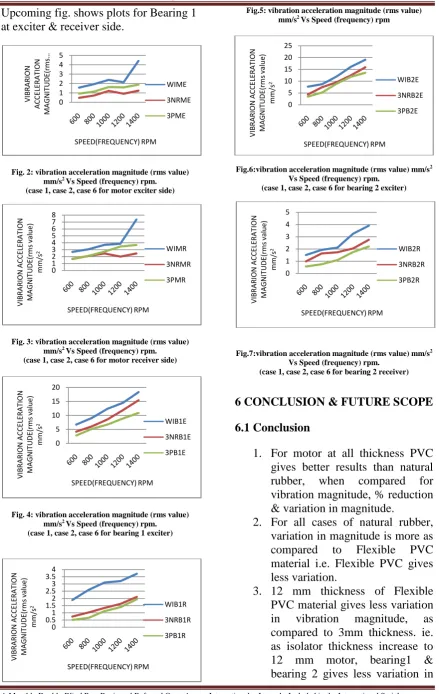
Upcoming fig. shows plots for Bearing 1 at exciter & receiver side.
Fig. 2: vibration acceleration magnitude (rms value) mm/s2 Vs Speed (frequency) rpm. (case 1, case 2, case 6 for motor exciter side)
Fig. 3: vibration acceleration magnitude (rms value) mm/s2 Vs Speed (frequency) rpm. (case 1, case 2, case 6 for motor receiver side)
Fig. 4: vibration acceleration magnitude (rms value) mm/s2 Vs Speed (frequency) rpm. (case 1, case 2, case 6 for bearing 1 exciter)
Fig.5: vibration acceleration magnitude (rms value) mm/s2 Vs Speed (frequency) rpm
Fig.6:vibration acceleration magnitude (rms value) mm/s2 Vs Speed (frequency) rpm.
(case 1, case 2, case 6 for bearing 2 exciter)
Fig.7:vibration acceleration magnitude (rms value) mm/s2 Vs Speed (frequency) rpm.
(case 1, case 2, case 6 for bearing 2 receiver)
6 CONCLUSION & FUTURE SCOPE
6.1 Conclusion
1. For motor at all thickness PVC gives better results than natural
rubber, when compared for
vibration magnitude, % reduction & variation in magnitude.
2. For all cases of natural rubber, variation in magnitude is more as
compared to Flexible PVC
material i.e. Flexible PVC gives less variation.
3. 12 mm thickness of Flexible PVC material gives less variation
in vibration magnitude, as
compared to 3mm thickness. ie. as isolator thickness increase to 12 mm motor, bearing1 & bearing 2 gives less variation in
A Monthly Double-Blind Peer Reviewed Refereed Open Access International e-Journal - Included in the International Serial
magnitude (it is better for machines whose operating speed range is more.)
4. When natural rubber with
corrugated profile compared with
other material at 3-12mm
thickness, result of this material are poor than both of natural rubber & Flexible PVC in all cases.
5. At bearing 1 & bearing 2 for all thickness & all considered operating speed PVC gives better
result when compared with
natural rubber & corrugated profile of natural rubber for vibration magnitude, % reduction & variation in magnitude.
6. In single point we can conclude as, when PVC, natural rubber & corrugated profile of natural rubber, are used as isolator for same thickness PVC gives less vibration than other two isolator material.
6.2 Future scope
Some of the following important corrective actions are suggested for future work:
Varying thickness & geometry can be tested for more viscoelastic material.
1. For vibration isolation in
different operating conditions
like temperature, pressure,
flexible PVC material can be tested. Furthermore it is to be tested in contamination.
2. In combination with various
viscoelastic material flexible PVC can be tested as isolator. 3. Results of PVC for reciprocating
machines also can be checked to analyze intermittent & impact stresses behavior of flexible PVC.
4. Elaborate for testing parameters, working condition, stress values & types.
5. By knowing the values of
damping damping coefficient & critical damping coefficient or damping ratio or loss factor of
isolator material force
transmissibility can be found out.
7 REFERENCES
1. H.G. Tillema, Thesis Noise
reduction of rotating machinery by viscoelastic bearing supports, University of Twente, Enschede, Netherlands, pp. 2-3, February 2003.
2. Carlos Alberto Bavastri, Euda Mara da S. Ferreira, Jose Joao de Espindola, Eduardo Marcio de O.
Lopes, Modeling of Dynamic
Rotors with Flexible Bearings due to the use of Viscoelastic Materials, Journal of the Brazil, Soc. of Mech. Sci. & Eng., 3(1), pp. 23-29, January-March 2008. 3. Panda, K.C.,Dutt J.K., Design of
Optimum Support Parameters for Minimum Rotor Response and Maximum Stability Limit, Journal of Sound and Vibration, 223 (1), pp. 1-21, May 1999.
4. Dutt, J.K., Toi T.,
RotorVibration Reduction With Polymeric Sectors, Journal of Sound and Vibration, Vol. 262(4), pp. 769-793, May 2003. 5. H.G. Tillema, Noise Reduction
Of Rotating Machinery By Viscoelastic Support, SKF Engineering & Research Centre
BV in Nieuwegein, the
Netherlands, PhD thesis,
University of Twente, Enschede, The Netherlands February 2003 6. Espindola, J.J., Silva Neto, J.M.
and Lopes, A Generalized
Approach to Viscoelastic Material Properties Measurement, Applied Mathematics and Computation, Vol. 164(2), pp. 493-506, May 2005.
7. N. Venugopal, C.M. Chaudhari,
Nitesh P. Yelve, An
Investigation on Vibration of Visco-elastic materials by Using Taguchi Method & ANOVA,NCRTM 2006.
8. M. I. Friswell, J. T. Sawicki, D.
J. Inman, A. W. Lees, The
Response of Rotating Machines on Viscoelastic Supports,
International Review of
Mechanical Engineering
(I.RE.M.E.), 1 (1), pp. 32-40, 2007.
9. Snowdon, J.C., Rubberlike
Materials, Their Internal Damping and Role in Vibration Isolation, Journal of Sound and Vibration, 2 (2), pp. 175-193, April 1965.
APPENDEX
Fig. 8: Sample vibration spectrum.
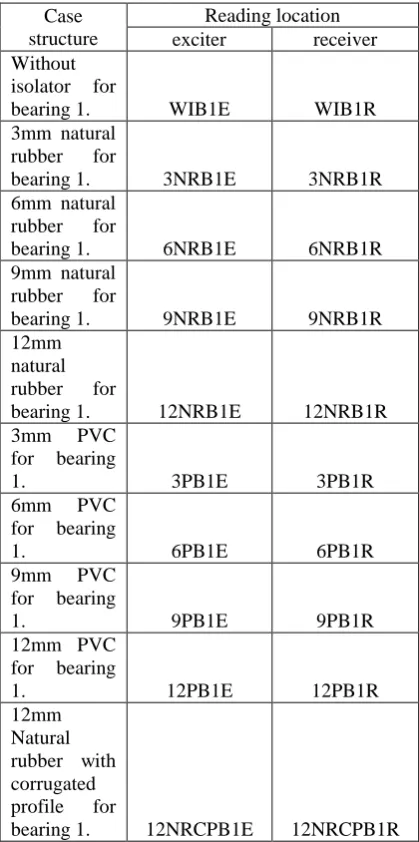
ABBREVIATION
Case structure
Reading location exciter receiver Without
isolator for
bearing 1. WIB1E WIB1R 3mm natural
rubber for
bearing 1. 3NRB1E 3NRB1R 6mm natural
rubber for
bearing 1. 6NRB1E 6NRB1R 9mm natural
rubber for
bearing 1. 9NRB1E 9NRB1R 12mm
natural rubber for
bearing 1. 12NRB1E 12NRB1R 3mm PVC
for bearing
1. 3PB1E 3PB1R 6mm PVC
for bearing
1. 6PB1E 6PB1R 9mm PVC
for bearing
1. 9PB1E 9PB1R 12mm PVC
for bearing
1. 12PB1E 12PB1R 12mm
Natural rubber with corrugated profile for
![3 (2 Methylphenyl) 3a,4 dihydro 3H chromeno[4,3 c]isoxazole 3a carbonitrile](data:image/gif;base64,R0lGODlhAQABAIAAAP///wAAACH5BAEAAAAALAAAAAABAAEAAAICRAEAOw==)