O R I G I N A L R E S E A R C H
Impacts of Different Spirometry Reference Equations
and Diagnostic Criteria on the Frequency of Airway
Obstruction in Adult People of North China
This article was published in the following Dove Press journal: International Journal of Chronic Obstructive Pulmonary Disease
Mengshuang Xie Liwei Cui Jinhuan Liu Wei Wang Jun Li Wei Xiao
Department of Pulmonary and Critical Care Medicine, Qilu Hospital, Shandong
University, Jinan, People’s Republic of
China
Background and Objective:The reference equations and diagnostic criteria play a critical role in the interpretation of pulmonary function tests (PFTs). The aim was to investigate the impacts of different reference equations and diagnostic criteria on the frequency of airway obstruction in adult people of a large teaching hospital of North China.
Methods: The spirometry data of all adult people who underwent PFTs in Qilu hospital from April 2012 to November 2015 were collected. Two spirometry reference equations, namely, Zhongshan-2011 and Global Lung Function Initiative 2012 (GLI-2012) were com-pared. The frequency of airway obstruction using different spirometry prediction equations and diagnostic criteria including forced expiratory volume in 1 s (FEV1)/forced vital capacity (FVC) <92% of predicted value and FEV1/FVC <lower limits of normal (LLN) were investigated.
Results:A total of 57,888 subjects were recruited with a mean age of 55.5 ± 13.72. There were significant differences in LLN and predicted value between the GLI-2012 and Zhongshan-2011. The average age of those who had an LLN of FEV1/FVC below 0.7 was 66.59 ± 6.05 years using GLI-2012, which was significantly lower than that in Zhongshan-2011 (77.46±2.63, P<0.001). Using FEV1/FVC<LLN as diagnostic criteria, Zhongshan-2011 identifies more obstructive subjects than GLI-2012 in each age group. In 45–59 or 60–80 age group, more participants were defined as obstructive using FEV1/FVC<92%pred than FEV1/FVC<LLN (both P<0.001).
Conclusion: Zhongshan-2011 identifies more airway obstruction than GLI-2012 in adult people of North China. Compared to FEV1/FVC<LLN, FEV1/FVC<92%pred may lead to overdiagnosis of airway obstruction in elderly people.
Keywords:lung function, LLN, airflow limitation, reference equations, COPD
Introduction
Airway obstruction is caused by an increase in airway resistance when intrathoracic
or extrathoracic narrowing of the airway leads to a reduction of airflow. Airway
obstruction is one of the main characteristics of obstructive lung diseases including
asthma and chronic obstructive pulmonary disease (COPD).1,2Spirometry is the most
commonly used method for the diagnosis of airway obstruction. Among the para-meters of spirometry, the ratio of forced expiratory volume in 1 s (FEV1) to forced vital capacity (FVC) is the most widely accepted indicator of airway obstruction. The
reduction of FEV1/FVC generally indicates the presence of airway obstruction.3
Although pulmonary function tests (PFTs) have been widely used for decades,
there are still some difficult issues in the accurate interpretation of PFTs and
Correspondence: Wei Xiao
Department of Pulmonary and Critical Care Medicine, Qilu Hospital, Shandong University, 107 Wenhua West Road, Jinan
250012, People’s Republic of China
Tel/Fax +86 53182166294 Email [email protected]
International Journal of Chronic Obstructive Pulmonary Disease
Dove
press
open access to scientific and medical research
Open Access Full Text Article
International Journal of Chronic Obstructive Pulmonary Disease downloaded from https://www.dovepress.com/ by 118.70.13.36 on 24-Aug-2020
diagnosis of airway obstruction. One of the problems is the controversial diagnostic criteria. In the diagnosis of airway obstruction, there is still a controversy regarding the appropriate cut-off values for FEV1/FVC. FEV1/FVC < lower limits of normal (LLN) are accepted by various guidelines on PFTs such as American Thoracic Society (ATS)/European Respiratory Society (ERS) interpretative
strategies for lung function tests.4 In China, FEV1/
FVC <92% of predicted value is also recommended by the guidelines for PFTs published by Chinese Thoracic
Society.5 Fixed cut-off such as FEV1/FVC <0.7 is
accepted as the definition of airflow limitation by Global
Initiative for Chronic Obstructive Lung Disease (GOLD).6
Reference equations also play an important role in the correct interpretation of PFTs. The interpretation of PFTs is usually dependent on the comparisons of data measured in an individual patient or subject with reference values deriving
from the epidemiological data of healthy subjects.4 Using
different lung function reference equations may influence the
interpretation of PFTs results. There are two widely accepted reference equations for adult people of North China: the reference equations published by Zhongshan hospital
(Zhongshan-2011)7 and Global Lung Function Initiative
2012 equations (GLI-2012) for northeast Asians.8
Zhongshan hospital is one of the earliest hospitals which carry out PFT in China and the Zhongshan-2011 reference equations are widely used in Northern and Eastern China. The GLI-2012 are multi-ethnic reference equations for
spiro-metry for the 3–95-yr age range.8GLI-2012 were developed
for four specific populations: Caucasian, Black, North-East
Asian and South-East Asian and were intended to be applied
globally.8Previous studies showed that the applicability of
GLI-2012 was different in different countries or
populations.9–14However, the values of GLI-2012 in North
Chinese have not been fully investigated yet.
In clinical practice, the presence of different reference
equations and/or diagnostic criteria causes great difficulties
for the accurate interpretation of PFTs. The aim of this study was to investigate the impacts of different reference equations and diagnostic criteria on the frequency of airway obstruction in adult people of a large teaching hospital of North China.
Population and Methods
Study Population
The study was conducted in accordance with the Declaration
of Helsinki, national and institutional standards.15The study
was approved by the Ethics Committee of Qilu Hospital of
Shandong University (No 2015091). To preserve the
partici-pants’privacy and data confidentiality, the participants’data
have been identified before analysis. All analyses in this
retrospective study were performed based on the data from anonymized patients. Due to the non-interventional retro-spective nature of this study, the Ethics Committee of Qilu Hospital of Shandong University approved an informed con-sent waiver for the retrospective medical record review.
The data were collected from a database that contained
all the adult patients’PFTs data of Qilu hospital, one of the
top medical centers in North China, between April 2012 and November 2015. The database includes 70,513 subjects who underwent PFTs, including patients with pulmonary diseases, people who underwent health examinations and patients who underwent preoperative examination. The inclusion criteria were: 1) age between 18 and 80 years; 2)
PFTs that fulfil ATS/ERS guidelines of lung function
tests.4,16
Pulmonary Function Tests
All PFTs were performed on computerized spirometers (Masterscreen, Jaeger, Hochberg, Germany) according to
the ATS/ERS recommendations.4,16 Each spirometer was
calibrated daily using a syringe of 3 L volume. A minimum of three satisfactory slow and forced vital capacity manoeu-vers were required of each subject. All the data of PFTs enrolled in this study were measured without the use of bronchodilators. The Basic information involving age (year), height (m), weight (Kg), body mass index (BMI;
Kg/m2) were collected before PFTs. Spirometry parameters
including FEV1 [L], FVC (L), FEV1/FVC (%) and vital capacity (VC; L) were collected.
Calculation of Predicted Value and LLN
The predicted values and LLN of FEV1, FVC and FEV1/ FVC were derived using prediction equations from the
GLI-2012 (North-East Asian) and Zhongshan-2011.7,8The
pre-diction equations include sex, age, height and weight. The impacts of different reference equations and diagnostic cri-teria on the frequency of airway obstruction in adult people of a large teaching hospital of North China. Those partici-pants with pre-bronchodilator FEV1/FVC lower than cut-off values were termed as airway obstruction. The cut-off values of FEV1/FVC were calculated using two different reference equations (Zhongshan-2011 and GLI-2012) and two diag-nostic criteria (LLN and 92% predicted).
International Journal of Chronic Obstructive Pulmonary Disease downloaded from https://www.dovepress.com/ by 118.70.13.36 on 24-Aug-2020
Statistical Analysis
Statistical analyses were performed using SPSS version 19.0 (IBM Corporation, Armonk, NY, USA) and Medcalc version 15.2 (MedCalc Software, Ostend, Belgium). Demographic and clinical characteristics
of all subjects were summarized descriptively.
Quantitative data were expressed as mean and standard deviation (SD). The normality assumption was tested through the kolmogorov-smirnov test. The independent samples and paired t-tests were used to test group differences of normally distributed data and
chi-square test was used to compare classified variables.
The differences of predicted values of spirometry para-meters between two prediction equations were evalu-ated using Bland-Altman plot. Correlation between the measurements was calculated with the Pearson
correla-tion coefficient. A P-value less than 0.05 was
consid-ered statistically significant.
Results
Participants
’
Characteristics
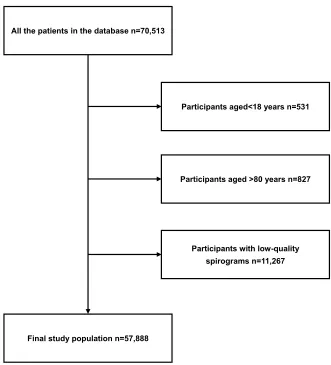
A total of 12,625 subjects were not included and 57,888
subjects met the selection criteria (Figure 1). The mean
age was 55.5±13.72 and 33,677 (58.18%) were males. The
participants were divided into three groups: age 18–44,
age 45–59 and age 60–80 according to the global burden
of disease study 2000.17 The basic characteristics of the
participants are shown inTable 1.
The Comparison Between Two
Reference Equations
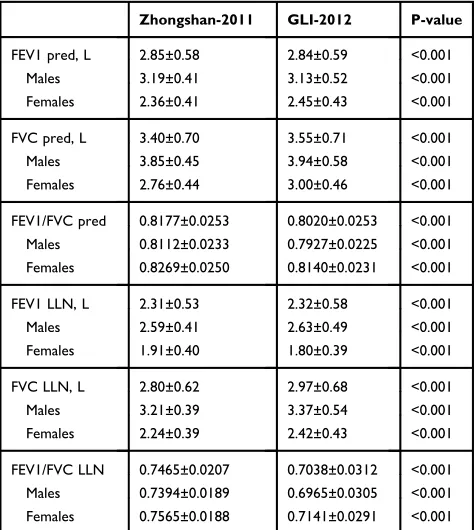
The predicted value between the two versions of
refer-ence equations are compared in Table 2. The LLN and
predicted FEV1/FVC from Zhongshan-2011 was higher than that from GLI-2012. The LLN and predicted FVC from Zhongshan-2011 was lower than that from GLI-2012. The trends of FEV1/FVC and FVC were same in
All the patients in the database n=70,513
Final study population n=57,888
Participants aged<18 years n=531
Participants aged >80 years n=827
Participants with low-quality
spirograms n=11,267
Figure 1Flowchart of the selection of the study population.
International Journal of Chronic Obstructive Pulmonary Disease downloaded from https://www.dovepress.com/ by 118.70.13.36 on 24-Aug-2020
males and females. The predicted value of FEV1 from Zhongshan-2011 was higher in males and lower in females compared to that from GLI-2012. The LLN of FEV1 from Zhongshan-2011 was lower in males and higher in females compared to that from GLI-2012. The difference was 0.15L in FVC and 0.01L in FEV1 between two reference equations.
The Bland-Altman plot also showed that compared to GLI-2012, the Zhongshan-2011 underestimate the predicted value and LLN of FVC whereas predicted value and LLN of FEV1/FVC were overestimated in Zhongshan-2011 than in
GLI-2012 (Figure 2).
The Relationship Between Reference
Values of FEV1/FVC and Age
The relationship between reference values of FEV1/FVC and ages using Zhongshan-2011 and GLI-2012 was investigated. The predicted value of FEV1/FVC was
negatively correlated with ages (R=−0.7 in
Zhongshan-2011 and R=−0.917 in GLI-2012) at a significant level.
We further investigated the age of the participants whose LLN of FEV1/FVC were lower than 0.7. Using
GLI-2012 of reference value, 27,893 (48.18%) participants’
LLN of FEV1/FVC were lower than 0.7 and only 113
(0.20%) of the participants’ LLN of FEV1/FVC were
lower than 0.7 using Zhongshan-2011. The average age of those participants with an LLN of FEV1/FVC below
0.7 was 66.59±6.05 using GLI-2012, which was signifi
-cantly lower than that in Zhongshan-2011 (77.46±2.63, P<0.001). The smallest age of LLN blow 0.7 was 52 in GLI-2012 whereas 70 in Zhongshan-2011.
The In
fl
uence of Diagnostic Criteria on
the Frequency of Airway Obstruction
The frequency of airway obstruction using different diagnostic
criteria: FEV1/FVC< LLN or FEV1/FVC<92%pred (Table 3)
was compared. When Zhongshan-2011 was used as reference
value, there was no significant difference in airway obstruction
frequency between two diagnostic criteria in 18–44 age group
(31.66% vs 32.59%, P=0.124). However, in other age groups
Table 1Participants’Spirometric and Anthropometric Characteristics
Total Age 18–44 Age 45–59 Age 60–80
Subjects, n 57,888 12,134 19,977 25,777
Age, years 55.50±13.72 34.65±7.20 52.75±4.37 67.45±5.50
Sex (male, %) 58.18 48.82 56.01 64.26
Height, cm 163.37±8.17 165.17±8.38 163.52±7.97 162.41±8.07
Weight, kg 65.90±12.29 66.65±13.95 66.92±11.76 64.76±11.75
BMI, kg/m2 24.64±3.93 24.33±4.18 24.98±3.75 24.52±3.92
FEV1, L 2.36±0.87 2.98±0.84 2.44±0.81 2.00±0.73
FVC, L 3.14±0.94 3.74±0.95 3.26±0.88 2.78±0.80
VC, L 3.26±0.93 3.82±0.94 3.37±0.88 2.92±0.80
FEV1/FVC 0.7397±0.1354 0.7959±0.1086 0.7415±0.1312 0.7181±0.1414
Note:Data are presented as mean ± standard deviation and n or n (%)
Abbreviations:BMI, Body Mass Index; FEV1, forced expiratory volume in 1 s; FVC, forced vital capacity; VC, vital capacity.
Table 2The Comparison Between Zhongshan-2011 and GLI-2012 Reference Values
Zhongshan-2011 GLI-2012 P-value
FEV1 pred, L 2.85±0.58 2.84±0.59 <0.001
Males 3.19±0.41 3.13±0.52 <0.001
Females 2.36±0.41 2.45±0.43 <0.001
FVC pred, L 3.40±0.70 3.55±0.71 <0.001
Males 3.85±0.45 3.94±0.58 <0.001
Females 2.76±0.44 3.00±0.46 <0.001
FEV1/FVC pred 0.8177±0.0253 0.8020±0.0253 <0.001
Males 0.8112±0.0233 0.7927±0.0225 <0.001
Females 0.8269±0.0250 0.8140±0.0231 <0.001
FEV1 LLN, L 2.31±0.53 2.32±0.58 <0.001
Males 2.59±0.41 2.63±0.49 <0.001
Females 1.91±0.40 1.80±0.39 <0.001
FVC LLN, L 2.80±0.62 2.97±0.68 <0.001
Males 3.21±0.39 3.37±0.54 <0.001
Females 2.24±0.39 2.42±0.43 <0.001
FEV1/FVC LLN 0.7465±0.0207 0.7038±0.0312 <0.001
Males 0.7394±0.0189 0.6965±0.0305 <0.001
Females 0.7565±0.0188 0.7141±0.0291 <0.001
Notes:The data was the predicted value and LLN of the participants. Data are presented as mean ± standard deviation. Zhongshan-2011, the reference value published by Zhongshan hospital 2011.
Abbreviations:FEV1, forced expiratory volume in 1 s; FVC, forced vital capacity; GLI-2012, Global Lung Function Initiative 2012 equations; LLN, lower limits of normal; VC, vital capacity.
International Journal of Chronic Obstructive Pulmonary Disease downloaded from https://www.dovepress.com/ by 118.70.13.36 on 24-Aug-2020
(45–59 or 60–80), more participants were defined as obstruc-tive using FEV1/FVC<92%pred than FEV1/FVC<LLN (P<0.001). When GLI-2012 was used as reference value,
there were more subjects defined as obstructive using
FEV1/FVC<92%pred than FEV1/FVC<LLN (P<0.001) in all age groups.
The Frequency of Airway Obstruction
Using Different Reference Equations
Using FEV1/FVC<LLN as diagnostic criteria, more
peo-ple were defined as obstructive according to
Zhongshan-2011 than GLI-2012 in each age group (P<0.001). Among
all the age groups, the 60–80 age group showed the largest
Figure 2Bland-Altman spot of LLN and predicted values of GLI-2012 and Zhongshan-2011.
Note: Zhongshan-2011, the reference value published by Zhongshan hospital 2011.PanelsA, CandEillustrate the comparisons of LLN of FEV1, FVC and FEV1/FVC between GLI-2012 and Zhongshan-2011; PanelsB, DandFillustrate the comparisons of predicted values of FEV1, FVC and FEV1/FVC between GLI-2012 and Zhongshan-2011.
Abbreviations:Δ, difference of GLI-2012 data minus Zhongshan-2011 data; FEV1, forced expiratory volume in 1 s; FVC, forced vital capacity; GLI-2012, Global Lung Function Initiative 2012 equations; LLN, lower limits of normal.
International Journal of Chronic Obstructive Pulmonary Disease downloaded from https://www.dovepress.com/ by 118.70.13.36 on 24-Aug-2020
difference in airway obstruction frequency between two
reference equations (43.11% vs 30.45%, P<0.001). Using
FEV1/FVC<92%pred as diagnostic criteria produced
simi-lar results, more people were defined as obstructive
according to Zhongshan-2011 than GLI-2012 in each age
group (P<0.001). The largest difference was also showed
in 60–80 age group (45.90% vs 40.05%,P<0.001).
The Diagnosis Concordance Rate
Between the Two Reference Equations
When using FEV1/FVC<LLN as diagnostic criteria, the diagnosis concordance rate between the two reference equations was 88.99% (51,516/57,888) in all the
partici-pants, 91.83% (11,143/12,134) in 18–44 age group,
89.40% (17,860/19,977) in 45–59 age group, 84.34%
(22,513/25,777) in 60–80 age group (Table 4). When
using FEV1/FVC<92%pred as diagnostic criteria, the diagnosis concordance rate was 94.20% (54,530/57,888)
in all participants, 95.39% (11,575/12,134) in 18–44 age
group, 94.10% (18,798/19,977) in 45–59 age group and
93.72% (24,157/25,777) in 60–80 age group (Table 5).
Discussion
In this study, we investigated the influence of diagnostic
criteria and reference equations in the diagnosis of airway
obstruction in adult Chinese. There were significant
dif-ferences between the two reference equations (GLI-2012
and Zhongshan-2011). The Zhongshan-2011 identified
more obstructive subjects than GLI-2012. Different
diag-nostic criteria can also influence the frequency of airway
obstruction.
The reference equations are the basis for the interpreta-tion of PFT. To the extent of the authors' knowledge, there are still no reports comparing the applicability between Zhongshan-2011 and GLI-2012 in adult people of North China. In this study, a large sample of adult people who underwent PFTs in a teaching hospital of North China was
enrolled. The results of this study showed that there were
significant differences between the two reference
equa-tions in FEV1/FVC. The predicted value and LLN of
FEV1/FVC in GLI-2012 were significantly lower than
that in Zhongshan-2011. One possible reason is that two versions of reference equations were obtained from
differ-ently recruited“normal”or“healthy”subjects. This result
indicated that adult people are more likely to be diagnosed with airway obstruction when the Zhongshan-2011 rather than GLI-2012 is used.
Table 3The Influence of Diagnostic Criteria and Reference Equations on the Frequency of Airway Obstruction
Subjects, n(%) All Zhongshan-2011 P GLI-2012 P
FEV1/FVC<LLN FEV1/FVC<92% pred FEV1/FVC<LLN FEV1/FVC<92% pred
All 57,888 22,715(39.24%) 23,874(41.24%) <0.001 16,345(28.24%) 21,076(36.41%) <0.001
Age 18–44 12,134 3842(31.66%) 3954(32.59%) 0.124 2853(23.51%) 3685(30.37%) <0.001
Age 45–59 19,977 7761(38.85%) 8088(40.49%) <0.001 5644(28.25%) 7067(35.38%) <0.001
Age 60–80 25,777 11,112(43.11%) 11,832(45.90%) <0.001 7848(30.45%) 10,324(40.05%) <0.001
Notes:Data are presented as n or n (%). Zhongshan-2011, the reference value published by Zhongshan hospital in 2011.
Abbreviations:FEV1, forced expiratory volume in 1 s; FVC, forced vital capacity; GLI-2012, Global Lung Function Initiative 2012 equations; LLN, lower limits of normal.
Table 4 Numbers of Concordant and Discordant Pairs When Using FEV1/FVC<LLN as Diagnostic Criterion Between GLI-2012 and Zhongshan-2011 to Diagnose Airway Obstruction
Subjects, n(%) GLI-2012 Total
No Yes
All
Zhongshan-2011
No 35,172 (60.76%) 1 (0.00%) 35,173
Yes 6371 (11.01%) 16,344 (28.23%) 22,715
Total 41,543 16,345 57,888
Age 18–44
Zhongshan-2011
No 8291 (68.33%) 1 (0.01%) 8292
Yes 990 (8.16%) 2852 (23.50%) 3842
Total 9281 2853 12,134
Age 45–59
Zhongshan-2011
No 12,216 (61.15%) 0 (0.00%) 12,216
Yes 2117 (10.60%) 5644 (28.25%) 7761
Total 14,333 5644 19,977
Age 60–80
Zhongshan-2011
No 14,665 (56.89%) 0 (0.00%) 14,665
Yes 3264 (12.66%) 7848 (30.45%) 11,112
Total 17,929 7848 25,777
Note:Data are presented as n or n (%).
Abbreviations:FEV1, forced expiratory volume in 1 s; FVC, forced vital capacity; GLI-2012, Global Lung Function Initiative 2012 equations; LLN, lower limits of normal.
International Journal of Chronic Obstructive Pulmonary Disease downloaded from https://www.dovepress.com/ by 118.70.13.36 on 24-Aug-2020
The FEV1/FVC of normal population declined with the increase of ages. Our results also proved that the reference values of FEV1/FVC decreased with ages. However, the average age of those participants who had an LLN of
FEV1/FVC below 0.7 was significantly lower in
GLI-2012 than that in Zhongshan-2011. A previous US study proved that, in Caucasians, the difference between differ-ent reference equations in LLN of FEV1/FVC might be
influenced by height and age.18 Both of the two versions
have the average age at which the LLN of FEV1/FVC fall below 0.70 is over 60 years, which is older than the results of a previous study (42 and 48 years in males and
females).19 This may be due to differences in the race of
study populations. More people were defined as
obstruc-tive according to Zhongshan-2011 than GLI-2012, espe-cially in old people.
Beside the reference equations, the criterion for airway
obstruction definition also has a large impact on the
diag-nosis of airway obstruction.20–22The FEV1/FVC<LLN was
the most widely used diagnostic criteria for airway
obstruction. However, because the calculation of LLN was relatively complex, the usage of LLN in clinical practices was limited. In that case, some scholars proposed to use FEV1/FVC or FEV1/vital capacity (VC) lower than the percentage of predicted value as a surrogate diagnostic
criteria.4,23 For instance, the consensus statement of ERS
on COPD in 1995 recommended FEV1/VC <88% predicted in males or <89% predicted in females as the diagnostic
criteria of airway obstruction.23FEV1/FVC<92% predicted
has also been recommended by the Chinese guideline of
PFT,5 but there is still a lack of studies to confirm the
accuracy of these diagnostic criteria. The results show that
FEV1/FVC <92%pred identified more airway obstruction
than FEV1/FVC<LLN in people older than 45, especially in
60–80 age group. This indicates that FEV1/FVC <92%pred
may lead to overdiagnosis of airway obstruction in elderly people compared to LLN. The difference between the two diagnostic criteria was larger when using GLI-2012, which indicated the accuracy of FEV1/FVC<92%pred might be
influenced by different reference equations.
We further investigated the diagnostic concordance between two reference equations in different age groups. When using FEV1/FVC<LLN as diagnostic criteria, the diagnosis concordance rate between the two reference equa-tions was 88.99%, which was lower than that of using FEV1/ FVC<92%pred as diagnostic criteria (94.20%, p<0.001). When FEV1/FVC<LLN as diagnostic criteria, the diagnosis concordance rate between the two reference equations in
60–80 group was lower than younger groups.
In recent years, the z-score has been recommended as an
evaluating index for spirometry parameters.8Z-scores
indi-cate how many standard deviations a measurement is from its predicted value. However, the Zhongshan-2011 has no z-score equations of spirometry parameters. In addition, the
statistical value of z-score (−1.64) was equal to LLN at the
5th centile.8In order to compare between these two
refer-ence equations, we chose to use LLN but not z-score. In this study, we only based on the PFTs to determine airway obstruction. But in clinical practice, other factors including symptoms and chest imaging should also be considered, especially for patients near cut-off values.
The GOLD guideline uses post-bronchodilator FEV1/
FVC<0.7 as the diagnostic criteria of airflow limitation.6
Because thefixed cut-off value of FEV1/FVC is simple and
its value on the diagnosis and treatment of COPD has been
verified in numerous clinical trials, some hospitals in China use
GOLD criterion to define the airway obstruction.24–29
However, previous studies proved that using a fixed
Table 5 Numbers of Concordant and Discordant Pairs When Using FEV1/FVC<92% Pred as Diagnostic Criterion Between GLI-2012 and Zhongshan-2011 to Diagnose Airway Obstruction
Subjects, n(%) GLI2-012 Total
No Yes
All
Zhongshan-2011
No 33,734 (58.27%) 280 (0.04%) 34,014
Yes 3078 (5.32%) 20,796 (35.92%) 23,874
Total 36,812 21,076 57,888
Age 18–44
Zhongshan-2011
No 8035 (66.22%) 145 (1.19%) 8180
Yes 414 (3.41%) 3540 (29.17%) 3954
Total 8449 3685 12,134
Age 45–59
Zhongshan-2011
No 11,810 (59.12%) 79 (0.39%) 11,889
Yes 1100 (5.51%) 6988 (34.98%) 8088
Total 12,910 7067 19,977
Age 60–80
Zhongshan-2011
No 13,889 (53.88%) 56 (0.22%) 13,945
Yes 1564 (6.07%) 10,268 (39.83%) 11,832
Total 15,453 10,324 25,777
Note:Data are presented as n or n (%).
Abbreviations:FEV1, forced expiratory volume in 1 s; FVC, forced vital capacity; GLI-2012, Global Lung Function Initiative 2012 equations.
International Journal of Chronic Obstructive Pulmonary Disease downloaded from https://www.dovepress.com/ by 118.70.13.36 on 24-Aug-2020
FEV1/FVC ratio may result in a significant number of
false-positive results in old people.30,31In addition, GOLD criterion
for COPD is defined by a post-bronchodilator FEV1/FVC
<0.7, which may not suitable for pre-bronchodilator estimation of airway obstruction. So the GOLD criterion was not enrolled in this study.
Thefitness of GLI-2012 and Zhongshan-2011 in North
China has not been fully illustrated. The results of this
study showed that only 0.20% of the participants’LLN of
FEV1/FVC using Zhongshan-2011 were lower than 0.7, which indicated that FEV1/FVC was overestimated in Zhongshan-2011. In our previous study, we proved that the LLN of FEV1/FVC of GLI-2012 was lower than
normal people aged 60–84 years old in Jinan, a city with
more than 7 million people in North China.32 So both
Zhongshan-2011 and GLI-2011 may not be the most appropriate reference equations for the adult people of North China.
Our study has several limitations. First, this was a retrospective study and only those who underwent PFTs in hospital were enrolled, and the age was limited from 18 to 80. These might lead to possible selection bias. In the future, we will make a further study on the commu-nity population of Chinese with a wider range of ages.
Second, the fitness of the reference equations and
diag-nostic criteria for healthy people had not been
investigated.
Conclusion
In conclusion, the predicted value of GLI-2012 and
Zhongshan-2011 differs significantly. The
Zhongshan-2011 identifies more obstructive subjects than GLI-2012
in each age group of adult people of North China. The
influence of diagnostic criteria on the frequency of airway
obstruction related with reference equations and age groups. Compared to LLN, FEV1/FVC <92%pred may lead to overdiagnosis of airway obstruction in elderly people.
Acknowledgments
This work was supported by grants from the National Key Research and Development Program in China [grant num-ber 2016YFC0903603].
Disclosure
The authors report no conflicts of interest in this work.
References
1. Rogliani P, Ora J, Puxeddu E, Cazzola M. Airflow obstruction: is it asthma or is it COPD? Int J Chron Obstruct Pulmon Dis. 2016;11:3007–3013. doi:10.2147/COPD
2. Hogg JC, McDonough JE, Suzuki M. Small airway obstruction in COPD.Chest.2013;143(5):1436–1443. doi:10.1378/chest.12-1766 3. Crapo RO. Pulmonary-function testing. N Engl J Med. 1994;331
(1):25–30. doi:10.1056/NEJM199407073310107
4. Pellegrino R. Interpretative strategies for lung function tests. Eur Respir J.2005;26(5):948–968. doi:10.1183/09031936.05.00035205 5. Group SPFT. Guidelines for pulmonary function tests.Chin J Tubere
Respir Dis. 2014(7). 487–491. doi: 10.3760/cma.j.issn.1001-0939.2014.07.002)
6. GOLD. Global initiative for chronic obstructive lung disease, global strategy for the diagnosis, management and prevention of COPD 2017. [updated 2017; cited 2011]. Available from:https://goldcopd. org/gold-2017-global-strategy-diagnosis-management-prevention-copd/. Accessed March 17, 2020.
7. Ren WY, Zhu L, Zhao RY, et al. Preliminary study on medical reference range for adult pulmonary function parameters in Shanghai.Chin J Respir Crit Care Med.2012;11(3):253–256. 8. Quanjer PH, Stanojevic S, Cole TJ, et al. Multi-ethnic reference
values for spirometry for the 3–95-yr age range: the global lung function 2012 equations. Eur Respir J. 2012;40(6):1324–1343. doi:10.1183/09031936.00080312
9. Langhammer A, Johannessen A, Holmen TL, et al. Global lung function initiative 2012 reference equations for spirometry in the Norwegian population. Eur Respir J. 2016;48(6):1602–1611. doi:10.1183/13993003.00443-2016
10. Hüls A, Krämer U, Stolz S, et al. Applicability of the global lung initiative 2012 reference values for spirometry for longitudinal data of elderly women.PLoS One.2016;11(6):e157569. doi:10.1371/jour-nal.pone.0157569
11. Arigliani M, Canciani MC, Mottini G, et al. Evaluation of the global lung initiative 2012 reference values for spirometry in African children.Am J Resp Crit Care.2017;195(2):229–236. doi:10.1164/ rccm.201604-0693OC
12. Slattery F, Schermer T, Esterman A, Johnston K, Crockett A. The global lung function initiative 2012 equations are as well-suited as local population derived equations to a sample of healthy profes-sionalfirefighters.Can Respir J.2017;2017:1–6. doi:10.1155/2017/ 6327180
13. Backman H, Lindberg A, Sovijärvi A, Larsson K, Lundbäck B, Rönmark E. Evaluation of the global lung function initiative 2012 reference values for spirometry in a Swedish population sample.
BMC Pulm Med.2015;15(1). doi:10.1186/s12890-015-0022-2 14. Fasola S, La Grutta S, Cibella F, Cilluffo G, Viegi G. Global lung
function initiative 2012 reference values for spirometry in South Italian children. Resp Med. 2017;131:11–17. doi:10.1016/j. rmed.2017.07.061
15. World Medical Association. World medical association declaration of Helsinki: ethical principles for medical research involving human subjects.JAMA.2013;310(20):2191–2194. doi: 10.1001/jama.2013. 281053.
16. Miller MR. Standardisation of spirometry. Eur Respir J. 2005;26 (2):319–338. doi:10.1183/09031936.05.00034805
17. Shibuya K, Mathers CD, Boschi-Pinto C, Lopez AD, Murray CJ. Global and regional estimates of cancer mortality and incidence by site: II. Results for the global burden of disease 2000.BMC Cancer. 2002;2(1):37. doi:10.1186/1471-2407-2-37
18. Linares-Perdomo O, Hegewald M, Collingridge DS, et al. Comparison of NHANES III and ERS/GLI-2012 for airway obstruc-tion classification and severity. Eur Respir J.2016;48(1):133–141. doi:10.1183/13993003.01711-2015
International Journal of Chronic Obstructive Pulmonary Disease downloaded from https://www.dovepress.com/ by 118.70.13.36 on 24-Aug-2020
19. Swanney MP, Ruppel G, Enright PL, et al. Using the lower limit of normal for the FEV1/FVC ratio reduces the misclassification of airway obstruction. Thorax. 2008;63(12):1046–1051. doi:10.1136/ thx.2008.098483
20. Viegi G, Pedreschi M, Pistelli F, et al. Prevalence of airways obstruc-tion in a general populaobstruc-tion.Chest.2000;117(5suppl 2):339S–345S. 21. Andreeva E, Pokhaznikova M, Lebedev A, Moiseeva I, Kutznetsova O, Degryse J. The prevalence of chronic obstructive pulmonary disease by the global lung initiative equations in north-western Russia. Respiration. 2016;91(1):43–55. doi:10.1159/ 000442887
22. Vaz Fragoso CA, McAvay G, Van Ness PH, et al. Phenotype of normal spirometry in an aging population. Am J Resp Crit Care. 2015;192(7):817–825. doi:10.1164/rccm.201503-0463OC
23. Siafakas NM, Vermeire P, Pride NB, et al. Optimal assessment and management of chronic obstructive pulmonary disease (COPD).
Eur Respir J. 1995;8(8):1398–1420. doi:10.1183/09031936.95.08 081398
24. Vogelmeier C, Hederer B, Glaab T, et al. Tiotropium versus salme-terol for the prevention of exacerbations of COPD.New Engl J Med. 2011;364(12):1093. doi:10.1056/NEJMoa1008378
25. Singh D, Papi A, Corradi M, et al. Single inhaler triple therapy versus inhaled corticosteroid plus long-actingβ2-agonist therapy for chronic obstructive pulmonary disease (TRILOGY): a double-blind, parallel group, randomised controlled trial. Lancet. 2016;388(10048):963. doi:10.1016/S0140-6736(16)31354-X
26. Wedzicha JA, Banerji D, Chapman KR, et al. Indacaterol-glycopyrronium versus salmeterol-fluticasone for COPD.New Engl J Med.2016;374(23):2222. doi:10.1056/NEJMoa1516385
27. Vestbo J, Anderson JA, Brook RD, et al. Fluticasone furoate and vilanterol and survival in chronic obstructive pulmonary disease with heightened cardiovascular risk (SUMMIT): a double-blind rando-mised controlled trial.Lancet.2016;387(10030):1817. doi:10.1016/ S0140-6736(16)30069-1
28. Decramer M, Celli B, Kesten S, et al. Effect of tiotropium on out-comes in patients with moderate chronic obstructive pulmonary dis-ease (UPLIFT): a prespecified subgroup analysis of a randomised controlled trial. Lancet. 2009;374(9696):1171–1178. doi:10.1016/ S0140-6736(09)61298-8
29. Tashkin DP, Celli B, Senn S. A 4-year trial of tiotropium in chronic obstructive pulmonary disease—NEJM.N Engl J Med.2008;359 (15):1543–1554. doi:10.1056/NEJMoa0805800
30. Hardie JA, Buist AS, Vollmer WM, Ellingsen I, Bakke PS, Morkve O. Risk of over-diagnosis of COPD in asymptomatic elderly never-smokers. Eur Respir J. 2002;20(5):1117–1122. doi:10.1183/ 09031936.02.00023202
31. Medbø A, Melbye H. Lung function testing in the elderly—Can we still use FEV1/FVC<70% as a criterion of COPD? Resp Med. 2007;101(6):1097–1105.
32. Tian XY, Liu CH, Wang DX, et al. Spirometric reference equations for elderly Chinese in Jinan aged 60–84 years.Chin Med J (Engl). 2018;131(9):1016–1022. doi:10.4103/0366-6999.227840
International Journal of Chronic Obstructive Pulmonary Disease
Dove
press
Publish your work in this journal
The International Journal of COPD is an international, peer-reviewed journal of therapeutics and pharmacology focusing on concise rapid reporting of clinical studies and reviews in COPD. Special focus is given to the pathophysiological processes underlying the disease, inter-vention programs, patient focused education, and self management
protocols. This journal is indexed on PubMed Central, MedLine and CAS. The manuscript management system is completely online and includes a very quick and fair peer-review system, which is all easy to use. Visit http://www.dovepress.com/testimonials.php to read real quotes from published authors.
Submit your manuscript here:https://www.dovepress.com/international-journal-of-chronic-obstructive-pulmonary-disease-journal
International Journal of Chronic Obstructive Pulmonary Disease downloaded from https://www.dovepress.com/ by 118.70.13.36 on 24-Aug-2020