Surface
Phenomena on
Rhodium-Platinum
Gauzes
CATALYST ACTIVITY
DURING AMMONIA
OXIDATION
By J. E.
Philpott
Johnson Matthey Metals Limited
The rare occurrence of inactive catalyst gauzes for no obvious reason has led to comparative studies of the structures of rhodium-platinum wires from both active and inactive gauzes. Active gauzes showed the regular development of octagonal crystal faces on the nodular growths on the wires. Inactive gauzes showed no crystal development and an amorphous growth appeared on the wires. Segregation of rhodium and iron at the surface occurred
in
this case, perhaps due to unusual plant operating conditions, and may have caused deactivation.T h e use of rhodium-platinum alloy gauze as the catalyst in the modern process for ammonia oxidation is well established, as shown by the large number of papers re- viewed previously in this journal ( I ) and elsewhere (2). At the present time there are in the world more than
450
nitric acid plants and almost without exception they use plati- num alloy catalyst gauzes, usually of 10 per cent rhodium-platinum.T h e oxidation process is highly efficient and over a wide range of operating conditions a nearly quantitative conversion of ammonia to nitric oxide can be obtained. Conversion efficiencies of between 92 and 96 per cent are commonplace and are consistently achieved throughout the lifetime of a plant. I n general the shortfall from maximum efficiency is probably due to some decomposition of the ammonia feedstock before it reaches the gauzes, rather than to significant yields from possible alternative reactions ( I , 2) that can take place on the gauzes.
On rare occasions, however, a case is found of a catalyst gauze pad that is inactive. Although apparently indistinguishable from other gauzc pads, the inactive gauze pad does not maintain its initial conversion efficiency
and uneconomical yields are obtained only a short time after igniting the pad. It would appear that the high selectivity of the catalyst gauzes for promoting the desired oxidation reaction steadily declines and that yields from alternative side reactions become significant. Treating the inactive gauzes with constant boiling hydrochloric acid and replacing them in the plant does not improve their per- formance. Replacement of the inactive pad by a fresh pad of gauzes has always overcome the problem but has done nothing to explain it.
Analytical examinations of inactive gauzes and of the material from which they were woven and cut do not give any indication of the cause of inactivity. T h e chemical composition of the gauze material has always been found to lie within the tolerance limits. Analysis to determine whether some unusual impurity had been sealed into the wire surface during the wire drawing process, or whether the retention by the gauzes of impurities entrained in the feedstock gas might account for the drop in activity, did not reveal any cause of the inactivity.
Fig. 1 Carcful inspa tLon of gauzes fabricated by .Johnson Matthey Metals before dispatrh
to nitric nccd plants. Y’he fiat rircuEar pattze mil2 be Enstalled in a mediuin pressure plant and the smaller hemgonal g a m e s zn high pressure plants. The largi, rolled czrcular g:cizcze
loill be installed En a plant operating at atmospheric presnuro
embarrassment than a constant cause of trouble, a niore detailed examination of them was undertaken as part of a research pro- gramme to study the fundamental mech- anisms involved in ammonia oxidation for nitric acid production.
Examination
of
Inactive Ganzes
’To this end a number of inactive gauzes from two medium pressure plants were examined at various periods in their lifetime and the results, together with the results from a more general examination made of spcnt gauze pads taken from all types of plant in various parts of the world, were compared with those obtained from an examination of several inactive gauzes from two inactive gauze pads. A description of the results follows with a series of scanning electron microscope and electron microprobe analyser photographs illustrating the state of the gauze surface at various stages.
It has been previously reported (3) that rhodium-platinum gauzes develop nodules or “brussels sprout” growths on their surfaces while in operation in nitric acid plants. The catalytic activity of the gauzes appears to be related to the development of this nodular growth, since fresh gauzes with smooth as- drawn wire surfaces are inactive and need to be activated before they will oxidise ammonia efficiently. For this reason replacement gauzes are usually installed beneath some of the older activated gauzes already in the catalyst pad. When a new pad is being commissioned, each gauze in the new pad is activated by playing a hydrogen flame over its surface until the gauze just glows red. Alternatively, a few activated gauzes obtained from a plant already in commission are inserted on top of the fresh gauze pad and serve to ignite the remainder.
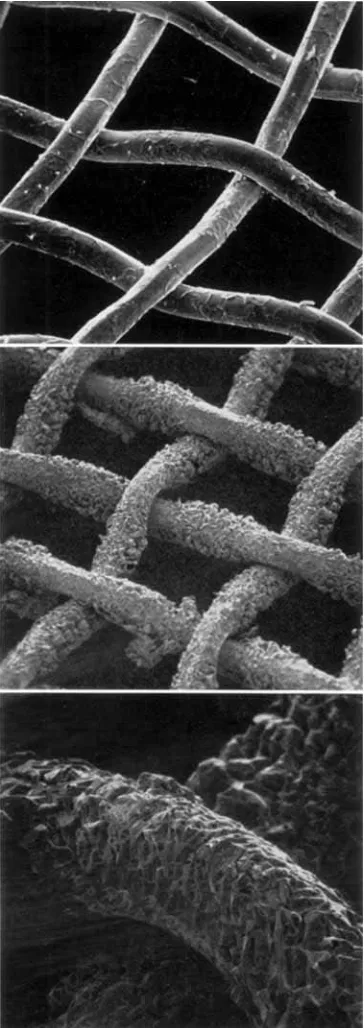
T h e photograph in Fig. 2 shows a gauze
F‘ig. 2 l O P ( , Rh-l’t gauze ioire 0.003 inch diameter
i n the as-drawn condition showing the uniforni grain structure and absence of nodules on the wires
k’ig. 3 The gauze of Fig. 2 after half the normal
gauze life installed i n a nitric acid plant showing the nodular pattern typicctl of a n active gauze
l+‘ig. 4 A n eizlarged a i e u of the crossoz’er point of
two gauze wires .from the gaua:! i n Fig. 3 showing the octagonal crystal structure a n d the nodules.
iohich are concmtmted on the wire surfaces between
crossover points
installed in a nitric acid plant for half the normal gauze life period. Its surface shows the development of the nodular pattern typical of an active gauze. An enlarged view of the crossover point of two gauze wires from the same gauze is seen in Fig. 4. A clearly developed octagonal crystal structure can be seen in the enlargement and also the development of the nodules, which appear to be concentrated on the surfaces between the crossover points. Perhaps nodular growth at crossover points is inhibited by the slight movement of the wires that occurs while the gauze is in service. T h e structure seen here is generally typical of active gauzes whether they have been operated in low, medium or high pressure plants.
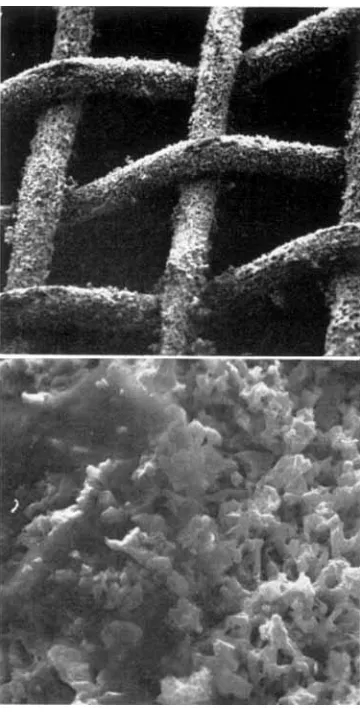
When individual gauzes from an inactive pad are examined, a markedly different structure is observed. T h e regular develop- ment of octagonal crystal faces cannot be distinguished and an amorphous “cauli- flower”-like growth as illustrated in Figs.
5
and 6 is seen, in contrast to the “brussels sprout” nodules usual on active gauzes.
Segregation at
Wire
Surfaces
Fig. 5 A I I inactive puuze after a f h (lays installed
in a nitric m i d plant showing the rrbsence o f
octcrgonul crystal ,faces
Vig. 6 An, edarged v i w of the g a m e toire shown
in Fig. 5 w i t h the cnullflozuer-lilce amorphous
,growth clmrcrcteristic of innetiiie gauzes
of both sets of gauzes were similar and those taken from one set are shown.
Examination of the electron images from the active gauzes (Fig. 7) shows that the wires were homogeneous and no unusual features are visible. In the electron images of the inactive gauzes (Fig. 8) a clearly defined concentration of material is seen on the surface of the wires. This segregation on the
Fig. 7 (right) Electron and X-ray images of spent active gauze showing its homogeneity. n ( t o p ) l<lectron
Fig. 0 l+:lrrtron and X-rmy images of spent inactiiie gauze showing srgrrgation of material at
the surjacr
( I
6 l’t M E X - r a y image
Elrctron image of cross-sertion of gauze
r Hh I,a X - r a y image Y 360
the effect is really due to the micro-section being a plane through the middle of the gauze so that more of the wire surfaces is visible at the crossover points where the wires dip and rise in crossing each other.
The composition of the material shown in Fig. 8c is very probably rhodium present as rhodium oxide Rh,OB. A similar electron image was seen showing a concentration of iron, probably as FerOa, which was as- sociated with the surface concentration of rhodium. Neither of the active gauzes examined showed any sign of surface con- centration of rhodium or iron oxides.
On both sets of inactive gauzes the cauli- flower-like nodular structure and the con- centration of rhodium and iron oxides on the wire surfaces were found to be present on all the gauzes in the pad although they became less severe from the top gauze downwards.
Fig. 9 ( ; a w e fabrication vn tl7e looms in the .Johnson
Matthey Metals g a i m shop. i ~ h f ) f ~ i u m - p l f l t i n i L n ~ gauzes 7 ~ p
to 140 in (3.56 metres) wide
(ire wot~eri f r o m 0.003 in d i a m r t w w i r e
‘The development of these inactive surfaces is the subject of further research work and in a later article it is hoped that an explanation will be given of the fundamental causes that lie behind these observations.
Acknowledgements References
The author is much indebted to Dr G. J. I<.
Acrcs for helpful discussions and to Mr J. G. l h y , who obtained the scanning electron micro- scope and electron microprobe analyser photo-
I H. Connor, Z’latinum Metals Rev., 1967, 11,
2 T. E L Chilton, Chem. Engng. Prog. Mon. Ser. 3 3 A. W. Holmes, Platinum Metals Rev., 1959, 3,
(I), 2-9 Ibid.; (2), 60-69
graphs. ( I ) , 2-8
The
Electrodeposition
of Rhodium
on
Titanium
T h e protection of titanium by a thin coating of platinum is well known in chemical technology but, although platinised titanium anodes are commonly used for industrial electrochemical purposes, little attention has been given to titanium coated with other platinum group metals.
A recent paper by K. P. Ratashev and
V. P. Zverev (
TT.
Leningrad. I’oiitekh. Inst., 1970, (304), 130-134) now reports on studies by the polarisation curve method of the electrodeposition of rhodium on titanium and indicates the feasibility of such plating. It can produce both protective and decorative coatings and also insoluble rhodium/titanium anodes. T h e features of rhodium for these purposes are its lesser density and greater hardness than platinum.Titanium alloys were degreased chemically and then were etched in sulphuric acid solution at 60 to 90‘C before plating in a bath containing 1 . 2 to 2.0 g/l rhodium and 40 to 50 g/1 sulphuric acid at current densities between 0.1 and