Note of Multidimensional MITM Attack on
25-Round TWINE-128
Long Wen1, Meiqin Wang1?, Andrey Bogdanov2?, Huaifeng Chen1
1
Key Laboratory of Cryptologic Technology and Information Security, Ministry of Education, Shandong University, Jinan 250100, China
[email protected], [email protected]
2
Technical University of Denmark, Denmark
Abstract. TWINE is a lightweight block cipher proposed in SAC 2012 by Suzakiet al.. TWINE operates on 64-bit block and supports 80 or 128-bit key, denoted as TWINE-80 and TWINE-128 respectively. TWINE has attracted some attention since its publication and its security has been analyzed against several cryptanalytic techniques in both single-key and related-single-key settings. In the single-single-key setting, the best attack so far is reported by Bozta¸set al. at LightSec’13, where a splice-and-cut attack on 21-round TWINE-128 and a multidimensional meet-in-the-middle (MITM) attack on 25-round TWINE-128 are presented. Yet, the evaluation of the time complexity of the multidimensional MITM attack on 25-round TWINE-128 is somehow controversial in the way we understand. We here describe the attack in detail and explains our concerns about the time complexity of the attack. And it turns out that the multidimensional MITM attack on 25-round TWINE-128 may have a time complexity higher than exhaustive search.
Keywords: Block Ciphers, Cryptanalysis, TWINE, Multidimensional MITM Attack
1
Description of TWINE
TWINE [1] is a 64-bit block cipher supporting two key lengths, 80 or 128 bits (de-noted as TWINE-80 and TWINE-128 respectively). The two versions of TWINE algorithm differ only in the key schedule. The global structure of TWINE is a variant of Type 2 generalized Feistel structure with 16 4-bit nibbles. TWINE’s round function consists of a nonlinear layer using 4×4 S-boxes and a diffusion layer permuting the 16 nibbles. Ther-th (1≤r≤36) round of TWINE is illus-trated in Figure 1, where we useXi
r,0≤i≤15 to denote the 16 input nibbles
into roundr. Each round function takes a 32-bit subkey RKr,1 ≤r≤36. The i-th nibble ofRKr is denoted asRKri,0≤i≤7.
The key schedules produce 36 32-bit subkeys RKr,1 ≤ r ≤ 36 from the keyκ.κcould be 80 or 128 bits depending on which version of TWINE we are dealing with. For details of the key schedule, we refer to [1].
?
F F F F F F F F
S
X2
r+1 Xr3+1Xr4+1 Xr5+1Xr6+1 Xr7+1 Xr8+1 Xr9+1X10r+1 X11r+1 X12r+1 X13r+1X14r+1 X15r+1
X0
r+1 Xr1+1
X0
r Xr1 Xr2 Xr3 Xr4 Xr5 Xr6 Xr7 Xr8 Xr9 X10r X11r X12r X13r X14r X15r
RKr0
RK2r RK3r
RKr0 RK1r RKr4 RK5r RKr6 RKr7
Fig. 1:r-th round of TWINE
2
Multidimensional MITM Attack on 25-Round
TWINE-128 [4]
In [4], Bozta¸set al.combined Splice-and-Cut technique [2] and multidimensional MITM technique [3] and mounted a key recovery attack on 25-round TWINE-128. The attack requires 248chosen plaintexts, 2122encryptions and 2125 blocks memory. The idea of their attack is interesting. However, after a careful evalua-tion on the attack procedure, we find some flaws in term of the time complexity of the attack on 25-round TWINE-128 [4]. The actual time complexity of their attack on 25-round TWINE-128 should be higher than what is claimed and unfortunately even higher than exhaustive search.
In the following, we firstly introduce the two dimensional MITM (2D-MITM) technique used in [4]. Then we dive into the details of the attack on 25-round TWINE-128 [4]. Finally, we revaluate the time complexity of the attack.
2.1 2D-MITM Technique
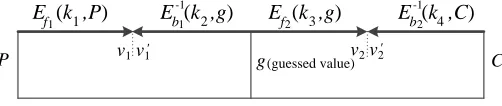
The main idea of the 2D-MITM attack is that the attacker splits the target cipher into two sub-ciphers and performs MITM attack on each of the sub-cipher by guessing an intermediate stageg, see Figure 2. Denote the common key bits of subkey k1 and k2 as kc1 and the common key bits of subkey k3 and k4 as kc2, the two dimensional MITM attack can be proceeded as follows.
E f (k ,P)
1 E b1(k ,g) E f2(k ,g) -1
E b(k ,C) 2 -1
P v1v1' g v2v2' C
1 2 3 4
(guessed value)
Fig. 2: overview of 2D-MITM attack
1. Computev1=Ef1(k1, P) for all values ofk1, and put all values ofk1into a tableT1indexed byv1||kc1, each entry of which is a set of certain k1. 2. Compute v0
2=E− 1
b2 (k4, C) for all values of k4, and put all values of k4 into a tableT2 (similar asT1) indexed byv20||kc2.
(a) Compute v10 = Eb−1
1 (k2, g) for all values of k2. Use v
0
1 and kc1 to find matched entries ofT1. Put all matched (k1, k2) into a tableQ.
(b) Computev2=Ef2(k3, g) for all values of possiblek3. Usev2 andkc2 to find matched entries of T2. Check whether (k3, k4) are also matched entries of Q. If so, do brute-force testing on the matched key tuple (k1, k2, k3, k4) with other P C pairs. If the key tuple survives all test-s, output the key tuple as the correct key and stop the attack.
2.2 Overview of the Attack on 25-Round TWINE-128 [4]
The 2D-MITM attack combined with Splice-and-Cut technique is applied on 25-round TWINE-128, and the attack framework is shown in Figure 3.
E f(k ,Y)
1 E b1(k ,g) E f2(k ,g) -1
E b(k ,C) 2 -1
P v1v1' g
' v2v2
C
1 2 3 4
(guessed value)
E b(k ,Y) 3 -1
5
Y (Fixed value)
Fig. 3: overview of Bozta¸set al.’s attack on 25-round TWINE-128
TWINE-128’s key schedule is taken into consideration to make the attack work.RK1 is extracted directly from κ, then κis updated to produce the next subkey. If RKi is extracted from the i-thκstate (denoted asκi), then it is the relation between subkey nibbles andκ8 that are taken into consideration in the attack on 25-round TWINE-128.
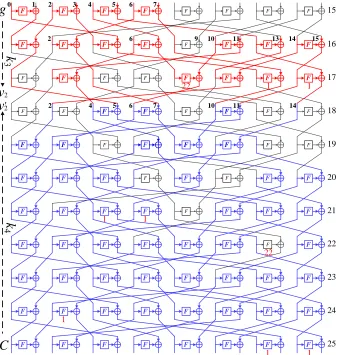
The details of the attack on 25-round TWINE-128 are illustrated in Figure 3 and Figure 4. In both figures, we show different partial encryption (or decryption) phase in different colors and the states nibbles andF-functions that are involved in the partial encryption (or decryption) are shown in bold. Sinceκ1
8andκ228 are the two special key nibbles considered, if aF-function’s input subkey is related to κ1
8 or κ228 , we put the number ‘1’ or ‘22’ beneath the F-function in both figures.
To be more concrete, Y = X12,6,14||X20,2,6,7,8,10,12||X36,12,14||X2 4||X
6,13 5 , g =
X150,...,7||X162,6,9,10,11,13,14,15. The first check point isv1=v10 =X
4,5,6,9,10,11,13,14,15
13 .
The second check point isv2=v02=X
2,4,5,6,7,10,11,14
18 . If we denote the bit length of a variable with | · |, then |v1| =|v01| = 36 and|v2| =|v02| = 32. k1 used in
Ef1 has nothing to do with κ1
8 and κ228 is not involved inE
−1
b2 andE
−1
b3 . Thus
|k1| = 124 and |k4| = 124. In Eb−11 and Ef2, there are respective 15 and 16
F-functions involved, this makes|k2|= 60 and|k3|= 64. According to TWINE-128’s key schedule, there are 48 common bits betweenk1andk2and 48 common bits betweenk3andk4, meaning that|kc1|=|kc2|= 48. The attack on 25-round TWINE-128 is proceeded as follows.
F F F F F F F F
F F F F F F F F
F F F F F F F F
F F F F F F F F
F F F F F F F F
F F F F F F F F
F F F F F F F F
F F F F F F F F
F F F F F F F F
F F F F F F F F
F F F F F F F F
0 1 2 3 4 5 6 7
2 6 9 10 11 13 14 15
F F F F F F F F
F F F F F F F F
F F F F F F F F
F F F F F F F F
F F F F F F F F
14
15 13 12 11 10 9 7
8 6
16 5 4 3 2 1
'
v
1v
1g
Y
P
2 6 140 2 6 7 8 10 12
6 12 14
2
6 13
10 11 13 14 15
9
5 6
4
k
5
k
1
k
2
22
22
22
22
1 1
1 1
F F F F F F F F
F F F F F F F F
F F F F F F F F
F F F F F F F F
F F F F F F F F
F F F F F F F F
F F F F F F F F
F F F F F F F F
F F F F F F F F
2 4 5 6 7 10 11 14
F F F F F F F F
F F F F F F F F
0 1 2 3 4 5 6 7
2 6 9 10 11 13 14 15
18
19
20
21
22
23
24
25 17 15
16
'
v
2v
2g
C
k
3
k
4
22
22
1 1
1
1 1
1 1
Fig. 5: round 15 to round 25 of Bozta¸set al.’s attack on 25-round TWINE-128
2. Decrypt Y without guessing κ22
8 and get the plaintext value. Get the cor-responding ciphertext value and continue to decrypt to get the value ofv20. ConstructT2 containing all values ofk4indexed byv2||kc2.
3. Choose a fixed value of g
(a) Do a MITM attack betweenY andgand write possible keys (k1, k2) to a tableQ.
(b) Do a MITM attack between g and C and check whether possible keys (k3, k4) are also in Q. If true, then output (k1, k2, k3, k4) as a right key candidate. Test these values with otherP C pairs.
(c) If no right key found, change the value of g.
The time complexity of Step 3.(b) is about 2121 encryptions becauseX9 16 can be fixed in Step 3.(b). Then, the total time complexity is about 2122 25-round encryptions. After a closer look at Step 3.(a), we find that X150,5,7 can actually be fixed in Step 3.(a). This observation will help to reduce the time complexity of Step 3.(a).
3
Revisiting Time Complexity of 2D-MITM Attack on
25-Round TWINE-128
In this section, we rewrite 2D-MITM attack on 25-round TWINE-128 (with improved Step 3 considering the above observation) in an algorithmic form (Al-gorithm 1) and show that the actual time complexity of the attack exceeds the exhaustive search. Algorithm 1 generally follows Bozta¸set al.’s attack procedure while we integrate the above observation into the procedure to help reduce the time complexity of Step 3.(a) of their attack on 25-round TWINE-128. Some comments are added to help understanding the attack procedure.
As wrote earlier, in [4] the authors claim that the dominant part of time complexity of the attack on 25-round TWINE-128 lies in Step 3.(a) and Step 3.(b), which is about 2121 25-round encryptions for each step. However, Step 1 (line 1 to line 3) and Step 2 (line 4 to line 6) actually have comparable time complexity.Ef1contains about 7 rounds of encryptions and computingv
0
2fromY in Step 2 (line 4 to line 6) needs about 8 decryptions. Thus, the time complexity of Step 1 and Step 2 is about 2124·(7/25 + 8/25)≈2123.325-round encryptions. From line 8 to line 12 of Algorithm 1, we show that the time complexity of Step 3.(a) can be reduced becausev10 has nothing to do withX150,5,7. In the way presented in Algorithm 1, the time complexity of Step 3.(a) is about 248·24·260· 2.5/25 ≈ 2108.7 25-round encryptions, which can be negligible compared with Step 1 and Step 2. The side effect of the new way to proceed Step 3.(a) is that after line 12, tableQcontains more (k1, k2) pairs. Since the memory requirements are dominated by Step 1 and Step 2, this side effect is trivial. Step 3.(b) in Algorithm 1 still have the time complexity of about 2121 25-round encryptions. Thus, about 2123.3+ 2121 ≈2123.6 25-round encryptions are preformed and the attack on 25-round TWINE-128 in [4] seems alright.
Yet, encryptions and decryptions are not the only operations that are per-formed in the attack. There are a few operations that seem can be done in one operation at the first glance requiring massive operations actually. Pay attention to line 12 of Algorithm 1, as each entity in T1 contains 240 k1, adding (k1, k2) to Qis actually adding 240 (k
Algorithm 1: Bozta¸set al.’s attack with improved Step 3
// Step 1 from line 1 to line 3
1 forall values of 124-bitk1 do
2 Computev1=Ef1(k1, Y)
3 Addk1 toT1[v1||kc1]
// T1 contains 2124 k1, each entity contains 240 k1
// Step 2 from line 4 to line 6
4 forall values of 124-bitk4 do
5 Computev20 fromY // P=Eb−31(k5, Y), ask for C, v
0
2=Eb−21(k4, C)
6 Addk2 toT2[v02||kc2]
// T2 contains 2124 k4, each entity contains 244 k4
// Step 3 from line 7 to line 21
7 forall values of 48-bitX151,2,3,4,6||X
2,6,20,11,13,14,15
16 do
// Step 3.(a) from line 8 to line 12
8 forall values of 4-bitX169 do
9 forall values of 60-bitk2 do
10 Computev10 =E
−1
b1 (k2, g)// no relation between v
0
1 and X 0,5,7 15
11 Extract the entity with indexv01||kc1 fromT1
12 Add (k1, k2), k1∈T1[v01||kc1] to a tableQ// one operation?
// Q contains 24·260·240= 2104 (k 1, k2)
// Step 3.(b) from line 13 to line 21
13 forall values of 12-bitX150,5,7 do
14 forall values of 64-bitk3 do
15 Computev2=Ef2(k3, g)// no relation between v2 and X 9 16
16 Extract the entity with indexv2||kc2 fromT2
17 Check whether (k3, k4), k4∈T2[v2||kc2] is inQ// Caution!
18 if find one match of (k1, k2) and (k3, k4)then
19 Exhaustively test (k1, k2, k3, k4) with a fewP C pairs
20 if key tuple (k1, k2, k3, k4) passes all tests then
21 return(k1, k2, k3, k4) as the right key
of our knowledge, there is no such way to achieve this goal). Nevertheless, the checking operation in line 17 will always be performed far more than 2128times and the time complexity of line 17 actually exceeds the exhaustive search. Thus, the whole 2D-MITM attack on 25-round TWINE-128 exceeds exhaustive search.
References
2. Aoki, K., Sasaki, Y.: Meet-in-the-Middle Preimage Attacks against Reduced SHA-0 and SHA-1. In: Halevi, S. (ed.) CRYPTO 2SHA-0SHA-09. LNCS, vol. 5677, pp. 7SHA-0–89. Springer, Heidelberg (2009)
3. Zhu, B., Gong, G.: Multidimensional Meet-in-the-Middle Attack and Its Applica-tions to KATAN32/48/64. IACR Cryptology ePrint Archive, 2011:619 (2011) 4. Bozta¸s, ¨O., Karako¸c, F., C¸ oban, M.: Multidimensional Meet-in-the-Middle Attacks