ISSN (Print) : 2320 – 3765 ISSN (Online): 2278 – 8875
I
nternational
J
ournal of
A
dvanced
R
esearch in
E
lectrical,
E
lectronics and
I
nstrumentation
E
ngineering
(An ISO 3297: 2007 Certified Organization)
Vol. 5, Issue 6, June 2016
Performance Analysis Mechanism of
Generalized Self-Organized Tree Based
Energy Balancing Routing Protocol (GSTEB)
and Swarm Based GSTEB Routing Protocol
Pratiksha Vinodrao Patil1, D. P. Adhyapak2
Student, Department of Electronics and Telecommunication, Modern College of Engineering, Pune, Savitribai Phule
Pune University Pune, India.1
Assistant Professor, Department of Electronics and Telecommunication, Modern College of Engineering, Pune,
Savitribai Phule Pune University Pune, India.2
ABSTRACT: Wireless Sensor Networks (WSNs) is a promising structure used to assist the stipulation of many militaryand industrial services. They have many different constraints, such as computational power, storage capacity, energy supply and etc are the important issue is their energy constraint. Many issues hold back the effectiveness of WSNs to support different applications, such as the resource confines of sensor devices and the finite battery power. To overcome this problem and to improve the performance need not only to minimize total energy consumption but also to balance WSN load. In this research, a novel tree based routing protocol is proposed which builds a routing tree using a process where, for each round, BS assigns a root node and broadcasts this selection to all sensor nodes. Subsequently, each node selects its parent by considering only itself and its neighbors’ information, thus making a dynamic protocol. The simulation results shows that the proposed approach performs better that other existing approaches. Generalized self-organized tree based energy balancing routing protocol (GSTEB) with shortest path algorithm and SWARM based GSTEB.
KEYWORDS: energy balance, network lifetime, GSTEB, Swarm, clustering, QOS parameter, Wireless sensor network.
I. INTRODUCTION
ISSN (Print) : 2320 – 3765 ISSN (Online): 2278 – 8875
I
nternational
J
ournal of
A
dvanced
R
esearch in
E
lectrical,
E
lectronics and
I
nstrumentation
E
ngineering
(An ISO 3297: 2007 Certified Organization)
Vol. 5, Issue 6, June 2016
aggregation method is widely used. In large sized network, efficient communication of data to the sink requires to find the best optimal path according to the number of hops in the network. It reduces the efficiency and increases the communication cost. In such a state instead of communicating data individually and directly to sink, it can be aggregated at cluster head, and transmitting the compressed data to sink [22].Clustering technique is enormously effective in broadcasting and data querying [14]. Cluster-heads will help to broadcast messages to the sink by collecting the data from own clusters. Clustering process works with the regional restrictions to enhance data aggregation efficiency and reduce energy consumption thereby extending the network lifetime [20]. In this paper, we propose a modified approach for General Self-Organized Tree based Energy Balance routing protocol (GSTEB) with clustering mechanism (CGSTEB).The remainder of the paper is organized as follows: Section II presents the related work. Section III presents the proposed scheme and section IV describes the simulation results. Finally, Section V concludes the paper and outlines the future research work.
The wireless network started in 1970 and the interest increases day by day. During the last decade, and especially at its end increases because of large use of internet. In this performance analysis network Lifetime and energy balancing are two design issues for wireless sensor networks (WSN).In this performance analysis General Self-Organized Tree-Based Energy-Balance routing protocol (GSTEB) which builds a routing process. In this protocol for each round, BS assigns a root node and broadcasts this selection to all sensor nodes. Since, each node selects its parent by considering only itself and its nearest node information, which makes GSTEB a dynamic protocol. A SWARM is a large number of uniform agents interacting with each other and their surrounding with no midmost control to allow a planetary interesting behavior to emerge. SWARM based GSTEB is a self-organized system mainly based on routing section. SWARM intelligence technique is used to find the shortest path between the cluster heads and base station. And also compare GSTEB with SWARM based GSTEB for increase the network lifetime. Here is the comparison of SWARM based GSTEB and GSTEB protocol is done. It is found that the SWARM based GSTEB is better in performance for balance energy consumption, and prolonging the lifetime of WSN.
II. RELATED WORK
The height and the number of levels of the tree is decided according to the distance of the member nodes to the cluster head.TBC is an excellent protocol in which each node records the information of its neighbor nodes and accordingly builds topography, which is similar to GSTEB. TREEPSI (Tree-based Efficient Protocol for Sensor Information)[15], selects a root node before data transmission occurs. There are two methods for building the tree path. One way is computing the path centrally by the sink. The other way is to run the same tree construction algorithm in each sensor node. In the initial phase, the root node using the standard tree traversal algorithm visits other nodes. Then in the data transmission phase, from the leaf nodes forwards the data to the root node which sends the collected data to the sink. The process is repeated until the root node dies. Simulation results has shown that communication distance for transferring data between the nodes in TREEPSI is shorter than PEGASIS ,so TREEPSI reduces the power consumption about 30% as compared to PEGASIS. PEACH, (Proxy-Enable Adaptive Clustering Hierarchy for wireless sensor network)[10] is an improvement over the LEACH protocol. In PEACH proxy node is selected which is assumed as the current cluster head having week power during one communication round. It is based on the consensus of healthy nodes for detecting and manipulating the failure of any cluster-head. PEACH protocol shows an improvement in the network lifetime by reducing the overhead of re-clustering. EDACH, (Energy-Driven Adaptive Clustering Hierarchy) [12] is based on the consensus of healthy nodes for detecting and manipulating faults in any cluster head. This protocol employs simulation-based fault injection method for the performance evaluation. It increases the reliability and lifetime of the network even in the presence of cluster-heads faults. EDACH extends the lifetime of LEACH up to about 50%. DEEC, (distributed energy-efficient clustering algorithm) [14] elects the CHs by the probability based on the ratio between the residual energy of each node and the network average energy. In DEEC protocol, cluster-heads having high initial and residual energy have more chances of being selected as the cluster-heads. DEEC achieves longer network lifetime than the current clustering protocols.
ISSN (Print) : 2320 – 3765 ISSN (Online): 2278 – 8875
I
nternational
J
ournal of
A
dvanced
R
esearch in
E
lectrical,
E
lectronics and
I
nstrumentation
E
ngineering
(An ISO 3297: 2007 Certified Organization)
Vol. 5, Issue 6, June 2016
nodes is fixed. The routing protocols has attention of congestion by routing tree, node’s neighbors average row length and residual energy of nodes. A new tree primarily based routing protocol (TBRP) is developed for improve network life of the sensor nodes. TBRP execute with a more strongly performance in life by leveling the energy load with relation to all the nodes [3]. The author given a unique routing protocol that considers sensors power restriction and increase the network’s life by rejecting extra messages between nodes [5]. General self-organized tree based energy-balance routing protocol is divided under hierarchical routing protocols. K-means is a partitioning [7] methodology that partition the network based on various standard. K-means based clustering approach use k-means algorithm to form clusters into the network. The LEACH protocol is described by using K-mean to create energy-efficient clusters for a given number of transmissions. The K-mean outcome recognizes the suitable cluster heads for the network. It works into two modes: setup mode and steady state mode. F. Bajaber and I.[8] Awan an energy efficient clustering protocol was introduced to rise lifetime of wireless sensor networks. The goal of EECPL was to distribute energy load among all the sensors to reduce the energy consumption and increase network duration of WSNs. EECPL organizes nodes into subgroups and ring topology is used to forward the data packets so that all sensor nodes receive the data from a prior neighbor and send the data to a next neighbor. After receiving aggregated information from neighbors, channels send the aggregated data to the Sink. EECPL reaches significant energy control, balances the energy consumption between the sensor nodes and decrees communication surface. EEABR[9] uses a colony of artificial ants that through the WSN for paths between the sensor nodes and a destination node, that are at the same time short in length and energy-efficient, define in that way to maximize the lifetime of the WSN. Swarm intelligence is artificial intelligence (2015) [10] approach which is widely used in network routing protocols to find efficient routing path. It is used to exchange information fast and deliver the messages quickly. The insect behavior is observed particularly seems to be amazing and interesting by the seamless integration of the group activity done with a specific organizational structure, which lives in a social colony.
III.SWARM BASED GENERALIZED SELF-ORGANIZED TREE BASED ENERGY BALANCING ROUTING PROTOCOL (GSTEB)
The main aim of GSTEB is to achieve a longer network lifetime for various application and increases the quality of service parameter. GSTEB protocol is the improvement in the LEACH protocol which selects the cluster head based on energy level of the sensor nodes. The nodes which having large energy level will become the cluster head. SWARM based GSTEB developed performance in energy saving, from each node has to select the adjacent neighbor because the parent. The GSTEB work will divide into four stages.
I. Initial stage
II. Tree constructing stage
III. Self-organized data collecting and transmittingstage IV. Information exchange stage
In Initial Phase, Base Station define a root node and broadcasts its ID and its coordinates to all sensor nodes. Then in Tree Constructing Phase, the network find the route by transmitting the route information from Base Station to sensor nodes or by having the same tree structure being changed and separately built by each node. Sensor nodes are indiscriminately distributed in the square field. there is only one Base Station place far away from the sensing area. Sensor nodes are static and energy constrained. Once distributed systematically, they will keep operating until their whole energy is consumed.
IV. IMPLEMENTATION DETAILS
ISSN (Print) : 2320 – 3765 ISSN (Online): 2278 – 8875
I
nternational
J
ournal of
A
dvanced
R
esearch in
E
lectrical,
E
lectronics and
I
nstrumentation
E
ngineering
(An ISO 3297: 2007 Certified Organization)
Vol. 5, Issue 6, June 2016
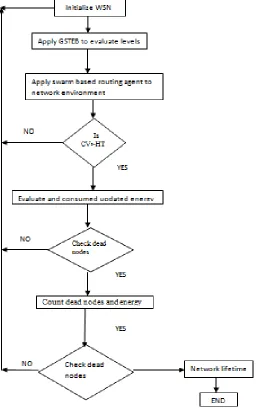
Fig. 1 implementation of SWARM based GSTEB
Steps for implementation of SWARM based GSTEB
Step 1: Initialize network
Step 2: Deploy the network randomly in predefined sensor field. Step 3: Apply GSTEB to evaluate the levels.
Step 4: Check if Current value (CV) > Hard threshold (HT)
Step 5: Apply SWARM intelligence (SI) agent on system to find probability of one to another node.
(1) Where,
ISSN (Print) : 2320 – 3765 ISSN (Online): 2278 – 8875
I
nternational
J
ournal of
A
dvanced
R
esearch in
E
lectrical,
E
lectronics and
I
nstrumentation
E
ngineering
(An ISO 3297: 2007 Certified Organization)
Vol. 5, Issue 6, June 2016
α and β are constant t= time
Vij= probability of node visited
Step 6: Clusters to find the best route among the nodes to sink. The selection of cluster heads is done by following equation:
T (n) = if ϵ (2)
Where,
r = the current round
G= Set of round haven’t cluster of head at 1/p rounds
n = given number of nodes.
p = the priori probability of a node being elected as a cluster-head. Step 7: The energy calculation is done using,
(3)
E= initial Energy
α=constant
V. EXPERIMENTAL RESULT
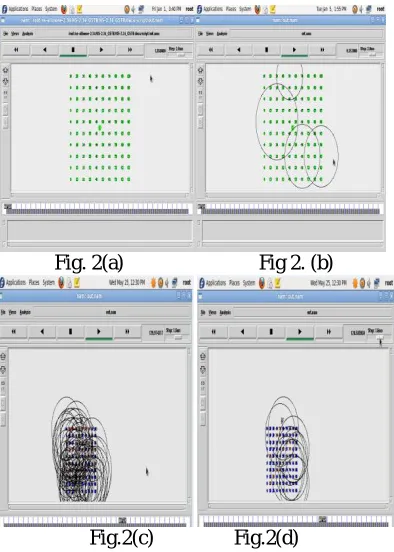
Figure below shows 101 sensor nodes are randomly distributed in square field there is only one base station far away from the sensing area.
Sensor node is stationary and energy constrained. They will keep operating until their energy is finished.
Fig. 2(a) Fig 2. (b)
ISSN (Print) : 2320 – 3765 ISSN (Online): 2278 – 8875
I
nternational
J
ournal of
A
dvanced
R
esearch in
E
lectrical,
E
lectronics and
I
nstrumentation
E
ngineering
(An ISO 3297: 2007 Certified Organization)
Vol. 5, Issue 6, June 2016
Figure below shows the graphs of GSTEB protocol for quality of service parameter Fig.2 (e) shows the simulation time Vs. Jitter X axis representing simulation time and y axis representing jitter. Fig 2.(f) shows the simulation time Vs. Avg.energy.
fig. 2(e) ST Vs jitter fig. 2(f) ST Vs Avg.energy
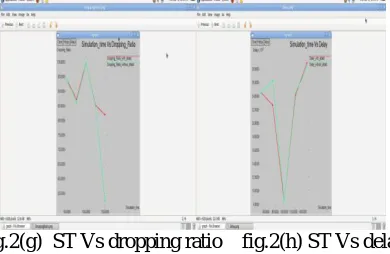
Figure below shows the graph of simulation time vs. dropping ratio. Fig.2 (G) X axis representing simulation. Y representing dropping ratio Fig.2(h) shows simulation time vs. delay.
fig.2(g) ST Vs dropping ratio fig.2(h) ST Vs delay
Figure below Fig.2(i) shows the simulation time vs. throughput axis representing simulation time and Y axis representing throughput. Fig.2 (j)shows the simulation time Vs packet delivery ratio.
fig.2(i) ST Vs throughput fig.2(j) ST VS PDR
VI. CONCLUSION
ISSN (Print) : 2320 – 3765 ISSN (Online): 2278 – 8875
I
nternational
J
ournal of
A
dvanced
R
esearch in
E
lectrical,
E
lectronics and
I
nstrumentation
E
ngineering
(An ISO 3297: 2007 Certified Organization)
Vol. 5, Issue 6, June 2016
improve the results further. A wireless sensor network is a group of tiny sensor nodes which communicate through radio interface. All sensor nodes are capable of sensing, computation, communication and power as four basic working units. There are various types of limitation on Wireless sensor networks, but limited energy, communication capability, storage and bandwidth are the main resource parameter. When we try to reduce energy consumption it leads to energy unstable and leads to dividing network which will decreases the level of network performance.The performance analysis of Swarm based GSTEB Successfully balances the energy consumption of the nodes and improve the quality of service (QOS) parameter like jitter, delay, packet loss. Swarm based algorithms provide solution to problems like energy consumption, scalability, maintainability and improves the lifetime of network etc.
REFERENCES
1. J. H. Chang and L. Tassiulas, “Energy Conserving protocol In Wireless Ad Hoc Networks,” Proc. IEEE INFOCOM, vol.1, pp.22–31,august 2000.
2. Jane Y.Yu and Peter H.J.chong, Nanyang “A survey of clustering schemes for mobile adhoc networks” volume 7, no.1, November 2005. 3. Prakash G L, Thejaswini M, S H Manjula, K R Venugopal, “Tree-on-DAG for Data Aggregation in Sensor Networks “Academy of
Science,Vol.3, pp.675-681, September 2009.
4. Sudip Misra, Karan verma, Prayag Narula “An ant swarm-inspired energy-aware routing protocol for wireless ad-hoc networks” journal of science and software 83. Pp. 2188-2199 June 2010
5. K. T. Kim and H. Y. Youn, “Tree-Based Clustering (TBC) for energy efficient wireless sensor networks,” in Proc. AINA vol. 3 pp. 680–685, August 2010.
6. F.Bajaber and I. Awan “Energy efficient clustering protocol to enhance lifetime of wireless sensor network”, Journal of Ambient Intelligence and Humanized Computing, vol. 4, pp. 239-248 August 2010.
7. S. Babaie, A. K. Zadeh and M. G. Amiri, “The new clustering algorithm with cluster members bounds for energy dissipation avoidance in wireless sensor network”, Computer Design and Applications (ICCDA), International Conference, IEEE, vol. 2, pp. 602-613, April 2010. 8. H.M. N. Dilum Bandara, Anura P. Jayasumana, and Tissa H. Illangasekare “A Top-Down Clustering and Cluster-Tree-Based Routing protocol
for Wireless Sensor Networks” International Journal of Distributed Sensor Networks Volume 2, Article ID 940751, November 2010.
9. Adamu Murtala Zungeru, Li-MinnAng, KahPhooiSeng, “Classical and swarm intelligence based routing protocols for wireless sensor networks: A survey and comparison” A.M. Zungeru et al. Journal of Network and Computer Applications vol.35 pp. 1508–1536, March 2012.
10. Zhao Han, Jie Wu, Jie Zhang, Liefeng Liu, and Kaiyun Tian “A General Self-Organized Tree- Based Energy Balance (GSTEB)Routing Protocol for Wireless Sensor” IEEE transaction vol. 2 pp. 732-740, April 2014
11. K. Akkaya and M. Younis, “A survey of routing protocols in wireless sensor networks,” Elsevier Ad Hoc Network J., vol. 3/3, pp. 325–349, 2005.
12. K. T. Kim and H. Y. Youn, “Energy-Driven Adaptive Clustering Hierarchy (EDACH) for Wireless Sensor Networks”, LNCS, vol. 3823, pp. 1098–1107, Dec 2005.
13. G. Werner-Allen, K. Lorincz, J. Johnson, J. Lees, and M. Welsh. Fidelity and yield in a volcano monitoring sensor network. In OSDI’06, Berkeley, CA, USA, USENIX Association, 2006.
14. L. Qing et al, “Design of a distributed energy-efficient clustering algorithm for heterogeneous wireless sensor networks,” ELSEVIER, Computer Communications, pp. 2230–2237, 2006.