ISSN 2286-4822 www.euacademic.org
Impact Factor: 3.4546 (UIF) DRJI Value: 5.9 (B+)
The Role of Active Training in the Development of
Creative Thinking in Biology Classes
ASADOVA B.G. MAMMADOVA G.A.
Azerbaijan State Pedagogical University Baku, Azerbaijan
Abstract
Each subject taught at secondary schools has its own peculiarities, and these features should be taken into consideration in the teaching process of individual disciplines. In many cases, age, pupil level, intellectual level of pupils are ignored.
At present, reforms in the field of education in Azerbaijan have also updated the application of new approaches in this direction. For example, today's approach to secondary education changes. Thus, education now requires that students not just give knowledge, but also develop specific skills and habits. That is to say, the pupil's ability to live independently has become the ultimate goal of personality education. The development of thinking in the formation of students as an identity is a very important factor. According to experts, the main advantage of active learning is that it enhances students' cognitive activity, promotes them, and leads to independent decision-making. The logical, critical, creative thinking of pupils develops in the course of cognitive activity.
Key words:creative thinking, active learning, teaching biology
İNTRODUCTION:
challenge for students. The learning process should be organized so that the students have an independent learning desire to engage in creative work. Creating cognitive activity depends greatly on activating thinking. Therefore, problematic situations that stimulate cognitive activity should be created in the learning process. As a result of the problem solving, all the cognitive processes in the student become more active and focus on gaining new knowledge independently. Therefore, methods and techniques that serve creative thinking should be used.
Today, general education schools should provide the creative thinking of the younger generation so that they can not only survive from the modern times, but also creatively approach the knowledge and skills they need for the future. With the development of cognitive activity in pupils in the problem-learning process can be solved.
The teacher should create a creative atmosphere in the lessons to encourage students in learning, and make the students "researchers". They need to make sure that they can find something by calling them to search. If the teacher leaves students to self-centered thinking to answer all the questions, then the training form will be directed towards the solution of the problem.
conditions for developing creative thinking is to involve students in independent work. It is also important for students to instill self-control habits. A teacher who creates conditions for students to study independently should make sure that their independent work is purposeful and personal. The higher the level of students' cognitive processes (attention, perception, thinking, imagination, emotion, memory, etc.), training is also successful. The highest form of activity is creative activity. Finding ways to solve a task, to find ways to cope with it, to cope with it, and even to identify the original means are typical for creative activity. Creative activity plays an important role in shaping the student as an individual. In the learning, the student's cognitive activity cannot be separated from his / her independence. They complement each other. The student's independence is reflected in a variety of ways: to feel the need for knowledge, to achieve independent thinking, to cope with the new situation, to cope with the new task, to seek a creative way of learning new knowledge, to critically approach another's point of view, proof and so on.
RESULTS AND DISSCUSSION:
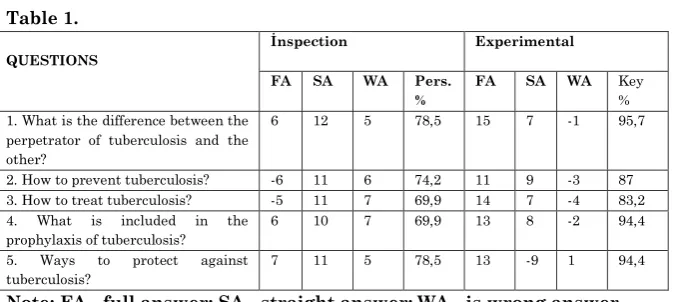
Based on the results of the experiment, it is possible to say that when the students prepare and present projects, the activity of teachers and pupils increases, the lessons are interesting, the students have confidence in their knowledge and skills, and the teacher-student collaboration is strengthened.
Table 1.
QUESTIONS
İnspection Experimental
FA SA WA Pers. %
FA SA WA Key % 1. What is the difference between the
perpetrator of tuberculosis and the other?
6 12 5 78,5 15 7 -1 95,7
2. How to prevent tuberculosis? -6 11 6 74,2 11 9 -3 87 3. How to treat tuberculosis? -5 11 7 69,9 14 7 -4 83,2 4. What is included in the
prophylaxis of tuberculosis?
6 10 7 69,9 13 8 -2 94,4
5. Ways to protect against tuberculosis?
7 11 5 78,5 13 -9 1 94,4
Note: FA - full answer; SA - straight answer; WA - is wrong answer.
It should be noted that 23 people from each class participated in the survey. The results of the survey confirmed that the method of the project is crucial to the development of students' creative thinking. Impact of the developed methodology on the quality of training and the impact that pupils have on the development of creative thinking are clearly outlined in Table 1.
The organization of the pedagogical experiment and the conclusions that the achievement of the results have led to the development of creative thinking in pupils, increasing the attention to questions and exercises aimed at the development of the students' creative thinking, the methods of organizing the active lesson, the problem solving in the lesson. Placing more space in the organization of independent work (essay, essay, storytelling, presentation and project preparation etc.) that are appropriate for age and knowledge of pupils is a positive result.
REFERENCES
1. Education standards of the Republic of Azerbaijan. Baku, 2000.
2. Abbasov A.N, Alizade H.A Pedagogy. Baku, Renesans, 2000
3. Recommendations for access to active learning methods (for school teachers). Baku, 2000
4. Hajiyeva H.M, Maharramov A.M, Ahmedova Z.Z. Teaching evolutionary concepts in teaching biology in secondary schools. Baku, 2010
5. Integrative curriculum. Arnhem, The Netherlands, 2006 6. Bulavinseva L.I Forming a creative workflow. Biology at
school, Moscow, 2008, № 6, p. 16-20.
7. Gusev M. M, Sefer G. D Biological education of the XXI century. // Биология в школе, Moscow, 2001