Cryptosystem
Chenglian Liu1and Ziwei Ye2 1
Department of Electrical Engineering, National Tsing-Hua University, Taiwan [email protected]
2
Department of Computer Science and Technology, Tsing-Hua University, Beijing, China. [email protected]
Abstract. The RSA-768 (270 decimal digits) was factored by Kleinjung et al. on
December 12 2009, and the RSA-704 (212 decimal digits) was factored by Bai et al. on July 2, 2012. And the RSA-200 (663 bits) was factored by Bahr et al. on May 9, 2005. Until right now, there is no body successful to break the RSA-210 (696 bits) currently. In this paper, we would discuss an estimation method to approach lower/upper bound ofφ(n)in the RSA parameters. Our contribution may help researchers lock theφ(n)and the challenge RSA shortly.
Keywords: RSA cryptosystem; Euler’s totient function; Factoring;
1
Introduction
Challenge RSA [12] is an interesting and difficult work. Recently, most scientists and researchers [1, 4, 8] using general number field sieve (GNFS) algorithm to factor RSA modulusn. In practical environment, it looks like if you to want to break the RSA, you may have best choice to choose GNFS when you already factor the modulusn. In theoretical, Wiener [17] first proposed a cryptanalysis of short secret exponents where the d < N0.5 in 1990. Boneh [3] presented ‘Twenty years of attacks on RSA cryp-tosystem’ in 1999. He classified and described varieties attack. Followed by Boneh and Durfee [2], they suggested the provate keydshould be greater thanN0.292for the se-curity problem. Even though, some bodies focus on secret keydor factor composite numbern. Their purpose are clearly. We can not help but think, does it exist a general estimation way without factor to challenge RSA? In this article, we would introduce a new methodology where approach the lower bound and the upper bound ofφ(n). For this generalize conception, it may match any bit length composite numbern.
2
Review of RSA Conception
The signer prepares the prerequisite of a RSA signature: Two distinct large primepand
q,n=pq, Letebe a public key so thatgcd(e, φ(n)) = 1, whereφ(n) = (p−1)(q−1), then calculate the private keydsuch thated ≡ 1 (mod φ(n)). The signer publishes
2.1 RSA Encryption and Decryption
In RSA public-key encryption, Alice encrypts a plaintextMfor Bob using Bob’s public key(n, e)by computing the ciphertext
C≡Me (modn) (1)
wheren, the modulus, is the product of two or more large primes, ande, the public exponent, is an (odd) integere ≥ 3that is relatively prime toφ(n), the order of the multiplicative groupZ∗n.
2.2 RSA Digital Signature
s≡Md (modn) (2)
where(n, d)is the signer’s RSA private key. The signature is verified by recovering the messageM with the signer’s RSA public key(n, e):
M ≡se (modn) (3)
3
Our Methodology
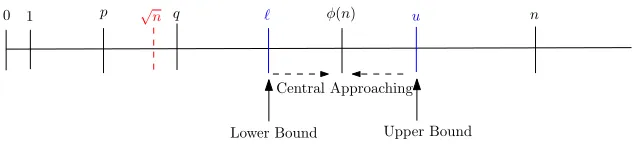
In this section, we would calculate the upper bound and the lower bound of φ(n)in RSA scheme. The detail described as below.
Notation:
ℓ: means lower bound.
u: means upper bound.
ε: a decimal expansion number (e.g99/100 = 0.99· · ·).
3.1 Approachingφ(n)
Ifnis composite, hence
φ(n)≤n−√n, (4)
Sierpinski [15] mentioned it in 1964. It is know that if equation (4) is a good upper bound forφ(n). Is there a good lower bound forφ(n)? This question also be discussed by a newsgroup dialog between Ray Steiner and Bob Silverman in 1999 [16]. Forn >
30, the φ(n) > n2/3, Kemdall and Osborn proved it [7]; for n ≥ 3, theφ(n) > log 2
2
n
logn given by Hatalova and Salat [6].
3.1.1 Estimate upper bound Does the equation (4) a good upper bound? In follows,
we would estimate a new value where its smaller than previous and optimize.
Theorem 1. Assumep, qare large prime numbers, wheren = pq, thenφ(n) = 4k,
n
u
φ(n)
ℓ
q p
1 0
Upper Bound Lower Bound
Central Approaching √
n
Fig. 1. The lower/upper bound ofφ(n)in RSA scheme.
Proof. As known two variantpandqare large prime numbers, andp, q > 2, since
2∤p, 2∤q,
therefore2|p−1, 2|q−1.
4|(p−1)(q−1), 4|φ(n).
φ(n) = 4k, k∈Z+.
We will discuss how calculate the range of valuek.
φ(n) = (p−1)(q−1) =pq−(p+q) + 1
=n−(p+q) + 1. (5) And
p+q>2√n, p+q∈Z+,
2|p+q. p+q>2⌈√n⌉. φ(n)≤n+ 1−2⌈√n⌉. φ(n) = 4k, k∈Z+.
φ(n)≤4· ⌊n+ 1−2⌈ √
n⌉
4 ⌋. (6)
Here, we know the maximum value (limit superior) for k ≤ ⌊n−2⌈√4n⌉+1⌋, we call boundary value.
Consequently, according to above inference, we obtain a best upper bounduofφ(n)
whereφ(n)≤4⌊n−2⌈√4n⌉+1⌋.
Theorem 2. Assume p, q are large prime numbers, and p, q > 2,n = pq, where
φ(n) ≤ t ≤ n, t ∈ Z. Thent = φ(n) ⇐⇒ x2−(n+ 1−t)x+n = 0have two positive integer solutions.
Proof. We describe two properties, necessary and sufficient conditions as follow: Necessary condition:
in the same time, the formula bex2−(p+q)x+pq= 0. It is clearly, the equation of the two rootspandqare needed to set up.
Sufficient condition:
If equationx2−(n+ 1−t)x+n= 0have two integer solutions. Assumex1, x2be the equation of the two roots, wherex1, x2∈Z+. The equation could be transformed to(x−x1)(x−x2) = 0. Promptly,x2−(x
1+x2)x+x1x2= 0.
Thenn=x1x2, according ton’s structure, there are two choice: 1)x1= 1andx2=n(orx1=nandx2= 1).
2)x1=pandx2=q(orx2=qandx2=p). Ifx1, x2one for1andn.
Now,x1+x2=n+ 1, becausex1+x2=n+ 1−t, hencet= 0.
However, in our assumption, the condition ist >0, so this inference contradiction. The equation have two integerspandqwhere
x1+x2=p+q, (7)
then
p+q=n+ 1−t. (8)
Promptly,
t=n+ 1−(p+q), (9)
and
t=φ(n). (10)
Thus, for the sufficient condition is setting up.
Theorem 3. Assume p, qare large prime numbers, and p, q > 2,n = pq, t = 4k
whereφ(n)≤t≤n, t∈Z. Ifp(n+ 1−t)2−4nis an integer number, the equation
x2−(n+ 1−t)x+n= 0has two integer solutions.
Proof. Sincep, qare both prime numbers wheren=pq,2∤n, but2|n+ 1. Supposet= 4k, and2|t. Thus2|n+ 1−t.
Ifp(n+ 1−t)2−4n∈Z, so2|p(n+ 1−t)2−4n. The equationx2−(n+ 1−t)x= 0of the two solutions are:
x=n+1−t±
√
(n+1−t)2−4n
2 .
Because2|n+ 1−t, and whilep(n+ 1−t)2−4n∈Z, it exists2|p(n+ 1−t)2−4n.
Whenp(n+ 1−t)2−4n∈Z,2|n+ 1−t±p(n+ 1−t)2−4n. Due top(n+ 1−t)2−4n∈Z, thexis also∈Z.
Here, the two solutions of equationx2−(n+ 1−t)x+n= 0are both integers.
3.1.2 Estimate lower bound Loomis et al. [10] thought the Shapiro’s [13] lower
boundφ(n) > n(log 2)/(log 3)as a (naive) lower bound forE
n, they can determine
when all members of a givenEnhave been found. Powell [11] pointed out that
positive integer and thatpis an odd prime number withp≡1 (modn); that is a good bound ifpis a small compared ton, and establishes that
N1(n, p)≥( p
φ(n)( Y
q prime q|n
q1/(q−1))/n)p1−1/φ(n). Powell also discussed an
improve-ment the upper and lower bounds in [11]. What is the optimal lower bound? The other discuss in following:
Theorem 4. For all n ≥ 3 we haveφ(n) ≥ eγlog logn n + Ø(
n
(log logn)2), whereγ
is the Euler-Mascherone Constant, and the above holds with equality infinitely often. Remark:note in particular that sinceloglogn→ ∞asngrows large, we see that the result mn < φ(n)can not hold for any fixed integerm.
Proof. Consider R, set of allnsuch thatm < nimplies φ(nn) < φ(mm). This set is then all of the ‘record breaking’n. Ifn∈R haskprime factors, letn∗be the product of the firstkprime factors. Ifn6=n∗andφ(n)∗
n∗ ≤
φ(n)
n , which is impossible. Hence, R consist
entirely ofnof the formn = Qp≤ypfor somey. Now forn ∈ R, we can choosey
so thatlogn=Pp≤ylogp=θ(y). Then using one of Mertens estimates we see that
φ(n)
n =
Q
p≤y(1−
1
p) = e−γ logy+O(
1
(logy)2). Sincelog logn= log(θ(y)) = logy+Ø(1)
by Mertens estimates again, we have forn∈R,φ(n) = ne−r log logn+O(
1 (log logn)2.
Fig. 2. The same digits ofφ(n)and modulusnparameters in RSA.
From above, it seems so complexity. Does it exist a simple computation method? We observed the modulusnwithφ(n), there have some characteristics. An example for RSA-200, the modulusn and theφ(n) are 200 decimal digits. We comparednand
φ(n)each other, there are the same digits from left to right 110 digits. The example showed in Figure2. Discuss on RSA modulus number with haft of the bit prescribed, be introduced some literatures in [5, 9, 14]. To RSA-704, the n andφ(n) had same
Table 1. Comparison of some types in RSA parameters. Unit: decimal digits
type Modulusnlength φ(n)length plength qlength same digitsn&φ(n) same digitsφ(n)&u
RSA-200 200 200 100 100 110 101
RSA-210 200 200 105 105 ? ?
RSA-704 212 212 106 106 106 108
digits106, it amounts same length withporq. We computed the upper bound value according to Theorem1, this upper bound had same 108digits with its φ(n). And analyzed the RSA-768, thenhad115digits same withφ(n); theφ(n)had120digits same with its upper boundu. Please see Table1We observed the relationship ofφ(n)
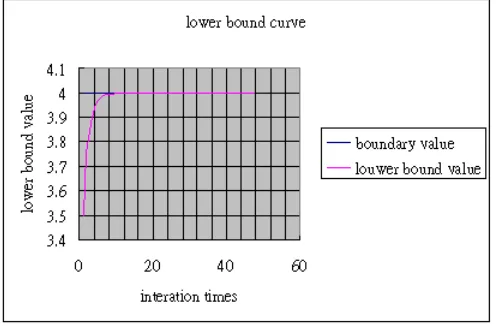
and its boundary valuek, whenφ(n)divided byk, we obtained this quotient are very approaching to number4, these lower bounders are very close to multiples of number
4. We say3.999, and have106’s9after decimal point for case of RSA-210 type. The lower bound approximation figure diagram be shown in figure4 and in Table2. As
Fig. 3. The lower bound approximation curve status.
Table 2. The relationship ofφ(n)and its boundary valuek.
type φ(n)/k statement
RSA-2003. 99′s9
z }| {
99999 8 there have99’s9after the decimal point
RSA-2103.
106′s9
z }| {
99999 2Estimating have106’s9after decimal point
RSA-7043. 107′s9 z }| {
99999 8 there have107’s9after decimal point
RSA-7683. 117′s9
z }| {
99999 7 there have117’s9after decimal point
known as the modulus numbernof RSA-210, we re-estimated its lower/upper bounds. We assume:
(3 +ε)⌊n−2⌈ √
n⌉+ 1
4 ⌋ ≤φ(n)≤4⌊
n−2⌈√n⌉+ 1
whereε= 0.
106′s9 z }| {
99999. We therefore compute the upper bounduand lower boundℓ; those shown result in Figure4.
Fig. 4. The lower/upper bound parameters ofφ(n)in RSA-210.
4
Conclusion
In this paper, we re-estimated a new lower/upper bound values ofφ(n)in RSA-210, our methodology are easily, simply, clearly, no intricately and intuitive. It may be useful to researchers who would quickly reduce the searching ranges. Looking back, more researchers focus on secretdor modulusn, such as well known short exponent attack, side channel attack, or common modulus and cyclic attacks. Our method is differ to previous literatures. Finally, We presented what we claimed actually.
References
1. Bai, S., Thom´e, E., Zimmermann, P.: Factorisation of RSA-704 with cado-nfs. IACR Cryp-tology ePrint Archive p. 369 (2012)
2. Boneh, D., Durfee, G.: Cryptanalysis of RSA with private keydless than N0.292 . IEEE Transactions on Information Theory 46(4), 1339–1349 (July 2000)
3. Boneh, D.: Twenty years of attacks on the RSA cryptosystem. Notices of the AMS 46, 203– 213 (1999)
4. F. Bahr, M. Boehm, J.F., Kleinjung, T.: RSA-200 is factored. Website (2005),http:// www.rsa.com/rsalabs/node.asp?id=2879
5. Graham, S.W., Shparlinski, I.E.: On RSA moduli with almost half of the bits prescribed. Discrete Applied Mathematics 156(16), 3150–3154 (2008)
6. Hatalova, H., Salat, T.: Remarks on two results in thelementary theory of numbers. Acta. FacRer. Natur Univ Comenian. Math. (20), 113–117 (1969)
7. Kendall, D.G., Osborn, H.B.: Two Simple Lower Bounds for Euler’s Function, vol. 17. Texas Journal of Science (1965)
9. Meng, X.: On RSA moduli with half of the bits prescribed. Journal of Number Theory 133(1), 105–109 (2013), http://www.sciencedirect.com/science/ article/pii/S0022314X12002302
10. Paul Loomis, M.P., Polhill, J.: Summing up the Eulerφfunction. The College Mathematics Journal 39(1), 34–42 (2008)
11. Powell, C.: Bounds for multiplicative cosets over fields of prime order. Mathematics of Com-putation 66(218), 807–822 (April 1997)
12. Rivest, R., Shamir, A., Adleman, L.: A method for obtaining digital signatures and public-key cryptosystems. Communications of the ACM 21, 120–126 (1978)
13. Shapiro, H.: An arithmetic function arising from theφfunction. The American Mathematical Monthly 50, 18–30 (1943)
14. Shparlinski, I.: On RSA moduli with prescribed bit patterns. Designs, Codes and Cryptog-raphy 39 (2006)
15. Sierpinski, W.F.: Elementary Theory of Numbers. North-Holland PWN-Polish Scientific Publishers, Warsawa (1964)
16. Silverman, B.: Euler’s phi functions. Website (2012),http://www.math.niu.edu/ ˜rusin/known-math/99/min_phi