ISSN (Print) : 2320 – 3765 ISSN (Online): 2278 – 8875
I
nternational
J
ournal of
A
dvanced
R
esearch in
E
lectrical,
E
lectronics and
I
nstrumentation
E
ngineering
(An ISO 3297: 2007 Certified Organization)
Website: www.ijareeie.com
Vol. 6, Issue 1, January 2017
Thermal Unit Commitment with
Environmental Considerations using Modified
Water Evaporation Optimization Algorithm
R. Anandhakumar
Assistant Professor, Department of Electrical & Electronics Engineering, Annamalai University, Annamalainagar,
Tamilnadu, India
ABSTRACT: The thermal unit commitment problem involves determining the start-up and shut-down schedules for generating units to meet the forecasted demand at the minimum cost. The commitment schedule must satisfy the other constraints such as the generating limits, spinning reserve, minimum up and down time, ramp level and individual units. In this paper thermal unit commitment problem with emission minimization is solved by modified water evaporation optimization algorithms. The priority list method has been used for to obtain the unit commitment schedule and MWEO algorithm uses to obtain the economic schedule among the committed units for each interval.
KEYWORDS: Thermal unit commitment, Emission, Generation scheduling, Modified water evaporation optimization.
I. INTRODUCTION
Unit commitment which is considered as a large scale, nonlinear, mixed-integer optimization problem plays a very important role in optimal operation of power systems. Solving the UC problem is a complex decision-making process since multiple constraints must be satisfied and a good UC solution method can substantially contribute to annual savings of production cost. The objective of the UC problem is to minimize the total cost of thermal generating units while maintaining sufficient spinning reserve and satisfying the operational constraints of generating units over a given schedule time horizon. Due to the increasing environmental protection the emission is also added to UC problems [1].
An optimal solution to the UC problem in power system operation can be obtained by a complete enumeration. However, the requirement of the excessive computational resource is impossible to be implemented in practice. Therefore, many research efforts have been focused on efficient UC algorithms for lower total production cost and computational time [1].
Over the years, extensive research has been conducted on developing efficient UC algorithm that can be mainly grouped as numerical based techniques and Heuristic search based techniques [2-27] has been proposed. In this paper, the thermal unit commitment problem with emission has been proposed using modified Water Evaporation Optimization (WEO) [26] are implemented to handling ramp rates with the aims of achieving the desired solution accuracy and to reduce the cost and computational effort in 24 hr time horizon.
II. PROBLEM FORMUATION
The main goal of UC is to minimize overall system generation cost over the scheduled time horizon subject to system and operational constraints.
Objective Function
ISSN (Print) : 2320 – 3765 ISSN (Online): 2278 – 8875
I
nternational
J
ournal of
A
dvanced
R
esearch in
E
lectrical,
E
lectronics and
I
nstrumentation
E
ngineering
(An ISO 3297: 2007 Certified Organization)
Website: www.ijareeie.com
Vol. 6, Issue 1, January 2017
T t N i t i t i t i t i t ii
P
U
SC
U
U
FC
C
Min
1 1 11
F
(2.1)Where, FCi
Pit is the cost function of the ith unit is given by
i it iN i t i i t i
i P a P b P c
FC
2 1 (2.2) i down i off i i i down i off i down i i i
cshour
T
T
t
c
cshour
T
T
T
t
h
SC
;
cos
;
cos
(2.3) FCi is the fuel cost of ith unit ($), SCit is the startup cost of ith generating unit ($). The ai, bi, ci are fuel cost coefficient for ith generating unit and CF is the cost function of on line generating units during time interval of t hours. Uit is on/off status of ith generating unit during hour t, Pit power output of the ith generating unit during hour t. N is the number of thermal generating units. T is the number of schedule times in hours.THERMAL UNIT COMMITMENT WITH EMISSION
For many years the environmental impacts were ignored in solving the conventional UC problem. However, the current standards for smart and green electrical grids require the reduction of harmful emissions such as nitrogen oxides (NOx), sulphur dioxide (SO2), and carbon dioxide (CO2). Thus, another objective, emission is included in the UC problem formulation and the release of pollutant from thermal plants into the atmosphere is expressed as,
T t N i t i i EmissionE
P
F
1 1
(2.4)
i i i i it i
i
P
d
P
e
P
f
E
2
(2.5) Where di, ei, fi are Emission coefficient for ith generating unit and Ei is the emission of unit i in lb.
Constraints
Power balance constraint
Power balance constraint states that, the generated power should be sufficient enough to meet the power demand and is
given by,
N i t i tiP t T
U 1 ,..., 2 , 1 (2.6)
Generated power limits
The generated power of online generating units should lie between its upper and lower limits as given by,
t i i t i t i
i U P P U
P,min ,max
(2.7)
Pi,min and Pi,max are the minimum and maximum thermal output power at ith unit.
Spinning reserve requirement
Spinning reserve is essential to maintain system reliability; sufficient spinning reserve must be available at every time
period. Usually, the spinning reserve is given as some percentage of the total power demand.
N i t t i tiP LD SR
U 1 max , (2.8)
ISSN (Print) : 2320 – 3765 ISSN (Online): 2278 – 8875
I
nternational
J
ournal of
A
dvanced
R
esearch in
E
lectrical,
E
lectronics and
I
nstrumentation
E
ngineering
(An ISO 3297: 2007 Certified Organization)
Website: www.ijareeie.com
Vol. 6, Issue 1, January 2017
Minimum up and down time
This constraint helps to determine shortest time periods during which a unit must be on or down.
i off t i i on t i MD HR MU HR , , (2.9)
HRit,on and HRit,off are number of hours at unit i is continuously online and offline unit until tth hour. MUi is the
minimum up time hours and MDi is the minimum down time hours.
Ramp rate
Because of the physical restrictions on thermal generating units, the rate of generation changes must be limited within certain ranges. The ramp rate limits confine the output movement of a generating unit between adjacent hours.
i t i t i i t i t i RD P P RU P P 1 1 (2.10)
III. WATER EVAPORATION OPTIMIZATION ALGORITHM
The evaporation of water is very important in biological and environmental science. The water evaporation from bulk surface such as a lake or a river is different from evaporation of water restricted on the surface of solid materials. In this WEO algorithm water molecules are considered as algorithm individuals. Solid surface or substrate with variable wettability is reflected as the search space. Decreasing the surface wettability (substrate changed from hydrophility to hydrophobicity) reforms the water aggregation from a monolayer to a sessile droplet.
Such a behavior is consistent with how the layout of individuals changes to each other as the algorithm progresses. And the decreasing wettability of surface can represent the decrease of objective function for a minimizing optimization problem. Evaporation flux rate of the water molecules is considered as the most appropriate measure for updating individuals which its pattern of change is in good agreement with the local and global search ability of the algorithm and make this algorithm have well converged behavior and simple algorithmic structure. The details of the water evaporation optimization algorithm are well presented in (Kaveh and Bakhshpoori, 2016).
In the WEO algorithm, each cycle of the search consists of following three steps (i) Monolayer Evaporation Phase, this phase is considered as the global search ability of the algorithm (ii) Droplet Evaporation Phase, this phase can be considered as the local search ability of the algorithm and (iii) Updating Water Molecules, the updating mechanism of individuals.
(i) Monolayer Evaporation Phase
In the monolayer evaporation phase the objective function of the each individuals Fitit is scaled to the interval [-3.5, -0.5] and represented by the corresponding Esub(i)t inserted to each individual (substrate energy vector), via the following scaling function.
minmin max
E
Fit
Min
Fit
MaX
Fit
Min
Fit
E
E
i
E
t i t sub
(3.1)Where Emax and Emin are the maximum and minimum values of Esub respectively. After generating the substrate energy vector, the Monolayer Evaporation Matrix (MEP) is constructed by the following equation.
t sub ij t sub ij t iji
E
rand
if
i
E
rand
if
MEP
exp
0
exp
1
(3.2)ISSN (Print) : 2320 – 3765 ISSN (Online): 2278 – 8875
I
nternational
J
ournal of
A
dvanced
R
esearch in
E
lectrical,
E
lectronics and
I
nstrumentation
E
ngineering
(An ISO 3297: 2007 Certified Organization)
Website: www.ijareeie.com
Vol. 6, Issue 1, January 2017
(ii) Droplet Evaporation Phase
In the droplet evaporation phase, the evaporation flux is calculated by the following equation.
cos
1
cos
3
cos
3
2
3
J
oP
oJ
(3.3)
where Jo and Po are constant values. The evaporation flux value is depends upon the contact angle ϴ, whenever this angle is greater and as a result will have less evaporation. The contact angle vector is represented the following scaling function.
minmin
max
Fit
Min
Fit
Max
Fit
Min
Fit
i
t i t (3.4)Where the min and max are the minimum and maximum functions. The ϴmin & ϴmax values are chosen between -50o <ϴ < -20o is quite suitable for WEO. After generating contact angle vector ϴ(i)t the Droplet Probability Matrix (DEP) is constructed by the following equation.
t i ij t i ij t j iJ
rand
if
J
rand
if
DEP
0
1
(3.5)where DEPtij is the updating probability for the jth variable of the ith individual or water molecule in the tth iteration of the algorithm.
(iii) Updating Water Molecules
In the WEO algorithm the number of algorithm individuals or number of water molecules (nWM) is considered constant in all tth iterations, where t is the number of current iterations. Considering a maximum value for algorithm iterations (tmax) is essential for this algorithm to determine the evaporation phase and for stopping criterion. When a water molecule is evaporated it should be renewed. Updating or evaporation of the current water molecules is made with the aim of improving objective function. The best strategy for regenerating the evaporated water molecules is using the current set of water molecules (WM(t)). In this way a random permutation based step size can be considered for possible modification of individual as:
WM
permute
i
j
WM
permute
i
j
rand
S
.
t1
t2
(3.6)
where rand is a random number in [0,1] range, permute1and permute 2 are different rows of permutation functions. i is the number of water molecule, j is the number of dimensions of the problem. The next set of molecules (WM(t+1)) is generated by adding this random permutation based step size multiplied by the corresponding updating probability (monolayer evaporation and droplet evaporation probability) and can be stated mathematically as:
2
/
2
/
max max 1t
t
DEP
t
t
MEP
S
WM
WM
t t t t (3.7)ISSN (Print) : 2320 – 3765 ISSN (Online): 2278 – 8875
I
nternational
J
ournal of
A
dvanced
R
esearch in
E
lectrical,
E
lectronics and
I
nstrumentation
E
ngineering
(An ISO 3297: 2007 Certified Organization)
Website: www.ijareeie.com
Vol. 6, Issue 1, January 2017
molecules are more far from each other than the second phase. In this way the generated permutation based step size will guarantee global and local capability in each phase.
IV. IMPLEMENTATION OF WEO ALGOTIHM TO SOLVE UC PROBLEM
The detailed algorithmic steps for proposed MWEO algorithm to solve an UC problem are presented below.
Step 1: Initialize total no of generating units, generator power limits, ramp rate limits, minimum uptime, minimum
downtime, load demand, number of water molecules, maximum number of algorithm iteration (tmax), MEPmin, MEPmax,
DEPmin, DEPmax.
Step 2: Randomly initialize all water molecules.
Step 3: Obtain the ON/OFF status of generating units by applying priority list method and compute the objective
function given by Eq. (2.1), Eq. (2.4) and Eq. (2.8) for all water molecules.
Step 4: Check whether t (current iteration) ≤ tmax/2.
Step 5: If step 4 is satisfied, then, water molecules are globally evaporated based on monolayer evaporation
probability MEP using Eq. (3.2).
Step 6: For t > (1+ tmax/2)2, Based on DEP (Eq. 3.5), in the modified evaporation occurs.
Step 7: Generate random permutation based step size matrix according to Eq. (3.6).
Step 8: Generate evaporated water molecules by adding the product of step size matrix and evaporation matrix to
the current set of molecules MWM(t) by using Eq. (3.7) and update the matrix of water molecules.
Step 9: Compare and update the water molecules.
Step 10: Return the best water molecule (generator outputs corresponding to the minimized value of CF or E).
Step 11: If the number of iteration of the algorithm (t) becomes larger than the maximum number of iterations
(tmax), the algorithm terminates. Otherwise go to step 3.
V. SIMULATION RESULTS AND DISCUSSION
ISSN (Print) : 2320 – 3765 ISSN (Online): 2278 – 8875
I
nternational
J
ournal of
A
dvanced
R
esearch in
E
lectrical,
E
lectronics and
I
nstrumentation
E
ngineering
(An ISO 3297: 2007 Certified Organization)
Website: www.ijareeie.com
Vol. 6, Issue 1, January 2017
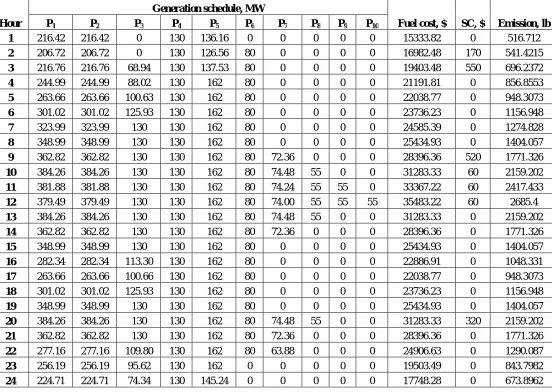
TABLE 5.2 TEST RESULTS OF 10-UNIT SYSTEM FOR EMISSION MINIMIZATION
Hour
Generation schedule, MW
Fuel cost, $ SC, $ Emission, lb P1 P2 P3 P4 P5 P6 P7 P8 P9 P10
1 216.42 216.42 0 130 136.16 0 0 0 0 0 15333.82 0 516.712
2 206.72 206.72 0 130 126.56 80 0 0 0 0 16982.48 170 541.4215
3 216.76 216.76 68.94 130 137.53 80 0 0 0 0 19403.48 550 696.2372
4 244.99 244.99 88.02 130 162 80 0 0 0 0 21191.81 0 856.8553
5 263.66 263.66 100.63 130 162 80 0 0 0 0 22038.77 0 948.3073
6 301.02 301.02 125.93 130 162 80 0 0 0 0 23736.23 0 1156.948
7 323.99 323.99 130 130 162 80 0 0 0 0 24585.39 0 1274.828
8 348.99 348.99 130 130 162 80 0 0 0 0 25434.93 0 1404.057
9 362.82 362.82 130 130 162 80 72.36 0 0 0 28396.36 520 1771.326
10 384.26 384.26 130 130 162 80 74.48 55 0 0 31283.33 60 2159.202
11 381.88 381.88 130 130 162 80 74.24 55 55 0 33367.22 60 2417.433
12 379.49 379.49 130 130 162 80 74.00 55 55 55 35483.22 60 2685.4
13 384.26 384.26 130 130 162 80 74.48 55 0 0 31283.33 0 2159.202
14 362.82 362.82 130 130 162 80 72.36 0 0 0 28396.36 0 1771.326
15 348.99 348.99 130 130 162 80 0 0 0 0 25434.93 0 1404.057
16 282.34 282.34 113.30 130 162 80 0 0 0 0 22886.91 0 1048.331
17 263.66 263.66 100.66 130 162 80 0 0 0 0 22038.77 0 948.3073
18 301.02 301.02 125.93 130 162 80 0 0 0 0 23736.23 0 1156.948
19 348.99 348.99 130 130 162 80 0 0 0 0 25434.93 0 1404.057
20 384.26 384.26 130 130 162 80 74.48 55 0 0 31283.33 320 2159.202
21 362.82 362.82 130 130 162 80 72.36 0 0 0 28396.36 0 1771.326
22 277.16 277.16 109.80 130 162 80 63.88 0 0 0 24906.63 0 1290.087
23 256.19 256.19 95.62 130 162 0 0 0 0 0 19503.49 0 843.7982
ISSN (Print) : 2320 – 3765 ISSN (Online): 2278 – 8875
I
nternational
J
ournal of
A
dvanced
R
esearch in
E
lectrical,
E
lectronics and
I
nstrumentation
E
ngineering
(An ISO 3297: 2007 Certified Organization)
Website: www.ijareeie.com
Vol. 6, Issue 1, January 2017
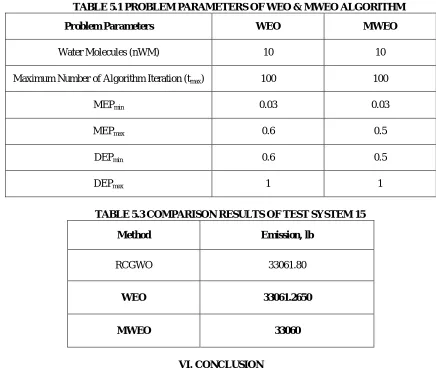
characteristics of generators are expressed as second-order polynomials. The WEO algorithm parameters for all test
systems are shown in Table 5.1.The MWEO is implemented on the 10-unit system for minimum emission dispatch and
the obtained schedule is presented in Table 5.2. The MWEO obtains the total fuel cost of $ 600025 and total emission of 33060 lb. The comparison of results presented in Table 5.3 indicates that the proposed method has obtained minimum value of emission among the RCGWO [27].
TABLE 5.1 PROBLEM PARAMETERS OF WEO & MWEO ALGORITHM
Problem Parameters WEO MWEO
Water Molecules (nWM) 10 10
Maximum Number of Algorithm Iteration (tmax) 100 100
MEPmin 0.03 0.03
MEPmax 0.6 0.5
DEPmin 0.6 0.5
DEPmax 1 1
TABLE 5.3 COMPARISON RESULTS OF TEST SYSTEM 15
Method Emission, lb
RCGWO 33061.80
WEO 33061.2650
MWEO 33060
VI. CONCLUSION
The effective unit commitment saves fuel costs and is a necessary contribution to the operating on/off plans of the generating units. In this paper, a modified water evaporation optimization based solution algorithm for solving the unit Commitment problem with emission minimization is presented. The proposed algorithm uses global search and local search to select the committed units and give the economic schedule for each specific hour. This new algorithm produces better results than the existing methods in addition to satisfaction of the system constraints. From the results, it is clear that the proposed method provides the quality solution with low cost and has a potential for on-line implementation.
REFERENCES
1. Wood A. J, and Wollenberg B. F, (1996), Power generation, operation and control, Second Edition, John Wiley and Sons, New York
ISSN (Print) : 2320 – 3765 ISSN (Online): 2278 – 8875
I
nternational
J
ournal of
A
dvanced
R
esearch in
E
lectrical,
E
lectronics and
I
nstrumentation
E
ngineering
(An ISO 3297: 2007 Certified Organization)
Website: www.ijareeie.com
Vol. 6, Issue 1, January 2017
3. Ongsakul W, and Petcharaks N, (2004), Unit commitment by enhanced adaptive Lagrangian relaxation, IEEE Transaction on Power System, Vol. 19, No. 1, pp. 620–628.
4. Chandram K, Subrahmanam N, and Sydulu M, (2011), Unit commitment by improved pre-prepared power demand table and Muller method, Electric Power and Energy System, Vol. 33, pp. 106–114.
5. Hobbs W. J, Hermon G, Warner S, and G. B. Sheble, (1988), An enhanced dynamic programming approach for unit commitment, IEEE Transaction on Power System, Vol. 3, No. 3, pp. 1201-1205.
6. Marian Marcoveccio G, Augusto Novals Q, and Ignacio Grossmann E, (2014), Deterministic optimization of the thermal unit commitment problem: a branch and cut search, Computers and Chemical Engineering, Vol. 67, pp. 53–68.
7. Han D, Jian J, and Yang L, (2014), Outer approximation and outer-inner approximation approaches for unit commitment problem, IEEE Transaction on Power System, Vol. 29, No. 2, pp. 505–513.
8. Roy P. K, (2013), Solution to the unit commitment problem using gravitational search algorithm, Electrical Power and Energy Systems, Vol. 53, pp. 85– 94.
9. Burns R. M, and Gibson C. A, (1975), Optimization of priority lists for a unit commitment program, IEEE PES proceedings, Vol. 75, pp. 453-461. 10. Patra S, Goswami S. K, and Goswami B, (2008), Differential evolution algorithm for solving unit commitment with ramp constraints, Electrical Power
and Components System, Vol. 36, No. 8, pp. 771–787.
11. Kazarlis S. A, Bakirtzis A. G, and Petridis V, (1996), A genetic algorithm solution to the unit commitment problem, IEEE Transaction on Power System, Vol. 11, No. 1, pp. 83–92.
12. Juste K. A, Kita H, and Tanaka E, (1999), An evolutionary programming solution to the unit commitment problem, IEEE Transaction on Power System, Vol. 14, pp. 1452–1459.
13. Zhuang F, and Galiana F. D, (1990), Unit commitment by simulated annealing, IEEE Transaction on Power System, Vol. 5, pp. 311–317.
14. Ebrahimi J, Hosseinian S. H, and Gevorg B, (2011), Unit commitment problem solution using shuffled frog leaping algorithm, IEEE Transaction on Power System, Vol. 26, No. 2, pp. 573–581.
15. Roy P. K, (2013), Solution to the unit commitment problem using gravitational search algorithm, Electrical Power and Energy Systems, Vol. 53, pp. 85– 94.
16. Roy P. K, and Sarkar R, (2014), Solution of unit commitment problem using quasi-oppositional teaching learning based algorithm, Electrical Power and Energy System, pp. 96–106.
17. Eslamian M, Hosseinian S, and Vahidi B, (2009), Bacterial foraging based solution to the unit commitment problem, IEEE Transaction on Power System, Vol. 24, No. 3, pp. 1478–1488.
18. Saber A. Y, Senjyu T, and Miyagi T, (2006), Fuzzy Unit commitment scheduling using absolute stochastic simulated annealing, IEEE Transaction on Power System, Vol. 21, No. 2, pp. 955–964.
19. Damousis I. G, Bakirtzis A. G, and Dokopoulos P. S, (2004), A solution to the unit commitment problem using integer coded genetic algorithm, IEEE Transaction on Power System, pp. 1165–1172.
20. Zhao B, Guo C. X, and Bai B. R, (2006), An improved particle swarm optimization algorithm for unit commitment, Electric Power and Energy System, Vol. 28, No. 7, pp. 482–490.
21. Cheng C. P, Liu C. W, and Liu G. C, (2000), Unit commitment by Lagrangian relaxation and genetic algorithms, IEEE Transaction on Power System, Vol. 15, No. 2, pp. 707–714.
22. Kumar N, Panigrahi B. K, Bhim Singh, (2016), A solution to the ramp rate and prohibited operating zone constrained unit commitment by GHS-JGT evolutionary algorithm, Electrical power and Energy system, Vol. 81, pp. 193-203.
23. Lau T. W, Chung C. Y, and Wong K. P, (2009), Quantum inspired evolutionary algorithm approach for unit commitment, IEEE Transaction on Power System, Vol. 24, No. 3, pp. 1503–1512.
24. Jeong Y. W, Park J. B, and Jang S. H, (2010), A new quantum inspired binary PSO: application to unit commitment problems for power systems,
IEEE Transaction on Power System, Vol. 25, No. 3, pp. 1486–1495.
25. Quan R, Jian J, and Yang L, (2015), An improved priority list and neighborhood search method for unit commitment, Electric Power and Energy System, Vol. 67, pp. 278–285.
26. Kaveh A, and Bakhshpoori T, (2016), Water Evaporation Optimization: A novel physically inspired optimization algorithm, Computer and Structures, Vol. 167, pp. 69-85.