S h o r t C o m m u n i c a t i o n
DOI: 10.1002/prep.201
Ultra-fast continuous-flow photo degradation of organic
peroxide explosives for their efficient conversion into
hydrogen peroxide and possible application
Parvez Mahbub
[a], Richard Wilson
[b], Pavel N. Nesterenko*
[a]Abstract: Fast, quantitative and efficient direct photo degradation of organic peroxide explosives (HMTD, MEKP, TATP) using characteristic continuous-flow UV radiation was investigated in aqueous solutions and achieved in less than 30 seconds.
Keywords:
Continuous Flow, Photo Degradation, Oreganic Peroxide Explosives
1 Introduction
Photo degradation techniques were employed for degradation of organic compounds in water environments since the early 1970’s [1]. During the past 15 years, photo degradation has gained further interest as an efficient solution for remediation of nitroaromatic explosives such as polycyclic nitramine (CL-20) and monocyclic nitramine (RDX) [2, 3]. The efficiency of photo degradation is related to strong absorbance of UV-radiation by nitro-compounds. In contrast, there has been little investigation into the photo degradation of organic peroxide explosives (OPEs) such as hexamethylene triperoxide diamine (HMTD), triacetone triperoxide (TATP) or other organic peroxide compounds with explosive potential such as methylethyl ketone peroxide (MEKP). Obviously, this is connected with absence of chromophore groups in OPE molecules and low absorbance of these compounds at UV range from 220 to 300 nm. In 2006, UK security and counter-terrorism authority thwarted plans to blow up as many as seven transatlantic airlines with home-made liquid bombs using HMTD as a key explosive [4]. The high solubility of OPEs in water was used to mask the presence of concentrated explosives in bottles of soft beverages within the permitted limit of liquids, which could be taken on plane by boarding passengers. The extreme danger of concentrated solutions of OPEs is further exacerbated by their sensitivity to impact, friction and temperature change. Hence there is a strong need for fast identification of OPEs in suspected samples and, more importantly, for their safe conversion into harmless products.
There are only two reports on application of photo degradation for their indirect determination in a form of H2O2 released after decomposition of these
OPEs. Parajuli and Miao [5] reported the detection of TATP using 30 min UV irradiation followed by electrochemiluminescent detection. Schulte-Ladbeck et al. [6] reported determination of HMTD and TATP using HPLC with post-column UV irradiation at 254 nm followed by enzymatic reaction and fluorescent detection. Another related study reported on determination of methyl hydroperoxide, ethyl
hydroperoxide, tert.-butyl hydroperoxide and di-tert .-butyl peroxide molecules that do not absorb UV light, in a form of H2O2 released after photo degradation in
presence of catalyst (horse radish peroxidase, HRP) in a reactor equipped with a 254 nm UV lamp wrapped with 10 m x 0.3 mm I.D. knitted PTFE coil [7]. Even in presence of HRP, photo degradation of di-tert.-butyl peroxide and tert.-butyl hydroperoxide required 2.8 and 4.7 min, respectively, while methyl hydroperoxide and ethyl hydroperoxide did not show any significant degradation. The inefficiency of converting OPEs into
H2O2 was briefly mentioned in [6] due to the
decomposition of the released H2O2 under UV light,
but no further studies were undertaken in this regard. Hydrogen peroxide as the main product of photo degradation of OPEs undergoes further decomposition under UV irradiation releasing reactive oxygen species
(ROS) such as hydroxyl (OH.) and hydroperoxyl
(HOO.) radicals, superoxide (O
2.-) radical anion as well
as less reactive molecular oxygen (O2) [8]. The
decomposition of H2O2 by mineral compounds in basic
solutions can also lead to formation of highly reactive singlet oxygen (1O2) [9, 10], although no evidence
regarding UV decomposition of aqueous H2O2
producing (1O2) species yet been reported. Thus,
efficient photo degradation of OPEs does not necessarily provide their desirable conversion in solutions into H2O2. A possible solution of the problem
is to stop the photo degradation of the released H2O2
from OPE degradation. Continuous-flow photochemistry is increasingly gaining ground as a method to facilitate various photochemical processes both in the laboratory and at pilot scale as compared to their batch-flow mode [11]. To consider continuous-flow photo degradation as a solution for remediation of OPEs, quantitative efficiency of the photo degradation for a range of OPEs in the shortest possible time with minimal reagent usage needs to be evaluated in terms of degradation products, irradiation time, conversion degree, degradation percentage, wavelength and source of UV radiation.
of UV radiation with a focus on its possible application in screening and remediation of OPEs.
2 Results and Discussion
There are currently no data on the photo degradation of OPEs, but literature data on acid degradation of TATP in HCl vapours reported the production of acetone, 1,1-dichloroacetone, 1,1,1-trichloroacetone, diacetonediperoxide (DADP), 1,3-dichloroacetone, 1,1,3-trichloroacetone, hexachloroacetone and chloroacetone along with H2O2 [12]. Therefore, the
photo degradation mechanism of TATP, HMTD and MEKP in different UV radiation source was investigated for the first time and conditions for a safe and selective photo degradation of OPEs were optimised. Special attention was paid to the possibility of selective conversion of OPEs into potentially useful H2O2.
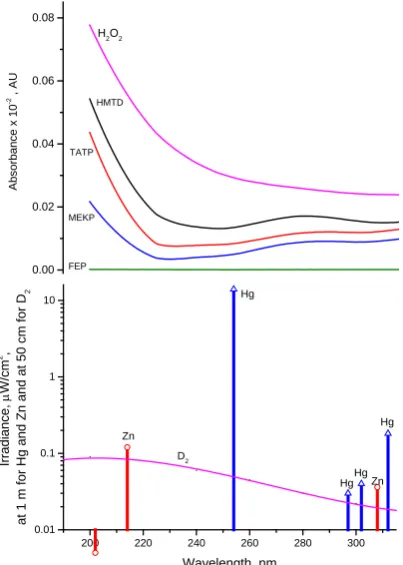
The key characteristics to be considered for photo degradation are UV absorption spectra of OPEs, H2O2 and the tubing material of reactor coil. The
absorption spectra of 12.5 µM HMTD, TATP, MEKP and H2O2 as well as 20 mm x 10 mm x 1 mm sheet of
FEP poly(tetrafluoroethylene-co-hexaflouropropylene) polymer having structure –(CF2-CF2)n––(CF2-
C2F4)m– are shown in Fig. 1. The OPE molecules
have no specific chromophores responsible for significant absorbance of UV light in the range 240-390 nm, so the absorbance range practically significant for photo degradation purposes of OPEs could be limited to a range 200-215 nm. It should be noted that the majority of organic and inorganic substances absorb light in the range 200-215 nm, so it would be difficult to expect selective and efficient degradation. The increased UV absorbance of H2O2 below 215 nm as
illustrated in Fig. 1, may cause further degradation of released H2O2. Finally, while using a coil reactor, a
significant amount of UV light in this range could be absorbed by tubing, but not in the case of transparent FEP tubing used in this work.
Three sources of UV light including zinc lamp with maximum emission at 214 nm, mercury lamp with maximum emission at 254 nm and a deuterium lamp with maximum emission at 200 nm were tested for degradation, which was estimated by using sensitive chemiluminescent detection of released H2O2. Table 1
shows the molar extinction coefficients of OPEs at different wavelengths.
Figure 1. UV absorption spectra of 12.5 µM MEKP, TATP, HMTD and H2O2 aqueous solutions and UV sources including zinc (Zn), mercury (Hg) and deuterium (D2) lamps.
Under UV radiation, all OPEs and H2O2
undergo degradation and conversion. Due to the fact that OPEs undergo conversion to H2O2 as well as
further degradation into other products (see discussion later) simultaneously under UV light, it is very important to report OPE degradation efficiency and conversion degree separately. The direct photo degradation products of H2O2 in aqueous solutions
were reported by Liao and Gurol [8] as follows: Initiation/light absorption
H2O2+hν 2OH. (1)
Propagation OH.+H
2O2/HOO- HOO./O2.- +H2O (2)
HOO.+ H
2O2 OH.+ H2O+O2 (3)
Termination
HOO.+ HOO. H
2O2+ O2 (4)
The chemiluminescent detection of H2O2 will
be affected by reaction driven by transition metal catalysts [13] as follows:
Mn+ +H
2O2 M(n+1)+ +OH. + OH- (5)
M(n+1)+ +O
2.- Mn+ +O2 (6)
Table 1.Molar extinction coefficients (ελ, mol-1cm-1) of
12.5 µM OPEs and H2O2 at maximum wavelengths of
deuterium, zinc and mercury lamps.
Sample Molar Extinction Coefficients
200 nm (D2) 214 nm (Zn) 254 nm (Hg)
ελ ελ/ ε200 ελ ελ/ ε200 ελ ελ/ ε200
MEKP 18 1.00 7 0.38 4 0.22
HMTD 43 1.00 24 0.56 11 0.26
TATP 35 1.00 15 0.43 7 0.20
H2O2 62 1.00 45 0.73 23 0.37
0.00 0.02 0.04 0.06 0.08
FEP MEKP TATP
HMTD
H2O2
A
bs
or
banc
e x
10
-2 ,
AU
200 220 240 260 280 300 0.01
0.1 1 10
Hg
Hg Hg Hg
Zn Zn
D2
Irradi
anc
e,
µ
W
/c
m
2,
at
1 m f
or H
g and Zn and at
50 c
m f
or D
2
Fast Photo Degradation of Organic Peroxide Explosives
As chemiluminescent detector has high sensitivity to OH., HOO. and O
2.- radicals, while
molecular oxygen (O2) provides very weak response
[13], it is obvious from equation 1-3 and 5 that the presence of OH., HOO. and O
2.- radicals will greatly
enhance the chemiluminescent detector response
whilst molecular oxygen (O2) will decrease the
response. So, depending on the reactivity (estimated
as standard reduction potentials) of the
abovementioned degradation products of H2O2, the
conversion degree (CD) under UV light can take values >1, <1 or =1. In this case the conversion degree can be defined as follows:
𝑪𝑪𝑪𝑪 =
𝑪𝑪𝑫𝑫𝑫𝑫𝑫𝑫𝑫𝑫𝑫𝑫𝑫𝑫𝑫𝑫 𝑫𝑫𝑫𝑫𝒓𝒓𝒓𝒓𝑫𝑫𝒓𝒓𝒓𝒓𝑫𝑫 𝑫𝑫𝒐𝒐 𝒌𝒌𝒓𝒓𝑫𝑫𝒌𝒌𝒓𝒓 𝑫𝑫𝑫𝑫𝒓𝒓𝑫𝑫𝑫𝑫𝒓𝒓𝑫𝑫𝑫𝑫𝒄𝒄𝑫𝑫𝒄𝒄𝑫𝑫𝒓𝒓 𝑫𝑫𝒐𝒐 𝑯𝑯𝑯𝑯𝑯𝑯𝑯𝑯 𝒌𝒌𝒘𝒘𝑫𝑫𝒓𝒓 𝑼𝑼𝑼𝑼 𝑫𝑫𝒕𝒕𝑫𝑫𝒓𝒓𝑫𝑫𝒕𝒕 𝑫𝑫𝒓𝒓 𝑪𝑪𝑫𝑫𝑫𝑫𝑫𝑫𝑫𝑫𝑫𝑫𝑫𝑫𝑫𝑫 𝑫𝑫𝑫𝑫𝒓𝒓𝒓𝒓𝑫𝑫𝒓𝒓𝒓𝒓𝑫𝑫 𝑫𝑫𝒐𝒐 𝒌𝒌𝒓𝒓𝑫𝑫𝒌𝒌𝒓𝒓 𝑫𝑫𝑫𝑫𝒓𝒓𝑫𝑫𝑫𝑫𝒓𝒓𝑫𝑫𝑫𝑫𝒄𝒄𝑫𝑫𝒄𝒄𝑫𝑫𝒓𝒓 𝑫𝑫𝒐𝒐 𝑯𝑯𝑯𝑯𝑯𝑯𝑯𝑯 𝒌𝒌𝒘𝒘𝑫𝑫𝒓𝒓 𝑼𝑼𝑼𝑼 𝑫𝑫𝒕𝒕𝑫𝑫𝒓𝒓𝑫𝑫𝒕𝒕 𝑫𝑫𝒐𝒐𝒐𝒐 (7)
Hence, CD = 1 indicates no degradation of H2O2, its value >1 indicates production of ROS such
as OH., HOO., O
2.- and 1O2 [9-10, 12], whilst its value
<1 will indicate possibility of production of less reactive molecular oxygen (O2).
It is clear from Table 1 that the conversion of H2O2 will be more significant under deuterium and zinc
lamps as compared to the mercury lamp. However, an intense heat (~200°C-290°C) of the sample in the reactor (see construction of used reactors in Supplementary) produced by the deuterium lamp caused complete degradation of the released H2O2,
resulting in poor conversion degree and lower response and thus restricted further investigation to only zinc and mercury UV sources.
Fig. 2 shows the CD of 1 nM to 5 mM H2O2 in
aqueous solution under the zinc and mercury UV lamp. From Fig. 2, it is quite remarkable that in this concentration range of H2O2, the CDs were very close
to 1 (ranging 0.6-0.9) under the mercury lamp whilst such conversion degree could not be achieved under zinc lamp. The low values of CDs with zinc lamp (ranging 0.025-0.4) in Fig. 2 indicated high degree of production of molecular oxygen (O2) under zinc lamp.
To the contrary, the CDs ranged from 0.6 to 0.9 under mercury lamp for the whole concentration range of aqueous H2O2 indicated very small yields molecular
oxygen (O2), which means little or no further
degradation of H2O2. Therefore, the choice of UV
source will depend on the objectives of a particular application. In case of safe degradation of OPEs to molecular oxygen, zinc UV source would be the best option. However, in case of simultaneous screening and selective degradation of OPEs to H2O2 only,
mercury UV source would be the best option. The corresponding data are provided in Supplementary.
Figure 2. CD of aqueous H2O2 under zinc and
mercury lamp; Reactor coil length 61 cm; Injection volume 2.2 µL; Flow rate= 81 µL/min. The blue line shows the desired conversion degree of H2O2.
Even though the mercury UV source demonstrated the potential for selective conversion of OPEs to H2O2, the residence time of OPEs in the UV
reactor coil can alter the outcomes of such conversion. FEP tubing of different length with internal diameter 0.254 mm were coiled around the mercury UV lamp and the detector responses were compared for MEKP, TATP or HMTD as shown in Fig. 3. As the residence time increased from 0.19 min to 1.31 min inside the coil reactor, the chemiluminescent response also increased, which meant the production of ROS increased steadily up to 1.31 min in the reactor. At the same time the enhancement of detector response was also due to the catalytic effect of transition metals present in the solution. However, the termination of photo degradation (eqn. 4) as well as the catalytic effects (eqn.6) started from 1.31 min residence time in the UV reactor coil. The complete degradation of 100 µL injection of 97.8 µM H2O2 required a residence
time > 2.44 min in mercury UV source. Interestingly, the kinetics of photo degradation of OPEs did not follow the same trend as H2O2 in Fig. 3. The initial
concentrations of H2O2 yield from OPE photo
degradation may have a significant effect on CD of H2O2. The rapid attenuation of the chemiluminescent
responses of TATP and HMTD with increased residence time indicated low initial yield of H2O2 from
their photo degradation. In this regard, the reaction between the intermediate products from photo
degradation of OPEs with ROSs from H2O2
degradation cannot also be ruled out. To the contrary,
the similar trend of MEKP and H2O2 responses
indicated an initial high yield of H2O2 from MEKP
photo degradation (please refer to the discussions of mass spectral analyses of MEKP). According to Fig. 3, shorter residence times (from 0.36 min to 0.5 min with corresponding coil lengths 0.58-0.8 m) were the best option for acceptable chemiluminescent responses from all three sources.
10-3 10-2
10-1 100
101 102
103 104 0.0
0.5 1.0 1.5
Zn
Zn
Zn
Hg Hg
Hg Hg Hg Hg
C
onv
ers
ionD
egree
Figure 3. The effect of the coil length on conversion degree shown as the detector response for 100 µL injection of 97.8 µM MEKP, HMTD, TATP and H2O2.
At 81 µL/min flow rate, the residence time of the sample plug inside the 0.3, 0.85, 2.1, 3.0 and 3.9 m coils were 0.19 min, 0.53 min, 1.31 min, 1.88 min and 2.44 min, respectively.
The photo degradation pathways of OPEs in the mercury UV source were studied by running OPE standards into a 61 cm reactor coil and turning the UV lamp off and on alternatively. The mass spectra of 100 mg L-1 HMTD standard in Fig. 4A revealed several
adducts of the dialdehyde form of HMTD [14] such as [C6H10O6N2+K]+ at m/z 245.0168, [C6H10O6N2+Na]+
at m/z 229.0428, [C6H10O6N2+NH4]+ at m/z 224.0875,
[C6H10O6N2+H]+ at m/z 207.0610 when UV was
turned off. After UV irradiation at 254 nm inside the UV degradation coil for 0.38 min, peaks corresponding to the dimeric form of a HMTD dialdehyde [2M+Na]+ at
m/z 435.0968, a sodium adduct of molecular HMTD [C6H12O6N2+Na]+ at m/z 231.0837 and an HMTD
product lacking two formaldehyde groups [M-2(CHO)+H]+ at m/z 149.0555 were observed. The UV
irradiation was strong enough for complete loss of O-O bonds and hence no further peroxide fragments such as [C3H6NO2]+ at m/z 88 and [C2H3NO2]+ at m/z 73 as
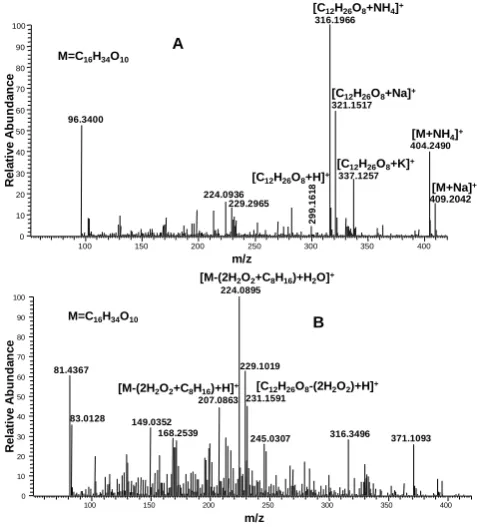
mentioned in Peña-Quevedo et al. [15] were detected. The mass spectra in Fig. 5A revealed the existence of sodium adduct of the MEKP tetramer [C16H34O10+Na]+ at m/z 409.2042, an ammonium
adduct at m/z 404.2490, as well as several adducts of the MEKP trimer (C12H26O8) when UV was turned off.
After UV irradiation at 254 nm inside the UV degradation coil, loss of H2O2 and C8H16 from the
MEKP tetramer were observed at m/z 224.0895 and m/z 207.0863 as well as loss of H2O2 from the MEKP
trimer was observed at m/z 231.1591. As no other intermediate product ions of MEKP such as [C4H9O3]+
at m/z 105.05 as described by DeTata et al. [16] was found in this study, further loss of the remaining O-O bonds from the MEKP trimer and tetramer under the mercury UV photo degradation cannot be ruled out. TATP was the most unstable amongst the three OPEs in this study and detailed investigations of the mass spectra of TATP are discussed in the supplementary section.
Figure 4. Mass spectra of 100 mg L-1 HMTD with UV
turned off (A) and UV turned on (B). 10 µL of the HMTD was injected into an Orbitrap mass
spectrometer and electrospray ionisation (ESI) with full scan (m/z from 50.00 to 2000.00) were undertaken. Residence time in 61 cm Hg UV coil was 0.38 min at 81±0.003 µL/min flow rate. The mass precision was set to 4 decimals with mass tolerance of 5 mg L-1.
Figure 5. Mass Spectra of 20.5 mg L-1 MEKP with UV
turned off (A) and UV turned on (B). 10 µL of the MEKP was injected into an Orbitrap mass
spectrometer and electrospray ionisation (ESI) with full scan (m/z from 50.00 to 2000.00) were undertaken. Residence time in 61 cm Hg UV coil was 0.38 min at
0.0 0.5 1.0 1.5 2.0 2.5 3.0 3.5 4.0
0 10 20 30 40 50 60 70
H2O2 UV On
TATP
HMTD
H2O2 UV Off
MEKP C hemi lum ines c ent R es pons e, mV
UV Reactor Coil Length, m
100 150 200 250 300 350 400
m/z 0 10 20 30 40 50 60 70 80 90 100 Rel at ive Ab u n d an ce 224.0875 207.0610 371.1008 149.0231 199.1691 245.0168 229. 042 8 352.3390 115.0751 404.2487
[M+NH4]+
[M+H]+
[M+Na]+
[M+K]+
M=C6H10O6N2 A
100 150 200 250 300 350 400
m/z 0 10 20 30 40 50 60 70 80 90 100 Rel at ive Ab u n d an ce 224.0876 207.0610 229.0429 245.0168 231.0837
149.0555 316.4162 371.1010 435.0968
M=C6H10O6N2
[M+NH4]+
[M+H]+
[M+Na]+
[C6H12O6N2+Na]+
[M+K]+ [2M+Na]+ [M-2(CHO)+H]+ B 299. 161 8
100 150 200 250 300 350 400
m/z 0 10 20 30 40 50 60 70 80 90 100 Rel at ive Ab u n d an ce 316.1966 321.1517 96.3400 404.2490 337.1257 224.0936 409.2042 229.2965
M=C16H34O10
[M+Na]+
A
[M+NH4]+
[C12H26O8+H]+
[C12H26O8+NH4]+
[C12H26O8+Na]+
[C12H26O8+K]+
100 150 200 250 300 350 400
m/z 0 10 20 30 40 50 60 70 80 90 100 Rel at ive Ab u n d an ce 224.0895 229.1019 81.4367 231.1591 207.0863 83.0128 149.0352
168.2539 245.0307 316.3496 371.1093
M=C16H34O10
[M-(2H2O2+C8H16)+H2O]+
B
Fast Photo Degradation of Organic Peroxide Explosives
81±0.003 µL/min flow rate. The mass precision was set to 4 decimals with mass tolerance of 5 mg L-1.
The degradation efficiency of the UV reactor coil was calculated by measuring the concentrations of H2O2 produced from OPE degradation by constructing
a standard curve of H2O2 with details provided in the
supplementary. In this study, the results indicated that photo degradation efficiencies of the mercury UV coil were 13-20% for HMTD, 16-26% for TATP and 8-12% for MEKP.
4 Conclusion
This study demonstrated continuous-flow photo degradation for safe and selective conversion of three
OPEs (HMTD, MEKP and TATP) to H2O2 using two
different UV radiation sources. The usage of zinc lamp resulted in fast conversion of OPEs to molecular oxygen, while the use of mercury lamp would be preferable for selective conversion of OPEs to H2O2
only using a 61 cm long coil reactor coil with 0.38 minute exposure to UV radiation at 254 nm.
The maximum degradation efficiency of 20%, 26% and 12% for HMTD, TATP and MEKP was achieved with mercury lamp that can be used to drastically reduce the runtime of FIA-chemiluminescent analysis to less than 0.5 min and increase its sensitivity down to nanomole level using previously reported approach [17]. Additionally, this photochemical flow conditions can provide efficient remediation of OPEs with 0.6-0.9 conversion degree depending on concentration of OPEs. Importantly, the kinetic nature of the direct photo degradation of H2O2
(i.e., UV+H2O2) can also be applied to maximise ROS
production particularly for water treatment.
Acknowledgements
The authors thankfully acknowledge the Prime
Minister and Cabinet of Australia for funding this
project with Grant of National Security Science
and Technology Unit (NSSTU) on Counter
Terrorism. We also gratefully acknowledge
Central Science Laboratory of University of
Tasmania during the mass spectral analysis.
References
[1] O. M. Alfano, D. Bahnemann, A. E. Cassano, R. Dillert, R. Goslich, Photocatalysis in Water Environments Using Artificial and Solar Light,
Catal. Today, 2000, 58, 199-230
[2] J. Hawari, A. Halasz ,C. Groom, S. Deschamps , L. Paquet , C. Beaulieu , A. Corriveau,
Photodegradation of RDX in Aqueous Solution: A Mechanistic Probe for Biodegradation with
Rhodococcus sp., Environ. Sci. Technol., 2002,
36, 5117-5123.
[3] J. Hawari, S. Deschamps, C. Beaulieu, L. Paquet, A. Halasz, Photodegradation of CL-20: Insights into the Mechanisms of Initial Reactions and Environmental Fate, Water Res., 2004, 38, 4055– 4064.
[4] The Drink Bottle That Could Have Downed A Plane, The Guardian, Australia Edition, Tuesday 8 Sept. 2009;
http://www.theguardian.com/uk/2009/sep/07/plane -bomb-plot-drink-bottle; accessed 19 August 2015.
[5] S. Parajuli, W. Miao, Sensitive Determination of Triacetone Triperoxide Explosives Using Electrogenerated Chemiluminescence, Anal. Chem., 2013, 85, 8008-8015.
[6] R. Schulte-Ladbeck, P. Kolla, U. Karst, Trace Analysis of Peroxide-Based Explosives, Anal. Chem., 2003, 75, 731-735.
[7] J. Hong, J. Maguhn, D. Freitag, and A. Kettrup, Determination of H2O2 and Organic Peroxides by
High-Performance Liquid Chromatography with Post-Column UV Irradiation, Derivatization and Fluorescence Detection Fresen. J. Anal. Chem.,
1998, 361, 124-128.
[8] C.-H. Liao, M. Gurol, Chemical Oxidation by Photolytic Decomposition of Hydrogen Peroxide,
Environ. Sci. Technol.1995, 29, 3007-3014. [9] J. M. Aubry, Search for Singlet Oxygen in the
Decomposition of Hydrogen Peroxide by Mineral Compounds in Aqueous Solutions, J. Am. Chem. Soc.1985, 107, 5844-5849.
[10]S. Hanaoka, J.-M.Lin, M. Yamada,
Chemiluminescent Flow Sensor for H2O2 Based
on the Decomposition of H2O2 Catalyzed by
Cobalt(II)-Ethanolamine Complex Immobilized on Resin, Anal. Chim. Acta, 2001, 426, 57-64. [11]Y. Su, N. J. W. Straathof, V. Hessel, T. Noel,
Photochemical Transformations Accelerated in Continuous-Flow Reactors: Basic Concepts and Applications, Chem-Eur J., 2014, 20, 10562-10589.
[a] P. Mahbub, P. N. Nesterenko
Australian Centre for Research on Separation Science, School of Physical Science
University of Tasmania
Sandy Bay Campus, Hobart 7001 Australia E-mail: [email protected]
[b] R. Wilson
Central Science Laboratory University of Tasmania
Sandy Bay Campus, Hobart 7001 Australia
[12] D. Armitt, P. Zimmermann, S. Ellis-Steinboener, Gas Chromatography/Mass Spectrometry Analysis of Triacetone Triperoxide (TATP)
Degradation Product, Rapid Commun. Mass
Spectrom., 2008, 22, 950-958.
[13] S. Lis, M. Kaczmarek, Chemiluminescent Systems Generating Reactive Oxygen Species from the Decomposition of Hydrogen Peroxide and Their Analytical Applications,Trends Anal. Chem.2013,
44, 1-11.
[14] A. Wierzbicki, E. A. Salter, E. A. Cioffi, E. D. Stevens, Density Functional Theory and X-ray Investigations of P- and M-Hexamethylene Triperoxide Diamine and Its Dialdehyde Derivative, J. Phys. Chem., 2001, 105, 8763-8768.
[15] A. J. Peña-Quevedo, S. P. Hernandez-Rivera, (2009). Mass spectrometry analysis of
hexamethylene triperoxide diamine by its decomposition products, Proceedings of SPIE 7303, doi:10.1117/12.819080.
[16]D. DeTata, P. Collins, A. McKinley, A Fast Liquid Chromatography Quadrupole Time-of-Flight Mass Spectrometry (LC-QToF-MS) Method for the Identification of Organic Explosives and
Propellants, Forensic Sci. Int., 2013, 233, 63-74. [17]P. Mahbub, P. Zakaria, R. Guijt, M. Macka, G.
Dicinoski, M. Breadmore and P. N. Nesterenko, Flow Injection Analysis of Organic Peroxide Explosives Using Acid Degradation and Chemiluminescent Detection of Released
Hydrogen Peroxide, Talanta, 2015, 143, 191-197.