From Dust to Dawn: Practically Efficient
Two-Party Secure Function Evaluation Protocols and their
Modular Design
(Full Version)
Vladimir Kolesnikov1, Ahmad-Reza Sadeghi2, and Thomas Schneider3
1
Alcatel-Lucent Bell Laboratories, Murray Hill, NJ 07974, USA [email protected]
2 CASED, Technical University Darmstadt, Germany
3 Horst G¨ortz Institute for IT-Security, Ruhr-University Bochum, Germany
Abstract. General two-party Secure Function Evaluation (SFE) allows mutually distrusting par-ties to (jointly) correctly computeany function on their private input data, without revealing the inputs. SFE, properly designed, guarantees to satisfy the most stringent security requirements, even for interactive computation. Two-party SFE can benefit almost any client-server interaction where privacy is required, such as privacy-preserving credit checking, medical classification, or face recog-nition. Today, SFE is subject of an immense amount of research in a variety of directions, and is not easy to navigate.
In this paper, we systematize the mostpractically important work of the vast research knowledge ongeneralSFE. It turns out that the most efficient SFE protocols today are obtained by combining several basic techniques, such as garbled circuits and homomorphic encryption. We limit our detailed discussion to efficient general techniques. In particular, we do not discuss the details of currently
practically inefficient techniques, such as fully homomorphic encryption (although we elaborate on its practical relevance), nor do we coverspecialized techniques applicable only to small classes of functions.
As an important practical contribution, we present a framework in which today’s practically most efficient techniques for general SFE can be viewed as building blocks with well-defined interfaces that can be easily combined to establish a complete efficient solution. Further, our approach naturally lends itself to automated protocol generation (compilation). This is evidenced by the implementation of (parts of) our framework in the TASTY SFE compiler (introduced at ACM CCS 2010). In sum, our work is positioned as a comprehensive guide in state-of-the-art SFE, with the additional goal of extracting, systematizing and unifying the most relevant and promising general techniques from among the mass of SFE knowledge. We hope this guide would help developers of SFE libraries and privacy-preserving protocols in selecting the most efficient SFE components available today.
Table of Contents
From Dust to Dawn: Practically Efficient Two-Party Secure Function Evaluation Protocols and
their Modular Design. . . 1
Vladimir Kolesnikov, Ahmad-Reza Sadeghi, and Thomas Schneider 1 Introduction . . . 4
Scope of this paper . . . 4
Efficient SFE techniques . . . 4
Composition and Performance Evaluation of Efficient SFE Techniques . . . 4
Applications of SFE . . . 5
Outline of the presentation . . . 5
2 Function Representations . . . 5
3 SFE: Security Notions, Parameters, Notation . . . 6
3.1 Security Notions . . . 6
3.2 Computation under encryption . . . 7
3.3 Parameters and Notation . . . 7
4 SFE of Circuits and OBDDs in the Semi-honest Model . . . 7
4.1 Homomorphic Encryption: SFE of Arithmetic Circuits . . . 7
Additively Homomorphic Cryptosystems . . . 8
Fully Homomorphic Cryptosystems . . . 8
Computing on Encrypted Data . . . 8
Packing . . . 9
Homomorphic Values and Conversions . . . 9
Plain Value to Homomorphic Value for Inputs . . . 9
Homomorphic Value to Plain Value for Outputs . . . 9
Multiplication of Homomorphic Values with Additively-Homomorphic Encryption . . . 9
4.2 Garbled Functions: SFE of Boolean Circuits and OBDDs . . . 9
Garbled Values and Conversions . . . 10
Garbled Value to Plain Value for Outputs . . . 10
Plain Value to Garbled Value for Inputs . . . 10
Oblivious Transfer . . . 10
Efficient OT Protocols . . . 10
Extending OT Efficiently . . . 11
Pre-Computing OT . . . 11
Covert and Malicious Adversaries . . . 11
4.3 Garbled Circuits: SFE of Boolean Circuits . . . 12
Efficient Garbled Circuits . . . 12
Circuit Optimizations . . . 13
Hardware-based SFE . . . 13
Pre-Computation vs. Streaming . . . 13
Efficient Circuit Constructions with free XOR . . . 13
Private Circuits . . . 13
4.4 Garbled OBDDs: SFE of OBDDs . . . 14
Create Garbled OBDD . . . 14
Evaluate Garbled OBDD . . . 14
Implementation observations and optimizations . . . 15
Efficiency . . . 15
Private OBDDs . . . 15
5 Composition of SFE Blocks . . . 15
5.1 Garbled Values to Homomorphic Values. . . 15
Additive Blinding . . . 16
Bitwise Encryption . . . 16
Performance Comparison . . . 16
6 Conclusion . . . 16
Where we’ve come from . . . 16
Where we are . . . 16
Where we may be going . . . 17
Acknowledgements . . . 17
A Where SFE Fits in Secure Computing . . . 21
B Function Representations . . . 21
B.1 Boolean Circuits . . . 21
Automatic Generation . . . 22
B.2 Arithmetic Circuits . . . 22
Number Representation . . . 22
B.3 Ordered Binary Decision Diagrams . . . 22
Example . . . 22
Generalizations . . . 23
Efficiency . . . 23
C Intuition Behind SFE Definitions . . . 23
D Efficient Techniques for Protection Against Malicious Actions . . . 24
D.1 Zero-Knowledge Proofs . . . 24
Zero-Knowledge Proofs for SFE . . . 24
D.2 Multiplication of Homomorphic Values . . . 25
Optimization . . . 25
D.3 Garbled Values to Homomorphic Values . . . 25
D.4 Homomorphic Values to Garbled Values . . . 25
1
Introduction
The concept of two-party Secure Function Evaluation (SFE) was introduced in 1982 by Yao [Yao82]. The idea is to let two mutually mistrusting parties compute an arbitrary function on their private inputs without revealing any information about their inputs beyond the output of the function. Since then, this concept has been an appealing research subject in crypto and security communities, with many exciting results.
Although a large number of security-critical applications (e.g., electronic auctions and voting, data classification, remote diagnostics, etc.) with sophisticated privacy and security requirements can benefit from SFE, its real-world deployment was believed to be very limited and expensive for a relatively long time. Fortunately, the cost of SFE has been dramatically reduced in the recent years thanks to many algorithmic improvements and automatic tools, as well as faster computing platforms and communica-tion networks. (We note that SFE is only a part of a general task of secure computing as discussed in Appendix§A.)
Scope of this paper In this paper we survey and systematize the current state of the art ofpractically effi-cient generalsecure two-party computation. In particular, we do not discuss in detail currently practically inefficient techniques, such as fully homomorphic encryption (we elaborate on its practicality in §4.1), nor do we cover specialized techniques applicable only to small classes of functions. Moreover, we present a framework which allows to modularly combine the required techniques with well-defined interfaces to obtain highly efficient protocols suitable for practical applications. We build our presentation in the style of a tutorial, and aim for the paper to be both a reference on practically efficient SFE for experts, and an understandable area guide for non-experts in secure computation.
Efficient SFE techniques For several years, two different approaches for secure two-party computation have co-existed. One approach is based on homomorphic encryption (HE). Here one party sends its en-crypted inputs to the other party, who then computes the intended function under encryption using the homomorphic properties of the cryptosystem, and sends back the encrypted result. Popular examples are the additively homomorphic cryptosystems of Paillier [Pai99] and Damg˚ard-Jurik [DJ01], and the recent fully homomorphic schemes [Gen09, vDGHV10, SV10]. (We elaborate on the practicality of fully homo-morphic schemes in§4.1). Alternatively, SFE can be done usinggarbled functions (GF), a generalization of Yao’s garbled circuits (GC) [Yao86] that works as follows: one party (constructor) “encrypts” the function (using symmetric keys), the other party (evaluator) obliviously obtains the keys corresponding to both parties’ inputs and the garbled function, and is able to decrypt the corresponding output value. Both approaches have their respective advantages and disadvantages, i.e., GF requires to transfer the garbled function (communication complexity is at least linear in the size of the function) but allows to pre-compute almost all expensive operations resulting in a low latency of the online phase, whereas most HE schemes require relatively expensive public-key operations in the online phase but can result in a smaller overall communication complexity.
For a particular primitive, one of the techniques is usually more suitable than the other. For example, for comparison or maximum selection, GF [NPS99,KSS09] is better than HE [DGK07,DGK08b,DGK08a], whereas multiplication often benefits from using HE. Therefore, simply switching from one approach for secure computation to the other can result in substantial performance improvements. For instance, for privacy-preserving DNA matching based on secure evaluation of finite automatons, GC-based [Fri09] is more efficient than HE-based [TPKC07].
We also note that GCs are gaining popularity as a versatile tool whose applicability goes beyond the “simple” SFE [GGP10, KM10b, SS10]. Further, most published work (e.g., [GKR08, SS10]) do not give concrete GC instantiations, or constructions for how to hide the topology of the evaluated function (for which efficient universal circuit constructions are needed). We summarize today’s most efficient constructions for garbled circuits and universal circuits in§4.3 of our paper.
One of the goals of this work is a design and presentation of a unifying framework (§5), which allows for the above compositions in a modular way. The need for and the usefulness of this framework is illustrated by its recent (partial) implementation, “Tool for Automating Secure Two-partY computations” (TASTY) [HKS+10]. TASTY allows a programmer to provide a high-level description of the computation to be performed on encrypted data in a domain-specific language, and automatically transforms this description into efficient protocols based on HE, GC, and arbitrary combinations of both. TASTY allows to compare the performance of different protocols with each other. For example, it may help determine (and quantify!) that GC-based multiplication has a more efficient online phase than HE-based multiplication for`≤16 bit values [HKS+10].
Applications of SFE There is a large body of literature on SFE applications, in particular those with strong privacy requirements such as Privacy-Preserving Genomic Computation [TPKC07, JKS08, Fri09, KM10b], Remote Diagnostics [BPSW07], Graph Algorithms [BS05], Data Mining [LP02, LP09b], Credit Checking [FAZ05], Medical Diagnostics [BFK+09], Face Recognition [EFG+09,SSW09], or Policy Check-ing [FAL04, FAL06, FLA06], just to name a few. These applications are based on either HE or GF or a combination of both as explained before. Recently, verifiable outsourcing of computations for cloud-computing applications has been proposed, based on evaluating GCs under fully HE [GGP10]. Existence of a variety of SFE compilers, coming from both academia, e.g., [MOR03, MNPS04, HKS+10], and indus-try [SKB+09, SKM10], further proves significant interest in the SFE technology.
Moreover, we note that secure two-party protocols can often be naturally extended to secure multi-party protocols. Examples include secure mobile agents which can be based on HE [ST98] and GC [CCKM00], as well as privacy-preserving auction systems based on GC [NPS99] or HE [DGK07]. However, in this work, we do not address the issues of multi-party computation with more than two players. We mention, however, that this is a vibrant field with many efficient solutions [CDN01, BDNP08, BLW08, BCD+09,IPS09,DO10,JMN10,DK10]. We note that in-depth conceptual and, where possible, performance comparison of two- and multi-party computation is an open problem.
Outline of the presentation We start our discussion in§2 with a few of most popular function represen-tations and point out their relative advantages in terms of possibility of efficient secure evaluation. We note that it is possible to “mix-and-match” the representations in the construction of protocols. Then, in §3, we briefly discuss various notions of security and their relationship. In §4, we describe today’s practically efficient SFE constructions for each of the function representations we consider. We handle the actual details of the composition, namely the techniques to convert encrypted intermediate values between the protocols in §5 for semi-honest players, a model which suits most client-server applications. We summarize the main techniques for achieving security in the malicious player setting in Appendix§D.
2
Function Representations
Given the function to be securely computed, the first decision we face is the choice of the “programming language” for describing the function. It turns out that this decision has a major impact on the efficiency of the final solution. Further, it is not feasible to describe the optimal choice strategy as finding minimal function representations is hard [BW96, KC00].
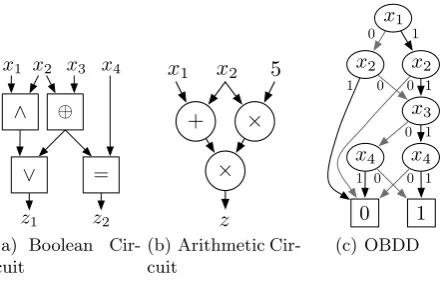
The following standard representations for functions are particularly useful for SFE: boolean circuits (cf. Fig. 1(a)), arithmetic circuits (cf. Fig. 1(b)) and ordered binary decision diagrams (OBDD) (cf. Fig. 1(c)).
In Appendix§B, we give their detailed descriptions and provide guidelines regarding efficiency choices. Here we stress that the cost of implementing SFE protocols varies greatly among the function representa-tions. For example, the GC technique for SFE of boolean circuits is much more efficient than techniques for evaluating arithmetic circuits (e.g., using HE). However, some functions are represented much more compactly as an arithmetic circuit. As another example, some functions (e.g., decision strategies) are most compactly represented as OBDDs, while others (e.g., multiplication), require exponentially large OBDDs.
∧
∨ ⊕
= x1 x2 x3 x4
z1 z2
(a) Boolean Cir-cuit
x
1x
25
×
z
×
+
(b) Arithmetic Cir-cuit
x1
x3
x4 x4
x2 x2
0 1
0 1
0 1
1 0
1 0
1 0 0 1
(c) OBDD
Fig. 1.Function Representations
3
SFE: Security Notions, Parameters, Notation
3.1 Security Notions
In this section, we give the intuition of the security notions we use. Due to the lack of space, we do not include the standard definitions here. However, we present the intuitive discussion of definitional approaches in Appendix §C and refer the reader to standard sources for formal definitions and further discussion, e.g., [Gol04, LP09b]. The definitions modelsemi-honest,covertandmaliciousbehavior.
The strongest and most general (and, perhaps, the most natural) notion is themalicious adversary. Such attacker is allowed to arbitrarily deviate from the prescribed protocol, aiming to learn private inputs of the parties and/or to influence the outcome of the computation. Not surprisingly, protection against such attacks is relatively expensive, as we discuss later in§4.2 and Appendix§D. To be malicious-secure, a protocol must guarantee that there does not exist a course of action that results in any gain to the attacker.
A somewhat weakercovert adversary is similar to malicious, but with the restriction that he must avoid being caught cheating. That is, a protocol in which an active attacker may gain advantage may still be considered secure if attacks are discovered with certain fixed probability (e.g., 1/2). It is reasonable to assume that in many social, political and business scenarios the consequences of being caught overweight the gain from cheating; we believe covert adversaries is the right way to model the behavior of players in the interactions of interest. At the same time, protocols secure against covert adversaries are substantially more efficient than those secure against malicious players, e.g., as summarized later in§4.2.
Finally, we consider thesemi-honestadversary, one who does not deviate from the protocol, but aims to learn the output of the computation. At first, it may appear contrived and trivial. Consideration of semi-honest adversaries, however, is important in many typical practical settings. Firstly, even externally unobservable cheating, such as poor random number generation, manipulations under encryption, etc., can be uncovered by an audit or reported by a conscientious insider, and cause negative publicity. There-fore, especially if the gain from cheating is low, it is often reasonable to assume that a well-established organization will exactly follow the protocol (and thus can be modeled as semi-honest). Further, even if players are trusted to be fully honest, it is sometimes desired to ensure that the transcript of the interaction reveals no information. This is because in many cases, it is not clear how to reliably delete the transcript due to lack of control of the underlying computing infrastructure (network caching, virtual memory, etc.) Running an SFE protocol ensures that player’s input cannot be subsequently revealed even by forensic analysis.
At the same time, designing semi-honest-secure SFE protocols is far from trivial, and is in fact an important basic step in designing protocols secure against covert and malicious adversaries (cf.§4.2).
Hybrid Security.It is often the case that players are not equal in their capabilities, trustworthiness, and motivation. This is true especially often in the client-server scenarios. For example, it may be reasonable to assume that the bank will not deviate from the protocol (act semi-honestly), but similar assumption cannot be made on bank clients, who may be much more willing to take the risks of committing fraud.
proposing a protocol, the security claim may be in the form “ProtocolΠ is secure against maliciousAand semi-honestB.” The proof of security then involves two different definitions, and simulator constructions would also be correspondingly different. The benefit of this hybrid approach is the possibility to design significantly more efficient protocols. For example, the garbled circuit protocol (in which players take the roles of constructor or evaluator of garbled circuits) is almost free to secure against malicious evaluator, and much more expensive to secure against malicious constructor (details later in§4.2). Thus, GC-based protocols are good candidates for settings with corresponding trust relationships.
3.2 Computation under encryption
Before presenting the protocols in the next section, we find it instructive to present the following simple insight: each of the SFE techniques we consider can be viewed asevaluation under encryptionwith hints. Evaluation under encryption is very complicated in its generality. In fact, only recently the first promising candidate was proposed – an encryption scheme that allows to perform an arbitrary number of both multiplications and additions on the plaintext [Gen09]. We stress that this (and similar) schemes are currently prohibitively expensive, and are not likely to be considered for practice in the foreseeable future (see§4.1 for more discussion). In comparison, we propose extremely efficient solutions to a much simpler problem, where the computed function is fixed. Now, for example, the first player can send his encrypted input and additional function-specific “hints” to assist the second player with evaluation under encryption. This assistance can also be interactive. We further simplify our work by considering only elementary operations, e.g., boolean gates, and show how to compose their evaluation in a secure way.
3.3 Parameters and Notation
We denote thesymmetric security parameterbytand theasymmetric security parameter, e.g., bitlength of RSA moduli, byT. From 2011 on, NIST recommends at leastt= 112 andT = 2048. For detailed rec-ommendations on the choice of security parameters we refer to [GQ09]. Thestatistical security parameter is denoted by σand can be set toσ= 112. Thebitlengthof variablexis written|x|.
In the following, we refer to the two SFE participants as clientC and server S. Our naming choice is mainly influenced by the asymmetry in the SFE protocols, which fits into the client-server model. We stress that, while in most of the real-life two-party SFE scenarios the corresponding client-server relationship in fact exists in the evaluated function, we do not limit ourself to this setting.
4
SFE of Circuits and OBDDs in the Semi-honest Model
To reduce complexity, functions can be decomposed into several sub-functions (blocks). Each of these blocks can be represented in its own way, e.g., a multiplication block can be represented as an arithmetic circuit, a comparison block as a boolean circuit and a specific decision tree as an OBDD.
In this section, we present the SFE protocols for the three representations of interest with semi-honest adversaries. We explain how to prevent/detect deviations from the protocol in Appendix §D.
It is our goal to be able to arbitrarily compose the three protocols. This, in particular, means that the encrypted output of one protocol will be fed as input into another. To preserve a common interface and simplify the presentation, we will extract and describe separately the core – computation under encryption – of each protocol (done in this section). (For completeness, we also discuss here the simple issue of how to appropriately encrypt the inputs and decrypt the outputs.) We will discuss the issues of composition of the protocols, such as conversions of encryptions, in§5. Overall, the protocol structure will look as follows: (i) encrypt the plaintext inputs, (ii) perform the computation under encryption (which may include a composition of encrypted computations), and, (iii) decrypt the output values.
4.1 Homomorphic Encryption: SFE of Arithmetic Circuits
Additively Homomorphic Cryptosystems An additively homomorphic encryption scheme allows addition under encryption as follows. It defines an operation + on plaintexts and a corresponding opera-tionon ciphertexts, satisfying∀x, y∈P:JxKJyK=Jx+yK. This naturally allows for multiplication with a plaintext constantausing repeated doubling and adding:∀a∈N, x∈P:aJxK=JaxK.
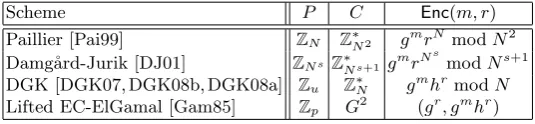
Popular instantiations for additively homomorphic encryption schemes are summarized in Table 1: The Paillier cryptosystem [Pai99] provides a T-bit plaintext space, where T is the size of the RSA modulus N, and is sufficient for most applications. The Damg˚ard-Jurik cryptosystem [DJ01] is a gener-alization of the Paillier cryptosystem which provides a large plaintext space of size sT-bit for arbitrary s≥1. The cryptosystems of Damg˚ard-Geisler-Krøigaard (DGK) [DGK07, DGK08b, DGK08a] and lifted EC-ElGamal [Gam85] (implemented over an elliptic curve group G with prime order p) have smaller ciphertexts, but are restricted to a small plaintext space Zu(respectively a small subset of the plaintext spaceZp) as decryption requires to solve a discrete log.
Table 1.Additively Homomorphic Encryption Schemes (N: RSA modulus,s≥1,u: small prime,p: large prime)
Scheme P C Enc(m, r)
Paillier [Pai99] ZN Z∗N2 gmrNmodN2
Damg˚ard-Jurik [DJ01] ZNs Z∗
Ns+1gmrN
s
modNs+1 DGK [DGK07, DGK08b, DGK08a] Zu Z∗N g
m
hrmodN Lifted EC-ElGamal [Gam85] Zp G2 (gr, gmhr)
Fully Homomorphic Cryptosystems For completeness, we mention that some cryptosystems allow both addition and multiplication under encryption. For this, a separate operation×for multiplication of plaintexts and a corresponding operation on ciphertexts is defined satisfying∀x, y∈ P :JxKJyK= Jx×yK. Cryptosystems with such a property are calledfully homomorphic.
Until recently, it was widely believed that such cryptosystems do not exist. Several works pro-vided partial solutions: [BGN05, GHV10] allow for an arbitrary number of additions and one multi-plication, and ciphertexts of [SYY99, AS08] grow exponentially in the number of multiplications. While one-multiplication schemes are relatively efficient, their use is limited due to their inherent restriction. Recent schemes [Gen09, vDGHV10, SV10] are fully homomorphic. However, the size of ciphertexts and computational cost of elementary steps in fully homomorphic schemes aredramaticallylarger than those of additively homomorphic schemes.
Recently, the first working implementation of fully homomorphic encryption was presented [GH10]. Its performance for reasonable security parameters is in the order of Gigabytes of communication and minutes of computation on high-end IBM System x3500 servers. Other recent implementation results of [SV10] show that even for very small parameters where the multiplicative depth of the evaluated circuit is d = 2.5, i.e., at most two multiplications, encrypting a single bit takes 3.7 s on 2.4GHz Intel Core2 (6600) CPU.
Although significant effort is underway in the theoretical community to improve its performance, it seems unlikely that fully homomorphic encryption would reach the efficiency of current public-key en-cryption schemes. Intuitively, this is because a fully homomorphic cryptosystem must provide the same strong security guarantees, while, at the same time, possessing extra algebraic structure to allow for ho-momorphic operations. The extra structure weakens security, and countermeasures (costing performance) are necessary. In this work, we do not rely on, but could use, (expensive) fully homomorphic schemes.
Computing on Encrypted Data Homomorphic encryption naturally allows to evaluate arithmetic cir-cuits via computation on encrypted data, as follows. The clientCgenerates a key pair for a homomorphic cryptosystem and sends his inputs encrypted under the public key to the serverStogether with the public key. With a fully homomorphic scheme, S can simply evaluate the arithmetic circuit by computing on the encrypted data and send back the (encrypted) result toC, who then decrypts it to obtain the output. If the homomorphic encryption scheme only supports addition, one round of interaction betweenC and
S is needed to evaluate each multiplication gate (or a layer of multiplication gates) as described later in
schemes. (The latter, however, allows non-interactive evaluation of private functions by S; this can be done efficiently without fully HE, but with interaction, using universal circuits as shown in§4.3.)
Packing Often the plaintext space P of the homomorphic encryption scheme is substantially larger than the encrypted values. This allows for optimization of many HE-based protocols by packing together multiple ciphertexts into one before or after additive blinding and sending the single ciphertext fromS
to Cinstead. This substantially decreases the message size and the number of decryptions performed by
C. The computational overhead forSis small as packing the ciphertextsJx1K, ...,JxnKinto one ciphertext JXK = Jxn||. . .||x1K costs less than one full-range modular exponentiation by using Horner’s scheme: JXK=JxnK; fori=n−1..1 :JXK= 2|xi+1|JXKJxiK.
Homomorphic Values and Conversions We mention a few relatively simple issues and optimizations with encrypting the input, and decrypting the output of the homomorphic computation. Describing these procedures completes (at a high level) the description of SFE of arithmetic circuits.
The interface for SFE protocols based on homomorphic encryption arehomomorphic values, i.e., homo-morphic encryptionsheld bySencrypted under the public key ofC(see Fig. 3 in§5). These homomorphic values can be converted from or to plaintext values as described next.
Plain Value to Homomorphic Value for Inputs To convert a plain `-bit value x, i.e., |x| = `, into a homomorphic value JxK, xis simply encrypted underC’s public key. Ifxbelongs to C,JxKis sent to S. IfC is malicious he has to prove in zero-knowledge that the encryption was performed correctly andJxK indeed encrypts an `-bit value (details later in§D.1).
Homomorphic Value to Plain Value for Outputs To convert a homomorphic value into a plain value forC,
S sends the homomorphic value toCwho decrypts and obtains the plain value. If onlySshould learn the plain value corresponding to a homomorphic `-bit valueJxK,S additively blinds the homomorphic value by choosing a random maskr∈R{0,1}`+σ, whereσis the statistical security parameter, and computing Jx¯K=JxKJrK.S sends this blinded value toCwho decrypts and sends back ¯xtoS. Finally,Scomputes x= ¯x−r. IfCis malicious he has to prove in zero-knowledge that he correctly decrypted ¯x.Packingcan be used to improve efficiency of parallel output conversions.
Multiplication of Homomorphic Values with Additively-Homomorphic Encryption To
multi-ply two homomorphic`-bit valuesJxKandJyKheld bySthe following standard protocol requires one single round of interaction with C:S randomly choosesrx, ry ∈R {0,1}`+σ, where σis the statistical security parameter, computes the blinded valuesJx¯K=Jx+rxK,Jy¯K=Jy+ryKand sends these toC.Cdecrypts, mul-tiplies and sends backJzK=Jx¯y¯K.SobtainsJxyKby computingJxyK=JzK(−rx)JyK(−ry)JxKJ−rxryK. Efficiency of parallel multiplications can be improved by packing multiple blinded ciphertexts together instead of sending them to C separately. Interactive multiplication with malicious players is given in Appendix§D.2.
4.2 Garbled Functions: SFE of Boolean Circuits and OBDDs
Efficient techniques for evaluating boolean circuits and OBDDs are quite similar; in fact the underlying idea is the same. In this section we will present the main idea and a complete high-level treatment of the two protocols. We then present the corresponding details for SFE of boolean circuits in§4.3 and OBDDs in §4.4.
The idea for SFE, going back to Yao [Yao86], is to evaluate the function, step by basic step, un-der encryption. Yao’s approach, which consiun-dered boolean circuits, is to encrypt (or garble) each wire with a symmetric encryption scheme. In contrast to homomorphic encryption (cf. §4.1), the encryp-tions/garblings here cannot be operated on without additional help. We will explain in detail how to operate under encryption on the basic function steps in§4.3,§4.4.
To securely evaluate a functionf, the constructor(server S) creates a garbled function fefrom f (a detailed description on how this is done is given later in §4.3 for boolean circuits and§4.4 for OBDDs). In fe, the garbled values of each wire Wi are two (random-looking) secrets we0i,wei1 that correspond to the values 0 or 1. We note that a garbled value weij does not reveal its corresponding plain value j. S sends feto evaluator(client C) and C additionally obtains both players’ garbled input values ex1, . . . ,xeu from S in an oblivious way (this requires further interaction as described later in §4.2). C uses the garbled function and the garbled input values to obliviously compute the corresponding garbled output values (ez1, . . . ,ezv) =fe(xe1, . . . ,exu). We emphasize that during the step-by-step encrypted evaluation, all intermediate results are garbled values and hence do not reveal any additional information. (We give details on evaluatingfelater in§4.3 for boolean circuits and§4.4 for OBDDs.) Finally, the garbled output valuesezj are translated into their corresponding plaintext valueszj (cf.§4.2).
We stress that a garbled functionfecannot be re-used. Each secure evaluation requires construction and transfer of a new garbled function which can be done in a pre-computation phase.
Garbled Values and Conversions For garbled functions, conversions between plaintext values and encryptions involve a number of subtleties and tricks. Recall, we first convert both players’ plain inputs into their corresponding garbled values (encrypt inputs), then evaluate the garbled function (evaluate under encryption), and finally convert the garbled outputs back into plain values (decrypt result).
The interface for SFE protocols based on garbled functions are garbled values(see Fig. 3 in §5). A garbled boolean value exi represents a bit xi. Each garbled boolean value exi =hki, πiiconsists of a key ki∈ {0,1}t, wheretis the symmetric security parameter, and a permutation bitπi∈ {0,1}. The garbled valuexei is assigned to one of the two corresponding garbled valuesxe0i =
k0 i, πi0
orxe1
i =
k1 i, π1i
with π1
i = 1−π0i. The permutation bitπiallows efficient evaluation of the garbled function using the so-called point-and-permute technique but does not reveal information about the corresponding plain value as it looks random [MNPS04]. Of course, a garbled`-bit value can be viewed as a vector of`garbled boolean values.
We show how to convert a plain value into its corresponding garbled value and back next.
Garbled Value to Plain Value for Outputs To convert a garbled valuexei=hki, πiiinto its corresponding plain valuexifor evaluatorC, constructorS reveals the output permutation bitπi0which was used during construction of the garbled wire andC obtainsxi=πi⊕πi0.
If the garbled valuexei should be converted into a plain value for constructorS, evaluatorC simply sends xei (or πi) to S who obtains the plain value by decrypting it, e.g., compare with xe0i and xe1i. We note that maliciousCcannot cheat in this conversion as he only knows eitherex0
i orex1i, but is unlikely to guess the other one.
Plain Value to Garbled Value for Inputs To translate a plain valuexi held byS into a garbled valuexei forC,S sends the corresponding garbled valueex0
i orxe1i toC depending on the value ofxi.
To convert a plain valuexi held byC into a garbled valuexei forC, both parties execute an oblivious transfer (OT) protocol where C inputsxi, S inputsxe0
i andxe1i, and the output to C is xei =xe0i ifxi = 0 or ex1
i otherwise. In the following we describe how OT can be implemented efficiently in practice.
Oblivious Transfer Parallel 1-out-of-2 Oblivious Transfer (OT) of n t0-bit strings (where t0 =t+ 1 is the length of garbled values for symmetric security parametert), denoted as OTnt0, is a two-party protocol
run between a chooser (client C) and a sender (server S) as shown in Fig. 2: Fori= 1, . . . , n,S inputs pairs of t0-bit strings s0
i, s1i ∈ {0,1}t
0
andC inputs choice bitsbi∈ {0,1}. At the end of the protocol,C learns the chosen stringssbii but nothing about the other stringss1i−bi, whereasSlearns nothing aboutC’s choicesbi. As described above, OT is used to convert plain values ofCinto corresponding garbled values. Efficient OT Protocols OTnt0 can be instantiated efficiently with different protocols [NP01,AIR01,Lip03b].
For example the protocol of [AIR01] implemented over a suitably chosen elliptic curve using point com-pression has communication complexityn(6(2t+ 1)) + (2t+ 1)∼12ntbits and is secure against malicious
Cand semi-honestSin the standard model as described in [KSS09]. Similarly, the protocol of [NP01] has communication complexityn(2(2t+ 1) + 2t0)
∼6ntbits and is secure against maliciousCand semi-honest
ServerS
ClientC
OTn t�
∀i= 1, .., n:
Si=
�
s0 i, s1i
�
s0
i, s1i∈ {0,1}t �
S1, .., Sn
b1, .., bn
sb1 1, .., sbnn
Fig. 2.Parallel Oblivious Transfer
Extending OT Efficiently The extensions of [IKNP03] can be used to reduce the number of computation-ally expensive public-key operations of OTnt0 to be independent ofn.4The transformation for semi-honest Creduces OTnt0 to OTttand a small additional overhead: one additional message, 2n(t0+t) bits additional communication, and O(n) invocations of a correlation robust hash function such as SHA-256 (2n for
S and n for C) which is substantially cheaper than O(n) asymmetric operations. An OT extension for maliciousC is given in [IKNP03] and improved in [Nie07].
In some computation-sensitive applications, the technique of [IKNP03] provides a critical performance improvement by getting rid of expensive public-key operations. We strongly recommend using it for functions with many/large inputs, possibly in conjunction with the following pre-computations.
Pre-Computing OT All computationally expensive operations for OT can be shifted into a setup phase by pre-computing OT [Bea95]: In the setup phase the parallel OT protocol is run on randomly chosen values. Then, in the online phase,Cuses its randomly chosen valuesrito mask his private inputsbi, and sends them to S. S replies with encryptions of his private inputs sji using his random values mji from the setup phase. Which input of S is masked with which random value is determined by C’s message. Finally, C can use the masks mi he received from the OT protocol in the setup phase to decrypt the correct output values sbii .
More precisely, thesetup phaseworks as follows: for i= 1, . . . , n,C chooses random bitsri∈R{0,1} and S chooses random masks m0
i, m1i ∈R {0,1}t
0
. Both parties run a OTnt0 protocol on these randomly
chosen values, where S inputs the pairsm0 i, m1i
and C inputsri and obtains the masks mi =mrii as output. In theonline phase, for eachi= 1, . . . , n,Cmasks its input bitsbiwithrias ¯bi=bi⊕riand sends these masked bits toS.Sresponds with the masked pair oft0-bit stringss¯0
i,s¯1i
=m0
i ⊕s0i, m1i ⊕s1i
if ¯
bi= 0 or¯s0i,s¯1i
=m0
i ⊕s1i, m1i ⊕s0i
otherwise.Cobtains¯s0 i,s¯1i
and decryptssbii = ¯s ri
i ⊕mi. Overall, the online phase consists of two messages of size nbits and 2nt0 bits and negligible computation (XOR of bitstrings).
Covert and Malicious Adversaries SFE protocols based on garbled functions can be easily protected against covert or malicious client C, by using an OT protocol with corresponding security.
Standard SFE protocols with garbled functions which additionally protect against covert [AL07, GMS08] or malicious [LP07] server S rely on the following cut-and-choose technique:S creates multiple garbled functionsfei, deterministically derived from random seedssi, and commits to each, e.g., by sending
e
fior Hash(fei) toC. In the covert case,Casks S to open all but one garbled functionIby revealing the correspondingsi6=I. For all opened functions,Ccomputesfeiand checks that they match the commitments. The malicious case is similar, but C asks S to open half of the functions, evaluates the remaining ones and chooses the majority of their results. Additionally, it must be guaranteed that S’s input into OT is consistent with the GCs as pointed out in [KS06], e.g., using committed, committing, or cut-and-choose OT [LP10]. The practical performance of cut-and-cut-and-choose-based GC protocols was investigated experimentally in [LPS08, PSSW09].5
For completeness, note that cut-and-choose may be avoided with SFE schemes, e.g., [JS07], which use zero-knowledge proofs of correctness of circuit construction, and operate on committed inputs [GMY04]. However, their elementary steps involve public-key operations. As estimated by [PSSW09], malicious-secure protocols [JS07, NO09] often require substantially more computation than garbled functions/cut-and-choose-based protocols.
4
This is the reason for our choice of notation OTnt0 instead ofn×OTt 0
. 5
We further note that there are yet other approaches to malicious security, e.g., [IPS08] that compiles a secure multi-party computation protocol into a two-party SFE protocol. Their precise performance com-parison is a desired but complicated undertaking, since, firstly, there are several performance measures, and, further, some schemes may work well only for certain classes of functions.
4.3 Garbled Circuits: SFE of Boolean Circuits
We now turn to presenting the boolean-circuit-specific details for SFE of garbled functions as introduced in [Yao86] and excellently presented in [LP09a]. Recall, in §4.2 we left out the method of step-by-step creation of the garbled functionfeand its evaluation given the garblings of the input wires. In the following we describe how the garbled circuit is constructed and evaluated.
To construct the garbled circuitCe for a given boolean circuit C, constructorS assigns to each wire Wi of the circuit two random-looking garbled valueswe0i,wei1 – encryptions of 0 and 1 on that wire. We now show how to perform a basic step – to evaluate a gate Gi under encryption. That is, given two garblings (one for each of the two inputs of the gate), we need to obtain the garbling of the output wire consistently with the gate function. Here the constructor S gives help to the evaluatorC in the form of a garbled table Tei with the following property: given a set of garbled values of Gi’s inputs,Tei allows to recover the garbled value of the correspondingGi’s output, but nothing else. This is easily done as follows. There are only four possible input combinations (and their garblings). The garbled table will consist of four entries, each of which is an encryption under a pair of input wire garblings of the corresponding output garbling. Clearly, this allows the evaluator to computeGi under encryption, and it can be shown that Tei does not leak any information [LP09a].
This method is composable s.t. the entire boolean circuit can be evaluated gate-by-gate. This technique also applies to gates with more than two inputs, but the size of garbled tables grows exponentially in the number of gate inputs.
The above is a simple description of Yao’s technique. Today, a number of optimizations exist, which we survey next (but do not discuss in detail).
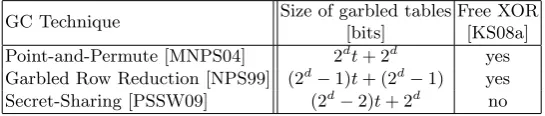
Table 2.Size of efficient GC techniques per garbledd-input gate (t: symmetric security parameter)
GC Technique Size of garbled tables Free XOR [bits] [KS08a] Point-and-Permute [MNPS04] 2dt+ 2d yes
Garbled Row Reduction [NPS99] (2d−1)t+ (2d−1) yes
Secret-Sharing [PSSW09] (2d−2)t+ 2d no
Efficient Garbled Circuits A summary of several techniques for garbled circuits is shown in Table 2. In the following we concentrate on the currentlymost efficient technique for garbled circuits, Garbled Row Reduced Free XOR (GRRFX) of [PSSW09], which combines free XOR gates of [KS08a] with garbled row reduction of [NPS99]. This technique requires less communication than the secret-sharing based technique of [PSSW09] as soon as more than 33% of the circuit’s gates are XOR gates. This is achieved in almost all cases when applying the optimization techniques of [PSSW09] (see below). However, it can be proven secure only under a slightly stronger assumption than the standard model.
The GRRFX technique of [PSSW09] allows “free” evaluation of XOR gates from [KS08a], i.e., a garbled XOR gate has no garbled table (no communication) and its evaluation consists of XOR-ing its garbled input values to obtain the garbled output value (negligible computation).
The other gates, referred to asnon-XOR gates, are evaluated with the garbled row reduction technique of [NPS99], i.e., eachd-input non-XOR gate requires a garbled table of size (2d
−1)t+ (2d
twice as high. Indeed, all known efficient GC constructions listed in Table 2 require exactly this number of hash invocations.
Circuit Optimizations As the costs of GC constructions for creating and transferring garbled tables grow exponentially in d, it is beneficial to optimize the circuit such that gates have small degree d while exploiting free XOR gates as much as possible. [LPS08] propose to encode circuit components with d inputs consisting of multiple 2-input gates by a single d-input gate. Afterwards, when XOR gates are “free”, thesed-input gates are decomposed into 2-input gates while minimizing the number of non-XOR gates [PSSW09].
Hardware-based SFE We note that the transfer of garbled tables can be avoided entirely when serverS can send to client C a tamper-proof hardware token that generates the garbled circuit on behalf of
S. The token needs to compute only symmetric key primitives, processes the gates one-by-one using a constant amount of memory and does not need to be trusted by C [JKSS10b]. Another direction for improving SFE protocols is to use a cryptographic coprocessor for costly operations [IS10]. Using trusted hardware also allows to implement OT non-interactively, called one-time programsin combination with GC [GT08, GKR08, JKSS10c].
Pre-Computation vs. Streaming We note that most GC-based SFE implementations (e.g., [MNPS04, LPS08, PSSW09, HKS+10]) follow the compilation paradigm, in which the circuit is first compiled from a high-level description and then optimized for size (see above). Although this approach requires storage linear in the size of the circuit, it is beneficial when the function is fixed and the compilation (and possibly GC creation) can be done in a pre-computation phase. When pre-computation is not feasible (e.g., in scenarios where parties make ad-hoc decisions when and what to compute securely), it is also possible to generate the circuit and its garbling with constant storage/memory: Firstly, the circuit can be compiled on-the-fly using a constant amount of memory as implemented in [HKS+10] (see discussion in full version of [HKS+10]). Further, this stream of gates can be directly combined with the constant-memory GC creation technique of [JKSS10b], and the garbled tables can be streamed directly over the network to the evaluator who evaluates them on-the-fly [JKSS10c]. Finally, OT can be extended on-the-fly as mentioned in [IKNP03], s.t. only a constant (in the security parameter) number of public key operations is needed for an arbitrary (and unknown in advance) number of OTs. We note, however, that some circuits cannot be streamed as their evaluation requires memory linear in the circuit size [JKSS10a]. The recently proposed VMCrypt library [MK10] specifically aims to maximize GC streaming. The techniques described above as well as the “use cheapest SFE block” approach advocated in our work can be also used with their architecture, resulting in corresponding performance improvements.
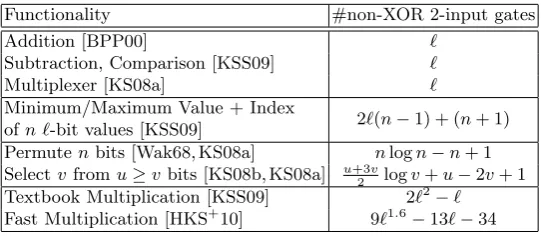
Efficient Circuit Constructions with free XOR As XOR gates can be evaluated “for free”, the circuits to be evaluated can be optimized so that the number of non-XOR gates is minimized as described above. These tricks can improve many basic functions, some of which are summarized in Table 3. For example, addition, subtraction and comparison have cheap circuit representations (linear in the size of the inputs). Also selecting the minimum or maximum value ofnvalues together with its index (the function evaluated in a first-price auction [NPS99]) has linear overhead. Permuting (without duplicates) or selecting (with duplicates)nbits grows likeO(nlogn) and is hence feasible as well. In contrast, multiplication has a relatively expensive circuit representation. Fast multiplication [KO62] with complexityO(`1.6) is more efficient thanO(`2) textbook multiplication for`
≥20 [HKS+10].
Table 3.Efficient circuit constructions for`-bit values (optimized for free XOR)
Functionality #non-XOR 2-input gates
Addition [BPP00] `
Subtraction, Comparison [KSS09] `
Multiplexer [KS08a] `
Minimum/Maximum Value + Index
2`(n−1) + (n+ 1) ofn `-bit values [KSS09]
Permutenbits [Wak68, KS08a] nlogn−n+ 1 Selectvfromu≥vbits [KS08b, KS08a] u+3v
2 logv+u−2v+ 1 Textbook Multiplication [KSS09] 2`2−` Fast Multiplication [HKS+10] 9`1.6−13`−34
detailed analysis of the break-even points between these constructions are given in [SS08]. The recent proposal of [KM10a] avoids the super-linear complexity of UCs, but requires much more expensive public-key operations.
While UCs entirely hide the structure of the evaluated functionalityf, it is sometimes sufficient to hide f only within a class of topologically equivalent functionalitiesF; this is called secure evaluation of asemi-privatefunctionf ∈ F. The circuits for many standard functionalities are topologically equivalent and differ only in the specific function tables, e.g., comparison (<, >,=, . . .) or addition/subtraction. It is possible to directly evaluate the circuit and avoid the overhead of UC for semi-private functions as GC constructions of [MNPS04] and [NPS99] completely hide the type of the gates from evaluator C
[FAL04, FAZ05, FLA06, FAL06, PSS09].
4.4 Garbled OBDDs: SFE of OBDDs
OBDDs can be evaluated securely in a way analogous to garbled circuits, as first described in [KJGB06]. We base our presentation on the natural extension of [KJGB06] described in [Sch08,§3.4.1] and [BFK+09], which also offers a (slight) improvement. Alternative approaches [IP07, Lip08] based on homomorphic encryption have smaller communication overhead, but put more computational load on S (public key operations instead of symmetric operations for each decision node).
We now turn to presenting the OBDD-specific details for SFE of garbled functions. Recall, in §4.2 we left out the method of step-by-step creation of the garbled function feand its evaluation given the garblings of the input wires. In the following we describe how the garbled OBDD is constructed and evaluated. We note that the technique is somewhat similar to that of GCs described in§4.3.
Create Garbled OBDD In the pre-computation phase,S generates a garbled versionOe of the OBDDO. For this, the OBDD is first extended with dummy nodes to ensure that each evaluation path traverses the same number of variables in the same order resulting in evaluation paths of equal length. Further, OBDD nodes are randomly permuted to prevent leaking information from the sequence of steps taken by the evaluator (the start nodeP1 remains the first node in Oe). Then, each decision node Pi, labeled with boolean variable xj, is converted into a garbled node Pei in Oe, as follows. A randomly chosen key ∆i ∈R {0,1}t is associated with each node Pi. Node’s information (pointers to the two successor nodes, and their encryption keys) is encrypted with the node’s key ∆i. To preserve security, we ensure that ∆i is only revealed to the evaluator, if this node is reached by executing on the parties’ inputs. Processing/evaluating an OBDD node is simply following the pointer to one of the two child nodes, depending on the input. Since we must prevent the evaluator from following both successor nodes, we additionally encrypt left (resp. right) successor information with the garbling of the 0-value (resp. 1-value) ofPi’s decision variablexj.
Evaluate Garbled OBDD It is now easy to see the corresponding OBDD evaluation procedure.C receives the garbled OBDD Oe from S, and evaluates it locally on the garbled values ex1, ..,xen and obtains the garbled valuezethat corresponds to the resultz=O(x1, . . . , xn), as follows.Ctraverses the garbled OBDD
e
Implementation observations and optimizations The employed semantically secure symmetric encryption scheme can be instantiated as Encsk(m) = m⊕H(k||s), where s is a unique identifier used once, and H(k||s) is a pseudo-random function (PRF) evaluated onsand keyed withk, e.g., a cryptographic hash function from the SHA-2 family. Additionally the following technical improvement from [KJGB06] can be used: instead of encrypting twice (sequentially, with∆iandkji), the successorPij’s data can be encrypted with ∆i⊕kij. The terminal nodes are garbled simply by including their corresponding garbled output value (ze0 for the 0-terminal or ez1 for the 1-terminal) into the parent’s node (instead of the decryption key∆i).
Efficiency To evaluate the garbled OBDDOe, the cryptographic hash function (e.g., SHA-256) is invoked once per decision node along the evaluation path.
The garbled OBDD Oe for an OBDD with d decision nodes (after extension to evaluation paths of equal length) contains dgarbled nodesPei consisting of two ciphertexts of sizedlogde+t+ 1 bits each. The size ofOe is 2d(dlogde+t+ 1)∼2d(logd+t) bits. Overall, creation ofOe requires 2dinvocations of a cryptographic hash function.
Private OBDDs The garbled OBDD reveals only a small amount of information about the evaluated OBDD toC, namely the total numberdofdecisionnodes. We note that in many cases this is acceptable. If not, this information can be hidden by appropriate padding with dummy-nodes.
5
Composition of SFE Blocks
We now show how to convert encryptions of intermediate values between the different representations that are used in the three protocols we described. Done securely, this allows arbitrary compositions of the three techniques, and implies significant improvements to SFE.
We had already described the conversions between the plaintext values and encryptions. These conver-sions are only applicable for input encryption and output decryption. Intermediate values in the protocol must be converted without ever being decrypted entirely.
Fig. 3 shows the types of conversions that may occur in the composed SFE protocol. Both parties have plain values as their inputs into the protocol. These plain values, denoted asx, are first encrypted by converting them into their corresponding encrypted value (garbled value, denoted asxe, or homomorphic value, denoted asJxK, depending on which operations should be applied). After encryption the function is securely evaluated on the encrypted values, which may involve conversion of the encryptions between several representations. Finally, an encryption of the output is obtained. The encrypted outputs are decrypted by converting them into their corresponding plain output values. In the following we describe how to efficiently convert between the two types of encryptions.
Plain Valuex
Boolean Circuits or OBDDs with Garbled Function
ClientC
Homomorphic Value�x�
Plain Valuex ServerS
Garbled Value�x
Arithmetic Circuits with Homomorphic Encryption Inputs/Outputs
Encrypted Values
SFE of
Fig. 3.Composition of Secure Function Evaluation Protocols
5.1 Garbled Values to Homomorphic Values.
Additive Blinding S randomly chooses a random mask r ∈R {0,1}`+σ, where σ is the statistical security parameter and `+σ ≤ |P| to avoid an overflow, and adds the random mask converted into garbled value reto xeusing a garbled (`+σ)-bit addition circuit that computes e¯xwith ¯x=x+r. This value is converted into a plain output value ¯xforCwho homomorphically encrypts this value and sends the result Jx¯K to S. Finally, S takes off the random mask under encryption asJxK= Jx¯K(−1)JrK. A detailed description of this conversion protocol is given in [KSS09].
Bitwise Encryption If the bitlength`ofexis small, a bitwise approach can be used as well in order to avoid the garbled addition circuit: C homomorphically encrypts the permutation bits πi of the garbled boolean output valuesexi=hki, πiiand sendsJπiKtoS.Sflips those encrypted permutation bits for which the permutation bit was set asπ0
i = 1 during creation toJπ0iK=J1K(−1)Jπ0iKor otherwiseJπiK0 =JπiK. Then,S combines these potentially flipped bit encryptions using Horner’s scheme asJxK=Jπ0
`||..||π01K.
Performance Comparison The conversion based on additive blinding requires a garbled addition circuit for (`+σ)-bit values and the transfer of the (`+σ)-bit garbled valueer. When using the efficient GC technique described in §4.3, this requires in total 4(`+σ)(t+ 1) bits sent from S to C in the pre-computation phase. In the online phase, the garbled circuit is evaluated and the result is homomorphically encrypted and sent toS (one ciphertext).
The conversion using bitwise encryption requires`homomorphic encryptions and transfer of` cipher-texts fromCtoS in the online phase. At least for converting a single bit, i.e., when`= 1, this technique results in better performance.
5.2 Homomorphic Values to Garbled Values
In the following we describe how to convert a homomorphic `-bit value JxK into a garbled value ex. This protocol has been widely used to combine homomorphic encryption with garbled functions, e.g., in [BPSW07, BS09, JP09, BFK+09].
Sadditively blindsJxKwith a random padr∈R{0,1}`+σ, whereσis the statistical security parameter and `+σ ≤ |P| to avoid an overflow, as Jx¯K =JxKJrK. S sends the blinded ciphertext J¯xK to C who decrypts and inputs the`least significant bits of ¯x,χ= ¯xmod 2`, to an`-parallel OT protocol to obtain the corresponding garbled valueχe. Then, the mask is taken off within a garbled`-bit subtraction circuit which gets as inputsχeandρeconverted fromρ=rmod 2`as input from
S. The output obtained byC is e
xwhich corresponds tox=χ−ρ.
Again, packing as described in §4.1 can be used to improve efficiency of parallel conversions from homomorphic to garbled values by packing multiple ciphertexts together before additive blinding and sending them toC.
6
Conclusion
We conclude our survey with a summary of past, present, and possible future directions in practically efficient SFE.
Where we’ve come from Although the theoretical foundations of SFE have been laid over two decades ago, until recently, SFE was seen merely as a theoretical concept. Around ten years ago first SFE imple-mentations were reported, and new primitives, such as efficient additively homomorphic encryption, have been proposed. About five years ago, coinciding with the availability of general SFE tools, a variety of privacy-preserving protocols started appearing in the research area of security, and real-life applications became within reach. In 2008 came a first major deployment of secure computation – its use in executing a nation-wide beets auction in Denmark [BCD+09].
Where we are Today, we are on the verge of SFE gaining widespread recognition and use. Even now, the efficiency of existing protocols allows for business justification of its use in a number of scenarios. At the same time, both theoretical and applied research in SFE are experiencing a great surge in anticipation of its success.
Where we may be going With the growth of the web and social networking, came the realization of the value of privacy. Governments are introducing far-reaching restrictions on data collection and use, especially in the personal health domain. SFE is a clear candidate to help achieve privacy, while en-abling a variety of applications. (Of course, no single technology, not even powerful primitives such as fully homomorphic encryption, can be used as a universal solution for private computing. This is due to both impossibility results [vDJ10] and the cost barriers raised by some SFE techniques. Instead, a comprehensive approach would include SFE, secure hardware, hardened code, legal agreements, etc.) With the political and business need in place, the Moore’s-law performance improvements of hardware and expected algorithmic improvements, it is clear that SFE’s use will be practically justified in more and more of security- and privacy-critical applications. In the longer term, fully homomorphic encryption may become practically efficient, and enable new opportunities.
We hope that our work serves to promote secure computation beyond theoretical research communi-ties, and helps facilitate its earlier and broader practical use.
Acknowledgements The work described in this paper was supported in part by the European Com-mission through the ICT program under contract 216676 ECRYPT II and 216499 CACE. The authors would like to thank Juan Garay for helpful comments on the paper.
References
AIR01. W. Aiello, Y. Ishai, and O. Reingold. Priced oblivious transfer: How to sell digital goods. In EURO-CRYPT’01, volume 2045 ofLNCS, pages 119–135. Springer, 2001.
AL07. Y. Aumann and Y. Lindell. Security against covert adversaries: Efficient protocols for realistic ad-versaries. InTCC’07, volume 4392 ofLNCS, pages 137–156. Springer, 2007.
ALR99. E. Allender, M. C. Loui, and K. W. Regan. Complexity classes. In M. J. Atallah, editor,Algorithms and Theory of Computation Handbook, chapter 27. CRC Press, 1999.
AS08. F. Armknecht and A.-R. Sadeghi. A new approach for algebraically homomorphic encryption. Cryp-tology ePrint Archive, Report 2008/422, 2008.
BCD+09. P. Bogetoft, D. L. Christensen, I. Damg˚ard, M. Geisler, T. P. Jakobsen, M. Krøigaard, J. D. Nielsen, J. B. Nielsen, K. Nielsen, J. Pagter, M. I. Schwartzbach, and T. Toft. Secure multiparty computation goes live. InFC’09, volume 5628 ofLNCS, pages 325–343. Springer, 2009.
BDNP08. A. Ben-David, N. Nisan, and B. Pinkas. FairplayMP: a system for secure multi-party computation. InCCS’08, pages 257–266. ACM, 2008.
Bea95. D. Beaver. Precomputing oblivious transfer. In CRYPTO’95, volume 963 ofLNCS, pages 97–109. Springer, 1995.
BFK+09. M. Barni, P. Failla, V. Kolesnikov, R. Lazzeretti, A.-R. Sadeghi, and T. Schneider. Secure evaluation of private linear branching programs with medical applications. In ESORICS’09, volume 5789 of
LNCS, pages 424–439. Springer, 2009.
BGN05. D. Boneh, E.-J. Goh, and K. Nissim. Evaluating 2-dnf formulas on ciphertexts. InTCC’05, volume 3378 ofLNCS, pages 325–341. Springer, 2005.
BLW95. B. Bollig, M. L¨obbing, and I. Wegener. Simulated annealing to improve variable orderings for OBDDs. IWLS’95, 1995.
BLW08. D. Bogdanov, S. Laur, and J. Willemson. Sharemind: A framework for fast privacy-preserving com-putations. InESORICS’08, volume 5283 ofLNCS, pages 192–206. Springer, 2008.
BPP00. J. Boyar, R. Peralta, and D. Pochuev. On the multiplicative complexity of boolean functions over the basis (∧,⊕,1). Theoretical Computer Science, 235(1):43–57, 2000.
BPSW07. J. Brickell, D. E. Porter, V. Shmatikov, and E. Witchel. Privacy-preserving remote diagnostics. In
CCS’07, pages 498–507. ACM, 2007.
Bry86. R. E. Bryant. Graph-based algorithms for boolean function manipulation. IEEE Transactions on Computers, 35(8):677–691, 1986.
Bry91. R. E. Bryant. On the complexity of VLSI implementations and graph representations of boolean functions with application to integer multiplication. IEEE Transactions on Computers, 40(2):205– 213, 1991.
BS05. J. Brickell and V. Shmatikov. Privacy-preserving graph algorithms in the semi-honest model. In
ASIACRYPT’05, volume 3788 ofLNCS, pages 236–252. Springer, 2005.
BS09. J. Brickell and V. Shmatikov. Privacy-preserving classifier learning. InFC’09, volume 5628 ofLNCS, pages 128–147. Springer, 2009.
CCKM00. C. Cachin, J. Camenisch, J. Kilian, and J. M¨uller. One-round secure computation and secure au-tonomous mobile agents. InICALP’00, volume 1853 ofLNCS. Springer, 2000.
CDN01. R. Cramer, I. Damg˚ard, and J. B. Nielsen. Multiparty computation from threshold homomorphic encryption. InEUROCRYPT’01, volume 2045 ofLNCS, pages 280–299. Springer, 2001.
CDS94. R. Cramer, I. Damg˚ard, and B. Schoenmakers. Proofs of partial knowledge and simplified design of witness hiding protocols. InCRYPTO’94, volume 839 ofLNCS, pages 174–187. Springer, 1994. CLRS01. T. H. Cormen, C. E. Leiserson, R. L. Rivest, and C. Stein.Introduction to Algorithms, Second Edition.
The MIT Press, September 2001.
CM99. J. Camenisch and M. Michels. Proving in zero-knowledge that a number is the product of two safe primes. InEUROCRYPT’99, volume 1592 ofLNCS, pages 107–122. Springer, 1999.
Cra97. R. Cramer. Modular Design of Secure yet Practical Cryptographic Protocols. PhD thesis, CWI and University of Amsterdam, 1997.
DBG96. R. Drechsler, B. Becker, and N. Gockel. Genetic algorithm for variable ordering of OBDDs. IEE Proceedings on Computers and Digital Techniques, 143(6):364–368, 1996.
DGK07. I. Damg˚ard, M. Geisler, and M. Krøigaard. Efficient and secure comparison for on-line auctions. In
ACISP’07, volume 4586 of LNCS, pages 416–430. Springer, 2007.
DGK08a. I. Damg˚ard, M. Geisler, and M. Krøigaard. A correction to “efficient and secure comparison for on-line auctions”. Cryptology ePrint Archive, Report 2008/321, 2008.
DGK08b. I. Damg˚ard, M. Geisler, and M. Krøigaard. Homomorphic encryption and secure comparison.Journal of Applied Cryptology, 1(1):22–31, 2008.
DJ01. I. Damg˚ard and M. Jurik. A generalisation, a simplification and some applications of paillier’s probabilistic public-key system. InPKC’01, volume 1992 ofLNCS, pages 119–136. Springer, 2001. DK10. I. Damg˚ard and M. Keller. Secure multiparty AES. InFC’10, volume 6052 ofLNCS, pages 367–374.
Springer, 2010.
DO10. I. Damg˚ard and C. Orlandi. Multiparty computation for dishonest majority: from passive to active security at low cost. InCRYPTO’10, volume 6223 ofLNCS, pages 558–576. Springer, 2010. EFG+09. Z. Erkin, M. Franz, J. Guajardo, S. Katzenbeisser, I. Lagendijk, and T. Toft. Privacy-preserving face
recognition. InPrivacy Enhancing Technologies Symposium (PETS’09), volume 5672 ofLNCS, pages 235–253. Springer, 2009.
FAL04. K. B. Frikken, M. J. Atallah, and J. Li. Hidden access control policies with hidden credentials. In
WPES’04, pages 27–27. ACM, 2004.
FAL06. K. B. Frikken, M. J. Atallah, and J. Li. Attribute-based access control with hidden policies and hidden credentials. IEEE Transactions on Computers, 55(10):1259–1270, 2006.
FAZ05. K. B. Frikken, M. J. Atallah, and C. Zhang. Privacy-preserving credit checking. InEC’05, pages 147–154. ACM, 2005.
FLA06. K. B. Frikken, J. Li, and M. J. Atallah. Trust negotiation with hidden credentials, hidden policies, and policy cycles. InNDSS’06, 2006.
FMK91. M. Fujita, Y. Matsunaga, and T. Kakuda. On variable ordering of binary decision diagrams for the application of multi-level logic synthesis. InEURO-DAC’91, pages 50–54. IEEE, 1991.
Fri09. K. B. Frikken. Practical private DNA string searching and matching through efficient oblivious automata evaluation. InDBSec’09, volume 5645 ofLNCS, pages 81–94. Springer, 2009.
FS87. A. Fiat and A. Shamir. How to prove yourself: practical solutions to identification and signature problems. InCRYPTO’86, volume 263 ofLNCS, pages 186–194. Springer, 1987.
F¨ur07. M. F¨urer. Faster integer multiplication. InSTOC’07, pages 57–66. ACM, 2007.
Gam85. T. El Gamal. A public key cryptosystem and a signature scheme based on discrete logarithms. In
CRYPTO’84, volume 196 ofLNCS, pages 10–18. Springer, 1985.
Gen09. C. Gentry. Fully homomorphic encryption using ideal lattices. InSTOC’09, pages 169–178. ACM, 2009.
GGP10. R. Gennaro, C. Gentry, and B. Parno. Non-interactive verifiable computing: Outsourcing computation to untrusted workers. InCRYPTO’10, volume 6223 ofLNCS, pages 465–482. Springer, 2010. GH10. C. Gentry and S. Halevi. Implementing gentry’s fully-homomorphic encryption scheme. Cryptology
ePrint Archive, Report 2010/520, 2010. http://eprint.iacr.org/.
GHV10. C. Gentry, S. Halevi, and V. Vaikuntanathan. A simple BGN-type cryptosystem from LWE. In
EUROCRYPT’10, volume 6110 ofLNCS, pages 506–522. Springer, 2010.
GKR08. S. Goldwasser, Y. T. Kalai, and G. N. Rothblum. One-time programs. InCRYPTO’08, volume 5157 ofLNCS, pages 39–56. Springer, 2008.
GMS08. V. Goyal, P. Mohassel, and A. Smith. Efficient two party and multi party computation against covert adversaries. InEUROCRYPT’08, volume 4965 ofLNCS, pages 289–306. Springer, 2008.
GMY04. J. A. Garay, P. MacKenzie, and K. Yang. Efficient and universally composable committed oblivious transfer and applications. InTCC’04, volume 2951 of LNCS, pages 297–316. Springer, 2004. Gol01. O. Goldreich. Foundations of Cryptography, volume 1: Basic Tools. Cambridge University Press,