
Key-policy Attribute-based Encryption for Boolean Circuits
from Bilinear Maps
Ferucio Laurent¸iu T¸ iplea and Constantin C˘at˘alin Dr˘agan
Department of Computer Science “Al.I.Cuza” University of Ia¸si
Ia¸si 700506, Romania
e-mail:{fltiplea,constantin.dragan}@info.uaic.ro
Abstract. We propose the first Key-policy Attribute-based Encryption (KP-ABE) scheme for (monotone) Boolean circuits based on bilinear maps. The construction is based on secret sharing and just one bilinear map, and can be viewed as an extension of the KP-ABE scheme in [7]. Selective security of the proposed scheme in the standard model is proved, and comparisons with the scheme in [5] based on leveled multilinear maps, are provided. Thus, for Boolean circuits representing multilevel access structures, our KP-ABE scheme is more efficient than the one in [5].
1 Introduction
Attribute-based encryption (ABE) is a new paradigm in cryptography, where messages are encrypted and decryption keys are computed in accordance with a given set of attributes and an access structure on the set of attributes. There are two forms of ABE: key-policy ABE(KP-ABE) [7] andciphertext-policy ABE(CP-ABE) [2]. In a KP-ABE, each message is encrypted together with a set of attributes and the decryption key is computed for the entire access structure; in a CP-ABE, each message is encrypted together with an access structure while the decryption keys are given for specific sets of attributes. In this paper we focus only on KP-ABE.
ABE was introduced in [10] in the form offuzzy identity-based encryption, as a ization of identity-based encryption[11]. The first KP-ABE scheme was proposed in [7], where the access structures were specified by monotone Boolean formulas (monotone Boolean circuits of fan-out one, with one output wire). An extension to the non-monotonic case has later appeared in [9]. Both approaches [7] and [9] take into consideration only access structures defined by Boolean formulas. However, there are access structures of practical importance that cannot be represented by Boolean formulas, such as multilevel access structures [14, 15]. In such a case, defining KP-ABE schemes for access structures defined by Boolean circuits becomes a necessity. The first solution to this problem was proposed in [5] by using leveled multilinear maps (sets of bilinear maps with some special property). A little later, a lattice-based construction was also proposed [6].
Contribution The KP-ABE schemes for Boolean circuits proposed so far are either based on leveled multilinear maps or on lattices. Direct extensions of the scheme in [7] to Boolean circuits face thebacktracking attack[5]. Moreover, it was conjectured in [5] that such exten-sions cannot be realized using bilinear maps.
the encryption keys are “transmitted” to their input wires in order to be further processed by the sharing procedure. This prevents the backtracking attack because it is not possible to compute the value at an output wire (of a FANOUT-gate) by knowing the value at the other output wire, without computing bottom-up the value at the input wire.
The selective security of our KP-ABE scheme is proved in the standard model under the decisional bilinear Diffie-Hellman assumption.
We then discuss the complexity of our scheme and compare it with the scheme in [5]. Thus, if the FANOUT-gates are not path-connected in the Boolean circuit, our scheme may perform better than the one in [5]. We prove this by considering Boolean circuits representing conjunctive and disjunctive multilevel access structures, and we show that our scheme distributes shorter decryption keys than the one in [5]. Whatever the considered Boolean circuit, our KP-ABE scheme has the advantage of using just one bilinear map while the scheme in [5] uses leveled multilinear maps whose size quadratically depends on the Boolean circuit depth.
Paper organization The paper is organized into eight sections. The next section fixes the basic terminology and notation used throughout the paper. The third section discusses the scheme in [7], illustrates the backtracking attack, discussed the solution in [5] which thwarts the backtracking attack, and gives an informal overview of our solution. It also fixes the terminology on the Boolean circuits we use. Our construction is presented in the fourth section, its security is discussed in the fifth one, while the sixth section presents some comparisons between our scheme and the one in [5]. The seventh section shows that our scheme performs better than the one in [5] for Boolean circuits representing multilevel access structures. We conclude in the last section.
2 Preliminaries
Access structures Recall first that [13], given a non-empty finite setU whose elements are calledattributes in our paper, anaccess structure overU is any setS of non-empty subsets ofU.S is calledmonotoneif it contains all subsetsB ⊆ U withA⊆B for someA∈ S. The subsets (of U) that are in S are called authorized sets, while those not inS, unauthorized sets. An authorized set Ais minimalif there is noB ∈ S such thatB ⊂A.
It is customary to represent access structures by Boolean circuits (for more details about Boolean circuits the reader is refereed to [1]). A Boolean circuit has a number of input wires (which are not gate output wires), a number of output wires (which are not gate input wires), and a number of OR-, AND-, and NOT-gates. The OR- and AND-gates have two input wires, while NOT-gates have one input wire. All of them may have more than one output wire. That is, the fan-in of the circuit is at most two, while the fan-out may be arbitrarily large but at least one. A Boolean circuit ismonotoneif it does not have NOT-gates, and it is offan-out oneif all gates have fan-out one. In this paper all Boolean circuits have exactly one output wire. Boolean circuits of fan-out one correspond to Boolean formulas.
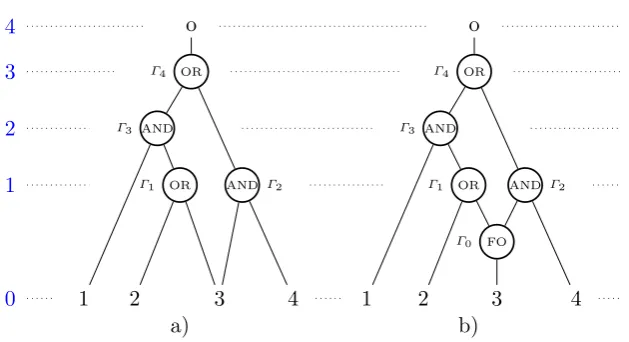
Figure 1a pictorially represents a Boolean circuitCoverU ={1,2,3,4}. ForA={1,2} we have C(A) = 1 and for B ={2,4}we have C(B) = 0.
Attribute-based encryption A KP-ABE scheme consists of four probabilistic polynomial-time (PPT) algorithms [7]:
Setup(λ): this is a PPT algorithm that takes as input the security parameterλand outputs a set of public parametersP P and a master key M SK;
Enc(m, A, P P): this is a PPT algorithm that takes as input a messagem, a non-empty set of attributesA⊆ U, and the public parameters, and outputs a ciphertextE;
KeyGen(C, M SK): this is a PPT algorithm that takes as input an access structureC(given as a Boolean circuit) and the master key M SK, and outputs a decryption key D (for the entire Boolean circuitC);
Dec(E, D): this is a deterministic polynomial-time algorithm that takes as input a cipher-textE and a decryption key D, and outputs a messagem or the special symbol⊥.
The following correctness property is required to be satisfied by any KP-ABE scheme: for any (P P, M SK)←Setup(λ), any Boolean circuitCover a setU of attributes, any message
m, any A ⊆ U, and any E ← Enc(m, A, P P), if C(A) = 1 then m = Dec(E, D), for any
D←KeyGen(C, M SK).
Security models We consider the standard notion of selective security for KP-ABE [7]. Specifically, in the Init phase the adversary (PPT algorithm) announces the set A of at-tributes that he wishes to be challenged upon, then in theSetupphase he receives the public parametersP P of the scheme, and inPhase 1oracle access to the decryption key generation oracle is granted for the adversary. In this phase, the adversary issues queries for decryp-tion keys for access structures defined by Boolean circuitsC, provided thatC(A) = 0. In the Challengephase the adversary submits two equally length messagesm0andm1 and receives
the ciphertext associated toA and one of the two messages, saymb, whereb← {0,1}. The
adversary may receive again oracle access to the decryption key generation oracle (with the same constraint as above); this is Phase 2. Eventually, the adversary outputs a guess
b0 ← {0,1}in the Guessphase.
The advantageof the adversary in this game is P(b0 =b)−1/2. The KP-ABE scheme is secure (in the selective model) if any adversary has only a negligible advantage in the selective game described above.
Bilinear maps and the decisional BDH assumption Given G1 and G2 two multiplicative
cyclic groups of prime order p, a mape:G1×G1 →G2 is called bilinearif it satisfies:
– e(xa, yb) =e(x, y)ab, for anyx, y∈G1 and a, b∈Zp;
– e(g, g) is a generator ofG2, for any generator g ofG1.
G1 is called abilinear groupif the operation in G1 and eare both efficiently computable.
TheDecisional Bilinear Diffie-Hellman(DBDH) problem in the bilinear groupG2 is the
problem to distinguish between e(g, g)abc and e(g, g)z given g,ga, gb, and gc, where g is a generator ofG1 anda,b,c, andzare randomly chosen fromZp. TheDBDH assumptionfor G2 states that no PPT algorithmA can solve the DBDH problem inG2 with more than a
3 The Backtracking Attack
The closest approaches to, and the starting point of, our paper are [7, 5]. [7] introduces the first KP-ABE scheme. The main idea here is quite elegant and simple, and can be summarized as follows:
– let e:G1×G1 →G2 be a bilinear map and g a generator of G1, whereG1 and G2 are
of prime order p;
– to encrypt a message m ∈ G2 by a set A of attributes, just multiply m by e(g, g)ys,
wherey is a random integer chosen in the setup phase andsis a random integer chosen in the encryption phase. Moreover, an attribute dependent quantity is also computed for each attributei∈A;
– the decryption key is generated as follows. The integer y is shared to all attributes so that it can be recovered only by authorized sets of attributes (the authorized sets are defined by monotone Boolean formulas). The sharing procedure is based on linear secret sharing schemes because linear combinations can be efficiently obtained as exponents of the bilinear map e. The shares associated to attributes are then used to compute the decryption key (which consists of a key component for each attribute);
– in order to decryptme(g, g)ys, one has to computee(g, g)ys. This can be done only ifA
is an authorized set of attributes. The computation of e(g, g)ys is bottom-up, starting from the key components associated to the attributes in A.
It was pointed out in [5] that the construction in [7] cannot be used to design a KP-ABE scheme for Boolean circuits. The reason is that, in case of OR-gates, any value computed at an input wire should be the same with the value computed at the other input wire. Therefore, knowing the value at one of the input wires of an OR-gate implicitly leads to the knowledge of the value at the other input wire (although these values are computed by different workflows). This aspect leads to the possibility of computing the value at the output wire of the circuit starting from values associated to some unauthorized set of attributes. In order to illustrate this attack, called thebacktracking attackin [5], we consider the monotone Boolean circuit in Figure 1a (remark that it has a fan-out of two). As we can easily see, the
Level
4
3
2
1
0 1 2 3 4
o
OR
Γ1 AND Γ2
AND Γ3
OR Γ4
1 2 3 4
o
OR
Γ1 AND Γ2 AND
Γ3
OR Γ4
FO Γ0
a) b)
Fig. 1.a) The backtracking attack; b) Boolean circuits with FANOUT-gates
Assume that a given message is encrypted by the authorized set of attributes {2,3,4} and a user with the set of attributes {1,2,4}asks for a decryption key. His set of attributes is authorized and, therefore, he has the right to obtain a decryption key. According to the definition of a KP-ABE, the decryption key for the set {1,2,4} of attributes must not be valid to decrypt a message encrypted by the attributes {2,3,4}. However, the user can do as follows. The value computed at the input wire 2 “migrates” to the input wire 3 due to the existence of the OR-gate Γ1. Corroborating this with the values at the input wires 1
and 4, a valid value will be computed at the output wire. This value is the same as the value computed by the set{2,3,4}and, therefore, it allows the decryption of the message. Remark also that {2,4}={1,2,4} ∩ {2,3,4}is unauthorized.
The backtracking attack illustrated above cannot occur in case of access structures defined by Boolean formulas as in [7] because, in such a case, the input wires of OR-gates are not used by any other gates (the circuit is of fan-out one).
To avoid the backtracking attack, [5] uses a “one-way” construction in evaluating mono-tone Boolean circuits. The idea is the next one:
– consider aleveled multilinear map, which consists ofkgroupsG1, . . . , Gk of prime order p, k generators g1, . . . , gk of these groups, respectively, and a set {ei,j : Gi ×Gj → Gi+j|i, j ≥ 1, i+j ≤ k} of bilinear maps satisfying ei,j(gia, gjb) = giab+j, for all i and j
and alla, b∈Z∗
p, wherek is the circuit depth plus one;
– the key components are associated to the circuit input wires and to each gate output wire (in [5], each gate has one output wire which may be used by more than one gate);
– the circuit is evaluated bottom-up and the values associated to output wires of gates on levelj are powers ofgj+1;
– as the mappings ei,j work only in the “forward” direction, it is not feasible to invert
values on the level j+ 1 in order to obtain values on the level j, defeating thus the backtracking attack.
As with respect to the existence of leveled multilinear, [5] shows how this scheme can be translated into the GGH graded algebra framework [4].
Looking more carefully at the example in Figure 1a, we remark that the value obtained at the wire 3 via the input wire 1 and the OR-gate Γ1 is then used at the AND-gate Γ2.
The backtracking attack illustrated above would be thwarted if the two outputs from 3 (one leading toΓ1 and one leading toΓ2) were different. This is in fact the starting point of
our proposal. That is, we use explicit FANOUT-gates with encrypted outputs to multiply input wires and gate output wires. Therefore, the Boolean circuits we use in the rest of the paper have FANOUT-gates too. A FANOUT-gate has one input wire and at least two output wires, and its role is to propagate its input to all outputs. In this way, the fan-out of all logic gates will be restricted to one. Moreover, as FANOUT-gates may have arbitrary fanout, we assume that no two FANOUT-gates are directly connected. Figure 1b pictorially represents the Boolean circuit in Figure 1a using FANOUT-gates (“FO” stands for “FANOUT”).
We close this section by informally describing our solution and why it thwarts the backtracking attack (details will be given in the next sections). In fact, it is quite similar to the one described at the beginning of this section:
– the FANOUT-gates, which are not present in [7], are processed by associating random keys to their input wires in order to deal with the output wires. In this way, the value computed at one of the output wires cannot be used to derive values at the other output wires. For instance, the value computed at the input wire 2 in Figure 1b can “migrate” to the left output wire of the FANOUT-gate Γ0, but cannot be used as an input value
for the AND-gate Γ2.
4 Our Construction
In this section we propose a KP-ABE scheme for monotone Boolean circuits based on bilin-ear maps. The restriction to Boolean circuits that are monotone does not constitute a loss of generality (see page 7 in [5]). However, recall from the previous section that our Boolean circuits have FANOUT-gates and all the logic gates have fan-out one. Assuming that the wires are labeled, we may write the gates as tuples (w1, w2, OR, w), (w1, w2, AN D, w), and
(w, F AN OU T, w1, . . . , wj), where j ≥ 2. The elements before (after) the gate name are
the input (output) wires of the gate. The output wire of a Boolean circuit will always be denoted byo, and the input wires by 1, . . . , n(assuming that the circuit hasninput wires). Before describing our KP-ABE scheme assume that two multiplicative cyclic groupsG1
and G2 of prime order p are given, together with a generator g of G1 and a bilinear map
e:G1×G1 → G2. As our KP-ABE scheme is based on secret sharing, we will define two
procedures, one for secret sharing and the other one for secret reconstruction.
The sharing procedure, denoted Share(y,C), inputs a Boolean circuit C and a value
y∈Zp, and outputs two functionsS and P with the following meaning:
1. S assigns to each wire of C a list of values inZp;
2. P assigns to each output wire of a FANOUT-gate a list of pairs of values inG1.
By alist of lengthnof elements over a setXwe understand any vectorL∈Xn.|L|stands for the length ofL,L1L2for theconcatenationof two listsL1andL2, andpos(L) ={1, . . . ,|L|}
for theset of positionsin the listL.L(i) denotes theith element ofL. IfL is a list of lists, thenL(i, j) denotes the jth element of the list L(i).
Now, the sharing procedure is the following one.
Share(y,C)
1. Initially, all gates of C are unmarked; 2. S(o) := (y);
3. IfΓ = (w1, w2, OR, w) is an unmarked OR-gate andS(w) =L, then markΓ and assign
S(w1) :=L and S(w2) :=L;
4. If Γ = (w1, w2, AN D, w) is an unmarked AND-gate and S(w) = L, then mark Γ and
do the followings:
(a) for eachi∈pos(L) choose uniformly at randomxi1 ∈Zp and compute x2i such that
L(i) = (x1
i +x2i) modp;
(b) computeL1 = (x1i|1≤i≤ |L|) and L2 = (x2i|1≤i≤ |L|);
(c) assignS(w1) :=L1 and S(w2) :=L2;
5. If Γ = (w, F AN OU T, w1, . . . , wj) is an unmarked FANOUT-gate and S(wk) =Lk for
all 1≤k≤j, then markΓ and, for each 1≤k≤j, do the followings:
(a) for eachi∈pos(Lk) choose uniformly at random ai ∈Zp and computebi such that Lk(i) = (ai+bi) modp;
(c) AssignS(w) :=L01· · ·L0j;
6. repeat the last three steps above until all gates get marked.
We will write (S, P)← Share(y,C) to denote that (S, P) is an output of the probabilistic algorithm Share on input (y,C). S(i) will be called the list of shares of the input wire i
associated to the secrety(1≤i≤n). Figure 2a generically illustrates the procedureShare. We define now a reconstruction procedureRecon(C, P, V, gs) which reconstructs a “hid-den form” of the secret y from “hidden forms” of shares associated to some set A of at-tributes. This procedure is deterministic and outputs an evaluation functionRwhich assigns to each wire a list of values inG2∪ {⊥}. The notation and conventions here are as follows:
– C is a monotone Boolean circuit withn input wires;
– (S, P) is an output ofShare(y,C), for some secret y;
– s∈Zp;
– V = (V(i)|1 ≤ i ≤ n), where V(i) is either a list (e(g, g)αi|1 ≤ j ≤ |S(i)|) for some
αi ∈Zp, or a list of |S(i)|undefined values⊥, for all 1≤i≤n;
– ⊥is anundefined value, not inG2, for which the following conventions are adopted:
• ⊥< x, for all x∈G2;
• ⊥ ·z=⊥,z/⊥=⊥, and ⊥z=⊥, for all z∈G
2∪ {⊥}.
The reconstruction procedure can now be described as follows.
Recon(C, P, V, gs)
1. Initially, all gates ofC are unmarked; 2. R(i) :=V(i), for alli∈ U;
3. If Γ = (w1, w2, OR, w) is an unmarked OR-gate and both R(w1) and R(w2) were
de-fined, then markΓ and assignR(w, i) :=sup{R(w1, i), R(w2, i)},for all 1≤i≤ |R(w1)|
(remark that |R(w1)| = |R(w2)| and, for any i, if R(w1, i) 6= R(w2, i) then either
R(w1, i) =⊥ orR(w2, i) =⊥);
4. If Γ = (w1, w2, AN D, w) is an unmarked AND-gate and both R(w1) and R(w2) were
defined, then mark Γ and assign R(w, i) := R(w1, i)·R(w2, i),for all 1 ≤i ≤ |R(w1)|
(remark that|R(w1)|=|R(w2)|);
5. IfΓ = (w, F AN OU T, w1, . . . , wj) is an unmarked FANOUT-gate andR(w) was defined,
then markΓ and do the followings:
(a) split R(w) into j lists R(w) =R1· · ·Rj with |Rk|=|P(wk)| for all 1≤ k≤j (see
the sharing algorithm for correctness);
(b) R(wk, i) :=Rk(i)·e(P(wk, i), gs), for all 1≤k≤j and for all 1≤i≤ |Rk|;
6. repeat the last three steps above until all gates get marked.
We are now in a position to define our KP-ABE scheme, calledKP-ABE Scheme.
KP-ABE Scheme
Setup(λ, n): the setup algorithm uses the security parameter λ to choose a prime p, two multiplicative groups G1 and G2 of prime order p, a generator g of G1, and a bilinear
map e: G1×G1 → G2. Then, it defines the set of attributes U = {1, . . . , n}, chooses
y∈Zp and, for each attributei∈ U, choosesti ∈Zp. Finally, the algorithm outputs the
public parameters
P P = (p, G1, G2, g, e, n, Y =e(g, g)y,(Ti=gti|i∈ U))
Encrypt(m, A, P P): the encryption algorithm encrypts a messagem∈G2 by a non-empty
set A⊆ U of attributes as follows:
– s←Zp;
– outputE = (A, E0 =mYs,(Ei =Tis=gtis|i∈A), gs);
KeyGen(C, M SK): the decryption key generation algorithm generates a decryption keyD
for the access structure defined by a monotone Boolean circuit C withn input wires as follows:
– (S, P)←Share(y,C);
– outputD= ((D(i)|i∈ U), P), where D(i) = (gS(i,j)/ti|1≤j ≤ |S(i)|), for alli∈ U;
Decrypt(E, D): givenE and Das above, the decryption works as follows:
– computeVA= (VA(i)|i∈ U), where
VA(i, j) =e(Ei, D(i, j)) =e(gtis, gS(i,j)/ti) =e(g, g)S(i,j)s
for all i ∈ A and 1 ≤ j ≤ |S(i)|, and VA(i) is a list of |S(i)| symbols ⊥, for all i∈ U −A;
– R:=Recon(C, P, VA, gs);
– m:=E0/R(o,1) (recall that ois the output wire ofC).
Theorem 1. The KP-ABE Scheme above satisfies the correctness property. That is, us-ing the notation above, for any encryption E = (A, mYs,(Ei|i ∈ A), gs), any circuit C
with n inputs and C(A) = 1, and any (S, P) ← Share(y,C), the valuation R returned by
Recon(C, P, VA, gs) satisfiesR(o,1) =Ys.
Proof. By a simple inspection of the Shareand Reconprocedures. ut
5 Security Issues
We begin by showing that our scheme is resistant to the backtracking attack. This will be achieved by associating an access tree TC to a Boolean circuit C and showing that the
backtracking attack succeeds on C if and only if it succeeds on TC. Then, our claim will
follow because the backtracking attack does not work in access trees.
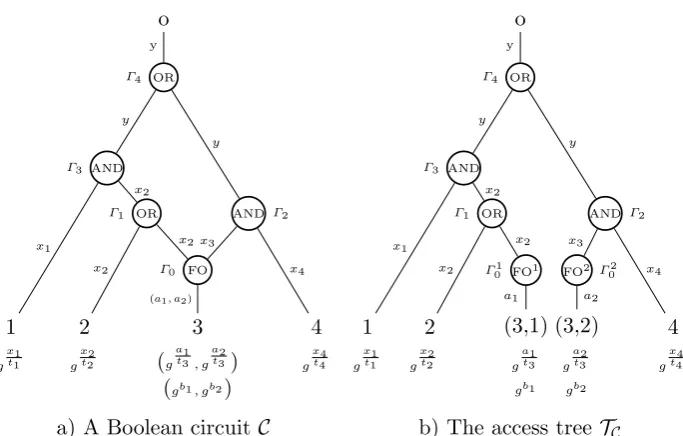
The construction ofTC consists of multiplying each wire ofCas many times as paths are
from the wire to the output wire (the number of such paths gives the numbers of shares the wire receives in the sharing process performed by the procedureShare). Then, each wire is labeled in order to distinguish the path associated to it. This is done by splitting up each FANOUT-gate Γ with j ouput wires into j pseudo-gates Γ1, . . . , Γj, each with one input and one output wire (the kth output wire ofΓ is the output wire ofΓk, for all 1≤k≤j). If we collect all these exponents on the path from an wire to the output wire, we obtain a label which uniquely identifies the wire. The wires with an empty label have exactly one path from them to the output wire. For instance, the two wires 3 in Figure 2b have, one of them the label 1 and the other one the label 2. The wires 1, 2, and 4 in the same figure have all an empty label.
If a wirewofC receives a listS(w) of shares by theShareprocedure applied toC, then it is straightforward to see that each share S(w, j) uniquely corresponds to some labeluw,j
as defined above. In the tree TC, the wire (w, uw,j) will receive the share S(w, j).
This technique “unfolds” C with its lists of shares into a tree TC which has exactly one
share for each wire. Now, it is straightforward to see that the backtracking attack succeeds on C if and only if it succeeds on TC. As the backtracking attack does not work in access
1 g x1 t1 2 g x2 t2 3 (g a1
t3, g
a2
t3) (gb1, gb2)
4 g x4 t4 o OR
Γ1 AND Γ2
AND Γ3 OR Γ4 FO Γ0 x2
x2x3
x4 x1
x2 y
y
(a1, a2)
y
1 2 (3,1) (3,2) 4
o
g
x1
t1 g x2
t2 g a1
t3
gb1 g
a2
t3
gb2
g
x4
t4
OR
Γ1 AND Γ2
AND Γ3
OR Γ4
FO1
Γ01 FO2 Γ02 x2
x2 x3
x4 x1 x2 y y a1 a2 y
a) A Boolean circuit C b) The access tree TC
Fig. 2.The construction ofTC
Theorem 2. The KP-ABE Scheme is secure in the selective model under the decisional bilinear Diffie-Hellman assumption.
Proof. In Appendix 9. ut
6 Complexity of the Construction
We will discuss in this section the complexity of our construction (KP-ABE Scheme) and we will compare it with the complexity of the construction provided in [5].
As our scheme uses just one bilinear map, the only question we have to answer with respect to the complexity of our construction is about the size of the decryption key. Assume that the Boolean circuit hasn input wires andr FANOUT-gates of fanout at mostj. Two cases are to be considered:
Case 1: there is no path between any two FANOUT-gates. In this case, by the sharing procedure, exactly r input wires will receive at most j shares (but at least two), and the other input wires will receive exactly one share. This leads to at mostn+r(j−1) key components, and this is the minimum size of the decryption key (remark also that
r≤n in this case);
Case 2: there are paths between FANOUT-gates. In this case, the FANOUT-gates on the highest level in the circuit may transmit the j shares collected at their input wires to FANOUT-gates on the previous level. The sharing procedure will associate now at most
j2 shares to the input wires of these gates. This reasoning shows that the maximum number of shares some input wires of the circuit may receive is at most jα, where α is the number of levels that contain FANOUT-gates (α is less than or equal to miminum ofr and the circuit depth).
AND-gate output wire gets three keys. The approach does not use explicit FANOUT-gates, but an output wire of some gate may be used as an input wire for more than one gate. Therefore, the total number of keys is bounded from below by 2n+ 3q and from above by 2n+ 4q, where q is the number of gates. The Boolean circuits in [5] can be transformed into our formalism if we replace each wire which is used byj≥2 gates by a FANOUT-gate withj outputs. In this way, one can easily remark that q depends on both the numberr of FANOUT-gates and on the maximum numberj of outputs of these FANOUT-gates.
Another main difference between our scheme and the one in [5] consists of the number of bilinear maps used by them. While ours uses just one bilinear map, the one in [5] uses a leveled multilinear map with `(`+ 1)/2 bilinear map components interrelated with each other (see Section 3), where `is the circuit depth.
7 Extensions and Applications
The above section shows that our KP-ABE Scheme may be more efficient than the one in [5] when the Boolean circuits do not have FANOUT-gates connected between them by paths. We will show in this section that the Boolean circuits representing multilevel access structures [12, 14] fulfill this property. For a compact representation of multilevel access structures we need Boolean circuits withthreshold gates(as in [7]). An (a, b)-threshold gate, where a and b are integers satisfying 1 ≤ a ≤ b and b ≥ 2, is a logic gate with b input wires and one output wire. The output wire of such a gate is evaluated to the truth value 1 whenever at leastainput wires of the gate are assigned to the truth value 1. OR-gates are (1,2)-threshold gates, while AND-gates are (2,2)-threshold gates.
Adisjunctive multilevel access structure[12] over a setU of attributes is a tuple (a,U,S), where a = (a1, . . . , ak) is a vector of positive integers satisfying 0 < a1 < · · · < ak, U =
(U1, . . . ,Uk) is a partition of U (that is, allUi are non-empty and their union isU), and S
is defined by:
S ={A⊆ U |(∃1≤i≤k)(|A∩(∪i
j=1Uj)| ≥ai)}.
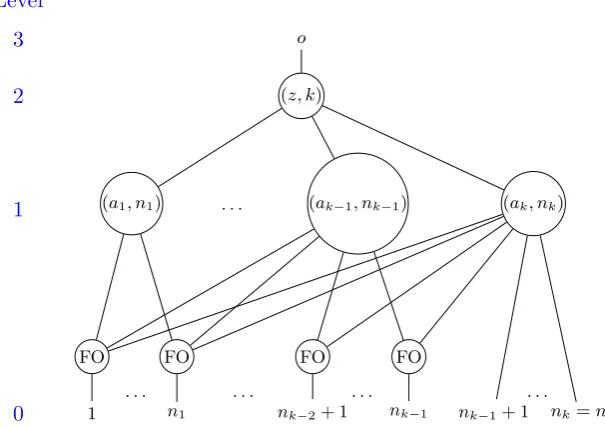
If we replace “∃” by “∀” in the above definition, we obtain the concept of conjunctive multilevel access structure [14]. It is well-known, and not difficult to prove (see Appendix 10), that disjunctive and conjunctive multilevel access structures cannot be represented by Boolean formulas. Using Boolean circuits, these access structures can be easily represented as in Figure 3. Moreover, the FANOUT-gates are in between the first two levels.
Our KP-ABE Scheme can be easily adapted to accommodate threshold gates. Assume that LSSS is a probabilistic linear secret sharing scheme [7] such that, given a and b as above, and given a master secret x∈Zp, the scheme outputsb shares x1, . . . , xb such that x can be uniquely reconstructed from anyashares. Moreover, assume that there exists an associated and efficient deterministic procedure LSSS−1 such that
LSSS−1(e(g, g)xi1s, . . . , e(g, g)xias) =e(g, g)xs,
for any asharesxi1, . . . , xia and any s∈Zp.
Shamir’s threshold secret sharing scheme satisfies this property and it was used in [7] exactly with this purpose.
Define now a procedure Share0 obtained from Shareby replacing the steps 3 and 4 by just one step:
3’. If Γ = (w1, . . . , wb,(a, b), w) is an unmarked (a, b)-threshold gate and S(w) =L, then
Level
3
2
1
0 1 n1 nk−2+ 1 nk−1 nk−1+ 1 nk=n
o
FO FO FO FO
(a1, n1) (ak−1, nk−1) (ak, nk)
(z, k)
· · · ·
· · ·
· · ·
Fig. 3.Boolean circuit representation of multilevel access structure:zis 1 for the disjunctive case, andkfor the conjunctive case.
(a) for eachi∈pos(L), runLSSS and obtain the sharesx1i, . . . , xbi; (b) for each 1≤j≤b compute the list Lj from Lby replacing L(i) by xji;
(c) assignS(wj) :=Lj, for all 1≤j≤b;
The corresponding reconstruction procedure Recon0 is obtained by replacing the steps 3 and 4 inRecon by just one step:
3’. IfΓ = (w1, . . . , wb,(a, b), w) is an unmarked (a, b)-threshold gate andR(wj) was defined
for all 1≤j ≤b, then markΓ and assignR(w) by
R(w, i) :=sup{LSSS−1(R(wi1, i), . . . , R(wia, i))|i1, . . . , ia∈ {1, . . . , b}},
for all 1≤i≤ |R(w1)|;
The new ABE scheme, denoted KP-ABE Scheme0, is obtained from KP-ABE Scheme by replacingShareand Recon byShare0 and Recon0, respectively. Its security can be proved as for the KP-ABE Scheme.
The number of key components distributed by our KP-ABE Scheme’ when applied to a multilevel access structure as in Figure 3 is
n1·k+ (n2−n1)·(k−1) +· · ·+ (nk−nk−1)·1
If we approximaten1 and ni−ni−1 by the average valuen/k, for all 2≤i≤k, the average
number of the decryption key components is n(k+ 1)/2.
The KP-ABE scheme in [5] can be easily adapted to accommodate (1, b)- and (b, b )-threshold gates. In the first case 2bkey components are associated to the gate, while in the second case b+ 1 key components are associated to the gate. However, there is no direct way to accommodate (a, b)-threshold gates when 1< a < b. The indirect way is to consider
Case 1: ai=ni, for all i. In this case, the number of key components is
2n+
k
X
i=1
(C(ni, ni) + 1) + (2k+ 1−z) = 2n+ k
X
i=1
(ni+ 1) + (2k+ 1−z)
If we write each ni in the form
ni=n1+ (n2−n1) +· · ·+ (ni−ni−1)
and approximaten1 andnj−nj−1 by the average valuen/k, for all 2≤j≤i, we obtain
the average number of the decryption key components as beingn(k+ 5)/2 + (3k+ 1−z), where z= 1 for the disjunctive case andz=kfor conjunctive case;
Case 2: ai< ni, for all i. In this case, ai≥ifor all i. Using the inequalityC(ni, ai)≥ni,
we can bound from below the number of key components by
2n+
k
X
i=1
(ai+ 1)C(ni, ai) + k
X
i=1
2C(ni, ai) + (2k+ 1−z)≥2n+ k
X
i=1
(i+ 3)ni+ (2k+ 1−z).
If we apply the same reasoning as in the previous case to the right hand side of this inequality, we obtain the average estimate (2 + (k+ 1)(k+ 5)/3)n+ (2k+ 1−z) (z is as above).
Moreover, the leveled multilinear map has six bilinear map components, but only three of them are used (the approach in [5] counts three levels).
Our discussion so far, summarized in Table 1 below, shows clearly that our approach is more efficient than the one in [5] for multilevel access structures.
Scheme Average no. of keys No. of bilinear maps
KP-ABE scheme in [5]
Case 1: nk+5
2 + 3k+ 1−z
Case 2: ≥2 +(k+1)(k+5)3 n+ 2k+ 1−z
3
Our KP-ABE Scheme0 nk+12 1
Table 1.Comparisons between the scheme in [5] and our scheme for multilevel access structures
8 Conclusions
We have proposed in this paper a KP-ABE scheme for monotone Boolean circuits. The scheme is based on secret sharing and just one bilinear map, and can be viewed as an extension of the scheme in [7]. It is in fact the first KP-ABE scheme for monotone circuits based on bilinear maps.
of decryption keys. However, it faces the problem of computing leveled multilinear maps. Although some progress has recently been achieved along this direction [4, 3], working with leveled multilinear maps is far more expensive than working with just one bilinear map.
References
1. Mihir Bellare, Viet Tung Hoang, and Phillip Rogaway. Foundations of garbled circuits. InProceedings of the 2012 ACM Conference on Computer and Communications Security, CCS ’12, pages 784–796, New York, NY, USA, 2012. ACM.
2. John Bethencourt, Amit Sahai, and Brent Waters. Ciphertext-policy attribute-based encryption. In
IEEE Symposium on Security and Privacy, S&P 2007, pages 321–334. IEEE Computer Society, 2007. 3. Jean-S´ebastien Coron, Tancr`ede Lepoint, and Mehdi Tibouchi. Practical multilinear maps over the
integers. In Ran Canetti and Juan A. Garay, editors,CRYPTO 2013 - 33rd Annual Cryptology Con-ference Advances in Cryptology, volume 8042 of Lecture Notes in Computer Science, pages 476–493, Santa-Barbara, ´Etats-Unis, August 2013. Springer. Preprint on IACR ePrint 2013/183.
4. Sanjam Garg, Craig Gentry, and Shai Halevi. Candidate multilinear maps from ideal lattices. In Thomas Johansson and Phong Q. Nguyen, editors,EUROCRYPT, volume 7881 ofLecture Notes in Computer Science, pages 1–17. Springer, 2013. Preprint on IACR ePrint 2012/610.
5. Sanjam Garg, Craig Gentry, Shai Halevi, Amit Sahai, and Brent Waters. Attribute-based encryption for circuits from multilinear maps. In Ran Canetti and JuanA. Garay, editors,Advances in Cryptology CRYPTO 2013, volume 8043 of Lecture Notes in Computer Science, pages 479–499. Springer Berlin Heidelberg, 2013. Preprint on IACR ePrint 2013/128.
6. Sergey Gorbunov, Vinod Vaikuntanathan, and Hoeteck Wee. Attribute-based encryption for circuits. In Dan Boneh, Tim Roughgarden, and Joan Feigenbaum, editors,STOC, pages 545–554. ACM, 2013. Preprint on IACR ePrint 2013/337.
7. Vipul Goyal, Omkant Pandey, Amit Sahai, and Brent Waters. Attribute-based encryption for fine-grained access control of encypted data. InACM Conference on Computer and Communications Secu-rity, pages 89–98. ACM, 2006. Preprint on IACR ePrint 2006/309.
8. Ehud D. Karnin, J. W. Greene, and Martin E. Hellman. On secret sharing systems.IEEE Transactions on Information Theory, 29(1):35–41, 1983.
9. Rafail Ostrovsky, Amit Sahai, and Brent Waters. Attribute-based encryption with non-monotonic access structures. InACM Conference on Computer and Communications Security, pages 195–203. ACM, 2007. Preprint on IACR ePrint 2007/323.
10. Amit Sahai and Brent Waters. Fuzzy identity-based encryption. In Ronald Cramer, editor, EURO-CRYPT, volume 3494 ofLecture Notes in Computer Science, pages 457–473. Springer, 2005.
11. Adi Shamir. Identity-based cryptosystems and signature schemes. InProceedings of CRYPTO 84 on Advances in cryptology, pages 47–53, New York, NY, USA, 1985. Springer-Verlag New York.
12. G. J. Simmons. How to (Really) Share a Secret. In Shafi Goldwasser, editor, 8th Annual Interna-tional Cryptology Conference on Advances in Cryptology (CRYPT ’88), volume 403 ofLecture Notes in Computer Science, pages 390–448. Springer, 1988.
13. D.R. Stinson. Cryptography: Theory and Practice. Chapman and Hall/CRC, 3 edition, 2005. 14. T. Tassa. Hierarchical Threshold Secret Sharing. Journal of Cryptology, 20(2):237–264, 2007.
15. T. Tassa and N. Dyn. Multipartite Secret Sharing by Bivariate Interpolation. Journal of Cryptology, 22(2):227–258, 2008.
9 Appendix
In this appendix to prove the security of our KP-ABE Scheme.
Theorem 2. The KP-ABE Scheme is secure in the selective model under the decisional bilinear Diffie-Hellman assumption.
Proof. It is sufficient to prove that for any adversaryAwith an advantageηin the selective game for KP-ABE Scheme, a PPT algorithm B can be defined, with the advantage η/2 over the DBDH problem. The algorithmBplays the role of challenger forAin the selective game for KP-ABE Scheme.
The algorithmB is given an instance of the DBDH problem, that is: two groupsG1 and
G2 of prime orderp, a generator g of G1, a bilinear map e:G1×G1 →G2, the values ga,
gb,gc, and Zv ← {Z0, Z1}, where Z0=e(g, g)abc,Z1=e(g, g)z, and a, b, c, z←Zp.
Init LetAbe a non-empty set of attributes the adversary Awishes to be challenged upon.
Setup B chooses at random ri ∈Zp for all i ∈ U, and computes Y =e(ga, gb) =e(g, g)ab
and Ti=gti for all i∈ U, where
ti =
(
ri, ifi∈A bri, otherwise
(Bcan compute Ti because it knowsri and gb). Then, Bpublishes the public parameters
P P = (p, G1, G2, g, e, n, Y,(Ti|i∈ U)).
The choice of Ti in this way will be transparent in the next step.
Phase 1 The adversary is granted oracle access to the decryption key generation oracle for all queriesC withC(A) = 0. Given such a query, the decryption key is computed as follows. The algorithm B uses first a procedure F akeShare which will share ga as the procedure
Share sharesy =ab(remark that B does not know ab). Then,B delivers decryption keys based ongb. The following requirements are to be fulfilled:
1. from the adversary’s point of view, the secret sharing and distribution of decryption keys should look as in the original scheme;
2. the reconstruction procedureRecon, starting from the decryption keys and an authorized set of attributes, should returne(g, g)abc.
In order to easily describe the procedure F akeSharewe adopt the notation Cw(A) for the truth value at the wire w when the circuit C is evaluated for A. The main idea in
F akeShareis the following:
1. if the output wire w of a logic gate Γ = (w1, w2, X, w) satisfies Cw(A) = 0, where X
stands for “OR” or “AND”, then the value to be shared at this wire is of the formgx, for somex∈Zp; otherwise, the value to be shared at this wire is an elementx∈Zp; 2. the shares obtained by sharing the value associated tow, and distributed to the input
wires of Γ, should satisfy the same constraints as above. For instance, if Cw1(A) = 0 and Cw2(A) = 1, then the share distributed to w1 should be of the form g
x1 while the
share distributed tow2 should be of the formx2;
3. the same policy applies to FANOUT-gates as well.
The procedure F akeShareis as follows:
F akeShare(ga,C)
1. Initially, all gates ofC are unmarked; 2. S(o) := (ga);
3. If Γ = (w1, w2, OR, w) is an unmarked OR-gate and S(w) = L, then mark Γ and do
the followings:
(a) ifCw(A) =Cw1(A) =Cw2(A), then S(w1) :=L andS(w2) :=L;
(b) if Cw(A) = 1 = Cw1(A) and Cw2(A) = 0, then S(w1) := L and S(w2) := (g
L(i)|1≤
i≤ |L|);
(c) if Cw(A) = 1 = Cw2(A) and Cw1(A) = 0, then S(w2) := L and S(w1) := (g
L(i)|1≤
i≤ |L|).
4. If Γ = (w1, w2, AN D, w) is an unmarked AND-gate and S(w) = L, then mark Γ and
do the followings: (a) ifCw(A) = 1, then:
i. for each i∈pos(L) choosexi1 uniformly at random from Zp and compute x2i =
(L(i)−x1i) modp. Define L1 (L2, resp.) as being the list obtained from L by
replacingL(i) by x1i (x2i, resp.), for all i∈pos(L); ii. assign S(w1) :=L1 and S(w2) :=L2;
(b) ifCw(A) = 0 =Cw2(A) andCw1(A) = 1 then:
i. for eachi∈pos(L) choose x1i uniformly at random from Zp and compute gx
2 i =
L(i)/gx1i. Define L1 (L2, resp.) as being the list obtained from L by replacing
L(i) by x1i (gx2i, resp.), for all i∈pos(L); ii. assign S(w1) :=L1 and S(w2) :=L2;
(c) ifCw(A) = 0 =Cw1(A) andCw2(A) = 1 then do as above by switchingw1 and w2;
(d) ifCw(A) =Cw1(A) =Cw2(A) = 0 then:
i. for eachi∈pos(L) choose x1i uniformly at random from Zp and compute gx
2 i =
L(i)/gx1i. Define L1 (L2, resp.) as being the list obtained from L by replacing
L(i) by gx1i (gx2i, resp.), for all i∈pos(L); ii. assign S(w1) :=L1 and S(w2) :=L2;
5. If Γ = (w, F AN OU T, w1, . . . , wj) is an unmarked FANOUT-gate and S(wk) =Lk for
all 1≤k≤j, then markΓ and do the followings: (a) ifCw(A) =Cw1(A) =· · ·=Cwj(A) = 1 then
i. for each i∈ pos(L1) choose uniformly at random ai ∈Zp and compute bi such
that L1(i) = (ai+bi) modp;
ii. compute L01= (ai|1≤i≤ |L1|) and P(w1) := (gbi|1≤i≤ |L1|);
iii. compute L0k and P(wk) in a similar way to L10 and P(w1), for all 2≤k≤j;
iv. Assign S(w) :=L01· · ·L0j;
(b) ifCw(A) =Cw1(A) =· · ·=Cwj(A) = 0 then
i. for each i ∈ pos(L1) choose uniformly at random ai ∈ Zp and compute gbi = L1(i)/gai;
ii. compute L01= (gai|1≤i≤ |L
1|) and P(w1) := (gbi|1≤i≤ |L1|);
iii. compute L0k and P(wk) in a similar way to L10 and P(w1), for all 2≤k≤j;
iv. Assign S(w) :=L01· · ·L02;
6. repeat the last three steps above until all gates get marked.
Let (S, P)← F akeShare(ga,C). The algorithmB will deliver to Athe decryption key
D= ((D(i)|i∈ U), P0), where
D(i) =
(gb)S(i,j)/ri|1≤j≤ |S(i)|,ifi∈A
S(i, j)1/ri|1≤j≤ |S(i)|, ifi6∈A
for any i∈ U. Remark that the key component D(i) for i∈A is of the form
gbS(i,j)/ri|1≤j≤ |S(i)|
while for i6∈A it is of the form
gyi,j/ri|1≤j≤ |S(i)|
= gbyi,j/bri|1≤j≤ |S(i)|
The distribution of this decryption key is identical to that in the original scheme. Moreover, it is easy to see that the reconstruction procedure Recon, applied to VA(i, j) = e(g, g)S(i,j)bc for alli∈A and 1≤j≤ |S(i)|, returnse(g, g)abc.
Challenge The adversaryAselects two messagesm0 andm1 (of the same length) and sends
them toB. The algorithmB encryptsmu withZv, whereu← {0,1}, and sends it back to
the adversary (recall that Zv was randomly chosen from {Z0, Z1}). The ciphertext is
E = (A, E0 =muZv,{Ei=Tic=gcri}i∈A)
If v= 0,E is a valid encryption ofmu; ifv= 1,E0 is a random element fromG2.
Phase 2 The adversary may receive again oracle access to the decryption key generation oracle (with the same constraint as inPhase 1).
Guess Let u0 beA’s guess. Ifu0 =u, thenB outputsv0= 0; otherwise, it outputs v0 = 1.
We compute now the advantage ofB. Clearly,
P(v0 =v)−1
2 =P(v
0
=v|v= 0)·P(v= 0) +P(v0 =v|v= 1)·P(v= 1)− 1 2 Both P(v= 0) andP(v= 1) are 1/2. Then, remark that
P(v0 =v|v= 0) =P(u0=u|v= 0) = 1 2 +η
and P(v0 = v|v = 1) = P(u0 6= u|v = 1) = 12. Putting all together we obtain that the advantage of B isP(v0 =v)− 1
2 = 1
2η. ut
10 Appendix
We will show here, by means of an example, that disjunctive multilevel access structures cannot be represented by Boolean formulas (Boolean circuits without FANOUT-gates).
LetU ={1,2,3,4},U1 ={1,2},U2={3,4},a1 = 2, anda2= 3. The minimal authorized
sets are {1,2}, {1,3,4}, and {2,3,4}. If this disjunctive multilevel access structure would be representable by a Boolean formula, then the following would hold:
1. 1 and 2 cannot be connected by an OR-gate because then{1} would be authorized; 2. 1 and 2 cannot be connected by an AND-gate because{1,3,4} is authorized and{3,4}
would become authorized too, which is a contradiction;
3. 1 and 3 cannot be connected by an OR-gate because{1,2,3} is authorized and {2,3} would become authorized too, which is a contradiction. Similarly, 1 and 4 cannot be connected by an OR-gate;
4. 1 and 3 cannot be connected by an AND-gate because {1,2} is authorized and {2,3} would become authorized too, which is a contradiction. Similarly, 1 and 4 cannot be connected by an AND-gate;
5. 2 and 3 (2 and 4) cannot be connected by OR- or AND-gates by similar reasons as above;
6. 3 and 4 cannot be connected by an OR-gate because{1,3,4} is authorized and {1,3} would become authorized too, which is a contradiction;
7. according to the above items, 3 and 4 can be connected only by an AND-gate Γ. But then, it is easy to see that there is no way to connect 1, 2, andΓ to obtain this access structure (the discussion is similar to the one above).
![Table 1. Comparisons between the scheme in [5] and our scheme for multilevel access structures](https://thumb-us.123doks.com/thumbv2/123dok_us/7910640.1313484/12.595.94.480.463.582/table-comparisons-scheme-scheme-multilevel-access-structures.webp)
