Detection and Localization of Heart Sound Using
Adaptive Learning Technique
Sarbjit kaur#1, Jatinder Kaur*2 #1
Department of Electronics & Communication Engineering, CGCTC, Jhanjeri, Mohali, India
*2
Department of Electronics & Communication Engineering, CGCTC, Jhanjeri, Mohali, India
Abstract
—
In the field of artificial intelligence, adaptive learning technique refers to combinations of artificial neural networks. In this thesis the adaptive learning technique is been implemented to carry out the Detection and Localization of heart sound. It can be implemented in the NS2 and MATLAB In ns2 part logic will identify the sound of heart and in matlab part heart sound is detected. The issue of Detection and localization of heart sound source is discuss in this thesis in new algorithm for estimating heart location, based on adaptive learning technique introduced and describe.Keywords— Detection, Localization, Sound, Adaptive Learning Technique.
I. INTRODUCTION
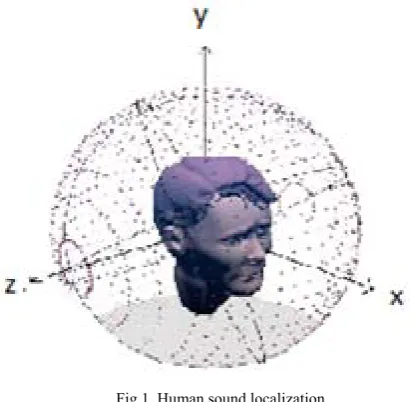
Sound localization is the process of clarifying the location of a sound source. Sound localization is a listener’s ability to identify the exact location or origin of a detected sound in direction and distance. The brain utilizes slight differences in strength, spectral, and timing cues to allow us to localize sound source .localization can be express in terms of 3-dimensional position, the azimuth or horizontal angle, vertical angle or elevation and distance or velocity.
Fig.1. Human sound localization
For a better understanding of a task of sound source localization different process steps have to be identified. Under the assumption of listening passively to the environment without use of any active localization
Fig. 2. Schematics of the Heart sound Localization Process
The sound localization is used to localize a sound source in three main items: first is the environment second is the noise and the third is the source itself. The environment could be quiet, noisy, and reverberant. Suppose a signal has to propagate through a medium in which noise is present. This noise could be any type either other sound or reverberations of the source itself. It is remarked that only mentioned external noise. Finally, the various attributes like directivity, constancy or the type of signal like random noise carries by sound itself. This brings a lot of uncertainties in a passive localization system. For simplification the sound source is supposed to be an Omni directional point source. Stethoscope sound localization technique is used to detect the sound of heart. The localization scheme is detect the direction of heart sound and after that we will use the sound filtering technique to differentiate heart sound from lung sound.
II. PROBLEM FORMULATION
we can learn the object with the help of adaptive learning to detect the different sounds. Mic which receive high sound pitch it store the information of different sounds and object identify those frequencies which they want to use.
III.PROPOSED ALGORITHM
The algorithm of above work is divided into three parts: A) Sound inputs
B) Algorithm Steps C) Flow Chart
In sound localization four different sound speaker samples taken, they all are in active mode. They produce different sound signals and object listen the all different sounds and object can identify the sounds they want to use.
A) Sound inputs
Fuzzy inference is the process of formulating the mapping from a given input to an output using neuro fuzzy system. The mapping then provides a basis from which decisions can be made. Following figure gives the snap shot of NS-2 for sound localization and MATLAB for sound detection .
Fig. 3. Different sound samples
B) Algorithmic steps:
Step-1. Applying adaptive learning technique to detect the Heart Sound in Chest.
Step-2. We modified the TFCM algorithm and call it adaptive learning technique.
Step-3. According to the comparison results, the classification performance of the future method was best among all the classifiers.
Step-4. In this research we use the concept of digital signal processing by which we detect the sound of heart by applying the adaptive learning technique.
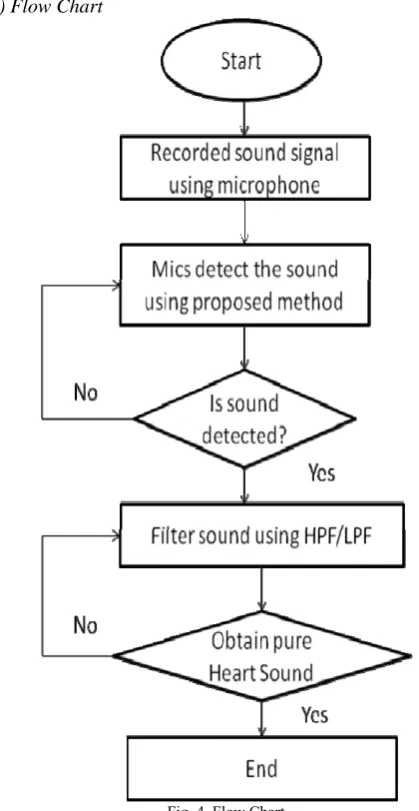
Step-5. We can capture the voice come from body then process that digital signal using low pass and high pass filter and then compare that signal spectrum with database stored spectrum.
C) Flow Chart
Fig. 4. Flow Chart
IV.EXPERIMENT AND RESULT
Fig. 5. Sound localization for speaker D
Fig. 6. Sound localization for speaker B
Figure 6, represents the sound samples of object B , when all the sound speaker are in active mode object B can be localized. Object wants to hear only particular MIC sounds all the other sounds are hearing are disabled.
Heart Sound Detection
Fig 7, depicts the heart sound sample is loaded in the matlab. It gives the frequency time graph and signal spectrogram. In this parameter load the original heart sound.
Fig.8. Heart Sound with noise in low pass filter
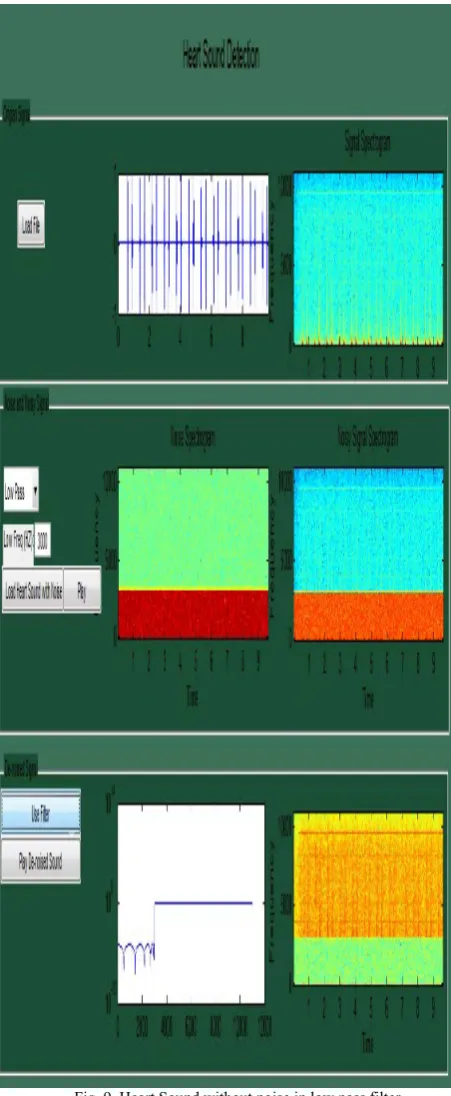
Fig. 9. Heart Sound without noise in low pass filter
The results shows in figure 9, depicts the heart sound filtered with low pass with low frequency 3000Hz than its frequency is shown in the graph with time. In this parameter use filter to neglect the noisy data and play the de-noised sound.
Fig. 10. Heart Sound noise with high pass filter
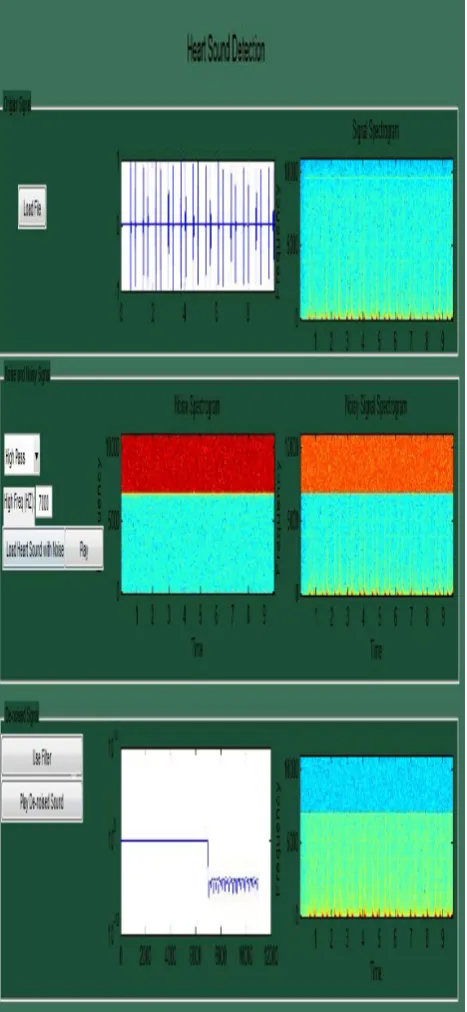
Fig. 11. Heart Sound without noise with high pass filter
Figure 11, shows the filtration of Heart sound with high pass with high frequency 7000Hz than its frequency is shown in the graph with time. In this parameter use filter to neglect the noisy data and play the de-noised sound. After playing the De-noise sound, listen the sound very careful after using filter heartbeat is very pure and sound of the heartbeats level high.
V. CONCLUSION
Heart sound analysis for detecting diseases is difficult when heart sound gets overlapped with other different sounds
removing other sounds interference from respiratory sound recordings is a big challenging and difficult task. This method is one of the efficient computerized method to detect and eliminate the other segments From HS. It can help respiratory sound researchers to bring about improvements to monitoring and diagnosis of respiratory disease. The potential usefulness of any method for removing other sounds from heart sound work on its ability to perform in a clinical setting. Manual inspection by visual means of the reconstructed signals confirmed that heart sound has the dominant sound with no perceptible other sounds in the background. Also, the proposed technique in this paper is far more efficient than other techniques for removing the other different sounds. This paper presents a best method for heart sound localization and detection from (lungs sounds, chest sound) other different sounds.
REFERENCES
[1] Abhilash Patangay, “Heart sounds based monitoring”, vol. 52, pp. 435-437, 2009.
[2] Alessio Brutti, Maurizio Omologo, “Compression between different sound source Localization techniques based on a real Data Collection”, Fondazione Bruno Kessler – irst, via Sommarive, 18, 38100 Trento, Italy, 2012
[3] Hamed Shamsi and I. Yucel Ozbek, “Heart Sound Localization in Chest Sound Using Temporal Fuzzy C-Means Classification”, 34th Annual International Conference of the IEEE EMBS San Diego, California USA, 28 August - 1 September, 2012.
[4] Ali Pourmohammad and Seyed Mohammad Ahad, “Real Time High Accuracy 3-D PHAT-Based Sound Source Localization Using a Simple 4-Microphone Arrangement”, IEEE SYSTEMS JOURNAL, VOL. 6, NO. 3, SEPTEMBER 2012.
[5] C. Ahlstrom, O. Liljefeldt, P. Hult, “Heart sound cancellation from lung sound recordings using recurrence time statistics and nonlinear prediction”, IEEE Signal Process. Lett, vol.12, no. 12, pp. 812–815, 2005.
[6] Emran M. Tamil, Nor Hafeezah Kamarudin, Rosli Salleh, M. Yamani Idna Idris, “Heartbeat Electrocardiogram (ECG) Signal Feature Extraction Using Discrete Wavelet Transforms (DWT)”,vol.5 Issue 6, ,pp.840-851, Feb 2008.
[7] Fatih Ça lar, and Yucel ozbek, “Heart Sound Localization in Chest Sound Using Convex-Hull Algorithm”, International Conference on Electrical and Electronics Engineering ,2011,vol. 58, no. 4, pp. 880– 883, 2011.
[8] Hiroshi Umezu and Kenji Suyama, “Multiple Sound Source Localization based on Local Existence Property of Speech Signal”, World Academy of Science, Engineering and Technology 60, 2011. [9] Jinqun LIU, Haibin WANG, Wuchang LIU, “Autonomous Detection
and Classi_cation of Congenital Heart Disease Using an Auscultation Vest”, Journal of Computational Information Systems vol. 8: 2, pp.485–492, 2012.
[10] Jonas Hörnstein, Manuel Lopes, Jose Santos-Victor, “Sound Localization for Humanoid Robots - Building Audio-Motor Maps based on the HRTF”,Beijing, China, October 9 - 15, 2006.
[11] M. Pourazad, “Heart Sounds Reduction from lung sounds recordings applying signal and image processing techniques in time-frequency domain”, M.Sc. thesis, Elect. Comput. Eng. Dept., Univ. Manitoba, Winnipeg,, MB, Canada, 2004.
[12] MB Malarvili, I Kamarulafizam, S Hussain, D Helmi, “Heart Sound Segmentation Algorithm Based on Instantaneous Energy of Electrocardiogram in IEEE Computers in Cardiology”, vol 30, pp. 327−313, 2003.
[13] R. M. Potdar, Nishi Shahnaj Haider, “Removal of Heart Sound from Lung Sound using LabVIEW 8.6” ,Vol. 2, Issue 3, pp.1313-1319, May-Jun 2012,
[15] Tseng YL, Ko PY, Jaw FS, “Detection of the Third and Fourth Heart Sounds Using Hilbert-Huang Transform”, BioMedical Engineering OnLine. 2012.
[16] Yadollahi and Z. Moussavi, “A robust method for heart sounds localization using lung sounds entropy”, IEEE Trans. Bio-Medical Engineering, vol. 53, no. 3, pp. 497–502, march 2006.
[17] Z. Dokur, T. Ölmez, “Heart sound classification using wavelet transform and incremental self-organizing map”, Digital Signal Processing vol.18, pp. 951–959, 2008.