R E S E A R C H
Open Access
A novel sparse representation algorithm for
AIS real-time signals
Shuaiheng Huai
*and Shufang Zhang
Abstract
Sparse representation of signals based on a redundant dictionary is a new signal representation theory. Recent research activities in this field have concentrated mainly on the study of dictionary design and sparse decomposition algorithms. Currently, the application of sparse representation on an Automatic Identification System (AIS) signal still requires further investigations. In this paper, a novel sparse representation of the AIS signal is proposed based on an adaptive redundant dictionary. Considering the characteristics of the AIS signal, an adaptive redundant dictionary is constructed using theKsingular value decomposition (K-SVD) algorithm. Furthermore, an effective pursuit algorithm is proposed to obtain the sparse representation of AIS signal using the adaptive dictionary. The binary AIS message is demodulated from the sparse representation of AIS signal. The experimental results indicate that the sparse representation of the AIS signal has high accuracy and the reconstructive error rate can be under 10%; thus, the reconstructive precision is simultaneously guaranteed. The processing time of the proposed sparse representation algorithm is less than 26.7 ms which satisfies the requirements of AIS real-time signal processing. It shows that introducing the signal sparse representation in a real-time signal system obtains a satisfactory result.
Keywords:Automatic Identification System (AIS) signal, Sparse representation,Ksingular value decomposition (K-SVD), Real-time signal
1 Introduction
The AIS is composed of shore-based stations and ship-borne equipment. It is a digital vessel navigation aid sys-tem that can identify vessels, assist in tracking targets, streamline information exchange and provide other auxil-iary information to avoid collisions, etc. [1,2]. The Inter-national Maritime Organization (IMO) has already required that all vessels should be equipped with both space- and land-based dual-positioning system in the fu-ture. To achieve the urgent requirements of IMO, the util-isation of the existing AIS shore stations has been studied for positioning. Therefore, the AIS can serve as a land-based wireless positioning system for coastal vessels, and the shipborne AIS equipment can perform both com-munication and positioning functions, which is referred to as the AIS autonomous positioning system (AAPS) [3]. The AAPS achieves autonomous positioning by measur-ing very high frequency (VHF) radio signals from AIS base stations which are established all over the world. However,
the existing AIS is essentially a communication system, and the positioning function has not been considered in the initial design and construction of the system. There are many technical problems exist that need to be solved using the AIS shore station for positioning, for example, how to extract location information from the AIS [4, 5] and develop the secondary phase correction model [6, 7] and the new carrier phase-measurement technology. The carriers currently used in the positioning system are all dual-phase-modulated carriers with the same frequency, and the equipment can be accurately positioned by carrier phase-measurement technology. However, according to the demands of communication, the carrier of an AIS sig-nal is dual-frequency Gaussian-filtered minimum shift keying (GMSK) modulated, which is much more compli-cated than the dual-phase modulation. The AIS signal cannot be applied to the carrier tracking and measure-ment method in traditional positioning system because of its characteristics in terms of frequency difference and non-periodicity. Therefore, a new carrier measurement method of AIS signal is needed, which is referred as the AIS signal holographic correlation detection. Since the * Correspondence:[email protected]
Information Science and Technology College, Dalian Maritime University, Dalian 116026, China
AIS is a real-time system, in the method, obtaining the data of AIS signal within a certain time interval is the pri-mary problem to be addressed. To solve this problem, the sparse representation theory is introduced into the AIS in the present study.
In the field of signal processing, an important issue is how to utilise the space transform to effectively express the signal and improve the compression efficiency. Con-ventional signal representation is usually based on ‘base expansion’such as the classical Fourier transform and the wavelet transform. However, this type of signal expansion, which is based on an orthogonal basis, suffers from some limitations. For example, it cannot always achieve a de-sired result, especially for signals that have a wide vari-ation range in the time and frequency. An ideal method of signal expansion should be based on the characteristics of the processed signal and adaptively select the appropriate base function to complete the decomposition of the signal. Mallat and Zhang proposed the cogitation of the signal sparse representation on a redundant dictionary in 1993 [8]. The so-called redundant dictionary was an ultra-complete redundant function library. The result of the sig-nal sparse decomposition on the redundant dictionary was that the coefficients of most of the base functions in the signal expansion were zero, and only a few base functions had large non-zero coefficients. The base functions in the present study are the elements in the dictionary that are called atoms. Therefore, the main features of the signal can be expressed by a small number of atoms. The com-pressed sensing theory proposed by Candes, Romberg, Tao and Donoho in 2004 raised the signal sparse represen-tation to a new level [9–11]. The compressed sensing the-ory was different from the traditional signal processing which was based on the Nyquist sampling theory. It indi-cated that as long as the signal contains sparsity in a cer-tain space, it can be reconstructed with high probability at a sampling frequency that is much lower than the Nyquist sampling frequency. In this theoretical framework, the sampling rate depends on the structure and content of the signal and not on the bandwidth of the signal. Therefore, further research on the signal sparse representation is ex-tremely significant in terms of theoretical and practical applications. The primary issue of signal sparse represen-tation is the construction of a redundant dictionary. The existing redundant dictionary schemes cannot always guarantee sparsity of the signal [12]. In recent years, methods to obtain a redundant dictionary through learning and training have been vigorously developed, one of which is the K singular value decomposition (K-SVD) [13].
In the present study, we construct the redundant dic-tionary adapted to AIS signal based on the K-SVD algo-rithm and carry out the sparse representation of AIS signal using the orthogonal matching pursuit (OMP)
algorithm. The suitable parameters of the sparse repre-sentation are calculated considering the noise. The bin-ary codes demodulated from the sparse AIS signal are obtained. The experimental results show that the whole sparse representation method exhibits good perform-ance. The adaptive redundant dictionary based on K-SVD makes the number of atoms required for the sparse decomposition small, and the accuracy of the AIS signal sparse representation is simultaneously guaran-teed. The sparse representation of the AIS signal is achieved with high accuracy within the required time, and the error rate of the demodulated sparse AIS signal is within the required range. We can obtain the data we need from the sparse representation of AIS signals, and the amount of data that needs to be processed reduces greatly as well as the time when compared with the ori-ginal AIS signals. The work presented in this paper lays the foundation for realising the AIS signal holographic correlation detection mathematical mode. It is an im-portant part of realising the autonomous positioning function of the AIS. The proposed method provides a reference to signal processing systems that need to ob-tain or save information from real-time signals.
The remainder of this paper is organised as follows. Section 2 introduces the principle of sparse representa-tion, including the AIS signal model and the theory of sig-nal sparse representation. Section 3 presents the sparse representation method including the adaptive redundant dictionary construction algorithm based on K-SVD and the sparse decomposition algorithm. Section 1 provides and discusses the experimental results. Section 5 con-cludes this paper.
2 Principle of sparse representation
2.1 AIS signal model
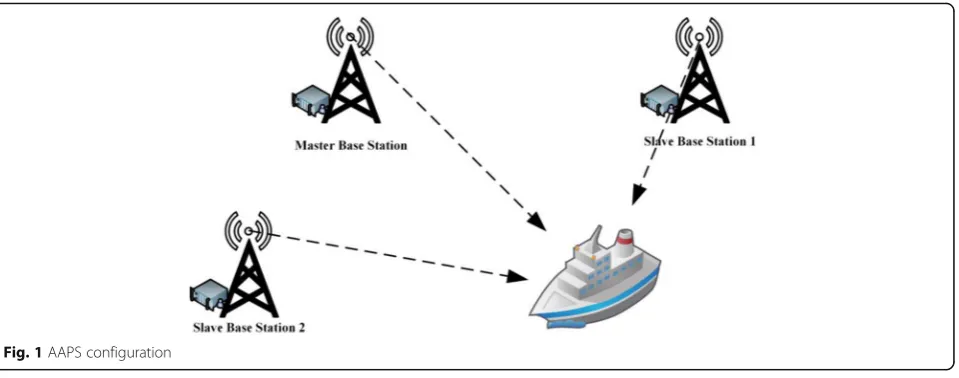
The AAPS is composed of a master AIS base station, some slave base stations and shipborne AIS equipment. The system configuration is shown in Fig.1. All the base stations take turns in sending signals, and the shipborne AIS equipment receives these signals. An additional sec-ondary factor correction system is present, which is used to improve the positioning accuracy.
The existing AIS operates in the VHF band of 161.975 and 162.025 MHz with a bandwidth of 25 kHz. The sig-nal modulation method is GMSK, and the transmission rate is 9.6 kb/s. The AIS signal model can be viewed as a GMSK signal model and expressed as
s tð Þ ¼Acos½ωctþθð Þt
¼A½cosθð Þt cosωct−sinθð Þt sinωct ð1Þ
θð Þ ¼t
where g(t) is the rectangular impulse response of the Gaussian filter,q(t) is the integral ofg(t) and the modu-lation indexhequals 0.5, i.e.
q tð Þ ¼2πh Z t
−∞gð Þτ dτ¼π Z t
−∞gð Þτ dτ ð3Þ
The transfer function of the Gaussian filter is expressed as
H fð Þ ¼ exp−α2f2 ð4Þ
whereαis a parameter related to the Gaussian filter with 3-dB bandwidthB. The definition ofBis given as
H2ð Þ ¼B 1
The impulse response of the Gaussian filter is expressed as
GMSK is the MSK modulation of a baseband digital signal processed by a Gaussian low-pass filter. The signal characteristics such as the mutual influence degree be-tween adjacent symbols are related to the parameters of the Gaussian filter. The value of the product with 3-dB bandwidth B of the Gaussian filter and input symbol
widthTis usually considered as among the main param-eters for designing a Gaussian filter. According to the AIS standard specification, the maximumBTproduct of the GMSK modulator used for transmitting data in the AIS should be 0.4, and the maximum figure should be 0.5 when receiving data [14].
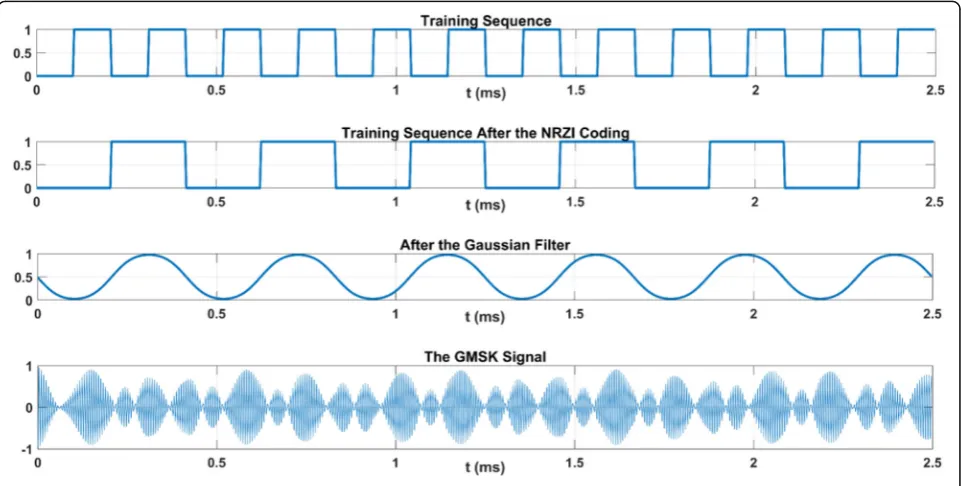
Figure 2shows that the smaller the BT product is, the slower is the decay of the GMSK signal-power spectral density with the frequency and the bigger is the main lobe. In this paper, for convenience of calculation, theBT prod-uct is set to 0.3. According to Recommendation ITU-R M.1371-4, the AIS data transmission should begin with a 24-bit demodulator training sequence (preamble) consist-ing of one segment synchronisation, as shown in Fig. 3. This segment should consist of alternating zeros and ones using the non-return-to-zero-inverted encoding. This se-quence always starts with a zero [14].
2.2 Sparse representation theory
The recent years have witnessed a rapid growth in interest in the research of signal sparse representation. From the Fourier transform to the wavelet transform to the multi-scale geometric analysis, the purpose of the re-searchers is to provide a more concise and direct analysis of signals in different function spaces. All these transforms are aimed at discovering the signal features and obtaining the sparse representation of the signal. The signal sparse representation is derived from the nonlinear approxima-tion theory. Given dicapproxima-tionary D= {dk,k= 1, 2,…,K}, its atoms are the unit vectors that span the whole Hilbert space H=RN(K≥N). For any signal x∈H, we adaptively selectmatoms formapproximation of signalxinD.
in which CardðImÞ ¼m and α= [α(1),…,α(K)]T is the vector of the decomposition factor. The approxima-tion absolute error is εm=‖x−Fmx‖2. When D is an orthogonal base, we preserve the largest m atoms of |α(k)|, and the optimal m approximation of signal x is obtained. When D is a redundant dictionary, multiple solutions of Eq. 9 are available. The objective of the signal sparse representation is to choose the one with the sparsest coefficient or that with the smallest m
value [15]. For a random redundant dictionary, this is a nondeterministic polynomial (NP) problem.
3 The sparse representation method
3.1 Adaptive redundant dictionary training algorithm based on K-SVD
The singular value of a matrix is a mathematical concept, usually obtained by singular value decomposition (SVD). SVD has a wide range of applications in data compression, such as image compression and noise reduction. Singular values often correspond to the important information hid-den in the matrix, and the importance is positively corre-lated with the size of the singular value. The K-SVD algorithm is based on this concept. In the AAPS, we need
Fig. 3Training sequence: the training sequence of AIS signal at different stages
to obtain and save the AIS signal within a certain time interval and we cannot lose its main features. In this re-gard, we construct the dictionary using the K-SVD algo-rithm for the AIS signal sparse representation.
For a given set of training signals, it adaptively obtains a redundant dictionary for sparse representation according to the training characteristics of the signals and sparse constraint conditions. K-SVD is characterised by the alter-nating application of a norm sparse constraint and SVD algorithms as well as the synchronous update of sparse dictionary and coefficients, which have strong sparse rep-resentation ability. The algorithm is flexible and works with any pursuit algorithm.
We assume that matrix Y¼ ½yiNi¼1 represents the train-ing signals,yi represents one of these signals, D¼ ½dkKk¼1
represents the dictionary to be trained and X¼ ½xiNi¼1 is
the sparse coefficient. The essence of dictionary training is the optimization problem shown by the following equation:
min
in whichT0represents the sparseness.
In order to implement the K-SVD algorithm, we sum-marise the specific steps, as follows:
1. Initialisation
We assign an initial value to dictionary matrix D. In general, we simply set the training signals in the matrix columns, and the optimisation problem is transformed into a problem of finding sparse representationXof sample setY.
2. Sparse coding
We use OMP algorithm to compute the sparse coefficient, i.e.
We update the dictionary column by column. We suppose that the column that needs to be updated is thekth column of the dictionary matrix, which is expressed asdkandxkrepresents thekth row of matrixX. Equation10is thus rewritten as
Y−DX
in whichEkis the error in thekth column of the diction-ary and can be expressed as
Ek ¼Y− X
j≠k
djxj ð13Þ
Thus, we decompose the multiplicationDXto the sum of Krank 1 matrices.K-1 terms are assumed fixed, and one remains in question.
Applying SVD onEk, we can obtain
Ek ¼UΔVT ð14Þ
The resulting first column ofUis an update of thekth column of the dictionary, and the first column of V
multiplied by Δ(1, 1) is an update of the kth coefficient vector. When all the columns of the dictionary are up-dated, we repeat step 2 until the iteration is completed.
Two conditions are available for stopping the iteration. In detail, the first one is to set the number of iterations. The second one is to set a fixed sparse error rate so that the iteration stops when the target value is reached.
An important issue of the K-SVD algorithm is its con-vergence [16, 17]. In the dictionary update stage of the K-SVD algorithm, SVD can ensure that the mean square error decreases or remains unchanged without affecting the sparse constraint conditions. The mean square error after iteration monotonically decreases, which ensures that the K-SVD converges to a local minimum. However, this does not mean that the convergence of the K-SVD algorithm is established. Instead, it depends on the con-vergence of the pursuit algorithm. Fortunately, the clas-sical matching pursuit (MP), OMP and basis pursuit (BP) algorithms all exhibit good performance whenT0is sufficiently small; thus, convergence of the K-SVD can be guaranteed.
3.2 Orthogonal matching pursuit
As discussed in Section2.2, Eq.9is an NP problem. On the surface, solving it appears to be hopeless. However, ac-cording to the premise that the signal is sparse, this prob-lem can be solved. Researchers have conducted extensive and in-depth research on this issue and proposed many al-gorithms for the signal sparse approximation, such as the convex relaxation and greedy algorithms [18, 19]. BP is one type of convex relaxation algorithms. It has the advan-tages of global optimisation, but its computational com-plexity is very high. MP is a typical greedy algorithm. It converges faster than the BP, but it does not have global optimality. The basic idea of the MP algorithm is to select an atom (one column) that best matches the signal from
the dictionary matrix to construct a sparse approximation and calculate the signal residual. Then, it iteratively con-tinues to select the atom that best matches the signal re-sidual. The signal can be represented by the linear combination of these atoms and the last residual value. Obviously, if the residual value is negligible, the signal is a linear combination of these atoms. However, if the signal is non-orthogonal in the vertical projection of the selected atom, this will make the result of each iteration subopti-mal, thus requiring more iterations. In this circumstance, the idea of OMP was proposed [20, 21]. The main im-provement of OMP is to orthogonalise all the selected atoms at every step of the decomposition, which leads to faster convergence than the MP under the same accuracy
Fig. 5Sparse AIS signal
requirements. The OMP procedures can be described as given the matrix A, the vectorb and the error threshold ɛ0, approximate the solution of
min
x k kx 0 s:t:Ax¼b ð15Þ
The specific steps summarised are as follows:
1. Initialisation
We initialisek= 0 and set the initial solutionx0= 0, the initial residualr0=b−Ax0=band the initial
for alljusing the optimal choice
zj ¼aTjrk−1= aj
The iteration stops when ‖rk‖2<ε0. Otherwise, do an-other iteration.
4 Results and discussion
In this section, we assess the performance of the proposed sparse representation algorithm in AIS via numerical sim-ulations. Figure4 shows that in AIS, the data part of the default transmission packet is 168 bits; considering this as an example, we produce 64 data signals with dimension of 168 to train the dictionary. Since the AIS is a real-time system, the signal processing time must satisfy the AIS re-quirements. Figure4shows that one frame in AIS is 60 s and divided into 2250 slots; thus, one slot is 26.7 ms. The time of the sparse representation of the AIS signal must be shorter than a slot, that is 26.7 ms [14]. We explore the effects of three parameters on the final results: the num-ber of coefficients in each linear combination, numnum-ber of iterations and size of the dictionary. The choice of these three parameters has a decisive influence on the time. The sparse representation accuracy is also calculated, and we use the root mean square error (RMSE) as representative
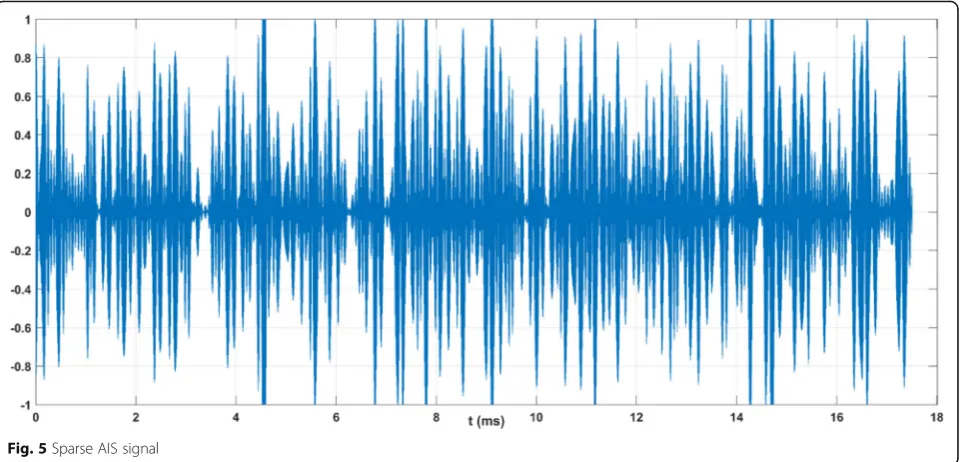
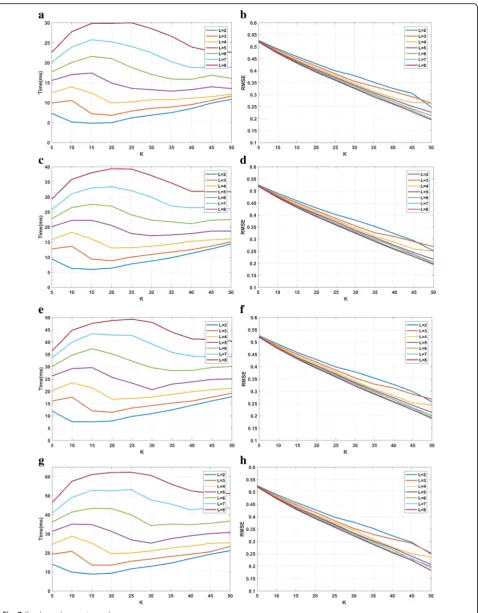
of the accuracy. Considering the impact of noise, the SNR is set to 10 dB [22]. Figure5is the sparse AIS signal ob-tained. The hardware specifications used in this study are Intel Core i7-6700 CPU at 3.40 GHz with 16-GB memory. All the three parameters have an effect on the time for sparse representation. The computation time must be in-creased with the number of iteration. Thus, we tentatively set the number of coefficients in each linear combination to 5 and the size of dictionary to 30 to find a proper num-ber of iteration (the numnum-ber of iteration is preset). Figure6ashows that as the number of iterations increases, the processing time essentially displays a rapid linear in-crease. However, in Fig. 6b, the reduction rate of the RMSE does not obviously sufficiently drop from 0.345 to 0.334 which indicate that increasing the number of itera-tions in the algorithm does not significantly improve the accuracy. Instead, the amount of data that needs to be cal-culated greatly increases, resulting in a substantial increase in computation time. In Fig. 6a, the orange dashed line represents 26.7 ms, to satisfy the AIS requirements, and the number of iteration should not be more than 13.
UseLto represent the number of elements in each lin-ear combination andK to represent the size of the dic-tionary. To study the effects of these two parameters on the time and accuracy of the sparse representation, use
Lequals 5 as the median, taking the values from 2 to 8, andKequals 30 as the median, taking the values from 5 to 50. Figure 7 shows the effect of different values ofK
and Lon the time and accuracy when the number of it-eration equals 6, 8, 10 and 12.
As shown in Fig.7a, c, e, g, as the value ofLincreases, the processing time shows a significant increase. With the increase ofK, the time curves basically have a process of rising then descending and then tending to be flat. The larger L is, the more obvious the process is. When K
reaches a certain value, the effect ofKon time tends to be flat. However, considering the requirements of AIS real-time signal processing, the value ofL should not be too large. Figure7b, d, f, gshows that as Kincreases, the RMSE essentially shows a significant linear decline. For example, in Fig.7b, whenLequals 2, the RMSE decreases from approximately 0.53 to around 0.25. It means the lar-ger the size of the dictionary, the more precise the sparse representation is. When the value ofKis small, the differ-ences in RMSE of different L are also small. The differ-ences gradually increase asKincreases.
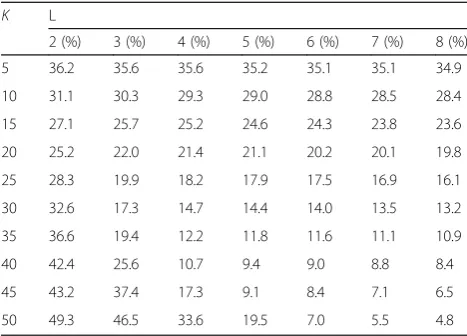
Subsequently, demodulation of the sparse signals is car-ried out, and we compare the results with the original AIS binary messages to calculate the error rate. In Table1, the (See figure on previous page.)
Fig. 7Performances of differentKandL: time and RMSE performances of different values ofKandL.aTime performances when iteration is 6.b
number of iterations is 6; we can see that asLincreases, the error rate declines, but it is not remarkable. The error rate decreases tremendously as Kincreases at first. How-ever, whenKreaches a certain value (depending on differ-ent values ofL), the error rate rapidly increases. TakingL
equals 3 as an example, when K equals to 50, the error rate is more than two times the value whenKis 30. This is because of multiple repeated matching processes that occur on the same feature of the signal, which leads to the increase in the signal sparse representation accuracy. However, it also results in erroneous feature responses that increase the error rate. In the AIS, the frame check sequence uses the cyclic redundancy check, and an error rate of approximately 10% is acceptable [23]. According to the experimental results, considering the time of sparse representation, the accuracy of sparse representation and the demodulation error rate, a suitable combination is the size of the dictionary is set to 45 and the number of coeffi-cients in each linear combination is set to 5.
Figure 8 is a binary signal demodulated from the sparse signal when the iteration is 6,Kis 45 and Lis 5.
The blue solid line represents the original AIS binary message, and the red dashed line represents the demo-dulated sparse signal. We can see that only five code dif-ferences exist between the two different lines; for most of the time, the two lines are coincident, which means that the error rate is quite small.
5 Conclusions
In this paper, a novel signal sparse representation algo-rithm has been proposed and applied on AIS signals. The time and accuracy performances of the sparse rep-resentation are studied with different values of iterations, number of elements in each linear combination and size of the dictionary to test whether the proposed algorithm meets the requirements of AIS real-time signal process-ing. For the accuracy of the AIS signal sparse representa-tion, the number of iterations did not show much influence. However, both the number of elements in each linear combination and size of the dictionary dis-played a significant effect. The adaptive redundant dic-tionary construction algorithm guaranteed accuracy. With regard to the signal processing time, each of the three parameters has an effect on it. The accuracy of the sparse representation increased as the size of the dic-tionary increases. However, a larger size cannot always guarantee a better performance by considering the error rate of the demodulated sparse signal. According to the experimental results, by considering 64 AIS signals with a dimension of 168 as an example, the best match dic-tionary matrix had a size of 168 × 45, the number of iter-ations was set to 6 and each signal was created by a linear combination of only 5 different dictionary atoms. Both the error rate and processing time satisfied the AIS real-time signal processing requirements, which implied that the proposed sparse representation algorithm can be well used in AIS.
Fig. 8The demodulated sparse signal: binary signal demodulated from the sparse signal Table 1Error rate of the different parameters
K L
2 (%) 3 (%) 4 (%) 5 (%) 6 (%) 7 (%) 8 (%)
5 36.2 35.6 35.6 35.2 35.1 35.1 34.9
10 31.1 30.3 29.3 29.0 28.8 28.5 28.4
15 27.1 25.7 25.2 24.6 24.3 23.8 23.6
20 25.2 22.0 21.4 21.1 20.2 20.1 19.8
25 28.3 19.9 18.2 17.9 17.5 16.9 16.1
30 32.6 17.3 14.7 14.4 14.0 13.5 13.2
35 36.6 19.4 12.2 11.8 11.6 11.1 10.9
40 42.4 25.6 10.7 9.4 9.0 8.8 8.4
45 43.2 37.4 17.3 9.1 8.4 7.1 6.5
The current work is an important part of realising the autonomous positioning function of the AIS. For further work such as the AIS signal holographic correlation de-tection, the proposed algorithm is applied to obtain the data of AIS signals within a certain time interval, which can significantly reduce the amount of data storage as well as the computation time. In other fields, such as the remote sensing, the detection and tracking of real-time signals with different frequencies are also necessary. The theory proposed in this paper provides a reference for real-time signal processing system.
Abbreviations
AAPS:AIS autonomous positioning system; AIS: Automatic Identification System; BP: Basis pursuit; GMSK: Gaussian-filtered minimum shift keying; IMO: International Maritime Organization; K-SVD:Ksingular value decomposition; NP: Nondeterministic polynomial; OMP: Orthogonal matching pursuit; RMSE: Root mean square error; VHF: Very high frequency
Acknowledgements
This work was supported by the Chinese National Science Foundation (nos. 61231006, 61501079 and 61601078).
Authors’contributions
SH provided the idea of algorithm, carried out the simulations, arranged the architecture and drafted the manuscript. SZ supervised the work and revised the manuscript. Both authors read and approved the final manuscript.
Competing interests
The authors declare that they have no competing interests.
Publisher’s Note
Springer Nature remains neutral with regard to jurisdictional claims in published maps and institutional affiliations.
Received: 11 July 2018 Accepted: 10 September 2018
References
1. B Hu, RW Liu, K Wang, Y Li, M Liang, Statistical analysis of massive AIS trajectories using Gaussian mixture models. Paper presented at the Second Int. Conf. on Multimedia and Image Process, Wuhan, China 2017, 113–117 2. L Liu, X Liu, X Chu, J Li, Z Jiang, Coverage effectiveness analysis of AIS base
station: a case study in Yangtze River. Paper presented at the Fourth Int. Conf. Transportation Information and Safety, Banff, AB, Canada 2017, 178–183 3. Q. Hu, Y. Jiang, S.F. Zhang, Development of an automatic identification
system autonomous positioning system. Sensors15, 28574–28591 (2015) 4. Y. Jiang, S.F. Zhang, D.K. Yang, A novel position estimation method based
on displacement correction in AIS. Sensors14, 17376–17389 (2014) 5. J.B. Zhang, S.F. Zhang, J.P. Wang, Pseudorange measurement method based
on AIS signals. Sensors17, 1183 (2017)
6. X.Y. Wang, S.F. Zhang, X.W. Sun, The additional secondary phase correction system for AIS signals. Sensors17, 736 (2017)
7. X.Y. Wang, S.F. Zhang, Evaluation of multipath signal loss for AIS signals transmitted on the sea surface. Ocean Eng.146, 9–20 (2017)
8. S. Mallat, Z. Zhang, Matching pursuit with time–frequency dictionaries. IEEE Trans. Signal Process.41(12), 3397–3415 (1993)
9. E Candes, Compressive sampling. Paper presented at the Proc. Int. Cong. of Mathematicians, Madrid, Spain 2006, 3. 1433–1452
10. E. Candes, J. Romberg, T. Tao, Robust uncertainty principles: exact signal reconstruction from highly incomplete frequency information. IEEE Trans. Info. Theory52(2), 489–509 (2006)
11. D.L. Donoho, Compressed sensing. IEEE Trans. Info. Theory52(4), 1289–1306 (2006) 12. T.J. Wang, B.Y. Zheng, Z. Yang, A speech signal sparse representation
algorithm based on adaptive overcomplete dictionary. Electron. Info. Technol.33(10), 2372–2377 (2011)
13. S. Chen, D.L. Donoho, M. Saunders, Atomic decomposition by basis pursuit. SIAM J. Scientific Comput.20(1), 33–61 (1999)
14. Recommendation ITU-R M. 1371-4, technical characteristics for an automatic identification system using time-division multiple access in the VHF maritime mobile band. 2010
15. A. Cohen, J. J Dales, Nonlinear approximation of random functions. SIAM J. Appl. Math.57(2), 518–540 (1997)
16. M. Aharon, M. Elad, A. Bruckstein, K-SVD: an algorithm for designing overcomplete dictionaries for sparse representation. IEEE Trans. Image Process.15(11), 4311–4322 (2006)
17. R. Rubinstein, T. Peleg, M. Elad, Analysis K-SVD: a dictionary-learning algorithm for the analysis sparse model. IEEE Trans. Signal Process.61(3), 661–677 (2013)
18. E.J. Candes, T. Tao, Near optimal signal recovery from random projections: universal encoding strategies. IEEE Trans. Info. Theory52(12), 5406–5425 (2006) 19. R. Baraniuk, A lecture on compressive sensing. IEEE Signal Process. Mag.24(4),
118–121 (2007)
20. YC Pati, R Rezaiifar, PS Krishnaprasad, Orthogonal matching pursuit: recursive function approximation with applications to wavelet decomposition. Paper presented at the Proc. 27th Asilomar Conf. Signals, Systems and Computers, Pacific Grove, CA, USA 1993, 1, 40–44 21. A.M. Bruckstein, D.L. Donoho, M. Elad, From sparse solutions of systems of
equations to sparse modelling of signals and images. SIAM Rev.51(1), 34– 81 (2009)
22. M. Zhou, A.J.V.D. Veen, R.V. Leuken, Multi-user LEO-satellite receiver for robust space detection of AIS messages. IEEE International Conference on Acoustics22(10), 2529–2532 (2012)