Soft-In Soft-Output Detection in the
Presence of Parametric Uncertainty via
the Bayesian EM Algorithm
A. S. Gallo
Department of Information Engineering, University of Modena and Reggio Emilia, via Vignolese 905, 41100 Modena, Italy Email:[email protected]
G. M. Vitetta
Department of Information Engineering, University of Modena and Reggio Emilia, via Vignolese 905, 41100 Modena, Italy Email:[email protected]
Received 30 April 2004; Revised 6 October 2004
We investigate the application of theBayesian expectation-maximization(BEM) technique to the design ofsoft-in soft-out(SISO) detection algorithms for wireless communication systems operating over channels affected by parametric uncertainty. First, the BEM algorithm is described in detail and its relationship with the well-knownexpectation-maximization(EM) technique is ex-plained. Then, some of its applications are illustrated. In particular, the problems of SISO detection of spread spectrum, single-carrier and multisingle-carrier space-time block coded signals are analyzed. Numerical results show that BEM-based detectors perform closely to themaximum likelihood(ML) receivers endowed with perfect channel state information as long as channel variations are not too fast.
Keywords and phrases: expectation-maximization algorithm, soft-in soft-out detection, fading channels, space-time coding, OFDM.
1. INTRODUCTION
In recent years, many research efforts have been devoted to the study of detection algorithms for digital signals trans-mitted over channels affected by random parametric un-certainty, like multipath fading channels and AWGN chan-nels with phase jitter (see, e.g., [1,2,3,4,5,6,7,8,9,10,
11,12,13] and references therein). In this field the atten-tion has been progressively shifting from maximum likeli-hood(ML) sequence detection [2,3,4] tomaximum a pos-teriori (MAP) symbol detection techniques [5, 6, 7, 8, 9,
10, 11, 12, 13] producing a posteriori probabilities (APPs) on the possible data decisions. This has been mainly due to the need of robust receiver structures for coded modulations and, more specifically, to the advent of theturbo processing principle applied to efficient iterative decoding of concate-nated coding structures [14,15,16,17,18,19,20,21,22]. Such a principle has been also exploited to design iter-ative detection/equalization/decoding algorithms for inter-leaved coded signals transmitted over channels with memory
This is an open access article distributed under the Creative Commons Attribution License, which permits unrestricted use, distribution, and reproduction in any medium, provided the original work is properly cited.
[10,11,12,13,23]. In all these cases good error performance is achieved by means of concatenated detection/decoding structures exchanging among each other soft information about the detected data. The basic building blocks of these structures are the so-calledsoft-in soft-out (SISO) modules [18,22].
Recently, an extension of the EM, dubbedBayesianEM (BEM), has been applied to solve MAP estimation problems and to derive SISO receivers [29,30,31,32] for single-user detection over frequency-flat Rayleigh fading channels. The BEM algorithm allows to design SISO modules estimating the channel state, incorporating the symbola priori proba-bilities(APRPs) and the statistics of the channel uncertainty, and generating the symbol APPs. Therefore, it can be eas-ily employed in iterative equalization/decoding structures for coded transmissions [17,23]. The favorable features of the BEM technique have suggested to further investigate its ap-plication to other communication scenarios.
This paper offers both a tutorial introduction to BEM-based estimation techniques and some recent research results about its applications. In fact, in its first part it describes the BEM technique, its relationship with the EM algorithm, and how it can be used to derive SISO algorithms for the detec-tion of digital data transmitted over channels having memory and affected by parametric uncertainty. Then, in the second part of the paper, the application of the BEM approach to some detection problems of current interest is illustrated. In particular, we consider
(1) the multiuser detection ofdirect sequence spread spec-trum(DSSS) signals in a synchronous CDMA system [33];
(2) the detection of single-carrier space-time block coded signals transmitted over frequency-flat fading channels [34];
(3) the detection of multicarrier space-time block coded signals transmitted over frequency-selective fading channels [35].
For each specific problem, in the third scenario, a BEM-based SISO algorithm is described and some numerical re-sults are illustrated. Moreover, the use of a BEM-based SISO module in an iterative receiver is described in detail.
The paper is organized as follows. The EM and BEM techniques are described inSection 2. The use of the BEM technique to devise SISO modules for channels with para-metric uncertainty and memory is illustrated in Section 3. Specific applications of the BEM tool are analyzed in
Section 4. Finally,Section 5offers some conclusions.
2. EXPECTATION-MAXIMIZATION ALGORITHMS
FOR PARAMETER ESTIMATION 2.1. The EM algorithm
Let Θ =. [Θ0,Θ1,. . .,ΘL−1]T denote anL-dimensional
de-terministic vector to be estimated from anN-dimensional received vectorR =. [R0,R1,. . .,RN−1]T of noisy data (with
N ≥L).1The ML estimate ofΘis the solution of the prob-lem [36]
θML=arg max
˜ θ Lr
˜
θ, (1)
1In the following, a random vector and its realizations are always denoted
by an uppercase letter and the corresponding lowercase letter, respectively.
where Lr(θ˜) =. logf(r|θ˜) is a log-likelihood function and f(x|y) denotes the probability density function(pdf) of the random vectorXconditioned on the event{Y=y}. Solving the problem (1) in a direct fashion requires a closed form ex-pression forLr(θ˜) but, even if this expression is available, the
search for its maximum may entail an unacceptable compu-tational burden. When this occurs, a feasible alternative can be offered by the EM algorithm [3,25]. The EM approach develops from the assumption that a completedata vector C =[C0,C1,. . .,CP−1]T (withP ≥N) is observed in place of the incompletedata setR. The vectorCis characterized by a couple of relevant properties: (1) it is not observed di-rectly but, if available, would ease the estimation ofΘ; (2) Rcan be obtained fromCthrough a many-to-one mapping C→R(C). In practice, in communication problems,Cis al-ways chosen as a superset of the incomplete data [3], that is,
C=RT,ITT, (2)
where the so-calledimputed dataI are properly selected to simplify the ML estimation problem [25]. In particular, when
Θ consists of all the transmitted channel symbols, I col-lects all the unwanted random parameters (fading, phase jit-ter, etc.) affecting the communication channel [3,25]. These choices lead toharddetection algorithms often having an ac-ceptable complexity and capable of incorporating the statisti-cal properties of the channel parameters. In the following the complete data vectorCwill be always structured as in (2).
GivenC, theauxiliary function
QEM
θ,θ˜=. EILc(θ)R=r,Θ=θ˜ =EI
logf(C|θ)R=r, Θ=θ˜ =
Silogf(r,i|θ)f
ir,θ˜di
(3)
is evaluated, whereEX{·}denotes the statistical average with
respect to a random vector X and Si is the space of I.
Then, this function is employed in the following two-step procedure generating successive approximations{θ(k), k = 1, 2,. . .}ofθML(1):
(1) expectation step—QEM(θ,θ) in (˜ 3) is evaluated forθ˜= θ(k)
EM;
(2) maximization step—givenθ(EMk), the next estimateθ(EMk+1) is computed as
θ(k+1)
EM =arg max
θ QEM θ,θ
(k) EM
, k=0, 1,. . . . (4)
An initial estimate θ(0)EM of θ must be provided for the algorithm start-up. In digital communication problems, proper initialization of the EM algorithm is usually accom-plished exploiting the information provided by known (pi-lot) symbols [3]. It can be proved that, under mild condi-tions, the sequence{θ(k)
2.2. The BEM algorithm
The unknown vector Θ = [Θ0,Θ1,. . .,ΘL−1]T mentioned in the previous paragraph can be also modeled as arandom
quantity, when its joint pdf f(θ) is available. In this case the
MAP estimateθMAPofΘ, given the observed data vectorr, can be evaluated as [36]
θMAP=arg max
˜ θ Mr
˜
θ, (5)
whereMr(θ)˜ =. logf(r,θ). Solving (˜ 5) may be a formidable
task for the same reasons previously illustrated for the ML problem (1). In principle, however, an improved estimate of
Θ can be evaluated via the MAP approach since statistical information about channel uncertainty are exploited.
Since there is a strong analogy between the ML prob-lem (1) and the MAP one (5), it is not surprising that an expectation-maximization procedure, dubbed BayesianEM (BEM) [29,37], for solving the latter, is available. The BEM algorithm evolves through the same iterative procedure as the EM, but with a different auxiliary function [29], namely,
QBEM
θ,θ˜=ECMc(θ)R=r,Θ=θ˜ =Elogf(C,θ)R=r,Θ=θ˜
=
Silogf(r,i,θ)f
ir,θ˜di.
(6)
A clear relationship can be established between the BEM and the EM algorithms. In fact, factoring the pdf f(r,i,θ) as
f(r,i,θ)= f(r,i|θ)f(θ) (7)
and substituting (7) into (6) produces
QBEM
θ,θ˜=QEMθ,θ˜+I(θ), (8)
where
I(θ)=. logf(θ). (9)
Equation (8) shows that the difference betweenQBEM(θ,θ˜) (6) andQEM(θ,θ) (˜ 3) is simply abiastermI(θ) (9) favoring the most likely values ofΘ. It is worth noting that, if a pri-ori information aboutΘwere unavailable and, consequently, a uniform pdf was selected for f(θ), the contribution from I(θ) would turn into a constant in (8), that is, it could be ne-glected. Therefore, the BEM encompasses the EM as a special case and, since the former benefits by the statistical informa-tion about Θ, it is expected to provide improved accuracy with respect to the latter. For the same reason, an increase in the speed of convergence and an improved robustness against the choice of the initial conditions could be offered by the BEM.
3. SISO DATA DETECTION IN THE PRESENCE OF PARAMETRIC UNCERTAINTY VIA THE BEM TECHNIQUE
In this section we show how the BEM technique can be employed to derive SISO algorithms for detecting digital signals transmitted over channels with parametric uncer-tainty and memory. A single-user transmission over a single-input single-outputchannel is considered for simplicity, but, as shown in the following section, the proposed approach can be extended to an arbitrary number of users and to a
multiple-input multiple-output(MIMO) system without any substantial conceptual problem.
Here we assume that thekth component of the received data vectorRcan be expressed as2
Rk=gk(D,A) +Nk, (10)
where D =. [D0,D1,. . .,DN−1]T is a vector of indepen-dent channel symbols belonging to a constellation Σ = {s0,s1,. . .,sM−1}of cardinalityMand average energyEs,A=. [A0,A1,. . .,AL−1]Tis a vector of random channel parameters
independentofDandwith known statistical properties,{Nk} is an AWGN sequence with varianceσ2
N, andgk(·,·) expresses
the known functional dependence of the channel on both the transmitted symbols and its parametric uncertainty. In particular, we concentrate onconditional finite memory chan-nels, that is, on random channels such that
gk(D,A)=gkDk,Dk−1,Dk−2,. . .,Dk−Lc,A
, (11)
whereLcdenotes thechannel memory.
Our target is devising MAP SISO detection algorithms [18, 22], given the observed data R=r and a statistically known parameter vector A. In data detection problems in-volving the EM technique, two different choices have been usually suggested for the imputed dataI(see (2)) and the pa-rameter vectorΘ:
(1) I=AandΘ=D[3]; (2) I=DandΘ=A[6,8,29].
It is extremely important to comment now on the mean-ing and the consequences of these choices.
In the first case, both EM and BEM-based algorithms aim at producinghardestimates of the transmitted data. The only substantial difference between these two classes of strategies is that BEM allows to exploit the data statistics, that is, their APRPs, in the detection algorithm, since I(θ) in (8) turns into (see (9))
I(θ)=I(D)=
N−1
n=0
log Prdn, (12)
2Here we concentrate on detection algorithms processing one sample per
where Pr(dn) denotes the probability of the event{Dn=dn}. In other words, employing the EM (BEM) technique leads to
hard-in(soft-in)hard-outputdetection algorithms.
In the second case, both EM- and BEM-based algo-rithms estimate the random parameters of the communica-tion channel in a direct fashion. Nonetheless, they can be considered as SISO detectors, since they generate soft esti-mates (i.e., the APPs) of the transmitted data as a by-product of the estimation procedure and can also incorporate the data APRPs. BEM-based estimators, however, also make use of channel statistics, whereas EM-based estimators do not, that is, they operate in ablindfashion. Since blind detection tech-niques can be substantially outperformed by their counter-parts exploiting channel statistics (see, e.g., [4,38,39]), this offers a strong motivation for preferring BEM-based strate-gies to EM-based ones when such statistical information are available. To further clarify these ideas, we derive now the BEM estimator ofΘ=A, givenI =D. In (6) the joint pdf
f(r,i,θ) can be factored as
f(r,i,θ)=f(r,d,a)= f(r|d,a)f(d)f(a) (13)
as the dataDare independent of the channel parametersA. Here
Λis the set of all theMN possible data sequences of length N, δN(·) is the N-dimensional Dirac delta function, and
since the kth sample rk depends on d through the couple (dk,∆k) only, and the random variables{Rk}, conditioned
onDandA, are independent. Moreover, the conditional pdf
f(i|r,θ˜) in (6) is given by relevant terms produces, after some manipulations,
QBEM
where Π denotes the set of MLc possible channel state
vectors. We define now the estimate vector a[k] =. [a0[k],a1[k],. . .,aL−1[k]]T generated, at the kth iteration, by the BEM estimation algorithm based onQBEM(a,˜a) (17). Such an algorithm operates as follows. First, Q(a,a[k]) is evaluated (E step). The next estimate a[k+ 1] corresponds to the maximum ofQ(a,a[k]) with respect toa. Then, taking the gradient of (17) with respect toaand setting it to zero produces the recursive relation
expressing a set of nonlinear equations for evaluatinga[k+1], given a[k] (M-step). It is worth noting that complexity of solving (18) depends on the type of functional dependence ofgk(·) onaand on the inner structure of logf(a).
We us now explain why the estimator based on (18) can be also interpreted as a SISO algorithm. First of all, we note that the contribution from Pr(dl) (coming from (14)),
be-ing independent ofa, has been dropped inQBEM(a,˜a) (17). The contribution from the APRPs of the channel symbols, however, has not really disappeared since such probabilities are used in the evaluation of the APPs{P(dk,∆k|r,˜a)}. This
de-following recursive equations:
fixed before starting the forward (21) and the backward iter-ations (22), respectively.
AfterKiterations the BEM algorithm stops, producing a final estimateaBEM=a[K] and the APPs{Pr(dk,∆k|r,aBEM)} of the channel symbols. The symbol APPs{Pr(dk|r,aBEM)} can be easily derived from these quantities as
Prdkr,aBEM
where Ω(dk) denotes the subset of all the state transitions ∆k → ∆k+1 labeled by the channel symbol dk. Then, deci-sions on the channel symbols can be taken according to the MAP decision strategy [6]
ˆ decoding stages (see, e.g., [30,31]) to improve the error per-formance of a digital receiver (see Section 4.4.3).
Finally, we note that substantial simplifications of the BEM-based procedure based on (18) can be found when the communication channel does not have memory, that is,
Lc = 1, since in this case the forward-backward procedure is no more required. Specific examples of BEM-based algo-rithms for memoryless channels can be found in [30,31,32], where frequency-flat fading and phase jitter are considered as channel impairments.
4. SPECIFIC APPLICATIONS
In this section, three specific applications of the BEM strat-egy are briefly illustrated. In particular, SISO detectors are developed for the following three different scenarios: (1) a synchronous multiuser CDMA system; (2) a single-carrier system employing an orthogonalspace-time block code
(STBC); (3) an orthogonal frequency division multiplexing
(OFDM) system using an orthogonal STBC on a subcarrier-by-subcarrier basis. For each scenario we provide a brief in-troduction citing a set of key references about the specific problem, a description of the signal and channel models, an analysis of the corresponding BEM-based SISO algorithm, and some numerical results.
4.1. Multiuser detection of synchronous DSSS signals over frequency-flat fading channels
4.1.1. Introduction
One of the most challenging problems in receiver design for DSSS-CDMA systems is the derivation of reduced-complexity multiuser detectors. This is due to the fact that the complexity of optimal multiuser detection grows expo-nentially with the number of users [41]. One of the interest-ing applications of the EM technique has been the derivation of multiuser detectors for synchronous DS-CDMA systems operating over frequency-flat fading channels [42,43,44]. However, all the solutions proposed in the cited papers pro-duce hard estimates of the data. A BEM-based soft detector is illustrated in the following.
4.1.2. Channel and signal models
Multiuser detection on synchronous uplink of aJ-user DS-CDMA system is considered here. In the presence of slow frequency-flat fading the output of the receiver matched filter bank in thelth symbol interval can be expressed as [42,43]
Z(l)=RB[l]A[l] +N[l], (25)
whereZ[l]=. [Z1[l],. . .,ZJ[l]]T,B[l]=. diag(B1[l],. . .,BJ[l]) is the channel symbol matrix, A[l] =. [A1[l],. . .,AJ[l]]T is the channel fading vector,R = [rmn] (m,n = 1, 2,. . .,J) is theJ×Jmatrix of signature cross-correlations, andN[l] is a complex Gaussian noise vector having zero mean and covari-ance matrixσ2
wR, withσw2 = 2N0. HereBj[l] ∈ {±
2Eb,j}
(Eb,j is the average transmitted energy per bit) is the BPSK
channel symbol transmitted by the jth user in thelth signal-ing interval,Aj[l] is the fading distortion affectingBj[l], and
rmn =TS
0 pm(t)pn(t)dt(m,n = 1, 2,. . .,J), whereTsis the symbol interval and pn(t) is the signature waveform3of the
nth user. In the following it is assumed that theJfading pro-cesses {Aj[l]} are independent, identically distributed and zero mean Gaussian (Rayleigh fading) with autocorrelation functionRa[m] (Ra[0]=1).
If R is positive definite, it can be Cholesky factored as R = ΓHΓ, whereΓis a lower triangular matrix. Then, pre-Gaussian since its covariance matrix is σ2
wIJ (IJ is theJ×J
identity matrix).
Extending the one-shot model (26) to an observation in-terval ofNconsecutive symbols (withl=1,. . .,N) yields
Y=diag(Γ)BA+W, (27)
3We assume that its support is the interval [0,T
where Y =. [YT[1],. . .,YT[L]]T,A =. [AT[1],. . .,AT[L]]T,
Gaussian vectors having zero mean and covariance matrix
E{Wj[l]WHj[l]} = σw2,jIJ, withσw2,j = βjσw2. Here{βj}are
real positive coefficients satisfying the constraintJj=1βj=1 in order to ensure statistical equivalence. Then,Y[l] (26) can be decomposed asJj=1Uj[l], where the complete and parameter vectors, respectively. This leads to the auxiliary function (further analythical details are avail-able in [33]) expressed as follows [33]. Given the fading estimatesakj =
[ak
to be recomputed as long as the channel statistics do not
change, and that such matrix depends on j, that is, on the considered user, through Eb,j andσw2,j only. The APPs
for the independence of theJusers.
After K iterations the BEM-based algorithm based on (31)–(36) (dubbed CDMA-BEM in the following) stops pro-ducing a channel estimateaBEM =a(K+1)and the data APPs {P(bj[l]|y,aBEM)}. Then, data decisions can be taken accord-ing to a MAP decision strategy (see (24)) or, if channel cod-ing is used, can be delivered to soft decodcod-ing stages.
4.1.4. Numerical results
Computer simulations have been carried out in order to as-sess thebit error rate(BER) performance of the CDMA-BEM multiuser detector. In the following it is always assumed that (1) the autocovariance function of the fading process{Aj[l]} (with j =1,. . .,J) isRa[m] = J0(2πmBDTs) (Clarke’s fad-ing [46]), whereJ0(x) is the zeroth-order Bessel function of the first kind andBD is the fading Doppler bandwidth; (2) each user continuously transmits packets containingN=14 consecutive symbols; (3) each packet consists of 12 informa-tion symbols and is preceded by a couple of pilot symbols (used for channel estimation), so that the pilot symbol rate isRp =1/7; (4) Wiener filtering techniques are exploited at the receiver side in order to evaluate the channel estimates needed for the initialization of the CDMA-BEM [29]; (5) the CDMA-BEM processes a block of (2·N+2)=30 received sig-nal samples corresponding to 2 consecutive packets (plus the first two samples of the next packet) and carries outK=3 it-erations; (6) thesignal-to-noise ratiofor thejth user (SNRj)
is defined asEb,j/N0, whereEb,j is the average received
en-ergy per bit for the jth user andN0/2 is the noise two-sided power spectral density; (7) the receiver is provided with an ideal estimate of the SNR for all the active users so that the parameters{βj,j=1,. . .,J}can be selected as [42]
βj=JEb,j i=1Eb,i
MLR CDD CDMA-BEM
5 10 15 20 25
Eb/N0(dB)
0.001 0.01 0.1
BER
4 6 8 2 4 6 8 2 4 6 8 2
Figure 1: BER performance of the CDMA-BEM algorithm with
BDTs=5·10−3,J=4,N =14, andK=3. The BER performance of the MLR and CDD is also shown for comparison.
In the following, we consider a four-user scenario (J=4) characterized by the matrix of signature cross-correlations [43]:
R4= 1 7
7 −1 3 3
−1 7 3 −1
3 3 7 −1
3 −1 −1 7
. (38)
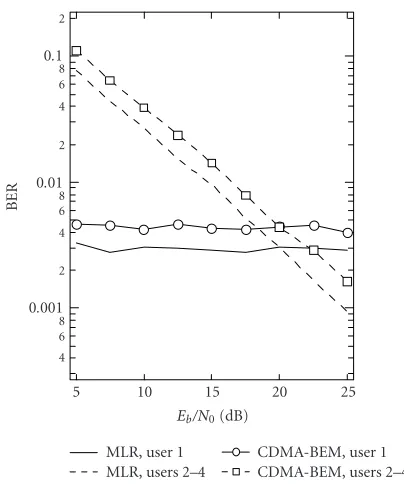
The BER performance of the CDMA-BEM receiver is il-lustrated in Figure 1. Here it is assumed that the normal-ized Doppler bandwith isBDTs =5·10−3 and that all the users have the same SNR. In this figure the performance of the maximum likelihood receiver (MLR) endowed with ideal channel state information (CSI) and that of the co-herent decorrelator detector (CDD) [47] are also shown for comparison. It is interesting to note that, in these scenar-ios, the CDMA-BEM almost achieves the same performance of the MLR and outperforms the CDD by about 1.5 dB in SNR.
Figure 2shows the performance of CDMA-BEM versus the normalized Doppler bandwidth forBDTs∈(5·10−3, 5· 10−2), under the assumption that SNR
j =15, 20, 25 dB for j = 1,. . ., 4. The error performance of the proposed algo-rithm slightly worsens as the Doppler bandwidth increases because of the poorer quality of the initial channel estimates. Finally, the near-far resistance of the CDMA-BEM re-ceiver is illustrated in Figure 3. The SNR of the first user (SNR1) is set to 20 dB, whereas the other three SNRs (SNRj, j = 2, 3, 4) are equal and vary in the range (5, 25) dB.
Eb/N0=15 dB
Eb/N0=20 dB
Eb/N0=25 dB
5 6 7 8 90.01 2 3 4 5
BDTs
0.001 0.01 0.1
BER
4 6 8 2 4 6 8 2 4 6 8 2
Figure2: BER performance of the CDMA-BEM algorithm versus
BDTs.J=4,Eb,k/N0=20 dB,N=14, andK=3.
MLR, user 1 MLR, users 2–4
CDMA-BEM, user 1 CDMA-BEM, users 2–4
5 10 15 20 25
Eb/N0(dB)
0.001 0.01 0.1
BER
4 6 8 2 4 6 8 2 4 6 8 2
Figure3: Near-far resistance of the CDMA-BEM algorithm.J=4, SNR1=20 dB, SNRk∈(5, 25) dB (k=2, 3, 4), andBDTs=5·10−3.
4.2. SISO detection of space-time block coded signals
4.2.1. Introduction
In the last years it has been shown that the information ca-pacity of wireless communication systems can be substan-tially increased by employing antenna arrays [48], jointly with proper coding [49] and signal processing techniques [50]. One of the most promising results in this research area has been the development of new block and trellis codes for multiple antennas, known as space-time codes (STCs) [49,
51]. Such codes provide significant diversity gains without bandwidth expansion. Exact knowledge of the CSI is often assumed in devising space-time decoding algorithms even if channel estimation may represent a serious problem, es-pecially in time-varying environments [52]. EM-based hard detectors for STCs have been derived in [52,53,54]. In this section a BEM-based soft detector for orthogonal STBCs is illustrated.
4.2.2. Signal and channel models
Here we focus on a space-time block coded system employing
NT transmit andNRreceive antennas [49]. The set of chan-nel symbols transmitted during the nth block4 is denoted by theL×NT matrixS[n] = [sl,i[n]] (withl = 1, 2,. . .,L, i=1, 2,. . .,NT), whereLis the overall duration of the block in channel symbols andsl,i[n] is the channel symbol feeding
theith antenna in the symbol interval (l+nL).
In the following we assume that the multiple channels involved in the communication system are (a) affected by frequency-flat Rayleigh fading and (b) quasi-static, that is, channel variations within each block are negligible, whereas changes from block to block are taken into account. Then the path gainai,j[n] (withi=1, 2,. . .,NT andj =1, 2,. . .,NR)
from the ith transmit antenna to the jth receive antenna during the nth block is a complex Gaussian random pro-cess having zero mean and correlation function Ra[m] =.
E{ai,j[n+m]ai∗,j[n]}(withRa[0] = 1). Moreover, the gain
processes {ai,j[n]} areindependent (rich scatterer
environ-ment).
Letrl,j[n] denote the received signal sample taken at the
output of the jth receive antenna in the (l+nL)th symbol
W[n] are independent Gaussian random variables, all having zero mean and varianceσ2
w=2N0.
4Throughout the section, the parameter ndenotes the block index,
whereaskspecifies the location of a channel symbol within each block.
A set ofNconsecutive vectors (39) (withn=0,. . .,N− 1) can be grouped asR =. [RH[0],RH[1],. . .,RH[N−1]]H
((A)T and (A)H denote transpose and conjugated transpose
ofA, resp.), with
R=D(S)A+W, (40)
where A =. [AH[0],AH[1],. . .,AH[N − 1]]H and W =.
[WH[0],WH[1],. . .,WH[N−1]]H, respectively, andD(S)=.
diag{S[0],S[1],. . .,S[N−1]}.
4.2.3. A BEM-based SISO algorithm for space-time block coded systems
Following the same indications illustrated in the previous ap-plication, we setΘ=AandC= {R,S}in applying the BEM technique. Then the auxiliary function is (analytical details can be found in [55])
covariance matrix, andV˜jis thejth column of the matrix
˜
ing BEM-based recursive channel estimator can be derived. Given the channel estimateA(k)at thekth iteration, the next estimateA(k+1)is evaluated as
A(jk+1)=[P]−1V(k)
j , (44)
whereP =. INNT +σw2C−A1. The APPs{Pr(S[n]= Sm|R,A˜)}
It is important to note that (a)Pdoes not depend on the index of the receive antenna; (b) the inverse ofPdoes not need to be recomputed as long as the channel statistics do not change; (c) (44) can be simplified factoringCAas
CA=C˜a⊗INT, (47)
where C˜a is the covariance matrix of the vector ai,j =
[ai,j[0],ai,j[1],. . .,ai,j[N−1]]Tand⊗is the Kronecker
prod-uct, so thatP=(IN+σw2C˜−a1)⊗INT.
After K iterations the BEM algorithm stops producing a channel estimateABEM = A(K)and the APPs{Pr(S[n] = Sm|R,ABEM)}which can be processed exactly like in the pre-vious application. In the following the BEM-based estima-tion algorithm (43)–(46) is dubbed STBC-BEM.
4.3. Numerical results
The error performance of the STBC-BEM algorithm has been assessed by computer simulation for the Alamouti’s space-time block code [51]. Then we have
S[n]=.
! s1
n s2n
−s2
n
∗
s1
n ∗
"
, (48)
where the symbols{s1
n,s2n}belong to a BPSK constellation.5
In the following we assume that (1)Ra[m]=J0(2πmLBDT), where J0(x) is the zeroth-order Bessel function of the first kind,BD is the fading Doppler bandwidth, andT is the sig-naling interval; (2) the SNR is defined asEb/N0, whereEbis the average received energy per receive antenna and informa-tion bit; (3) eachpacketof (NB−1) consecutive information blocks is followed by one pilot block, so that the pilot symbol rate isRp=1/NB.
The STBC-BEM algorithm processes a sample setR con-sisting of N·Lconsecutive received signal samples, corre-sponding toNtransmitted symbol blocks. It is assumed that the first and lastLsamples ofRalways correspond to a pi-lot block. This entails that (a)N =NpNB+ 1, ifNppackets are processed, and (b) the last block of each set is in com-mon with the first of the next one. The information provided by the pilot symbols is exploited to initialize the BEM algo-rithm. In particular the initial channel estimate for the jth receive antenna is evaluated as Aj = FRj, whereRj is the jth column ofR, with j = 1, 2,. . .,NR. HereFis an opti-malNNT×NLmatrix that can be easily derived by standard methods (Wiener filtering) [29,36], under the assumptions that (a) the information channel symbols are independent and identically distributed and (b) the pilot symbols are ex-actly known.
In all the following results it is assumed that the BEM algorithm processesNp =4 consecutive packets, each con-sisting ofNB=10 consecutive blocks.
5Further results (not shown for space limitations) evidence that the
com-ments expressed for a BPSK system also apply to larger constellations.
Coherent BEM and WF
ML and WF ML and LMS
0 5 10 15 20 25
Eb/N0
10−6
10−5
10−4
10−3
10−2
10−1
100
BER
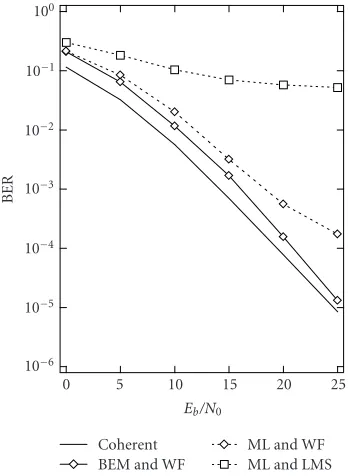
Figure4: BER performance of various detection algorithms with Alamouti’s STBC.NR=1 andBDT=2·10−2.
In Figure 4 the error performance of the STBC-BEM (withK =3) is compared with that provided by an ML re-ceiver using WF channel estimation6and an ML receiver us-ing decision-directedleast mean square(LMS) channel track-ing with step sizeµ=0.5 (the tracker is initialized for each packet using the pilot block at its beginning in order to avoid runaway problems) for single receive diversity (NR =1) and
BDT=2·10−2. The BER performance of a coherent receiver endowed with ideal CSI is also shown. These results evidence that (1) since the energy loss due to pilot symbols is 0.45 dB, the BEM performs very well if the fading rate is not too large; (2) the BEM substantially outperforms the other detectors. Further simulations have also shown that a blind SISO de-tector based on the EM-based approach illustrated in [6] and initialized by a WF does not outperform the ML detector en-dowed with the same channel estimator.
Figure 5shows the error performance of the STBC-BEM with a different number of iterations, that is, withK = 1, 2, and 3, in the same scenario as the previous figure. These results evidence the usefulness of running three full iterations in the BEM procedure, in order to approach the performance of a coherent receiver endowed with ideal CSI. We also found, however, that negligible gains are offered byK >3.
The comments already expressed about the results of
Figure 4 also apply to Figure 6, referring to double receive diversity (NR = 2), channel estimation based on WF and
BDT = 5·10−3, 10−2, and 2·10−2 for the BEM (BDT = 2·10−2 only is considered for the ML detector). This figure
6Its error performance coincides with that offered by the BEM without
Coherent BEM, 1st iter.
BEM, 2nd iter. BEM, 3rd iter.
0 5 10 15 20 25
Eb/N0
10−5
10−4
10−3
10−2
10−1
BER
Figure5: BER performance of the BEM detection algorithm with Alamouti’s STBC. The error performance of the coherent detector is also shown for comparison.NR=1,BDT =2·10−2, andK=1, 2, and 3.
also evidences that the BEM performance is not substan-tially affected by a change in the Doppler rate, provided that
BDT≤2·10−2.
InFigure 7the BEM and the ML detector BER versus the normalized Doppler bandwidth BDT is shown forBDT ∈ (10−2, 5·10−2) andEb/N
0=10 dB (WF is used in both cases). It is worth noting that the performance degradation increases for larger Doppler bandwidths as the quality of the initial es-timate of the BEM becomes poorer and this prevents BEM convergence to the global maximum, at least over some data blocks. Simulation results have also evidenced that, in this case, increasing the number of BEM iterations provides a negligible improvement.
4.4. SISO detection of space-time block coded OFDM signals
4.4.1. Introduction
The use of OFDM is often suggested to simplify channel equalization in the presence of appreciable frequency se-lectivity. When employed in MIMO wireless systems, the OFDM technique can be also easily combined with channel codes devised for multiple transmit antennas, that is, with
space-time (ST) codes. A further improvement in the sys-tem performance can be achieved when conventional outer channel codes, likeconvolutional codes[56,57] orlow-density parity-check(LDPC) codes [58], are used in conjunction with proper ST symbol mappers.
Decoding of ST codes usually requires an accurate knowl-edge of CSI at the receiver. In MIMO OFDM systems, how-ever, channel estimation may represent a serious problem,
Coherent
BEM,BDT=5·10−3
BEM,BDT=10−2
BEM,BDT=2·10−2
ML,BDT=2·10−2
0 2 4 6 8 10 12 14
Eb/N0
10−5
10−4
10−3
10−2
10−1
BER
Figure6: BER performance of various detection algorithms with Alamouti’s STBC.NR=2.
especially in time-varying environments, because of the high complexity needed to achieve a satisfying accuracy [59], even if simplified pilot-based channel estimators can be devised [60]. Recently, it has been shown that, when OFDM is com-bined with ST block coding [51] and a pilot-based channel estimate is available at the receiver, the EM technique can be applied to devise accurate channel estimators [61] and that such estimators can be used forsoft-in hard-outputdetection [54]. In the last case, hard decisions are then converted to soft data information which can be exploited in iterative receiver architectures when outer coding is employed at the transmit-ter. In this part we tackle the same problem, but from a dif-ferent perspective. In fact, we derive a SISO module based on the BEM technique. Preliminary simulation results sug-gest that this algorithm offers better performance than that derived in [54] with a lower overall computational burden.
4.4.2. Signal and channel models
In this paper we consider an ST block coded OFDM system employingN subcarriers jointly withNT transmit and NR
receive antennas. The block diagram of the communication system is illustrated inFigure 8a. The coding scheme results from the concatenation of a convolutional or an LDPC code with an orthogonal STBC. It is worth noting that that LDPC codes have some relevant properties [62], like low decoding complexity and excellent performance, which make them a promising coding technique for ST coded OFDM systems [58].
Coherent,NR=1
Coherent,NR=2
BEM,NR=1
BEM,NR=2
ML,NR=1
ML,NR=2 5 6 7 8 90.01 2 3 4 5 6 7 8 90.1
BDT
10−6
10−5
10−4
10−3
10−2
10−1
BER
Figure7: BER versus the normalized Doppler bandwidthBDTfor various detection algorithms with STBC.Eb/N0 =10 dB.NR =1 and 2.
into channel symbols belonging to an M-ary PSK constel-lation. The resulting symbol sequence feeds an ST orthog-onal block encoder. In the following, we consider, for sim-plicity, the Alamouti’s STBC [51], even if the proposed de-tection algorithm can be easily extended to any orthogonal ST block code. The output sequence of the ST encoder is passed through a bank of NT inverse discrete Fourier trans-form(IDFT) processors, which generate an ST-OFDM code-word spanningLOFDM symbol intervals. For instance, with Alamouti’s STBC, we haveL =2 and, ifc0[l,n] andc1[l,n] denote the channel symbols transmitted on thenth OFDM subcarrier (with n = 0,. . .,N−1) in thelth OFDM sym-bol interval (withleven) by the first and the second trans-mit antenna, respectively, thenc0[l+ 1,n]= −c∗1[l,n] and
c1[l+ 1,n]=c0∗[l,n] are sent in the next symbol interval. In other words, the resulting codeword associated with thenth subcarrier is represented by the matrix
S[n]=
!
c0[l,n] c1[l,n]
c0[l+ 1,n] c1[l+ 1,n]
"
(49)
belonging to an alphabetΩ= {Sp, p=1,. . .,P}(withP = M2) of unitary matrices [51].
The OFDM signal is transmitted over awide sense sta-tionary uncorrelated scattering (WSS-US) MIMO channel [63]. In the following it is assumed that (a) all the single-input single-output channels associated with different trans-mit/receive antenna pairs are mutually independent, iden-tically distributed and are affected by Rayleigh fading; (b) in the propagation scenario, frequency dispersion is inde-pendent of time dispersion. Under these hypotheses a full
statistical description of the MIMO channel is provided by itspower delay profile(PDP) and its Dopplerpower density spectrum(PDS) or, equivalently, by its frequency correlation functionRH(f) and its time correlation functionRD(t), re-spectively [63]. At the receiver (seeFigure 8b) a bank ofNR
DFT processors (one per receive antenna) is fed byNR dis-tinct discrete-time signal sequences produced by matched-filtering and symbol-rate sampling. The outputs of the DFTs are processed by a BEM-based SISO detection algorithm (see the following paragraph) operating on a codeword-by-codeword basis. For this reason, in the following, we con-centrate on the detection of a single ST-OFDM codeword. In particular, ifrj[l,n] denotes the received signal sample taken
at the output of the jth DFT for thenth subcarrier frequency in thelth OFDM symbol interval, with j =0, 1,. . .,NR−1 andn = 0,. . .,N−1, we always take a couple of consecu-tive received signal samples forl = 0, 2, 4,. . .. If we assume that the fading process remains constant over an ST code-word (i.e., over two adjacent OFDM symbol intervals with Alamouti’s STBC), theL×NRmatrixR[l,n]=[rj[l,n]]
col-lecting the received signal samples over the observation in-terval for thenth subcarrier can be expressed as [54]
R[l,n]=S[l,n]H[l,n] +W[l,n]. (50)
Here,S[n,l] is theL×NTtransmitted codeword matrix (see (49)),H[l,n]=[Hi,j[l,n]] is anNT×NRchannel response
matrix (Hi,j[l,n] represents the complex channel gain
be-tween theith transmit and thejth receive antenna at thenth subcarrier frequency), andW[l,n]=[wl,j[l,n]] is anL×NR
noise matrix. The elements {wl,j[l,n]}ofW[l,n] are
inde-pendent complex zero mean Gaussian random variables with varianceσ2
w =2N0. We also note that{Hi,j[l,n]}are
com-plex Gaussian random variables with zero mean and that the correlation between Hi,j[l,n+m] andHi,j[l,n] is given by RH[m]=E{Hi,j[l,n+m]Hi∗,j[l,n]} =RH(m f∆), where f∆is
the subcarrier spacing.
For a givenl, the matrices (50) associated with all the dif-ferent subcarriers (n = 0,. . .,N−1) can be grouped in an
LN×NRmatrixR[l]=. [RH[l, 0],RH[l, 1],. . .,RH[l,N−1]]H.
If the dependence onlis dropped, for simplicity, this vector can be expressed as
R=D(S)H+W, (51)
whereH=. [HH[0],HH[1],. . .,HH[N−1]]H,W=. [WH[0],
WH[1],. . .,WH[N−1]]H, andD(S)=. diag{S[0],S[1],. . .,
S[N−1]}.
4.4.3. A BEM-based SISO algorithm for OFDM systems
Following the same approach as the previous two scenarios, we choose Θ = H andI =S. Then, as shown in [35], the BEM auxiliary function (6) can be expressed as
QH,H˜= −
NR
j=1 HH
jMHj− 2 σ2
w
ReV˜H jHj
Data in Outer encoder
Symbol
mapper
Space-time block encoder
. . .
OFDM modulator
OFDM modulator
(a)
Data out Outer SISO
decoder Π−1
Bit metric computation
I(2)d,i[k] I(1)d,e[k]
+ +
−
I(1)d,o[k]
ST-OFDM BEM
R
A0
R
Bu
ff
er .. .
OFDM demodulation
OFDM demodulation
Π STBC metriccomputation I
(2)
d,o[k] +
+
− I(2)d,e[k] I(1)d,i[k]
BEM initialization
Π STBC metriccomputation I
(2)
d,o[k]
k=0
(b)
Figure8: Block diagrams of the space-time block coded OFDM: (a) transmitter and (b) receiver.
where Hj is the jth column of the matrix H,M =. C−H1+
(1/σ2
w)INIwithCH=E{HjHHj},V˜jis the jth column of the
matrixV˜ =. DH(˜S)R, and the matrix˜Sresults from the
or-dered concatenation of the matrices{˜S[n], n=0, 1,. . .,N− 1}, with
˜S[n]=.
Sm∈Ω
SmPr
S[n]=SmR,H˜
. (53)
The APPs{Pr(S[n]=Sm|R,H˜)}can be evaluated using the
Bayes formula
PrS[n]=SmR,H˜
= f
R[n]Sm,H˜[n]
PSm
˜Sm∈Ωf
R[n]˜Sm,H˜[n]
P˜Sm ,
(54)
where
fR[n]Sm,H˜[n]
=CRexp
#
−h
R[n],Sm,H˜[n]
σ2
w
$
(55)
withCR=. det(πσ2
wIL)−NR andh(R[n],Sm,H˜[n])=. tr{(R[n]
−SmA˜[n])H·(R[n]−SmA˜[n])}. The BEM algorithm
oper-ates as follows. Given the channel estimateH(k) at the kth iteration, the next estimateH(k+1)is evaluated as
H(jk+1)=P−1V(k)
j (56)
withP=. INNT+σw2CH−1andj=1, 2,. . .,NR. It is important
to note that (a)Pdoes not depend on the index of the receive antenna; (b) the inverse ofPdoes not need to be recomputed as long as the channel statistics do not change; (c) (56) can be simplified factoringCHas
CH=C˜H⊗INT, (57)
where C˜H is the covariance matrix of the vector Hi,j =
[Hi,j[0],Hi,j[1],. . .,Hi,j[N −1]]T and ⊗is the Kronecker
product, so thatP = (IN +σw2C˜−H1)⊗INT. In the following
the BEM-based estimation algorithm (53)–(56) is dubbed ST-OFDM BEM.
AfterKiterations the BEM algorithm stops producing a channel estimate HBEM = H(K) and the APPs{Pr(S[n] = Sm|R,HBEM)}. These can be exploited to take MAP deci-sions or for soft decoding of an outer code in a concate-nated scheme. In our work, we have considered the iter-ative receiver structure as shown in Figure 8b. This struc-ture operates as follows. After OFDM demodulation, the ST-OFDM BEM module takes as input the received signal vector R=. [RH[0],RH[1],. . .,RH[N−1]]H, an initial channel
esti-mate matrixH(0)(consisting ofN·NT×NRmatricesH(0)[n]) and the N ×P a priori information matrices {Il(1)
d,i[k] =
[(Idl(1),i [k])n,m]}. Here (Idl(1),i [k])n,m = log Pr(l)(S[n] = Sm),
where Pr(l)(S[n] = Sm) denotes the APRP that S[n] is
equal to the mth codeword of the alphabet Ω at the
the N × P output matrices {Il(1)
d,o[k] = [(I l(1)
d,o[k])n,m]}
with (Idl(1),o[k])n,m = log Pr(l)(S[n] = Sm|R,HBEM), where Pr(l)(S[n] = S
m|R,HBEM) represents the APP of the event {S[n]=Sm}at thekth step. Then theextrinsic information
matrices{Ild(1),e[k]}are evaluated asI l(1)
d,e[k]=I l(1)
d,o[k]−I l(1)
d,i[k].
Since interleaving is performed at the bit level, before send-ing the extrinsic information to the deinterleaver (Π−1) and to the SISO decoder, the evaluation of thesoftbit metrics is needed (see [64, Section II-C]). The channel decoder pro-duces the a posterioribitinformation matrices and, after bit interleaving and probability recombination, the a posteriori
symbolinformation matrices{Il(2)
d,o[k]}(in log form). Finally,
at the last iteration, the SISO decoder computes the APP matrix{Pb}together with a bit estimate vector. Subtracting
{Il(2)
d,i[k]}from{I l(2)
d,o[k]}produces the extrinsic information
matrices{Il(2)
d,e[k]}of the channel symbols which are fed back
as input to the ST-OFDM BEM decoder.
In our simulations both convolutional and LDPC codes have been employed. With convolutional codes the bit APRPs produced by the ST-OFDM BEM feed aBahl Cocke Jelinek Raviv (BCJR) algorithm [20] implemented in its log MAP form [65]. With LDPC codes bitlog-likelihood ratios(LLRs) are evaluated on the basis of the bit APRPs and sent to an LDPC decoder based on the belief propagation (BP) algo-rithm [62,66]. It is important to point out that (a) the par-ity check matrices of the LDPC codes employed in our work have been generated in a random fashion [67], avoiding cy-cles of length 4 in the code graph in order to improve the code distance properties; (b) due to the random generation of the encoding matrix, no external interleaver (deinterleaver) is needed at the output (input) of the LDPC encoder (decoder) [58].
Finally, we note that, in the proposed receiver structure, the APPs{Il(2)
d,o[k]}, after interleaving, are also used to
eval-uate the estimateH(k+1) needed for the initialization of the ST-OFDM BEM in the (k+ 1)th iteration of the receiver. At the beginning of the first iteration, however, noa priori in-formation on the channel symbols is available. For this rea-son the initial fading estimateH(0) of the ST-OFDM BEM is evaluated by means of the pilot-based channel estimation algorithm derived in [60].
4.5. Numerical results
In this paragraph some BER results are illustrated. In our computer simulations the reduced complexity model for WSS-US channels proposed in [68] has been used for the generation of a MIMO multipath fading channel. In particu-lar, for a given Doppler bandwidthBD, the Doppler PDS has been defined asSD(f) = 1−1.72f2
0 + 0.785f04for f0 ≤ 1 andSD(f) = 0 for f0 > 1, where f0 = f /BD [69]. More-over, the multipath MIMO channel has been modeled as a 3-tap delay line approximating an exponential PDPPh(τ)=
τ0−1exp(−τ/τ0)u(τ), withτ0=1.56 microseconds (the corre-sponding frequency correlation function isRH(f)=1/(1 +
j2π f τ0)). Then, in accordance with the OFDM physical layer specifications for the broadband radio access networks
(BRAN) in [70], the following parameters have been selected for the ST block coded OFDM system: (a) the DFT order is N = 256; (b) the number of useful OFDM subcarriers is equal to 192, since the total number of subcarriersN in-cludes 27 suppressed carriers on the upper frequencies, 28 suppressed carriers on the lower frequencies, 8 BPSK pilot symbols, and 1 DC carrier set to 0; (c) the OFDM symbol in-terval isTS=0.125 microseconds; (d) the length of the cyclic prefix in the OFDM modulator has been set to 64; (d) with convolutional codes, a 4-state rate 1/2 convolutional code with generatorsg1 =(5)8andg2 = (7)8has been adopted, when used; (e) with LDPC codes, a regular (3,6) code with rate R = 1/2 and a BP algorithm with a maximum num-ber of iterations equal to 10 have been adopted, when used; (f) QPSK modulation has been employed for both uncoded and coded transmission; (g) a single frame consists of 9 ST block coded OFDM information codewords plus one pilot ST block coded OFDM codeword appended at its beginning. Moreover a single receive antenna, that is, NR = 1 and a Doppler bandwidthBD =200 Hz have been chosen for our simulations.
In addition, the following assumptions have been made at the receive side: (a) the SNR is defined asEb/N0, whereEb is the average captured energy per receive antenna and in-formation bit; (b) the BEM algorithm processes a block con-sisting of 192 Alamouti’s space-time block codewords, and accomplishesK =3 complete iterations; (c) the last channel estimate generated by the the BEM algorithm for each ST-OFDM codeword is used as an initial estimate of the same algorithm for the next codeword.
Figure 9 shows the ST-OFDM BEM algorithm perfor-mance without outer channel coding. Comparison is made with an ML detector endowed with ideal CSI (genie bound) and with an ML detector endowed with the same pilot-based
channel estimator (CE) as the BEM [60]. These results evi-dence that the ST-OFDM BEM algorithm substantially out-performs a realistic ML detector. We also note that the energy loss due to pilot symbol insertion is 0.45 dB, so that the en-ergy gap between the genie bound and the ST-OFDM BEM is about 1.5 dB [71].
Genie bound ML with CE ST-OFDM BEM
0 2 4 6 8 10 12
Eb/N0
0.1
BER
2 3 4 5 6 7 8 9 2
Figure9: BER performance of the ST-OFDM BEM algorithm with-out with-outer coding.NR=1 andK=3.
Genie bound ML with CE ST-OFDM BEM
ST-OFDM BEM, iter. 1 ST-OFDM BEM, iter. 2
0 2 4 6 8 10 12
Eb/N0
0.001 0.01 0.1
BER
Figure10: BER performance of the ST-DFDM BEM iterative re-ceiver. Convolutional coding,NR=1, andK=3.
the appreciable Doppler rate. These results are substantially different than those illustrated in [54, page 223], evidencing, for instance, a strong gap between the performance in the ab-sence of iterations and that achieved after one iteration and suggesting the use of 3–5 global iterations. On the basis of these preliminary results, since the complexity (per iteration)
Genie bound ML with CE ST-OFDM BEM
0 2 4 6 8 10 12
Eb/N0
0.001 0.01 0.1
BER
Figure11: BER performance of the ST-OFDM BEM receiver. LDPC coding,NR=1, andK=3.
of the ST-OFDM BEM and that of the EM algorithm derived in [54] are comparable, the use of the former should be pre-ferred to the latter, since it ensures faster convergence, that is, a smaller overall complexity.
Finally, in Figure 11the performance of the ST-OFDM BEM receiver for LDPC-coded signals is illustrated. The BER performance of the proposed algorithm is compared with that obtained by a BP algorithm endowed with perfect CSI. The curve labeled as “ML with CE” represents the BER per-formance of an ML detector endowed with pilot-based CE and followed by the LDPC decoder. Even without turbo de-coding , the ST-OFDM BEM algorithm brings a substantial gain against the ML-based symbol detection approach. It is worth noting that, in this scenario, the BER performances given by the LDPC and convolutional coding schemes are widely comparable. This poor behavior obtained by LDPC coding is mainly due to the small dimension of the parity-check matrix employed in our simulations.
5. CONCLUSIONS