THE RELATIONSHIP BETWEEN USE OF COLLOCATIONS AND EXPRESSIVENESS: FULFILLING THE REFERENTIAL FUNCTION OF LANGUAGE
Seyedhamed sadoughvanini Faculty of Education, Universiti Teknologi Malaysia
ABSTRACT
This study intended to investigate the relationship between the number of correct lexical
collocations and expressiveness in a writing task. 45 Iranian undergraduate EFL learners of an
English language institute in Tehran who had passed the upper-intermediate level were recruited
to sit for a model test of IELTS writing task 1 to describe a single-line graph. Before the test, they
had undergone a 50-hour course of instructions on how to accomplish the IELTS writing task 1
focusing on the correct and effective use of suitable collocations. The number of correct
collocations of each participant in the test was extracted. An experienced IELTS teacher and
assessor was asked to rate the expressiveness of each writing on the scale of 1 to 10.
Expressiveness in this study implies the extent to which each participant was able to convey the
single-line graph to the assessor who had not seen the graph before rating the EFL learners'
written description of the graph. Since the participants try to convey information of a graph and a
context is oriented, the referential function of language is involved and is tried to be fulfilled by the
participants. Spearman rank correlation was conducted to investigate the relationship between the
number of correct lexical collocations and expressiveness. The results (rs = 0.886, N = 45, p<
0.01) showed a strong and significant relation.
Key Words: Collocation; Lexical collocation; Expressiveness; Multifunctionality of Language; Referential function of language.
INTRODUCTION
EFL and ESL learners deal with learning vocabularies and words from the very first step and lowest level of learning a language to the highest level they may reach. So, learning and teaching vocabulary is essential for all levels of English proficiency. However, the way vocabulary is taught is different based on the level of the learners. For intermediate level and below, what is practiced is
International Journal of English Language and Literature Studies
summarized in memorizing the vocabularies and making sentences. For advanced learners, learning vocabulary and word should go beyond sheer memorization of individual words and vocabularies to learning combination of words that are far more useful for a natural, expressive and fluent communication. These combinations, called as fixed phrases and prefabricated chunks, are focus of many scholars in the field of teaching EFL/ESL learners among which collocations are the focus of this study. Collocations must be highlighted by teachers especially for advanced learners. It is upon teachers to raise consciousness of learners to collocations and use of them in productive skills. Expressiveness, as promoted by use of collocations, is underscored in this study to fulfill the referential function of language. By expressiveness what is implied is the extent to which the speaker or writer, the addressor, has been able to express an idea clearly with all detailed aspects.
(Golkar and Yamini, 2007), Qian (2002) and Webb (2005) point out that learning vocabulary are essential for language proficiency but not enough per se. Learning words regardless of their relation with other words spoils production since according to Firth (1957) "a word is characterized by the company it keeps". In this respect, fixed phrases and prefabricated chunks become a matter of very high importance. Nattinger and Decarrico (1992) mention collocations are a subcategory of fixed phrases and prefabricated chunks that focus on the relation of words. Which words does a word tend to sit beside in a context? There are different definitions for collocations. According to Lewis (2000), collocations are defined as “The way in which words co-occur in natural text in statistically significant ways”. As for Schmitt (2000), he defines collocation as “tendency of two or more words to co-occur in discourse”. Sinclair et al. (2004) points out that “the co-occurrence of two items in a text within a specified environment” is defined as collocation. (Nattinger and Decarrico, 1992)
consider collocation ”strings of specific lexical items that co-occur with a mutual expectancy greater than chance, such as rancid butter and curry favor”. James (1998) puts the definition of collocation as “The other words any particular word normally keeps company with”.
It is worth mentioning that based on Benson et al. (1997), two categories of collocations are evident: lexical, which is the focus of this study, and grammatical. As this study focuses on conveying a context or a fact that is related to referential function of language as explained in the following part, lexical collocations have been focused since errors of lexical collocations can be more challenging since according to (Yang, 2010) "native speakers consider the lexical errors in learners’ IL to be more disruptive and irritating than other types. On the contrary, use of them can be more helpful than grammatical collocations in an expressive and meaningful production of language since meaning is carried by content words that comprise lexical category of collocations.
MULTIFUNCTIONALITY OF LANGUAGE
According to Ahearn (2011), in common perspective to language in the United States, language is assumed to play the role of describing events " to label objects and concepts". However, functions and the numerous goals people achieve through language exceed this. Jakobson (1960), a Russian linguist, is among the first scholars to refer to functions of language. Jakobson (1960) identifies six "constitutive factors" in any verbal event and relates each of the six factors to a function. Presence of all functions is obvious in all verbal events and in some cases one overshadows others.
Jakobson (1960) model of the functions of language distinguishes six elements, or factors of communication, that are necessary for communication to occur: (1) context, (2) addresser (sender), (3) addressee (receiver), (4) contact, (5) common code and (6) message. Each factor is the focal point of a relation or function that operates between the message and the factor. The functions are the following, in order: (1) referential ( water boils at 100°C), (2) emotive (Yummy), (3) conative ( Listen to me), (4) phatic ( Hi ), (5) metalingual ( I don't know how to spell chrysanthemum), and (6) poetic ( splash). When we analyze the functions of language for a given unit (such as a word, a text or an image), we specify which functions are present/absent, and the characteristics of these functions.
According to Jakobson (1960), any act of verbal communication is composed of six elements, or factors (the terms of the model): (1) a context (the co-text, that is, the other verbal signs in the same message, and the world in which the message takes place), (2) an addresser (a sender, or enunciator), (3) an addressee (a receiver, or enunciatee), (4) a contact between an addresser and addressee, (5) a common code and (6) a message.
Table- 1. Jakobson's [16] model of functions of language Target Factor Source Factor Function 1 Addresser Message Emotive
2 Addressee Message Conative 3 Context Message Referential 4 Message Message Poetic 5 Contact Message Phatic 6 Code Message Metalingaual
Ahearn (2011) elaborates on Jakobson's concept of multifunctionality in the following way: If a message is basically speaker-oriented, emotive is dominant function since they express feelings and opinions of the speaker. Ahearn (2011) mentions that this function is considered the predominant function by Jakobson (1960).
Example: I cannot stand the situation
If the utterance is addressee-oriented, then conative is the predominant function. Commands and questions are the examples of this category of functions due to focusing mainly on the addressee. Example: would you please open the door?
If in an utterance a third person, the context or events are oriented, the function is referential. It is assumed to be to be the main function of language by many people. However, Jakobson argues that it is one of the six functions of language.
If the utterance itself is oriented, the predominant function will be poetic where sounds and patterns are important. Ahearn (2011) clarifies on poetic function in the way that poetic is does not only considers poetry. Rather, it also encompasses alliteration, repetition and any kind of playing with sounds of words.
Example: "Political slogans"
The phatic function is oriented toward "the channel that it carries", whether social or physical. Jakobson mentions the example of "microphone" as the physical channel or mode of contact between the addresser and the addressees when you are "testing1, 2, 3". The social mode is to keep social relations for the sake of maintaining relations such as "friendship and kinship".
Example: "Hi, how are you" and the addressee answers "fine, thank you".
If the verbal event is language-oriented, then the predominant function is metalingual. It is knowledge of language structure and language use.
Example: "Do you know how to spell relief", (structure), and "It is not appropriate to tell a joke on the first date, (use).
Halliday (1973) identifies seven functions that language has for children in their early years. For
Regulatory: This is where language is used to tell others what to do (e.g. 'Go away')
Interactional: Here language is used to make contact with others and form relationships (e.g. 'Love you, mummy')
Personal: This is the use of language to express feelings, opinions, and individual identity (e.g. 'Me good girl')
The next three functions are heuristic, imaginative, and representational, all helping the child to come to terms with his or her environment.
Heuristic: This is when language is used to gain knowledge about the environment (e.g. 'What is the tractor doing?')
Imaginative: Here language is used to tell stories and jokes, and to create an imaginary environment.
Representational: The use of language to convey facts and information.
Several studies have investigated collocations, both lexical and grammatical, in different ways. For example, (Koosha and Jafarpour, 2006) investigated collocational errors of Iranian EFL learners focusing on prepositional collocations. (Tim Hsu and Chiu, 2008) investigated the relation of the knowledge and use of English lexical collocation to the Taiwanese EFL learners' speaking proficiency. (Fan, 2009) study on collocations was based on the assumption that L2 learners' collocational use is different from that of the native speakers partially influenced by L1.
In the studies of collocations, the notion of expressiveness has hardly been investigated. Fan (2009)
and Lewis (2000) pointed out that use of collocations makes the message expressive. In other word, the use of collocations helps the addresser express the message well. Fan (2009) study analyzed the description of a drawing of a face focusing on the point that the use of collocation by British native speakers helped them to better express, convey and picture a third person. In other word based on this study, Fan (2009) analyzed how the British native addressers were successful in fulfilling the referential or representational function of language.
The purpose of this study is to analyze the extent to which the number of correct lexical collocations used in writing task influences expressiveness.
To address the purpose of this study, our research question is as follows:
Is there any significant relation between the number of correct lexical collocations used in a writing task and expressiveness?
METHODOLOGY
This study is a correlational study which analyzes the relationship between the number of correct lexical collocations used in a writing task and expressiveness benefiting from a quantitative approach.
Participants
To access the needed data for this study, 45 Iranian undergraduate students of different fields of study in an English language institute in Tehran participated in the study. The participants had passed upper-intermediate level in the institute and enrolled in IELTS preparation classes of the institute. The study was conducted in the writing class focusing on task 1. Recruiting upper-intermediate level learners is due to the fact that learners at this level have obtained an acceptable level of knowledge of vocabulary and structure and they are ready to appreciate tiny points such as collocations to improve their proficiency.
writing task 1. Based on the rules of IELTS tests, the participants were required to complete the task in 20 minutes using 150 words. Among the different models of IELTS writing task 1 include description of a single single-line graph, double-line graph, bar chart, pie chart and process, the following single-line graph was chosen. The graph, as shown in figure 1, indicates the price of rubber in 2005.
Figure -1. price of rubber in 2005 in Malaysia
Research procedure
After attending a 50-hour class on IELTS writing task 1, which focused on lexical collocations suitable for task 1 of the IELTS writing test, the participants sat for the test with a time limit of 20 minutes to complete the task using 150 words.
Since this study investigates the relationship between the number of correct lexical collocations used in writing task 1 of the IELTS test and expressiveness, the correct lexical collocations were counted for each participant. Correct lexical collocations in this study refer to the collocations that are specifically suitable for writing task 1. The participants were well aware of the notion of correct collocations.
An experienced IELTS teacher and assessor in the institute was asked to rate each participant's writing output based on the scale of 1 to 10 in terms of expressiveness. The assessor was given only the writings without the graph as the purpose was for the assessor to rate the expressiveness of the writings; how well each writing could form the graph in the mind of the assessor or the extent to which each participant could help the assessor to visualize the graph in his mind. In other word, by rating expressiveness it was intended to rate the ability of each participant in conveying the graph, its related information and its picture to the addressee, the assessor.
Thus, to answer the research question of the study, Spearman Rank correlation analysis was conducted to investigate the relation between the two ordinal data.
RESULTS
Based on the research question of the study the null hypothesis was formulated as Ho= there is no relation between the number of correct collocations used in writing task and expressiveness. Spearman Rank correlation analysis was applied to try to reject the null hypothesis.
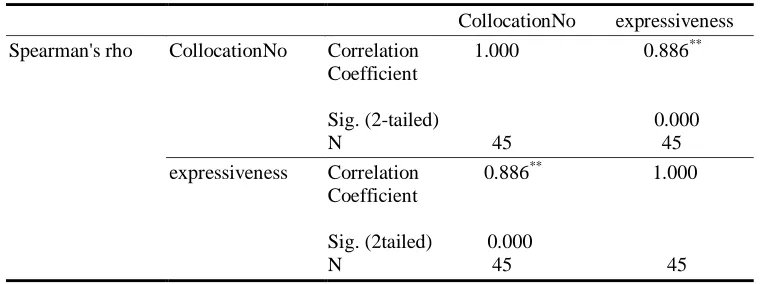
Table 2 shows the spearman's rho correlation. It is clear that rs = 0.886, N = 45, p< 0.01.
The results obtained by conducting Spearman Rank correlation unveiled r = 0.886. According to Table 2, there is a positive and strong correlation between the number of correct lexical collocations used in the writing task and expressiveness, r = 0.886, that it is significant at the 0.01 level for a two-tailed prediction. The p value is shown to be 0.000 that indicates the fact that the result is significant enough to be generalized to the population of Iranian Upper-intermediate EFL learners.
To put in detail, the following table shows the range of the number of correct lexical collocations used by a participant and the corresponding range of level of expressiveness.
Table- 2. Result of spearman correlation
CollocationNo expressiveness Spearman's rho CollocationNo Correlation 1.000 0.886**
Coefficient
Sig. (2-tailed) 0.000 N 45 45 expressiveness Correlation 0.886** 1.000
Coefficient
Sig. (2tailed) 0.000
N 45 45
**. Correlation is significant at the 0.01 level (2-tailed).
Table-3. The number of correct lexical collocations and the corresponding level of expressiveness Number of Collocations Level of Expressiveness
15-22 4-5 23-29 6-7 30-37 8-10
To sum up, the result is significant enough to reject the null hypothesis and prove that there is a significant relationship between the number of lexical collocations used in a writing task and expressiveness.
DISCUSSION AND CONCLUSION
This study showed that raising consciousness of Iranian EFL learners to collocations and use of them were highly helpful to fulfill the referential or representational function of language that focuses on conveying a fact or context. The learners that were endowed with higher application of collocations in describing the graph could turn out to be more expressive. In other word they could visualize the picture of the graph in the mind of the assessor who had not seen the graph. Therefore, the use of collocations has the potential to help the learners or the addressers to convey what they have in mind as well as possible. Through use of correct collocations facts, information or a context can be clearly conveyed to the mind of the addressee so that the addressee also forms the same picture as the addresser intended to convey.
REFERNCES
Ahearn, L.M., 2011. Living language: An introduction to linguistic anthropology, michigan: Wiley-blackwell.
Benson, M., E. Benson and R. Ilson, 1997. A guide to word combinations. The BBI Combinatory Dictionary of English. City.
Fan, M., 2009. An exploratory study of collocational use by esl students - a task based approach. 37: 110-123.
Firth, J.R., 1957. Papers in linguistics, oxford. Oxford University Press.
Golkar, M. and M. Yamini, 2007. Vocabulary, proficiency and reading comprehension. The Reading Matriix, 7(3): 88-112
Halliday, M.A.K., 1973. Exploration inn the functions of language, london: Edward arnold.
Jakobson, R., 1960. Linguistics and poetics", in t. Seeok, (ed.), style in language. Cambridge. M.I.T. Press.
James, C., 1998. Errors in language learning and use Exploring error analysis.
Koosha, M. and A. Jafarpour, 2006. Data-driven learning and teaching collocation of prepositions: The case of iranian efl adult learners. Asian EFL J 2006, 8(8): 187-199.
Nation, I.S.P., 2011. Learning vocabulary in another languag, cambridge. Cambridge University Press.
Nattinger, J. and J. Decarrico, 1992. Lexical phrases and language teaching, oxford. Oxford University Press.
Qian, D., 2002. Investigating the relationship between vocabulary knowledge and academic reading performance: An assessment perspective. Language Learning 52: 513- 536.
Schmitt, N., 2000. Vocabulary in language teaching, cambridge. Cambridge University Press.
Sinclair, J.M., S. Jones and R. Daley, 2004. English collocation studies. The OSTI Report, London: Continuum.
Thornbury, S., 2002. How to teach vocabulary, harlow: Longman.
Tim Hsu, J. and C. Chiu, 2008. Lexical collocations and their relation to speaking proficiency of college efl learners in taiwan. Asian EFL J 2008, 10: 1.
Webb, S., 2005. Receptive and productive vocabulary learning:The effects reading of and writing on word knowledge. Studies in Second Language Acquisition 27: 33-52. Yang, W., 2010. A tentative analysis of errors in language learning and use Journal of