ISSN(Online): 2320-9801
ISSN (Print): 2320-9798
International Journal of Innovative Research in Computer
and Communication Engineering
(An ISO 3297: 2007 Certified Organization) Vol. 3, Issue 9, September 2015
Human Interaction Pattern Mining Using
Enhanced Artificial Bee Colony Algorithm
S. Uma
1, Dr. J. Suguna
2Assistant Professor, School of Computer Science, C.M.S. College of Science & Commerce, Coimbatore, India1 Associate Professor, Dept of Computer Science, Vellalar College for Women, Erode, India2
ABSTRACT: Interactions between human beings occur often in meeting discussions. Semantic knowledge of such
meetings can be revealed by discovering interaction patterns from them. Artificial Bee Colony (ABC) algorithm is a relatively new swarm intelligence algorithm that has attracted great pact of attention from researchers with the advantage of less control parameters and strong global optimization ability than other optimization algorithms. In this research work ABC algorithm is enhanced using Partial Least Square (PLS) mechanism in order to extract frequent interaction among patterns. The objectives of the research are three-fold such as detecting more number of interactions made, more number of frequent interactions made and reducing the execution time of the algorithm. The experimental results shows that by using Enhanced Artificial Bee Colony algorithm more interesting patterns that are useful for the interpretation of human behavior in meeting discussioncan be extracted.
KEYWORDS: Tree Based Mining, Enhanced Artificial Bee Colony, Human Interaction Pattern Mining, Partial
Least Square, Partial Ancestral Graph meet.
I. INTRODUCTION
Optimization techniques play a major role in many scientific and engineering fields. Among them, Evolutionary Algorithms (EAs) have attracted researchers during the past decades in solving optimization problems as these methods do not force assumption on continuity and differentiability like traditional methods. Also, they do not easily fall into local optima.
Artificial Bee Colony (ABC) algorithm is most prominent among the population-based algorithms. It is an effective algorithm proposed for global optimization. Numerical performance demonstrated that ABC algorithm is competitive to that of other population-based algorithms with the advantage of employing fewer control parameters and the need for fewer function evaluations to arrive at an optimal solution [1]. Due to its simplicity and ease of implementation, ABC has captured much attention and has been employed to solve many numerical as well as practical optimization problems since its inception [2, 3, 4]. An upgraded artificial bee colony (ABC) algorithm for constrained optimization problems is discussed in [5].
ISSN(Online): 2320-9801
ISSN (Print): 2320-9798
International Journal of Innovative Research in Computer
and Communication Engineering
(An ISO 3297: 2007 Certified Organization) Vol. 3, Issue 9, September 2015
The paper is organized as follows. In section II, the related works are given. In section III, methodologies used for generation of interaction flow are introduced. In section IV, the results of the comparison with EPCA-ABC-PAG Meet and EPCA-EABC-PAG Meet are presented and discussed. Finally, a conclusion is provided.
II. RELATED WORK
ABC algorithm for the first time was adapted by Karaboga and Bastruck [6] to solve unconstrained optimization problems. In recent years there have been many efforts to develop a constrained ABC algorithm possessing balanced exploration and exploitation behaviour. Constrained ABC algorithm is also applied to solve many real-world engineering problems in recent years. A chaotic search mechanism was applied in [7] to initialize population for constrained ABC. A modified constrained ABC algorithm was proposed in which chaotic mechanism as well as opposition based method was applied for population initialization to enhance the global convergence of algorithm [8]. Modified constrained ABC by applying multiple onlooker bees was developed in [9] to improve constrained ABC. A genetically inspired ABC algorithm was presented for Constrained Optimization Problem (COP). In this algorithm uniform crossover and mutation operators from Genetic Algorithm (GA) are applied to scout bee phase to improve the performance of ABC algorithm [10]. ABC was used to solve large scale optimization problems as well as engineering design problems [11] and it outperforms other optimization algorithms.
Another modification on ABC algorithm was in [12]. What makes this algorithm different from the original ABC is the probability selection mechanism and parameter setting process. In this algorithm a new probability selection mechanism is presented to enhance diversity by allowing infeasible solutions in the population. The infeasible solutions were introduced inversely proportional to their constraint violations and feasible solution were defined based on their fitness values.
A modified ABC [13] introduced four modifications related with the selection mechanism, the equality and boundary constraints, and scout bee operators to improve the behaviour of ABC in constrained search space. A smart bee [14] was introduced to solve constrained problems which apply its historical memories for the solution. ABC-BA [15] is a hybrid algorithm that integrates ABC and Bee Algorithm (BA). It can perform as an ABC individual in ABC sub-swarm or a BA individual in the BA sub-swarm. In addition, the population size of the ABC and BA sub-swarms change stochastically based on current best fitness values achieved by the sub-swarms.
III.METHODOLOGY
3.1 Dimension Reduction
A. Enhanced Principal Component Analysis (EPCA)
In human interactions, patterns can be derived from multiple interactions. Such interaction dataset will have confusing and irrelevant words in sentences. EPCA will reduce such complex data to a lower dimension and eliminate the variations present in the data [16]. When EPCA completes the reduction of deviated discussion contents, ABC algorithm is applied.
B.Artificial Bee Colony (ABC) algorithm
ABC is a relatively new population-based algorithm [17] emulating the foraging behaviour and waggle dance of honey bee swarm. Artificial bee colonies are classified into three groups, employed bees, onlooker bees and scout bees. Half of the colony includes employed bee and the other half consist of onlooker bees. In ABC, the position of food source denotes a possible solution to the optimization problem and the nectar amount of food source represents fitness value of the associated solution. The number of employed bees or the onlooker bees is equal to the number of solutions (SN) in the population. Each solution xi (i1, 2,,SN)is a d-dimensional vector and
x
i
{
x x
i1,
i2,
,
x
id}
represents the ith solution in the population.
ISSN(Online): 2320-9801
ISSN (Print): 2320-9798
International Journal of Innovative Research in Computer
and Communication Engineering
(An ISO 3297: 2007 Certified Organization) Vol. 3, Issue 9, September 2015
min,
(0,1)(
m , min,)
ij j ax j j
x
x
rand
x
x
---> (1)
where each solution
x
i,
i
1, 2,
,
SN
is d-dimensional vector forj
1,2,
,
d
. In addition,x
min,j andx
max j, arethe lower and upper bounds for the dimension
j
respectively. These food sources are randomly assigned to SNnumber of employed bees and their fitness are evaluated. At the initialization phase the human interaction dataset is taken as the input.
After initialization, the population of the solutions is subjected to repeat the search processes for employed bee, the onlooker bees and the scout bee phases. The process continues until the algorithm reaches the Maximum Cycle Number (MCN). In employed bee phase each employed bees produces a modification on the solution
x
i where only onedimension of this solution is changed using Equation (2) and the rest keep the same as
x
i(
)
ij ij ij ij kj
v
x
x
x
---> (2)
where
k
{1,2,
,
SN
}
andj
{1, 2,
, }
d
are randomly chosen indexes andk
has to be different fromi
.
ijis arandom number in the range [ 1,1] . After
v
i is obtained, its fitness value is evaluated and a greedy selectionmechanism is applied comparing
x
iwithv
i . If the fitness value of the new solutionv
i is less than the current solutionthen, the solution is replaced with the
x
i, otherwise the current solution remains. Indexes are assigned for the data present in the human interaction dataset and the fitness value is given by using the frequently used discussions.After the employed bee phase, the solution information is transferred to the onlooker bee phase. In this phase a solution
is chosen depending on the probability value
p
i associated with that solution calculated using the following formula,1
( ) ( )
( ) i
i SN
j j
fit p
fit
=
=
å
x x
x
---> (3)
The
fit
( )
x
i is defined in Equation (4).1
( ) ( ) 0
1 ( )
( )
1 ( ) ( ) 0
i i
i
i i
f f
fit
f f
x x
x
x x ---> (4)
where f(xi)is the objective value of solution xi. Once the onlooker has selected solution xi.a modification is done on this
solution similar with employed bee using Equation (2). Then fitness values of generated solutions are evaluated and greedy selection mechanism is employed. If new solution has better fitness value than current solution, the new solution remains in the population and the old solution is removed. The new solution consists of the repeatedly used contents of the meeting minutes.
In the scout bee phase, if solution xi cannot be improved further through a predetermined number of cycles
ISSN(Online): 2320-9801
ISSN (Print): 2320-9798
International Journal of Innovative Research in Computer
and Communication Engineering
(An ISO 3297: 2007 Certified Organization) Vol. 3, Issue 9, September 2015
Artificial Bee Colony Algorithm for Human Interaction Pattern Mining
Initialize the population of solution i.e. human interaction dataset
Evaluate the initial population cycle=1
Repeat
Employee bee phase – repeatedly use contents of the minutes of the meeting Apply greedy selection process
Calculate the probability values for the solution Onlooker bee phase
Apply greedy selection process Scout bee phase
Memorize the best solution achieved so far
cycle=cycle+1
until cycle=maximum cycle number
When ABC completes removal of unwanted contents, the PAG meet takes the pre-processed meeting contents and constructs the PAG graph.
C.Enhanced Artificial Bee Colony (EABC) algorithm
In most of the unconstrained ABC algorithms the role of population initialization is ignored. In order to have powerful algorithm preliminary solutions must be generated uniformly within the search space. The uniformly distributed initial solutions help to produce at least some points in the neighbourhood of global solution. To obtain that, this section introduces Partial Least Square (PLS) dimension reduction mechanism. PLS is based on correlation. PLS is very popular in areas like chemical engineering, where predictive variables often consist of many different measurements in an experiment and the relationships between these variables are ill-understood [18].
The basic idea of partial least squares is that, the characteristic variable matrix
X
is compressed, and given consideration to the correlation of the dependent variable matrixY
. Suppose there are n characteristic variables,n
x
x
x
1,
2,
,
andp
dependent variablesy
1,
y
2,
,
y
p,thenX
is decomposed intoE
TP
X
T
---> (5)
where,
T
is the score matrix,P
is the load matrix,E
is the residual error matrix. Matrix multiplication ofTP
Tcan be expressed as the sum products of score vectort
i (thei-th column of matrixT
) and load vectorp
i (the i-th column of matrixP
). Then the above formula can be written as
ni T i i
p
E
t
X
1
n
i
1
,
2
,
,
---> (6)
Similarly, matrix
Y
is decomposed withQ
as the load matrix andu
j as score vector. PLS analysis separately extracts the score t andu
from correspondingX
andY
.They are the linear combination of characteristic variables and dependent variables. And both score satisfies the maximum load of variation information of characteristic variables and dependent variables. The regression equation is established asi k
j
b
t
u
---> (7)
where,
b
kis regression coefficient.
ISSN(Online): 2320-9801
ISSN (Print): 2320-9798
International Journal of Innovative Research in Computer
and Communication Engineering
(An ISO 3297: 2007 Certified Organization) Vol. 3, Issue 9, September 2015
BX
Y
---> (8)
where
T T
Q
W
P
W
B
(
)
1---> (9) here B is the coefficient matrix and W is the weight matrix.
PLS follows an iterative process to extract the factors or scores for X and Y until the residual matrix element of absolute value approximates to zero. After initialization, the main loop consisting of employed bees, onlooker bees and scout bees phase are subjected to be repeated until the stopping criterion is met.
In main loop after producing a new solution in employee bee phase, Deb‟s constrained handling method is adopted in order to adapt ABC algorithm for solving constrained optimization problems instead of using greedy selection in unconstrained ABC [19]. Applying Deb‟s rules, the bee either memorizes the new solution by forgetting the current solution or keeps the current solution. Deb's method uses a tournament selection mechanism where two solutions are compared at a time by applying following rules.
Any feasible solution is preferred to any infeasible solution,
Among two feasible solutions, the one having better objective function value is preferred,
Among two infeasible solutions, the one having smaller constraint violation is preferred.
Algorithm 2: Enhanced ABC algorithm
Initialize the population using PLS Evaluate the initial population Cycle=1
Repeat
Employed bee phase
Apply Deb's mechanism to select between Viand Xi
Calculate the probability values for the solution Onlooker bee phase
Apply Deb's mechanism Scout bee phase
Memorize the best solution achieved so far Cycle = cycle + 1
Until cycle = maximum cycle number
After completion of the search by all employed bees, the information of the solutions are shared with the onlooker bees. Then the probability value for onlooker bee phase is calculated. If the new solution is better, it will be kept in the population and the current solution is removed, otherwise the current solution is retained.
In the scout bee phase, if solution
x
i cannot be improved further through a predetermined number of cycles (limit), then that solution is abandoned and replaced with a new solution generated randomly by using Equation (1). The cycle is repeated until all the unwanted contents are removed that achieves maximum convergence of the minutes of the meeting.When EABC completes removal of unwanted contents, the PAG meet takes the pre-processed meeting contents and constructs the PAG graph.
3.2 Partial Ancestral Graph (PAG) meet
ISSN(Online): 2320-9801
ISSN (Print): 2320-9798
International Journal of Innovative Research in Computer
and Communication Engineering
(An ISO 3297: 2007 Certified Organization) Vol. 3, Issue 9, September 2015
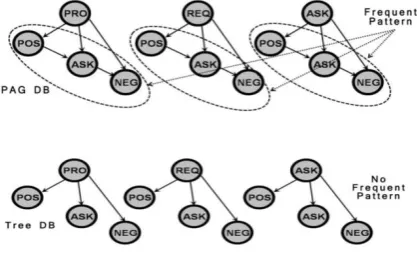
based mining will not distinguish multiple interactions but PAG meet will identify such multiple interactions and will extract both temporal and triggering relations.
Figure 1. PAG representation vs Tree representation of meetings
The previous three methodologies EPCA, ABC and EABC remove irrelevant data from meeting contents and give the preprocessed content as input for the PAG meet.
IV.EXPERIMENTAL RESULTS
Dataset is gathered from meetings that are conveyed through on-line forums and documented discussions from various data sources. Table 1 shows the categorization of datasets.
Table 1. Dataset Information
The datasets are focused on the topics namely corruption, democracy, defense, expenditure, social expenditure, backwardness, women quota bill, politics, communal and religious reservations, retirement age, elections etc. The datasets have certain amount of irrelevant data and hence EPCA mechanism followed by ABC mechanism is used to remove such irrelevant data and then PAG meet is applied to generate interaction flow in meetings. This work is named as EPCA-ABC-PAG meet. Another observation is done by applying EPCA mechanism followed by EABC mechanism and then applying PAG meet. This work is named as EPCA-EABC-PAG meet.
The Table 2 shows the interaction percentage made during the sessions andFigure 2 clearly depicts that EABC-PAG meet detects more number of interactions in the conversation made during the sessions than EPCA-ABC-PAG Meet.
Document Type Number of documents Maximum number of conversations per
document
Mini dataset 2000 8
Large dataset 2000 250
ISSN(Online): 2320-9801
ISSN (Print): 2320-9798
International Journal of Innovative Research in Computer
and Communication Engineering
(An ISO 3297: 2007 Certified Organization) Vol. 3, Issue 9, September 2015
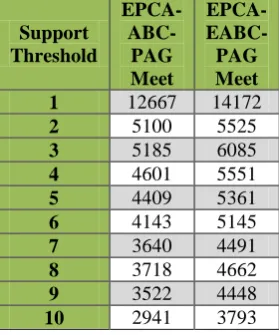
The Table 3 illustrates execution time of EPCA-ABC-PAG Meet and EPCA-EABC-PAG Meet . It can be clearly understood that the EPCA-EABC-PAG meet consumes less execution time than EPCA-ABC-PAG Meet and it is noteworthy fact that when support threshold value increases the execution time is decreased and the same is flashed in Figure 3.
Figure 3. Support Threshold Vs Execution Time
Table 3. Support Threshold Vs Execution Time
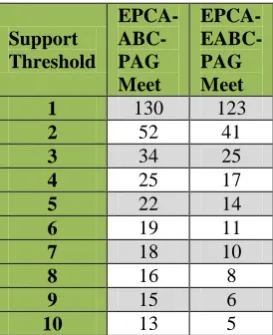
Detecting more number of interactions gains advantage towards discovering frequent pattern mining. From Table 4 it is shown that the number of discovered frequent subtrees is increased in EPCA-EABC-PAG meet than EPCA-ABC-PAG Meet and it is exposed in Figure 4.
Support Threshold
EPCA- ABC-PAG Meet
EPCA-EABC- PAG Meet
1 130 123
2 52 41
3 34 25
4 25 17
5 22 14
6 19 11
7 18 10
8 16 8
9 15 6
ISSN(Online): 2320-9801
ISSN (Print): 2320-9798
International Journal of Innovative Research in Computer
and Communication Engineering
(An ISO 3297: 2007 Certified Organization) Vol. 3, Issue 9, September 2015
Figure 4.Support Threshold Vs Number of Discovered Frequent Subtrees
Table 4. Support Threshold Vs Number of Discovered Frequent Subtrees
V. CONCLUSION
This paper considers the problem of detecting more number of interaction patterns made in the meeting to gain semantic knowledge of meetings. The idea is to employ EPCA algorithm and EABC algorithm to reduce irrelevant data in meeting content and then construct the PAG graph. The performance is analysed by applying EPCA-ABC-PAG meet and proposed EPCA-EABC-PAG meet. The results indicate that the proposed method outperforms earlier mechanism in terms of session percentage, execution time and number of discovered frequent sub-trees. Future research work may apply any soft computing techniques like machine learning or fuzzy logic for identifying more frequent subtrees.
REFERENCES
1. Karaboga D., Basturk B., “On the performance of artificial bee colony (ABC) algorithm”, Applied soft computing, vol.8, no. 1, pp. 687-697, 2008.
2. Gao W. F., Liu S. Y., Huang L. L., “Enhancing artificial bee colony algorithm using more information-based search equations”, Information Sciences, 270, pp.112-133, 2014.
3. Aydina D., Zyn S., Yasar C., Liao T., “Artificial bee colony algorithm with dynamic population size to combined economic and emission dispatch problem”, Electrical Power and Energy Systems, vol.45, pp.144-153, 2014.
4. Li G., Peifeng N., Xiao X., “Development and investigation of efficient artificial bee colony algorithm for numerical function optimization”, Applied soft computing, vol.12, no. 1, pp. 320-332, 2012.
5. Brajevic I., Tuba M., “An upgraded artificial bee colony (ABC) algorithm for constrained optimization problems”, Journal of Intelligent Manufacturing, vol. 24, no. 4, pp.729-740, 2013.
6. Karaboga D., Basturk B., “A powerful and efficient algorithm for numerical function optimization: artificial bee colony (ABC) algorithm”, Journal of global optimization vol.39, no. 3, pp.459-471, 2007.
7. Babaeizadeh, S., and A. Rohanin, “Modified Artificial Bee Colony Algorithm with Chaotic Search Method for Constrained Optimization Problems”, Proceeding of 2nd International Science Postgraduate Conference 2014 (ISPC2014), Faculty of Science, Universiti Teknologi Malaysia, (2014a).
8. Babaeizadeh, S., and A. Rohanin, “A Modified Artificial Bee Colony Algorithm for Constrained Optimization Problems”, Journal of Convergence Information Technology, Vol.9, No.6, 2014b, pp. 151- 163.
9. Subotic M., “Artificial bee colony algorithm with multiple onlookers for constrained optimization problems”, In Proceeding of the European Computing Conference, pp. 251-256. 2011.
10. Bacanin N., Tuba M., “Artificial bee colony (ABC) algorithm for constrained optimization improved with genetic operators”, Studies in Informatics and Control, vol. 21, no. 2, pp. 137-146, 2012.
11. Akay B., Karaboga D., “Artificial bee colony algorithm for large-scale problems and engineering design optimization”, Journal of Intelligent Manufacturing, vol. 23, no. 4, pp. 1001-1014, 2012.
12. Karaboga D., Akay B., “A modified artificial bee colony (ABC) algorithm for constrained optimization problems”, Applied Soft Computing, vol. 11, no. 3, pp.3021-3031, 2011.
13. Mezura-Montes E., Cetina-Domínguez O., “Empirical analysis of a modified artificial bee colony for constrained numerical optimization”, Applied Mathematics and Computation, vol. 218, no. 22 pp.10943-10973, 2012.
14. Stanarevic N., Tuba M., Bacanin N. , “Modified artificial bee colony algorithm for constrained problems optimization”, International journal of mathematical models and methods in applied sciences, vol.5, no. 3, pp. 644-651, 2011.
Support Threshold
EPCA-ABC- PAG Meet
EPCA- EABC-PAG Meet 1 12667 14172
2 5100 5525
3 5185 6085
4 4601 5551
5 4409 5361
6 4143 5145
7 3640 4491
8 3718 4662
9 3522 4448
ISSN(Online): 2320-9801
ISSN (Print): 2320-9798
International Journal of Innovative Research in Computer
and Communication Engineering
(An ISO 3297: 2007 Certified Organization) Vol. 3, Issue 9, September 2015
15. Tsai H. C., “Integrating the artificial bee colony and bees algorithm to face constrained optimization problems”, Information Sciences, vol. 258, pp. 80-93, 2014.
16. Uma. S, Suguna.J, “Human Interaction Pattern Mining Using Enhanced Principal Component Analysis”, International Journal of Informative & Futuristic Research, ISSN: 2347-1697, vol.2, no.7,pp. 2279-2289, March 2015.
17. Salamin, H.; Vinciarelli, A., "Automatic Role Recognition in Multiparty Conversations: An Approach Based on Turn Organization, Prosody, and Conditional Random Fields," Multimedia, IEEE Transactions on , vol.14, no.2, pp.338,345, April 2012
18. Kleinbaum, David G., et al., “Applied Regression Analysis and Multivariable methods”, 3rd edition, (Pacific Grove, Ca.:Brooks/Cole
Publishing Company, 1998).
19. Dervis Karaboga , Bahriye Basturk., “Artificial Bee colony Optimization Algorithm for solving Constrained Optimization Problems”, IFSA 2007, LNAI 4529, pp.789-798, 2007.
20. Uma. S, Suguna.J, "Temporal Semantic Analysis Based Human Interaction Pattern Mining using Partial Ancestral Graph", Research Journal of Applied Sciences, Engineering and Technology, vol. 8, no. 12, pp. 1487-1491, 2014
21. Christian Beckar and Zhiwen Yu, “Tree-Based Mining for Discovering Patterns f Human Interactions in Meetings”, „Proc.Eigth IEEE Int‟l Conf.Knowledge Discovery and Data Mining, pp 107-115, 2012.
BIOGRAPHY
1
S.Uma received master‟s degree in Information Technology from Bharathidasan University, Trichy in 2004 and M.Phil degree in Computer Science from Bharathidasan University, Trichy in 2007. She is currently an Assistant Professor in School of Computer Science, C.M.S.College of Science & Commerce (Autonomous), Coimbatore, Tamil Nadu. Her research interests are Data Mining and Image Processing.
2Dr. J. Suguna received the master‟s degree in mathematics from Annamalai University, Chidambaram in 1988 and the